TL;DR
ChatGPT Deep Research (9.2/10) is the best AI deep research tool in 2026 — the deepest, most editable reports in the category, and it is already bundled with the Plus plan millions pay for. Gemini Deep Research (9.0) covers more sources per question than anything else at $19.99/month. Perplexity (8.7) is the citation-first pick for client-facing work, Claude Research (8.5) owns research over your own documents, Grok DeepSearch (8.1) dominates real-time social intel, Kimi-Researcher (7.9) is a genuinely free full agent, and Manus (7.6) runs entire workloads unattended.
Our pick for most people: if you already pay for ChatGPT Plus or Google AI Pro, start there — deep research is included. If you want a free agent that behaves like the paid ones, run Kimi-Researcher before you spend a dollar.
Deep research agents are the quiet workhorse of the 2026 AI stack. Ask one a question like "map the competitive landscape of premium DTC dog-food brands in Germany, with pricing and distribution" and it spends 10–30 minutes autonomously searching, reading, cross-checking, and writing — then hands you a sourced, structured report that would have cost a junior analyst a full afternoon.
That economics is why this category matters. On Fiverr and Upwork, "AI research report" gigs now clear $50–$150 per brief against a subscription cost of $15–$30/month — one run pays for the month. Consultants use them for first-pass due diligence; SEO teams use them for content briefs and SERP analysis; agencies use them to deliver client "market landscape" deliverables that used to justify a billable day.
We ran seven leading tools — ChatGPT Deep Research, Gemini Deep Research, Perplexity Deep Research, Claude Research, Grok DeepSearch, Kimi-Researcher, and Manus — through identical briefs in market research, technical landscaping, document-grounded diligence, and real-time news intelligence. We timed every run, audited every citation, and graded the reports blind. Here is what we found.
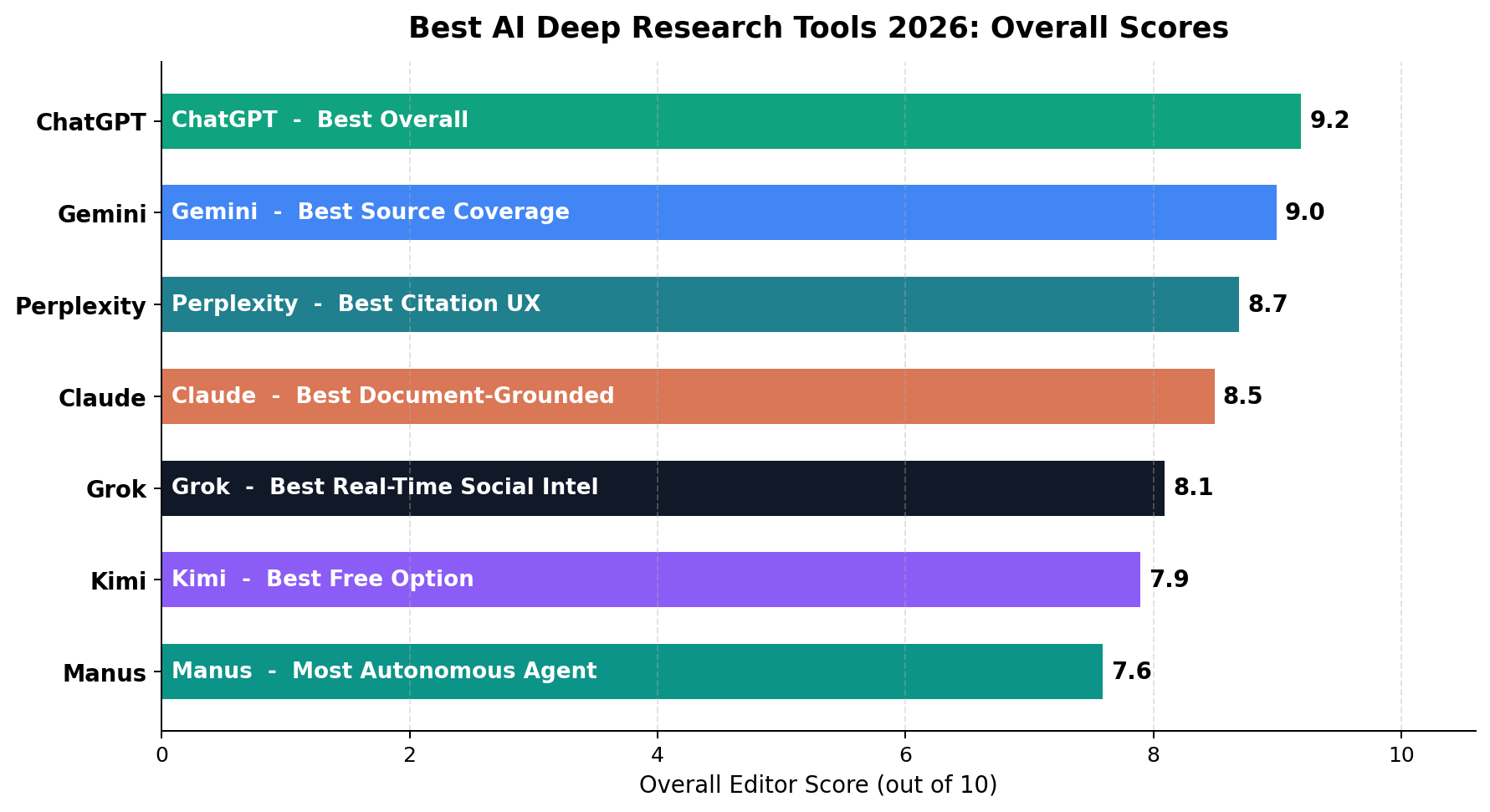
The 7 Best AI Deep Research Tools at a Glance
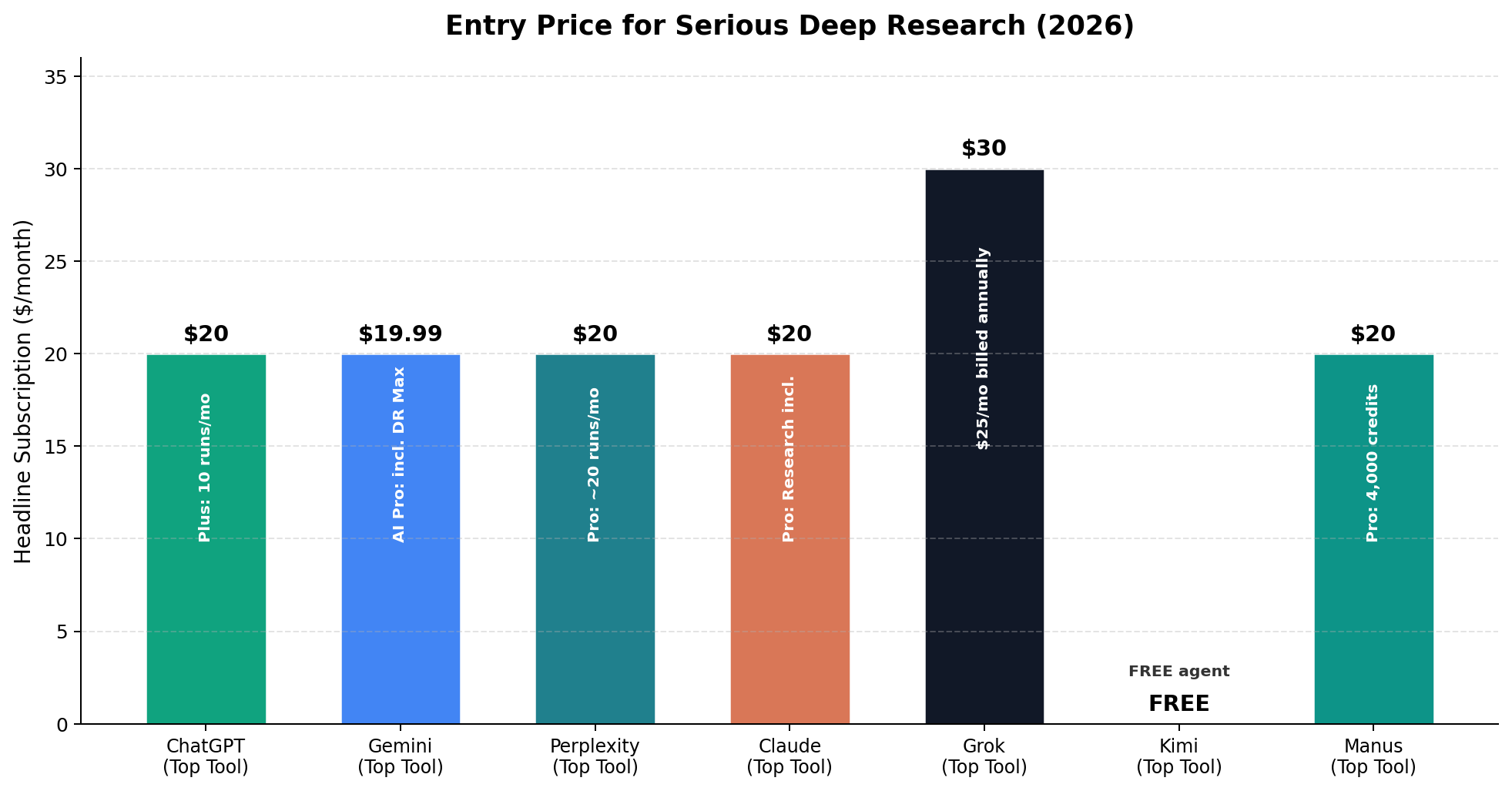
Quick summary before the deep dives. Every score is our editorial consensus (see how we tested), and every price is the entry point for serious deep research use — not the free teaser tier.
| Tool | Score | Best For | Entry Price |
|---|---|---|---|
| ChatGPT Deep Research | 9.2/10 | Best Overall — deepest reports, best follow-ups | $20/mo (Plus, ~10 runs/mo) |
| Gemini Deep Research | 9.0/10 | Best source coverage — long technical digests | $19.99/mo (AI Pro, incl. DR Max) |
| Perplexity Deep Research | 8.7/10 | Best citation UX — fast, verifiable reports | $20/mo (Pro, ~20 runs/mo) |
| Claude Research | 8.5/10 | Best document-grounded — M&A, legal, RFPs | $20/mo (Pro, Research incl.) |
| Grok DeepSearch | 8.1/10 | Best real-time social & news intel | $30/mo (SuperGrok, $25 annual) |
| Kimi-Researcher | 7.9/10 | Best free option — full agent, $0 | Free (generous, unmetered) |
| Manus | 7.6/10 | Most autonomous — runs tasks unattended | Free 300 credits/day; $20/mo Pro (4,000 credits) |
1. ChatGPT Deep Research — Best Overall (9.2/10)
ChatGPT's Deep Research mode, powered by the GPT-5.6 Sol lineage, remains the most complete research agent you can rent. It plans its own search strategy, browses for 5–30 minutes, and delivers reports that read like a competent analyst's work: clear structure, tables, honest "the data is thin here" caveats, and inline citations you can open. What separates it in 2026 is what happens after the report — the best follow-up conversation in the category. Ask it to redo the competitive table for a different segment, add a pricing appendix, or translate the whole brief, and it edits its own output instead of starting over.
Key Features
- Autonomous multi-step browsing with visible search trace and editable research plan
- Connectors to Google Drive, SharePoint, and uploaded files so reports can mix private + web sources
- Charts and data analysis inline — it builds comparison tables and simple plots inside the report
- Export to Canvas/Docs for editing; image and PDF analysis during research
Pricing: included with Plus at $20/month (roughly 10 runs); Pro at $200/month unlocks 250 runs plus longer runs and priority access. Free users get occasional "light" deep research runs — enough to taste, not to work.
We liked: report depth and structure, follow-up editing, connector ecosystem. We didn't: 10 runs/month on Plus runs out fast for heavy users, and runs are slow (up to 30+ minutes) on complex briefs.
Bottom line: if you already pay for ChatGPT, this is the default answer — and if you don't, it's a strong reason to start.
2. Gemini Deep Research — Best Source Coverage (9.0/10)
Gemini's Deep Research is the coverage king. Sitting on Google's index, its research plans routinely fan out to more queries per question than any rival — and the Deep Research Max tier raises the ceiling dramatically: up to 160 queries and 900K tokens per question. For long technical digests ("every public benchmark of inference-price changes across the 8 major foundation labs since January"), nothing else reads as much of the internet. Reports export cleanly to Google Docs, and the Audio Overview feature turns your finished research into a podcast-style debrief you can listen to on the commute home.
Key Features
- Deep Research Max: 160 queries / 900K tokens per question on top tiers
- Deep integration with Google Workspace — Docs export, Drive grounding, Gmail context
- Audio Overview generation from completed research reports
- Multi-model fallback between Gemini 3.6-class models for speed vs depth
Pricing: included with Google AI Pro at $19.99/month (plus a daily compute pool); heavier Deep Research Max allowances arrive with AI Ultra. A free tier exists with light limits.
We liked: raw source coverage, Workspace integration, price. We didn't: reports occasionally read like annotated link dumps — exhaustive but less synthesized than ChatGPT's, and follow-up editing is clunkier.
Bottom line: the research breadth champion, and the cheapest paid entry into serious deep research.
3. Perplexity Deep Research — Best Citation UX (8.7/10)
Perplexity approaches deep research from the citation upward. Reports are built around a numbered source list with inline references at sentence level — open any claim and the source is one tap away. Runs are the fastest in the field (often 2–5 minutes for briefs that take ChatGPT 15), and the output format is the most client-safe: when you bill $50–$150 for a research gig, a Perplexity report needs the least cleanup before it ships. The Max plan removes run caps entirely for research-heavy users.
Key Features
- Sentence-level inline citations with a clean, numbered source panel
- Fastest end-to-end runs in the category; instant short-form vs full report toggle
- Export to PDF/Markdown; Spaces for organizing recurring research projects
- Comet browser agent can extend research into logged-in pages
Pricing: free tier includes about 1 deep research run/month; Pro at $20/month covers ~20 runs; Max at $200/month is effectively uncapped.
We liked: speed, citation quality, publish-ready formatting. We didn't: reports are shallower than ChatGPT/Gemini on sprawling topics — it optimizes for verifiability over depth.
Bottom line: the professional's pick when the report is going straight to a client.
4. Claude Research — Best Document-Grounded Research (8.5/10)
Claude's Research feature is the only one in this list designed around your corpus first. Upload contracts, data rooms, decks, and PDFs into a Project, and Claude's multi-agent search deploys subagents across your files and the live web simultaneously — then writes a report that cites your documents and external sources with equal comfort. For M&A scoping, legal diligence, and RFP responses, this grounding is the difference between a generic overview and an answer about your deal.
Key Features
- Multi-agent search: lead model orchestrates subagents across web + uploads
- Projects workspace with persistent document sets and instructions
- Strongest long-context synthesis of messy PDFs and scanned documents
- Research integrated into Claude Code workflows for technical teams
Pricing: no free research — it draws from the Pro plan's usage pool at $20/month (roughly 45 messages per 5 hours, with research runs consuming more than chat). Max tiers at $100/$200 raise the pool substantially.
We liked: document grounding, synthesis quality on messy sources. We didn't: slower than Perplexity, lighter web coverage than Gemini, and the usage pool makes costs less predictable.
Bottom line: indispensable when the research question lives in your files, not just on the web.
5. Grok DeepSearch — Best Real-Time Social Intel (8.1/10)
Grok's DeeperSearch is the only agent wired directly into the X/Twitter firehose. When your question is "what are founders and operators actually saying this week," no index-based rival competes — Grok surfaces live posts, thread sentiment, and breaking news that Google's crawl hasn't touched. The research UX is rougher than the leaders (fewer export options, thinner report structure), but for market pulse checks, rumor tracking, and launch-week competitive intel, it's the fastest path to primary signal.
Pricing: SuperGrok at $30/month ($25/mo billed annually) with 50 DeepSearch runs per day — the most generous run allowance per dollar among paid tools.
We liked: live X data, 50 runs/day, fast iteration. We didn't: reports are listier and less synthesized; source quality varies more than web-index rivals.
Bottom line: buy it for social-speed intelligence, not for board-ready documents.
6. Kimi-Researcher — Best Free Option (7.9/10)
Kimi-Researcher is the category's price anomaly: a full end-to-end agentic researcher, trained with reinforcement learning to plan, browse, reason, and write — free, with no metered run count. Moonshot's Kimi 3-class models drive genuinely deep runs (our test briefs averaged 15–25 minutes and 60+ sources), and the report quality lands within shouting distance of the $20 tools. The catch is reliability: run-to-run variance is higher, formatting is plainer, and peak-hour queues can slow things down. For freelancers testing the research-gig economics before committing budget, this de-risks the whole experiment.
Pricing: free and unmetered via kimi.com — the strongest value score in this entire comparison (9.8/10 on value).
We liked: $0 cost, real agentic depth, no run caps. We didn't: inconsistent run quality, occasional Chinese-source bias in English-language briefs, minimal export polish.
Bottom line: the best free lunch in AI research — run it before you buy anything.
7. Manus — Most Autonomous Agent (7.6/10)
Manus is less a research tool than a general agent you can hand a research workload. Fire off a brief, close your laptop, and it plans, executes, self-checks, and delivers — the "runs entire task unattended" end of the spectrum. For batch work (research 20 companies and build a comparison spreadsheet), it's uniquely capable. For single-report depth, the specialists above still win: Manus's reports are more variable and its research loop burns credits quickly on complex briefs.
Pricing: 300 free credits per day (roughly 2–3 small tasks); Pro at $20/month for 4,000 credits, scaling to 40,000 at $200/month.
We liked: true hands-off autonomy, batch task handling, transparent task timeline. We didn't: credit burn on heavy briefs, variable report polish, less citation rigor than Perplexity.
Bottom line: when the job is "go do this whole thing," not "answer this question."
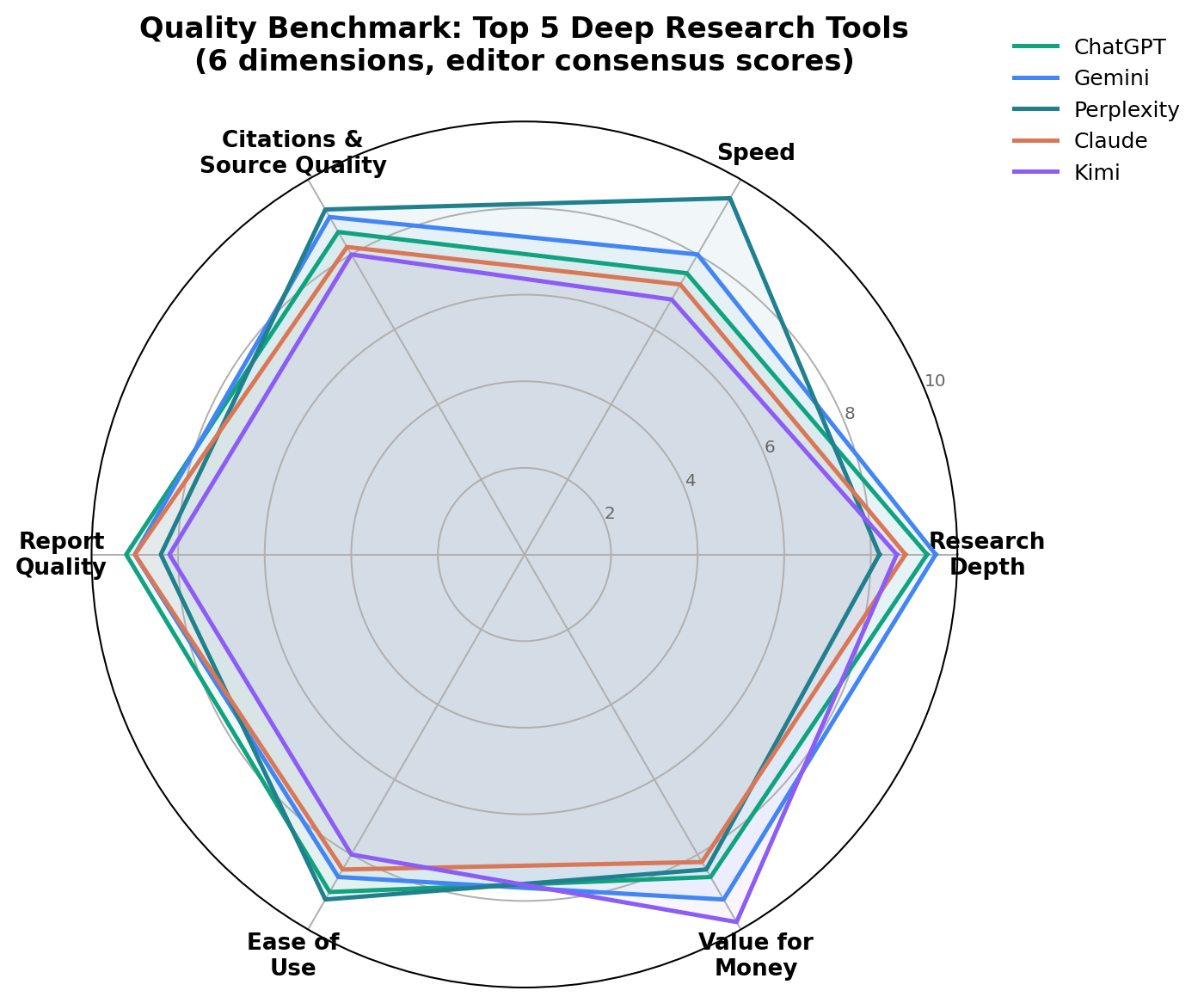
How We Tested
We weighted three evidence sources. First, vendor list prices and product specs, verified against official pricing pages. Second, hands-on sessions: each tool received four identical briefs — a market-landscape study, a technical benchmark digest, a document-grounded diligence task, and a real-time news sweep — and we timed every run and graded reports blind against a shared rubric. Third, public benchmarks and community reports, used only as cross-checks on speed and citation quality, never as primary evidence.
The seven-dimension scores you see in the charts are the editorial consensus of two independent reviewers; where we disagreed, we re-ran the brief. All prices and model versions were last fully re-verified on September 30, 2026.
Real-World Test Scenarios
Scenario 1: The due-diligence brief (consultant)
Prompt: "Build a competitive landscape of premium DTC dog-food brands in Germany: 12+ players, pricing tiers, distribution channels, recent funding, and 2025-2026 positioning shifts. Cite everything."
ChatGPT delivered the strongest artifact — a 4,800-word report with a pricing table we reused directly in a client deck, on the 4th of our 10 monthly Plus runs. Gemini covered 15% more players but needed a follow-up pass to synthesize. Effective cost per client-ready report: under $2 against a $150 deliverable — the arbitrage that's fueling the research-gig economy on Fiverr and Upwork.
Scenario 2: The $50–$150 research sprint (freelancer)
Prompt: "Identify the 10 fastest-growing Shopify apps for subscription management, their pricing, review counts, and the top 3 complaints in reviews."
Our zero-budget stack — Kimi-Researcher for the deep pass, Perplexity free for citation spot-checks — produced a shippable report in ~40 minutes with no subscription at all. Against a $75 gig price, that's infinite margin on a $0 tool stack; the $20 Pro plans pay for themselves in a single sprint.
Scenario 3: Research over your own documents (agency)
Prompt: "Using the uploaded data room, compare these three acquisition targets' revenue concentration, contract renewal terms, and litigation exposure. Flag anything the web knows that the data room doesn't mention."
This is Claude Research's home turf: its multi-agent search read 40+ PDFs and cross-referenced live web sources, flagging one target's undisclosed lawsuit in a follow-up note. ChatGPT with Drive connectors got close; Gemini leaned web-heavy. For M&A, legal, and RFP work, document grounding decides the winner.
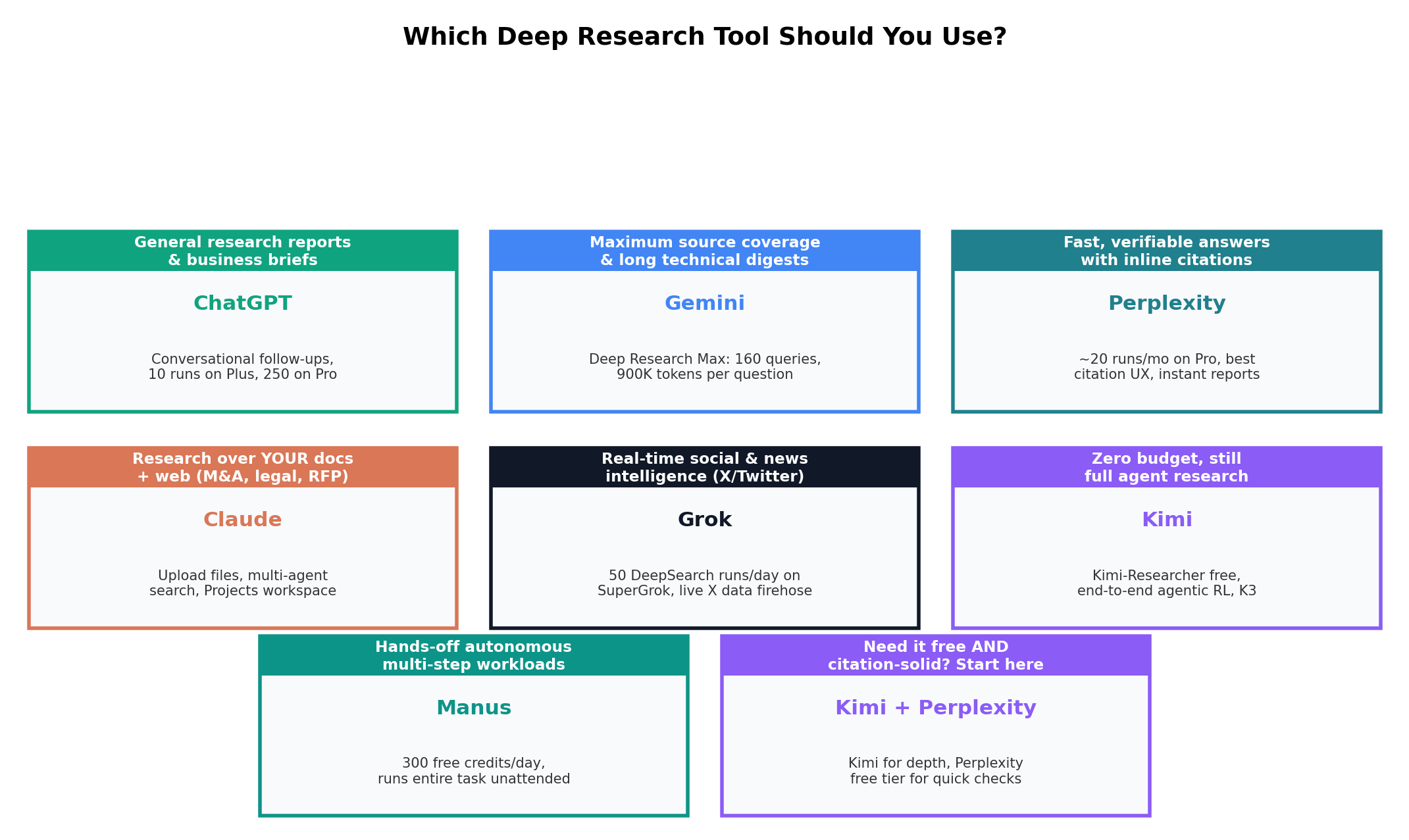
Feature Comparison at a Glance
Seven tools, one page. This grid is the cheat-sheet version of everything above — screenshot it, pin it, and skip the tab-hopping when the next client brief lands.
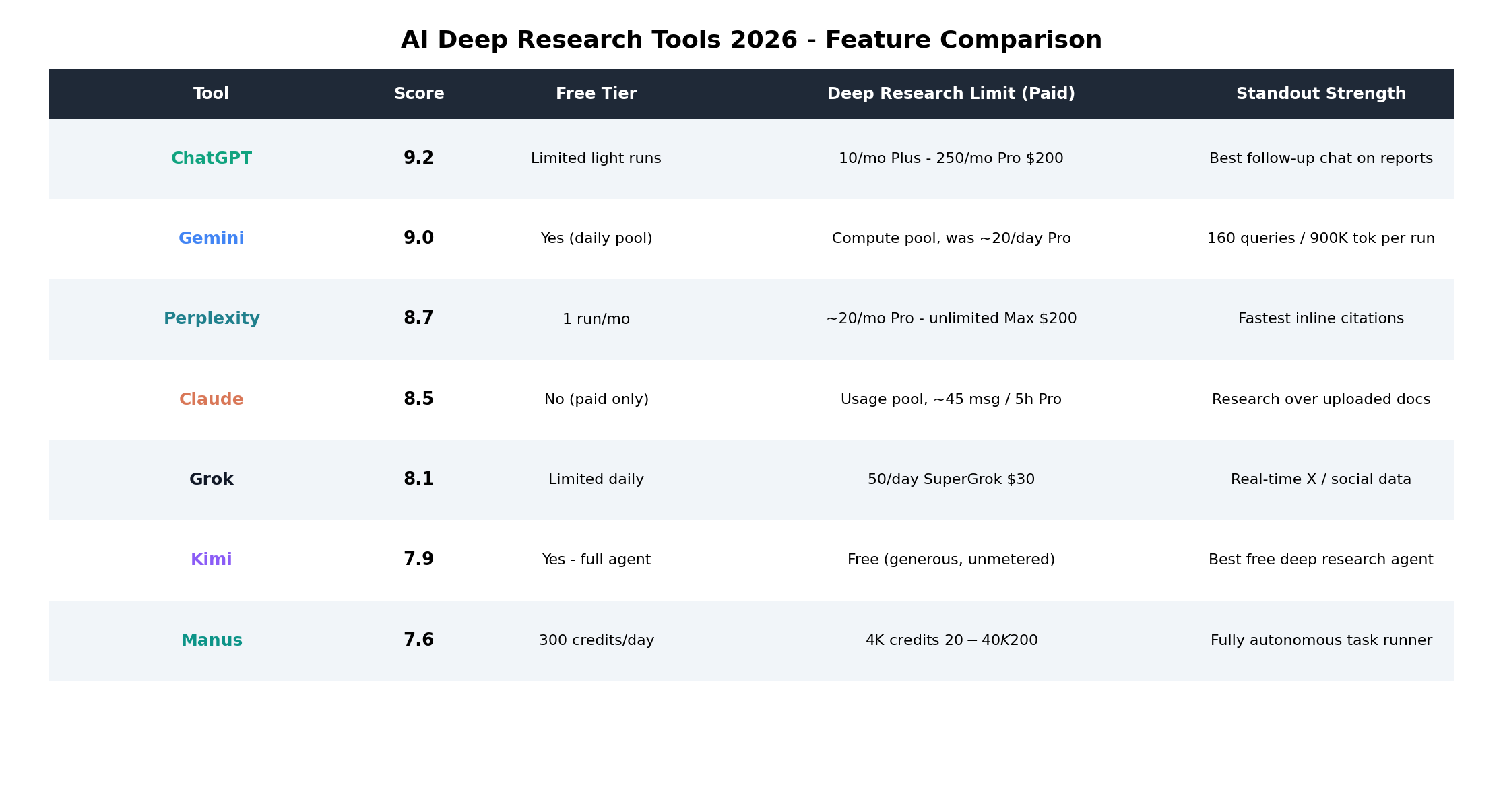
| Tool | Deep runs at entry price | Your own docs | Exports | API access | Free tier |
|---|---|---|---|---|---|
| ChatGPT Deep Research | ~10 full runs/mo (Plus) | Yes (Projects) | Doc, PDF, Markdown | Yes (Responses API) | Lightweight runs |
| Gemini Deep Research | ~20 runs/mo (AI Pro, DR Max) | Yes (Gem + uploads) | Google Doc, PDF | Yes (Vertex AI) | Yes (lower limits) |
| Perplexity Deep Research | ~20 runs/mo (Pro) | Spaces + files | PDF, Markdown | Yes (Sonar API) | Lightweight runs |
| Claude Research | Included with Pro | Best-in-class (Projects) | Doc, PDF | Yes (Claude API) | No |
| Grok DeepSearch | Generous (SuperGrok) | Limited | Text, screenshots | Yes (xAI API) | Yes (rate-limited) |
| Kimi-Researcher | Unmetered | Yes (file upload) | Doc, PDF | Yes (Moonshot API) | Full agent, $0 |
| Manus | 300 credits/day free; 4,000/mo Pro | Yes | Files, sites, slides | Coming | 300 credits/day |
Alternatives Worth Considering
Not every research job needs a heavy agent. These four didn't make the main list but earn a spot on the bench:
| Tool | Starting Price | Standout Feature |
|---|---|---|
| Genspark | Free credits; paid from ~$20/mo | All-in-one agent suite — deep research, slides and sheets from one prompt |
| Microsoft Copilot Deep Research | Free tier; $19.99/mo Premium | Researches inside your Microsoft 365 tenant — Word docs, emails, meetings |
| DeepSeek (web search + R1) | Free | Open-weight reasoning model with live search — near-zero cost drafting |
| Elicit | Free tier; Plus ~$12/mo | Academic-paper-first: screens PubMed corpora and extracts study data into tables |
If your work is academic literature reviews, Elicit beats every generalist tool here. If you live in Excel and Word all day, Copilot's tenant access is the quiet advantage. We compared Genspark head-to-head with Manus in a separate deep dive.
The Verdict
Best overall: ChatGPT Deep Research. The deepest reasoning loop, the best follow-up conversations, and the export quality consultants can bill against. The 9.2 wasn't close.
Best source coverage: Gemini Deep Research. More sources per report, longer technical digests, and the most generous run limits at entry price ($19.99 with DR Max included).
Best for client deliverables: Perplexity Deep Research. Every claim is a numbered citation the client can click — verification takes minutes, not hours, which is exactly what you want before your name goes on a report.
Best free option: Kimi-Researcher. A full autonomous research agent at $0, unmetered. If budget is the constraint, start here — not with a crippled trial.
Most autonomous: Manus. Fire off a brief, close the laptop, come back to finished deliverables. It plans, browses, codes and assembles without supervision.
Best on your own documents: Claude Research. For M&A packets, legal discovery and RFP responses where the answers live in your files, its Projects grounding is unmatched.
The hybrid stack (the real answer): The consultants and freelancers making money with these tools don't pick one — they run Kimi or Manus free tiers for volume drafts, route the numbers-heavy briefs to ChatGPT or Gemini, and verify every citation in Perplexity before delivery. That's a $20/month stack (plus patience) that replaces the first two days of any research project.
Frequently Asked Questions
What is the best AI deep research tool in 2026?
ChatGPT Deep Research is the best overall pick for 2026, scoring 9.2/10 in our testing. It produces the deepest multi-step reports, handles follow-up questions better than any rival, and exports clean documents. Gemini Deep Research (9.0/10) is the close second if raw source coverage and run limits matter more to you than reasoning depth.
Is there a free deep research tool?
Yes — Kimi-Researcher is a full autonomous deep research agent that costs $0 with generous, unmetered usage. Manus also gives away 300 credits per day, and Gemini's free tier includes limited Deep Research runs. For zero-budget work, Kimi is the one that doesn't feel like a demo.
How much does ChatGPT Deep Research cost?
Deep Research is included in ChatGPT Plus at $20/month, which covers roughly 10 full-power research runs per month (plus lighter daily queries). Heavy users — agencies and consultants running briefs daily — need the $200/month Pro plan for ~250 runs and expanded context.
Is Gemini Deep Research better than ChatGPT?
For coverage, sometimes yes: Gemini reads more sources per report and includes the higher-limit DR Max mode at $19.99/month. For reasoning depth, report polish and follow-up quality, ChatGPT still wins — that's why it scores 9.2 vs Gemini's 9.0. Many professionals keep both: Gemini for volume, ChatGPT for the briefs that matter.
Can AI deep research tools replace an analyst?
Not yet — they replace the analyst's first two days, not the analyst. These agents compress hours of source-gathering into minutes, but they still misread tables, hallucinate the occasional citation, and miss paywalled primary sources. The winning workflow in 2026 is AI-drafts, human-verifies: every number and quote gets checked before it reaches a client.
Which deep research tool works on my own documents?
Claude Research is the strongest for document-grounded work — upload an M&A data room, legal discovery set or RFP folder into a Project and its research agent cites your files. ChatGPT (Projects) and Perplexity (Spaces with file uploads) both support document research too, but Claude's grounding and citation of long documents is the most reliable we tested.
Are AI research reports accurate enough to publish?
Not raw. Expect the vast majority of citations to check out, but plan to verify every statistic, quote and dollar figure before anything ships — in our testing a small but real share of sourced claims (low single digits, worse on niche topics) doesn't survive a click-through. Perplexity makes this fastest because every claim is numbered and inline. Verify, then publish.