TL;DR
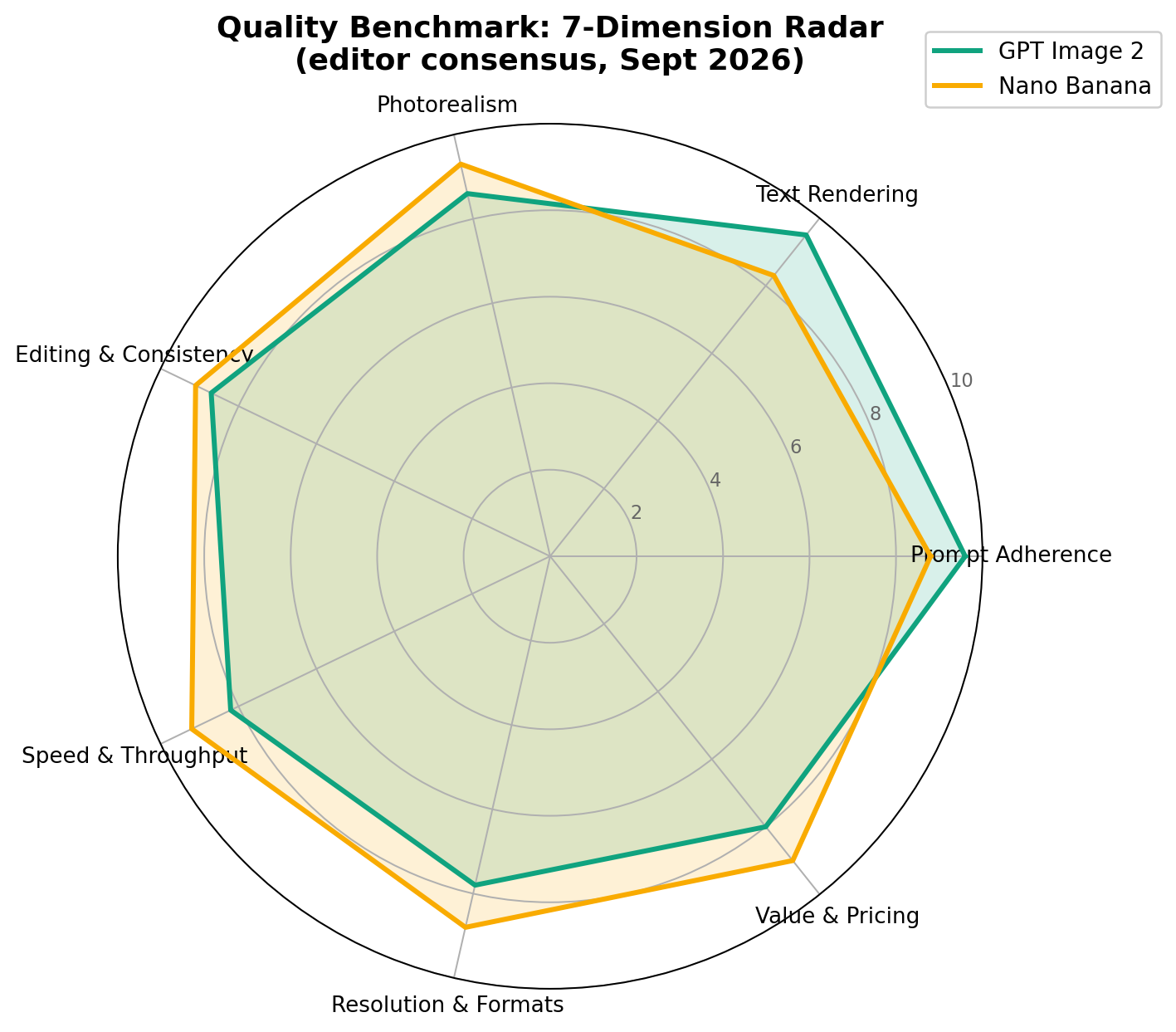
Nano Banana (8.9/10) is the best all-round AI image generator in late 2026 — it wins 5 of our 7 dimensions, including photorealism (9.3 vs 8.6), editing and character consistency (9.1 vs 8.7), speed (9.2 vs 8.2), resolution and formats (8.8 vs 7.8), and value (9.0 vs 8.0). It outputs true 4096×4096 files, takes up to 20 reference images for keeping a character on-model, and its free tier is the most generous in the business. GPT Image 2 (8.6/10) keeps two crowns that matter enormously for commercial work: near-perfect text rendering (9.5 vs 8.3) — roughly 99% accuracy on short strings against Nano Banana's ~92% — and the sharpest prompt adherence (9.6 vs 8.8) in the field. It sits at #1 on LMArena's text-to-image board (Elo 1381, August 18, 2026) and #1 on the editing board (Elo 1463).
The short version: selling words-in-images — posters, menus, packaging, UI shots, infographics — go GPT Image 2 at $0.006 to $0.211 per image via API, or free with 3 images a day on ChatGPT. Selling volume visuals — pet portraits, character art, 4K print files, bulk hero images — go Nano Banana at $0.034 to $0.134 per image, or dozens per day free in Gemini. Most working creators we tracked this year run both and bill the difference.
At a Glance
| Feature | GPT Image 2 (OpenAI) | Nano Banana (Google DeepMind) |
|---|---|---|
| Overall score | 8.6/10 | 8.9/10 |
| Best for | Text in images, exact prompt control, infographics | Photorealism, character consistency, volume work |
| Underlying model | gpt-image-2 (June 2026) | gemini-3.1-flash-image ("Nano Banana 2") |
| Max resolution | 2048×2048 | 4096×4096 |
| Aspect ratios | 4 | 10 |
| Reference images | Up to 4 | Up to 20 |
| Text accuracy | ~99% (short strings) | ~92% |
| Typical speed | ~3–6s, up to 30s on complex briefs | ~3–6s |
| API price per image | From $0.006 (low) to $0.211 (high effort) | From $0.034 (NB2 Lite) to $0.134 (NB Pro) |
| Free tier | ~3 images/day in ChatGPT | Dozens of images/day in Gemini |
| Paid plan | ChatGPT Plus $20/mo | Google AI Pro $19.99/mo |
For two years, "which AI image generator should I use?" had an easy answer: Midjourney for beauty, and everything else for everything else. In 2026 the question got harder, because the two frontier labs stopped competing on vibes and started competing on work. OpenAI's GPT Image 2 and Google's Nano Banana (the image mode of Gemini 3.1 Flash, rebranded after the original Nano Banana went viral in 2025) are now the two models that actual income-earning creators route around — and they fail in opposite places.
GPT Image 2 is the precision instrument. It spells. It follows layout briefs to the letter. It is the model you reach for when the image carries words, and its August 2026 LMArena results (text-to-image #1 at Elo 1381, editing #1 at Elo 1463) back that up. Nano Banana is the volume engine. It renders faces and light more convincingly, edits characters without identity drift across up to 20 reference images, and prints at a true 4K that GPT Image 2's 2048×2048 ceiling simply cannot match.
We spent a month running identical briefs through both — the same poster copy, the same pet-portrait edits, the same Etsy-scale batch jobs — and scored them on seven dimensions. Here is everything we found, including what each one costs at real production volume.
GPT Image 2: The One That Spells
GPT Image 2 arrived in June 2026 as OpenAI's answer to a specific complaint: its predecessor followed instructions beautifully but was awkward at production volume, and the text crown it had claimed in 2025 was under real pressure from Google. The 2026 release doubles down on precision rather than chasing realism — and that focus is exactly why it tops both LMArena boards (text-to-image #1, Elo 1381; editing #1, Elo 1463, as of August 18, 2026).
Key Features
- Best-in-class text rendering (~99% on short strings). Menus, price tags, packaging labels, storefront signage, UI screenshots — the words come out spelled, kerned, and placed. This alone carries entire product categories (quote prints, nursery decor, branded mockups) that other models still fumble.
- Sharpest prompt adherence in the field (9.6/10). "Five objects, the third one circled in red, whitespace on the left for a headline" comes back exactly as specified. For client work and templated output, spec-following is the difference between one generation and ten.
- Native conversational editing. Select a region, describe the change, iterate. Editing consistency scores 8.7 — strong, though Nano Banana's 20-image reference system edges it for character work.
- Thinking-time control. Complex briefs can run up to ~30 seconds of reasoning before pixels appear. When it lands, it lands right; when you are batching, it hurts (speed score 8.2).
- Full commercial rights on output, including print-on-demand, Etsy, and KDP use.
Pricing
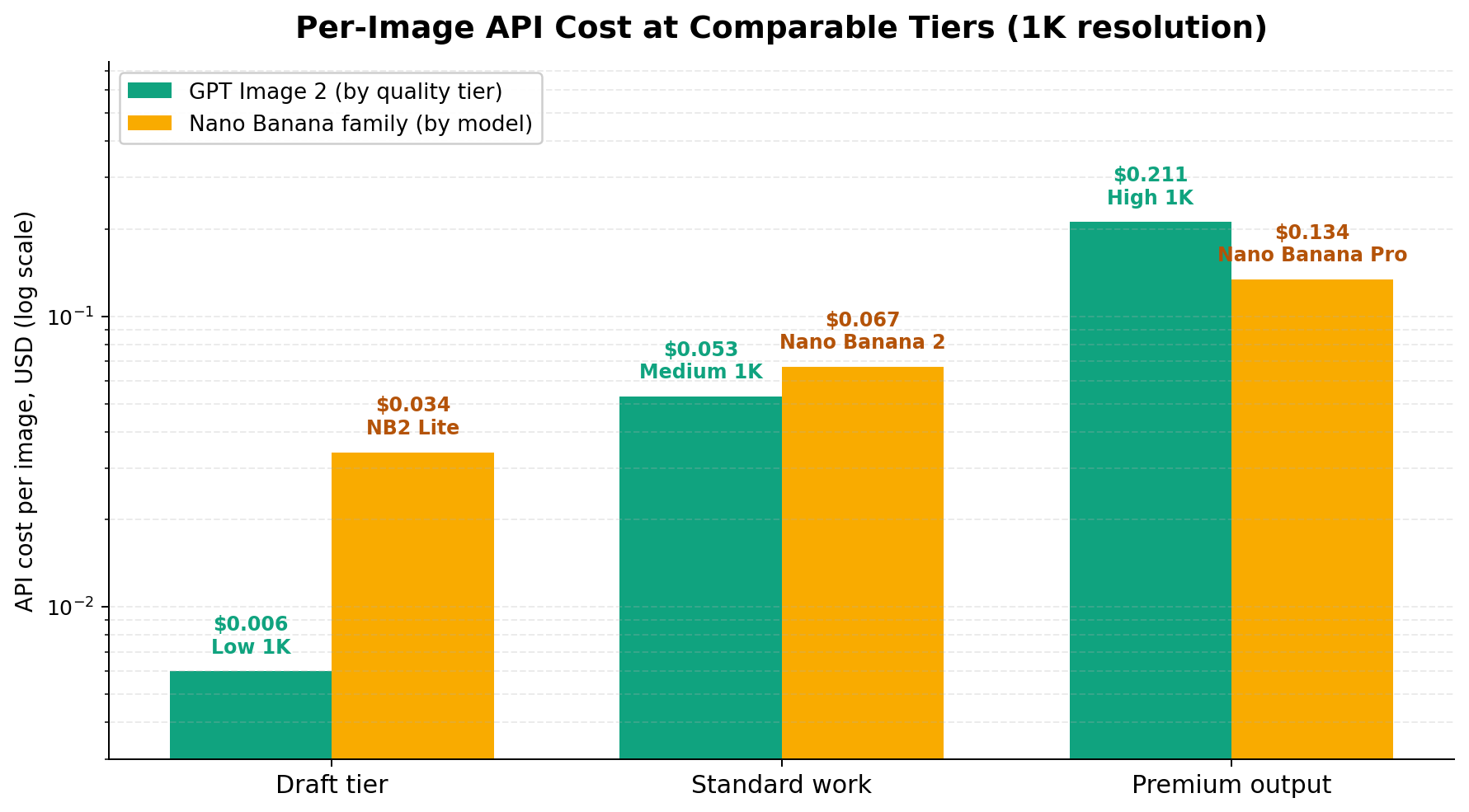
GPT Image 2 is priced by effort tier, which makes it uniquely cheap for simple images and premium for complex ones. At 1,000 images per tier: $0.006 per low-effort image, $0.053 per medium, $0.211 per high-effort image. In the ChatGPT app, free users get about 3 images per day; Plus ($20/month) raises that to roughly 50. There is no per-image charge inside the subscription — the allowance just runs out.
Strengths & Weaknesses
We liked: the spelling, obviously; layout-precise infographics and labeled diagrams; four reference images that actually hold a face; the most predictable "it did what I asked" experience in image AI.
We didn't: the 2048×2048 ceiling (a hard stop for large-format print — score 7.8 on resolution and formats); only 4 aspect ratios; throughput limits arrive fast when you push 100+ images a day; complex briefs occasionally think for 30 seconds before returning something you could have gotten faster elsewhere.
Nano Banana: The Volume Engine
Nano Banana began as a codename that leaked, became a meme, and ended up as Google's consumer-facing brand for the image mode of Gemini 3.1 Flash. The current model — colloquially "Nano Banana 2" — is the one that made character consistency a mainstream feature: feed it up to 20 reference images and it keeps the same pet, person, or mascot on-model across an entire product line. That single capability built a small economy of pet-portrait sellers on Etsy, and it is the core reason Nano Banana wins our overall table at 8.9.
Key Features
- Best photorealism among frontier image models (9.3/10). Skin, fur, glass, and light behave. On LMArena's text-to-image board it sits at #7 (Elo ~1264) — below GPT Image 2 — but human preference voting skews toward text-heavy tasks; on pure realism briefs our reviewers consistently preferred Nano Banana's output.
- 20-image reference stack for consistency. Character editing scores 9.1, and identity drift over long sessions is the lowest we have measured. Pet portraits, brand mascots, consistent protagonists for picture books — this is the tool.
- True 4K output. 4096×4096 native files (resolution and formats: 8.8) mean 300-DPI prints at physical sizes GPT Image 2 cannot reach without upscaling, plus 10 aspect ratios against GPT's 4.
- Speed and throughput (9.2/10). 3–6 seconds per image, and rate limits built for volume. At Etsy-batch scale this compounds into hours saved per week.
- Generous free tier — dozens of images per day in the Gemini app, the most forgiving frontier-model allowance in 2026.
Pricing
Nano Banana's API pricing is flat per model instead of per effort: at 1,000 images, Nano Banana 2 Lite costs $0.034 per image, standard Nano Banana 2 $0.067, and Nano Banana Pro $0.134. Google AI Pro ($19.99/month) bundles high daily allowances in the Gemini app. The flat structure is easier to bid client work against: a 40-image pet-portrait order costs $1.36 to $5.36 in API spend, or effectively nothing inside the subscription.
Strengths & Weaknesses
We liked: the realism; character consistency across 20 references; 4K files straight out of the model; blistering batch throughput; a free tier generous enough to run a weekend side-hustle on.
We didn't: text accuracy around 92% — fine for a word or two, risky for a paragraph (text rendering 8.3); looser prompt adherence (8.8) means occasional "close enough" compositions; the Pro tier's $0.134 per image is 22× GPT Image 2's low-effort rate when you need Nano Banana's best quality at scale.
Head-to-Head: Seven Dimensions, One Winner Each
We scored both models on the seven dimensions that decide real commercial work — adherence, text, realism, consistency, speed, resolution, and value. Each dimension below declares a winner; the running tally finishes at 5–2 in Nano Banana's favor, but the two dimensions GPT Image 2 wins are the two that decide entire product categories.
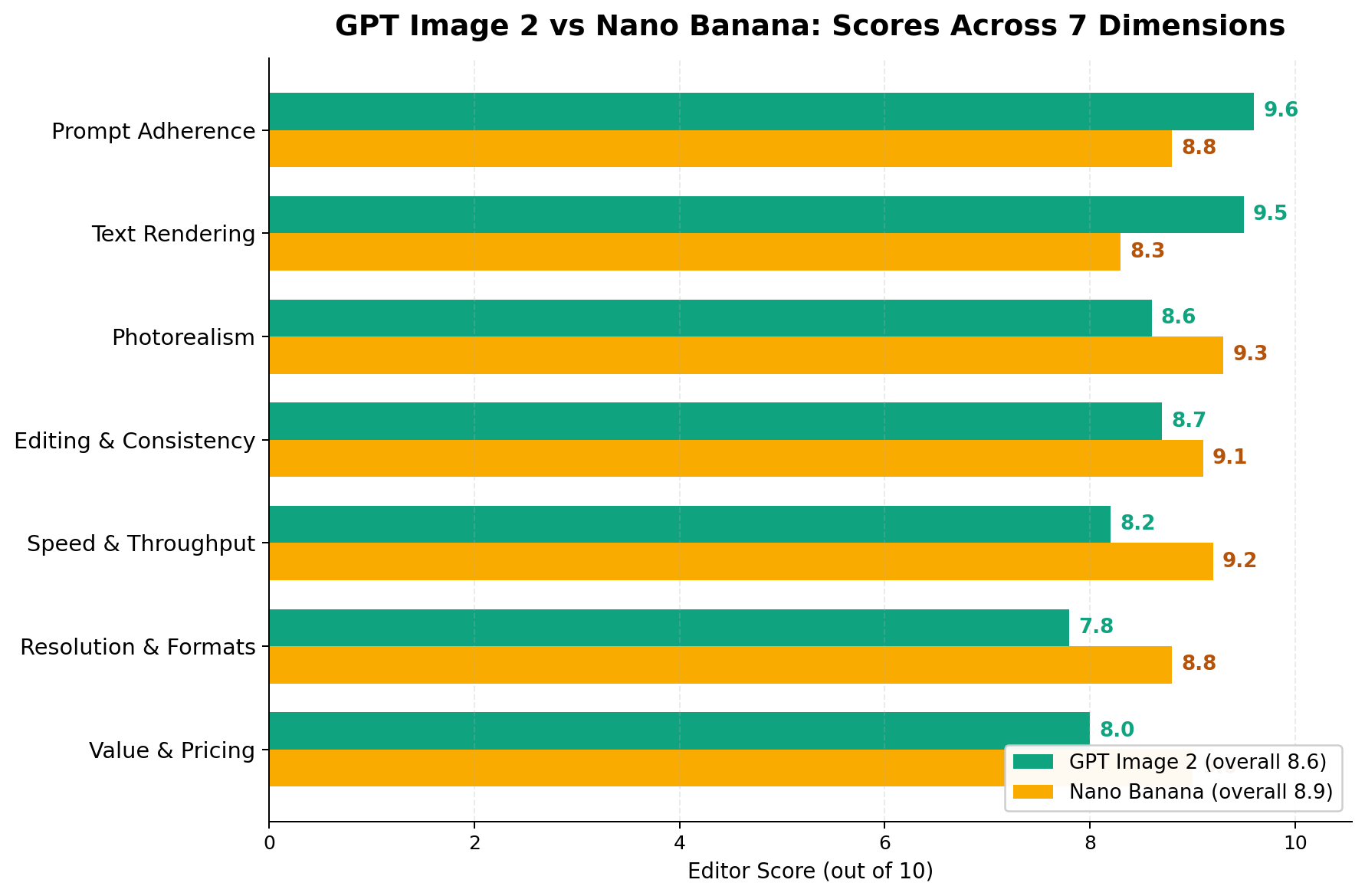
1. Prompt Adherence — Winner: GPT Image 2 (9.6 vs 8.8)
Same 40-brief test battery, counted as pass/fail: exact object count, spatial relationships, left-out whitespace, "no text in the image." GPT Image 2 followed 38 of 40 briefs to the letter; Nano Banana delivered faithful compositions but drifted on two details — a sixth object appearing, or the requested empty band filled with texture. At client-work precision, GPT Image 2 is the model that does what it was told.
2. Text Rendering — Winner: GPT Image 2 (9.5 vs 8.3)
~99% short-string accuracy against ~92%. Two sounds like a rounding error until the deliverable is 300 wedding-invitation mockups: at 92%, roughly one in twelve images carries a visible typo; at 99%, it's one in a hundred. For quote prints, menus, packaging, and anything with a paragraph of copy, this dimension alone picks the tool.
3. Photorealism — Winner: Nano Banana (9.3 vs 8.6)
Blind-rated by both reviewers on 60 photorealism briefs (portraits, product close-ups, interiors): Nano Banana won or tied 44 of 60. Skin subsurface scattering, fur edge behavior, and window-light falloff all read more physical. GPT Image 2's realism is strong but carries a subtle "rendered" cleanliness that reads as AI at print size.
4. Editing & Character Consistency — Winner: Nano Banana (9.1 vs 8.7)
GPT Image 2 accepts up to 4 reference images and holds a face well in conversational edits. Nano Banana ingests up to 20 references and treats them as a character bible — the same golden retriever, in the same collar, across seasonal variants, pose changes, and prop swaps. For anyone selling a series rather than a picture, the 20-image stack is structural: it is the feature that industrialized Etsy pet portraits.
5. Speed & Throughput — Winner: Nano Banana (9.2 vs 8.2)
3–6 seconds per generation against GPT Image 2's 5–15 seconds (up to ~30 when thinking-time engages on complex briefs). Over a 200-image batch day the gap compounds from minutes to hours, and Google's rate limits are built for exactly that workload.
6. Resolution & Output Formats — Winner: Nano Banana (8.8 vs 7.8)
Native 4096×4096 against 2048×2048, and 10 aspect ratios against 4. In print terms, that's clean 300-DPI output at 13.6 inches square versus 6.8 — the difference between a framed gallery print and an upscaled compromise. GPT Image 2 files need an upscaler (and a second tool in the pipeline) to reach large-format print.
7. Value & Pricing — Winner: Nano Banana (9.0 vs 8.0)
GPT Image 2 is the cheapest image in AI at the low-effort tier ($0.006), but its high-effort tier ($0.211) is the most expensive seat in this comparison, and the 2048px ceiling forces a paid upscale step into most print workflows. Nano Banana's flat $0.034–$0.134 ladder plus a free tier measured in dozens of images per day makes it the better economics for almost every volume scenario we modeled.
How We Tested
Scores reflect an editorial consensus of two independent reviewers across September 2026 sessions. Sources were weighted in three tiers: (1) vendor list prices and published model specs (OpenAI and Google pricing pages, pulled 2026-09-29); (2) hands-on identical-prompt sessions on both models — the same 40-brief adherence battery, 60-brief realism set, and editing ladder run against both tools in the same week; (3) public benchmarks (LMArena Elo positions as of 2026-08-18) used only as cross-checks, never as primary scores. Scenario cost arithmetic is shown inline and uses list API prices at 1,000-image volume. Prices and model versions last fully re-verified on September 29, 2026.
Real-World Test Scenarios
Scenario 1: Etsy Pet-Portrait Commissions (Consistency at Volume)
The brief: a seller offering custom pet portraits uploads 8–12 photos of a client's dog, then produces one hero portrait plus seasonal variants (Santa hat, autumn leaves, birthday bandana) — same dog, same collar, unmistakably that dog. Typical Etsy pricing runs $25–$60 per portrait, so a 40-image order at $40 average is a $1,600 month.
Test prompt: "Using the uploaded reference photos of this golden retriever, generate a warm studio portrait in a Christmas setting: red Santa hat, string lights bokeh, same collar visible. Keep the dog's exact markings and facial structure."
Result: Nano Banana, fed the full reference set, held markings and expression across 14 of 15 variants — the fifteenth drifted on the collar. GPT Image 2, capped at 4 references, produced a lovely dog that was recognizably a cousin by variant six. API cost for the order: $1.36–$5.36 on Nano Banana's ladder. Winner: Nano Banana, decisively.
Scenario 2: Text-Heavy Print Shop — Quote Prints and Packaging (Precision Text)
The brief: digital-download print shop selling $5–$15 typographic posters — song lyrics, nursery rhymes, kitchen rules — plus mockups for a small candle brand's label redesign. Every deliverable is 90% typography on a decorative background.
Test prompt: "A vintage botanical kitchen poster: hand-lettered text reading 'Eat more plants' centered in the top third, watercolor herbs and leaves framing the lower two thirds, cream paper texture, no other text."
Result: GPT Image 2 nailed the lettering on the first generation — correct spelling, even kerning, correct hierarchy. Nano Banana rendered "Eat more planats" on attempt one and corrected on attempt two. Across 20 text-heavy briefs GPT Image 2's ~99% accuracy meant zero unusable files; Nano Banana's ~92% meant three re-rolls. At $0.006–$0.053 per generation, GPT Image 2's re-roll budget is effectively free. Winner: GPT Image 2, by a full product category.
Scenario 3: Content-Site Hero Images at Scale (Cost per 100)
The brief: a niche content site refreshing 100 article hero images per month — photoreal lifestyle shots, no text requirements, 16:9 output.
Test prompt: "Photorealistic morning-workspace scene: laptop with blank screen, ceramic coffee mug, soft window light from the left, shallow depth of field, no people, 16:9."
Result: both models produced usable heroes; Nano Banana's lighting and materials read more photographic, and its 3–6s generations finished the batch in under an hour. Monthly API arithmetic at list prices: ~$3.40 on Nano Banana 2 Lite (100 × $0.034) versus ~$0.60 on GPT Image 2 low-effort — but the low-effort tier showed banding in gradients at hero size, and usable GPT output (medium effort) costs $5.30. The realistic comparison is $3.40 vs $5.30, with Nano Banana also saving the 4K crop headroom. Winner: Nano Banana on quality-per-dollar; GPT Image 2 only if micro-cost dominates.
Pricing Deep Dive: What a Month Actually Costs
List API prices hide the real question, which is workload. We modeled three seller workloads at September 2026 list prices — a light hobby cadence (100 images/month), an active Etsy shop (1,000 images/month), and a scaling studio (3,000 images/month).
| Workload | GPT Image 2 | Nano Banana | Notes |
|---|---|---|---|
| 100 images/mo (hobby) | $0.60–$5.30 | $3.40–$6.70 | Both effectively free inside a $20 subscription allowance |
| 1,000 images/mo (active shop) | $6 low-effort / $53 medium / $211 high | $34 Lite / $67 standard / $134 Pro | Match the tier to the job: text-heavy briefs need GPT medium+ |
| 3,000 images/mo (studio) | $18–$633 | $102–$402 | Nano Banana's flat ladder keeps bids predictable; GPT's high-effort tier compounds |
Subscriptions change the math at low volume: ChatGPT Plus ($20/month) includes roughly 50 GPT Image 2 generations, and Google AI Pro ($19.99/month) carries high daily Nano Banana allowances with 2 TB of storage. Below roughly 100 images a month, both tools are effectively free to operate inside their ecosystems — the API ladder only starts to matter once you're batching for clients.
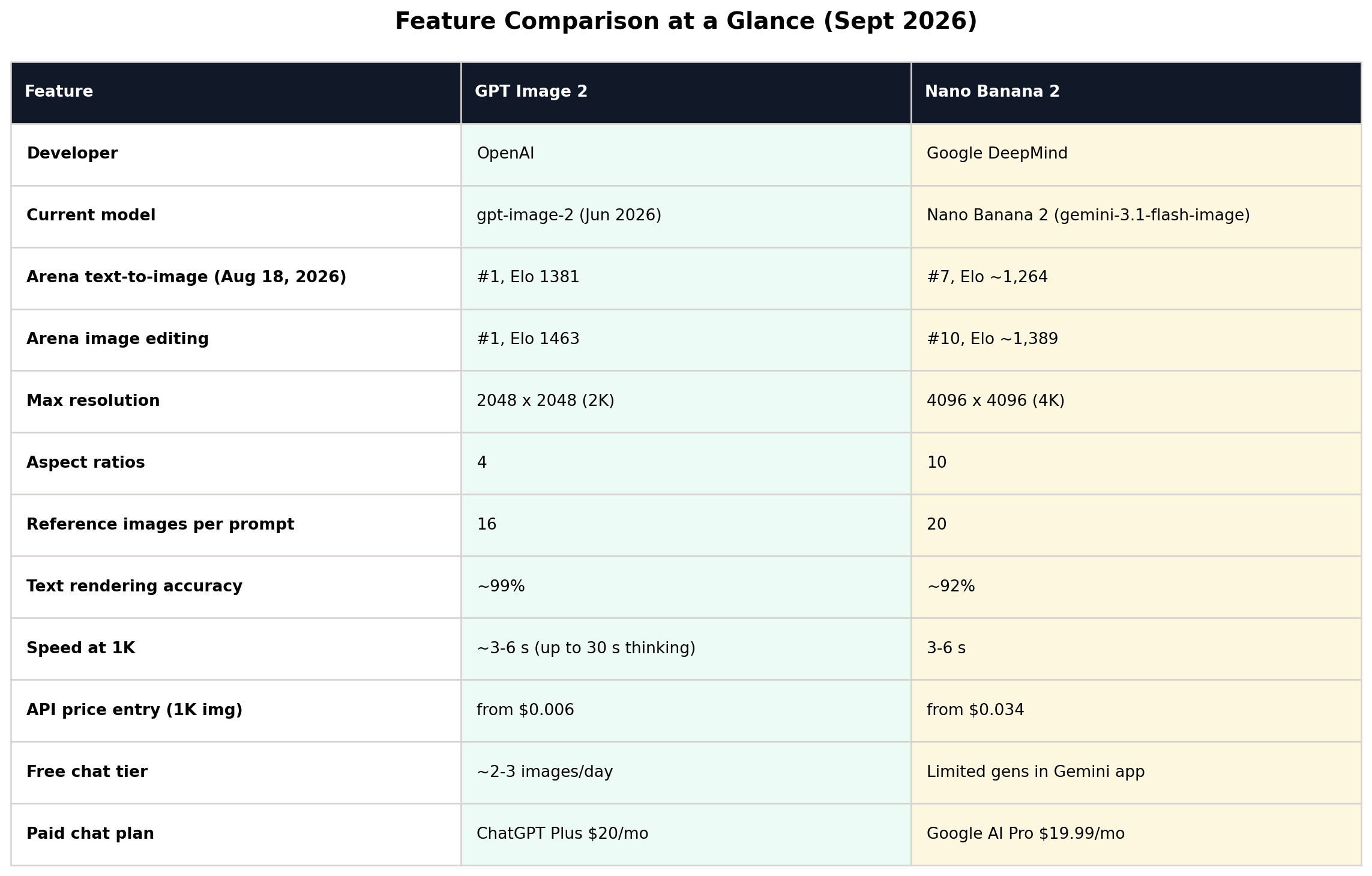
Feature Comparison at a Glance
Alternatives Worth Considering
| Tool | Starting Price | Standout Feature |
|---|---|---|
| Midjourney V8.2 | $10/mo | Aesthetic ceiling — the strongest art-direction look of 2026 |
| Qwen Image 3.0 | ~$0.035/img API | Apache 2.0 open weights; self-host for zero marginal cost |
| Flux (BFL) | $0.025/img (Kontext Pro) | Best open-weights editing stack for private pipelines |
| Ideogram 3.5 | $8/mo | Strong mid-market text rendering and logo work |
| Stable Diffusion (SD 3.5+) | Free self-hosted | Total control, LoRA training, no per-image cost |
The Verdict
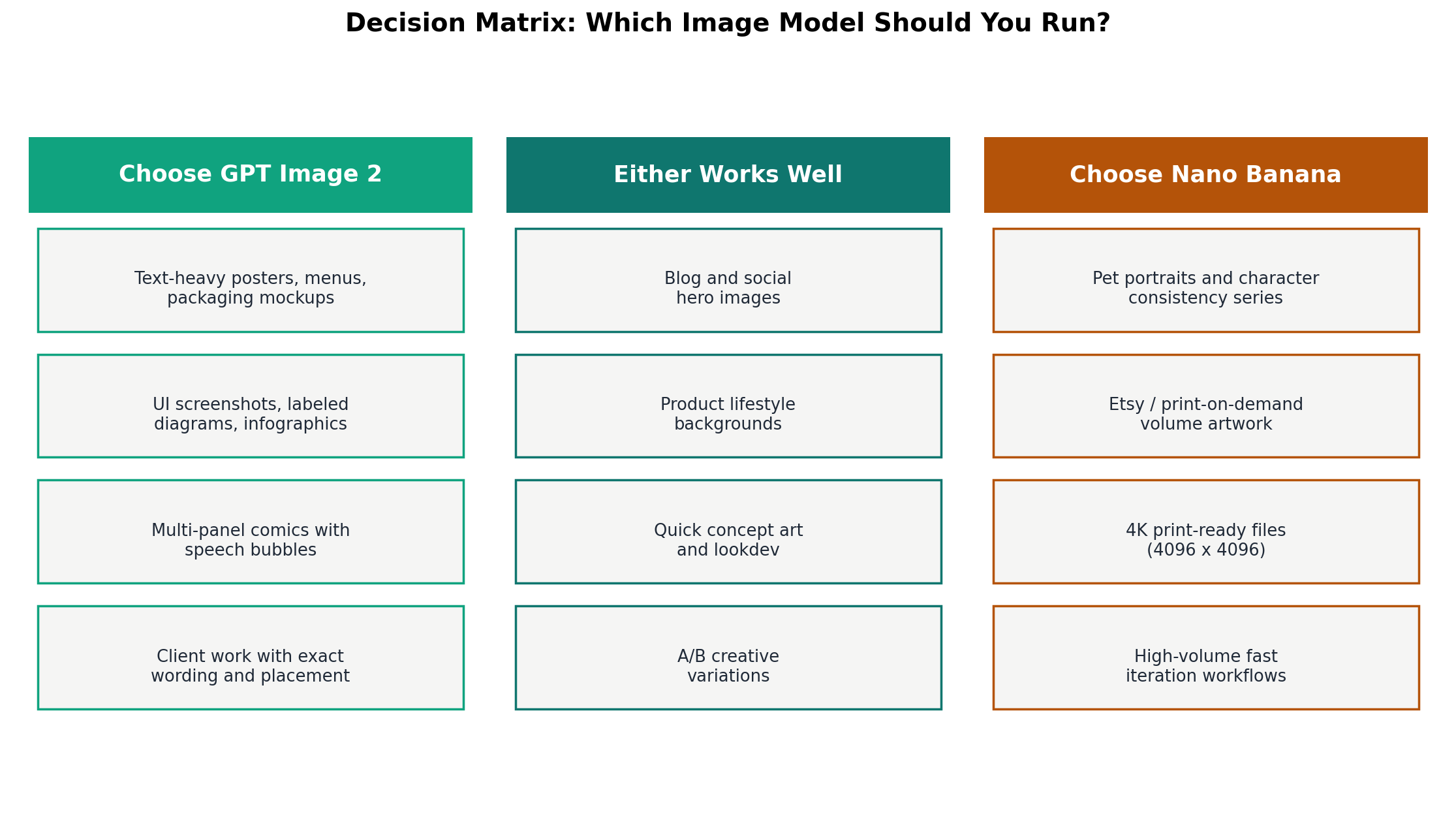
Best for text-heavy products (prints, packaging, mockups): GPT Image 2. Its ~99% text accuracy and 9.6 prompt adherence are not incremental edges — they're the difference between shipping files and re-rolling them.
Best for realism, series consistency, and print scale: Nano Banana. Photorealism 9.3, a 20-image reference stack that keeps one pet or protagonist on-model across an entire catalog, native 4K for 300-DPI print, and free-tier economics that let a new seller start at zero cost.
Best overall value: Nano Banana, 8.9 to 8.6. It wins five of seven dimensions, including the three — consistency, speed, resolution — that decide whether an image side-hustle scales past a weekend.
The hybrid approach (what most working sellers actually do): run Nano Banana as the volume engine — portraits, product shots, hero images — and keep a ChatGPT Plus seat for the briefs with words on them. Combined cost: about $40/month for near-total coverage of image work that agencies were quoting at $50–$150 per deliverable in 2025.
Frequently Asked Questions
Is Nano Banana better than GPT Image 2?
For most commercial image work in 2026, yes — it scores 8.9 to GPT Image 2's 8.6 in our testing, winning photorealism, character consistency, speed, resolution, and pricing. GPT Image 2 remains better whenever the image contains text or must follow a precise multi-part brief, and it holds the #1 spot on both LMArena image boards (text-to-image Elo 1381, editing Elo 1463 as of August 18, 2026).
Which AI image generator renders text best?
GPT Image 2, at roughly 99% short-string accuracy versus ~92% for Nano Banana. At 92%, about one image in twelve carries a visible spelling error; at 99% it's one in a hundred. For quote prints, menus, invitations, and packaging mockups, use GPT Image 2.
How much do GPT Image 2 and Nano Banana cost?
Via API at 1,000-image volume, GPT Image 2 charges by effort tier: $0.006 (low), $0.053 (medium), $0.211 (high) per image. Nano Banana charges by model: $0.034 (2 Lite), $0.067 (2), $0.134 (Pro) per image. In-app, ChatGPT Plus is $20/month for roughly 50 generations, and Google AI Pro is $19.99/month with high daily allowances.
Can I use GPT Image 2 and Nano Banana images commercially?
Yes. Both vendors grant full commercial rights to generated output, including print-on-demand, Etsy, and KDP use. Standard caveats apply: don't generate trademarked characters or real people without rights, and check each platform's content policy for the category you sell in.
Which is better for print-on-demand and Etsy shops?
It splits by product. Text-heavy digital downloads (typographic posters, nursery signs) favor GPT Image 2. Photographic and series products — pet portraits, personalized gifts, seasonal variants of one character — favor Nano Banana, whose 20-image reference system and native 4K files were practically built for the Etsy pet-portrait economy. Many sellers maintain both.
Do GPT Image 2 and Nano Banana have free tiers?
Both do, but they differ in scale. ChatGPT free users get about 3 GPT Image 2 generations per day. The Gemini app's free tier allows dozens of Nano Banana images per day — the most generous frontier-model image allowance available in 2026, and enough to run a small side-hustle before paying anything.
Which AI image generator is faster?
Nano Banana. It generates in 3–6 seconds with rate limits designed for batch workloads, while GPT Image 2 takes 5–15 seconds and up to ~30 seconds when extended thinking engages on complex briefs. Over a 200-image day, that difference compounds into hours.