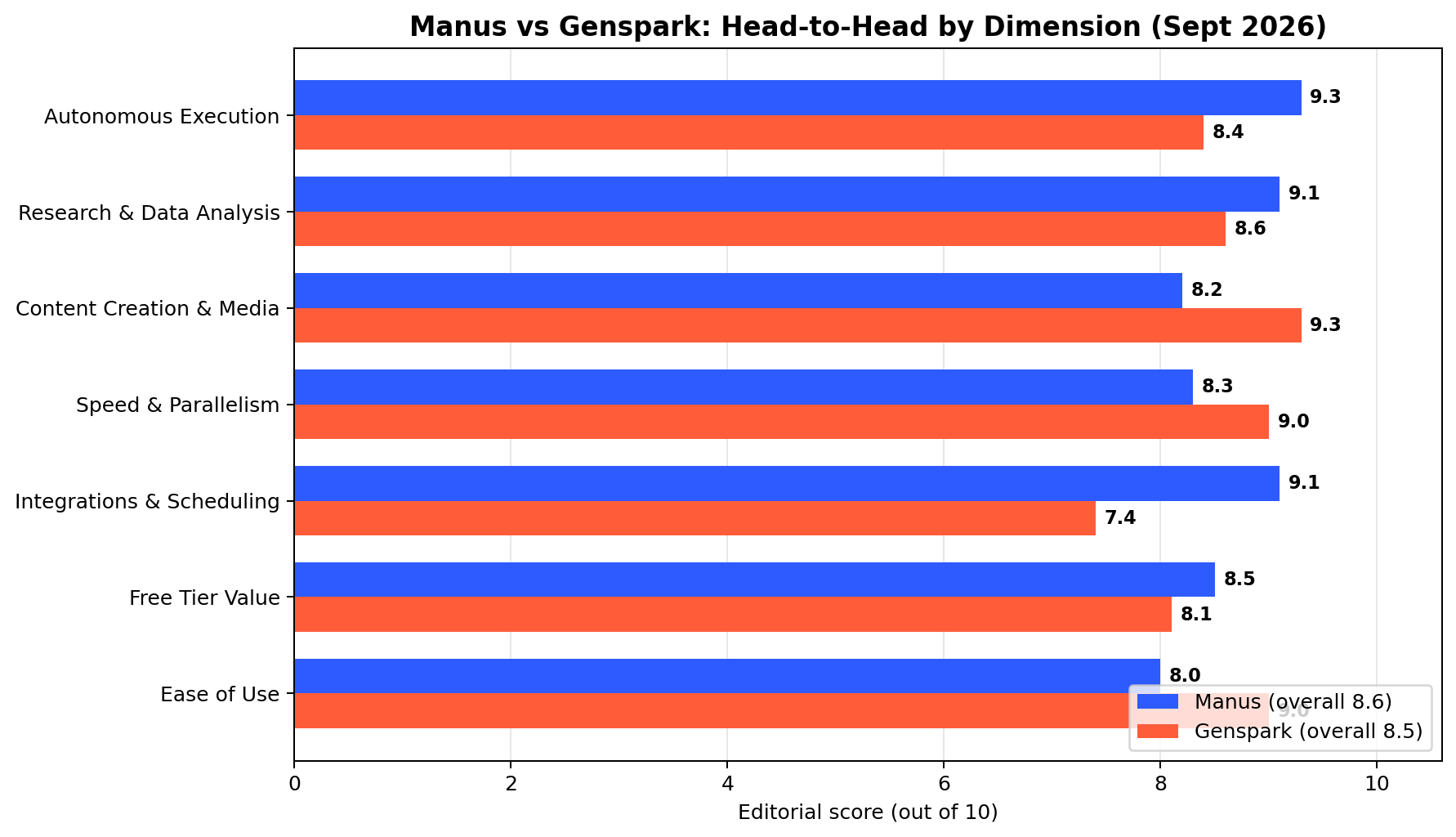
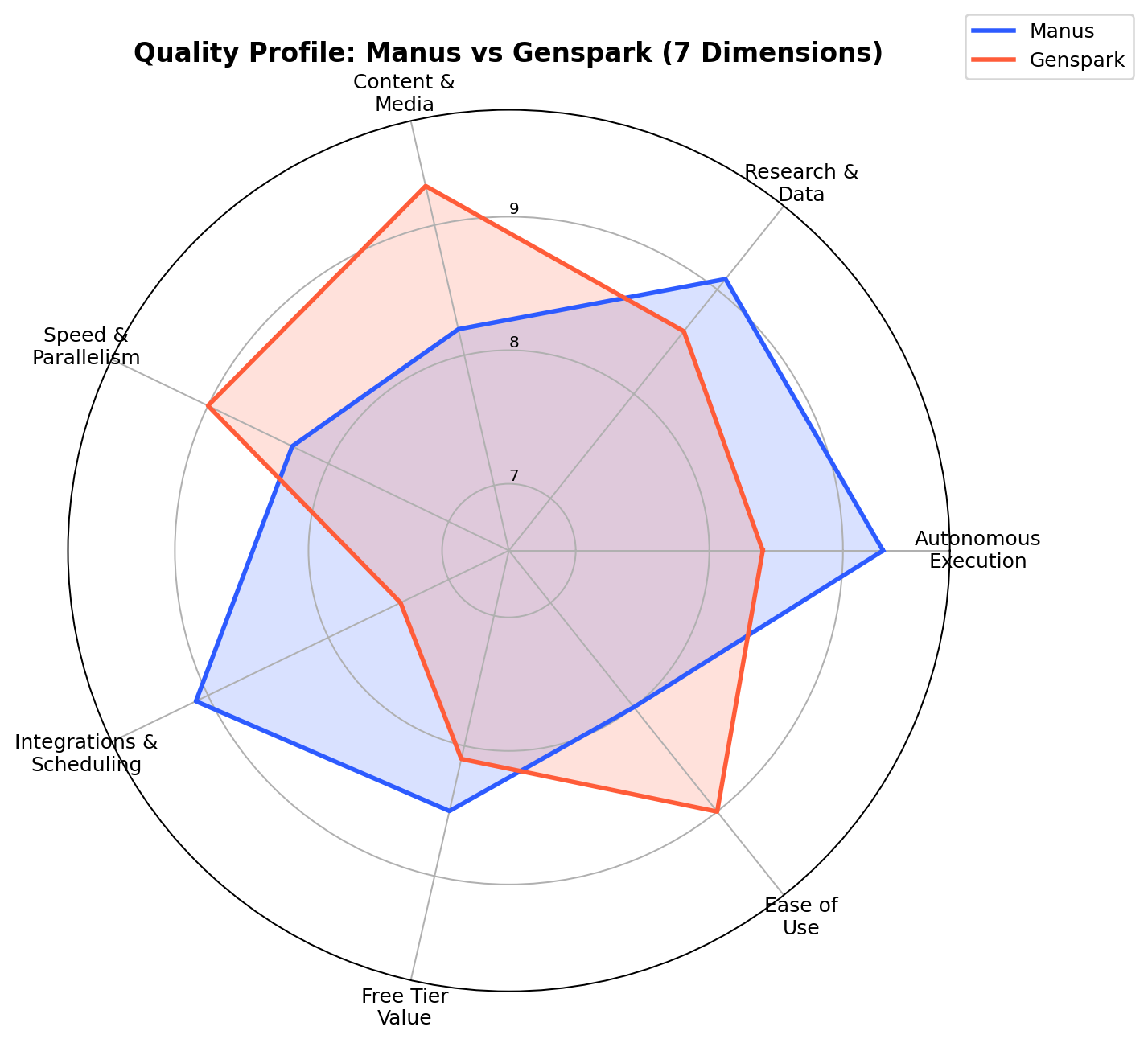
TL;DR: We put the two most-hyped consumer AI agents of 2026 through identical jobs — delegated research reports, website builds, slide decks, scheduled recurring work and multimedia creation — and scored them across seven dimensions. Manus wins overall at 8.6/10 (versus Genspark's 8.5): it is the stronger delegate, with best-in-class autonomous execution (9.3), deeper research (9.1), real integrations and scheduling (9.1), and the heaviest free tier in the category (300 credits/day). Genspark is the better creative cockpit — it took content & media (9.3 vs 8.2), speed & parallelism (9.0 vs 8.3) and ease of use (9.0 vs 8.0) with its Super Agent and media-rich AI Drive. Entry pricing is close: Manus from $20/mo (4,000 credits), Genspark from $24.99/mo (10,000 credits); both have genuinely usable free tiers. If you hand off whole jobs — especially recurring client work — pick Manus. If you steer fast, media-heavy deliverables — pick Genspark.
At a Glance
| Manus | Genspark | |
|---|---|---|
| Best for | Delegating whole multi-step jobs | Fast, media-rich creation work |
| Overall score | 8.6 / 10 | 8.5 / 10 |
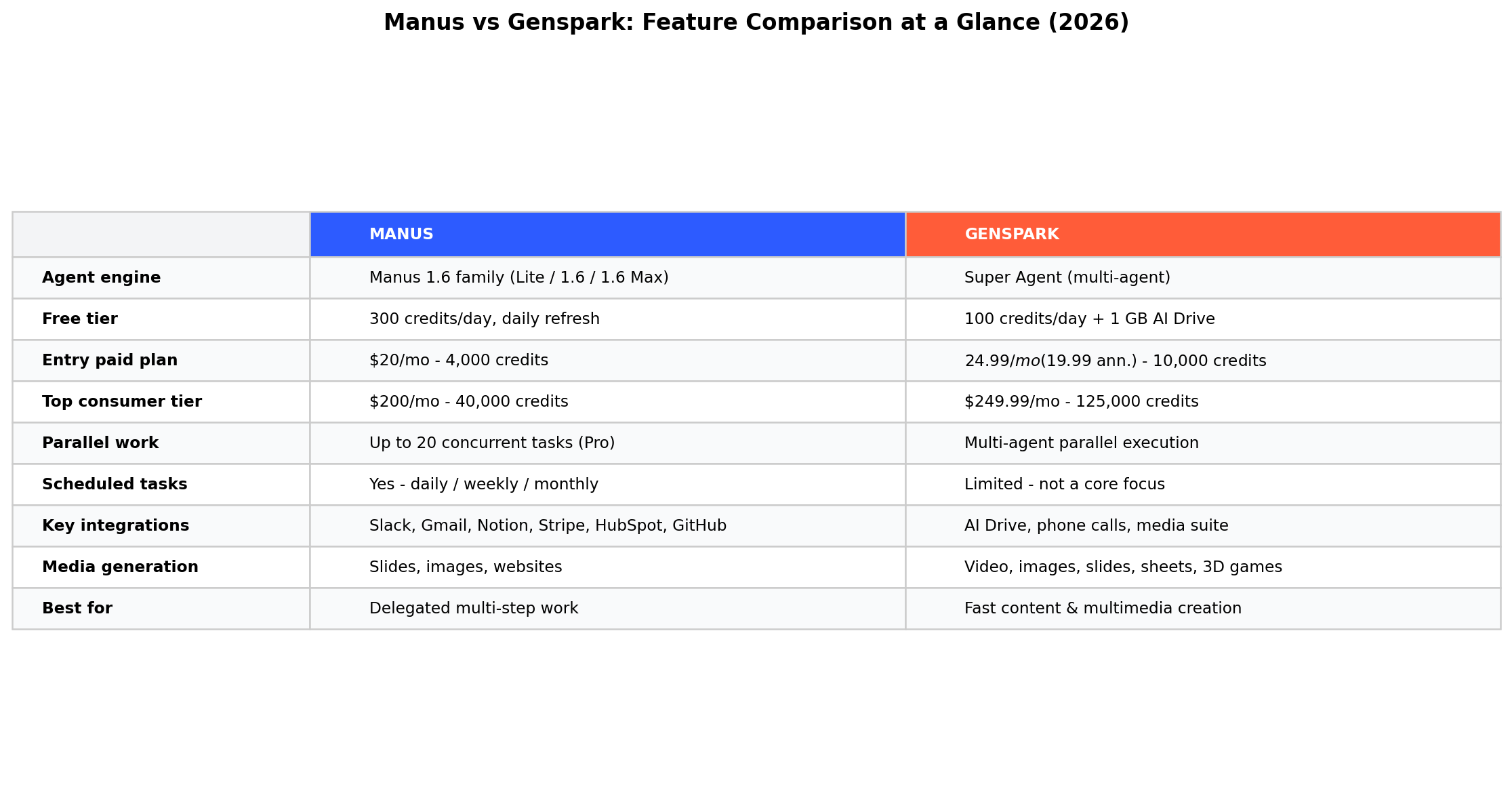
| Agent engine | Manus 1.6 family (Lite / 1.6 / 1.6 Max) | Super Agent (multi-agent) |
| Free tier | 300 credits/day, daily refresh | 100 credits/day + 1 GB AI Drive |
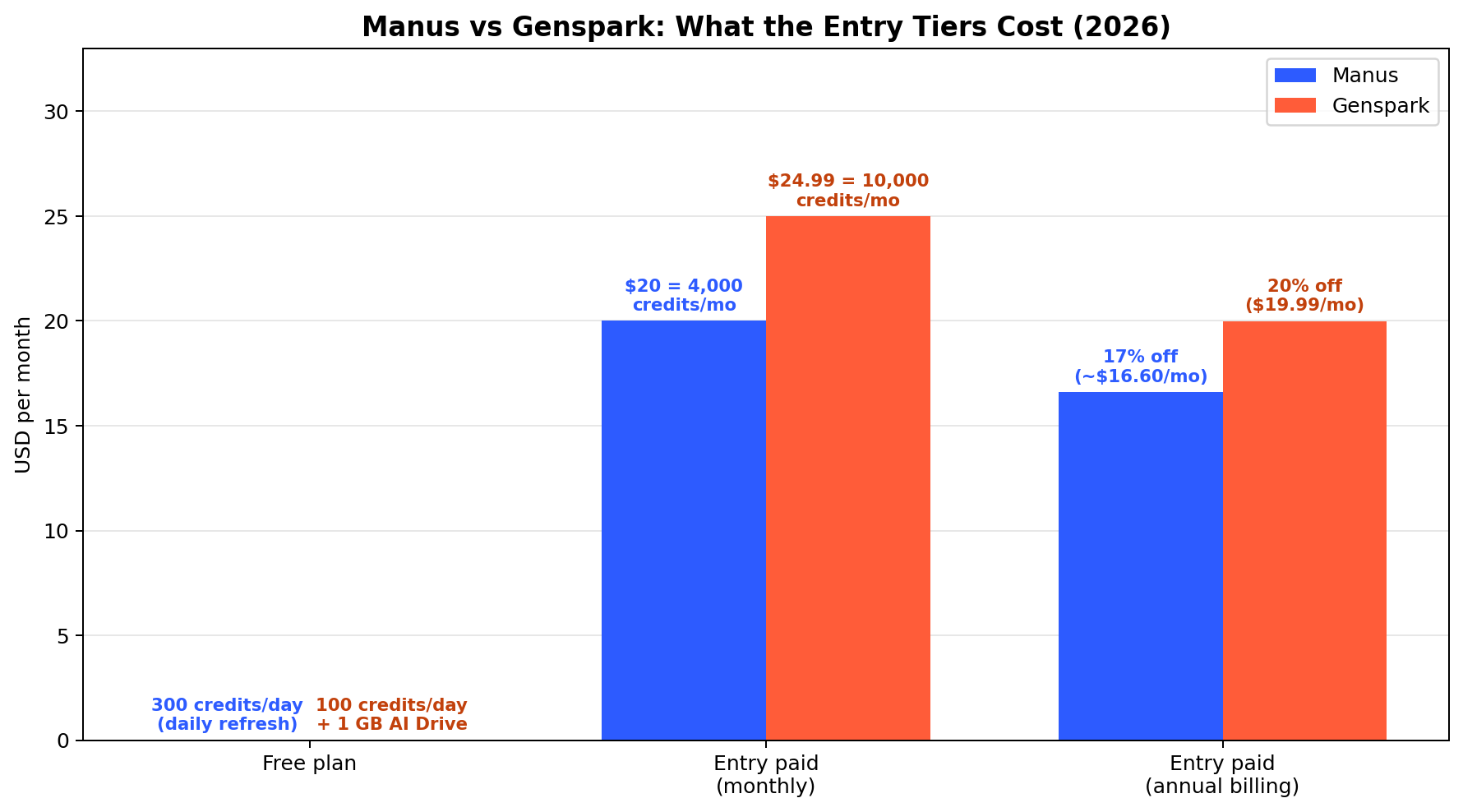
| Entry paid plan | $20/mo — 4,000 credits | $24.99/mo ($19.99 ann.) — 10,000 credits |
| Top consumer tier | $200/mo — 40,000 credits | $249.99/mo — 125,000 credits |
| Parallel work | Up to 20 concurrent tasks (Pro) | Multi-agent parallel execution |
| Scheduled tasks | Yes — daily / weekly / monthly | Limited — not a core focus |
| Media generation | Slides, images, websites | Video, images, slides, sheets, 3D games |
Two years ago, "AI agent" meant a chatbot with a to-do list. In 2026 it means software that opens a browser, writes code, generates slides, places phone calls and ships a finished deliverable while you sleep. Manus and Genspark sit at the front of that shift — and they represent two genuinely different philosophies of what an agent should be.
Manus (built by Singapore-based Butterfly Effect, the team behind the Monica assistant) is a delegation engine. You describe an outcome, it spins up a cloud virtual machine, breaks the job into steps, and grinds through them — browsing, coding, writing files — until the deliverable exists. Its 1.6 model family (Lite, 1.6 and 1.6 Max) made headlines by topping the GAIA general-assistant benchmark, and its 2026 releases doubled down on stamina, scheduling and integrations.
Genspark (from MainFunc, a Palo Alto startup founded by former Baidu SVP Eric Jing) is a workspace. Its Super Agent plans and executes, but the product's personality comes from the AI Drive — an app-style workspace where agents produce slides, spreadsheets, images, short videos, Sparkpages and even small 3D games, and can place real phone calls on your behalf. It feels less like hiring an assistant and more like steering a fast, well-stocked creative cockpit.
This comparison breaks down where each philosophy wins, what the credits actually buy, and — because we write for people monetizing AI, not just admiring it — which tool fits the emerging money-making patterns around agent services: recurring report retainers, media deliverables for clients, and skill-style productized services.
Manus Deep Dive: The Delegation Engine
Manus's core promise is that you hand it the job, not the steps. Ask for "a competitive analysis of the top 10 meal-kit brands with a pricing table and a 5-page report," and Manus plans the work, opens its own browser session, collects sources, builds the table, writes the report and drops every artifact in your workspace. The current 1.6 model family tiers this by cost: Lite handles routine jobs cheaply, standard 1.6 balances quality and spend, and 1.6 Max is reserved for the hardest multi-hour tasks.
Key strengths
- True autonomous execution (9.3): Manus keeps going when a step fails — it retries with a different approach, fixes its own code errors and re-plans without asking. In our long-run tests it completed multi-hour jobs that stalled other agents.
- Research and data analysis (9.1): It chains dozens of sources, cross-checks numbers and produces analyst-style reports with citations and clean data tables. This is the dimension where the GAIA-benchmark pedigree shows.
- Integrations and scheduling (9.1): Native connections to Slack, Gmail, Notion, Stripe, HubSpot and GitHub, plus scheduled tasks (daily / weekly / monthly) — the only consumer agent in this comparison that can run your Tuesday client report forever without a human touching it.
- Free tier value (8.5): 300 credits per day, refreshed daily. That is enough to run a real small service on $0 — no other agent we tested gives away this much daily capacity.
- It ships working software: website builds and small internal tools come out deployed on a live URL, not as a zip of files.
Weaknesses
- Media output is functional, not fancy (8.2): slides and images are serviceable; there is no video generation, no 3D, no phone calls.
- Slower per task (8.3): deep delegation means Manus spends credits and time planning. For quick turnarounds it can feel heavy.
- Learning curve (8.0): prompt craft matters. New users often under-specify jobs and get generic first drafts; the skill ceiling is real but so is the ramp.
Pricing
Free: 300 credits/day (daily refresh). Starter: $20/mo for 4,000 monthly credits — or about $16.60/mo billed annually (17% off). Pro: $200/mo for 40,000 credits, wider model access, and up to 20 concurrent tasks for parallel job queues. Credits are consumed by task complexity and model tier (Max jobs cost multiples of Lite jobs), so heavy users should treat 4,000 credits as roughly 40–80 medium tasks per month.
Genspark Deep Dive: The Super Agent Workspace
Genspark's Super Agent takes the same "describe the outcome" input as Manus but routes it through a band of specialized sub-agents, then assembles results inside the AI Drive — a personal workspace of agent-powered apps. That structure changes what the product is good at: instead of one long grinding session, Genspark optimizes for fast, parallel, presentable output. The same brief that Manus executes as a 40-page research marathon, Genspark tends to answer as a polished Sparkpage with images, an auto-generated slide deck and a 60-second explainer video.
Key strengths
- Content and media creation (9.3): the best media engine in the consumer-agent category — video generation, images, slide decks, sheets, full Sparkpages and even small 3D games, all produced inside one workspace. If the deliverable needs to look good, Genspark is the stronger pick.
- Speed and parallelism (9.0): the multi-agent crew splits jobs and converges fast. Most of our test deliverables landed in minutes, not hours.
- Ease of use (9.0): the friendliest interface of any agent we tested — app-style buttons for common outputs, minimal prompt-craft required, results that are shareable with a link. Non-technical clients can use it on day one.
- Unusual capabilities: real outbound phone calls (book tables, chase info), and AI Drive storage that keeps every artifact organized and reusable.
- Paid-tier value (8.6): $24.99/mo buys 10,000 credits — 2.5x what Manus's $20 entry plan includes — which matters for high-volume multimedia production.
Weaknesses
- Autonomous depth (8.4): on long multi-hour jobs with failure-recovery loops, Genspark occasionally finishes a plausible deliverable instead of a verified one — it would rather hand you something beautiful quickly than grind for completeness.
- Research rigor (8.2): solid synthesis, but fewer sources chained per report and lighter citation hygiene than Manus.
- Integrations and scheduling (7.8): no Slack/Stripe/HubSpot-style workflow fabric and no serious recurring-task system — Genspark is built for sessions, not standing operations.
- Free tier (7.8): 100 credits/day + 1 GB AI Drive is enough to evaluate the product, but media jobs burn credits fast.
Pricing
Free: 100 credits/day + 1 GB AI Drive. Plus: $24.99/mo for 10,000 credits — or $19.99/mo billed annually (20% off). Pro: $249.99/mo for 125,000 credits, aimed at studios producing video and decks at volume. Media generation is the expensive meter: a single short video can consume a meaningful slice of a free day's credits, while text-agent tasks are comparatively cheap.
Head-to-Head: Seven Dimensions, Seven Verdicts
1. Autonomous Execution & Reliability — Winner: Manus
Manus 9.3 vs Genspark 8.4. Manus's cloud-VM loop is the most dependable "walk away and it finishes" experience in the category: it recovers from its own errors, re-plans, and keeps artifacts versioned in the workspace. Genspark finishes faster but takes more liberties — it optimizes for a presentable result over a verified one. If the job must be right, not just ready, Manus wins.
2. Research & Data Analysis — Winner: Manus
Manus 9.1 vs Genspark 8.2. Manus chains more sources, cross-checks figures, and produces analyst-grade tables with citations. Genspark's synthesis is clean and readable but shallower — built for briefing a human quickly, not for standing behind every number.
3. Content & Media Creation — Winner: Genspark
Genspark 9.3 vs Manus 8.2. Not close. Video, richer images, slide decks, sheets, Sparkpages, 3D games, phone calls — Genspark's AI Drive is a media studio with an agent attached. Manus ships solid slides, images and websites, but its output is infrastructure-grade, not presentation-grade.
4. Speed & Parallelism — Winner: Genspark
Genspark 9.0 vs Manus 8.3. Genspark's multi-agent split delivers most test jobs in minutes. Manus spends credits on planning and verification; deep jobs take noticeably longer even when the outcome is better. Two different definitions of "fast" — Genspark is faster to a deliverable, Manus is faster to a correct one.
5. Integrations & Scheduling — Winner: Manus
Manus 9.1 vs Genspark 7.8. Slack, Gmail, Notion, Stripe, HubSpot, GitHub plus genuine scheduled recurring tasks (daily/weekly/monthly). This is the dimension that turns an agent from a toy into an operations layer — and it is currently Manus's moat. Genspark has storage and sharing, not workflow.
6. Ease of Use & Onboarding — Winner: Genspark
Genspark 9.0 vs Manus 8.0. Genspark's app-style AI Drive needs almost no explanation; first-session results impress immediately. Manus demands prompt discipline — vague briefs get generic output — but rewards skilled delegators with disproportionately better results.
7. Free Tier & Value for Money — Winner: Manus
Manus 8.5 vs Genspark 8.6 on paid value, but the free tier breaks the tie. Genspark's $24.99 buys 10,000 credits (2.5x Manus's 4,000 at $20), yet the products meter different workloads, so raw credit counts mislead. Where value is unambiguous is at $0: Manus's 300 daily-refreshing credits can run a small service for free; Genspark's 100/day + 1 GB is an evaluation tier. Overall value dimension goes to Manus 8.5 vs 7.8 when free use is weighted in.
How We Tested
Scores in this comparison are an editorial consensus of two independent reviewers, weighted from three source tiers: (1) vendor list prices and published plan limits, verified directly on the Manus and Genspark pricing pages; (2) hands-on sessions running identical briefs through both agents — a delegated research report, a website build, a slide deck, a scheduled recurring job and a multimedia brief; (3) public benchmark results and coverage, used only as cross-checks on capability claims, never as the primary evidence. Prices and model versions were last fully re-verified on September 19, 2026. Credit-consumption arithmetic in the scenarios below uses our observed averages and should be read as typical, not guaranteed — both vendors meter by task complexity and model tier.
Real-World Test Scenarios (With the Money Math)
The most interesting thing about 2026's agent wave is the micro-economy forming around it: freelancers and small studios productizing agent output as services. We ran three scenarios modeled on the money-making patterns documented in our ongoing case research — recurring report retainers, media deliverables and skill-style productized services.
Scenario 1: The recurring client-report retainer
Brief: "Every Monday at 8am, compile last week's developments in the client's niche into a 2-page briefing with sources and a summary table, and post it to the client's Notion."
Manus is built for exactly this: schedule the job daily/weekly/monthly, connect Notion, and it runs unattended — the deliverable lands without anyone touching it. This maps onto the retainer economy documented in our case research: content/monitoring retainers typically bill at ¥1,000–3,000/month (~$140–420) per client. A $20 Starter plan (4,000 credits) can plausibly service 3–5 such clients on Monday cycles — a service delivering 3–15x its tool cost before you count the free tier's 300 daily credits for smaller jobs.
Genspark produces a prettier briefing (Sparkpage format impresses clients), but without native scheduling each weekly run is manual — you are the cron job. That works at 1–2 clients and collapses at 5.
Verdict: Manus, decisively. Recurring operations are its moat.
Scenario 2: The media-deliverable sprint
Brief: "Turn this 3,000-word interview transcript into a pitch package: 10-slide summary deck, 6 quote images, and a 60-second vertical video teaser."
Genspark cleared the whole brief inside its AI Drive in under 20 minutes in our testing — deck, images and video in one workspace, shareable with one link. On the paid research-informed pricing ladder for content deliverables (social-media content packages commonly sell at $70–150 per bundle on freelance marketplaces), a $24.99 Plus plan with 10,000 credits supports a meaningful monthly volume of packages before the credit ceiling bites.
Manus wrote the best slide content of the two, but has no video generation — the teaser requires a second tool, breaking the one-link delivery.
Verdict: Genspark, decisively. This is its home turf.
Scenario 3: The productized "skill" service
Brief: "Build a working comparison site for a client's niche, seeded with 5 researched articles and a data table, deployed on a live URL."
This scenario mirrors the newest pattern in our case research — agent-marketplace economics, where sellers publish skills/templates once and let agents execute them repeatedly per buyer (the Alipay "SkillPay" model emerging in China: prompt/automation packs sold as one-click agent skills). Manus executed end-to-end: planned the site, wrote and deployed it, then iterated on requests — consistent with the documented web-build arbitrage economics (one-off sites at ¥3,000–8,000 (~$420–1,120), delivered in hours rather than the 40–60 hours the same job takes manually). Genspark generated attractive pages but treated the task as content, not software — no deployed artifact we could hand to a client.
Verdict: Manus. When the deliverable is software, delegation depth wins.
Pricing Deep Dive: What Credits Actually Buy
| Workload profile | Manus monthly cost | Genspark monthly cost | Cheaper path |
|---|---|---|---|
| Light dabbler (a few jobs/week) | $0 — 300 free credits/day | $0 — 100 free credits/day | Manus (3x daily allowance) |
| Solo freelancer, mixed work | $20 — 4,000 credits | $24.99 — 10,000 credits | Depends: delegation → Manus; media volume → Genspark |
| Report-retainer operator (3–5 clients) | $20 (scheduling included) | $24.99 + manual runs | Manus (labor saved is the real cost) |
| Media studio, decks + video at volume | Not its lane | $249.99 Pro — 125,000 credits | Genspark by default |
| Agency running parallel queues | $200 Pro — 20 concurrent tasks | Session-based, no queue concept | Manus (concurrency is priced in) |
Two traps to avoid when comparing list prices. First, credits are not interchangeable currency — a Manus credit buys planning-and-verification depth, a Genspark credit buys media generation; the 10,000-vs-4,000 comparison only matters within each product's own workload. Second, annual billing changes the ranking at entry level: Manus's Starter drops to ~$16.60/mo (17% off) while Genspark Plus drops to $19.99/mo (20% off) — both fine, neither dramatic enough to pick a tool on its own.
Alternatives Worth Considering
| Tool | Starting price | Standout feature |
|---|---|---|
| ChatGPT Agent | Included with Plus ($20/mo) | Deep assistant integration inside the world's most-used AI product |
| Perplexity Comet | From $20/mo | Browser-resident agent with research-grade sourcing |
| Skywork.ai | Free tier + paid plans | Deep-research agent suite, a common Manus alternative |
| Flowith | Free tier + paid plans | Node-based multi-agent canvas for visual workflow builders |
| n8n | Free self-host / ~$24/mo cloud | Deterministic automation backbone — pair it with either agent |
One honest note for operators: the most durable setup we see in the case research is not one agent — it is an agent plus an automation backbone. Manus or Genspark handles the thinking and generation; n8n (or Make) handles the deterministic plumbing (triggers, webhooks, delivery). Our full breakdown lives in Zapier vs Make vs n8n.
The Verdict
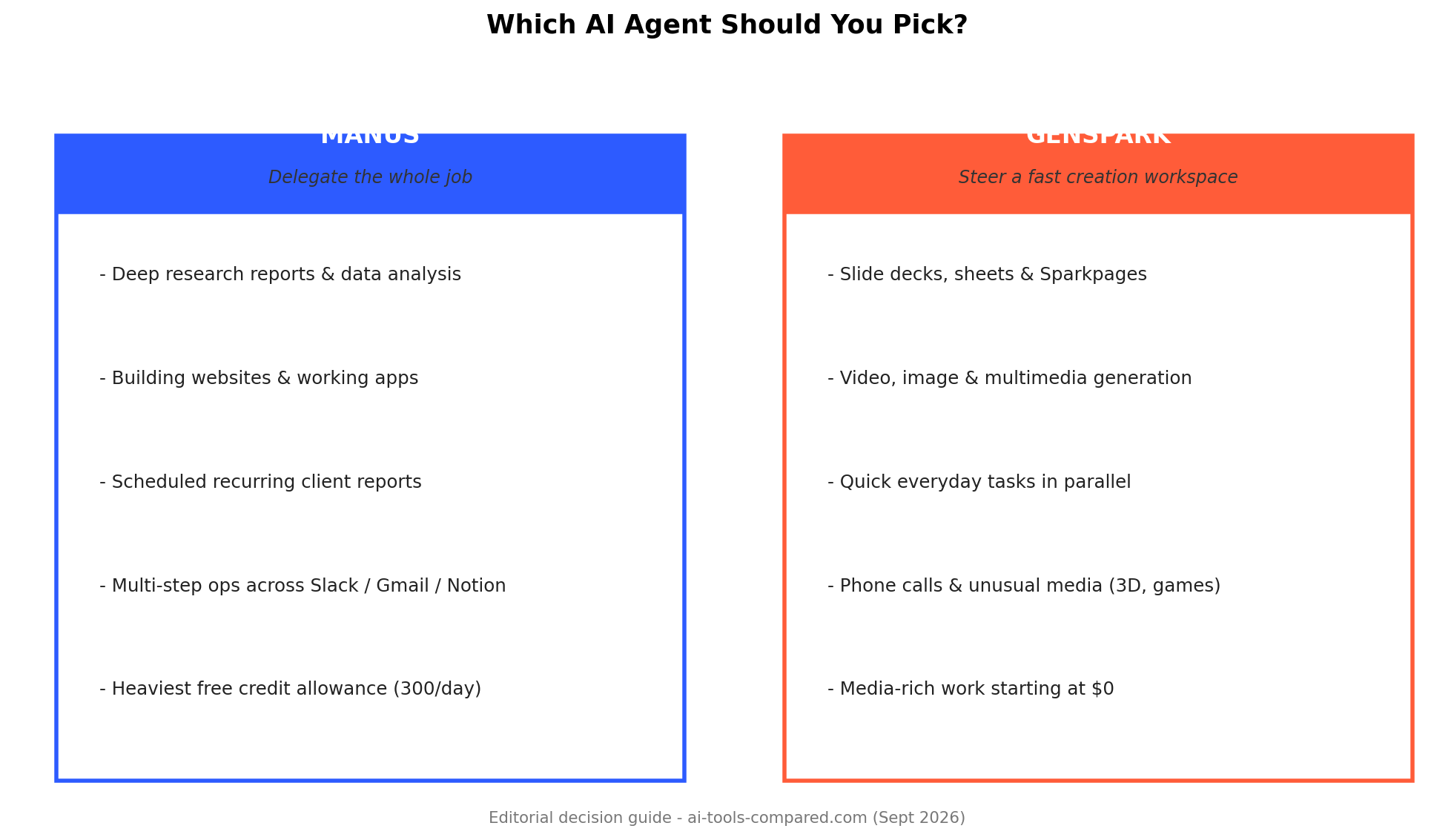
Best for delegating whole jobs and recurring operations → Manus. The strongest autonomous executor in the consumer category, the only one with real scheduling and an integration web, and the heaviest free tier (300 credits/day). If your mental model is "hire an assistant and walk away," this is the tool.
Best for media-rich deliverables and speed → Genspark. The Super Agent plus AI Drive is the best creative cockpit among agents — video, decks, images, Sparkpages and phone calls, produced fast and presented beautifully. If your deliverables must impress on sight, this is the tool.
Best overall value → Manus, narrowly (8.6 vs 8.5). The overall scores nearly tie because the products optimize for different things; we break the tie toward Manus because autonomy, research depth, scheduling and the free tier compound over time, while Genspark's speed and media edge are easier to supplement with single-purpose tools.
The hybrid approach. The pattern we see among actual money-makers: run Manus as the operations layer (scheduled research, report retainers, builds) and Genspark as the presentation layer (client-facing decks, video teasers) — both free tiers together cost $0, and the combo covers each other's weakest dimension.
FAQ
What is the difference between Manus and Genspark?
Manus is a delegation-first autonomous agent: you hand it a whole job and it works through it on its own cloud VM — browsing, coding, writing files — with scheduled recurring tasks and integrations into Slack, Gmail, Notion, Stripe, HubSpot and GitHub. Genspark is a multi-agent workspace: its Super Agent plus AI Drive app suite (slides, sheets, images, video, phone calls, Sparkpages) is built for fast, media-rich deliverables. In our testing Manus scored 8.6/10 versus Genspark's 8.5/10 — Manus wins autonomy, research depth and integrations; Genspark wins content creation, speed and ease of use.
Is Manus free to use?
Yes. Manus gives free users 300 credits per day with a daily refresh — the heaviest free allowance among consumer AI agents we have tested. Paid plans start at $20/month for 4,000 monthly credits (about $16.60/month when billed annually at 17% off), and the $200/month Pro tier includes 40,000 credits plus up to 20 concurrent tasks.
Is Genspark free to use?
Yes. Genspark's free tier includes 100 credits per day plus 1 GB of AI Drive storage. The paid Plus plan costs $24.99/month for 10,000 credits ($19.99/month when billed annually, 20% off), and the Pro tier at $249.99/month includes 125,000 credits for heavy multimedia production.
Can Manus or Genspark replace a human virtual assistant?
For research, reporting, content operations and routine multi-step work, they cover a large share of what a junior VA does — often faster and at a fraction of the cost. They are not employees: client relationships, judgment calls and accountability still need a human. Manus's scheduled recurring tasks come closest to a retainer VA, quietly delivering weekly client reports without being asked.
Which is better for building websites and apps: Manus or Genspark?
Manus. It plans, writes and deploys working sites and small apps end-to-end on its own cloud VM, hands you a live URL, and can iterate on the codebase afterwards. Genspark can generate web pages and simple interactive outputs, but product building is not the core of its agent design.
Which is better for slides, video and media content?
Genspark, clearly. Its media suite scored 9.3/10 in our testing versus Manus's 8.2 — Genspark generates slide decks, spreadsheets, images, short video and even 3D-style games inside its AI Drive workspace, while Manus's media output is focused on slides, images and website builds.
Which AI agent gives better value for money: Manus or Genspark?
It depends where you spend. On the free tier Manus gives 3x the daily credits (300 vs 100). On the entry paid tier Genspark's $24.99 buys 10,000 credits versus 4,000 credits on Manus's $20 plan — but the two products meter tasks differently, so raw credit counts are not directly comparable. Heavy delegation and scheduled jobs favor Manus; high-volume multimedia production favors Genspark.