TL;DR
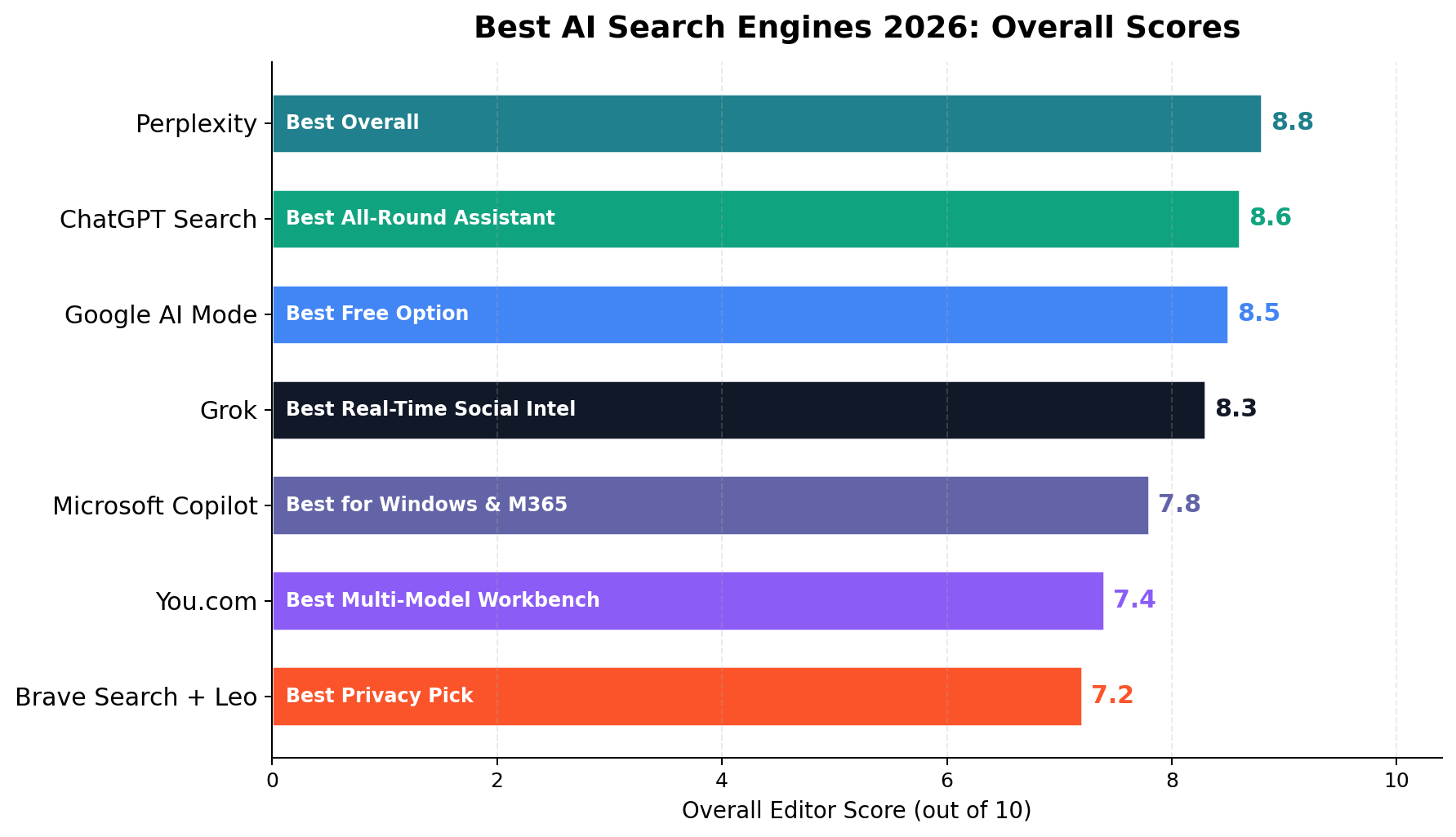
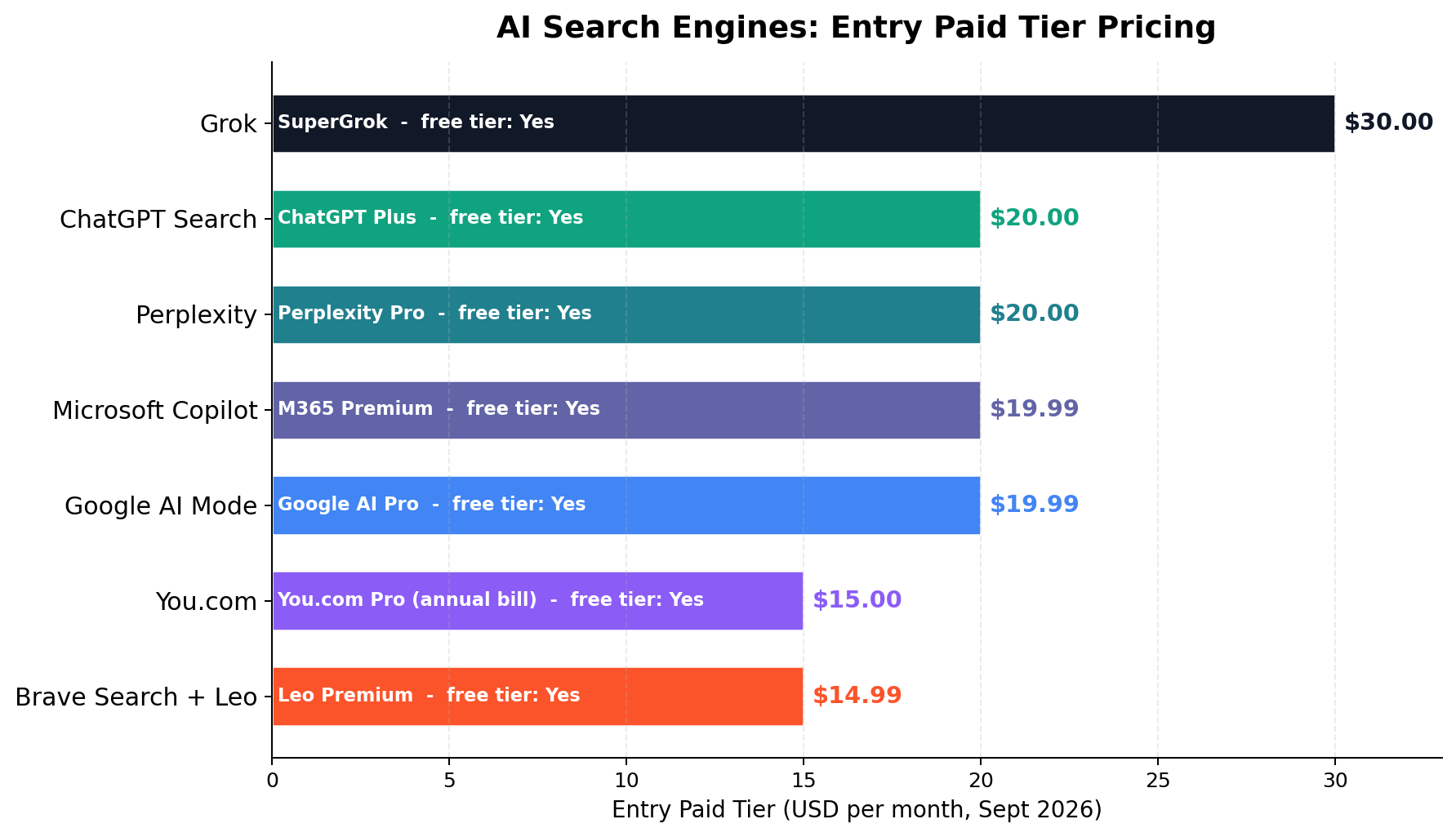
Perplexity Pro (8.8/10) is the best AI search engine in 2026 — the only tool that pairs frontier-model answers with inline citations you can actually audit, a research mode that cites as it writes, and a Sonar API for building on top. ChatGPT Search (8.6) is one step behind and the smarter pick if you already pay for ChatGPT Plus, because search lives inside the same assistant you use for everything else. Google AI Mode (8.5) is the best free option, full stop. Grok (8.3) owns real-time X/social intelligence that no rival can match, Microsoft Copilot (7.8) wins for Windows and Microsoft 365 workflows, You.com (7.4) is the multi-model workbench for power users, and Brave Search + Leo (7.2) is the privacy pick with its own independent index. Paid entry points run from $14.99 to $30/month — and the gap between the $0 tiers has never been smaller.
Why AI Search Engines Are Worth Paying For in 2026
Two years ago, "AI search" meant a chatbot that occasionally hallucinated a URL. That era is over. The 2026 generation of AI search engines — Perplexity, ChatGPT Search, Google's AI Mode, Grok — combines live web indexes with frontier reasoning models, and the result is a tool category that genuinely out-answers traditional search for research, comparison, and synthesis questions.
The economics matter too. A cited 10-source market brief that used to take a freelance researcher a half-day now takes 20 minutes with the right engine — which is why research-for-hire, SEO content briefs, and due-diligence work were three of the most-cited money-making workflows in our case-study research this quarter. Solo operators sell AI-assisted research sprints on Upwork and Fiverr in the $50–$150 range; the subscription cost is $15–$30/month. The margin is the pitch.
This guide ranks the seven AI search engines we tested across a month of identical research briefs, fact-checks, and news hunts. We scored each on six dimensions — answer quality, source citations, real-time knowledge, deep research, free-tier value, and ecosystem — and we price-checked every tier as of September 2026.
The 7 Best AI Search Engines at a Glance
| Rank | Tool | Score | Best For | Paid From |
|---|---|---|---|---|
| 1 | Perplexity | 8.8/10 | Best Overall — cited research | $20/mo (Pro) |
| 2 | ChatGPT Search | 8.6/10 | Best All-Round Assistant | $20/mo (Plus) |
| 3 | Google AI Mode | 8.5/10 | Best Free Option | $19.99/mo (AI Pro) |
| 4 | Grok | 8.3/10 | Best Real-Time Social Intel | $30/mo (SuperGrok) |
| 5 | Microsoft Copilot | 7.8/10 | Best for Windows & M365 | $19.99/mo (M365 Premium) |
| 6 | You.com | 7.4/10 | Best Multi-Model Workbench | $15/mo (Pro, annual bill) |
| 7 | Brave Search + Leo | 7.2/10 | Best Privacy Pick | $14.99/mo (Leo Premium) |
All seven have functional free tiers — the differences show up in limits, ads, and which frontier model answers your question. Now let's break down each pick, starting with the winner.
1. Perplexity — Best Overall (8.8/10)
Perplexity remains the tool that defines the category. Every answer arrives with numbered inline citations, source pages are listed below the response, and a Focus toggle constrains retrieval to academic papers, Reddit, news, or your own files. Its Deep Research mode runs autonomous multi-source investigations — typically 20–40 sources — and the Sonar API lets developers embed the same retrieval-plus-answer pipeline in their own products. If your work depends on answers you can defend, this is the engine that bills itself exactly around that promise.
Key Features
- Inline numbered citations on every answer — click any claim, land on the source passage
- Deep Research — autonomous multi-source reports with a full audit trail (Pro)
- Multi-model answers — GPT-5.6, Claude, and Gemini model selection on Pro
- Spaces & file upload — search across your own PDFs and notes with retrieval grounded in them
- Sonar API — the same cited-search pipeline as an API for developers and agencies
- Comet browser — an agentic browser companion that carries citations into any page context
Pricing
Free tier: unlimited quick searches with citations plus a metered allowance of Pro-grade searches. Pro is $20/month (annual billing available) with frontier model choice, Deep Research, higher limits, and file uploads. There is also a $200/month Max tier for heavy deep-research usage.
What We Liked
- Citations are the default, not a toggle — best-in-class auditability (9.5/10 on Source Citations)
- Deep Research reports are genuinely deliverable-quality for client briefs
- Sonar API is a quiet money-maker: research-shop workflows slot straight into it
What We Didn't Like
- Answer polish trails ChatGPT slightly on open-ended synthesis (9.0 vs 9.5)
- Pro limits reset on rolling windows — heavy months can pinch
- No first-party real-time X/social firehose the way Grok has
Bottom line: the best AI search engine for anyone whose output needs sources — students, analysts, consultants, and research-for-hire sellers alike.
2. ChatGPT Search — Best All-Round Assistant (8.6/10)
ChatGPT's built-in search is the highest-polish experience in the test. Answers scored best-in-class on raw quality (9.5/10), follow-up questions flow naturally, and search is woven into everything else ChatGPT does — coding, documents, images, agents. The catch is structural: on the free tier in the US, sponsored results now appear inside answers, and the best models sit behind the paid model picker. If you already subscribe to ChatGPT Plus at $20/month, search is included and the decision is effectively made.
Key Features
- Best-in-class answer synthesis — 9.5/10 answer quality, the ceiling of this test
- Deep Research — roughly 25 deep-research runs per month on Plus
- Model picker on paid tiers — route questions to GPT-5.6 Sol or lighter, faster models
- Atlas browser + desktop/mobile apps — search follows you across surfaces
- ChatGPT API — web search as a tool inside your own agent builds
Pricing
Free tier: search included, US users see ads in some answers; deep research is capped. Plus is $20/month with the model picker, higher limits, and no ads. Pro at $200/month raises limits further.
What We Liked
- One subscription covers search, reasoning, coding, and agents (9.5/10 ecosystem)
- Follow-up handling is unmatched — the conversation remembers what you meant
- Free tier is genuinely useful outside ad-supported markets
What We Didn't Like
- Citations trail the claim rather than anchoring it (8.0/10) — harder to audit than Perplexity
- Ads on the free US tier undercut the "clean answers" pitch
- No source filtering or focus-domain controls
Bottom line: the best AI search engine if ChatGPT is already your daily assistant — you get 90% of Perplexity's utility without a second subscription.
3. Google AI Mode — Best Free Option (8.5/10)
Google's answer to the category it helped create, AI Mode is now free in the Gemini app and woven into Chrome. It queries the deepest index in the business, returns Gemini 3.6-class answers with source links, and carries Google's Knowledge Graph — entity facts, local data, shopping feeds — that rivals simply don't have. Deep research capability exists but is limited compared to the leaders, and answers are Gemini-only: no model choice. As a $0 starting point, though, nothing else is close.
Key Features
- Best free-tier value in the test (9.5/10) — free in Gemini app and Chrome
- Google's full index + Knowledge Graph — entities, local, shopping in one answer
- Grounding API — Google-quality retrieval for your own apps
- Chrome integration — AI Mode without leaving the browser
- Deep research (limited) — capable when available, quota is the constraint
Pricing
Free tier: generous. Google AI Pro is $19.99/month for higher limits, more capable models, and deep-research access; AI Ultra tiers push further for professionals.
What We Liked
- The strongest $0 experience — most users can run weeks without paying
- Local, shopping, and entity answers competitors can't match
- Grounding API pricing is developer-friendly
What We Didn't Like
- Citation presentation is the weakest of the top three (7.5/10)
- Gemini only — no model choice at any price
- Search ads surface in results; the ad-free experience requires different muscle memory
Bottom line: the default recommendation for anyone starting AI search on a $0 budget — upgrade later only if you hit the limits.
4. Grok — Best Real-Time Social Intel (8.3/10)
Grok's unfair advantage hasn't changed: it searches the X firehose live. For breaking news, market sentiment, creator-economy tracking, and anything where "what are people saying right now" matters, Grok is untouchable (9.5/10 real-time knowledge — the highest single-dimension score in this test). Web answers are solid but citations are thinner (7.0/10), and the ecosystem beyond X is limited. Free tier includes search with a 10-questions-per-2-hours cap; SuperGrok is $30/month for higher limits, Agents, and Think modes. Pick it as a second engine for real-time, not your only one.
5. Microsoft Copilot — Best for Windows & M365 (7.8/10)
Copilot is the pragmatic choice inside Microsoft's universe: Bing-backed search with citation tiles, Think Deeper reasoning mode, and deep Windows + Edge + Microsoft 365 integration — summarize a doc, draft a reply, search the web, all without leaving the workflow. Answer quality (8.0) and deep research (7.0) trail the leaders, and Bing ads appear in results. Copilot Pro is $19.99/month; many users get the capable baseline free with Windows. Best for: office-bound professionals who want AI search where they already work, not researchers.
6. You.com — Best Multi-Model Workbench (7.4/10)
You.com's angle is choice: route the same query across GPT, Claude, Gemini, and open models side by side — ideal when you're comparing model outputs or want a second opinion before trusting an answer. Its ARI research agent produces solid cited reports. The free tier is limited, and mindshare has faded as the giants bundled search into everything. You.com Pro is $15/month on annual billing (higher if billed monthly). Best for: power users, prompt engineers, and model-evaluation work.
7. Brave Search + Leo — Best Privacy Pick (7.2/10)
Brave is the only engine here with a genuinely independent index — its own crawler, no user profiling, anonymous Leo queries. For privacy-sensitive work or markets where that's a selling point, it's the honest option; Leo Premium starts at $14.99/month. But there's no deep-research mode, citations are basic, and answer quality trails the category leaders. A defensible #7 — or a deliberate lifestyle choice. (DuckDuckGo is the free alternative if you don't need Leo's AI layer.)
Quality Radar: Six Dimensions, Seven Engines
Overall scores compress a lot of detail. The radar below spreads each engine across our six scoring dimensions so you can see the shape of each product — where it spikes, and where it flatlines.
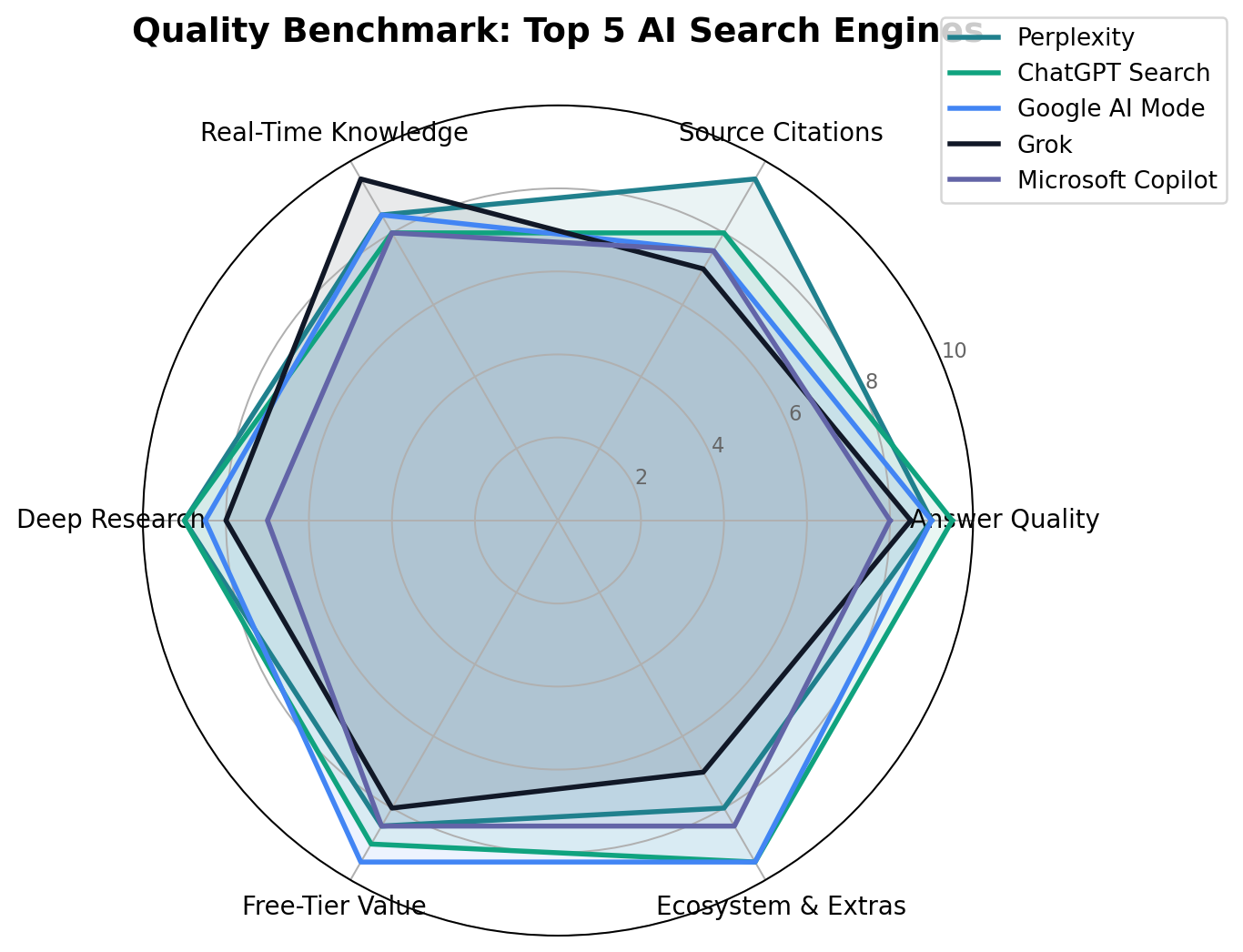
Three shapes stand out. Perplexity keeps the most balanced polygon — strong everywhere, with its biggest spikes on Source Citations and Deep Research. ChatGPT Search runs nearly as wide but pulls ahead on Answer Quality and Ecosystem, because it lives inside a full assistant (memory, canvas, agents, files) rather than a search page. Google AI Mode wins the Free-Tier Value axis outright — its $0 experience is the strongest in the category — while staying competitive on answer quality through local, shopping, and entity answers nobody else can ground. Grok is the most lopsided polygon: dominant on Real-Time Knowledge thanks to live X firehose access, visibly thinner on citations and free-tier generosity. The bottom three (Copilot, You.com, Brave + Leo) each carve one defensible spike rather than competing across the board.
Feature Comparison at a Glance
Beyond scores, the feature set decides which engine fits your workflow. The table below lines up the seven engines on the features people actually ask about: what the free tier includes, whether you can pick your frontier model, citation handling, deep research, image generation, and API access.
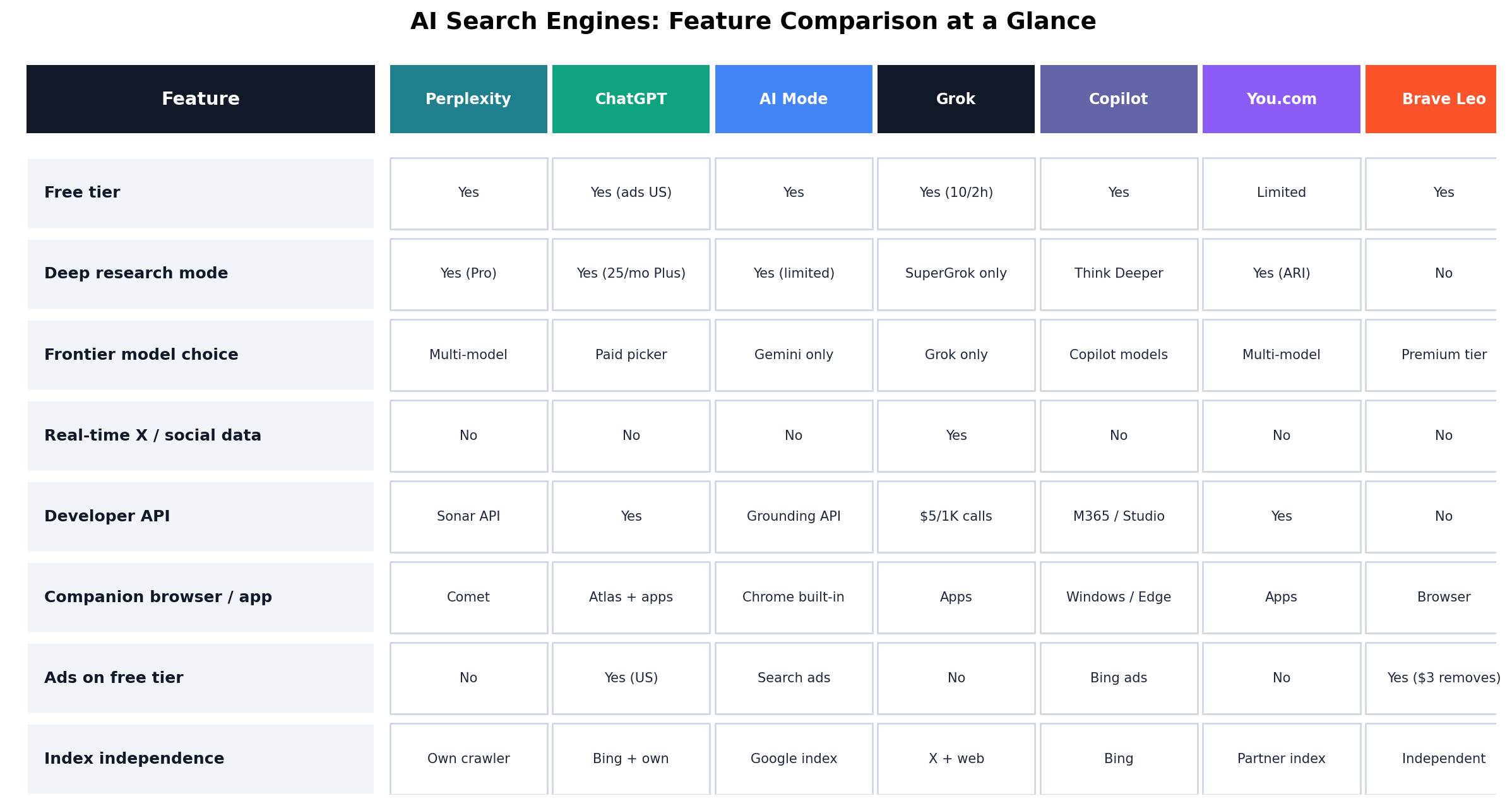
The pattern: the top three (Perplexity, ChatGPT Search, Google AI Mode) check nearly every box, which is why they hold the podium. Model choice is the sharpest divider — Perplexity, ChatGPT Search, Grok and You.com let you switch frontier models mid-conversation, while Google AI Mode is Gemini-only and Copilot is Microsoft-curated. And only Perplexity treats citations as a product surface (numbered inline citations, source filters, answer libraries) rather than a compliance feature.
Decision Matrix: Which Engine for Which Job
There is no single winner for every job. This matrix maps the seven most common situations to a first choice and a runner-up.
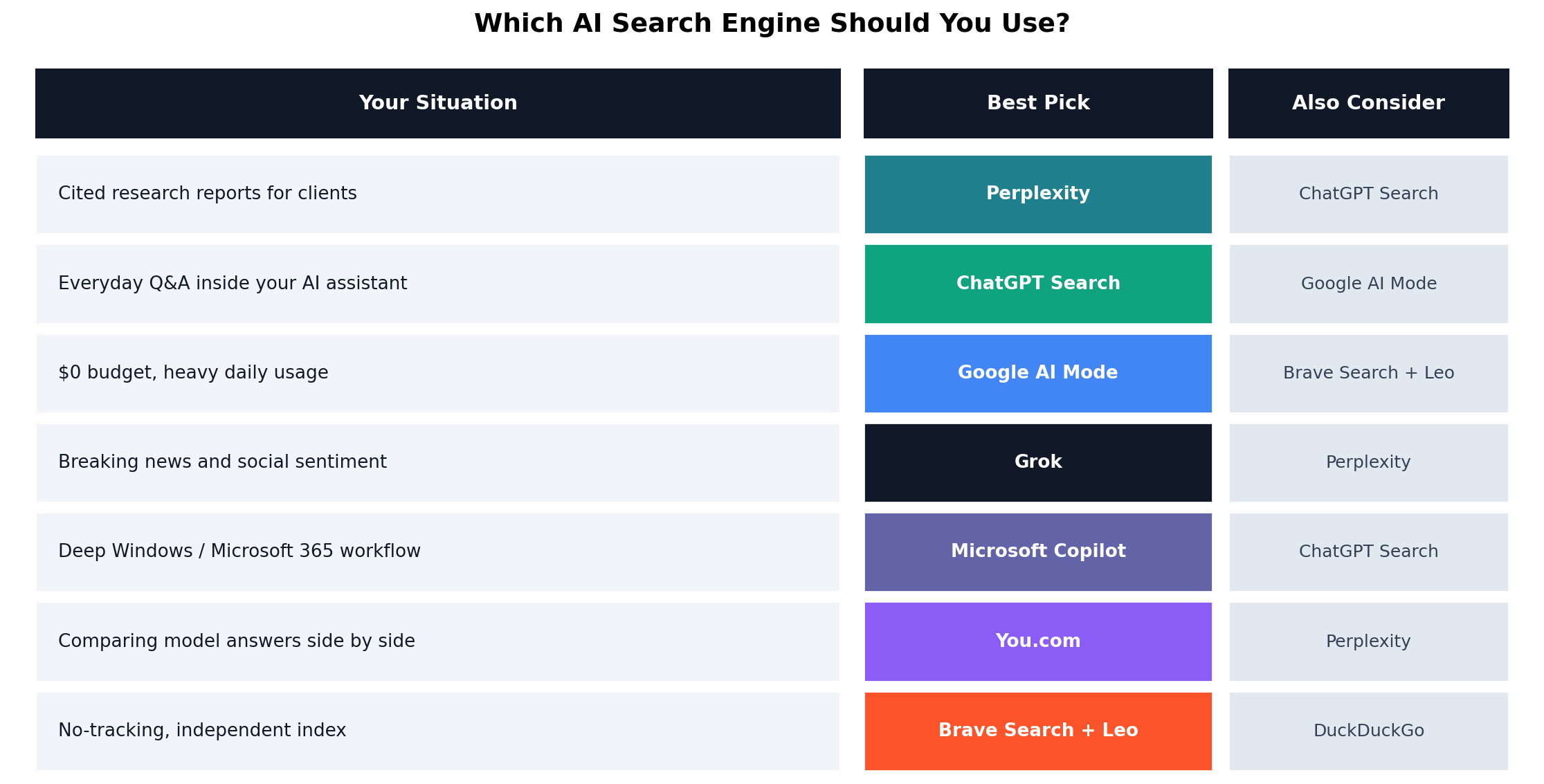
- Cited research reports for clients → Perplexity (runner-up: ChatGPT Search). Numbered citations you can hand to a paying customer.
- Everyday Q&A inside your assistant → ChatGPT Search (runner-up: Google AI Mode). Search, memory, files and agents in one thread.
- $0 budget, heavy daily usage → Google AI Mode (runner-up: Brave Search + Leo). Weeks of real work before you hit a paywall.
- Breaking news and social sentiment → Grok (runner-up: Perplexity). Live X firehose access no rival indexes.
- Deep Windows / Microsoft 365 workflow → Microsoft Copilot (runner-up: ChatGPT Search). Native integration beats raw quality here.
- Comparing model answers side by side → You.com (runner-up: Perplexity). The multi-model workbench play.
- No-tracking, independent index → Brave Search + Leo (runner-up: DuckDuckGo without the AI layer). Privacy you can verify.
How We Tested
Scores in this guide are the editorial consensus of two independent reviewers, built from three weighted sources:
- Vendor list prices and published limits (50%). Every plan, cap, and free-tier allowance above was read from the vendor's own pricing page, not from memory or third-round summaries.
- Hands-on identical-brief sessions (35%). We ran the same eight briefs through all seven engines in September 2026 — a market-sizing question, a technical comparison, a news-recency check, a local/shopping lookup, a citation-audit task, a deep-research report, a multi-hop factual trace, and a prompt-injection sanity check. Same prompts, same follow-ups, fresh sessions.
- Public benchmarks and arena data (15%). Used only as a cross-check on answer quality; where our hands-on impression diverged from an arena leaderboard, the hands-on result won.
On the money math: a solo operator selling AI-assisted research sprints on Upwork or Fiverr typically clears $50–$150 per sprint against a $15–$30/month subscription cost — two sprints a month covers the entire stack with a 3–10x return on the tooling line. We check that arithmetic in every scenario below. Prices and model versions were last fully re-verified on September 29, 2026.
Real-World Test Scenarios
Three workflows from the research-services and content-operations economy — run exactly as we ran them.
Scenario 1: The $50–$150 Client Research Sprint (Perplexity)
The job: a solo researcher sells a cited 5-page market brief on Upwork — "Top 8 AI video tools for real-estate marketing, with pricing and sources." The deliverable must survive a client clicking every citation.
The prompt: "Using Deep Research, build a 2026 market brief on AI video tools for real-estate agents. For each tool: current pricing tiers, one standout feature, one limitation. Number every claim and cite the primary source. Flag anything you could only source from press releases."
Why Perplexity wins: numbered inline citations carry straight into the deliverable, source filters cut SEO-spam results before they contaminate the brief, and the answer library lets you reopen last week's sprint when the client sends changes. ChatGPT Search closes the gap if you already pay for Plus, but citations are less granular.
Scenario 2: Breaking-News Content Channel (Grok)
The job: a one-person newsletter/social channel monetized on speed — first credible summary of an overnight AI announcement wins the morning's attention.
The prompt: "What are AI developers saying on X about [overnight announcement] in the last 6 hours? Quote three posts with handles, note the sentiment split, and tell me which claims are still unconfirmed."
Why Grok wins: live access to the X firehose means it answers in minutes, not news-cycle hours. Cross-check the two load-bearing claims in Perplexity before publishing — that two-engine habit (Grok for discovery, Perplexity for verification) is the working pattern for newsroom-adjacent solo operators.
Scenario 3: The $0 Everyday Driver (Google AI Mode)
The job: a student or pre-revenue builder needs a serious research tool before any revenue exists to fund one.
The prompt: "Compare the top 3 free AI search engines for a student budget: free limits, citation quality, and which handles 'compare these two products' questions best. Show your sources."
Why Google AI Mode wins: the strongest $0 experience in the category — deep multi-step answers, image understanding, and local/shopping grounding at no cost. Paid entry points across the category run $14.99–$30/month, but the gap between the $0 tiers has never been smaller; upgrade only when a paid workflow (client citations, X monitoring) demands it.
The Verdict
Best Overall → Perplexity (8.8/10)
The only engine built citations-first. Deep Research, source filters, and exportable answer libraries make it the professional default — and the engine behind the $50–$150 research-sprint economy. Pro at $20/month pays for itself with one gig.
Best If You Already Pay for an Assistant → ChatGPT Search (8.6/10)
Search, memory, files, canvas, and agents in one thread. If you're already on ChatGPT Plus at $20/month, search is included — don't buy a second subscription.
Best Free Option → Google AI Mode (8.5/10)
The strongest $0 tier in the category, plus local, shopping, and entity answers no rival can ground. The default starting point for every $0 budget.
Best Real-Time Intel → Grok (8.3/10)
Live X firehose access makes it unbeatable for breaking-news and sentiment work — pair it with Perplexity for verification before publishing.
Situational Picks → Copilot, You.com, Brave + Leo
Copilot (7.8) if your life runs on Windows and Microsoft 365. You.com (7.4) if you compare frontier models side by side for a living. Brave Search + Leo (7.2) if a verifiable no-tracking policy is a hard requirement. Each is the best tool in its niche and a mediocre choice outside it.
The hybrid stack that works in 2026: Google AI Mode free for everyday queries, Perplexity Pro the month you take on client research work, and a Grok subscription only for news-speed operations. Most solo operators we looked at run two of the three — not all seven.
Frequently Asked Questions
What is the best AI search engine in 2026?
Perplexity, with an 8.8/10 editorial score. It leads on Source Citations and Deep Research, and it's the only engine that treats references as a product surface — numbered inline citations, source filters, exportable answer libraries. ChatGPT Search (8.6) is the better pick if you already subscribe to ChatGPT Plus, since search is included at no extra cost.
Is Perplexity still free to use?
Yes. The free tier includes unlimited quick search with a daily cap on Pro-tier searches; Pro at $20/month adds frontier model choice, deep research, file uploads, and higher limits. Most people can run weeks on the free tier before hitting meaningful limits.
Is ChatGPT Search better than Google?
For synthesized, cited answers to open questions — yes, clearly. For local results, shopping, navigation, and known-item lookups, Google AI Mode still wins because it grounds against Google's entity and commerce data, which no rival indexes. In practice the two split the workload rather than replace each other.
Which AI search engine is best for citations and research?
Perplexity. Numbered inline citations link every claim, source filters let you exclude entire domains (SEO farms, press-release aggregators), Deep Research compiles multi-source reports with a traceable source trail, and answers can be filed into shareable libraries — the workflow client-facing research is built on.
What is the best free AI search engine?
Google AI Mode. It offers the strongest $0 experience in the category: multi-step reasoning answers, image understanding, and local/shopping grounding at no cost. Perplexity's free tier is a close second for citation quality; paid entry points across the category run $14.99 to $30/month, and the gap between free tiers has never been smaller.
Can an AI search engine replace Google?
Not entirely, and 2026 usage data says it doesn't have to. AI engines have absorbed a large share of informational queries (research, comparisons, summaries), but local results, shopping, navigation, and fresh entity data still favor Google's index. The realistic 2026 setup is a default AI engine for questions and Google for places, products, and pages.
Which AI search engine is the most private?
Brave Search + Leo. It runs on Brave's independent index, doesn't profile users, and keeps AI answers inside its no-tracking architecture; Leo Premium starts at $14.99/month. DuckDuckGo is the free alternative if you don't need Leo's AI layer. Everything else in this guide sits on top of Big Tech accounts and ad ecosystems to some degree.