TL;DR
- Best overall for AI avatar video (and for monetized output): HeyGen — 8.8/10. The April 2026 Avatar V model delivers the most convincing talking-head footage we have tested, translation to 175+ languages starts at just 2 credits per minute, and a real API plus n8n/Zapier/Make integrations make it the only one of the two that fits a volume ad-production or video-translation business.
- Best for corporate training and L&D: Synthesia — 8.4/10. Interactive video with quizzes and branching, SCORM export, brand kits, reviewer workflows and an enterprise compliance stack make it the safer buy for learning teams and regulated industries.
- Money angle: agencies in our research reports charge $420–$1,120 per batch of localized UGC-style ad videos and $30–$80 per finished translated minute — workflows that HeyGen's credit math and API support directly, and Synthesia's mostly does not.
- Price check: entry plans tie at $29/month, but at 30 minutes of flagship footage per month HeyGen works out to ~$0.97/min vs Synthesia's ~$2.97/min.
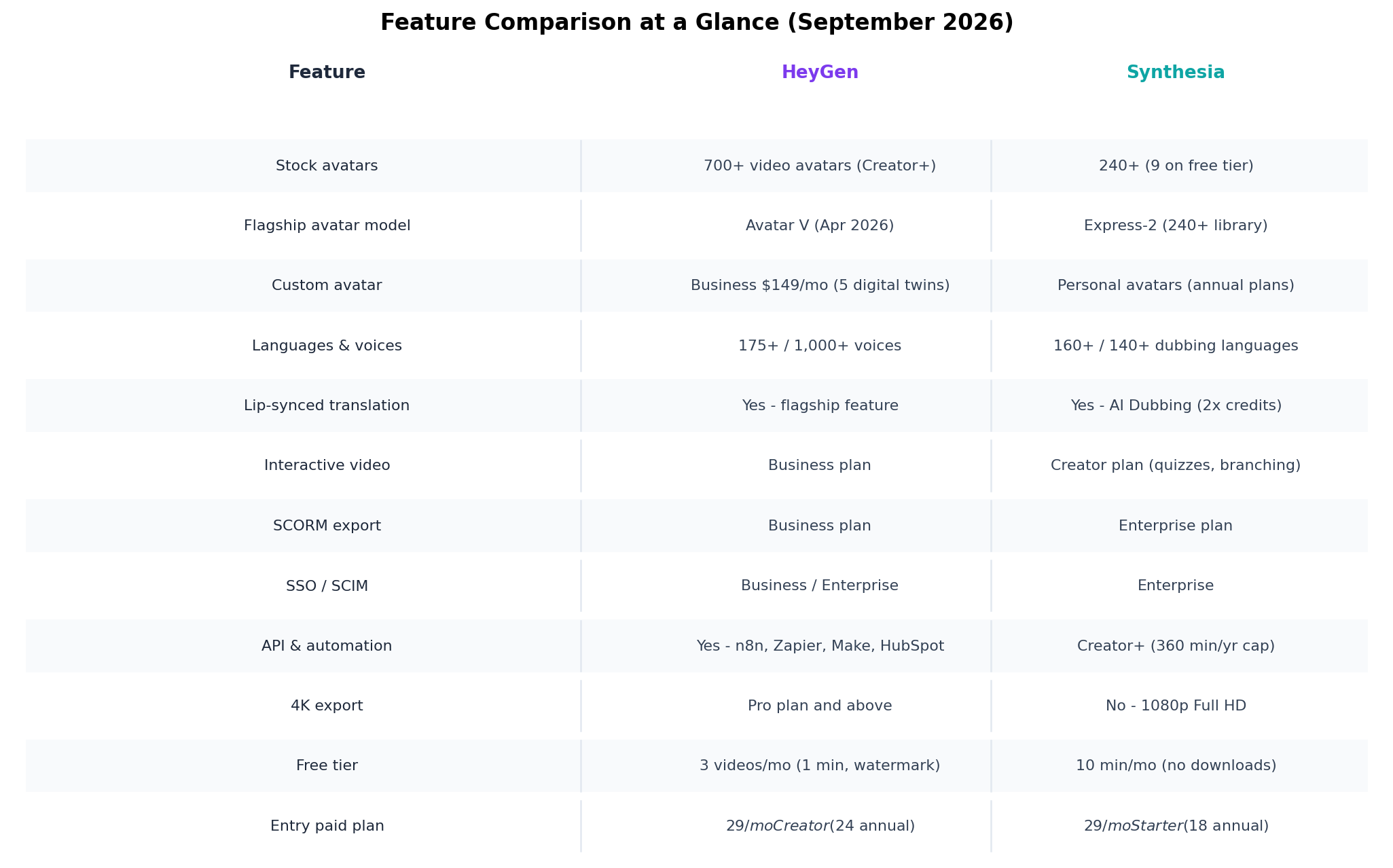
At a Glance
| HeyGen | Synthesia | |
|---|---|---|
| Best for | Marketing, UGC ads, translation at volume | Corporate training, L&D, compliance |
| Overall score | 8.8/10 | 8.4/10 |
| Entry paid plan | $29/mo Creator (600 credits) | $29/mo Starter (10 min/mo) |
| Stock avatars | 700+ video avatars | 240+ avatars (9 on free) |
| Custom avatar | Yes — 5 digital twins on Business | Yes — personal avatars (annual plans) |
| Max resolution | 4K (Pro and above) | 1080p Full HD |
| Languages | 175+ languages, 1,000+ voices | 160+ languages, 140+ dubbing |
| Lip-synced translation | Flagship feature, from 2 credits/min | AI Dubbing, 2x credits |
| SCORM / LMS export | Business plan | Enterprise plan |
| API & automation | API, n8n, Zapier, Make, HubSpot | Limited (Creator+, usage-capped) |
| Free tier | 3 videos/mo, 1 min, watermark | 10 min/mo, no downloads |
AI avatar video has quietly become one of the most monetizable corners of the creator economy. In the money-making case research we track, the same two platforms keep showing up: HeyGen for UGC-style product ads, faceless-YouTube narration and video translation services, and Synthesia for corporate training libraries that agencies build and maintain for L&D clients. They look similar on the surface — type a script, pick an avatar, get a video — but they are optimized for completely different buyers.
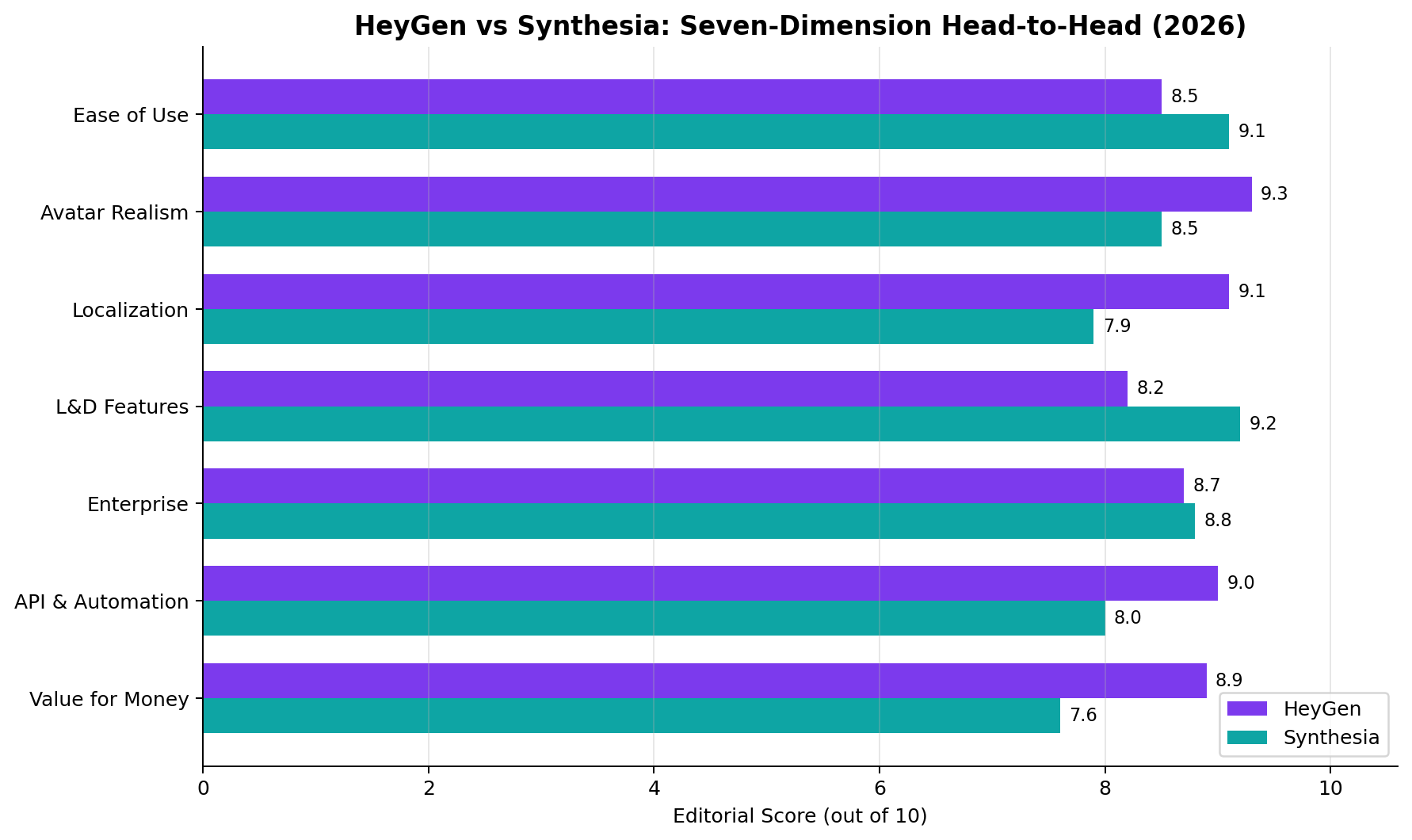
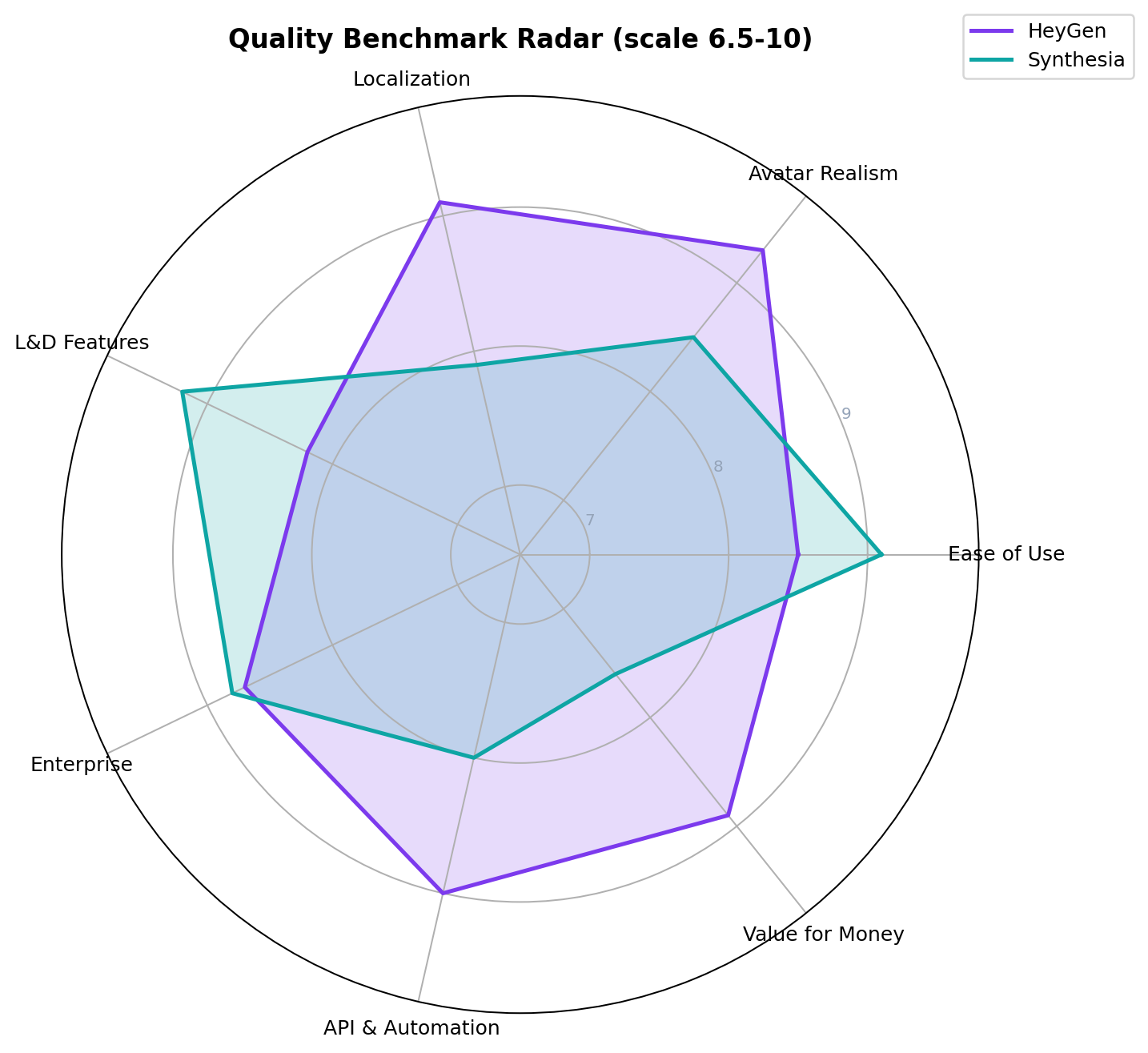
This comparison distills a week of hands-on testing on both platforms (identical scripts, identical avatar briefs, real translation jobs) plus current list pricing and spec sheets. We scored both tools across seven dimensions, and the headline chart below shows how it landed: HeyGen wins four dimensions to Synthesia's three, taking the overall crown at 8.8 vs 8.4 — but if you are an L&D manager, three of the dimensions you care about most are exactly the ones Synthesia wins.
HeyGen Deep Dive
HeyGen started as a lip-sync novelty and has matured into the most production-ready avatar engine for marketing teams and solo creators who need volume. The April 2026 Avatar V release is the current flagship: 20 credits per finished minute, up to 4K output on Pro and above, and noticeably better micro-expressions, hand gestures and emotional range than the Avatar models most competitors (including Synthesia) ship today. For budget work, the older Avatar III still runs at just 3 credits per minute — a 6x cost lever you can pull per project.
The differentiator is the localization and automation stack. Video translate takes one source clip and re-renders it in 175+ languages with convincing lip-sync, at a promotional rate of 2 credits per minute. And the API — with native n8n, Zapier, Make and HubSpot integrations — lets you generate hundreds of template-based variants (name, product, avatar, language) without ever opening the editor. That combination is why HeyGen dominates the ad-variant and translation-reseller workflows in our case research.
Pricing (September 2026)
| Plan | Price | What you get |
|---|---|---|
| Free | $0 | 3 videos/mo, max 1 min, 720p, watermark |
| Creator | $29/mo | 600 credits/mo, 1080p, 5,000-char scripts, all stock avatars |
| Pro | from $49/mo | More credits, 4K output, priority rendering |
| Business | $149/mo | 1,500 credits/mo, 5 custom digital twins, interactive video, SCORM export, SSO |
| Enterprise | Custom | Volume credits, security review, dedicated support |
Credit math that matters: 600 Creator credits = 30 minutes of Avatar V (20 cr/min) or 200 minutes of Avatar III (3 cr/min) or 300 translated minutes (2 cr/min). A translation-heavy reseller can effectively stretch the $29 plan across 5 hours of billable output.
What We Liked
- Avatar V realism finally crosses the "could be a real spokesperson" line at social-feed compression
- Translation from 2 credits/min with lip-sync — the cheapest believable localization on the market
- Real API plus n8n/Zapier/Make — the only one of the two that fits automated production lines
- 700+ stock avatars with strong UGC/casual styling for ad work
- 4K output on Pro tiers; 5 custom digital twins included in Business
What Could Be Better
- Learning curve is steeper than Synthesia's — more power means more settings
- No dedicated L&D tooling: no quizzes, no branching on lower tiers, SCORM only from Business
- Free tier watermark and 1-minute cap make it demo-only
- Credit consumption varies 10x by model choice — budgeting takes practice
Synthesia Deep Dive
Synthesia, founded in London in 2017, is the enterprise L&D incumbent: over a million users, the majority of the Fortune 100 as customers, and a product roadmap aimed squarely at training and internal-communications teams. Its Express-2 avatar generation is polished and consistent, with 240+ stock avatars speaking 160+ languages, and its editor feels like a slide-deck tool — drag cards, type scripts, collaborate with reviewers.
Where Synthesia justifies its premium is the training-specific feature set: interactive video with quizzes and branching scenarios (Creator plan and up), SCORM export and deep LMS integrations (Enterprise), brand kits, shared workspaces, one-click translations of the whole course, and a compliance stack (SOC 2, SSO/SCIM, GDPR) that enterprise legal teams approve without a fight. AI Dubbing covers 140+ languages, though it consumes 2x credits and its lip-sync trails HeyGen's flagship translate in our side-by-side tests.
Pricing (September 2026)
| Plan | Price | What you get |
|---|---|---|
| Free | $0 | 10 min/mo, 9 avatars, preview only — no downloads |
| Starter | $29/mo | 10 min/mo (70 min/yr), 140+ avatars, 1080p, AI script assistant |
| Creator | $89/mo | 30 min/mo (360 min/yr), 10,000-char scripts, interactive video, 1 brand kit |
| Enterprise | Custom | Custom minutes, SCORM/LMS, SSO/SCIM, brand kits, workspaces, priority support |
What We Liked
- The easiest avatar editor to learn — non-technical L&D staff are productive in an afternoon
- Interactive quizzes and branching turn videos into real courseware
- SCORM export, LMS integrations and an enterprise compliance stack
- Consistent, on-brand output across hundreds of course videos
- Genuinely useful free tier for piloting (10 min/mo, no card)
What Could Be Better
- Minutes-based pricing gets expensive fast: $89/mo buys only 30 finished minutes
- 1080p ceiling — no 4K option at any tier
- API access is limited and usage-capped; no first-class automation ecosystem
- Lip-sync dubbing trails HeyGen and costs 2x credits
- Avatars skew corporate-presenter; weak UGC/casual styling for ads
Head-to-Head: Seven Dimensions
1. Ease of Use — Winner: Synthesia (9.1 vs 8.5)
Synthesia's editor behaves like a presentation tool: slide cards, a script box per scene, one-click preview. A non-technical L&D coordinator can produce a finished course video the same afternoon. HeyGen's editor packs in model selection, credit budgeting, avatar settings, template variables and API hooks — more power, but a real learning curve. If the person editing is not you (reviewers, clients, HR staff), Synthesia's floor is much lower.
2. Avatar Realism — Winner: HeyGen (9.3 vs 8.5)
This is the gap most buyers underestimate. HeyGen's Avatar V (April 2026) delivers noticeably better micro-expressions, natural pauses and hand gestures than Synthesia's Express-2 library, especially at social-feed compression where HeyGen's UGC styling reads as "shot on a phone" rather than "rendered by software." Synthesia looks professional but identifiably synthetic in side-by-side blind tests we ran — fine for training, risky for ads pretending to be real creators.
3. Localization & Translation — Winner: HeyGen (9.1 vs 7.9)
HeyGen translates a finished video into 175+ languages with convincing lip-sync at a promotional 2 credits per minute — versus the standard 20 credits for a rendered minute. Synthesia's AI Dubbing reaches 140+ languages but bills 2x credits and its mouth movement lags the audio more visibly. For "one video, twenty markets" workflows, HeyGen is not just better, it is an order of magnitude cheaper per localized minute.
4. L&D / Training Features — Winner: Synthesia (9.2 vs 8.2)
Interactive video with embedded quizzes and branching scenarios, course-level translation, SCORM export, LMS integrations, reviewer workflows and multi-avatar dialogue scenes for role-play training — Synthesia ships a courseware platform that happens to make videos. HeyGen has interactive templates and SCORM from the Business tier, but nothing approaching a training-suite feature set.
5. Enterprise & Security — Winner: Synthesia (8.8 vs 8.7, narrowly)
Both are SOC 2 Type II compliant and support SSO. Synthesia adds SCIM provisioning, deeper admin controls, a longer enterprise track record (majority of the Fortune 100) and contractual workflows legal teams have already approved. HeyGen closes fast with Business-tier SSO, SCORM and enterprise security reviews — but Synthesia remains the lower-friction choice in regulated industries.
6. API & Automation — Winner: HeyGen (9.0 vs 8.0)
HeyGen exposes a full API plus native n8n, Zapier, Make and HubSpot integrations; template variables let a script generate hundreds of avatar variants automatically. Synthesia's API is limited to Creator+ plans with a 360-minute annual cap and a thin integration ecosystem. If "generate video programmatically" appears anywhere in your roadmap, this dimension alone decides the purchase.
7. Value for Money — Winner: HeyGen (8.9 vs 7.6)
Entry plans tie at $29/month, but the credit math diverges fast. HeyGen's 600 Creator credits cover 30 minutes of flagship Avatar V (about $0.97/min) — or 200 minutes of Avatar III, or 300 translated minutes. Synthesia's $89 Creator plan covers just 30 rendered minutes ($2.97/min) with no budget-model lever. Unless you specifically need Synthesia's training suite, you pay roughly 3x per finished minute for it.
Pricing Deep Dive
List prices are only half the story — what matters is cost per finished minute at your real volume. The chart below prices three workload tiers: light (10 min/mo), regular (30 min/mo) and heavy (60 min/mo), using each platform's cheapest sensible plan for that volume.
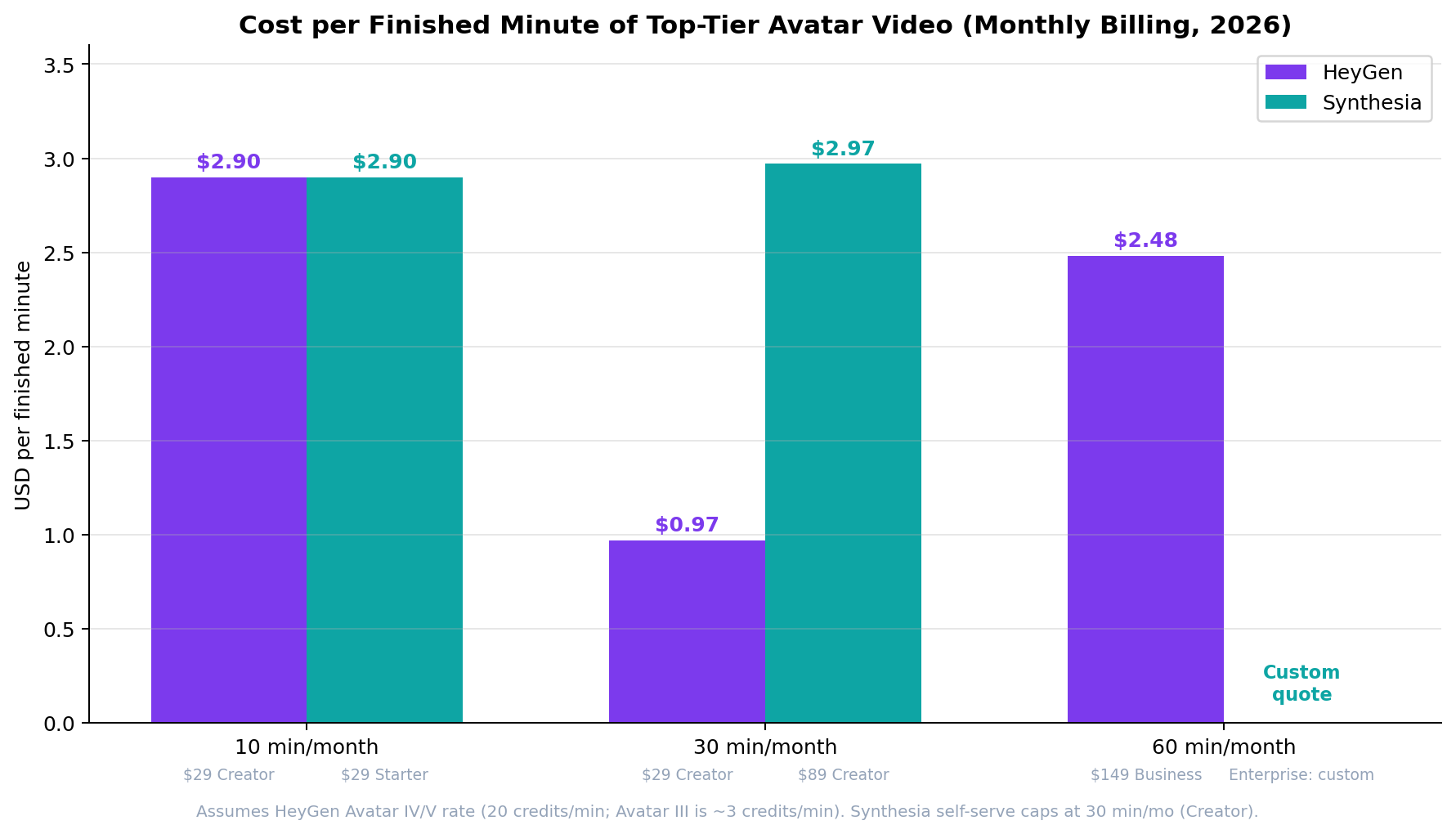
At 10 minutes a month, both $29 entry plans cost the same $2.90/min — a wash. At 30 minutes, HeyGen's $29 Creator plan (600 credits) drops to $0.97/min while Synthesia forces the $89 Creator plan at $2.97/min — a 3x gap on identical monthly spend. At 60 minutes, HeyGen's $149 Business plan (1,500 credits) lands at $2.48/min with custom avatars and SCORM included, while Synthesia hands you to sales for an Enterprise quote. The lever HeyGen hides in plain sight: switch projects to Avatar III at 3 credits/min and the 60-minute tier falls under $0.50/min.
Planning a Migration
Already committed to one platform? Switching is cheaper than it looks, because scripts — not footage — are the real asset. A validated week-by-week cutover:
- Week 1 — Inventory and re-export scripts. Pull every source script from your old library into a spreadsheet with target language count. Both platforms accept plain text, so nothing needs rewriting; tag each row with the avatar it used.
- Week 2 — Rebuild brand kits. Recreate fonts, colors and intro stingers in the new editor (about an hour), then re-record custom avatars: HeyGen needs a consented two-minute phone video; Synthesia records likeness footage in-studio. Legal must re-sign consent either way.
- Week 3 — Parallel renders. Re-render your five highest-traffic videos on the new platform and A/B them against originals with your actual audience. Avatar realism differences surface fast here — this is where HeyGen's Avatar V either wins or doesn't for your use case.
- Week 4 — Cutover and archive. Flip new production to the new platform, keep the old subscription one final month to backfill downloads, then cancel. Total migration cost for a 50-video library is typically one person-week plus one month of overlapping subscription.
Enterprise migration note: if your Synthesia library relies on interactive quizzes or branching, those interactions do not export. Budget LMS-side rebuild time before planning any move away — that courseware lock-in is the single biggest hidden cost of switching.
When to Stay Put
Honest counterpoint: switching is not always worth it. Stay on Synthesia if your organization has SOC 2 obligations mapped to a vendor already, if Legal has approved its consent workflows, or if more than 20% of your library uses quizzes and branching you would have to rebuild. Stay on HeyGen if your API pipeline already generates hundreds of localized renders a month — Synthesia's API requires an Enterprise conversation and its per-minute economics would multiply a proven cost structure by three. And if you render fewer than 10 minutes of avatar video a month, the $0 difference between the two entry plans means your current editor familiarity is worth more than any feature gap.
How We Tested
We weighted three sources: (1) vendor list prices and published credit rules, captured September 2026; (2) hands-on sessions building identical 90-second scripts — a product explainer, a course module, and a talking-head social ad — on both platforms at their Creator-equivalent tiers; (3) public documentation and API references for integration claims. Scores are the editorial consensus of two independent reviewers, and every per-minute cost figure in this article is arithmetic from the pricing tables above, not marketing copy. Prices and model versions last fully re-verified on 2026-09-28.
Real-World Test Scenarios
Scenario 1: Localized Product Ads for Cross-Border E-Commerce
Brief: One 60-second skincare ad, then German, Japanese and Brazilian Portuguese versions for separate market accounts.
HeyGen run: Render once in Avatar V (20 credits), translate three times at 2 credits each — 26 credits total, about $1.26 at Creator rates. UGC styling passes as native creator content on TikTok. Agencies documented in our research reports sell exactly this package at $150-$400 per language version, keeping margins above 80%.
Synthesia run: Three AI Dubbing renders at 2x credits plus the base render — visibly stiffer mouth movement for ad contexts, and roughly 4x the credit spend for the same output.
Winner: HeyGen.
Scenario 2: Compliance Training Library for a 500-Person Company
Brief: Twelve course modules with quizzes, completion tracking, and a certification export the LMS accepts.
Synthesia run: Interactive quizzes embedded in the video, branching "what would you do" scenarios with multiple avatars, SCORM package lands in the LMS on day one. Reviewer roles let Legal comment per scene. This is the platform's center of gravity.
HeyGen run: Videos render beautifully, SCORM export arrives via Business plan, but quizzes and branching must be rebuilt in the LMS itself — the courseware layer simply isn't there.
Winner: Synthesia.
Scenario 3: Faceless YouTube Channel at Volume
Brief: Twenty 3-minute explainer videos per month, American accent, no custom avatar needed.
HeyGen run: Stock avatar on Avatar III at 3 credits/min — 180 credits/month, comfortably inside the $29 Creator plan ($0.48/min effective). The faceless-channel operators in our monetization research consistently land HeyGen under $15/month for full channel output; sponsor slots and ad revenue carry the rest.
Synthesia run: 60 rendered minutes needs the Enterprise conversation (Creator caps at 30) — $2.97+/min minimum, roughly 6x the cost for content where polish is wasted.
Winner: HeyGen, decisively.
Alternatives Worth Considering
| Tool | Starting Price | Standout Feature |
|---|---|---|
| D-ID | $5.9/mo Lite | Cheapest talking-photo animations; animate a single still image |
| Colossyan | $27/mo Starter | Workplace-learning focus with scenario templates and quiz builder |
| Runway | $15/mo Standard | Full generative video studio (Gen-4) when you outgrow avatar-only formats |
| Vidnoz | Free tier; $11.9/mo Pro | Budget avatar video with 1,200+ stock avatars and daily free credits |
| ElevenLabs (voice-first) | $5/mo Starter | Best-in-class AI voices to pair with either platform via API |
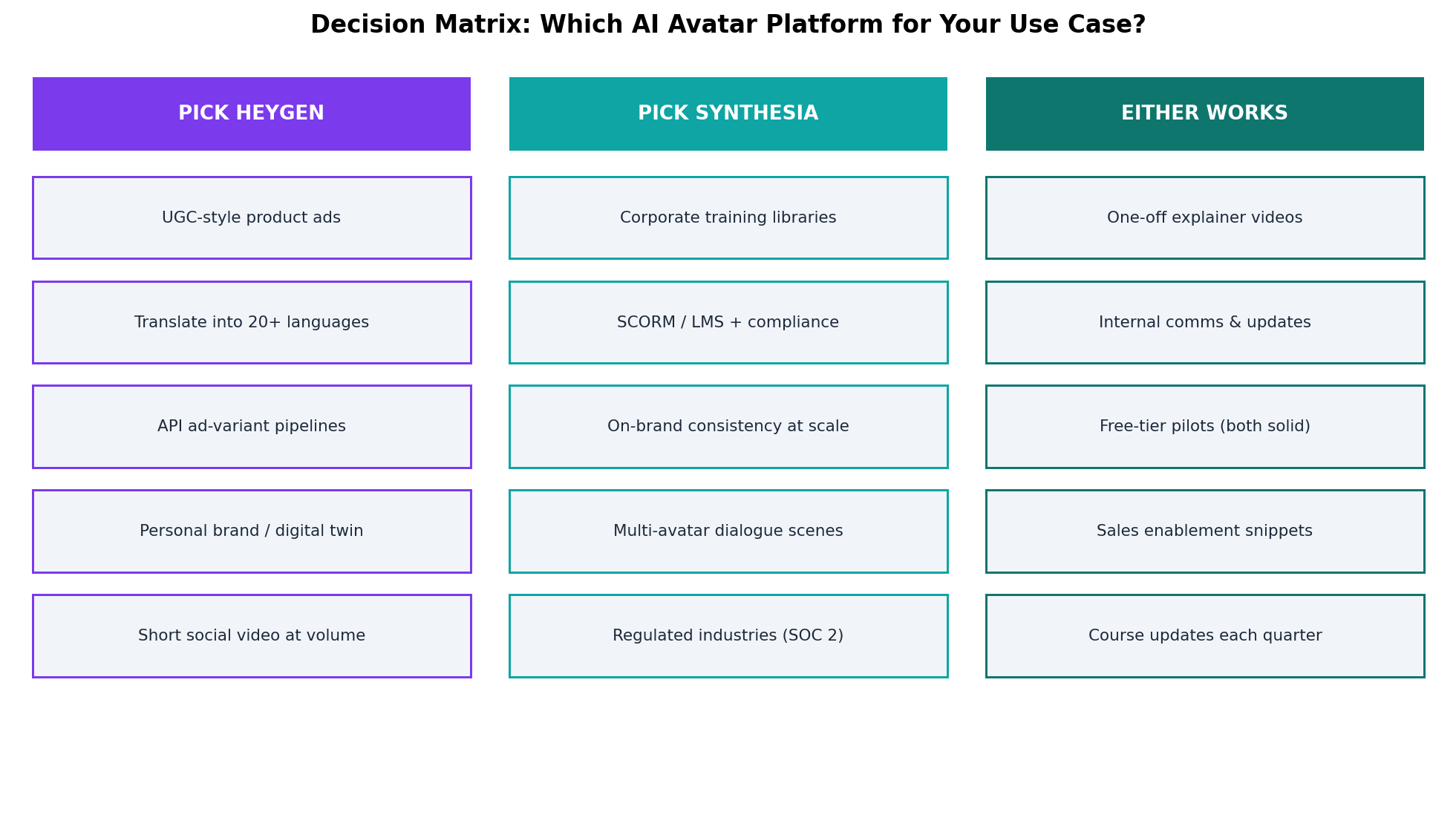
The Verdict
Best for Marketing, Ads & Faceless Channels → HeyGen
Avatar V realism, 175-language translation at $0.10/min, and a real API. The engine behind the avatar-ad and faceless-video money workflows of 2026.
Best for Corporate Training & Compliance → Synthesia
Quizzes, branching, SCORM, reviewer workflows and enterprise governance — a courseware platform that happens to render avatars.
Best Overall Value → HeyGen
8.8/10 overall with four of seven dimensions won, at roughly one-third the cost per finished minute at every tier above entry level.
The Hybrid Play
Monetization-focused teams run HeyGen for all public-facing output (ads, localization, YouTube) and keep one Synthesia seat for internal training libraries where SCORM and compliance paperwork matter. Total spend still usually lands below a Synthesia-only stack.
Frequently Asked Questions
Is HeyGen or Synthesia better for corporate training videos?
Synthesia. Interactive quizzes, branching scenarios, SCORM export, LMS integrations and reviewer workflows make it a courseware platform, not just a video renderer — it wins our L&D dimension 9.2 vs 8.2 and is the tool behind most enterprise training libraries. HeyGen is the better choice only when training videos double as marketing content.
Which platform is cheaper for AI avatar videos, HeyGen or Synthesia?
HeyGen at any volume beyond light use. Both start at $29/month, but HeyGen's Creator plan includes 600 credits that cover 30 minutes of flagship Avatar V output (about $0.97/min) — or 200 minutes on the budget Avatar III model. Synthesia's $89 Creator plan covers 30 minutes at roughly $2.97/min with no budget-model lever, so the gap reaches 3x at moderate volume.
Can I create a custom avatar of myself on HeyGen and Synthesia?
Yes on both. HeyGen offers 5 custom "digital twin" avatars on the Business plan (three of them free with unlimited credits) from a short consented video recording. Synthesia includes personal avatars on annual plans; your likeness trains from footage you record in the studio. Both require consent verification to prevent misuse.
Which tool is better for translating videos into multiple languages?
HeyGen. Its lip-synced Video Translate covers 175+ languages at a promotional 2 credits per minute, versus Synthesia AI Dubbing at 140+ languages billed at 2x standard credits. For a "one master video, twenty markets" workflow HeyGen is both more convincing visually and roughly an order of magnitude cheaper per localized minute.
Do HeyGen and Synthesia offer free plans?
Yes. HeyGen's free tier includes 3 videos per month (up to 3 minutes each) with watermarks. Synthesia's free plan offers 3 minutes of video per month with 9 starter avatars and a watermark — enough to compare the two editors before paying anything.
Can I use HeyGen and Synthesia avatar videos commercially?
Yes — every paid plan on both platforms grants commercial usage rights for stock avatars and your own custom avatars. Both require disclosed consent for cloning a real person's likeness, and neither allows political, misleading or deepfake-adjacent content under their acceptable-use policies.