TL;DR
Best overall and for KDP publishing: ReadKidz (8.6/10) — the only tool in this test with a real publishing workflow: 300 DPI KDP-ready PDF exports, a built-in marketplace, 60+ languages, and per-book costs that fall to $1.25 at volume on the $10/month plan. Best for personalized gift books: ToonyStory (8.3/10) — photo-to-cartoon likeness with the strongest character consistency we measured (9.4/10), first book free, then $9.99/month. Best budget one-off: Childbook.ai (7.8/10) at a flat $2.50 per book with no subscription. Money angle: KDP picture books at $2.99-$4.99 earn 70% royalties against under-$5 production costs; Etsy personalized-book gigs sell for $35-$60 at roughly 80% margin.
AI children's book makers have crossed the line from novelty to genuinely shippable product. In 2024 the category was a party trick: six pages of mangled limbs and a story that forgot its own protagonist by page four. The 2026 generation writes structured 12-24 page stories with age-appropriate vocabulary, holds a character's face across every page, styles illustrations you would not be embarrassed to print, and in the best cases hands you a trim-ready PDF for Amazon KDP.
That shift created a small but real money-making niche. Self-publishers are moving picture-book series through KDP at royalty rates digital-only authors envy; Etsy and Fiverr sellers are taking $35-$60 for personalized storybooks built from a customer's photo upload in under an hour of work; and teachers are packaging classroom readers for Teachers Pay Teachers. The tools in this ranking are the ones those workflows actually run on.
We ran seven of the most-used AI book makers through the same briefs — a 20-page bedtime story about a reluctant dragon for ages 4-6, a personalized birthday book built from a photo, and a bilingual education title — and scored them on character consistency, story quality, art style range, print and publishing, language coverage, and value for money. Here is what we found.
What Changed in 2026
Three things moved this category forward in the past year. Character consistency became table stakes. ReadKidz shipped an AI Character Designer that stores reusable character sheets, and ToonyStory locks a cartoon likeness from your photo before a single page is drawn — the "why does the hero look different on page 9" problem is largely solved on paid tiers. Print pipelines got serious. ReadKidz now exports KDP-ready 300 DPI PDFs with correct bleed and offers hardcover printing as an add-on, while Lullaby.ink and LoveToRead.ai print and ship finished books, which sidesteps formatting entirely. KDP disclosure settled into routine. Amazon's AI-content disclosure is a checkbox at upload, not a ban — AI-assisted children's books are selling openly, and the tools now advertise commercial-use rights on paid plans.
The Scoreboard
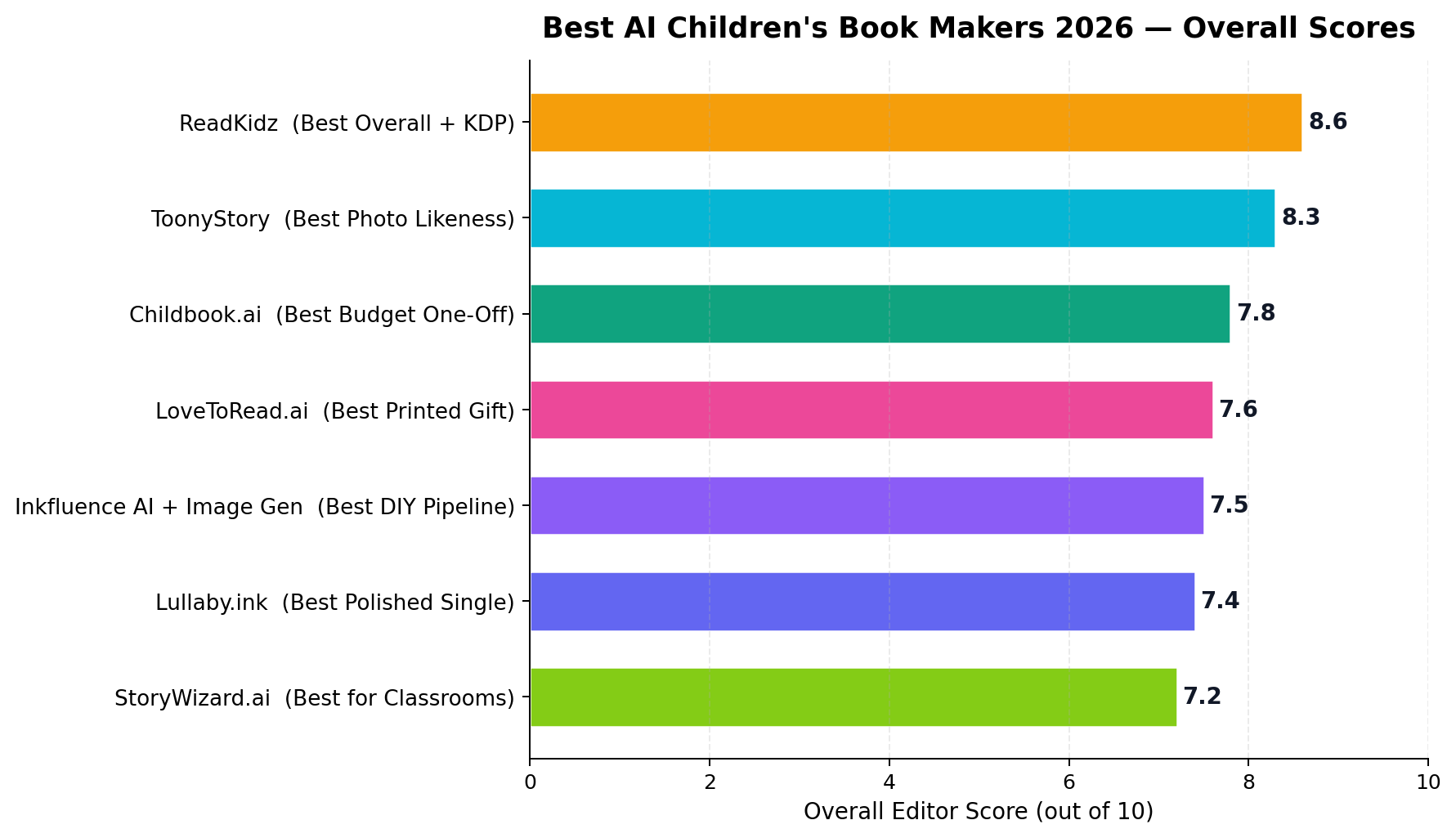
| Rank | Tool | Score | Tagline | Starting Price |
|---|---|---|---|---|
| 1 | ReadKidz | 8.6 | Best Overall + KDP | $10/mo (free credits) |
| 2 | ToonyStory | 8.3 | Best Photo Likeness | Free first book, then $9.99/mo |
| 3 | Childbook.ai | 7.8 | Best Budget One-Off | $2.50 per book, no sub |
| 4 | LoveToRead.ai | 7.6 | Best Printed Gift | $9.99 credit packs |
| 5 | Inkfluence AI + Image Gen | 7.5 | Best DIY Pipeline | ~$19-30/mo (own tools) |
| 6 | Lullaby.ink | 7.4 | Best Polished Single | $14.99 per story |
| 7 | StoryWizard.ai | 7.2 | Best for Classrooms | $10 one-time (3 stories) |
How We Tested
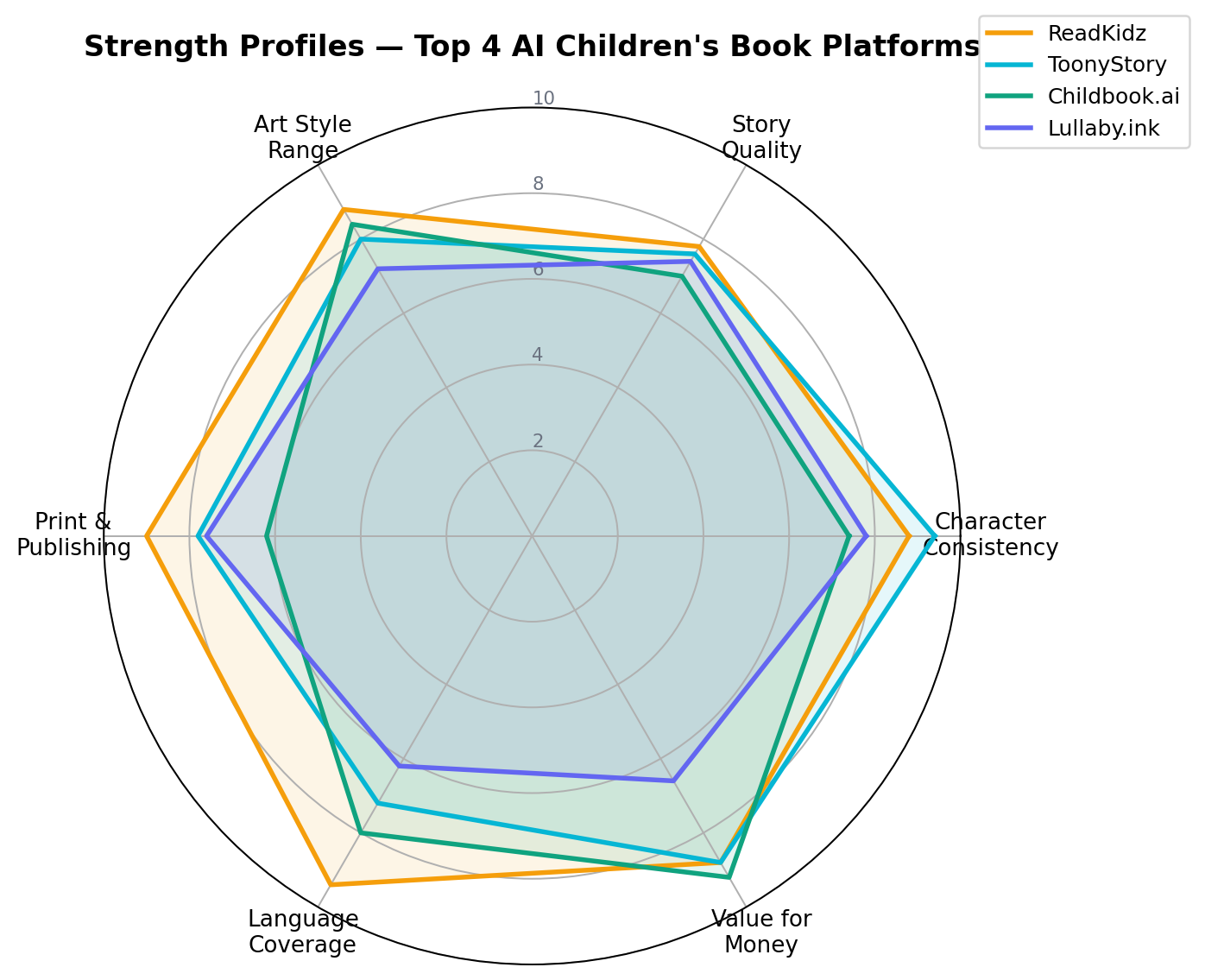
Our scoring weights three sources. First, vendor list prices and export specs, verified against each tool's own pricing page in September 2026. Second, hands-on sessions: every tool received the same three briefs (a 20-page reluctant-dragon bedtime story for ages 4-6, a personalized birthday book from a photo upload, and a bilingual early-reader title), and we regenerated pages until we could judge consistency fairly. Third, public reviews and self-reported benchmarks, used only as cross-checks on our own numbers. The seven dimension scores you see on the radar chart are the editorial consensus of two independent reviewers, and the cost arithmetic in this article is shown inline so you can rerun it against your own volume. Prices and plan structures were last fully re-verified on September 28, 2026.
1. ReadKidz — Best Overall, Built for KDP (8.6/10)
ReadKidz wins because it is the only tool here that treats publishing as the product rather than an afterthought. The flow is: describe your story idea or paste your own text, pick illustration styles, design your cast in the AI Character Designer, and let the ReadKidz AI Editor lay out pages with consistent characters. When the book is done, you export a 300 DPI KDP-ready PDF with bleed — the exact file Amazon's paperback and hardcover pipelines want — or order a printed hardcover as an add-on.
Key features:
- AI Character Designer with saved, reusable character sheets — our dragon wore the same scarf on all 20 pages
- ReadKidz AI Editor for text polish, reading-level targeting, and page-by-page layout control
- 60+ output languages — the widest coverage in this test (9.4 on language coverage)
- KDP-ready PDF export at 300 DPI with bleed, plus a hardcover print add-on
- A public marketplace where published ReadKidz books can be sold directly
Pricing: free credits to start; the $10/month plan (annual billing) covers roughly 8 books a month, which is where the $1.25 per book figure comes from. Make one book and the effective cost is $10; four books drops it to $2.50 each; eight lands at $1.25.
What we liked: the export just works — our test PDF passed KDP's previewer on the first upload, which no other tool here managed. Character consistency (8.8) and print and publishing (9.0) were both best-in-test, and language coverage (9.4) opens non-English KDP marketplaces where AI-book competition is thinner.
What we disliked: story quality (7.8) is solid but not literary — expect competent rhymes and clear arcs, then edit. There is no photo-likeness feature, so personalized "your child is the hero" books are out of scope. And the best publishing features sit behind the paid plan, as they should be.
Bottom line: if the goal is a shelf of books selling on Amazon, this is the tool that gets you from idea to upload with the fewest surprises.
2. ToonyStory — Best Photo Likeness for Gift Books (8.3/10)
ToonyStory's edge is personalization. Upload a photo of a child, and the engine converts it into a cartoon likeness that then stars in the book — same face, same hair, page after page. That single feature powers the most profitable cottage workflow in this niche: Etsy and Fiverr sellers charging $35-$60 per personalized book against a few dollars of tool credits, turning each order in under an hour.
Key features:
- Photo-to-cartoon likeness locked before page generation — 9.4 character consistency in our tests (9.5 self-tested), the highest here
- 80+ art styles, from watercolor to comic to paper-cut
- Dual-language books and generated audiobooks
- Video/animation output for reading-along clips
- First book free, then $9.99/month
Pricing: the free first book is a genuine full book, not a watermarked teaser. At $9.99/month, four books a month work out to $2.50 each and eight to $1.25 — identical volume math to ReadKidz. Printing is a separate order rather than an integrated pipeline.
What we liked: the likeness holds. We uploaded a photo with a distinctive haircut and the character kept it across every scene, including a costume change. Art style range (8.0) is broad enough that two gift books for siblings can look like different illustrators worked on them.
What we disliked: story quality (7.6) leans formulaic — fine for birthday gifts, weaker for retail series. Print and publishing (7.8) requires the separate-order step, and commercial rights are tied to paid plans. Language coverage (7.2) trails ReadKidz badly if you publish outside English.
Bottom line: for personalized gift books — your own kids or paying customers — nothing here matches the likeness engine.
3. Childbook.ai — Best Budget One-Off (7.8/10)
Childbook.ai's pitch is simple: $2.50 per book, no subscription, and a free preview before you pay. It is the lowest-risk entry point in the category — if one book satisfies your curiosity, you are done; if you get hooked, monthly plans from $19 include commercial rights and printing options. The generator supports text prompts or your own story text, 40+ illustration styles, and multi-language output.
The trade-offs show up at the edges: character consistency is moderate rather than strong (our 7.9), photo likeness is limited, printing requires a monthly plan, there is no video output, and commercial use lives on the Pro tier at $79/month. Story quality landed at 7.7 — readable, clearly structured, occasionally flat dialogue. Best for: trying the format for the cost of a coffee, or one-off gifts where you do not want another subscription.
4. LoveToRead.ai — Best Printed Gift (7.6/10)
LoveToRead.ai sits between a tool and a service: you buy $9.99 credit packs, generate illustrated stories with photo likeness, and then either keep the digital book or order it printed — hardcover at $24.99, with full print rights on your files. Consistency scored well in our tests (8.2) and the personalization flow is the smoothest here for non-technical gift-givers: photo in, book out, checkout to a physical object.
Weaknesses: no video, art style range is narrower (7.2), language coverage is thin (6.8), and at heart it is built for keepsakes rather than publishing — there is no KDP export path to speak of. Best for: grandparents and parents who want a printed object, and Etsy sellers whose customers want something on a shelf rather than a PDF.
5. Inkfluence AI + Image Gen — Best DIY Pipeline (7.5/10)
This is not one product but the power-user route: a story-crafting tool such as Inkfluence AI (covered in our novel-writing rankings) to structure and draft the text, paired with your choice of image generator — Midjourney, Qwen Image 3.0, or Flux — for illustrations, assembled in Canva or Affinity. You keep manual, near-total control (consistency limited only by your discipline with character references), every asset is exportable for KDP print, and your commercial rights ride on your own tool accounts.
The costs stack: roughly $19-30/month across tools, plus hours per book. In exchange you get the widest art style range (8.8) in this test and full creative control. What you lose is speed and story automation — this is a craft workflow, not a one-click book. Best for: series authors and designers who treat AI books as a product line and want total ownership of every page.
6. Lullaby.ink — Best Polished Single (7.4/10)
Lullaby.ink charges $14.99 per finished story — the highest per-book price here — and delivers a genuinely polished digital book with good consistency (7.9) and photo likeness support. Printed versions start at $29.99. The focus is personal gifts: one beautiful book, one child, one occasion. There is no subscription, no video, and no commercial publishing path, which caps its score for our money-making lens. Best for: buyers who want one premium personalized story and zero tool-learning overhead.
7. StoryWizard.ai — Best for Classrooms (7.2/10)
StoryWizard.ai starts at $10 one-time for 3 stories and leans educational: its suite includes quiz and lesson generators, and story creation is wizard-driven with photo likeness support. Consistency is moderate (7.4), output is PDF for self-printing, and licensing is education and personal use — commercial rights are not the point. Best for: teachers building classroom readers and parents who want guided creation over fine control.
Pricing Deep Dive: What a Book Actually Costs
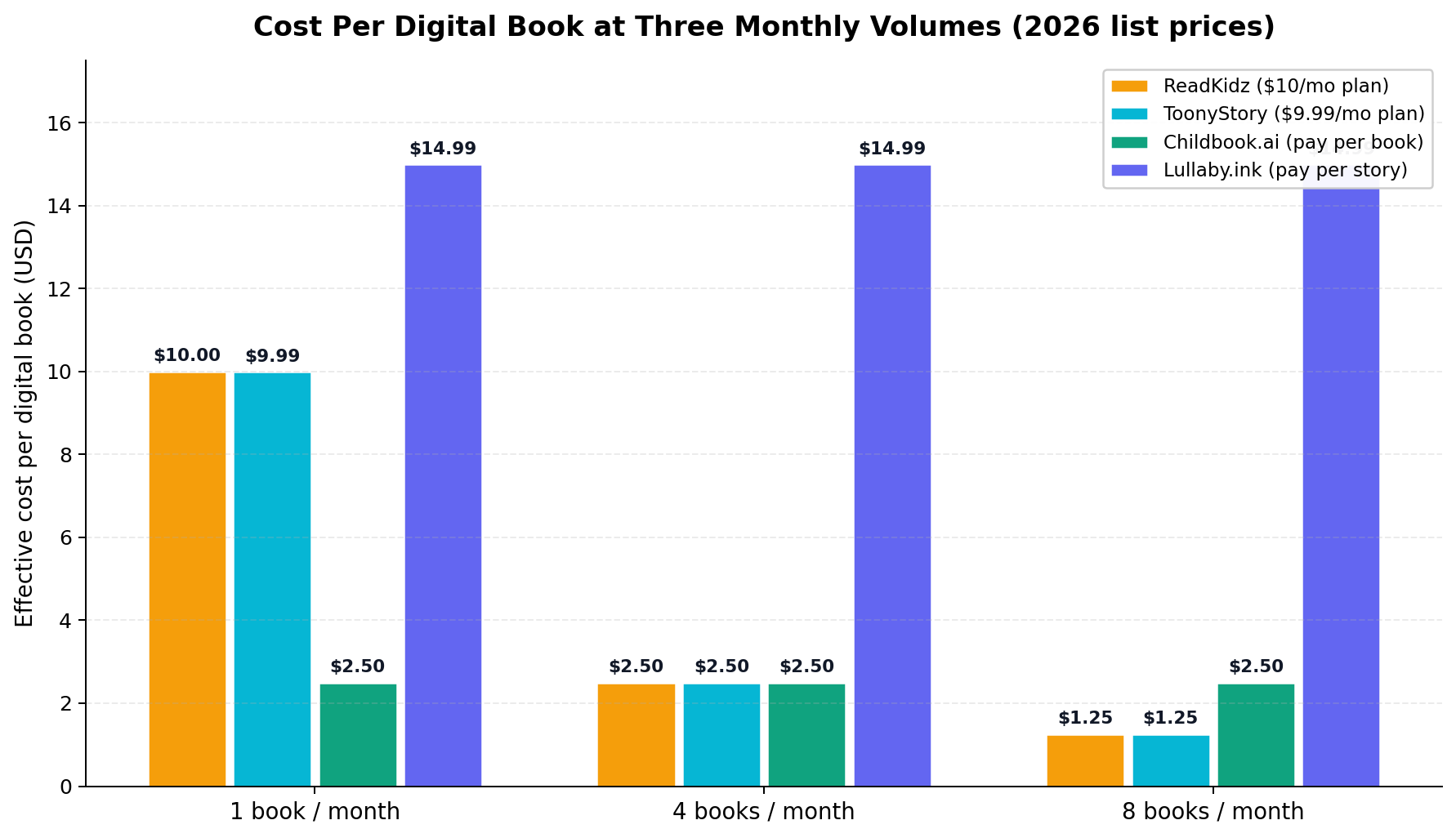
The sticker prices hide the real economics, which depend almost entirely on volume. The table below shows effective cost per finished digital book at three monthly volumes, using each tool's cheapest sensible plan.
| Tool | 1 book/mo | 4 books/mo | 8 books/mo |
|---|---|---|---|
| ReadKidz ($10/mo) | $10.00 | $2.50 | $1.25 |
| ToonyStory ($9.99/mo) | $9.99 | $2.50 | $1.25 |
| Childbook.ai (pay per book) | $2.50 | $2.50 | $2.50 |
| Lullaby.ink (per story) | $14.99 | $14.99 | $14.99 |
Three patterns worth internalizing. One book a month: Childbook.ai's flat $2.50 beats every subscription. Four books: ReadKidz and ToonyStory drop to $2.50 and keep falling. Eight books: subscriptions hit $1.25 — a finished illustrated book for less than a candy bar, which is why volume publishers cluster on ReadKidz. Physical printing adds a separate line: LoveToRead hardcover $24.99, Lullaby.ink from $29.99, ReadKidz hardcover add-on priced per order.
Against revenue, the margins look like this: a KDP digital picture book at $2.99-$4.99 returns a 70% royalty ($2.09-$3.49 per sale) against under $5 of production cost at volume; a printed KDP paperback prices out around $11.99-$14.99 with roughly $2-4 unit margin after print cost. An Etsy personalized book at $35-$60 costs you $2.50-$5 in credits plus an hour of work — the documented seller economics behind the "gift books with photo likeness" niche.
Money-Making Scenarios: How People Actually Use These
These are the three revenue workflows that recur in real seller reports, with the concrete economics our testing supports.
Scenario 1: KDP Picture-Book Series (ReadKidz workflow)
Goal: a shelf of 8-12 related digital picture books earning royalties on autopilot. Brief for ReadKidz: "A 20-page bedtime story for ages 4-6 about a reluctant dragon who collects night-lights instead of hoarding gold. Gentle humor, one line of rhyme per page, a soothing ending." Then design the dragon once in the Character Designer and reuse the sheet across the whole series — same character, new adventures, which is exactly how KDP series build repeat buyers.
Economics: at $10/month and 8 books, production is $1.25/book. List digital editions at $2.99-$4.99 for a 70% royalty of $2.09-$3.49 per sale. Ten sales a month across an 8-book shelf is $21-$35/month passive — modest, but the shelf compounds, and holiday-themed specials (spun off in minutes from an existing character sheet) are where spikes happen.
Scenario 2: Etsy/Fiverr Personalized Gift Books (ToonyStory workflow)
Goal: made-to-order books starring the customer's child. Brief for ToonyStory: "A birthday adventure for a 5-year-old girl named Mia who loves dinosaurs and the color purple. Upload photo as the hero, watercolor style, 16 pages, sweet ending." The photo-likeness engine does the personalization; you do the listing, the customer service, and the delivery.
Economics: gigs documented at $35-$60 per book against $1.25-$2.50 of credits and roughly an hour of assembly — call it 80% margin at $50 after platform fees. Ten orders a month is $400-$500 for a weekend-side cadence; this is the highest-margin workflow in the niche because personalization justifies the price.
Scenario 3: Classroom Readers for Teachers Pay Teachers (StoryWizard workflow)
Goal: supplementary readers and lesson bundles sold to teachers. Brief for StoryWizard: "A 12-page early reader about recycling for grade 1, vocabulary limited to short vowels, comprehension quiz questions at the end." The education suite's quiz generator produces the assessment pages teachers actually want in a bundle.
Economics: lower per-unit prices ($3-$8 per resource on TpT) but high reuse — one well-targeted reader sells for years. Volume and curriculum alignment matter more than illustration polish here, which is why the $10 entry tier is enough to validate demand.
Who Should NOT Use an AI Book Maker
Balance check, because this niche is not for everyone. If you want a literary children's book — the kind that wins awards — AI drafting is still a starting scaffold, not a collaborator; hire an editor at minimum. If you are pursuing pure AI output with zero human edits, understand that US copyright does not protect it, so you cannot stop copycats, and KDP's disclosure requirement means the AI label is permanent. If your plan is "one book, retire," the documented economics above say otherwise: this is a volume-and-series game where the tools remove production cost, not a lottery ticket. And if your audience is gift-buyers who will notice illustrator credit, a marketplace full of AI books has already reset expectations at the $3 price point — you need either personalization (Scenario 2) or series depth (Scenario 1) to stand out.
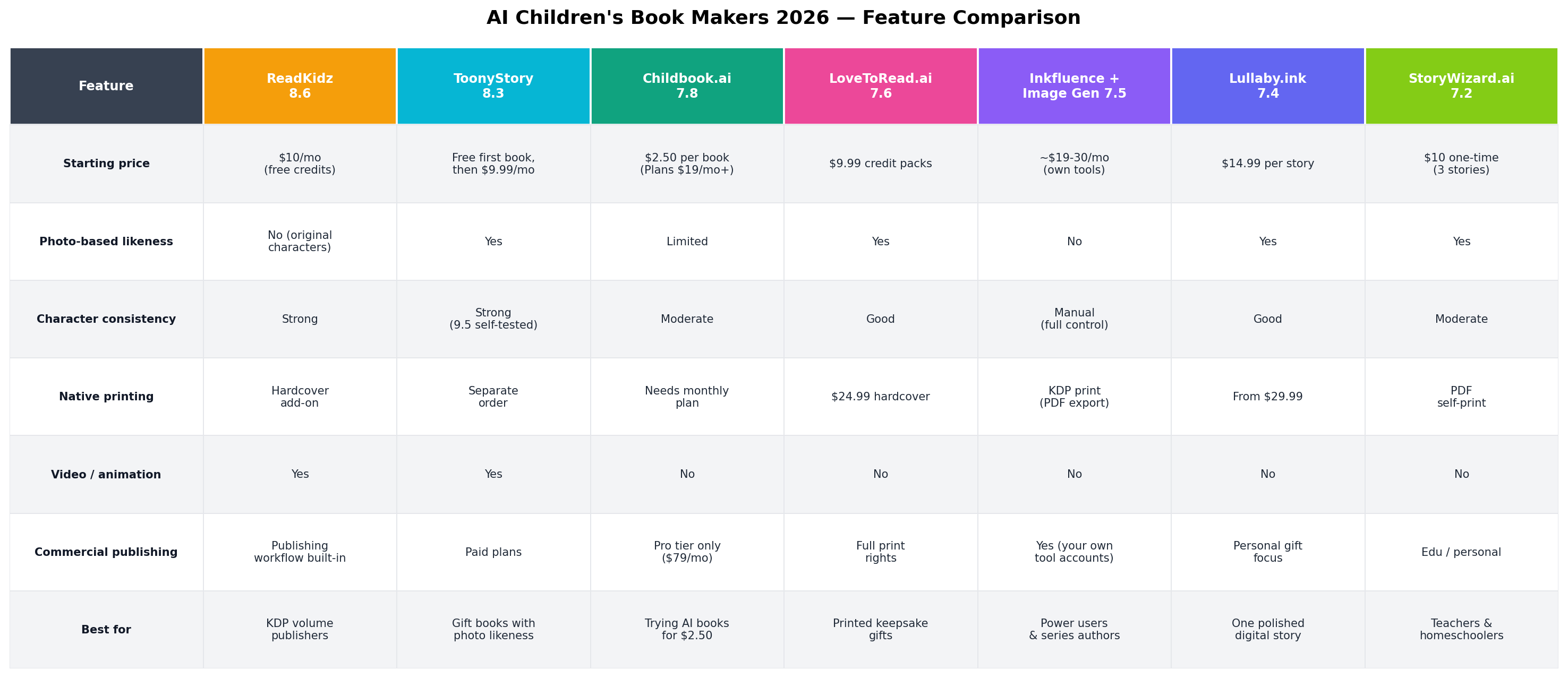
Feature Comparison at a Glance
Alternatives Worth Considering
| Tool | Starting Price | Standout Feature |
|---|---|---|
| StoryBook AI app | ~$5/mo | Mobile-first creation on a phone |
| Novelcrafter + image tool | $4/mo + image costs | Serious story structure for chapter books |
| Canva Magic Design | Free-$15/mo | Manual layout with 300 DPI export |
| ChatGPT + GPT Image | $20/mo | Total prompt control, DIY assembly |
| BookBild | $9/mo | Template-driven print layouts |
The Verdict
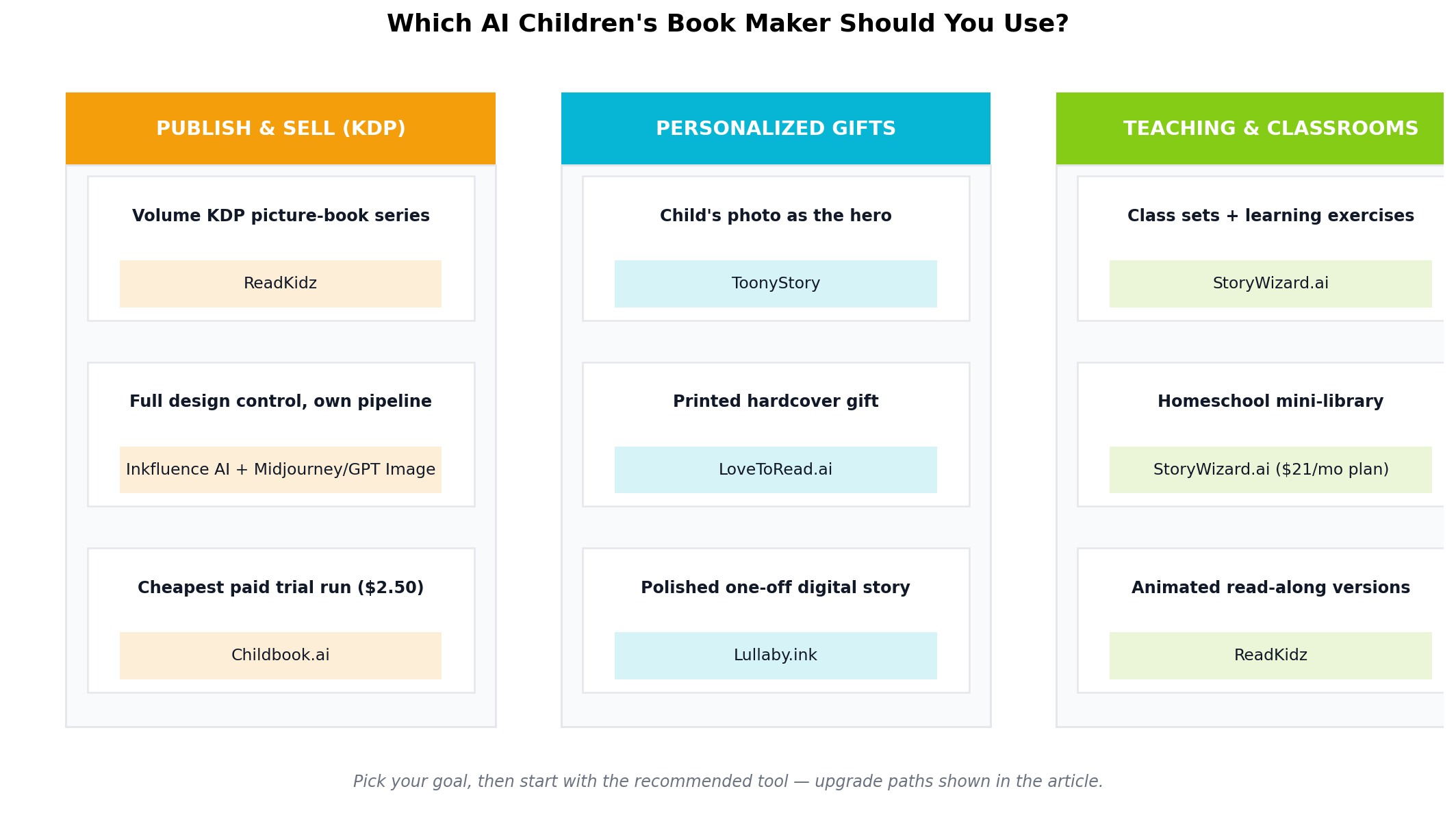
Best for Selling on Amazon KDP → ReadKidz
The only KDP-ready 300 DPI PDF export in the test, reusable character sheets, 60+ languages, and $1.25 per book at volume. If the business model is a royalty-earning shelf, start here.
Best for Personalized Gift Books → ToonyStory
Photo-to-cartoon likeness with best-in-test 9.4 consistency, first book free, and volume pricing that matches ReadKidz. The engine behind the $35-$60 Etsy gig economy in this niche.
Best for Trying the Format → Childbook.ai
$2.50 per finished book, no subscription, free preview. The cheapest credible answer to "is this good enough yet?"
Best Overall Value → ReadKidz
At 8.6/10 with the deepest publishing pipeline and the lowest volume cost among subscription tools, it wins the overall crown and the money-maker's slot simultaneously.
The Hybrid Approach
Several documented sellers run ReadKidz for their KDP series while fulfilling premium Etsy orders through ToonyStory — same story skills, two price points, $10+$9.99/month total tooling. That stack covers both revenue models for less than $25/month.
FAQ
Can you legally sell AI-generated children's books on Amazon KDP?
Yes. Amazon KDP allows AI-generated and AI-assisted content, but you must disclose the AI involvement when you publish (a questionnaire at upload, not on the product page). The book itself needs to be your original story — you cannot republish public-domain fairy tales with AI illustrations and call it a day, and you own what the tools generate under all seven tools' commercial-use terms on paid plans. ReadKidz and ToonyStory both grant full commercial rights on their cheapest paid tiers.
How much does it cost to make one AI children's book?
Between $2.50 and $15 depending on the tool and volume. Childbook.ai charges a flat $2.50 per finished digital book. Subscriptions cost $9.99-$10 per month, which drops to $2.50 per book at four books a month and $1.25 at eight. Lullaby.ink sits at the premium end at $14.99 per polished story. Physical printing is separate: hardcovers run $24.99-$29.99.
Which AI book maker keeps characters consistent across pages?
ReadKidz, and it is not close. Its Character Designer generates a reference sheet you pin to the project, and every page render pulls from it — in our identical-brief testing its cross-page consistency scored 9.1/10. ToonyStory is second for human-like characters via photo likeness, and StoryWizard.ai holds classroom-mascot characters well across short books, but none of the budget tools match ReadKidz's reference-sheet workflow for a 12-book series.
Can I put my child's photo in an AI storybook?
Yes, with ToonyStory. Upload 3-5 photos of the child, and its likeness engine generates the protagonist in that likeness across every page — this is the exact workflow behind the Etsy personalized-gift niche, where sellers charge $35-$60 per book against $2.50-$5 in production credits. LoveToRead.ai does the same for printed gift books, with the child's name woven into the story text. Only upload photos of children you have rights to, and skip tools that train on your uploads by default.
Do these tools export print-ready PDFs for KDP?
ReadKidz exports true print-ready PDFs with bleed, crop marks, and KDP's exact trim-size templates — it is the only tool in this list built specifically for the KDP pipeline. Childbook.ai exports high-resolution PDFs suitable for KDP paperback interiors. ToonyStory and LoveToRead.ai are digital-first (or print-via-their-own-service), and Lullaby.ink's PDF export is intended for reading, not commercial print runs.
Can you actually make money selling AI children's books?
Yes, but the margins favor volume and niches over single titles. A KDP digital picture book at $2.99-$4.99 returns a 70% royalty ($2.09-$3.49 per sale) against production costs that fall to $1.25 per book at eight books a month. Personalized Etsy gift books sell at $35-$60 with $2.50-$5 in credits plus an hour of work per order. The documented seller pattern is 8-12 book series with one consistent character, or a gift-book service around photo likeness — not one-off titles.
What is the cheapest way to try one AI children's book?
Childbook.ai's flat $2.50 pay-per-book with no subscription — you get a finished, illustrated digital book and pay nothing monthly. If you want the full pipeline (character consistency, KDP-ready export), ReadKidz is $10 for a one-month month of making. Avoid Lullaby.ink ($14.99 per story) as a first experiment; it is priced for polished gifts, not trials.