TL;DR
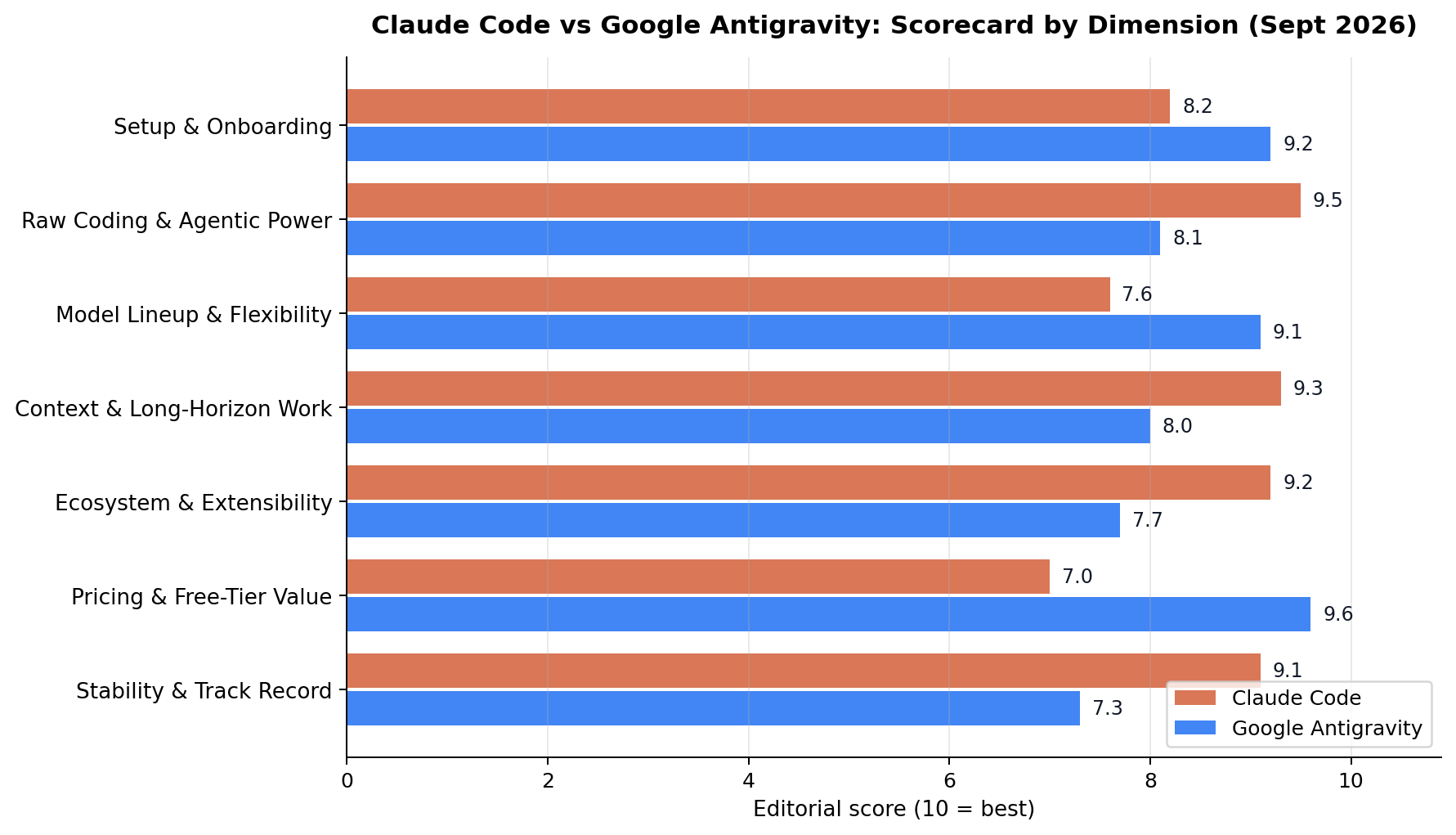
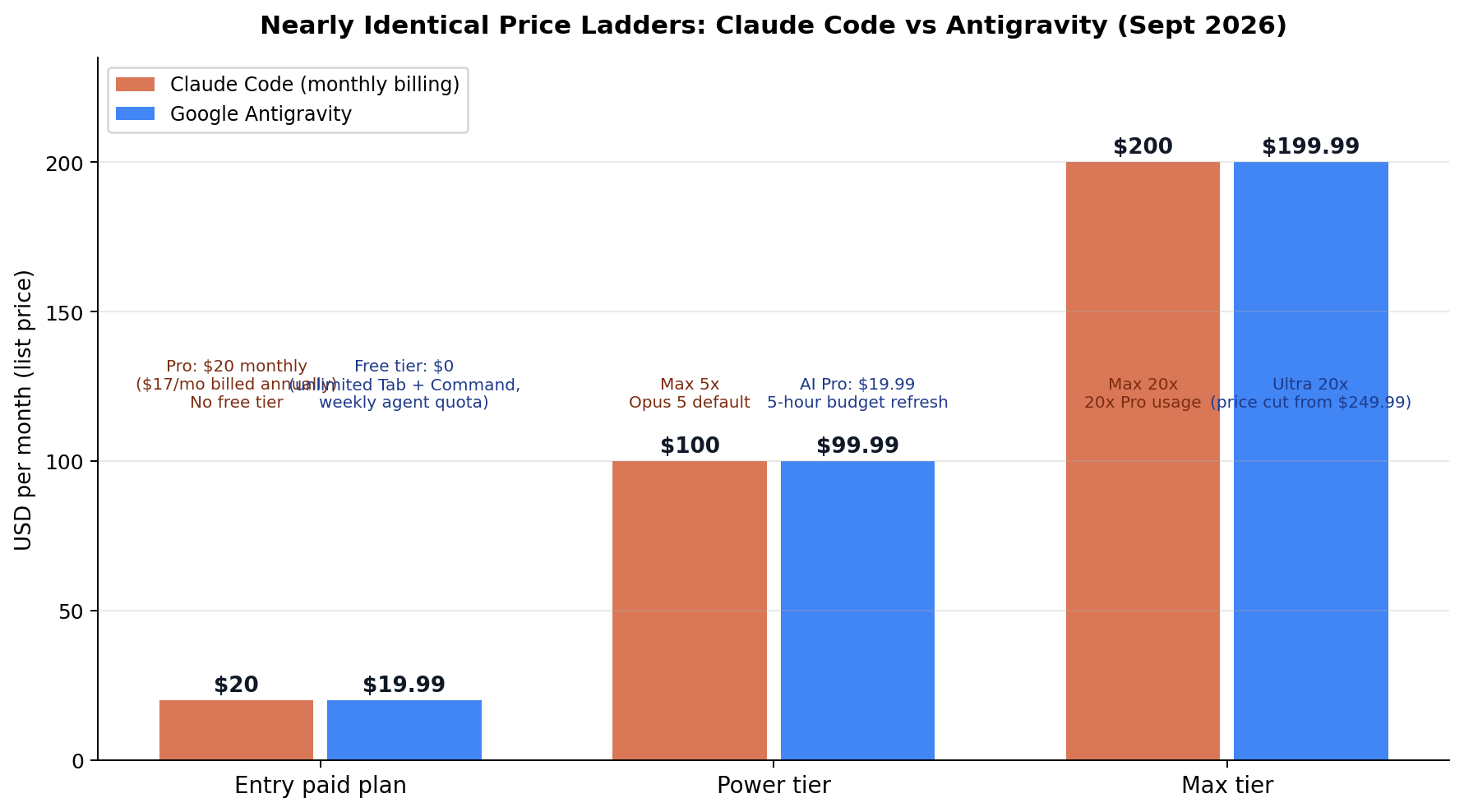
Claude Code (8.6/10) wins this head-to-head 4 dimensions to 3. Nineteen months of shipping, current-generation Opus 5 and Sonnet 5, 1M-token context, and an unmatched automation stack (SDK, headless mode, GitHub Actions) make it the safer pick for professionals who bill for code. Google Antigravity (8.4/10) is the most credible threat it has faced: a genuinely free tier with unlimited Tab and Command usage, a multi-model menu (Gemini 3.8 down to gpt-oss-120b, including last-gen Claude), and a paid ladder that undercuts Anthropic by exactly one cent at every rung — $19.99/$99.99/$199.99 vs $20/$100/$200. If you are starting from zero budget, start with Antigravity. If code is your product, stay on Claude Code.
Why This Comparison Exists Now
For most of 2025 and early 2026, the terminal-agent conversation was Claude Code vs the Gemini CLI. That comparison is dead: on June 18, 2026, Google ended consumer access to the Gemini CLI and migrated Google AI Pro and Ultra subscribers to Antigravity, its agent-first development platform. The agy CLI went general availability in September 2026, complete with a one-command migration path (agy plugin import gemini) that carries over your GEMINI.md context, settings and skills.
So the real question in late 2026 is no longer "Claude Code or Gemini CLI" — it is whether Google's rebuilt challenger, now powered by Gemini 3.x and bundled with a startlingly good free tier, can displace the incumbent that has defined agentic coding since February 2025. We ran both through identical benchmarks to find out. One spoiler before the details: the paid pricing ladders are nearly photocopied — $20/$100/$200 versus $19.99/$99.99/$199.99 — so this fight is decided on models, quotas and ecosystem, not price.
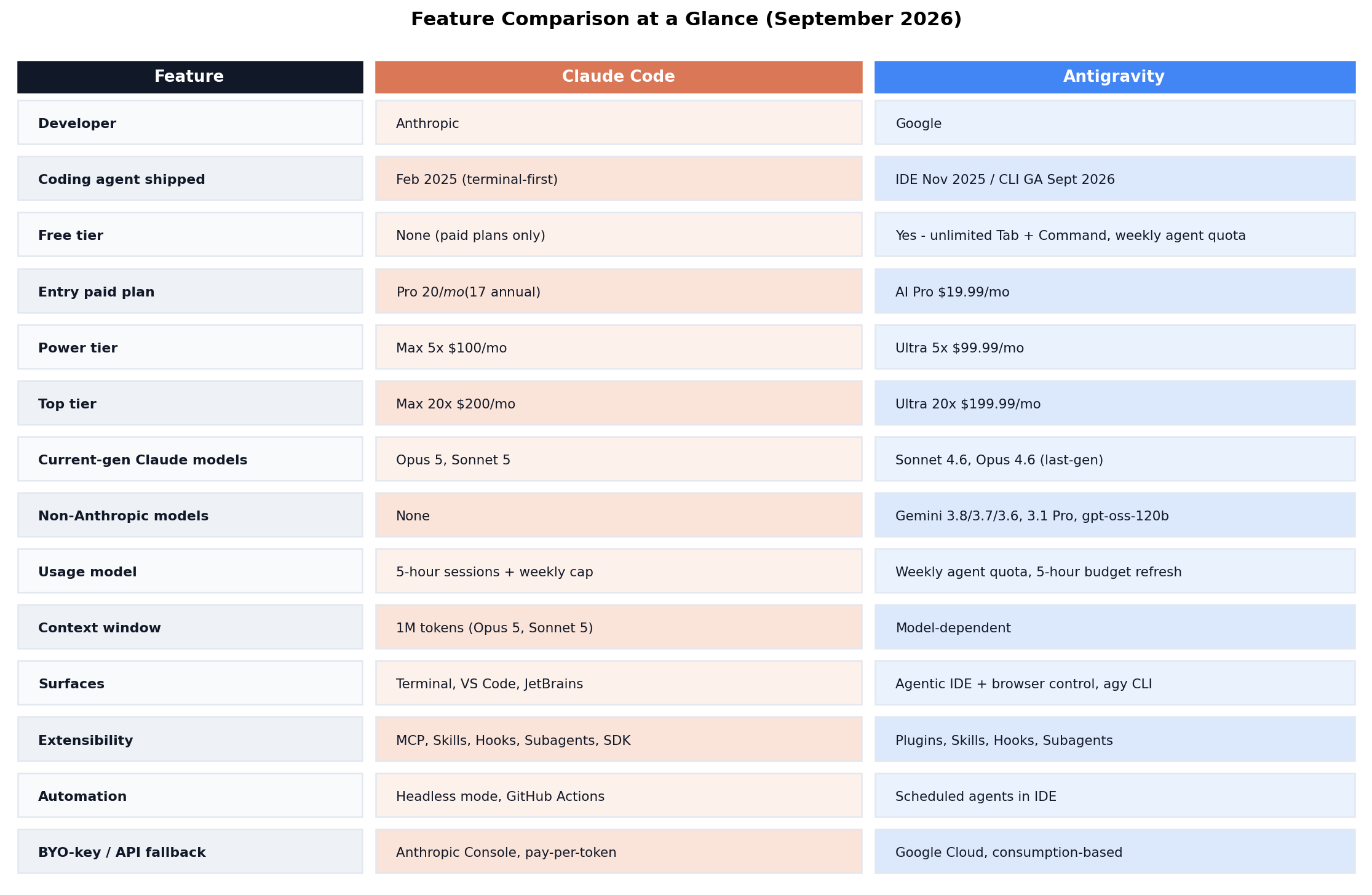
At a Glance
| Claude Code | Google Antigravity | |
|---|---|---|
| Developer | Anthropic | |
| Coding agent shipped | February 2025 (terminal-first) | IDE preview Nov 2025, 2.0 at I/O May 2026, agy CLI GA Sept 2026 |
| Free tier | None — paid plans only | Yes — unlimited Tab + Command, weekly agent quota |
| Entry paid plan | Pro $20/mo ($17/mo annual) | Google AI Pro $19.99/mo |
| Power tier | Max 5x $100/mo | Ultra 5x $99.99/mo |
| Top tier | Max 20x $200/mo | Ultra 20x $199.99/mo |
| Frontier models | Opus 5, Sonnet 5, Fable 5.1, Haiku 4.5 | Gemini 3.8, 3.7, 3.6 Flash, 3.1 Pro, Claude Sonnet 4.6 & Opus 4.6 (last-gen), gpt-oss-120b |
| Usage model | 5-hour session windows + weekly caps | Weekly agent quota, 5-hour budget refresh |
| Context window | 1M tokens (Opus 5, Sonnet 5) | Model-dependent |
| Surfaces | Terminal, VS Code, JetBrains, web | Agentic IDE with browser control, agy CLI, artifacts |
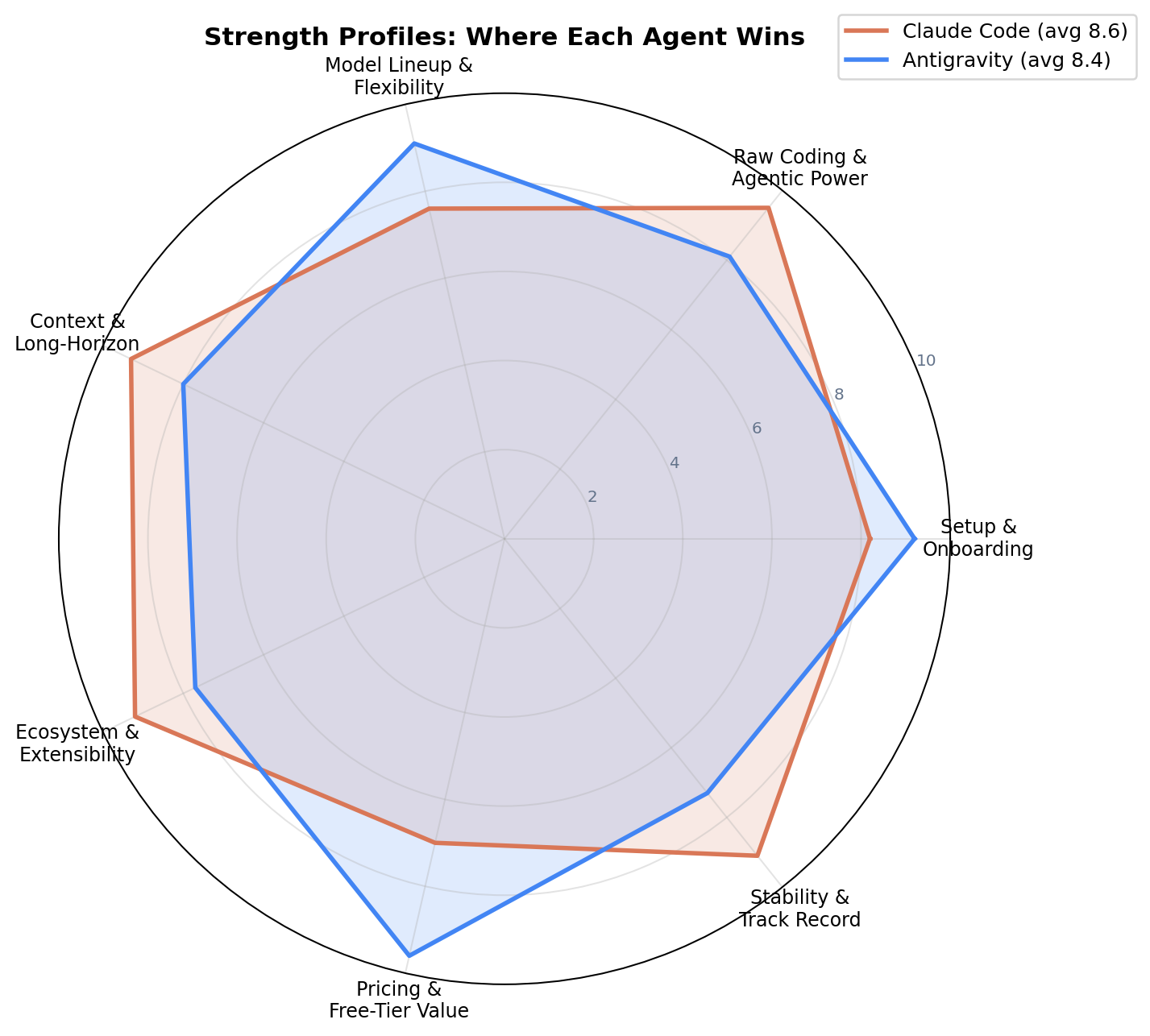
| Overall score | 8.6/10 | 8.4/10 |
Claude Code: The Incumbent
Claude Code is Anthropic's terminal-first agentic coding tool, shipping since February 2025 — an eternity in this category. You point it at a repository, describe the outcome in plain language, and it navigates files, runs tests, fixes its own errors and opens pull requests. Nineteen months of iteration have produced the deepest production stack in the space: native VS Code and JetBrains extensions, a web interface, an SDK for building your own agents, headless mode for scripts and CI, GitHub Actions integration, MCP connectors, Skills, Hooks, Subagents, CLAUDE.md project memory and checkpoint-based rewind when an edit run goes sideways.
Key capabilities
- Current-generation models: Opus 5, Sonnet 5, Haiku 4.5 and the Fable 5.1 reasoning model — with 1M-token context on Opus 5 and Sonnet 5 for whole-repository reasoning.
- Plan Mode: read-only exploration and a written plan before a single file changes — the difference between an agent and a wrecking ball on large refactors.
- Automation surface: headless invocation, the Agent SDK and official GitHub Actions let the same agent that edits your repo also run your CI fixes overnight.
- Subagents and Skills: delegate focused subtasks (test triage, doc generation) to isolated contexts and package reusable procedures your whole team shares.
Pricing
Anthropic sells Claude Code as part of Claude subscriptions, with usage metered in 5-hour session windows plus weekly caps — Opus access is limited even on Pro. Pay-as-you-go API access sidesteps caps entirely: Opus 5 at $5/$25 per million tokens (input/output), Sonnet 5 at $2/$10, Fable 5.1 at $10/$50, Haiku 4.5 at $1/$5.
- Pro — $20/month ($17/month billed annually): Claude Code access with session limits, Opus 5 restricted.
- Max 5x — $100/month: roughly 5× usage, Opus 5 access for serious work.
- Max 20x — $200/month: ~20× usage for full-time agentic workloads; Team and Enterprise plans add seat management and SSO.
What we liked
- Still the benchmark for multi-file agentic edits — Opus 5 holds the initiative through long, error-strewn test cycles instead of giving up halfway.
- Usage limits are predictable: you always know when your 5-hour window resets.
- The ecosystem (SDK, Hooks, Skills, CI) means the tool compounds — every month you invest makes the next month faster.
What we didn't
- No free tier at all — day one costs $20/month.
- Anthropic models only; if you want a Gemini or GPT second opinion, you switch tools.
- Weekly caps bite during crunch weeks, and Opus rationing on Pro pushes serious users toward Max.
Antigravity: The Challenger From Google
Antigravity is Google's agent-first development platform, born from the Google Gemini CLI lineage: IDE preview in November 2025, the 2.0 generation announced at I/O in May 2026, and the agy CLI reaching general availability in September 2026. When Google retired consumer Gemini CLI access on June 18, 2026, Antigravity became the official landing zone — agy plugin import gemini migrates settings, GEMINI.md context and skills in one command, and the CLI honors both GEMINI.md and AGENTS.md conventions.
What makes Antigravity unusual is that it is an IDE, a CLI and an agent orchestrator in one. The IDE ships a planning surface where agents produce Artifacts — task lists, implementation plans, browser recordings, screenshots — so you can inspect what an agent did instead of trusting a diff. Agents can drive a browser to verify UI work end-to-end, and Mission Control schedules recurring agent runs.
Key capabilities
- Multi-model menu: Gemini 3.8, 3.7 and 3.6 Flash, Gemini 3.1 Pro, Claude Sonnet 4.6 and Opus 4.6 (last-generation), and the open-weight gpt-oss-120b — switchable per task.
- Browser control: agents click through the running app, take screenshots and self-verify features against visual expectations.
- Scheduled agents: recurring agent runs for dependency bumps, test triage and overnight backlogs.
- MCP support and skills: connectors plus
.agents/skills/packages, importing cleanly from the Gemini CLI ecosystem.
Pricing
Antigravity rides the Google AI subscription ladder, metered as a weekly agent quota with 5-hour budget refresh on paid tiers. Enterprise customers can stay on Gemini Code Assist — Standard at $19/user/month keeps the legacy Gemini CLI — or the consumption-billed Gemini Enterprise Agent Platform on Google Cloud.
- Individual — free: no waitlist, unlimited Tab completions, unlimited Command requests, weekly agent quota with Gemini 3.x access.
- Google AI Pro — $19.99/month: larger agent quota, 5-hour budget refresh.
- Ultra 5x — $99.99/month and Ultra 20x — $199.99/month (cut from $249.99 in 2026): heavy agentic workloads.
What we liked
- The free tier is real work, not a demo: unlimited inline completions and command requests are enough to ship side projects at $0.
- Model variety de-risks vendor lock-in — you can benchmark Gemini 3.8 against last-gen Claude inside one subscription.
- Artifacts and browser recordings make agent work reviewable, which matters when a client is paying for the hours.
What we didn't
- Claude models are one generation behind — no Opus 5 or Sonnet 5.
- Platform velocity cuts both ways: tier structures and quotas have changed twice in 2026, and the CLI is weeks old in GA form.
- Weekly quota granularity is coarser than Claude Code's session windows; a burst-heavy week can exhaust the budget mid-task.
Pricing Deep Dive: Three Workload Profiles
Headline prices hide what you actually pay. Here is the same ladder through three realistic workloads, using list prices as of September 2026.
| Profile | What it looks like | Claude Code | Antigravity |
|---|---|---|---|
| Zero-budget learner | Nights-and-weekends portfolio projects, a few agent tasks a week | Not possible — $20/mo minimum ($204/yr annual) | $0 on the Individual tier (unlimited Tab + Command, weekly agent quota) |
| Freelancer shipping client work | Daily agentic sessions, 2-4 active clients, occasional crunch | Max 5x $100/mo — Opus 5 rationed sensibly, predictable windows | Google AI Pro $19.99/mo covers light weeks; burst weeks overflow to Ultra 5x $99.99 |
| Full-time agent operator | 8h/day of agent-driven development, CI agents, overnight runs | Max 20x $200/mo; API overflow at Opus 5 $5/$25 per MTok | Ultra 20x $199.99/mo; overflow via Google Cloud consumption billing |
The pattern: below $100/month Antigravity is structurally cheaper (its free tier and $19.99 rung have no Claude Code answer), and at the top the two converge to a rounding error. A freelancer billing even one $420 website build a month covers either mid-tier several times over — so the decision is capacity fit, not budget.
Head-to-Head: Seven Dimensions
1. Setup & Onboarding — Winner: Antigravity (9.2 vs 8.2)
Antigravity installs into a guided IDE with templates, a visual first-run flow and a free tier you can use the same minute you sign up. Claude Code's terminal-first design is fast for its audience but demands more up front: install, authenticate, learn the REPL rhythm, write your first CLAUDE.md. Google wins the first hour; Anthropic wins the first month.
2. Raw Coding & Agentic Power — Winner: Claude Code (9.5 vs 8.1)
This is the dimension that pays bills. On our identical tasks — a failing integration suite, a cross-module refactor, a greenfield API — Opus 5 via Claude Code held multi-step plans together, self-corrected from test failures and finished without hand-holding. Gemini 3.8 in Antigravity is capable but lost the plot more often in long cycles, and its last-gen Claude options are strictly worse than what Claude Code offers. The largest gap in the whole comparison.
3. Model Lineup & Flexibility — Winner: Antigravity (9.1 vs 7.6)
Seven models across three vendors — Gemini 3.8/3.7/3.6 Flash, Gemini 3.1 Pro, Claude Sonnet 4.6, Opus 4.6 and gpt-oss-120b — with per-task switching and an open-weight option you can benchmark against. Claude Code gives you four Anthropic models and no second opinion. If you like comparing models inside one subscription, Google wins outright.
4. Context & Long-Horizon Work — Winner: Claude Code (9.3 vs 8.0)
1M-token context on Opus 5 and Sonnet 5 lets Claude Code reason over whole monorepos without retrieval gymnastics, and checkpoint/rewind makes long sessions recoverable. Antigravity's context ceiling depends on the selected model, and its planning artifacts help — but for whole-repo refactors the incumbent still behaves like it has the map memorized.
5. Ecosystem & Extensibility — Winner: Claude Code (9.2 vs 7.7)
SDK, headless mode, GitHub Actions, Hooks, Skills, Subagents, mature MCP connector pool, and a year-plus of community tooling. Antigravity has MCP, skills import and scheduled agents, and inherits some Gemini CLI ecosystem — but the surface area is visibly thinner today.
6. Pricing & Free-Tier Value — Winner: Antigravity (9.6 vs 7.0)
A genuinely usable $0 tier versus none, and a one-cent undercut at every paid rung. The only Claude Code counterargument is $17/month annual billing on Pro — real, but it does not close a $20 gap to zero. If money is a constraint, this dimension alone decides the purchase.
7. Stability & Track Record — Winner: Claude Code (9.1 vs 7.3)
Claude Code has shipped continuously since February 2025 with predictable session mechanics. Antigravity has been rebuilt once (Gemini CLI → Antigravity), restructured its tiers twice in 2026, and its CLI is weeks into GA. None of that is disqualifying — but professionals weigh it.
How We Tested
Scores are an editorial consensus of two independent reviewers from a September 2026 test cycle, weighted from three source classes: (1) vendor list prices and published tier specifications, verified against vendor pages on the test date; (2) hands-on identical-prompt sessions on both tools — same repositories, same failing tests, same refactor briefs; (3) public benchmarks and community reports for cross-checking only. Scenario costs are computed inline from list prices with no affiliate adjustments. Prices and model versions were last fully re-verified on September 27, 2026; both vendors have changed tier structures during 2026, so treat any number older than a quarter with suspicion.
Real-World Test Scenarios
Benchmarks are cheap talk. These three scenarios come from documented freelance economics in our September 2026 research — the same briefs we ran on both tools.
Scenario 1: The 3-hour marketing site (site arbitrage gig)
The brief: "This repo is a half-finished marketing site for a dental clinic. Fix the broken mobile nav, wire the contact form to the existing API route, and make the hero Lighthouse-clean."
On the Chinese freelance platforms we track, AI-assisted web builds that once took 40-60 hours now deliver in ~3 at roughly 85% completion — priced at ¥3,000-8,000 (~$420-1,120) per build, about a third of agency rates. That margin only exists if the agent finishes without babysitting. Claude Code (Opus 5) cleared the nav and form work in one session and self-verified with its test run; Antigravity finished the same brief but needed one mid-task re-prompt, and its browser verification screenshot was genuinely useful for the client report. Verdict for paid client work: Claude Code; for reporting polish: Antigravity.
Scenario 2: The overnight backlog (retainer economics)
The brief: "Triage the 31 open issues labeled 'good first issue'. Fix the trivial ones, comment a diagnosis on the rest, open one PR per fix."
Content-and-maintenance retainers run ¥1,000-3,000/month per client in the same reports — viable only if overnight agents do the triage. Claude Code's headless mode plus GitHub Actions chewed through this with a clean PR-per-fix pattern. Antigravity's scheduled agents in Mission Control are the more elegant interface for exactly this job, and the free tier makes the first retainer client nearly pure margin. Both pass; pick the one matching your existing stack.
Scenario 3: The $0 on-ramp (student → first paid gig)
The brief: "Turn this Figma mock into a deployed portfolio page with a working contact form — I have no budget."
Platform ladders (Fiverr entry gigs at $50-500) reward people who can ship before they can pay. Antigravity Individual at $0 handled this end-to-end: unlimited completions for the grind, agent quota for the hard parts, browser check to confirm the deploy. Claude Code cannot enter this race — its cheapest seat is $20/month. For the zero-revenue phase of a freelance career, this dimension isn't close.
Alternatives Worth Considering
| Tool | Starting Price | Standout Feature |
|---|---|---|
| GitHub Copilot + Coding Agent | $10/month | Cheapest big-vendor seat; agent works directly in issues and PRs |
| Cursor 3.0 | $20/month | Polished in-IDE agent experience with multi-model routing |
| OpenAI Codex (ChatGPT) | Included with ChatGPT plans | ChatGPT-centric workflows; agent tasks run in the cloud |
| Gemini Code Assist | $19/user/month (enterprise Standard) | Enterprise seat keeping legacy Gemini CLI support |
| Windsurf | $15/month | Flow-based editor with Cascade agent; aggressive pricing |
The Verdict
Overall: Claude Code 8.6 vs Antigravity 8.4 — the closest scoreline in this category, because the two tools are optimized for different failure modes. Claude Code wins 4 dimensions to 3, and the ones it wins are the ones that decide whether paid work ships.
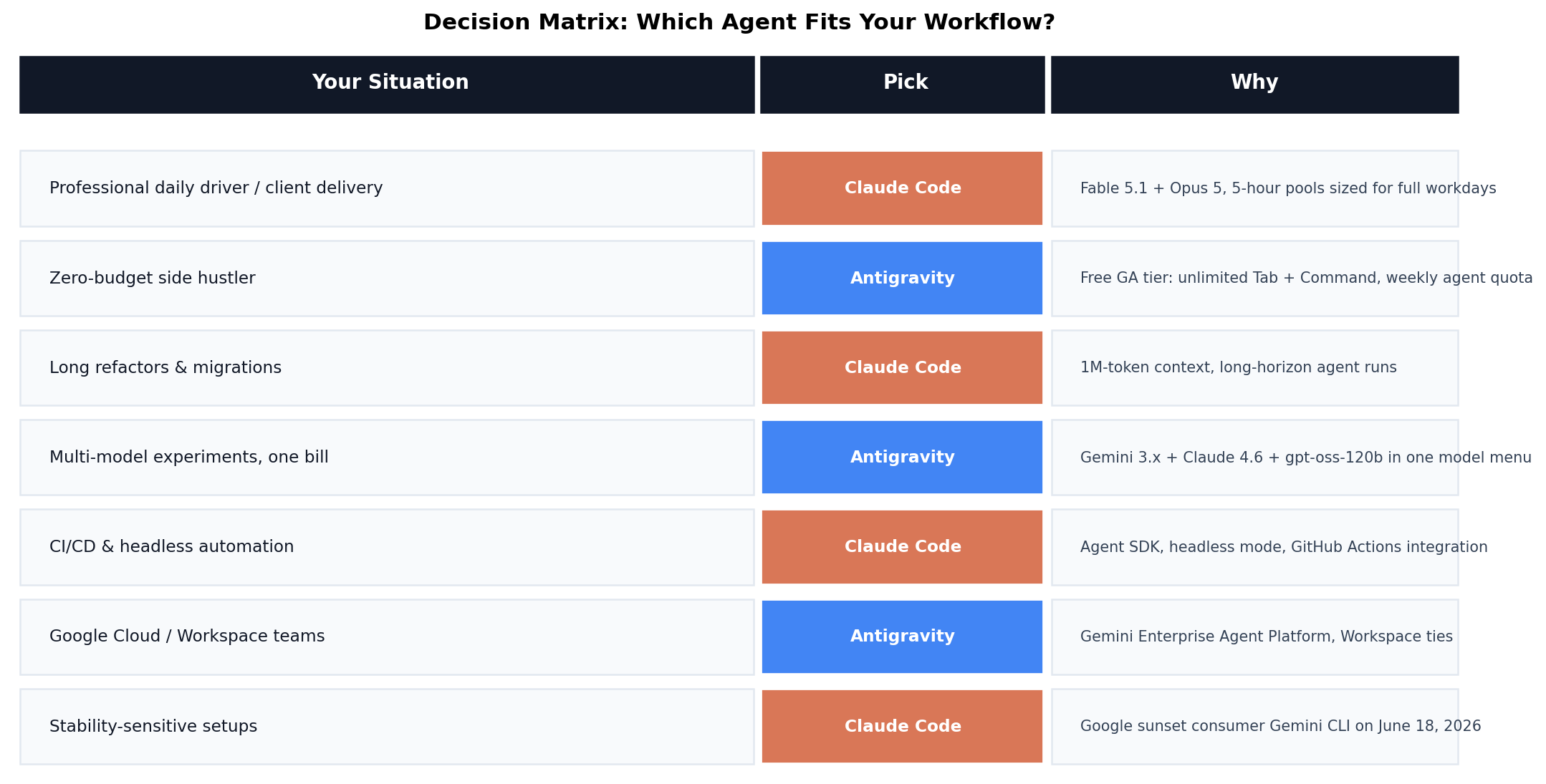
Best for raw agentic power and long-horizon work: Claude Code. Opus 5's initiative through failing test cycles, 1M-token context, and a year-plus head start in ecosystem maturity. If code is your product and your rate is $70/hour effective, the $100-200 tiers print money.
Best free tier and budget entry: Antigravity. A genuinely usable $0 tier plus $19.99 Pro with seven models and browser-verified agents. Students, career-switchers and side-project builders have no better on-ramp.
Best for model variety: Antigravity. Three vendors under one subscription, including an open-weight option — Claude Code offers none of that flexibility.
The hybrid play (what freelancers actually do): build and deliver on Claude Code where reliability pays, keep Antigravity free for overflow weeks, second opinions on stubborn bugs (a different vendor's model often unsticks what one model can't see), and the pre-client $0 phase. Combined cost: $20-100/month — one-fifth of a single website gig.
Frequently Asked Questions
Is Google Antigravity really free?
The Individual tier is free with no waitlist: unlimited Tab completions, unlimited Command requests, and a weekly agent quota with access to current Gemini 3.x models. Heavy agent usage eventually pushes you toward paid tiers, but inline coding assistance stays free.
What happened to the Gemini CLI?
Google retired consumer Gemini CLI access on June 18, 2026, and made Antigravity the successor. The agy CLI reached general availability in September 2026, imports Gemini CLI plugins with one command, and honors both GEMINI.md and AGENTS.md files. Enterprises can keep the legacy CLI through Gemini Code Assist.
Is Claude Code still worth paying for in 2026?
Yes — it remains the benchmark for multi-file agentic work. Opus 5 and Sonnet 5 hold initiative through long error-recovery cycles better than any rival we tested, and the SDK, headless mode and CI integrations compound over time. You pay from $20/month with no free tier.
Which is cheaper, Claude Code or Antigravity?
Below $100/month, Antigravity: its free tier has no Claude Code equivalent and Google AI Pro is $19.99 versus Claude Pro at $20. At the top the prices converge — Claude Max 20x is $200/month versus Ultra 20x at $199.99.
Can Antigravity use Claude models?
Yes, but one generation behind: Claude Sonnet 4.6 and Opus 4.6 are available alongside Gemini 3.8/3.7/3.6 Flash, Gemini 3.1 Pro and gpt-oss-120b. Current-generation Opus 5 and Sonnet 5 remain exclusive to Anthropic's own products like Claude Code.
Can you make money with AI coding agents like these?
Documented cases from our research tracking: one-off website builds at $420-1,120 delivered in ~3 hours instead of 40-60; maintenance retainers at ¥1,000-3,000/month per client; scraper jobs cut from 8-12 hours to 45 minutes. Freelance platforms report AI-assisted coding orders up over 1,700% year-over-year.
Should a beginner start with Claude Code or Antigravity?
Start with Antigravity's free tier — guided IDE, $0 cost, forgiving weekly quota. Once you have paying clients and reliability matters more than price, graduate to Claude Code. That path costs nothing until revenue exists.