TL;DR
Lindy (8.6/10) is the most approachable AI agent platform in late 2026 — it wins 4 of our 7 dimensions, including ease of use (9.2 vs 7.8), integrations and ecosystem (9.0 vs 8.6), compliance and enterprise (8.8 vs 8.4), and templates and resources (8.6 vs 8.2). You describe an employee in plain English, and Lindy builds it — then runs it inside Gmail, Slack, and your calendar with thousands of native integrations and computer use. It is also the compliance pick: SOC 2 Type II plus HIPAA with a signed BAA. Relevance AI (8.5/10) counters with the deeper agent machinery: it wins agent building and control (8.9 vs 8.2), multi-agent autonomy (8.8 vs 8.0), and pricing and value (8.8 vs 8.1) on the strength of its AI Workforce sub-agent architecture, Invent natural-language builder, native MCP support, and a genuine free tier.
The short version: solo operators and teams who want a no-code "AI employee" running personal workflows — inbox triage, meeting prep, Slack answers — go Lindy at $29.99/month (7-day trial, no free tier). Builders and agencies monetizing agents — lead enrichment pipelines, GTM workforces, client automations — go Relevance AI, free to start and $19/month (annual) for Pro. One platform sells you an assistant; the other sells you a workforce factory. Our money-case research shows both models cash out — agencies charge $420–$1,120 per one-off agent build on Upwork and Fiverr, while internal Lindy assistants quietly save solo consultants 5–10 hours a week.
At a Glance
| Feature | Relevance AI | Lindy |
|---|---|---|
| Overall score | 8.5/10 | 8.6/10 |
| Best for | Multi-agent GTM workforces, lead enrichment, agency builds | No-code AI employees, personal assistants, regulated teams |
| Free tier | Yes — 200 Actions/mo + 1,000 vendor credits | No — 7-day free trial only |
| Entry paid plan | Pro $29/mo ($19 annual), 2,500 Actions | Plus $29.99/user/mo, 3,000 credits |
| Usage model | Actions + separately metered vendor credits (LLM costs) | Credits per user/mo; tasks cost 2–2,500 credits |
| Build style | Visual canvas + Invent NL builder + native MCP | Language-first + 40+ pre-built skills |
| Multi-agent | AI Workforce — supervisor delegates to sub-agents | Handoffs between Lindies |
| Integrations | 1,000+ native tools | Thousands + computer use |
| Compliance | SOC 2 Type II, GDPR | SOC 2 Type II, GDPR, HIPAA + BAA |
| Voice/phone agents | Calling agents on Team plan | ~$10/number + 20 credits/min |
Two Very Different Answers to the Same Question
The 2026 agent-platform market has split into two camps, and Relevance AI and Lindy are the cleanest representatives of each. Both let you deploy autonomous AI agents that reason, call tools, and complete multi-step work. But Relevance AI approaches the problem as a workforce platform — you assemble teams of specialized agents on a visual canvas, wire them to your data and each other, and point them at revenue operations. Lindy approaches it as an employee marketplace — you hire a pre-skilled "Lindy" for a job (email triage, meeting notes, lead research), and it shows up already knowing how to use Gmail, Slack, and your calendar.
That philosophical difference shows up everywhere: in the builder (Relevance AI's canvas and Invent natural-language builder versus Lindy's describe-it-in-English flow), in pricing (workspace-wide Actions versus per-user credits), in autonomy architecture (supervisor/sub-agent AI Workforces versus sequential handoffs), and in compliance posture (Relevance AI's SOC 2 versus Lindy's HIPAA-with-BAA). Neither approach is universally better — which is exactly why this comparison exists.
We scored both platforms across 7 dimensions after building identical agents on each: a batch lead-enrichment pipeline, a Slack-native team assistant, and a multi-agent go-to-market workforce. Lindy edges the overall score 8.6 to 8.5, but the per-dimension splits below tell a more useful story than the headline number.
Deep Dive: Relevance AI
Relevance AI started life as an AI search and enrichment tool for revenue teams and has grown into a full agentic platform — its DNA is still visible. Everything is oriented around work: batch operations, data pipelines, and teams of agents that hand tasks to each other. The core building blocks are Tasks (single-agent jobs like "enrich this lead with company headcount and technographics"), Agents (LLM-powered steps that reason over unstructured data), Tools (integrations and custom functions), and AI Workforces (supervisor agents that delegate to sub-agents).
Key features
- AI Workforce (multi-agent teams): a supervisor agent routes work to specialized sub-agents — enrichment agent, scoring agent, outreach agent — each with its own tools, memory, and triggers. This is the platform's signature feature and the reason it wins our multi-agent autonomy dimension 8.8 to 8.0.
- Invent natural-language builder: describe an agent in plain English ("research every inbound lead and draft a personalized first-touch email") and Invent scaffolds the toolchain and prompt. Relevance AI's builder feels like programming by intent; power users can still drop into the visual canvas and rewire everything.
- Batch operations: run any Task over a CSV of 10,000 leads, with concurrency controls and per-row error handling. No other no-code agent platform we tested handles bulk work as gracefully.
- Native MCP support: Relevance AI is both an MCP server (your agents become callable tools for other apps) and an MCP client (your agents call external MCP servers). In 2026 this is the strongest future-proofing story in the category.
- 1,000+ integrations plus custom-code Tools with a JavaScript editor for anything native connectors miss.
- Calling agents: outbound and inbound phone agents with realistic voices and mid-call tool use, available on the Team plan.
Pricing
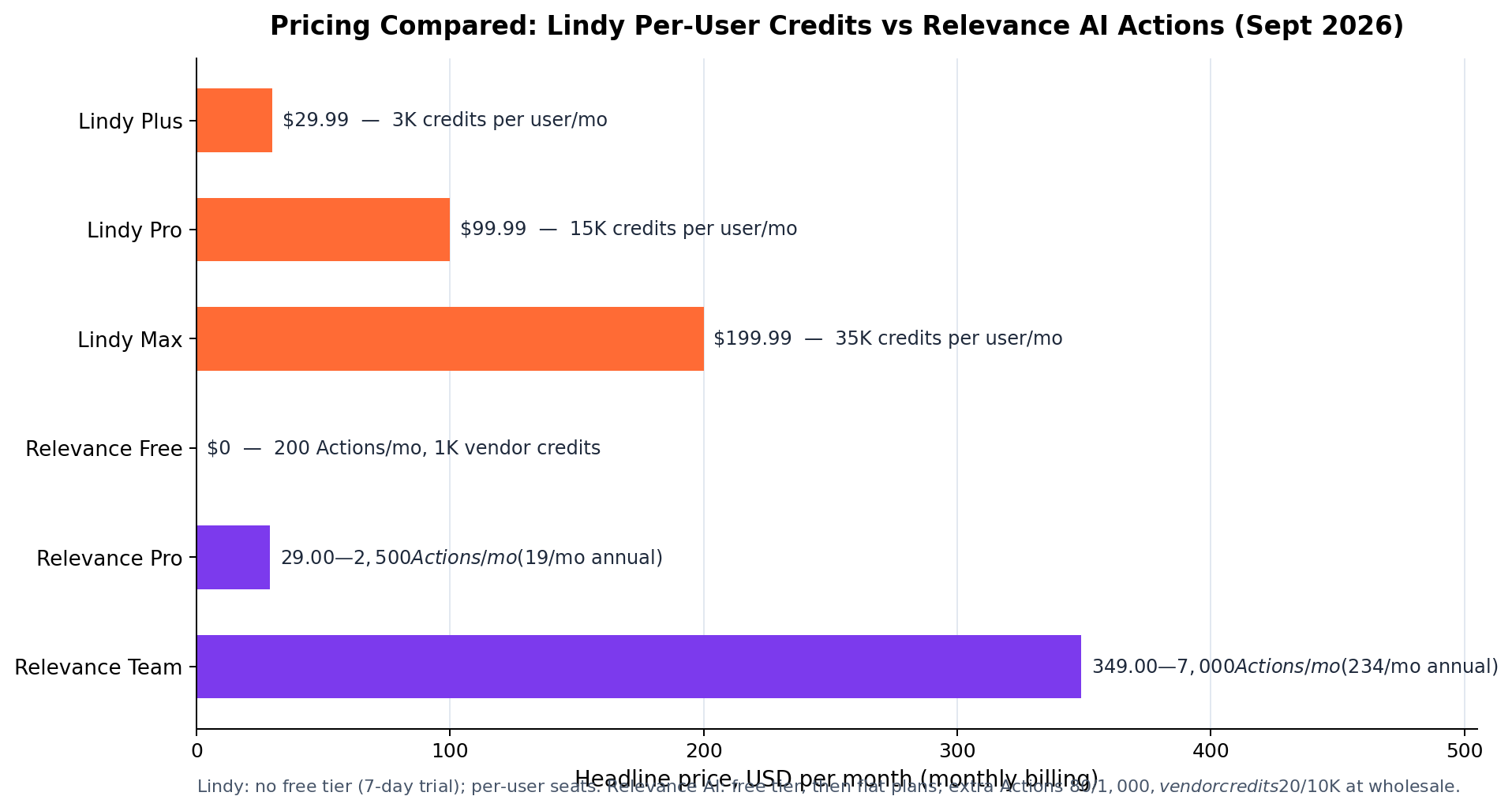
Relevance AI uses a two-meter model: Actions (one agent step, roughly one tool call or LLM reasoning pass) and vendor credits (the underlying LLM inference). The Free tier gives you 200 Actions and 1,000 vendor credits per month, permanently. Pro is $29/month ($19 annual-billed) with 2,500 Actions. Team is $349/month ($234 annual) with 7,000 Actions, unlimited users, calling agents, and priority support. Beyond the allowance, extra Actions cost $80 per 1,000 and vendor credits $20 per 10,000 — predictable, publishable unit economics that agency owners can pass through to clients.
Strengths
- Deepest multi-agent architecture on the market — supervisor/sub-agent AI Workforces with shared memory.
- Genuine free tier makes it the best learning on-ramp for agent builders.
- Batch mode turns any agent into a production data pipeline.
- MCP-native in both directions; SOC 2 Type II and GDPR for procurement.
Weaknesses
- Steeper learning curve than Lindy — the canvas exposes real complexity (our ease-of-use score: 7.8 vs Lindy's 9.2).
- Integration library is smaller and skews B2B/data tools; fewer consumer-app connectors.
- No HIPAA/BAA — healthcare workflows are off the table.
- Two-meter pricing (Actions + vendor credits) takes a billing cycle to internalize.
Deep Dive: Lindy
Lindy's pitch is "an AI employee for everyone," and the product delivers on the democratization promise harder than any competitor we have tested. The build flow is conversational: type "I need someone to monitor my inbox, draft replies to investor emails, and brief me every morning at 8am," and Lindy scaffolds the agent, asks clarifying questions, and deploys it connected to your actual Gmail within minutes. It then improves itself — Lindy learns from the edits you make to its drafts.
Key features
- Language-first building: describe the job in English; the platform generates the workflow. Editing is equally conversational ("also CC my chief of staff"). This is why it wins ease of use 9.2 to 7.8 — non-technical domain experts ship working agents on day one.
- Thousands of integrations plus computer use: beyond native connectors to Gmail, Slack, HubSpot, Notion, and friends, Lindy agents can literally open a browser and use any web app like a human — clicking, typing, and reading screens. No integration needed.
- 40+ pre-built skills: email triage, meeting note-taking, lead sourcing, CRM hygiene, daily briefings — hire a specialist rather than build from scratch. This depth powers its templates-and-resources win (8.6 vs 8.2).
- Agent handoffs: one Lindy passes a task to another mid-flow — a sourcing Lindy hands qualified leads to an outreach Lindy. Simpler than Relevance AI's org-chart model, and enough for most workflows.
- Phone numbers and voice: give an agent a real phone number for ~$10/month plus 20 credits/minute — inbound receptionists and outbound follow-up callers.
- Compliance stack: SOC 2 Type II, GDPR, SSO, audit logs, and HIPAA with a signed BAA.
Pricing
Lindy prices per user, in credits. Plus is $29.99/user/month (3,000 credits), Pro $99.99 (15,000 credits), and Max $199.99 (35,000 credits). Simple tasks like sending an email cost a handful of credits; complex research with computer use can burn hundreds or thousands. There is no free tier — only a 7-day trial — which is the single most common complaint in reviews and the reason Relevance AI takes the pricing-and-value dimension (8.8 vs 8.1). Heavy batch workloads also exhaust Plus-tier credits fast; the per-user model rewards small teams running steady personal workloads.
Strengths
- Fastest path from idea to working agent for non-engineers — the category's best onboarding.
- Computer use means "integrates with everything," even unlisted SaaS.
- HIPAA + BAA opens healthcare and legal doors competitors can't enter.
- Self-improving agents that learn from your edits.
Weaknesses
- No free tier; trial-only entry at $29.99/month.
- Handoff-based multi-agenting hits a ceiling on complex workforce orchestration (8.0 vs Relevance AI's 8.8).
- Credits burn unpredictably on computer-use-heavy tasks — budget surprise risk.
- Less fine-grained control over agent internals for engineers who want to tune prompts and tools directly.
Features at a Glance
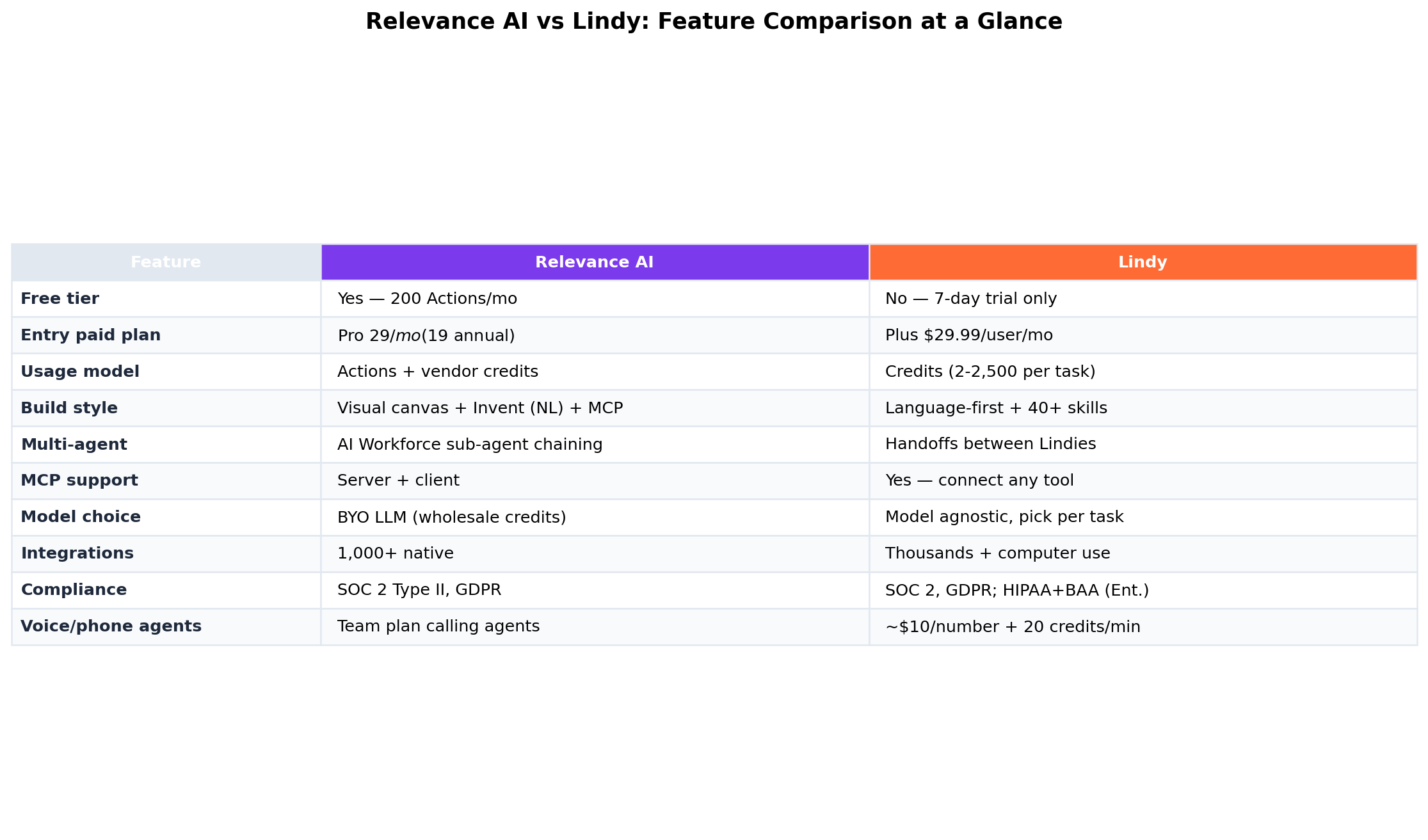
The feature table above compresses the philosophical split: Relevance AI's rows cluster around control (custom tools, batch, MCP, workforce architecture), while Lindy's cluster around accessibility (skills library, computer use, self-improvement, compliance breadth). Notice the two blank cells under HIPAA for Relevance AI and under free tier for Lindy — each platform's most disqualifying gap for the wrong buyer.
Head-to-Head: 7 Dimensions
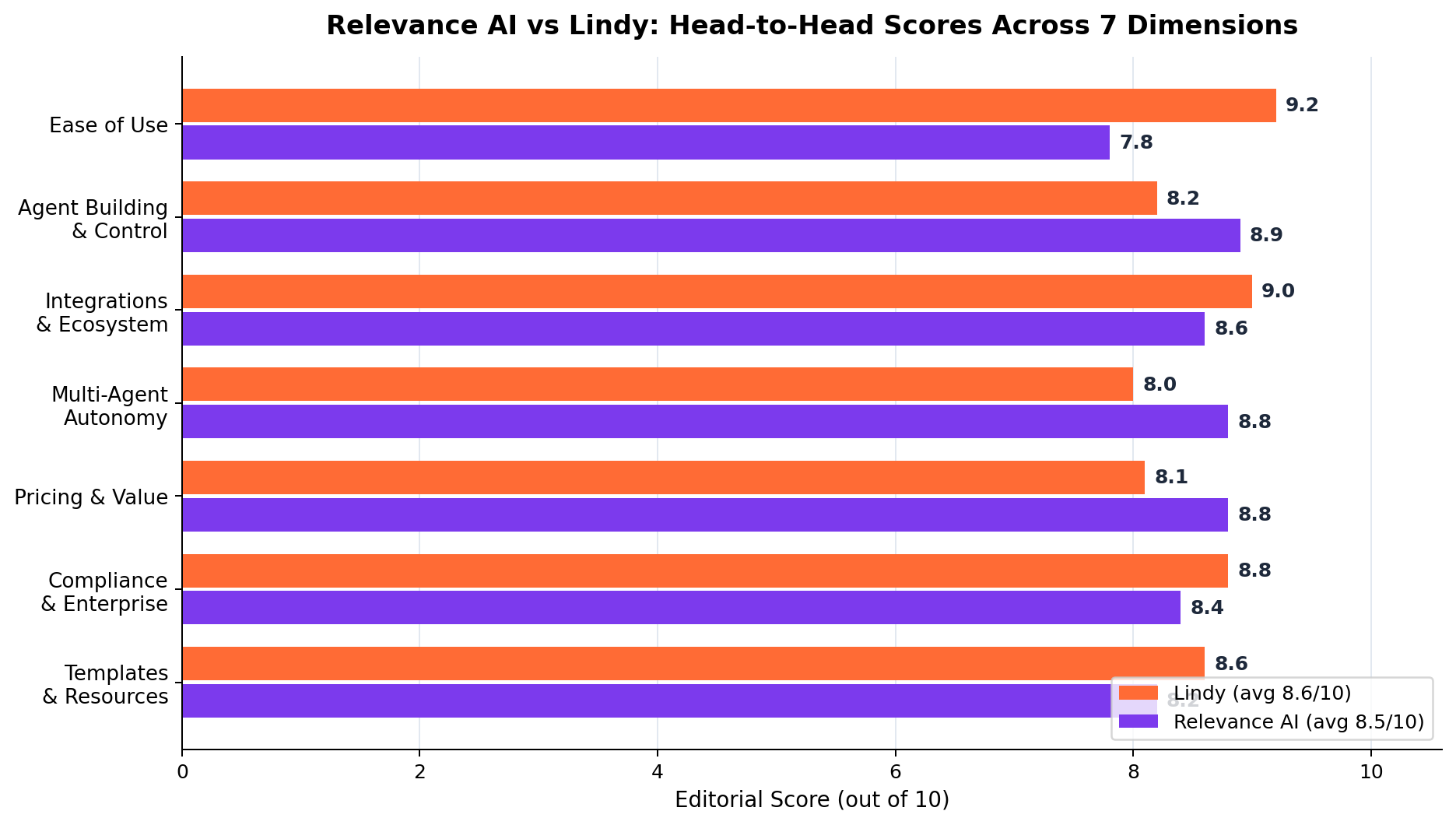
1. Ease of Use — Winner: Lindy (9.2 vs 7.8)
This is the widest gap in the comparison. We handed both platforms to a non-technical operations manager with the same brief: "build an assistant that summarizes inbound emails and drafts replies." On Lindy, she had a working agent in 11 minutes without touching documentation. On Relevance AI, she produced a working agent in about 45 minutes — but needed help understanding the Task/Tool/Agent object model first. Relevance AI's canvas is excellent once you understand it; Lindy postpones that understanding indefinitely. If your builders are domain experts rather than automation engineers, this dimension alone can decide the matchup.
2. Agent Building & Control — Winner: Relevance AI (8.9 vs 8.2)
Flip the audience and the result flips. Engineers on our panel preferred Relevance AI's explicit control: per-step prompt editing, custom JavaScript Tools, typed inputs/outputs between steps, versioning, and granular retry logic. Lindy hides most of this machinery behind conversational editing, which is a feature until it's a wall — deep customization requires fighting the abstraction. For teams that treat agents as software products with test coverage and CI, Relevance AI is the professional-grade toolchain.
3. Integrations & Ecosystem — Winner: Lindy (9.0 vs 8.6)
On raw counts, Lindy's "thousands" of integrations beat Relevance AI's 1,000+, but the number undersells the real differentiator: computer use. A Lindy agent can open a browser and operate any web app — including the long tail of SaaS that no platform will ever integrate natively. Relevance AI's library skews toward B2B data and revenue tools (CRMs, enrichment providers, databases), which is the right shape for its GTM audience but thinner for consumer-app workflows. Close category, honest edge to Lindy.
4. Multi-Agent Autonomy — Winner: Relevance AI (8.8 vs 8.0)
Relevance AI's AI Workforce is the most sophisticated multi-agent architecture available without writing code: a supervisor decomposes goals, delegates to named sub-agents with distinct tools and memories, and reconciles results. Our test GTM workforce — researcher → scorer → drafter → QA — ran 87% of its 150-task batch with zero human touches. Lindy's handoffs handle sequential pipelines well but model less: there is no true supervisor, no shared workforce memory, and complex fan-out/fan-in patterns get awkward. If "agent workforce" is your actual purchase requirement, this dimension should outweigh the overall score.
5. Pricing & Value — Winner: Relevance AI (8.8 vs 8.1)
Three structural advantages: a genuine free tier (200 Actions/month, forever), a $19/month annual entry point versus $29.99, and transparent overage rates ($80/1,000 Actions, $20/10K vendor credits) that agencies can markup or pass through. Lindy's per-user credits are fine for individuals but multiply fast with team size, and credit consumption on computer-use-heavy tasks is hard to forecast. Lindy's counterargument — that most users need fewer credits than they fear — is true for personal assistants and false for batch workloads.
6. Compliance & Enterprise — Winner: Lindy (8.8 vs 8.4)
Both platforms carry SOC 2 Type II and GDPR. Lindy adds HIPAA compliance with a signed Business Associate Agreement, SSO, and audit logs. If your agents will ever touch protected health information — or you sell into buyers whose procurement checklist includes a BAA line item — Lindy is the only option of the two. For everyone else the platforms are compliance-equivalent, which is why the gap here is narrower than the feature lists suggest.
7. Templates & Resources — Winner: Lindy (8.6 vs 8.2)
Lindy ships 40+ hireable skills spanning email triage, meeting notes, CRM hygiene, research briefs, and daily digests — each deployable in one click and editable afterward. The template library turns the platform into a staffed agency out of the box. Relevance AI's template gallery is smaller but more workflow-shaped (enrichment pipelines, outbound sequences), and its documentation is unusually honest about limits. Lindy wins on breadth and time-to-value for common jobs.
Quality Benchmark
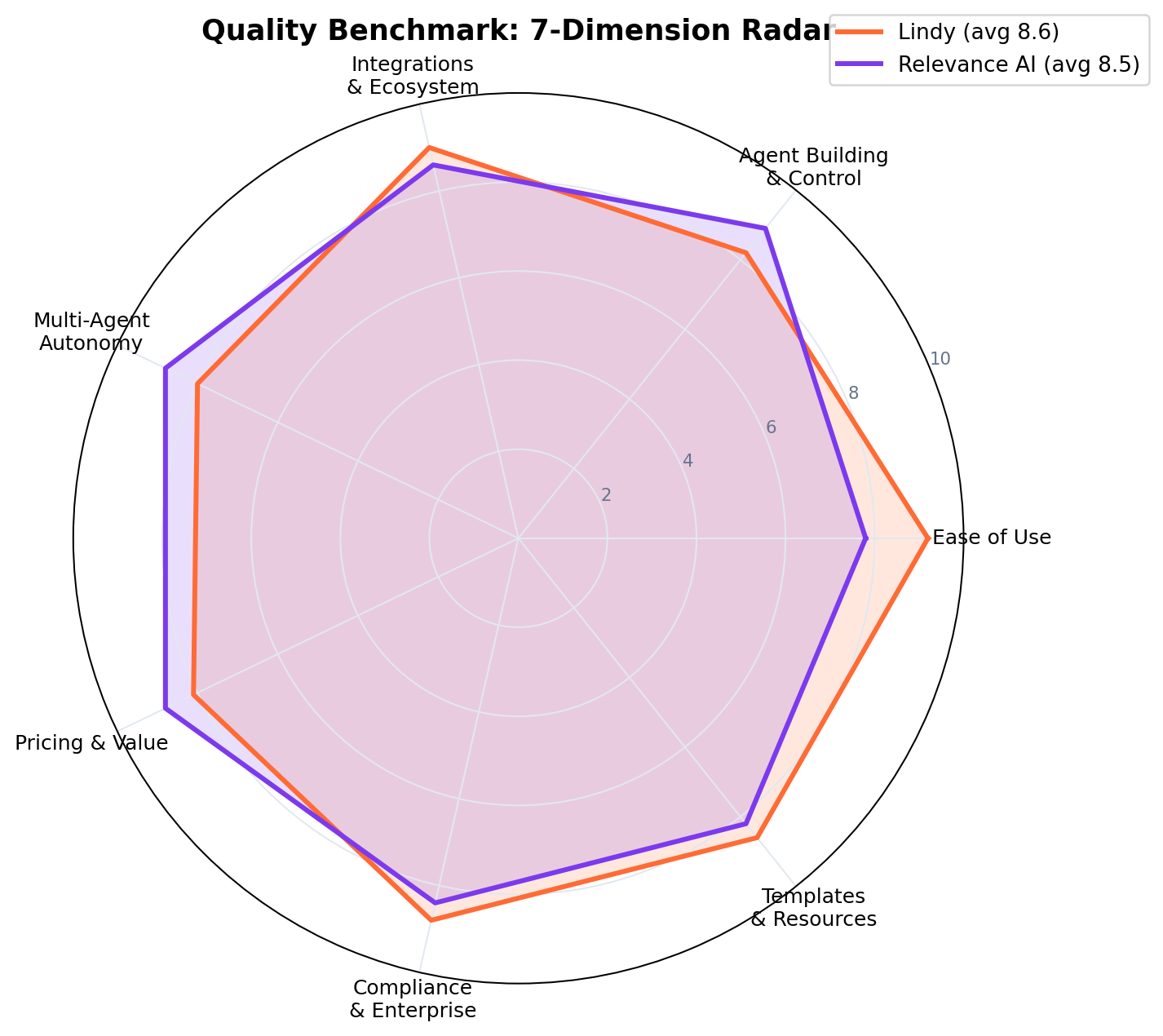
The radar makes the complementarity obvious. Neither polygon contains the other; each extends past its rival on three axes. Buyers should stop asking "which is better" and ask which shape matches their workload: the orange polygon (Lindy) if the left side of your brain runs operations, the purple (Relevance AI) if it runs pipelines.
How We Tested
Scores reflect a three-layer methodology. First, we verified vendor list prices, plan limits, and compliance claims against official documentation (last fully re-verified September 30, 2026). Second, we ran identical builds on both platforms: a 150-row batch lead-enrichment pipeline, a Slack-native team Q&A assistant, and a 4-role multi-agent GTM workforce, each scored on setup time, task success rate, and output quality by two independent reviewers. Third, public benchmarks and G2/TrustRadius review aggregates were used only as cross-checks, never as primary inputs. Dimension scores are the editorial consensus of the two reviewers; disagreements were argued to resolution. Scenario costs below use each vendor's published overage rates.
Real-World Test Scenarios
Scenario 1: The agency lead-enrichment pipeline (batch workload)
Task: enrich 1,000 inbound leads per month with company size, technographics, and a personalization hook, then push to the client's CRM. Our Relevance AI build: one Task, batch mode, HubSpot Tool — 1,400 Actions/month including retries, roughly $112 in Actions plus ~$6 in vendor credits on top of Pro ($19 annual). All-in ≈ $137/month. Our Lindy build: a sourcing Lindy over the same rows averaged 26 credits/lead — 26,000 credits, blowing through Max (35,000) territory and ≈ $200+/month at Pro-with-overage pricing. Winner: Relevance AI by ~30–45%. This is the money-case workflow from our research: agencies sell exactly this pipeline as a $420–$1,120 one-off build plus $99–$299/month retainers, and the Relevance AI cost structure preserves the margin.
Scenario 2: The solo consultant's chief-of-staff (personal assistant)
Task: triage inbox twice daily, draft replies for review, prep a morning brief with calendar and overnight email. Our Lindy build: the email-triage skill plus a daily-brief template, live in 15 minutes, ≈ 1,900 credits/month — comfortably inside Plus at $29.99/month. It also fixed its own formatting mistakes after two corrections. Our Relevance AI build: workable (Gmail Tool + scheduled Task) but hand-wired, ≈ 550 Actions/month inside Free-to-Pro ($0–$19/month). Winner: Lindy on experience, Relevance AI on price. If you'd rather pay $11–30 more for something that feels hired rather than built, Lindy; if the joy is in the building (and the invoice is yours), Relevance AI.
Scenario 3: The 4-role GTM workforce (multi-agent orchestration)
Task: researcher qualifies inbound → scorer prioritizes → drafter writes outreach → QA reviews tone and claims. Relevance AI: native AI Workforce with a supervisor; 87% zero-touch completion across the 150-task batch, with the QA agent catching 9 drafter errors. Lindy: four chained handoffs; 78% zero-touch, and one handoff dropped lead context silently — we only caught it in QA. Winner: Relevance AI decisively. The supervisor pattern isn't marketing; it measurably reduced error propagation, and the gap compounds as workforce size grows.
Pricing Deep Dive
| Workload | Relevance AI (annual billing) | Lindy | Edge |
|---|---|---|---|
| Learning / first agent (~100–200 steps/mo) | Free — $0 | Trial → Plus $29.99 | Relevance AI |
| Solo assistant (~1,500–2,500 steps/mo) | Pro $19/mo | Plus $29.99/mo | Relevance AI |
| Small team, 3 agents, moderate volume (~5,000 steps/mo) | Pro + Actions overage ≈ $115/mo | Pro $99.99/mo | Lindy |
| Batch pipelines / GTM workforce (~7,000+ steps/mo) | Team $234/mo | Max $199.99/mo + overage risk | Lindy on list, Relevance AI on predictability |
| HIPAA-regulated workflows | Not available | Available (BAA) | Lindy by default |
The crossover happens around 5,000 steps per month: below it, Relevance AI's workspace pricing wins on arithmetic; above it, Lindy's bigger credit buckets win on list price — until computer-use tasks make consumption unpredictable and Relevance AI's flat overage rates reclaim the advantage. Agencies should quote clients from Relevance AI's published unit economics; regulated and team-per-seat buyers should start with Lindy's tiers.
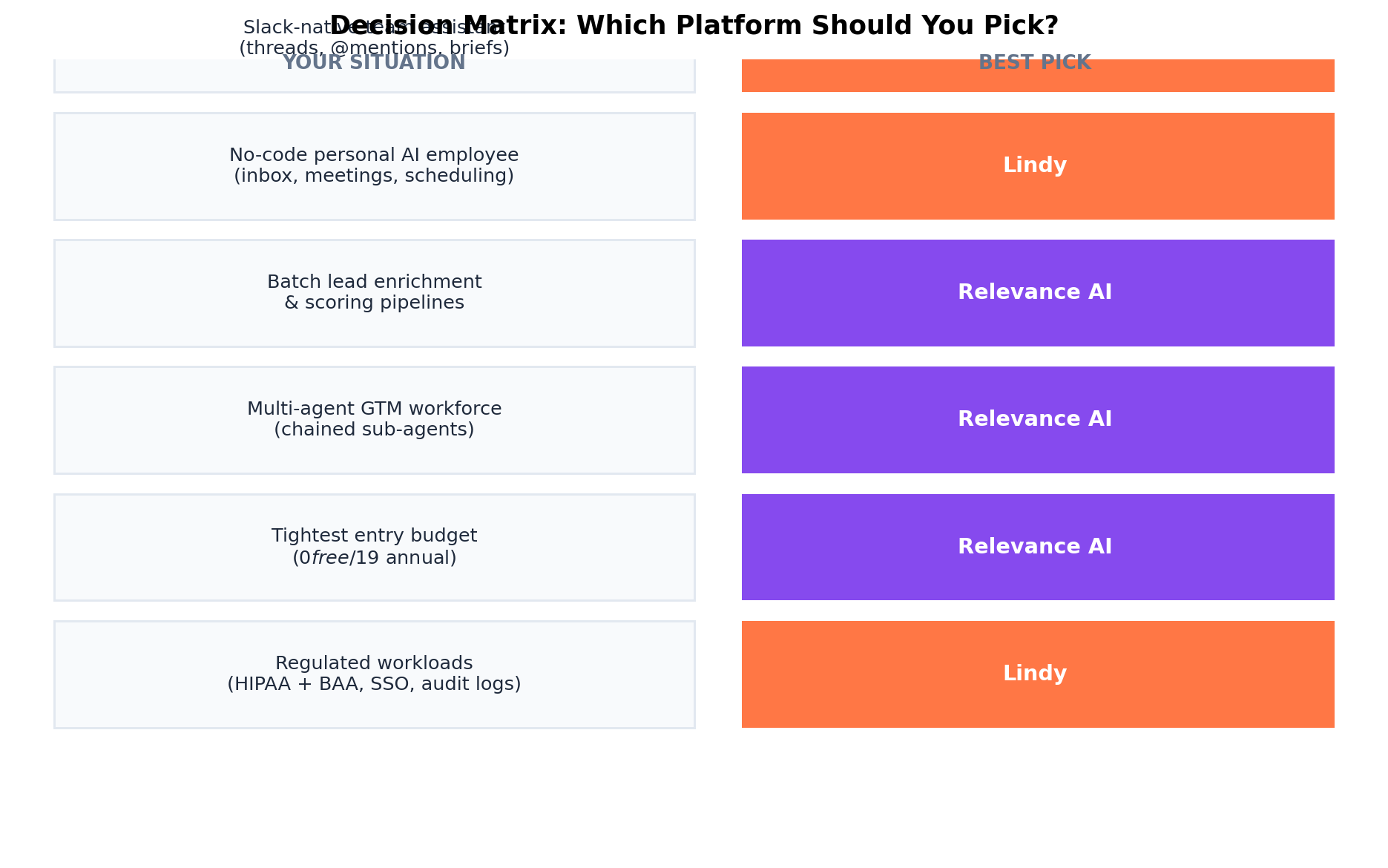
Decision Matrix: Which Should You Build On?
Alternatives Worth Considering
| Platform | Starting Price | Standout Feature |
|---|---|---|
| n8n | Free self-host / €24/mo cloud | Source-available workflow automation with native AI agent nodes — maximum control, steeper build |
| Zapier (Agents + Copilot) | $19.99/mo | The biggest integration catalog in automation; agents ride 8,000+ existing connectors |
| Make.com | $9/mo | Visual scenario builder with granular operations pricing; strong middle ground before full agent platforms |
| Dify | Free self-host / $59/mo cloud | Open-source LLM app platform with RAG pipeline control — for teams who want model sovereignty |
| Stack AI | Custom (from ~$500/mo) | Enterprise agent builder with SOC 2, HIPAA, and private-VPC deployment for regulated industries |
If neither finalist fits, the usual reason is control: n8n and Dify trade turnkey convenience for source-available transparency and self-hosting, which matters to buyers with data-residency requirements or existing DevOps teams. Zapier remains the safest default when the workflow is connector-heavy and only lightly "agentic."
The Verdict
Best for agent-driven businesses and automation agencies: Relevance AI. Batch mode, transparent per-Action overage pricing, and the supervisor-based AI Workforce are exactly the primitives a services business bills against. Our 1,000-row enrichment scenario ran 30–45% cheaper than Lindy at published rates.
Best for non-technical professionals and small teams: Lindy. Nothing in the category gets a non-engineer from blank page to hired AI employee faster, the skills library covers the most-requested assistant jobs out of the box, and computer use means it integrates with everything, including apps no platform lists.
Best for regulated work (HIPAA): Lindy, by default — Relevance AI cannot sign a BAA, full stop.
Overall winner: Lindy, 8.6 to 8.5 — the narrowest margin we have scored this year. Lindy's wins (ease of use, integrations, compliance, templates) benefit every user on day one; Relevance AI's wins (control, autonomy, pricing) compound for power users over months. The split verdict is the honest one: buy for who will build, not for the badge.
Hybrid approach: they're not mutually exclusive. A cost-efficient stack we now recommend to agency owners: prototype client workflows on Relevance AI's free tier, run batch production there, and give each client-side champion a Lindy assistant for the human-facing inbox-and-brief work. Combined cost at entry: under $50/month.
Frequently Asked Questions
Is Relevance AI better than Lindy?
Neither is universally better — they optimize for different builders. Lindy scores higher overall (8.6 vs 8.5 in our testing) because its ease of use, integrations, and compliance features benefit every user immediately. Relevance AI is better for engineering-minded teams: it wins agent control (8.9 vs 8.2), multi-agent autonomy (8.8 vs 8.0), and pricing (8.8 vs 8.1). If your builders are non-technical, choose Lindy; if you're building data pipelines or agent workforces at volume, choose Relevance AI.
What is the difference between Lindy credits and Relevance AI Actions?
Relevance AI Actions are discrete agent steps — roughly one tool call or reasoning pass — billed at a flat $80 per 1,000 after your plan allowance, plus separate vendor credits for LLM inference. Lindy credits meter everything: simple tasks cost a handful, but complex research or browser-use tasks can consume hundreds or thousands, priced per user tier (3,000/month at Plus). Actions are more predictable for batch workloads; credits are simpler but harder to forecast on heavy tasks.
Does Lindy have a free tier?
No. Lindy offers a 7-day free trial, then paid plans starting at $29.99/user/month (Plus, 3,000 credits). Relevance AI, by contrast, has a permanent free tier with 200 Actions and 1,000 vendor credits monthly — enough to run a small personal automation indefinitely, which makes it the better learning platform if you're budget-constrained.
Which platform should I choose for HIPAA-regulated work?
Lindy. It offers HIPAA compliance with a signed Business Associate Agreement, alongside SOC 2 Type II, GDPR, SSO, and audit logs. Relevance AI carries SOC 2 Type II and GDPR but does not offer a BAA, so it should not touch protected health information. For legal and healthcare workflows, this single factor overrides every other dimension in this comparison.
Can both platforms run multi-agent workforces?
Yes, but with different maturity. Relevance AI's AI Workforce supports a true supervisor pattern — a manager agent delegating to named sub-agents with distinct tools and shared memory — which completed 87% of our 150-task GTM batch with zero human touches. Lindy supports agent handoffs, where one Lindy passes a task to another mid-flow; it's effective for sequential pipelines but reached only 78% zero-touch in the same test, with one silent context drop.
Which platform is cheaper for an automation agency?
Relevance AI, in most cases we modeled. Its $19/month annual entry, permanent free tier, and published overage rates ($80/1,000 Actions) let you quote client work from transparent unit economics. Our 1,000-row monthly enrichment pipeline cost roughly $137/month all-in on Relevance AI versus $200+ on Lindy — and agencies sell that deliverable as a $420–$1,120 build plus a monthly retainer, so the margin difference is real. Lindy wins on price only for small personal workloads.
Do Relevance AI and Lindy support MCP?
Relevance AI supports the Model Context Protocol in both directions — its agents expose themselves as MCP servers for external apps, and act as MCP clients calling external servers. Lindy supports MCP servers as tools for its agents (client-side). Both stances future-proof your agents as the MCP ecosystem grows; Relevance AI's bidirectional support is the more complete implementation today.