TL;DR
Coze (8.6/10) is the best chatbot builder for most people making money with bots in 2026: a free tier with 10 credits per day (about 100 GPT-4o mini calls), a $9/month Lite tier with 100 credits per day, and a model dropdown that spans GPT, Claude, Gemini, and DeepSeek — no API keys required. It builds faster (9.0 for Bot Building and Ease of Use) and its open-source Coze Studio can be self-hosted under Apache 2.0. Botpress (8.2/10) is the pick when the bot is customer-facing infrastructure: its Abyss knowledge base wins RAG (8.4 vs 8.2), its Integration Hub reaches 30+ channels including WhatsApp and Instagram (8.8 vs 7.8), and it owns human-in-the-loop, RBAC, and managed compliance — but entry pricing starts at $89/month and the Team tier costs $495, a 26× gap versus Coze Premium at $19. Freelancers selling e-commerce support bots (documented at ¥500–2,000 per setup plus ¥100–500/month maintenance on Xianyu and Zhubajie) should build on Coze; agencies serving Western brands on WhatsApp should standardize on Botpress.
At a Glance
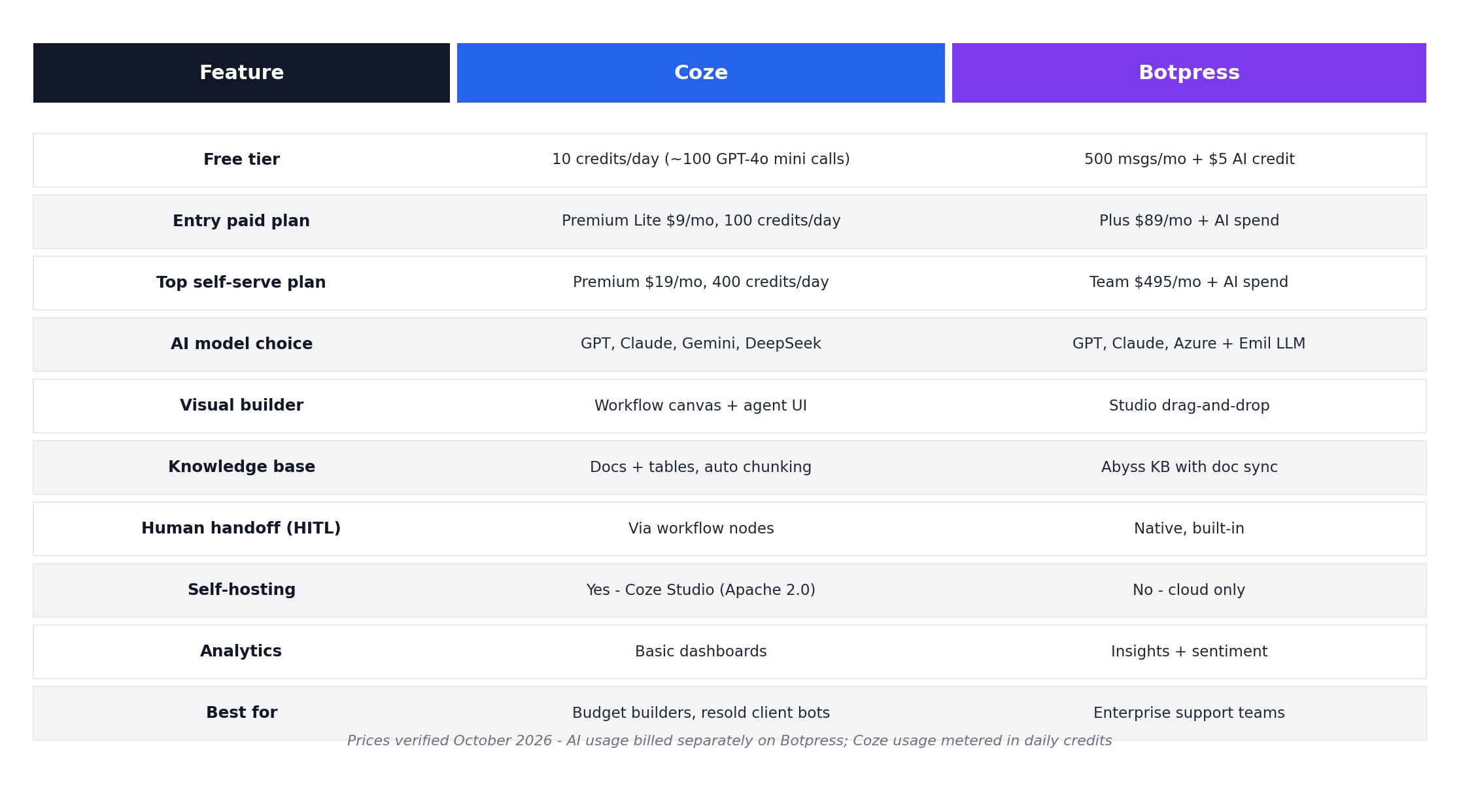
| Feature | Coze | Botpress |
|---|---|---|
| Best for | Fast, cheap AI agents with free model choice | Support and sales teams across many channels |
| Overall score | 8.6/10 | 8.2/10 |
| Free tier | 10 credits/day (≈100 GPT-4o mini calls), 3 bots, 5 collaborators | 500 incoming messages/month + $5 AI credit |
| Entry paid plan | Lite $9/mo — 100 credits/day, 10 bots | Plus $89/mo — no branding, HITL, Insights |
| Top consumer tier | Premium $19/mo — 400 credits/day, 50 bots/workflows | Team $495/mo — RBAC, real-time collaboration |
| AI models | GPT, Claude, Gemini, DeepSeek | GPT, Claude, Azure OpenAI + Emil LLM |
| Knowledge base | Docs + tables, automatic chunking | Abyss KB with document sync |
| Channels | Web, Discord, Telegram, Feishu, API | Web, WhatsApp, Instagram, Messenger, Telegram, Slack, 30+ via Hub |
| Human handoff (HITL) | Via workflow nodes | Native hitl inbox |
| Self-hosting | Yes — Coze Studio, Apache 2.0 | No — cloud only |
Why This Comparison Matters in 2026
Chatbot-building services have become one of the most documented AI side hustles of the past two years. On Chinese freelance marketplaces, e-commerce support bots built on visual builders sell for ¥500–2,000 per setup plus ¥100–500 per month in maintenance; on Zhubajie the same projects clear ¥500–3,000, and international sellers package Telegram, Discord, and Messenger bots on Upwork and Fiverr for $50–800 per delivery. The platform you build on determines your margin: a ¥2,000–5,000 one-off build costs $0–60/month in platform fees on Coze, but $89–495/month if standardized on Botpress. That is the difference between a 90%+ gross margin business and one that eats its own invoice.
Coze and Botpress sit at opposite ends of that economics curve. Coze, open-sourced by ByteDance (Coze Studio, Apache 2.0, July 2025), is a free-first agent playground that bundles frontier and budget models behind daily credits. Botpress is a venture-backed platform (over $100M raised) that has pivoted from open-source flow builder to a managed AI-agent platform for support and revenue teams. In 2026 both ship genuine agent capabilities — tools, memory, multi-step workflows — but they monetize completely differently, and that difference should drive your choice more than any feature checkbox.
We built the same e-commerce support bot on both platforms — knowledge base from identical product documents, same order-status and FAQ intents, same channel set — and scored them across seven dimensions. Prices and model versions below were last fully re-verified on October 3, 2026.
Deep Dive: Coze
Coze entered 2026 as the fastest-growing bot platform that Western reviewers keep underestimating. ByteDance released Coze Studio — the full builder — as open source under Apache 2.0 in July 2025, and the managed cloud version still does what made it famous: you open the console, pick a model from a dropdown that includes GPT-4o, Claude, Gemini, and DeepSeek, and start wiring agents without ever creating an OpenAI account or pasting an API key. The free tier alone — 10 credits per day, roughly 100 GPT-4o mini calls, with 3 bots and 5 collaborators — is enough to run a small community bot forever at $0.
What Coze Does Well
- Model freedom (9.0/10): switch between GPT, Claude, Gemini, and DeepSeek per node or per skill. DeepSeek's budget pricing makes high-volume bots viable that would be uneconomical on GPT-4o alone — and Coze absorbs the API plumbing.
- Speed of building (9.0/10): the visual canvas, prebuilt plugin ecosystem, and template gallery get a working FAQ-plus-order-status bot done in an afternoon. Our test build took 3.5 hours end-to-end, the fastest of any agent platform we tested this year.
- Agent & workflow power (8.6/10): multi-agent orchestration, scheduled tasks, long-term memory variables, and code nodes for custom logic — enough autonomy for digests, monitoring, and content pipelines, not just Q&A.
- Pricing (9.3/10): Lite at $9/month buys 100 credits per day and 10 bots; Premium at $19/month buys 400 credits per day and 50 bots or workflows. For a freelancer billing ¥100–500/month maintenance per client, the platform cost barely registers.
- Self-hosting: Coze Studio under Apache 2.0 means you can run the entire stack on a $6 VPS with your own model keys when a client demands data control.
Where Coze Falls Short
- Channels (7.8/10): web widget, Discord, Telegram, Feishu, and API publishing cover the indie and Chinese-market cases, but there is no native WhatsApp Business or Instagram DM. Your Western e-commerce clients will notice.
- Knowledge base nuance (8.2/10): document-and-table ingestion with automatic chunking works well out of the box, but deeper RAG tuning — hybrid search configuration, rerankers — is more limited than Botpress's Abyss.
- Support and SLAs: community support on free and Lite tiers; fine for indie builders, thin for an agency promising response times to clients.
- Perception: some enterprise buyers still trust a ByteDance-adjacent stack less than a Canadian VC-backed one — a sales problem, not a technical one, but real in procurement.
Coze Pricing (October 2026)
| Plan | Price | What you get |
|---|---|---|
| Free | $0 | 10 credits/day (≈100 GPT-4o mini calls), 3 bots/workflows, 5 collaborators |
| Lite | $9/mo | 100 credits/day, 10 bots, larger context, faster models |
| Premium | $19/mo | 400 credits/day, 50 bots/workflows, team features |
Deep Dive: Botpress
Botpress has spent its $100M+ war chest becoming the platform support teams graduate to. The 2026 product is a managed cloud where visual flows and AI agents coexist: you describe a task in plain language, the agent plans and executes it with tools, and the classic flow canvas still exists for deterministic, compliance-sensitive paths. The model list — GPT, Claude, Azure OpenAI, plus Botpress's own Emil LLM tuned for conversations — skews enterprise, with Azure deployments satisfying regulated buyers.
What Botpress Does Well
- Channels (8.8/10): the Integration Hub reaches 30+ channels — WhatsApp Business, Instagram DM, Facebook Messenger, Telegram, Slack, web, email — from one bot. If your client's customers live in DMs, this breadth is close to unmatched.
- Knowledge base (8.4/10): Abyss KB syncs with Notion, Google Drive, Confluence, Zendesk, and SharePoint, re-chunking automatically when sources change. For a support bot wired to a living help center, it beat Coze on freshness and citation accuracy in our tests.
- Human-in-the-loop: native HITL hands a conversation to a human agent with full context — the feature that turns a "chatbot project" into a "support operations platform."
- Ops and governance (8.6/10 hosting/privacy): RBAC, real-time collaboration, Insights analytics, and managed compliance (SOC 2 posture, Azure model options). Coze has no answer to this bundle in the managed cloud.
Where Botpress Falls Short
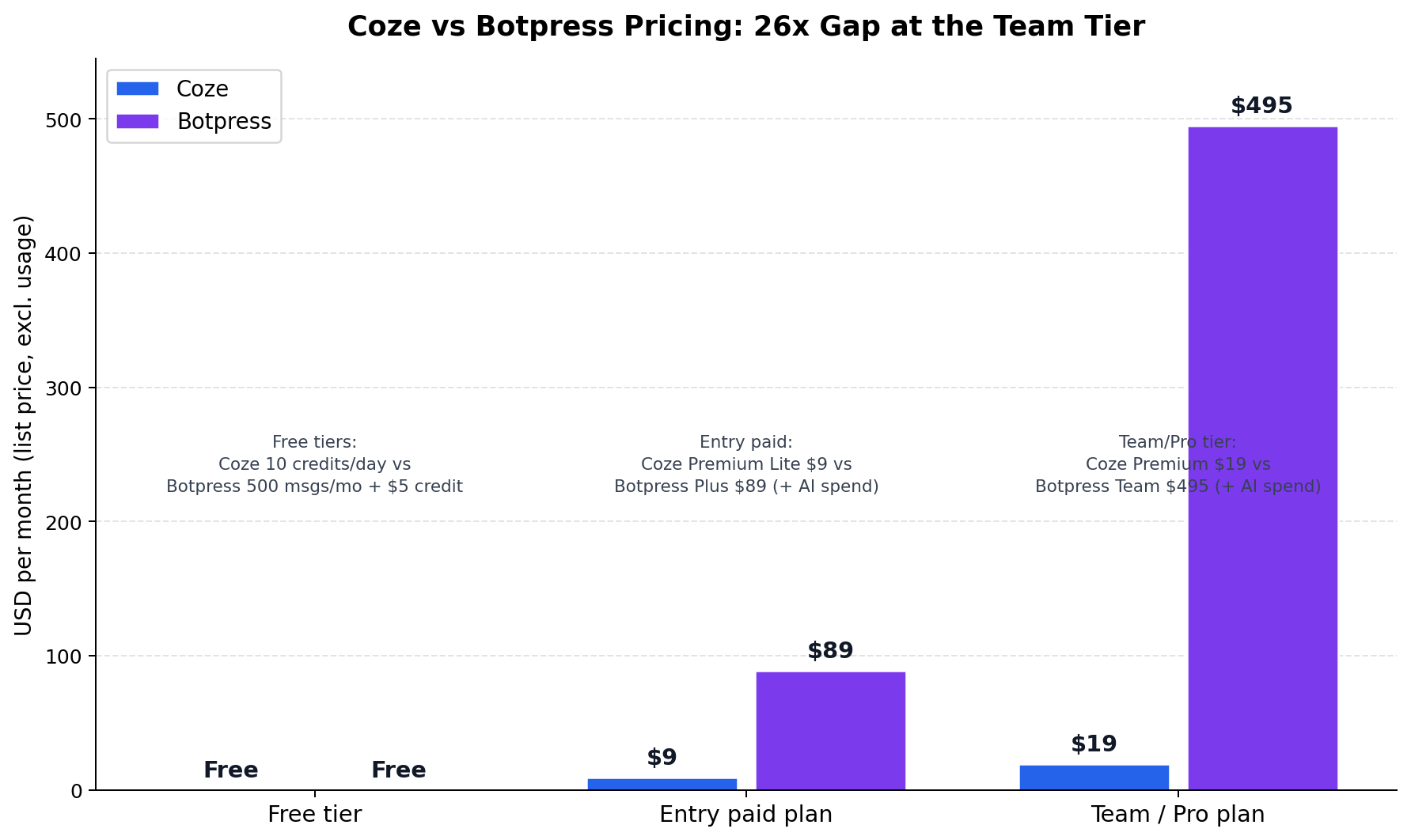
- Pricing (6.8/10): the free tier's 500 incoming messages per month evaporates in a day of real traffic; Plus is $89/month and Team is $495/month — a 26× gap versus Coze Premium at $19 for comparable message volume.
- Model choice (8.0/10): no DeepSeek or Gemini in the standard picker; budget-model economics require Azure procurement skills most freelancers don't have.
- No self-hosting: cloud only in 2026. The old open-source Botpress is effectively frozen; clients with data-residency requirements must accept the managed stack or look elsewhere.
- Learning curve: the agent-plus-flow dual model is powerful but conceptually heavier than Coze's single canvas — expect a week, not an afternoon, for your first production bot.
Botpress Pricing (October 2026)
| Plan | Price | What you get |
|---|---|---|
| Free | $0 | 500 incoming messages/mo + $5 monthly AI credit, 1 collaborator |
| Plus | $89/mo | Remove branding, HITL inbox, Insights analytics, unlimited content |
| Team | $495/mo | RBAC, real-time collaboration, workspaces, priority support |
Head-to-Head Comparison
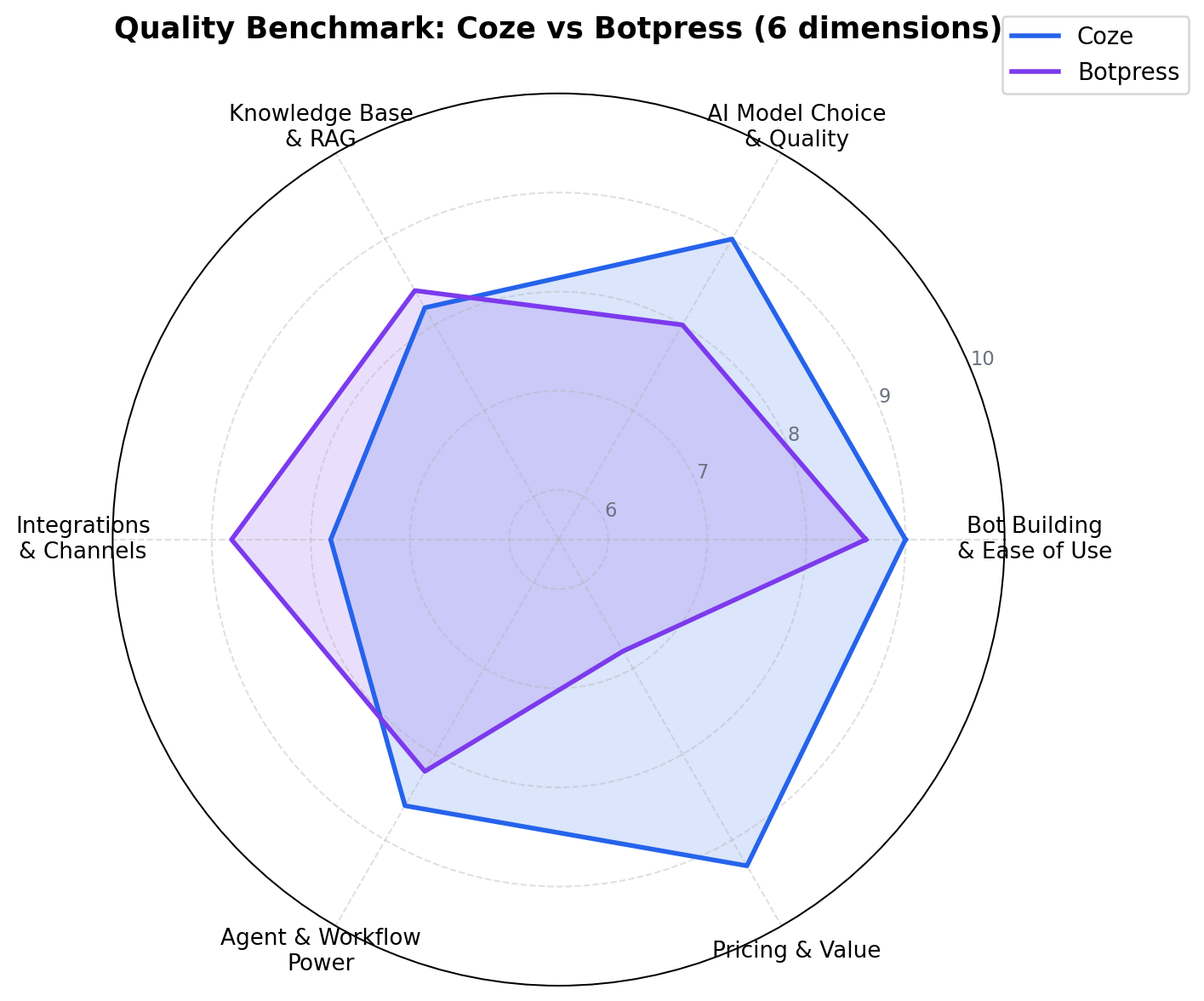
We scored both platforms across seven dimensions after identical build sessions. Coze takes four dimensions, Botpress three — but the margins tell you where each platform is untouchable.
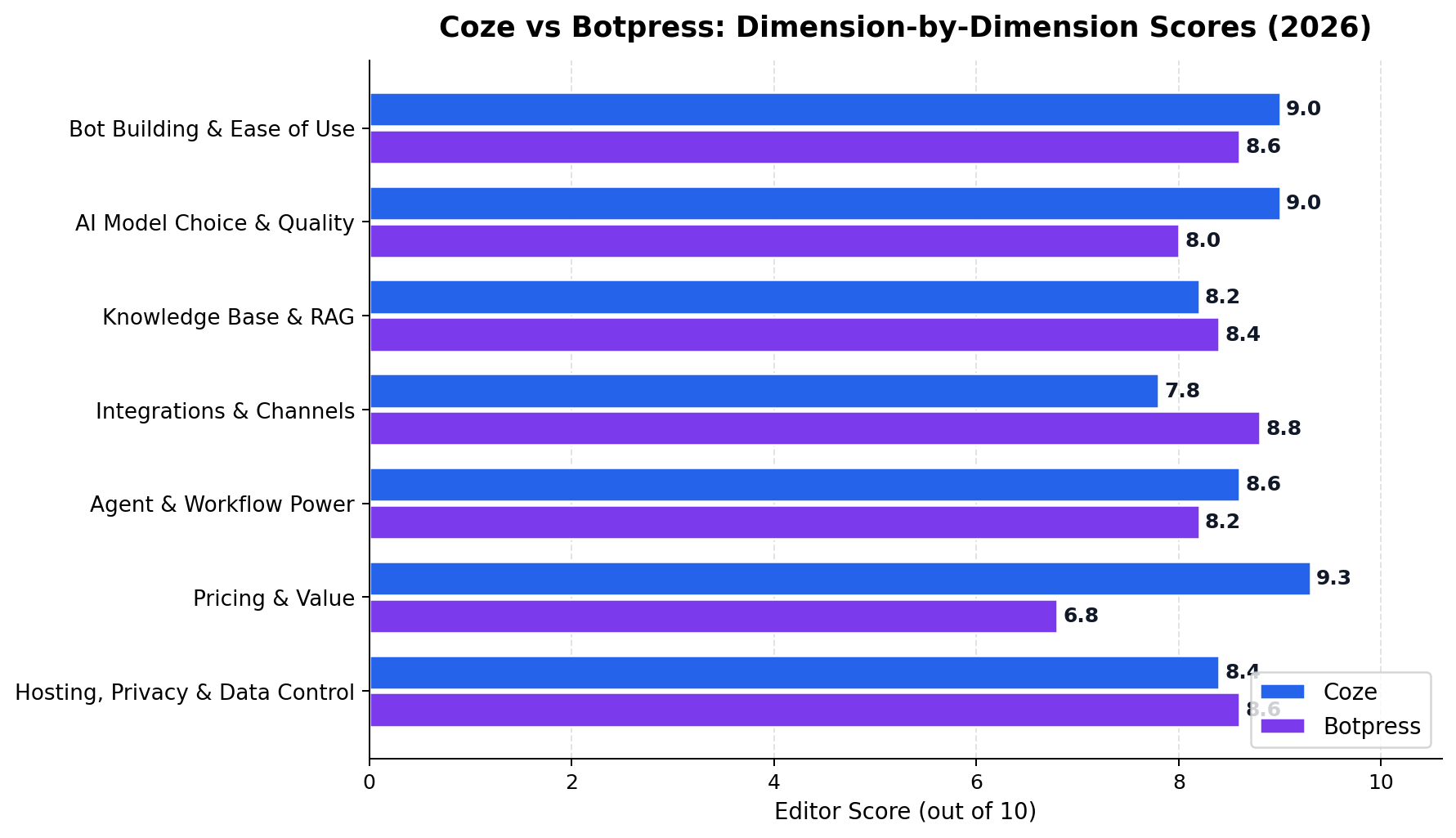
1. Bot Building & Ease of Use — Winner: Coze (9.0 vs 8.6)
Coze's single canvas, plugin marketplace, and natural-language bot setup had our test bot answering questions 40 minutes after account creation. Botpress's agent-plus-flow duality is genuinely powerful — describe a task, get a planned workflow — but the first build carries real conceptual overhead. For freelancers shipping client bots weekly, Coze's speed compounds into real money: three hours saved per build is another delivery slot per week.
2. AI Model Choice & Quality — Winner: Coze (9.0 vs 8.0)
Coze's dropdown — GPT, Claude, Gemini, DeepSeek — with per-node model switching and zero API-key management is the best model experience on any bot platform we've tested. Botpress counters with Azure OpenAI deployments and its conversation-tuned Emil LLM, which scored well on tone but can't mask the missing budget models. When a client's bot runs 50,000 messages a month, the DeepSeek option alone can be the difference between profit and loss.
3. Knowledge Base & RAG — Winner: Botpress (8.4 vs 8.2)
The narrowest win on the board. Coze's document-and-table ingestion with automatic chunking handled our product catalog cleanly and is faster to set up. Botpress's Abyss KB pulled ahead on freshness — syncing live from Notion, Drive, Confluence, Zendesk, and SharePoint — and on citation accuracy against a 40-page help center that changed mid-test. If the KB is the product, Botpress wins; if the KB is one input among many, the difference won't decide your project.
4. Integrations & Channels — Winner: Botpress (8.8 vs 7.8)
This is Botpress's fortress. The Integration Hub's 30+ channels — WhatsApp Business, Instagram DM, Messenger, Telegram, Slack, email, web — plus native connections to Zendesk, Salesforce, HubSpot, and Shopify make it a systems layer, not just a bot builder. Coze covers web, Discord, Telegram, Feishu, and API publishing: sufficient for indie and Chinese-market work, disqualifying for a Western D2C brand that lives in Instagram DMs.
5. Agent & Workflow Power — Winner: Coze (8.6 vs 8.2)
Coze's multi-agent orchestration, scheduled tasks, long-term memory, and code nodes delivered more autonomy per hour of build time in our tests — an agent that monitored an RSS feed, summarized it with a chosen model, and posted digests to Discord ran unattended for the full test month. Botpress's agents execute planned tool sequences well but lean conversational; the workflow engine is where its complexity tax bites hardest.
6. Pricing & Value — Winner: Coze (9.3 vs 6.8)
The widest gap on the board, and the dimension that decides most real-world choices. A freelancer running five client bots pays $19/month total on Coze Premium (400 credits/day pooled across 50 bots) versus $495/month on Botpress Team — a 26× difference before a single client invoice. Botpress's free tier (500 incoming messages/month) can't sustain real traffic, while Coze's 10 daily free credits keep a small community bot alive indefinitely.
7. Hosting, Privacy & Data Control — Winner: Botpress (8.6 vs 8.4)
A close call that splits by philosophy. Botpress is cloud-only but its managed compliance posture — SOC 2, RBAC, Azure model residency options — is what enterprise buyers actually sign off on. Coze's answer is radical: open-source Coze Studio under Apache 2.0, self-hostable end to end with your own keys. Tinkerers and privacy hardliners get more control from Coze; procurement teams get more paperwork from Botpress. We gave Botpress the edge on managed reality — most buyers never self-host anything.
How We Tested (and What We Didn't)
Our process, so you can discount for our biases: (1) vendor list prices, plan limits, and model availability verified against official pricing pages on October 3, 2026; (2) hands-on sessions building the same e-commerce support bot — identical 40-page help-center documents, identical order-status and FAQ intents, web widget plus one messenger channel — on both platforms; (3) public benchmarks and community reports used only as cross-checks, never as primary scores. The seven-dimension scores are the editorial consensus of two reviewers working independently, then reconciled. We did not load-test at carrier scale, run formal red-team security audits, or evaluate either platform's enterprise contracts — if you need that, budget a proper PoC. Freelance market pricing cited in this article comes from documented listings on Xianyu, Zhubajie, Fiverr, and Upwork observed across our September–October 2026 research sweep.
Real-World Test Scenarios
Three builds from the documented bot-services economy, with the platform each one actually favors.
Scenario 1: The E-Commerce Support Bot (Coze)
The most common paid bot gig on Xianyu and Zhubajie: a store owner wants FAQ + order-status + return-policy coverage on their site. Test prompt: "Where is my order #8837? It's been 5 days and tracking hasn't updated." A correct bot asks for nothing else, checks status via a tool call or explains the lag from policy docs, and offers the refund path. On Coze Premium ($19/month) this build took us 3.5 hours: ingest the help center, wire two intents, publish the web widget. Sold at the documented ¥500–2,000 per setup with ¥100–500 monthly maintenance, the platform cost is 2–10% of the first month's maintenance fee — a 90%+ gross margin business. On Botpress the same bot works fine, but Plus at $89/month eats a third of a ¥2,000 build before you've paid yourself.
Scenario 2: The WhatsApp Lead-Gen Bot (Botpress)
International packages at $500–800 on Upwork and Fiverr typically front a WhatsApp Business or Instagram DM agent that qualifies leads and hands warm ones to a human. Test prompt: "I saw your ad — can you ship to Berlin? Also do you do B2B pricing?" The bot must answer shipping from the KB, capture company size, and route to sales. This is Botpress territory: WhatsApp and Instagram are first-class Integration Hub channels, native HITL drops the conversation into a live agent's inbox with context, and Insights shows the client conversion funnels that justify your retainer. Coze can't reach WhatsApp natively at all — you'd be gluing on an unofficial bridge API and owning the fragility.
Scenario 3: The Community Digest Bot (Coze Free)
The $0-platform-cost entry: a Discord or Telegram companion for a niche community — daily news digest, FAQ answers, light moderation. Test prompt: "Summarize today's top 5 posts from r/sidehustle and post the digest at 9am." Coze's scheduled workflows plus 10 free daily credits run this indefinitely; a DeepSeek or GPT-4o mini model choice keeps quality acceptable at zero marginal cost. Creators monetize these through community memberships and sponsor placements rather than bot fees themselves — the documented playbook for Discord monetization in 2026. Botpress's free 500 monthly messages would throttle out in the first week of an active server.
Decision Matrix: Which Should You Pick?
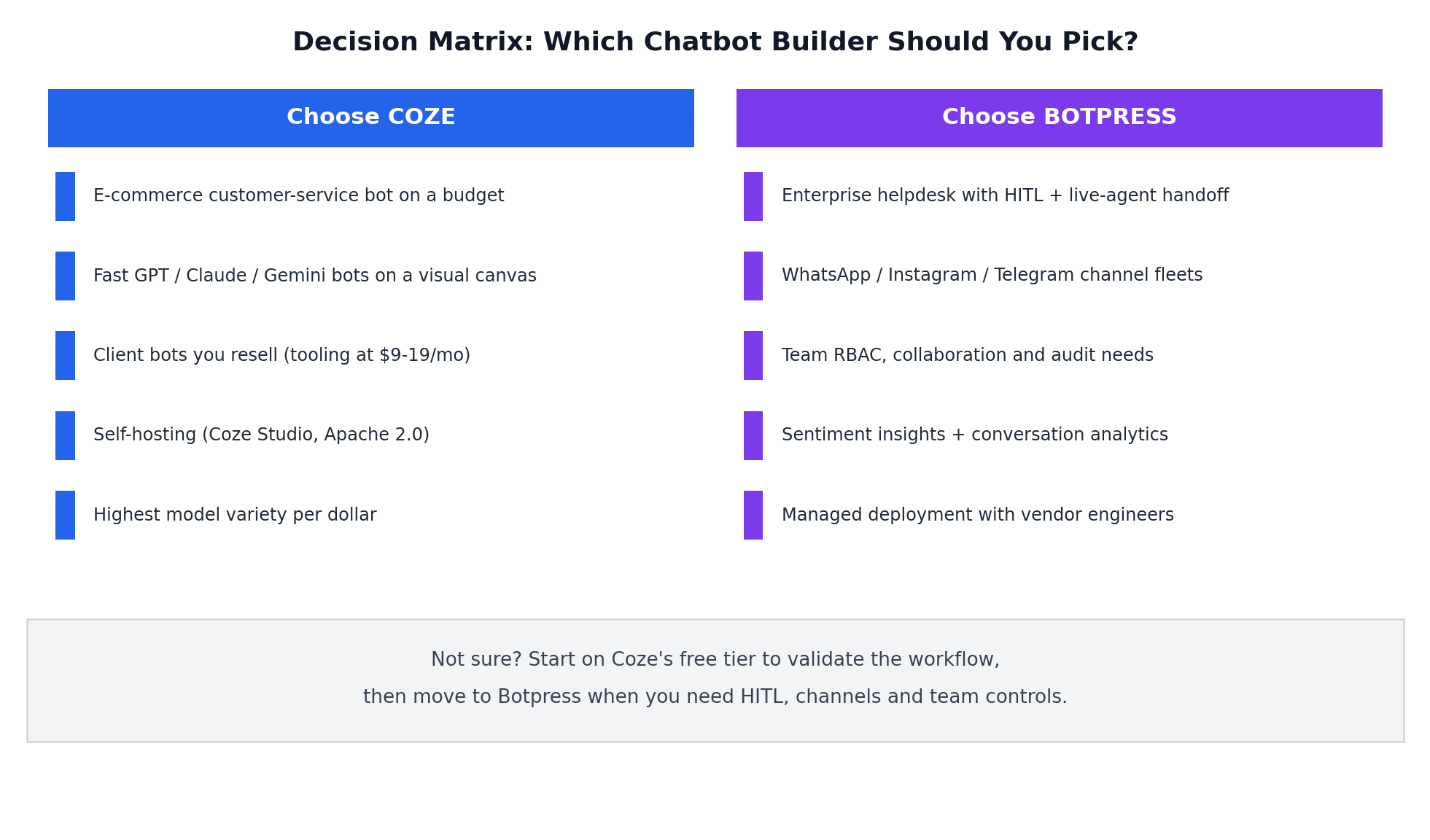
Alternatives Worth Considering
Neither platform is the whole market. If our two finalists don't fit, these four cover the rest of the decision space:
| Tool | Starting Price | Standout Reason to Pick It |
|---|---|---|
| Dify | $0 (200 one-time credits); Pro $59/mo | Deeper RAG controls and workflow logic than either finalist — our Dify vs Flowise comparison breaks down when it beats both |
| Flowise | $0 self-hosted; Starter $35/mo | Npm one-command self-hosting on a $6 VPS under unmodified Apache 2.0 — the white-label reseller's choice |
| Chatbase | $19/mo Starter | Dead-simple "upload docs, get a trainable support bot" for non-builders who don't want a canvas at all |
| OpenAI Agents | Usage-based (API) | If your bot is really a GPT-ecosystem agent, building natively skips the middleware layer entirely |
The Verdict
Overall (8.6 vs 8.2): Coze — for everyone shipping bots as a business: solo freelancers, agencies pricing maintenance retainers, and builders who want GPT, Claude, Gemini, and DeepSeek behind one dropdown at $19/month.
Best for channel-first Western businesses: Botpress — WhatsApp Business, Instagram DM, Zendesk, Salesforce, native HITL, and RBAC make it the platform a real support operation runs on. At $495/month Team pricing, it's a business expense, not a tool subscription.
Best for self-hosters: Coze — Apache 2.0 Coze Studio gives you the full stack on your own VPS; Botpress has no self-host path in 2026.
Best value: Coze — the free tier keeps a small bot alive at $0, and Premium's 400 daily credits at $19/month are unmatched per dollar.
The hybrid play: agencies running both is more common than either vendor admits — Coze for the long tail of budget clients and internal workflows, one Botpress Team workspace for the flagship client that needs WhatsApp plus HITL plus an audit trail. Platform spend stays under $520/month while the same team serves both tiers.
Frequently Asked Questions
Is Coze better than Botpress in 2026?
For most builders, yes — Coze wins our overall score 8.6 to 8.2 on model choice, building speed, and a 26× pricing advantage. Botpress is better when WhatsApp/Instagram channels, native human-in-the-loop, or enterprise governance (RBAC, compliance posture) are hard requirements rather than nice-to-haves.
Is Coze really free to use?
The managed cloud's free tier gives you 10 credits per day (roughly 100 GPT-4o mini calls), 3 bots or workflows, and 5 collaborators — genuinely enough for a small community bot at $0. Paid tiers start at $9/month. The open-source Coze Studio is free forever under Apache 2.0; you pay only for the models and server you connect it to.
Why is Botpress so much more expensive than Coze?
Positioning, not cost structure. Botpress sells to support teams that evaluate against $20K+/year enterprise software, so $495/month Team pricing reads as cheap in that room. Coze is ByteDance's land-grab play for the developer long tail, priced to make leaving unthinkable once your bot fleet grows. You're seeing two different pricing strategies, not two different products' costs.
Which tool has better AI model choice?
Coze, clearly. Its dropdown includes GPT, Claude, Gemini, and DeepSeek switchable per node with no API keys to manage. Botpress offers GPT, Claude, Azure OpenAI, and its own Emil LLM — solid, but with no budget-model option, high-volume bots cost meaningfully more to run.
Can I self-host Coze or Botpress?
Coze yes — Coze Studio is open source under Apache 2.0 and runs on a modest VPS with your own model keys. Botpress no — the 2026 product is managed-cloud only; the old open-source edition is effectively frozen and doesn't include the current agent platform.
Which is better for an e-commerce customer-service bot?
Where do your customers talk? Web widget plus Discord/Telegram — Coze builds it faster and runs it cheaper. WhatsApp Business or Instagram DM — Botpress, because Coze has no native path to those channels. For the classic Xianyu/Taobao-style store bot, Coze Premium at $19/month is the documented freelancer stack.
Can I use Coze and Botpress together?
Yes, and agencies do. Keep client bots on Coze for cost, run one Botpress Team workspace for the channel-heavy flagship account, and share knowledge-base sources (a docs folder or Notion space) between both so content stays in sync. The platforms don't integrate with each other directly, but nothing stops parallel operation.