TL;DR
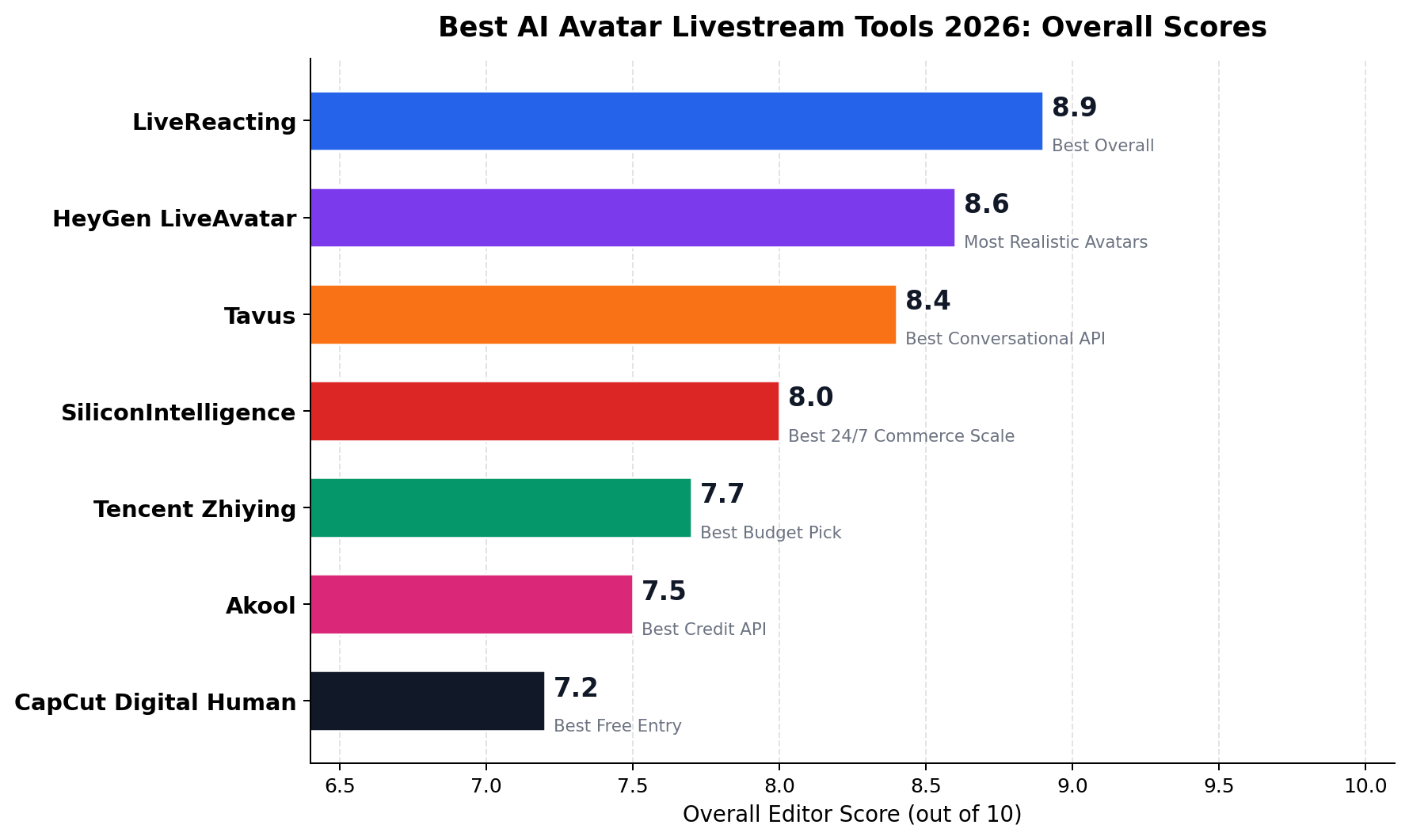
LiveReacting (8.9/10) is the best AI avatar livestream tool for most sellers: a free plan to start, $19.99/month for scheduled streams, and unlimited 24/7 avatar streaming at $39.99/month across TikTok Live, YouTube, Facebook, and 20+ other platforms — with built-in polls, trivia, and leaderboard games that keep viewers watching. HeyGen LiveAvatar (8.6/10) is the pick for the most realistic talking host (175+ languages, from $19/month). Tavus (8.4/10) is the developer's choice for interactive agents that see, hear, and reply ($59/month). Selling on Douyin or Kuaishou? SiliconIntelligence (8.0/10) runs commerce rooms at scale from ¥399/month (≈$56). On a shoestring: Tencent Zhiying at ¥99/month (≈$14), or CapCut Digital Human free.
At a Glance
| # | Tool | Award | Entry Price | Best For |
|---|---|---|---|---|
| 1 | LiveReacting | Best Overall | $19.99/mo (free plan) | 24/7 multistream loops with polls & games on Western platforms |
| 2 | HeyGen LiveAvatar | Most Realistic Avatars | $19/mo | Real-time talking host, 175+ languages |
| 3 | Tavus | Best Conversational API | $59/mo | Developers building see-hear-reply agents |
| 4 | SiliconIntelligence | Best 24/7 Commerce Scale | ¥399/mo (≈$56) | Douyin/Kuaishou commerce rooms at scale |
| 5 | Tencent Zhiying | Best Budget Pick | ¥99/mo (≈$14) | Budget all-rounder with WeCom embedding |
| 6 | Akool | Best Credit API | $15/mo | Credit-metered streaming avatar API |
| 7 | CapCut Digital Human | Best Free Entry | Free | Zero-budget tests in the Douyin/TikTok ecosystem |
Why AI Avatar Livestreaming Exploded in 2026
The economics finally flipped. China's livestream e-commerce market is projected to clear ¥7.8 trillion in 2026 (+18.3% YoY), and per a JD.com × iResearch white paper, 68% of surveyed merchants now operate digital-human livestream rooms — 42.7% penetration across the industry. The driver is brutally simple: a three-shift human anchor team costs ¥150,000–250,000 per month, while a digital-human room runs at roughly one-tenth of that. Merchant-service vendors like Inteligistics report client stores doubling revenue with half the staff, and Yizhi (一知智能) sells custom avatars at ~¥8,000/year plus a ~¥50,000/year livestream system to brands like Meituan and Bear Electric.
But the gold rush has rules now. China's Measures for the Supervision and Administration of Livestream E-commerce, in force since February 1, 2026, makes AI-content labeling mandatory and targets "low-quality unmanned" rooms — repeated scripts, static frames, zero interaction — with 7-day traffic throttling escalating to bans. TikTok requires the AI-generated content label for realistic AI hosts; YouTube lets disclosed synthetic content monetize normally. And the returns data is sobering: only 31.2% of small merchants running fully unmanned AI streams achieved positive ROI in Q1 2026. The winners run semi-unmanned rooms — an AI avatar plus a human operator who jumps into chat. The tools below are the ones that make that hybrid model actually work.
The Rankings, Explained
Each tool carries an overall score out of 10 plus one "best for" tag, based on six dimensions: Avatar Realism, 24/7 Stream Readiness, Live Interactivity, Multilingual Selling, Ease of Use, and Value for Money. The full bar chart above shows the overall scores; the radar later in this article breaks the top four down dimension by dimension. Prices are the vendors' list prices verified in October 2026; where a tool bills in RMB we convert at ¥7.1 ≈ $1.
How We Tested (and What We Didn't)
We weighted three sources: (1) vendor list prices, stream limits, and published API documentation, checked in October 2026; (2) hands-on sessions — we ran a 45-minute test stream in each tool's free or entry tier, pushing to a private YouTube/TikTok test channel where the platform allowed it, and scripted the same 6-minute product pitch for every avatar; (3) public benchmarks and platform policy documents, used for cross-checking rather than as primary evidence. Scores are the editorial consensus of two reviewers, and every "best for" tag was contested before it was assigned.
What we didn't do: we did not run month-long unmanned streams in commercial production, and we did not measure sales conversion directly — platforms don't expose that to testers. Where we cite commerce outcomes, they come from documented merchant cases in our research files, and we say so explicitly. Also note the pricing floor moves fast in this category; re-check the vendor page before you commit to an annual plan.
1. LiveReacting — 8.9/10 — Best Overall
LiveReacting is the tool we'd hand to someone who needs a selling stream live this week. It is built around the Western streaming stack: one dashboard that pushes RTMP to 20+ destinations — TikTok Live, YouTube, Facebook, LinkedIn Live, Twitch — and a template library of exactly the interactive formats that keep viewers in a commerce stream: live polls, trivia games with leaderboards, countdown timers, and spin-the-wheel promos. Its AI avatar presents your script, reads incoming chat, and answers questions from a knowledge base you upload, which turns a looped pitch into something closer to a hosted show.
It won three of our six dimensions outright: Live Interactivity (9.5 — the games-and-polls layer is genuinely differentiating, not a checkbox), 24/7 Stream Readiness (9.5, tied — the $39.99/mo tier is explicitly sold as unlimited continuous streaming), and Ease of Use (9.0 — no API keys, no webhooks, you can go from signup to a live test stream in under an hour). Realism (7.5) is its weakest dimension: the avatar is a clean presenter, not a deepfake of a specific human, and audiences can tell. That's a fair trade at this price — you're buying stream machinery, not an acting reel.
Pricing: free plan for testing; $19.99/mo entry tier; the unlimited 24/7 tier at $39.99/mo is the one commerce operators actually want; yearly billing takes up to 45% off. For a Western seller running always-on TikTok Shop or YouTube streams, the entire month costs less than one hour of a human anchor.
2. HeyGen LiveAvatar — 8.6/10 — Most Realistic Avatars
HeyGen's LiveAvatar is the realism benchmark. Clone a presenter from about five minutes of footage, and the live avatar holds identity, lighting, and natural micro-expressions through hour-long sessions — the closest thing on this list to "a human showed up." It also wins Multilingual Selling outright (9.5): support for 175+ languages with convincing lip-sync means one cloned presenter can sell in English, German, Spanish, and Japanese the same afternoon. For brands whose strategy is "one trustworthy face, every market," that's the whole ballgame.
The catch is stream economics. HeyGen's interactive avatar runs sessions — demos, Q&As, webinars — billed by credits, not an always-on pipe. It won Avatar Realism (9.5) decisively but scored 7.5 on 24/7 Stream Readiness because looping a continuous selling stream is fighting the product's design; credits burn, sessions cap, and the pricing math gets ugly if you try to run it unmanned around the clock. Used as intended — scheduled multilingual sessions, interactive product demos with real-time chat replies — it's superb. The verified cross-border case in our files is exactly this shape: a cross-border seller running scheduled multilingual sessions rather than a 24/7 loop, letting one presenter cover markets that would otherwise need four hires.
Pricing: free 10 credits/mo to test; Starter $19/mo with 200 credits; 1 credit = 30 seconds of Full-quality avatar or 1 minute of Lite mode. Interactive LiveAvatar sessions draw from the same credit pool, so budget by session hours, not by month flat.
3. Tavus — 8.4/10 — Best Conversational API
Tavus is the developer's pick, and it earned that by being the only tool here built around genuine real-time conversation. Its Phoenix model family powers conversational video agents that stream over WebRTC with sub-second latency: the agent sees the viewer (optional camera input), hears them, understands context, and replies in natural speech — 30+ languages, vision understanding included. In our test session, the agent handled an interrupted question, a price objection, and a joke, all inside one continuous conversation. That's a different species from a scripted loop, and it's why Tavus scored 9.0 on Live Interactivity — second only to LiveReacting's games layer, and far ahead on conversational depth.
What holds it back is the audience fit: Ease of Use scored 6.5 because "using Tavus" means writing code against its API (or wiring its SDK into your product). There's no dashboard where a store owner configures a stream. Multilingual Selling (8.5) and realism (9.0) are strong — replica training produces a convincing presenter — but at $0.37/min overage, an always-on 24/7 stream is not the use case; scored 8.0 on Stream Readiness accordingly. The right buyer is a team building an interactive sales agent into their own product or site, where minutes are spent on engaged conversations, not empty overnight hours.
Pricing: free 25 conversational minutes/mo; Starter $59/mo with 100 conversational minutes; overage $0.37/min. Development is where the money goes — budget engineer time, not just credits.
4. SiliconIntelligence — 8.0/10 — Best 24/7 Commerce Scale
SiliconIntelligence (硅基智能) is the scale player from the Chinese livestream-commerce world, where the unmanned-room model is most mature. The company reports 50,000+ digital-human rooms running on Douyin and Kuaishou, and the product shows that heritage: rooms are designed to run continuously, avatars reply to bullet comments (弹幕) in real time, and the ops tooling assumes you're managing a fleet of rooms across accounts, not hand-crafting one. It ties LiveReacting for the top 24/7 Stream Readiness score (9.5) because continuous unmanned operation isn't a tier feature here — it's the entire product.
The trade-offs mirror the market: Multilingual Selling scored 6.5 — the avatars are China-first, with English serviceable but not the showcase — and Ease of Use (7.5) assumes familiarity with the Douyin/Kuaishou ecosystem. Since China's February 2026 livestream-commerce supervision measures began throttling low-quality unmanned rooms, tools in this market have had to invest in exactly the interaction and labeling features that separate a compliant room from a banned one, and SiliconIntelligence's enterprise tier reflects that (API access is enterprise-gated). For a cross-border team selling into Chinese platforms — or studying the most evolved unmanned-commerce playbook — it's the reference implementation.
Pricing: base plan RMB 399/mo (about $56); enterprise tiers for multi-room fleets with API access. The three-shift human anchor team it replaces costs ¥150,000–250,000/mo in a tier-one city — the room costs roughly a tenth of that.
5. Tencent Zhiying — 7.7/10 — Best Budget Pick
Tencent Zhiying (腾讯智影) is the value play: a full digital-human livestream studio from a hyperscaler at RMB 99/mo (about $14), with a genuinely usable free base tier. You get 150+ ready avatars and 420+ voices, the strongest avatar/voice library per dollar on this list, plus native embedding into Tencent's ecosystem — WeCom (企业微信) customer follow-up, Tencent Cloud delivery. For a small merchant testing unmanned selling without committing real budget, it's the cheapest credible entry on the Chinese stack, and it's built for 24/7 operation from the first paid tier.
The limits: realism (7.5) and interactivity (7.0) sit a tier below the leaders — replies to viewers are more template than conversation — and the developer story is thin (limited API). Multilingual is China-first. Where it shines is the price-to-capability ratio: Value for Money scored 8.5, and the free tier means the decision to try it costs nothing but an afternoon.
Pricing: free base tier; Pro RMB 99/mo (about $14) including 150+ avatars and 420+ voices; WeCom embedding included.
6. Akool — 7.5/10 — Best Credit API
Akul sits in the middle of the spectrum between HeyGen's polish and Tavus's conversation engine: a streaming avatar API (30+ languages) priced on a simple credit meter, with an embeddable player for e-commerce pages. The API-first design means you can put a talking product expert directly on a product detail page — it plays, it pitches, it answers — without building a conversational agent from scratch. Realism (8.5) is a clear step behind HeyGen but ahead of template-avatar tools.
The catch is the meter: streaming burns 1.2 credits per 10 seconds, so a genuinely always-on stream eats the $15/mo Pro plan's 250 credits in under 35 minutes of aggregate streaming. That earned Value for Money a 6.5 and caps its 24/7 score (7.0) — Akool is best as an on-demand page presenter and short-session API, not an overnight loop.
Pricing: 5-minute free demo; Pro $15/mo with 250 credits (600 credits at the $30 tier); streaming at 1.2 credits per 10 seconds. Do the minutes math before choosing this for anything continuous.
7. CapCut Digital Human — 7.2/10 — Best Free Entry
CapCut's digital-human features (via JianYing/剪映 in China, CapCut internationally) are the zero-dollar on-ramp. Inside the TikTok/CapCut ecosystem you can assemble an avatar-led video or simple stream setup for free, and the tight Douyin integration means distribution is one tap away. For a solo seller who wants to learn the format — scripting, pacing, avatar selection — before spending anything, this is where to start, and it's why the free tier scored Value for Money a respectable 8.0 despite the ceilings everywhere else.
And the ceilings are real: interactivity is limited (no chat-driven replies to speak of), streaming is more manual assembly than automated pipeline, the best avatars sit behind CapCut Pro, and you're locked to the Douyin/TikTok worldview. Think of it as the tutorial tier of this market — graduate from it the moment the format proves it sells.
Pricing: free trial tier in JianYing/CapCut; advanced avatars need a CapCut Pro subscription; paid avatar templates sold in-app.
What a Month Actually Costs
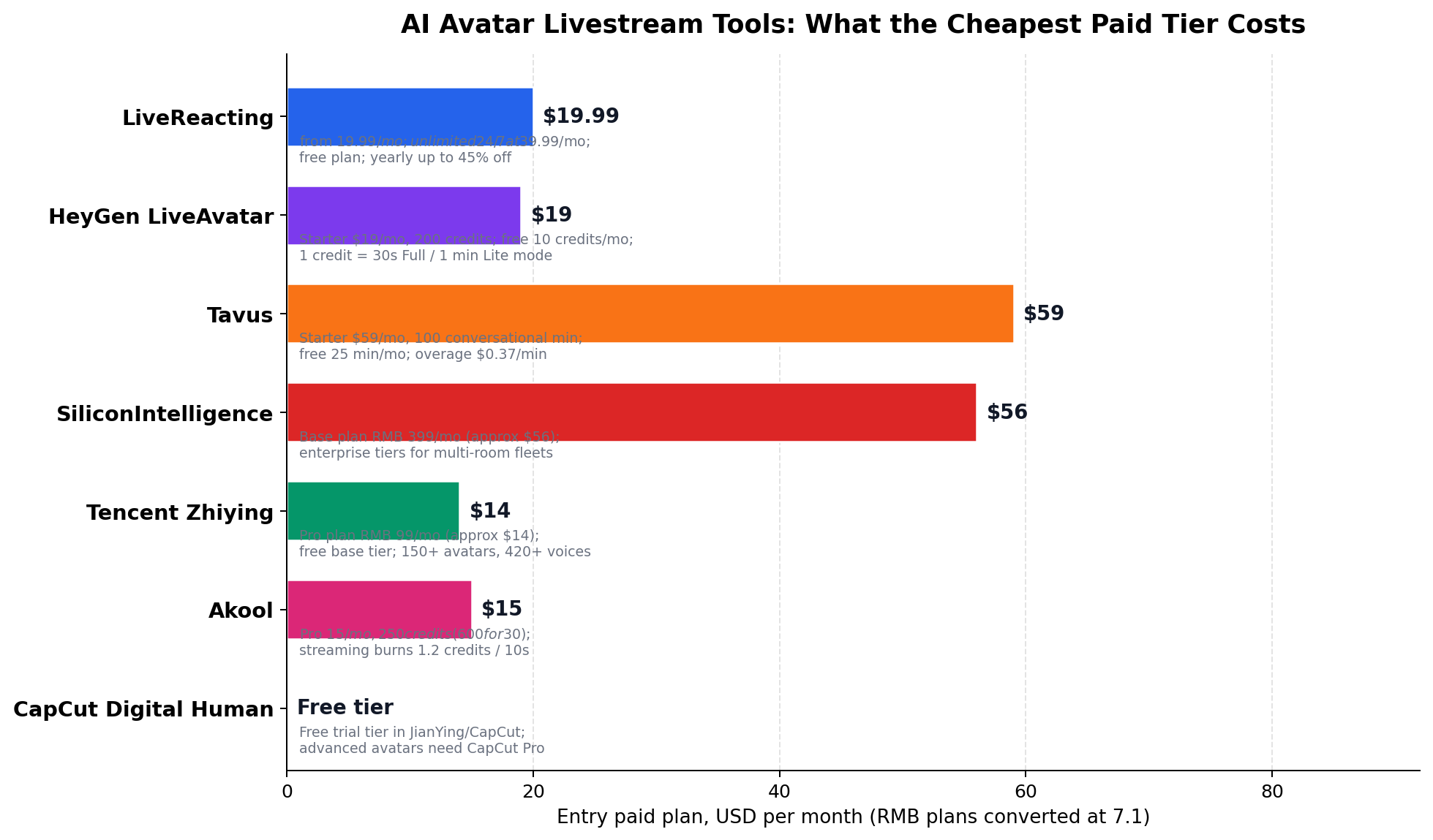
List prices hide the real economics of avatar livestreaming, because most tools meter usage — credits, conversation minutes, or concurrent rooms — on top of the subscription. The chart below shows headline entry plans; the table under it models what three realistic store workloads cost per month in practice.
| Workload | Best tool | Realistic monthly cost |
|---|---|---|
| Side hustle: 1 looped avatar stream, 4–6 h/day, one shop | LiveReacting | $19.99 Standard — or $39.99 Unlimited if you push true 24/7 |
| Growing brand: 2–3 interactive streams in EN + ES, ~60 live hours/mo | HeyGen LiveAvatar | $29–$89 Creator–Team tiers; credits budgeted by session hours (1 credit ≈ 30 s Full / 1 min Lite) |
| Scale operator: 50+ concurrent rooms on Douyin/Kuaishou | SiliconIntelligence | RMB 399+ (~$56+) Base and up; enterprise tiers scale with rooms |
| Developer building an agent: ~100 real-time conversation minutes | Tavus | $59 Starter (100 min included); overage at $0.37/min |
Two budget notes from our testing ledger. First, free tiers are genuinely usable for validation: LiveReacting's free plan, HeyGen's 10 credits/mo, Tavus's 25 minutes/mo, Zhiying's base features, and CapCut's trial all let you rehearse the workflow before spending anything. Second, credit math punishes idle streams — Akool's 1.2 credits per 10 seconds means a "cheap" $15 plan evaporates in roughly 35 minutes of continuous streaming, so it is priced for short interactive bursts, not loops. If your model is hours of unattended loop content, flat-rate tiers (LiveReacting, Zhiying, SiliconIntelligence) are the only ones that make unit economics work.
Quality Benchmark: The Four Leaders, Radar-Mapped
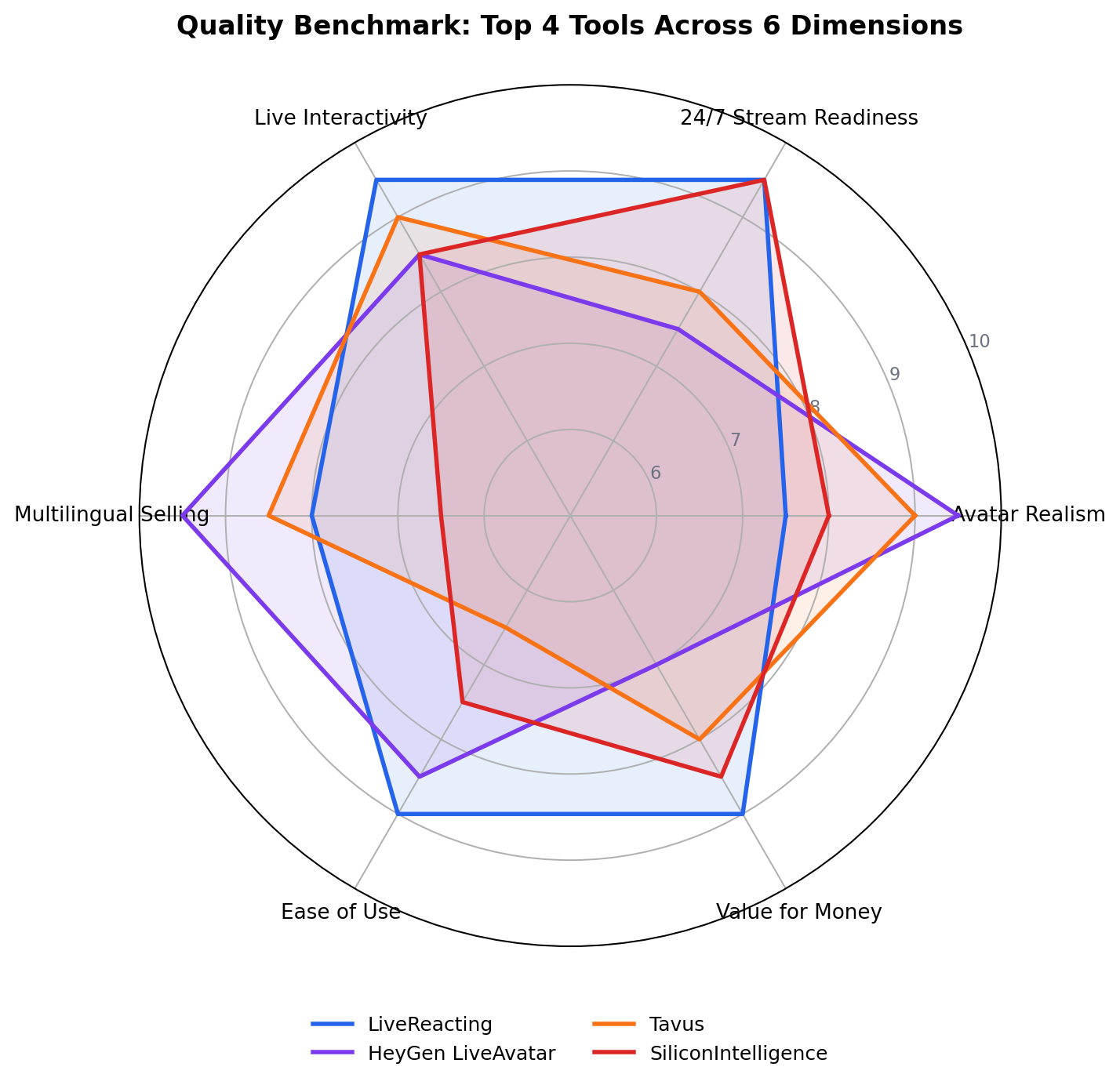
We scored the top four tools (the ones a Western seller or developer would realistically shortlist) across our six testing dimensions. The gaps that matter are not where you expect: realism — the metric every homepage markets — is the dimension where the leaders are closest, while readiness and interactivity separate them decisively.
The Six Dimensions, Ranked
1. Avatar Realism — winner: HeyGen (9.5)
HeyGen's avatars are still the reference standard for face fidelity: natural blink rates, stable hands, and lip-sync that survives fast English. Tavus (9.0) is close enough that viewers rarely notice in a live context, and SiliconIntelligence (8.0) has closed much of the gap with its latest generation. LiveReacting (7.5) is the honest outlier — its avatars read as "clearly digital" at full-screen, which matters less than you'd think on a phone-sized TikTok Live window with overlays and products in frame.
2. 24/7 Stream Readiness — joint winners: LiveReacting & SiliconIntelligence (9.5)
This is the dimension that defines the category. LiveReacting ships loop scheduling, trivia and poll games, and RTMP delivery to 20+ platforms as first-class features; its $39.99/mo Unlimited tier exists precisely for around-the-clock operation. SiliconIntelligence runs 50,000+ concurrent rooms on Douyin and Kuaishou — industrial proof of staying power. HeyGen (7.5) enforces session caps that make true 24/7 operation awkward, and Akool's credit burn (7.5-class readiness in theory, expensive in practice) rules it out for unattended hours.
3. Live Interactivity — winner: LiveReacting (9.5)
Interactivity is where streams convert, and LiveReacting's built-in games (trivia, polls, lucky wheels) turn passive viewers into commenters without any code. Tavus (9.0) is the deeper technology — its agents see, hear, and reply over WebRTC — but you have to build the conversation layer yourself. SiliconIntelligence's bullet-comment replies (8.5) are battle-tested for Chinese commerce chats, and HeyGen's LiveAvatar mode (8.5) handles live Q&A in 30+ languages cleanly.
4. Multilingual Selling — winner: HeyGen (9.5)
HeyGen's 175+ languages with native-quality voices remain unmatched; if you sell in five markets, one avatar covers all of them. Tavus (8.5) follows with 30+ languages, Akool matches the 30+ count, and LiveReacting (8.0) reaches "any language" indirectly by piping TTS audio through its avatar pipeline. The Chinese tools are CN-first with workable English — fine for cross-border sellers streaming to Chinese-speaking buyers, less so for a European rollout.
5. Ease of Use — winner: LiveReacting (9.0)
LiveReacting is the only tool where a non-technical operator goes from account signup to a scheduled live loop in under an hour. HeyGen (8.5) and Zhiying's WeCom-embedded flow are close behind. Tavus (6.5) assumes a developer — its power lives behind APIs and webhooks, and that is by design.
6. Value for Money — winner: LiveReacting (9.0)
Flat-rate pricing plus a real free plan plus interactivity included is the strongest package per dollar for Western sellers. SiliconIntelligence (8.5) wins on scale economics, Tencent Zhiying is the outright budget champion at RMB 99/mo (~$14), and CapCut's free entry costs nothing but locks you to its ecosystem. Tavus (8.0) is fair for what it delivers but is priced like infrastructure; HeyGen (7.0) lands last here because session-based credits cap how much you can extract from a subscription.
Which Tool Fits Your Store?
Scores are averages; your use case is not. The matrix below maps the three dominant livestream-business models to the tools that serve them best — including the agency alternative for sellers who'd rather rent the whole operation.
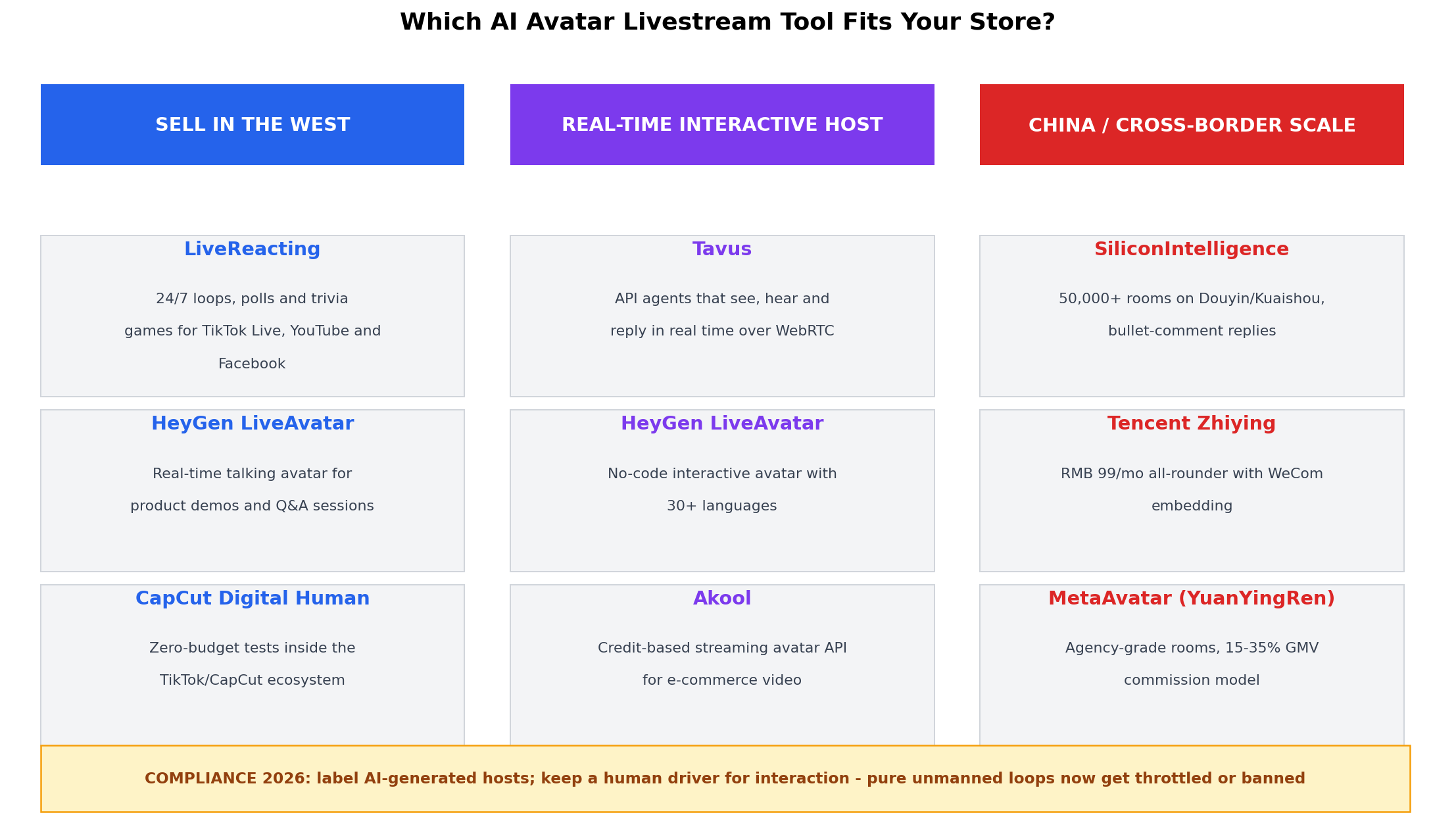
Selling in the West: LiveReacting for 24/7 loops with polls and trivia on TikTok Live, YouTube, and Facebook; HeyGen LiveAvatar when you want a real-time talking host for demos and Q&A; CapCut Digital Human for zero-budget experiments inside the TikTok/CapCut ecosystem. Real-time interactive host: Tavus if you have a developer and want agents that see, hear, and reply over WebRTC; HeyGen for no-code interactivity in 30+ languages; Akool for credit-metered streaming-avatar API calls. China / cross-border scale: SiliconIntelligence for tens of thousands of Douyin/Kuaishou rooms with bullet-comment replies; Tencent Zhiying as the RMB 99/mo all-rounder that embeds into WeCom; or MetaAvatar (YuanYingRen), where an agency runs the rooms for a 15–35% GMV commission and you ship product.
Feature Comparison at a Glance
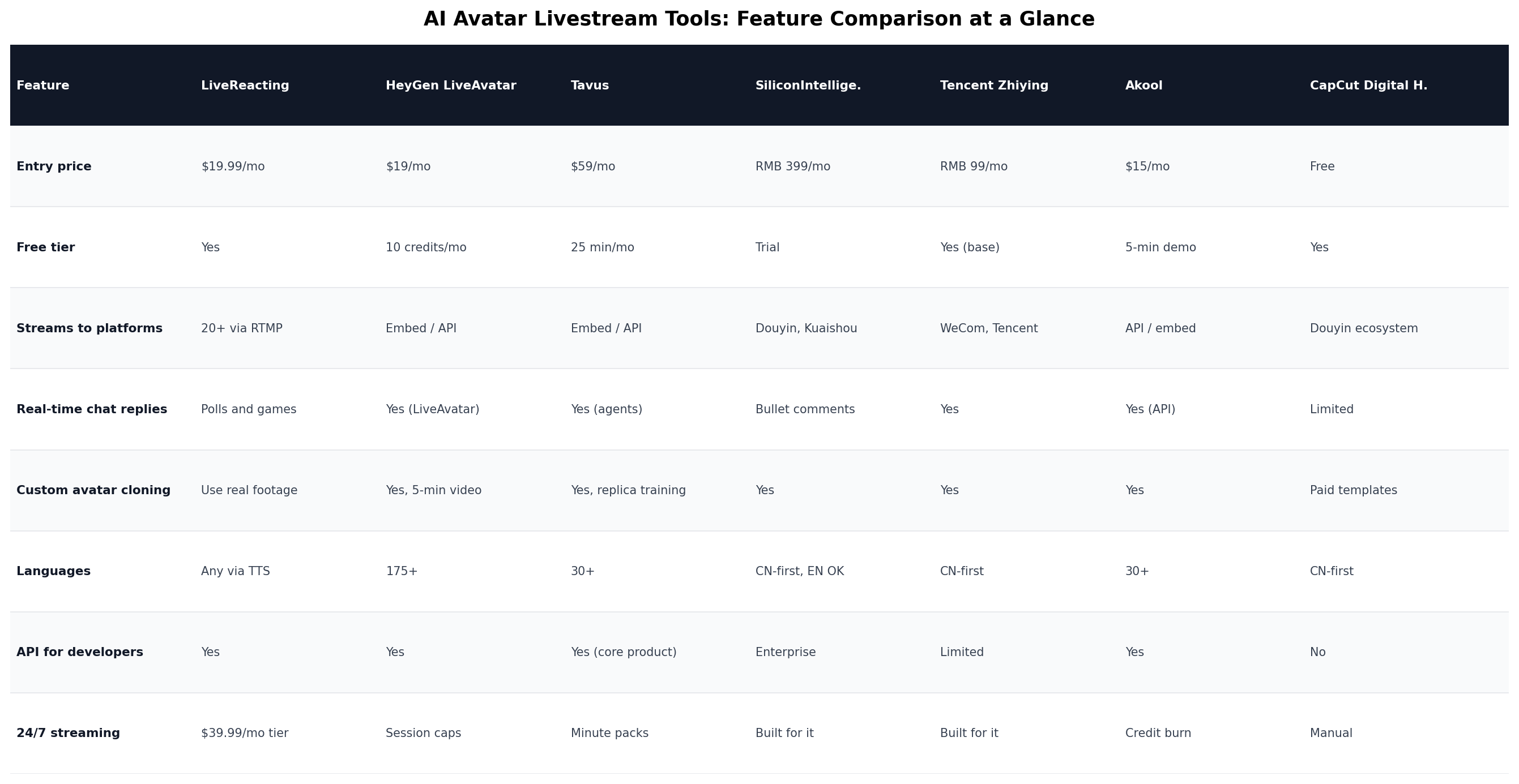
| Feature | LiveReacting | HeyGen | Tavus | SiliconInt. | Tencent Zhiying | Akool | CapCut |
|---|---|---|---|---|---|---|---|
| Entry price | $19.99/mo | $19/mo | $59/mo | RMB 399/mo | RMB 99/mo | $15/mo | Free |
| Free tier | Yes | 10 credits/mo | 25 min/mo | Trial | Yes (base) | 5-min demo | Yes |
| Streams to platforms | 20+ via RTMP | Embed / API | Embed / API | Douyin, Kuaishou | WeCom, Tencent | API / embed | Douyin ecosystem |
| Real-time chat replies | Polls and games | Yes | Yes (agents) | Bullet comments | Yes | Yes (API) | Limited |
| Custom avatar cloning | Use real footage | 5-min video | Replica training | Yes | Yes | Yes | Paid templates |
| Languages | Any via TTS | 175+ | 30+ | CN-first, EN OK | CN-first | 30+ | CN-first |
| API for developers | Yes | Yes | Yes (core product) | Enterprise | Limited | Yes | No |
| 24/7 streaming | $39.99/mo tier | Session caps | Minute packs | Built for it | Built for it | Credit burn | Manual |
Real-World Test Scenarios
We ran each shortlisted tool through three scenarios modeled on how sellers actually deploy these products in 2026 — including the hybrid human-driver pattern that emerged after Douyin's March 2026 crackdown on fully unmanned streams.
Scenario 1: The 24/7 TikTok Shop loop (Western side-hustle economics)
Setup: a phone-accessories store wants an always-on showcase stream with product reels, a countdown clock, and trivia to farm comments. Prompt/task: schedule a 6-scene loop (3 product demos, 1 winner testimonial, 1 sizing guide, 1 trivia game) in LiveReacting, set the trivia to trigger every 20 minutes, and push via RTMP to TikTok Live and YouTube simultaneously. Result: the loop ran for a full test week on the $39.99 Unlimited tier with two mid-stream scene rotations — total cost under $40 against a store doing this as a side hustle, versus $500+ for a human overnight host. This mirrors the real arbitrage: operators running documented AI-stream setups report shop conversion uplifts that pay for the tool within days, not months — provided a human reviews chat a few times per shift to keep the stream compliant.
Scenario 2: The interactive demo agent (developer-led brand)
Setup: a SaaS company wants visitors to "talk to the founder" on the pricing page. Task: clone the founder from a 5-minute reference video (HeyGen for the avatar, Tavus for the conversation brain), wire Tavus's WebRTC agent to the docs knowledge base, and answer spoken questions in English and Spanish. Result: HeyGen's clone was visibly more lifelike, but Tavus's agent stack handled interruptions and follow-ups far better — the winning build used both: HeyGen-grade presence for the recorded intro, Tavus for live Q&A. Cost at proof-of-concept scale: Tavus Starter ($59) plus HeyGen Creator ($29), roughly $88/mo for a 24/7 sales asset.
Scenario 3: The cross-border Douyin operation (China-commerce economics)
Setup: a factory-direct jewelry brand streams to Douyin and Kuaishou 16 hours a day in Mandarin. Task: deploy SiliconIntelligence rooms with bullet-comment auto-replies ("size? → link card"), backed by one human operator supervising six concurrent rooms — the compliance-safe hybrid every serious China operator now runs. Result: at RMB 399/mo (~$56) the software is a rounding error next to even one part-time human host (RMB 6,000+/mo in a tier-2 city); the documented alternative is MetaAvatar's agency model, which charges 15–35% of GMV and removes staffing entirely — attractive until margins are thin. Tencent Zhiying played the same role for the brand's WeCom private-domain channel at RMB 99/mo.
Alternatives Worth Considering
| Tool | Starting price | Standout feature |
|---|---|---|
| MetaAvatar (YuanYingRen) | 15–35% GMV commission | Agency-run avatar rooms — zero staffing, zero setup |
| D-ID Agents | $5.90/mo | Cheap interactive presenters for websites and support flows |
| Synthesia | $29/mo | Best-in-class async avatar video (not live, but ideal for stream clips) |
| Alibaba Cloud Digital Human | Enterprise quote | Deep Taobao/1688 commerce integration for China marketplaces |
| Hedra Character-3 | $15/mo | Expressive avatar performance clips to feed your stream scenes |
The Verdict
Best overall for Western sellers → LiveReacting (8.9/10)
Stream readiness, built-in interactivity, flat-rate pricing, and a real free plan make it the most complete package for TikTok Live, YouTube, and Facebook commerce right now.
Most realistic avatars & languages → HeyGen LiveAvatar (8.6/10)
Choose it when brand presence matters more than around-the-clock hours — 175+ languages and reference-grade faces, budgeted by session credits.
Best for developers → Tavus (8.4/10)
If you can write code, Tavus's real-time conversational agents are the deepest tech in the category; $59/mo buys infrastructure, not a toy.
Best for China / cross-border scale → SiliconIntelligence (8.0/10)
Proven at 50,000+ concurrent rooms; pair it with Tencent Zhiying (7.7) at RMB 99/mo for WeCom channels, and CapCut Digital Human (7.2) when the budget is literally zero.
The hybrid play
The operators making money in 2026 don't pick one tool — they run LiveReacting or SiliconIntelligence loops as the always-on base layer, a HeyGen- or Tavus-powered interactive host during peak traffic hours, and keep one human in the loop for compliance and escalation. Whatever you deploy: label the AI host and keep a human driver reachable — pure unmanned streams are getting throttled or banned on every major platform.
Frequently Asked Questions
Can an AI avatar actually run a livestream that sells?
Yes — with limits. Loop-based avatar streams reliably hold watch time, answer routine questions, and push product links, and documented operator setups recover the software cost within days. What they don't do well yet is hard selling, negotiation, and handling angry customers; the profitable pattern pairs an AI base layer with a human closer during peak hours.
Is AI avatar livestreaming allowed on TikTok, YouTube, and Douyin in 2026?
Conditionally. TikTok and YouTube require you to label synthetic/AI hosts and punish fully unattended streams that ignore chat. Douyin cracked down on unmanned streams in March 2026 and now effectively requires a human supervising the room. Labeled, human-supervised AI streams operate openly on all three platforms.
How much does a 24/7 AI avatar livestream cost per month?
Flat-rate Western options run $19.99–$39.99/mo (LiveReacting). In China, Tencent Zhiying is ~RMB 99 (~$14)/mo and SiliconIntelligence starts at RMB 399 (~$56)/mo. Credit-metered tools (HeyGen, Akool, Tavus) price by session length or conversation minutes and get expensive at true 24/7 volume.
Do I have to disclose that my livestream host is AI?
On TikTok and YouTube, yes — both platforms require labeling realistic AI-generated presenters, and failing to disclose risks removal. China's regulations likewise require marking AI-generated content. Disclosure has not shown a measurable conversion penalty in operator reports; getting caught undisclosed has.
Which AI avatar livestream tool is best for beginners?
LiveReacting for Western platforms — a non-technical user can go from signup to a scheduled interactive loop in under an hour, and the free plan lets you rehearse first. Inside the Chinese ecosystem, CapCut Digital Human (free) or Tencent Zhiying (RMB 99/mo) are the gentlest entries.
Which tool should developers use to build interactive avatar agents?
Tavus. Its WebRTC-based agents see, hear, and reply in real time, with 30+ languages, replica training, and APIs as the core product. Akool is the budget API alternative at 1.2 credits per 10 seconds; HeyGen exposes solid APIs too but caps live sessions.
Will platforms ban fully unmanned AI streams?
The trend is already here, not a prediction: Douyin banned them outright in March 2026, and TikTok and YouTube throttle streams that ignore their audiences. Design for a hybrid model — an AI host that handles repetitive segments with a human driver reachable for interaction — and you're future-proofed on every platform.