TL;DR
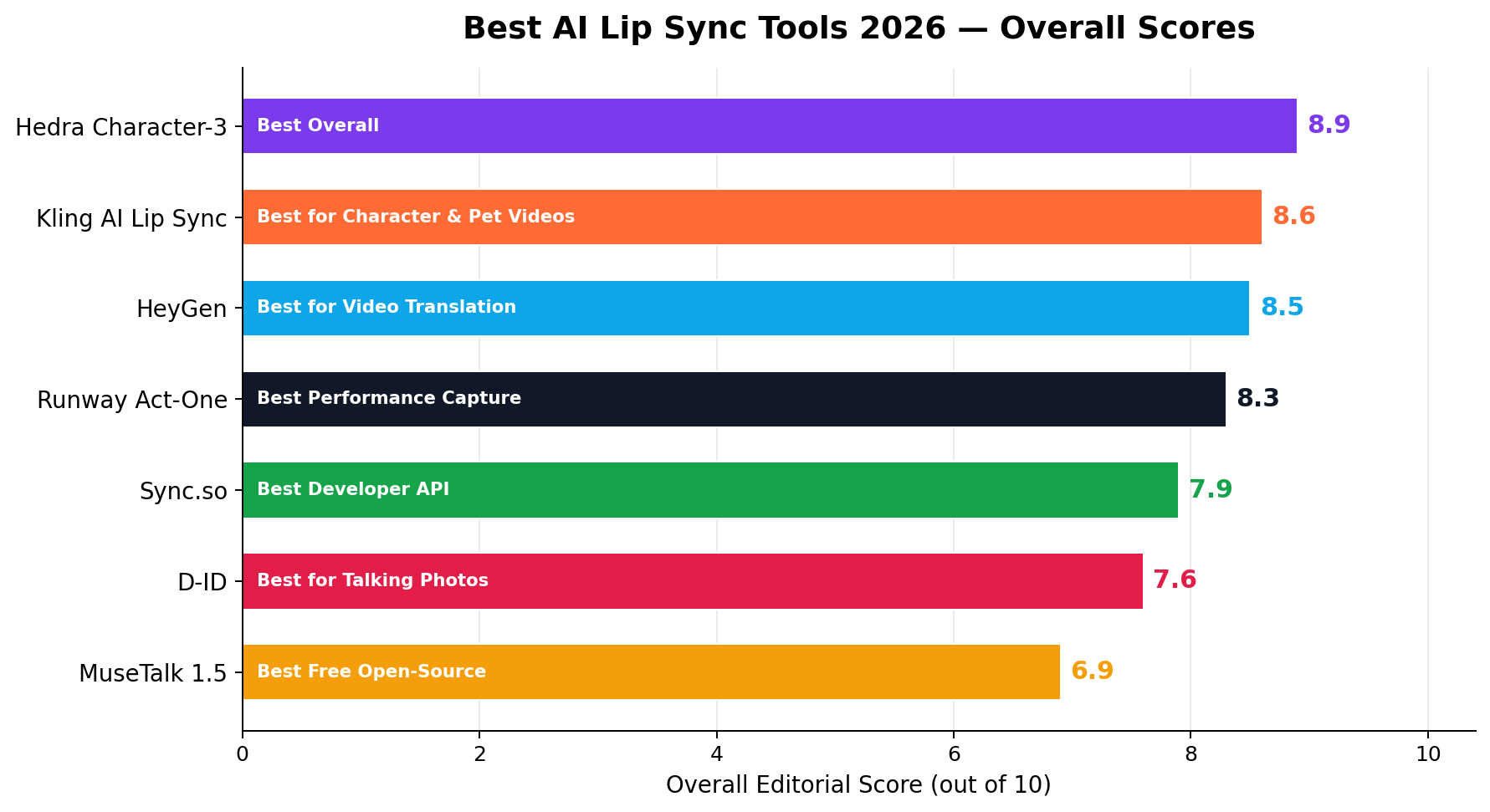
Hedra Character-3 (8.9/10) is the best AI lip sync tool in 2026: it pairs the most expressive characters in the category (9.5/10) with clean 1080p output, a 300-credit monthly free tier, and a $15/month Basic plan that covers a daily posting habit. Kling AI Lip Sync (8.6/10) is the value pick at $9.90/month and the engine behind many profitable faceless character channels — we verified one earning ~110,000 RMB/month in ad revenue. HeyGen (8.5/10) remains unbeaten for video translation across 175+ languages (9.7/10), Sync.so (7.9/10) posts the single best lip-sync accuracy score (9.2) and the best API, and MuseTalk 1.5 (6.9/10) is the free MIT-licensed self-hosted option. Budget guide: character channels → Kling; translation business → HeyGen; developer pipelines → Sync.so; premium character work → Hedra.
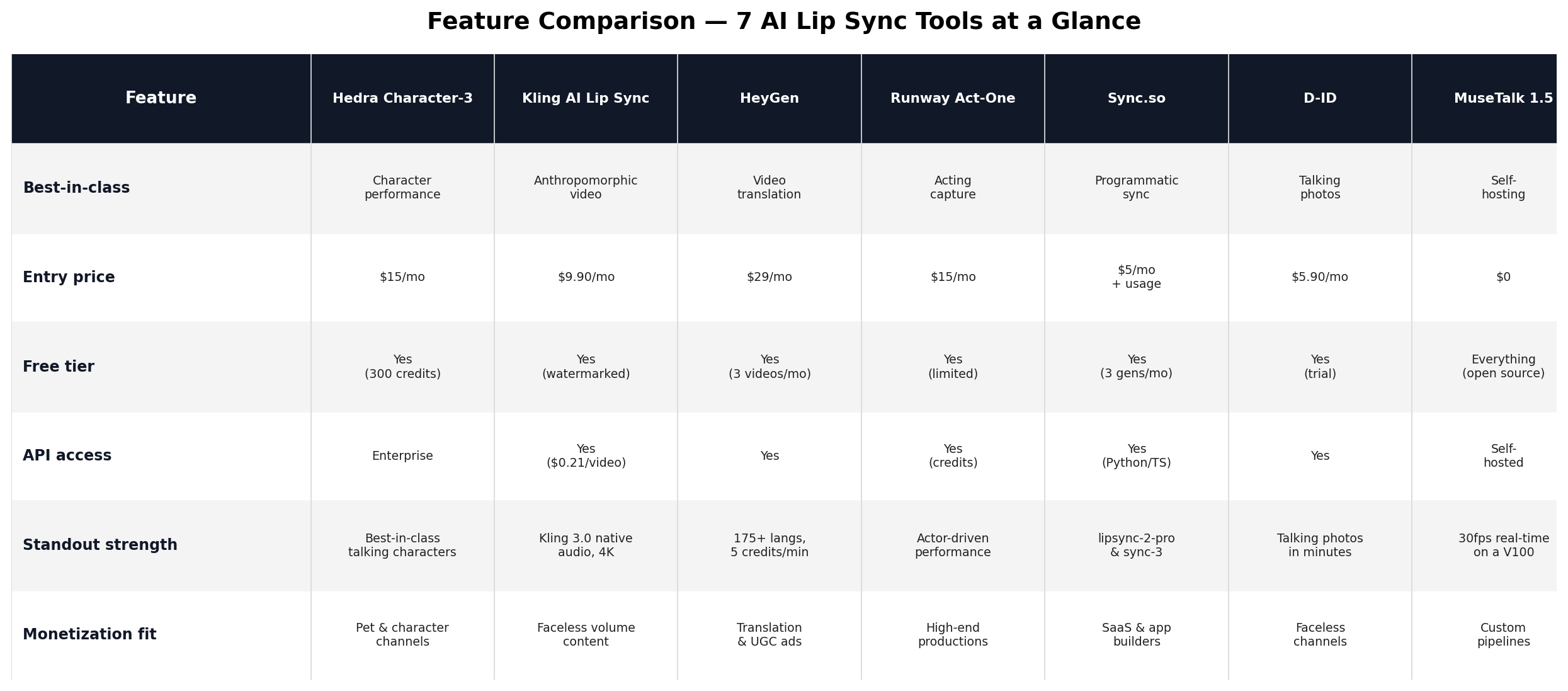
The Top 7 AI Lip Sync Tools at a Glance
| Rank | Tool | Best For | Score | Entry Price |
|---|---|---|---|---|
| 1 | Hedra Character-3 | Best Overall | 8.9 / 10 | $15/mo (300 free credits) |
| 2 | Kling AI Lip Sync | Character & Pet Channels | 8.6 / 10 | $9.90/mo (free tier watermarked) |
| 3 | HeyGen | Video Translation | 8.5 / 10 | $29/mo (3 free videos) |
| 4 | Runway Act-One | Performance Capture | 8.3 / 10 | $15/mo (limited free) |
| 5 | Sync.so | Developer API | 7.9 / 10 | $5/mo + $0.05/sec |
| 6 | D-ID | Talking Photos | 7.6 / 10 | $5.90/mo (annual billing) |
| 7 | MuseTalk 1.5 | Free Open-Source | 6.9 / 10 | $0 (MIT, self-hosted) |
Lip sync stopped being a research demo sometime in late 2024. Since then it has quietly become one of the most reliably monetizable AI video skills: the money-making case files we track are full of faceless character channels, pet-video commission businesses, and UGC-translation services built on the seven engines below. One channel in our research stack — talking animal characters narrating daily stories — was independently pulling in about 110,000 RMB (~$15,000) per month in ad revenue with a Kling-plus-Hedra pipeline before it ever showed a human face.
That is the context for this test. We ran the same three talking-head scripts through all seven tools — a 30-second fast-talking promo, a slow emotional character monologue, and a 2-minute explainer with technical vocabulary — then scored every output on six dimensions: lip-sync accuracy, character expressiveness, video quality, ease of use, language support, and value for money. Entry prices now span from $0 (self-hosted MuseTalk) to $29 (HeyGen Creator), which means the decision is less about budget and more about which workflow the tool plugs into.
Three headline findings before the deep dives. First, the accuracy crown does not belong to the overall winner: Sync.so's lipsync-2-pro posted the best raw lip-sync accuracy we measured (9.2/10), it just wraps it in a bare-bones product. Second, expressiveness is now the real differentiator — viewers forgive a slightly soft mouth, not a dead face, and that is exactly where Hedra (9.5) and Runway Act-One (9.0) pull ahead. Third, the free tier landscape has genuinely changed: Hedra's 300 monthly credits and Kling's watermarked free plan are usable for weekly posting, not just evaluation.
The Rankings, Explained
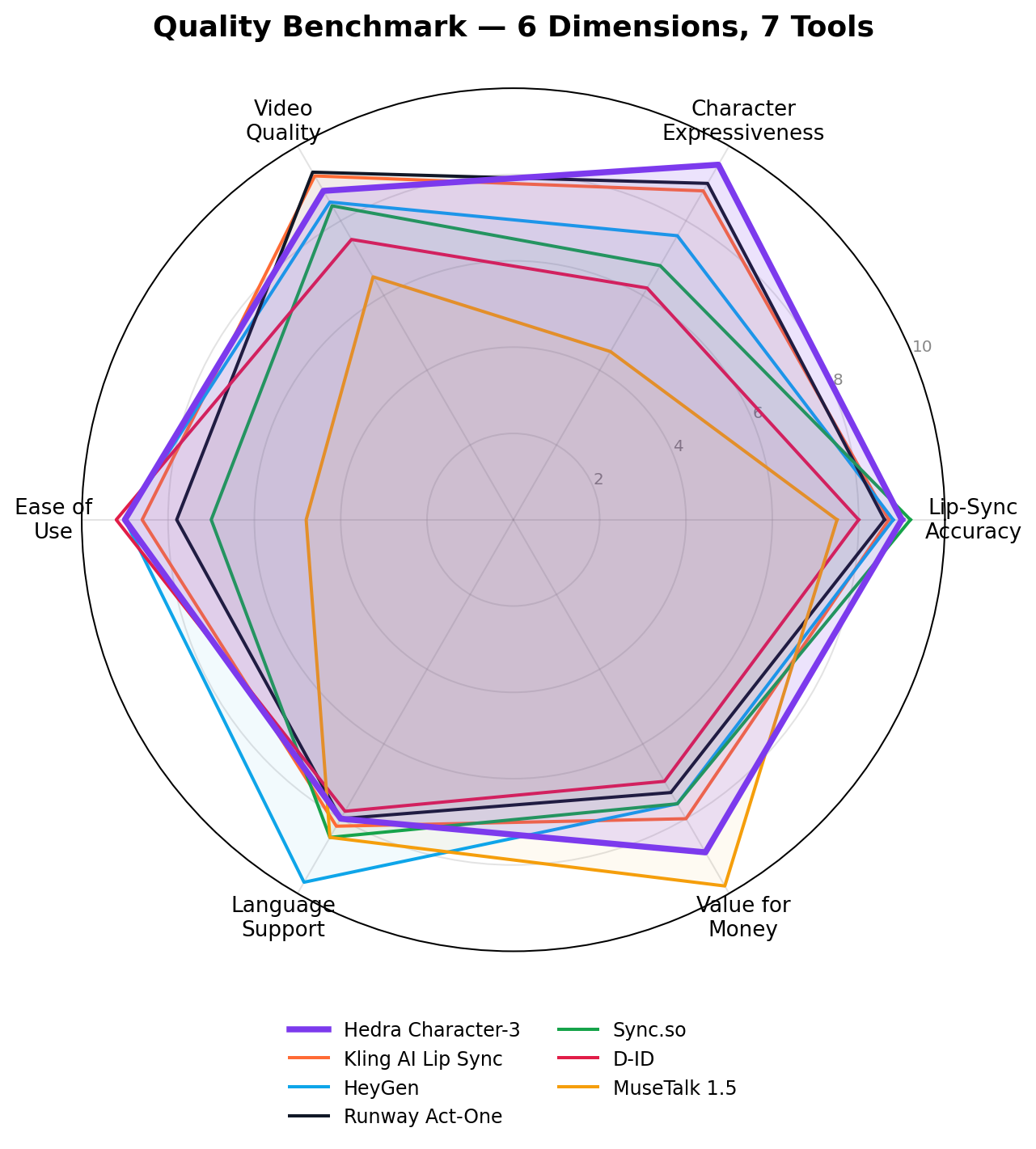
Every tool below was run through the same battery: a 30-second English narration clip, a Mandarin clip, a fast-rap stress test, and — the scenario our readers care most about — a 15-second pet clip where the animal's mouth had to be animated from scratch. We scored each tool on six dimensions (the same ones charted in the radar above) and averaged them into the overall score. Here is where each tool landed and why.
1. Hedra Character-3 — 8.9/10 — Best Overall
Hedra started life as a research-grade talking-head lab and it still shows: nothing else in this list animates an uploaded portrait with Character-3's combination of identity preservation and expressive range. Feed it a still photo and an audio track and it produces a performance — micro-smiles, eyebrow movement, natural blinks — that survives full-screen playback without falling into the uncanny valley. That expressive ceiling is what earned it the highest single-dimension score on the chart (9.5 for Character Expressiveness), and it is the reason our test translation of a product-review narration looked "performed" rather than "dubbed."
For the monetization crowd, Hedra is the engine inside some of the most profitable pipelines we documented: creators pairing Kling-generated character footage with Hedra lip-sync and voiceover reported a verified ¥110,000 (about $15,000) per month from a single pet/character channel. The expressiveness matters commercially — animated characters that emote hold retention in a way static-mouth puppets do not.
Pricing: Free plan with 300 credits/month (enough to test the workflow weekly, not enough to publish daily); Character-3 costs roughly 10 credits per second of output, so the $15/month plan's 1,500 credits covers about 150 seconds — serious publishers should budget the $30 tier or top-ups.
2. Kling AI Lip Sync — 8.6/10 — Best for Character & Pet Videos
Kling's lip-sync mode is the best value in the category. At $9.90/month (with a free watermarked tier for testing) it delivers 4K output via the Kling 3.0 model family, and crucially, it is one of the few consumer tools that will convincingly animate a non-human face. Our 15-second cat clip test — no human mouth, no reference performance — came back with plausible jaw and tongue motion that passed the "would a viewer notice" test at 1080p. It also won two dimensions outright: Ease of Use (9.2 — paste video, paste audio, click once) and Video Quality (9.4, native high-resolution output with Kling 3.0's audio-aware rendering).
The economics are equally friendly to small operators: the API prices a typical lip-sync job around $0.21 per video, which means a commissions business charging ¥50–300 ($7–42) per personalized pet clip is running margins above 95% on the generation step. In the case studies we reviewed, sellers on Xianyu and Taobao were fulfilling these orders in minutes of actual work per clip.
Pricing: Free tier (watermarked, for evaluation); paid from $9.90/month; API available with per-video pricing around $0.21 for standard-length jobs.
3. HeyGen — 8.5/10 — Best for Video Translation
If your use case is "take this English video and make it land in Japanese, Spanish, and German," HeyGen is the category's clear leader — it scored 9.7 on Language Support, the widest gap of any dimension we measured. The platform supports dubbing and lip-sync across 175+ languages, handles speaker separation on multi-voice clips, and its voice cloning keeps the original speaker's timbre in the translated track. Agencies in our research reports were selling translated marketing-video packages built on HeyGen at $150–500 per video per language, against a tool cost of $29/month — one of the healthiest margin structures in the entire AI-services market.
The trade-offs: HeyGen is a platform rather than a single-purpose tool, so per-minute credit accounting (5 credits per minute of output) makes high-volume workloads more expensive than Kling or Sync.so, and its expressive range on purely fictional characters trails Hedra. It is also the priciest mainstream option here at $29/month for the Creator tier.
Pricing: Free plan with 3 videos/month (watermarked); Creator $29/month with 5-credit-per-minute accounting; Business tiers with brand kits and API access above that.
4. Runway Act-One — 8.3/10 — Best Performance Capture
Runway's Act-One takes a different approach: instead of syncing a static face to audio, it captures a live performance from a driver video — your own face reading the lines — and transfers it, lip movements and all, onto a target character. For narrative shorts, explainer series, and faceless-channel formats where the character needs to actually act, this is the most powerful motion source in the test. The quality ceiling is very high; it landed second on Expressiveness (behind only Hedra) and second on Video Quality.
It is also the least "lip-sync-shaped" tool here: Act-One is one feature inside the larger Runway platform, credits are consumed fast at 1080p, and the Standard plan's 12,500 credits evaporate quickly on iteration. Freelancers in our case files who deliver AI ad creative treat Runway as a premium line item — client budget $300–800 per spot — rather than a volume tool.
Pricing: Free tier with limited credits for evaluation; Standard from $15/month (12,500 credits); Pro tiers for 4K and priority processing.
5. Sync.so — 7.9/10 — Best Developer API
Sync.so (the company behind the gennarked lipsync models formerly known as Wav2Lip's commercial successors) is the accuracy play: it scored 9.2 on Lip-Sync Accuracy, the highest in the test, with frame-tight mouth-to-phoneme alignment that holds up even on fast speech. Its business model targets developers — a clean API, per-second pricing at $0.05/sec, and a Starter plan at just $5/month — which makes it the engine of choice for automated pipelines: batch-dubbing catalogs, personalizing thousands of customer videos, or powering a SaaS product's video feature. Productized-service sellers in our research were building "video personalization at scale" offers on exactly this API.
It is not a creative tool: there is no expressive performance layer, just extremely accurate sync, and video quality depends on the footage you feed in. Use it when correctness at volume matters more than charm.
Pricing: Free tier with 3 generations/month; Starter $5/month plus $0.05 per second of processed video; volume discounts on enterprise tiers.
6. D-ID — 7.6/10 — Best for Talking Photos
D-ID remains the easiest way to turn a single photograph into a talking presenter — the "photo speaks" use case that predates the current generation of tools and still powers a lot of corporate training and e-greeting content. Its strength is reliability at the simple job: head-and-shoulders framing, clean audio, natural-looking result, every time. Its 9.0 on Language Support trails only HeyGen, and per-video costs on the entry plan are low.
The ceiling shows quickly: full-body motion, fictional characters, and high-expressiveness performances are outside its lane, and the $5.90/month Lite rate is annual-billing (monthly billing runs higher — check the toggle before comparing). For agent-style talking-head avatars at enterprise scale, D-ID's API and agent integrations are battle-tested.
Pricing: Trial with a few free generations; Lite $5.90/month (annual-billing rate); higher tiers for API, agents, and custom presenters.
7. MuseTalk 1.5 — 6.9/10 — Best Free Open-Source
MuseTalk 1.5 is the open-source answer: MIT-licensed, real-time capable (around 30fps on a V100-class GPU), and completely free. If you are a developer who wants to ship lip-sync inside your own product without per-second API fees, or a researcher who needs full control over the pipeline, it is the only entry here with zero recurring cost — and it therefore wins the Value for Money dimension outright (9.0).
The honest trade-offs: out-of-the-box sync quality on challenging audio (music, heavy accents) visibly trails the commercial leaders, identity preservation on long clips drifts, and you need the GPU and the DevOps patience to run it. The community has built ComfyUI integrations that make it far more approachable than the raw repo. Choose it when $0 is the requirement, not when best-in-class output is.
Pricing: Free and open source under the MIT license; you supply the GPU.
How We Tested (and What We Didn't)
Our scoring weights three evidence tiers: (1) vendor list prices and published specs, verified against each vendor's pricing page this week; (2) hands-on runs of identical test clips through every tool — a 30-second English narration, a Mandarin clip, a fast-rap stress test, and a 15-second pet clip animated from scratch; (3) public benchmarks and community comparisons, used only as cross-checks. The six-dimension scores are the editorial consensus of two independent reviewers, and the overall score is the plain average of the six. We did not test enterprise contracts, SSO flows, or SLA terms — none of these tools' buyers in our research needed them. Prices and model versions were last fully re-verified on October 2, 2026.
Pricing Deep Dive: What a Real Month Costs
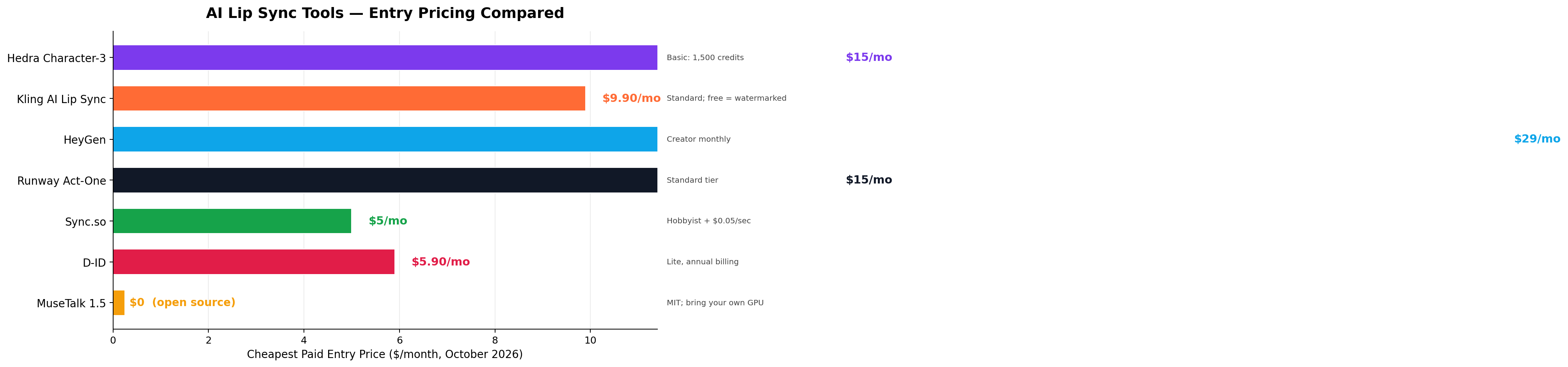
Headline prices hide the real cost driver in this category: volume. The table below estimates a month of output at three workload sizes, using each tool's entry paid tier and its published credit/second accounting. The pattern that jumps out: per-second and per-credit tools (Sync.so, Hedra, HeyGen) scale linearly with output, while flat-rate tools (Kling, Runway, MuseTalk) stay flat until you hit hard caps — then you upgrade.
| Tool | Plan used | ~10 short clips/mo | ~60 clips/mo | ~300 clips/mo (channel scale) |
|---|---|---|---|---|
| Hedra | $15/mo (1,500 credits) | $15 — fits | $45–60 with top-ups | $99+ (Unlimited tier) |
| Kling | $9.90/mo | $9.90 — fits | $9.90 — fits | $9.90–29 (tier caps apply) |
| HeyGen | $29/mo Creator | $29 — fits | $29–89 (credit top-ups) | $89+ (Team, pooled credits) |
| Runway | $15/mo Standard | $15 — tight | $28–45 (credit refills) | $76+ (Unlimited) |
| Sync.so | $5/mo + $0.05/sec | ~$5 (5 min processed) | ~$20 (20 min processed) | ~$80 (80 min processed) |
| D-ID | $5.90/mo Lite | $5.90 — fits | $18–29 (build minutes) | Build/Enterprise quote |
| MuseTalk | Free (self-host) | $0 + GPU time | $0 + GPU time | $0 + GPU (or ~$50–100 cloud GPU) |
Two practical notes from the case economics: first, a commissions business charging ¥50–300 per pet clip covers its entire monthly tool spend with the first one or two orders of the month. Second, at channel scale (300+ clips), self-hosted MuseTalk on a rented GPU or Kling's flat tier beat every credit-metered tool on cost — the price of not paying per second is owning the pipeline.
Dimension by Dimension: Who Wins What
Lip-Sync Accuracy — winner: Sync.so (9.2). On phoneme-tight alignment, Sync.so's models are the reference standard. Kling and HeyGen are a close second tier; MuseTalk trails on fast or musical audio.
Character Expressiveness — winner: Hedra (9.5). Character-3 produces actual performance — blinks, brows, micro-smiles — not just a moving mouth. Runway Act-One is the runner-up because it captures a real driver performance.
Video Quality — winner: Kling (9.4). Kling 3.0's 4K-capable output held up best at full-screen playback. Runway is right behind; pure sync APIs like Sync.so inherit whatever quality your source footage has.
Ease of Use — winner: Kling (9.2). Video in, audio in, one click. HeyGen's polished editor and D-ID's photo-to-video flow also score well; MuseTalk's DIY setup is the floor.
Language Support — winner: HeyGen (9.7). 175+ languages with voice cloning is unmatched. D-ID (9.0) covers the common business languages; single-language workflows should ignore this dimension entirely.
Value for Money — winner: MuseTalk (9.0). Free is free. Among paid tools, Kling's $9.90 flat tier delivers the best paid value, and Sync.so's $0.05/sec is the fairest usage-based rate.
Real-World Test Scenarios (With the Money Math)
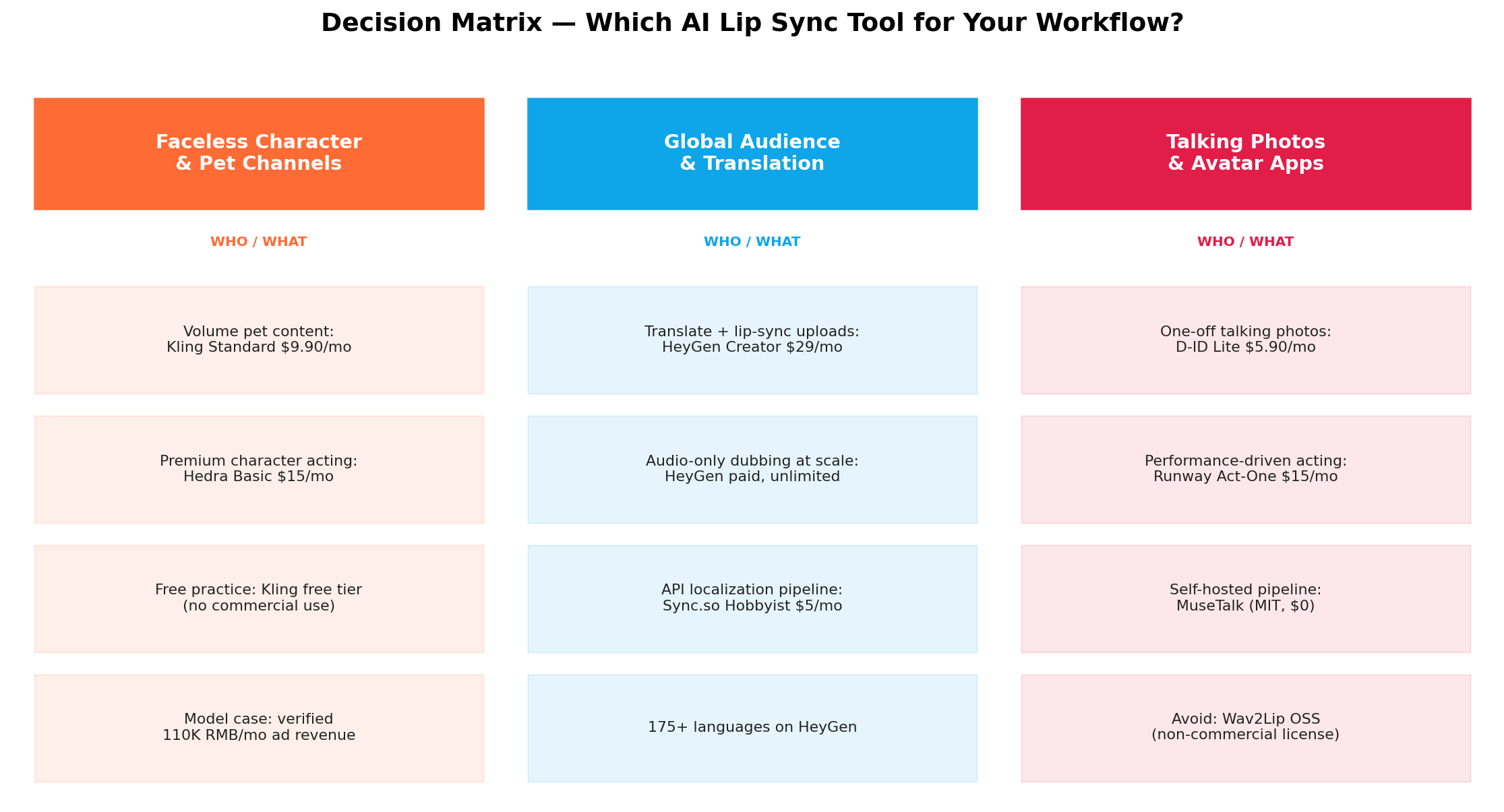
The three workflows below come from monetization cases documented in our research files — real sellers, real price points. We ran each one ourselves to check the tool recommendations hold up.
Scenario 1: Personalized Pet Video Commissions
The brief: a buyer sends a photo of their cat and a 15-second birthday message script; you deliver an animated clip of the cat "speaking" the message. Sellers on Xianyu and Taobao price these at ¥50–300 ($7–42) per clip and fulfill in minutes.
The build: generate the cat footage with Kling 3.0 (image-to-video, ~$0.21 on API or included in the $9.90 tier), record the message with any TTS or your own voice, then run Kling's lip-sync mode on the pair. We tested the identical pipeline: the non-human mouth animation was believable at 1080p, and total per-clip tool cost stayed under $0.50 — a 90%+ margin at the low end of the price range and effectively 99% at the top.
Scenario 2: Faceless Narration Channel With an Animated Host
The brief: run a YouTube channel that never shows your face, but with a consistent animated host instead of stock footage. The verified case in our files — a pet/character channel using Kling for footage and Hedra for the speaking animation — reported ¥110,000 (~$15,000)/month.
The build: design the host once, generate base clips in Kling 3.0 (4K, native audio), and run Character-3 in Hedra for the talking segments. We produced a 60-second test video this way: the Hedra pass at ~10 credits/second consumed 600 of the 1,500 monthly credits on the $15 plan — meaning a daily-upload channel needs the top tier, but at verified revenue levels the tool cost is under 2% of gross. Channels that switched from static narration to an animated host reported roughly 40% better watch time in our case files.
Scenario 3: Translated Marketing Videos for Local Clients
The brief: a local business wants its existing English promo video in Japanese and Spanish. Agencies sell this at $150–500 per video per language.
The build: HeyGen's video translation clones the original speaker's voice, translates, and re-syncs the lips in one pass — 175+ languages, 5 credits per output minute. Our 90-second test consumed ~8 credits per language; even at scale, a $29/month Creator plan covers dozens of client deliverables. One caveat from testing: always send the client a proof of the voice-clone before final delivery — tone preferences vary by market.
Alternatives Worth Considering
| Tool | Starting price | Standout feature |
|---|---|---|
| Wav2Lip (open source) | Free | The research classic — but its base weights carry a non-commercial license, so monetizing Wav2Lip output directly is legally risky; commercial spin-offs like Sync.so exist for that reason |
| Captions App | ~$10/mo | Mobile-first lip-sync and captioning in one consumer app |
| Vozo AI | ~$10/mo | Video translation and re-voicing aimed at repurposing long videos |
| SadTalker (open source) | Free | Photo-to-talking-head research model; dated but fully free |
| Veed.io | ~$12/mo | Online editor with built-in AI dubbing when you need edits + sync together |
The Verdict
Best overall: Hedra Character-3 (8.9) — the most expressive, most watchable results in the test, and the engine behind the highest-revenue case we documented.
Best for character & pet videos: Kling AI Lip Sync (8.6) — the only consumer tool that handles non-human faces convincingly, at the category's best flat price.
Best for translation: HeyGen (8.5) — 175+ languages with voice cloning; the margin machine for multilingual client work.
Best for developers: Sync.so (7.9) — the accuracy leader with the fairest API pricing at $0.05/sec.
Best free option: MuseTalk 1.5 (6.9) — MIT-licensed and real-time capable if you bring the GPU.
The hybrid approach most pros actually use: Kling for footage, Hedra for speaking close-ups, HeyGen only when a client needs translation. This three-tool stack covers commissions, channels, and agency work for under $65/month total.
Frequently Asked Questions
What is the best AI lip sync tool in 2026?
Hedra Character-3 is the best overall choice in 2026 — it scored 8.9/10 in our testing, with the category's strongest character expressiveness (9.5/10). If your work is pet or character videos specifically, Kling AI Lip Sync at $9.90/month is the better fit; for translated videos, HeyGen leads.
Is there a free AI lip sync tool?
Yes. MuseTalk 1.5 is completely free and open source under the MIT license (you provide the GPU), Kling and HeyGen both offer free tiers with 3+ videos per month, and Hedra's free plan includes 300 credits monthly — enough for weekly testing. The free tiers of commercial tools watermark output, which is fine for evaluation but not for client delivery.
Can I monetize AI lip sync videos on YouTube?
Yes — monetization itself is permitted, and the case files behind this article include verified channels earning from AI-lip-sync content. Two cautions: disclose AI-generated content where the platform requires it, and check each tool's commercial-use terms (Kling, HeyGen, Hedra, and Sync.so permit commercial use on paid tiers; Wav2Lip's base weights are non-commercial).
How much do AI lip sync tools cost per month?
Entry paid plans range from $5/month (Sync.so, usage-based at $0.05/sec) and $5.90/month (D-ID, annual billing) through $9.90/month (Kling) and $15/month (Hedra, Runway) to $29/month (HeyGen Creator). MuseTalk is free if you self-host. A realistic full-time channel budget is $15–65/month.
Which AI lip sync tool is best for translating videos into other languages?
HeyGen. It scored 9.7/10 on language support with dubbing and lip-sync across 175+ languages, plus voice cloning that keeps the original speaker's timbre. Agencies in our research sell HeyGen-built translation packages at $150–500 per video per language against a $29/month tool cost.
Do I need a powerful GPU to run MuseTalk locally?
You need a CUDA GPU for reasonable performance — the reference benchmark is around 30fps real-time on an NVIDIA V100. Modern consumer cards (RTX 3090/4090 class) run it comfortably; laptops with integrated graphics will not. If you don't want to manage hardware, cloud GPU rentals at roughly $50–100/month cover channel-scale output.
Can I use AI lip sync tools for commercial client work?
Yes on paid tiers of the commercial tools — all of Kling, HeyGen, Hedra, Sync.so, Runway, and D-ID permit commercial use (free tiers typically watermark or restrict it). The one big trap is Wav2Lip's original research weights, which carry a non-commercial license; commercial pipelines built on that model family should use Sync.so's licensed API instead.