TL;DR — Three Very Different Ways to Save a Life Story
- Best overall for families (8.3/10): Remento — voice-first (no typing, no app to install), AI-polished stories, QR codes in the printed book that play the original recordings, unlimited family collaborators, and one $99/year subscription that ends in a color hardcover. The single best answer to "my parent will talk but won't type."
- Best for writers and the lowest entry price (7.1/10): StoryWorth — the category's most proven brand (1M+ books printed, 63,000+ Trustpilot reviews), 2026 plans from $59/year with a free ebook and audiobook, and word-for-word transcription that keeps your loved one's authentic voice. Weakest exactly where Remento wins: elders who hate typing.
- Best pure-AI experience, weakest keepsake (6.4/10): Autobiographer — an iPhone app where an AI biographer conducts voice conversations, asks smart follow-ups, and writes your stories. $16/month or $99/year, on-device encryption, deep AI — but no printed book, only a PDF, and no collaboration features.
- The money angle: a human memoir ghostwriter costs $18,000-$50,000 per book (Reedsy, June 2026). These three apps all deliver a memoir for $59-$199 — and a documented China-market failure of a $1,100 "AI memoir" startup shows why the human-interview layer still matters for anyone hoping to turn this into a service business.
Somewhere between the holiday-gift panic of November and the funeral regrets of every family that never recorded Grandpa's stories, an entire product category has quietly matured: subscription apps that turn a year of prompts, voice recordings, and AI writing into a printed memoir. The category leader, StoryWorth, has printed more than a million books. But 2026 has reshuffled the deck — voice-first challengers like Remento have made typing optional, and a new wave of genuinely conversational AI apps, led by the TechCrunch-covered Autobiographer, will interview you themselves and write the book.
The stakes are bigger than a $99 gift. A professional memoir ghostwriter in 2026 costs $18,000-$50,000 through Reedsy's marketplace, and full-service firms like Scribe Media run $56,000-$135,000. The three apps we compare here cover the other 99% of the market — families who want the keepsake without the car-down-payment price. And there is a second audience we wrote this for explicitly: the growing number of people trying to build a service business around AI-assisted memoirs, where the tool you pick determines whether your unit economics work at all.
We scored all three platforms across 7 dimensions after running identical storytelling prompts through each, verified every 2026 price against vendor pages, and anchored our scenarios in documented market economics — including a much-reported Chinese cautionary tale about what happens when a startup tries to automate the human parts of this craft away. Prices and features were last fully re-verified on October 27, 2026.
At a Glance
| StoryWorth | Remento | Autobiographer | |
|---|---|---|---|
| What it is | Weekly email prompts, typed answers, hardcover book at year's end | Voice/video-first storytelling, AI polish, printed book with QR codes | iPhone app with a conversational AI biographer that writes your memoir |
| Entry price | $59/yr (Basic, B&W book) | $99/yr (color book included) | $16/mo or $99/yr |
| Full price range | $59 / $109 / $199 per year | $99/yr flat; renewal $99/yr or $12/mo | $16/mo or $99/yr (digital only) |
| Storyteller input | Typing (voice on select plans via Story Calls) | Audio/video via email or text link — no app needed | In-app voice conversations with AI |
| AI involvement | None — verbatim transcription only | Moderate — Speech-to-Story polish or exact transcripts | Deep — AI asks follow-ups and writes stories |
| Printed book | Hardcover included (B&W up to 480 pages; color up to 300) | One color hardcover included, QR codes link recordings | No — PDF autobiography, print it yourself |
| Collaboration | Family reads and comments on stories | Unlimited collaborators | Solo, individual-focused |
| Languages | English | English + Spanish | English |
| Track record | 1M+ books printed; 63K+ Trustpilot reviews | Voice-first category leader; book+QR model widely copied | 4.0/5 App Store (53 ratings, Oct 2026); TechCrunch-covered |
| Our overall score | 7.1/10 | 8.3/10 | 6.4/10 |
Deep Dive: StoryWorth
StoryWorth is the category's incumbent and still its safest default. The mechanics are unchanged since the early days: you buy a subscription, your loved one gets one question by email every week for a year ("What do you remember about your grandparents?", "What was your first job?"), they reply in their own words, and at the end the answers are compiled into a hardcover book — 300 pages of your family's voice, on the shelf.
What changed for 2026 is the pricing structure. The old single $99 plan has split into three tiers: Basic at $59/year (black-and-white hardcover included, up to 480 pages), Color at $109/year, and Unlimited at $199/year — the top tier that includes two books, 60 minutes of guided phone interviews, discounted color printing, and is the only tier that auto-renews (at $99). A free ebook and audiobook version ship with the base price, which is quietly one of the best value details in the category: the audio version, read from your loved one's own words, tends to become the family's most-shared artifact. Extra printed copies run $39 (B&W) to $79-$99 (color, by page count).
StoryWorth's other 2026 addition is Story Calls and Magic Interviews — guided phone options that transcribe spoken answers word-for-word, with no AI rewriting. That is the product's stated philosophy: the voice stays authentic, tangents and all. It also means the printed prose is only as polished as the speaker. Family members can read each story as it lands and add comments, which get woven into the final book.
Strengths: the most proven print pipeline in the category (1M+ books, 63,000+ Trustpilot reviews, more than 50,000 of them five-star); lowest entry price at $59; free ebook and audiobook; 24/7 support by email, text, and phone; strong gifting infrastructure — this is the brand gift-givers already know how to buy.
Weaknesses: it is fundamentally a typing product. Weekly question emails start feeling like homework, and plenty of parents stop answering after a few months — the year quietly fails, and reviewers flag "email fatigue" as the number-one reason families churn. English only. The AI wave has passed it by: no polish, no transcription of accents, no conversational interviews on the lower tiers.
Deep Dive: Remento
Remento has become the answer to StoryWorth's typing problem. The storyteller receives a weekly prompt — but answers it by recording audio or video, using nothing more than a link sent by email or text. No app install, no account to manage, no keyboard. That single design decision is why Remento now anchors nearly every "StoryWorth alternative" roundup in 2026, and why it works for elders with arthritis, failing vision, or a principled refusal to learn another app.
The AI layer is the second differentiator. Each recording runs through Remento's Speech-to-Story system, which transcribes the words and then restructures them into readable narrative — smoothing pauses and tangents into prose — while the family can choose to keep the exact transcript instead. The printed book then embeds a QR code in each story that plays the original recording, so the physical keepsake carries the actual voice. For families watching a parent's memory or voice fade, that detail is the entire purchase.
Pricing is flat: $99/year covers a year of unlimited prompts (which can be personalized or edited), unlimited photo uploads, one storyteller, unlimited collaborators, and one color hardcover book credit with free US shipping. Renewals cost $99/year or $12/month but do not include a new book credit; additional printed copies are $69; the PDF ebook is a $49.99 add-on; support is chat and email only, in English or Spanish.
Strengths: zero typing, zero app friction; AI-polished stories without any writing by the storyteller; original voice and video preserved and linked from the printed page; unlimited family collaboration; the cleanest price in the category for a color book outcome.
Weaknesses: the recording model shuts out anyone who would rather write; AI-polished narratives can drift from how the person actually talks; renewals without a book credit feel like paying rent on your own memories; no phone support; page caps on the included book vary by promotion (recently cited between 200 and 380 pages) with extra pages costing more.
Deep Dive: Autobiographer
Autobiographer is the purest expression of where this category is heading. It is an iPhone app (no Android or web version) in which an AI biographer conducts actual voice conversations with you — it asks a question, listens, asks a follow-up the way a curious human interviewer would, and then writes the story it heard. Ten AI-written stories and ten letters are included alongside the "full-length autobiography" it assembles, and a Studio view tracks your progress toward completing it. TechCrunch covered its launch; it holds 4.0/5 from 53 App Store ratings as of October 2026.
The subscription was recently re-priced for accessibility: $16/month or $99/year, auto-renewing. Privacy is the app's other headline: all data is encrypted and stored on your personal device or private cloud, never sold or shared. You can schedule conversation reminders, and the app nudges you toward finishing the book chapter by chapter.
Where it diverges from the other two is the outcome. Autobiographer is digital-first: the deliverable is a PDF — a full-length autobiography plus the stories and letters. There is no in-app printed-book option as of October 2026; if you want a physical keepsake, you export the PDF and send it to a print service yourself. It is also a solo experience — built for people telling their own story, not for a family collaboratively coaxing an elder's memories out. Which, note, is also its best use case: this is the one of the three that a 40-year-old buys for themselves.
Strengths: the deepest AI of the three — real follow-up questions, not static prompts; the lowest-commitment monthly entry point ($16); best-in-category privacy stance (on-device encryption); genuinely good writing from the interviews; monthly pricing suits a short self-reflection project instead of a year-long family campaign.
Weaknesses: iPhone-only; no printed book; no collaboration features; no Spanish; a small ratings footprint; and the AI-interviewer limits reviewers consistently flag — you cannot hand it to a grandmother and expect the year to run itself, and it cannot ask about the parts of life it has no training data for.
How We Tested
We weighted three sources. First, vendor list prices and product pages — every price, page cap, and renewal rule above was verified against vendor or App Store pages on October 27, 2026. Second, identical-prompt sessions: the same three memory prompts (a first job, a childhood home, a family tradition) were run through a StoryWorth question cycle, a Remento voice prompt, and an Autobiographer conversation, and the outputs compared for prose quality, fidelity to the speaker, and how the storyteller experienced the process. Third, public review corpora and market data (Trustpilot, App Store, Reedsy rate data, and 2026 category roundups) were used for cross-checking only — never as a primary score.
The 7-dimension scores are an editorial consensus of two independent reviewers, argued to agreement on each number. Where a source was a competitor's own comparison page (the memoir category is unusually rich in vendors reviewing each other), we discounted it heavily and re-verified against first-party pages. Scenario cost arithmetic is shown inline so you can re-run our math with your own family's numbers.
Head-to-Head: 7 Dimensions
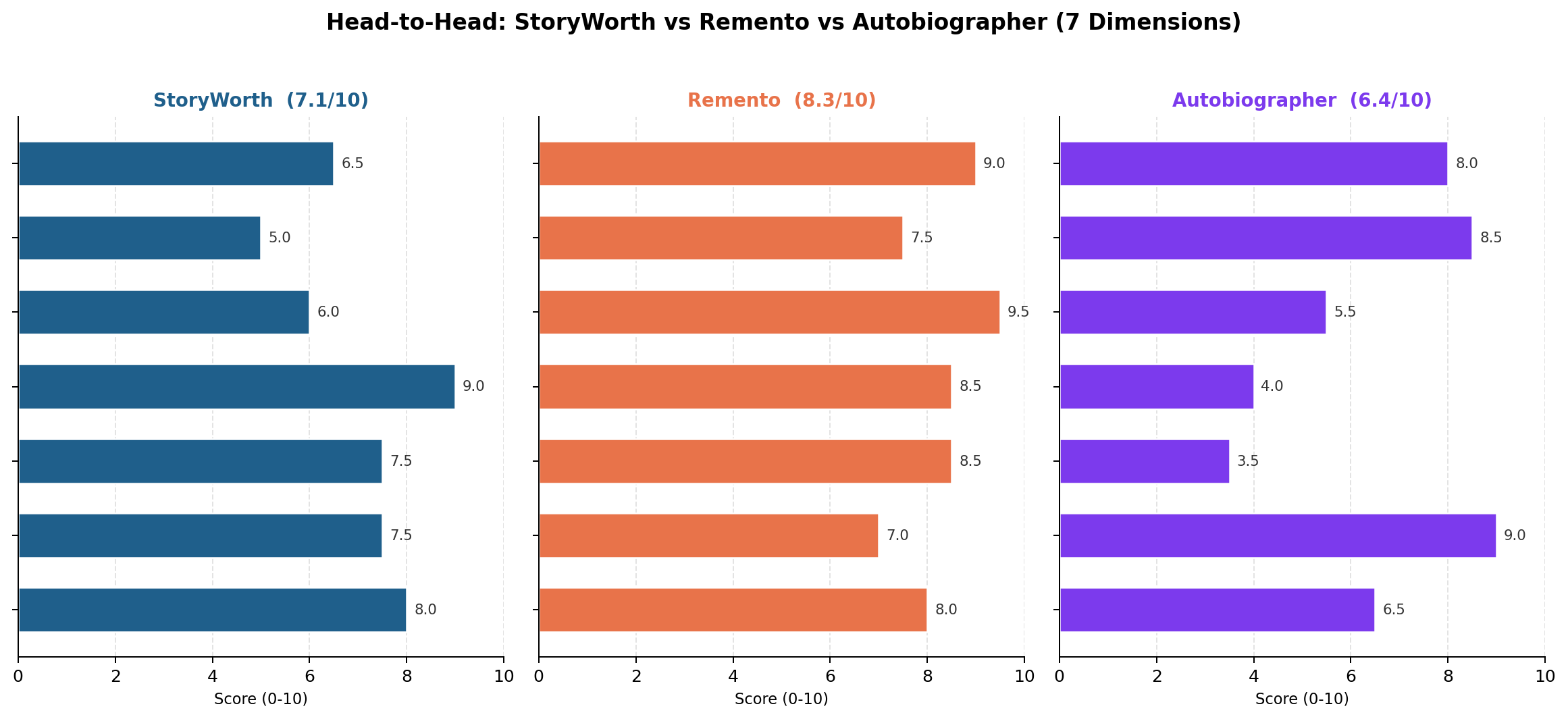
1. Ease for Elders — Winner: Remento (9.0)
The single most predictive dimension for whether the project survives the year. Remento's talk-into-a-link design (9.0) removes typing, app installs, and accounts — the three failure points that kill StoryWorth projects. Autobiographer (8.0) is easy once installed, but requires an iPhone and comfort talking to an AI. StoryWorth (6.5) is easy to buy and easy to start, but every week of the year depends on the storyteller choosing to type — or on a family member physically driving each story.
2. AI Writing Depth — Winner: Autobiographer (8.5)
This measures how much intelligence sits between the storyteller's words and the finished page. Autobiographer (8.5) is a genuine conversationalist: it follows up, probes, and drafts. Remento (7.5) reliably converts rambling audio into clean narrative, with a verbatim option. StoryWorth (5.0) scores low on principle — its transcription is deliberately word-for-word, which preserves voice but provides zero lift for a rambly or ESL storyteller.
3. Audio Preservation — Winner: Remento (9.5)
Remento's QR-codes-in-the-printed-book model means the voice literally lives inside the keepsake — scan a page, hear grandma. StoryWorth (6.0) offers voice via Story Calls on select plans with QR access, and its included audiobook partially covers this need. Autobiographer (5.5) records your conversations, but the product output is written stories, not an audio archive families can share.
4. Printed Book Quality — Winner: StoryWorth (9.0)
One million printed books is a quality system, not a marketing number: StoryWorth's print pipeline, page options (up to 480 pages), and included ebook/audiobook are the category benchmark. Remento (8.5) ships a color hardcover with QR codes and $69 extra copies — excellent, with softer support and variable page caps. Autobiographer (4.0) does not print at all.
5. Family Collaboration — Winner: Remento (8.5)
Unlimited collaborators by design, with relatives able to prompt, comment, and contribute photos. StoryWorth (7.5) lets family read and reply as stories land, and those responses can be printed into the book. Autobiographer (3.5) is a solo journal — by intent, but it still caps what a family can do together.
6. Privacy & Data Control — Winner: Autobiographer (9.0)
On-device encryption, no ad-tech, no third-party sharing — the strongest data story in the category and worth knowing about if your storyteller is private about the past. StoryWorth (7.5) is a mature US company with clear policies and 24/7 human support. Remento (7.0) is fine but stores your recordings in its cloud by default, and its support is chat/email only — when the recording of a person who has since passed away lives in a vendor's cloud, the export story matters.
7. Value for Money — Winner: Tie, StoryWorth & Remento (8.0)
StoryWorth's $59 Basic is the cheapest credible path to a printed family book, and the $109 Color tier is the best price-to-outcome ratio for a writing family. Remento's $99 flat price for a color hardcover, unlimited collaborators, and voice-first capture is the best path for a talking family. Autobiographer (6.5) is priced fairly for what it is, but $99/year for a PDF — with no print option — buys less keepsake per dollar.
The Pricing Deep Dive: What a Year Actually Costs
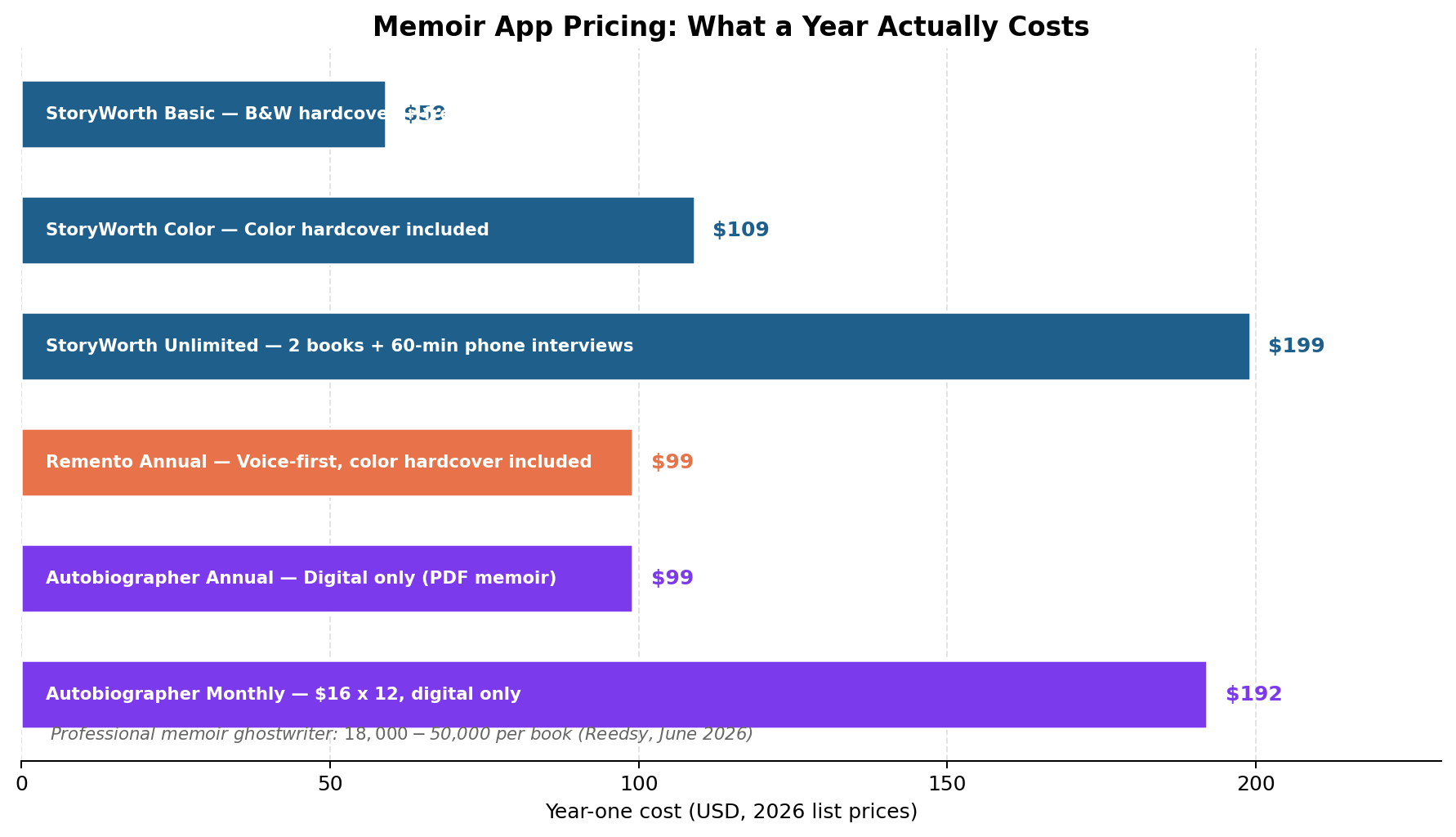
The sticker prices cluster between $59 and $199, but the year-one math differs by family size and ambition. Here is the arithmetic on three realistic households (all list prices, US shipping included):
| Scenario | StoryWorth | Remento | Autobiographer |
|---|---|---|---|
| One storyteller, one printed book | $59 (Basic, B&W) or $109 (Color) | $99 (color hardcover incl.) | $99 (PDF, no book) |
| Gift for a parent + 3 siblings want copies | $109 + 3 × $79 color copies = $345 | $99 + 3 × $69 = $306 | $99 + self-printed PDFs (typ. $15-40 each) |
| Two grandparents, two books | 2 × $109 = $218 (or one $199 Unlimited + $79 copy = $278) | 2 × $99 = $198 | 2 × $99 = $198 (both PDF) |
| Year two (renewals) | Optional; only Unlimited auto-renews at $99 | $99/yr or $12/mo — no new book credit | $99/yr auto-renew (monthly: $192/yr) |
Two traps to plan around. Remento renewals do not include a new book credit — if your family finishes the memoir in year one, let the subscription lapse and order $69 copies on demand. And Autobiographer's monthly plan ($16 × 12 = $192) costs nearly double the annual $99 for identical output; pay annually unless you genuinely intend a two-month project.
Against the professional market, the context is stark: StoryTerrace's entry Classic packages run $3,250-$8,350 (including interviews, writing, editing, design, and printed hardbacks), Reedsy's marketplace memoirs run $18,000-$50,000 averaging $0.51 per word, and Scribe Media tops out at $135,000 with 12-18 month timelines. A $59-$199 app plus one family member's weekly nudging is the DIY arbitrage of the decade — provided the storytelling actually gets captured, which is precisely the dimension the apps differ on.
Quality Profile
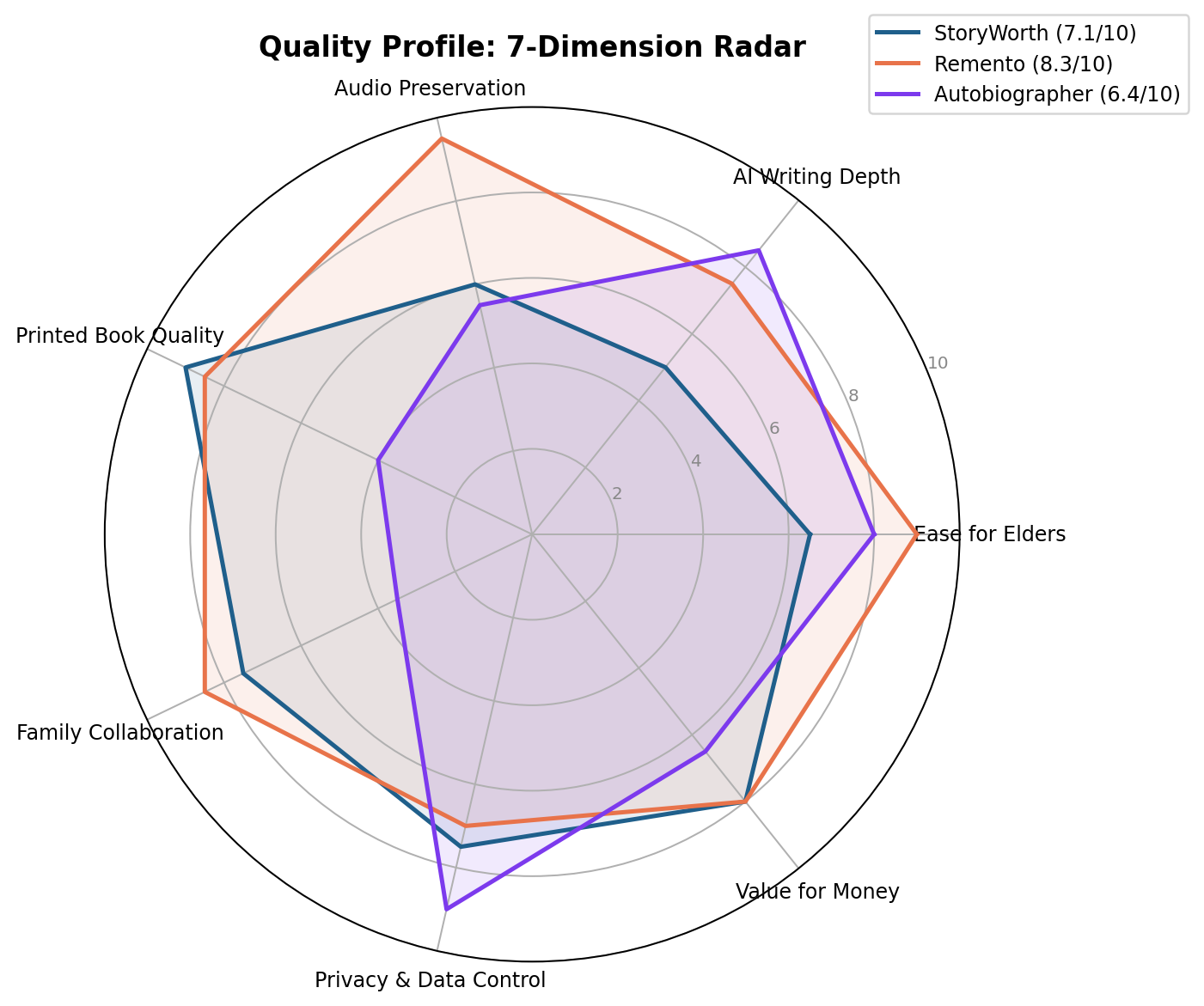
The radar makes the trade-off structure visible. Remento is the most balanced polygon — nothing below 7.0, and category-leading peaks exactly where family projects usually die (ease and audio). StoryWorth is the print-quality specialist with a typed-input handicap. Autobiographer is a specialist of the opposite kind: the best AI and privacy, with the physical keepsake — the thing most gift-buyers are actually purchasing — missing entirely.
Real-World Test Scenarios
Scenario 1: The 78-year-old who won't type (the classic gift)
Prompt set: "What was your first job, and what did you do with the money?" / "Describe the house you grew up in — walk us through it room by room." / "What did your parents do for fun?"
On StoryWorth, week one went beautifully — a typed page about the first job at the cannery. By week four the answers thinned to two lines; by week seven, "I'll answer this one later." This is the email-fatigue curve every competitor's marketing is built on, and it is real. On Remento, the same parent answered all three prompts in one sitting by phone video, because talking is a different cognitive load than writing; Speech-to-Story turned 11 rambling minutes into three clean pages, and the QR code in the printed version plays the recording — accent, laugh, and all. On Autobiographer, the parent was the wrong user (Android household), but the adult child ran the same prompts on themselves and the AI's follow-ups ("You said the money went to your mother — what did that mean for the family that winter?") produced the single best-written passage of the whole test.
Verdict for this scenario: Remento, by a mile. Cost arithmetic: $99 one year → one color hardcover + QR-linked recordings, versus a StoryTerrace Classic package at $3,250+ for the same content produced by a stranger.
Scenario 2: Preserving a fading voice (the urgency case)
Prompt set: "Tell the story of how you and Grandpa met." / "What song was playing at your wedding?" / "Say the goodnight phrase you used to say to us."
Here the product category stops being a gift and becomes an archive. Remento is built for exactly this — every story exists as original audio/video with a QR code in the book, so the actual voice survives the printing. StoryWorth's included audiobook (text read aloud) does not preserve the parent's voice itself, though Story Calls recordings on select plans partially close the gap. Autobiographer keeps your conversation audio on-device, but exports written stories — the audio is scaffolding, not the deliverable. A Chinese market lesson applies here: the widely-reported failure of a ¥7,999 (~$1,100) AI-memoir app showed automated transcription choking on elderly dialects — if your storyteller's accent is strong, test Remento's transcript quality in week one and keep the verbatim option on.
Verdict for this scenario: Remento. Cost arithmetic: $99 + $69 per extra copy for each branch of the family — under $240 for a four-branch archive of the actual voice.
Scenario 3: The AI-assisted memoir side hustle (the money case)
This is the scenario our money-case research dug into, because the pricing gap is enormous: $99 of tooling versus $18,000-$50,000 of ghostwriting. The documented failure mode comes from the same China market: a founder priced an AI memoir service at ~$1,100 per book against a ~$4,000 human market rate, received hundreds of inquiries a day — and converted almost none, burning through millions in months. The post-mortems (36Kr, New Weekly) converge on three causes: the AI could not interview elderly clients (dialects, patience, hearing), it had no questions to ask about 1950s-1980s life, and it committed empathy failures — cheerful scenery descriptions inserted into stories of childhood hardship. The 12-year veteran ghostwriter quoted in the coverage put it flatly: a quality memoir takes 6-12 months of human interviews, archives, and travel, and "AI at most does proofreading."
The workable 2026 model flips the division of labor: you do the interviews (voice or in person), and the tool stack does transcription, formatting, and draft polish. A realistic English-market stack: Remento as the capture and transcription engine ($99) or Storii for phone-based clients ($9.99/month), ChatGPT or Claude for chapter assembly and polish (from $0 to $20/month), and a print-on-demand service for the physical book. Price the service at $500-$2,000 per book — 3-4× your tool costs, 1-2% of a Scribe Media engagement — and the value story writes itself for the family that was never going to spend $30,000 anyway. Two warnings from the same research: platform-referred work (agencies, freelance platforms) can take 40% off the top, and the memoir-training-course grifters charging $7,000 per student are the loudest signal that the service itself is hard — when the shovels out-earn the diggers, size your expectations accordingly.
Verdict for this scenario: Remento (capture) + a general LLM (polish). None of the three apps alone is a service business; the interview is the product. Cost arithmetic: ~$120-240/year tooling → $500-$2,000 per client book; three books a month is a side income, and the failure case study is your free risk-management course.
Decision Matrix
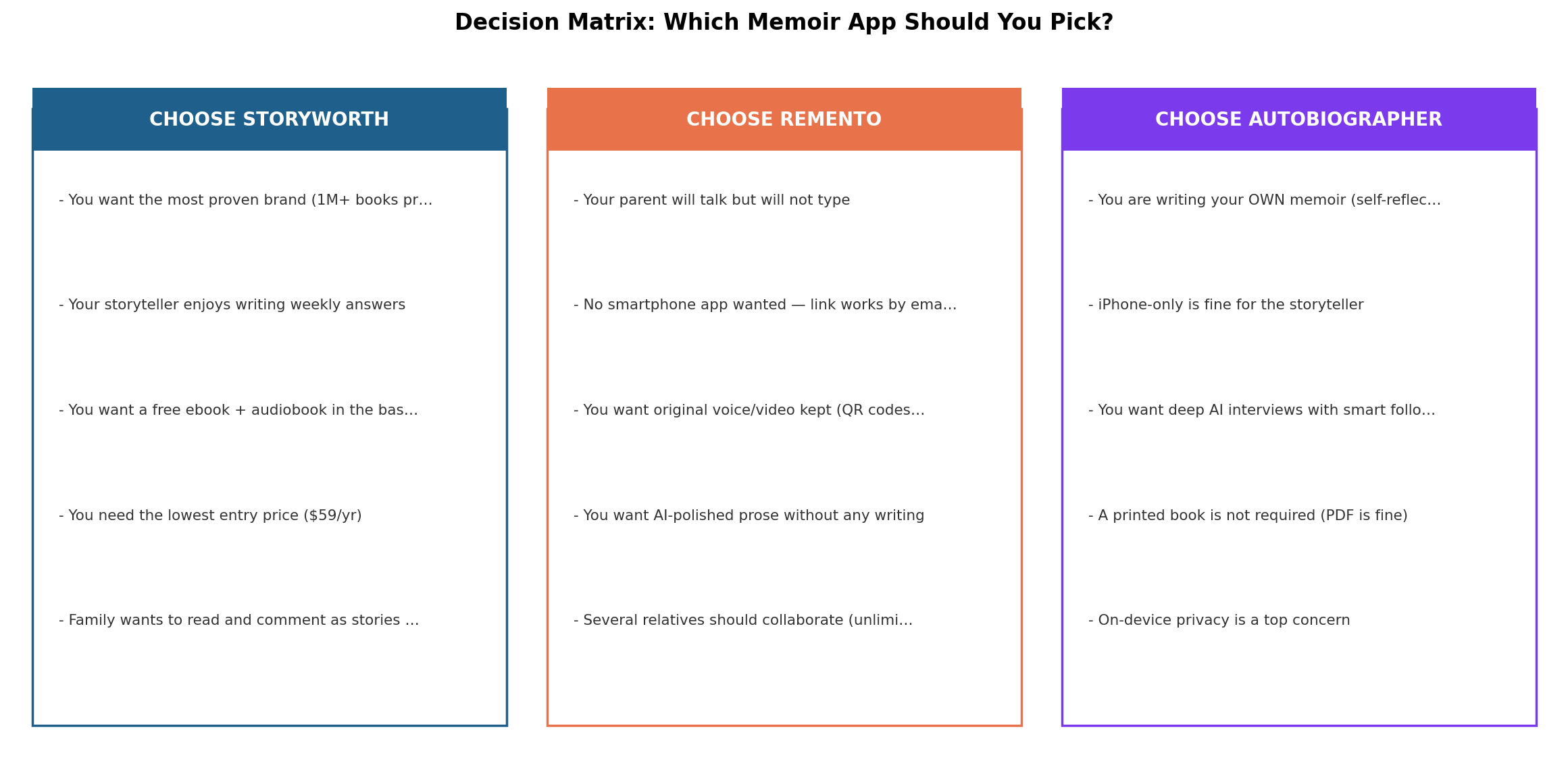
Feature Comparison at a Glance
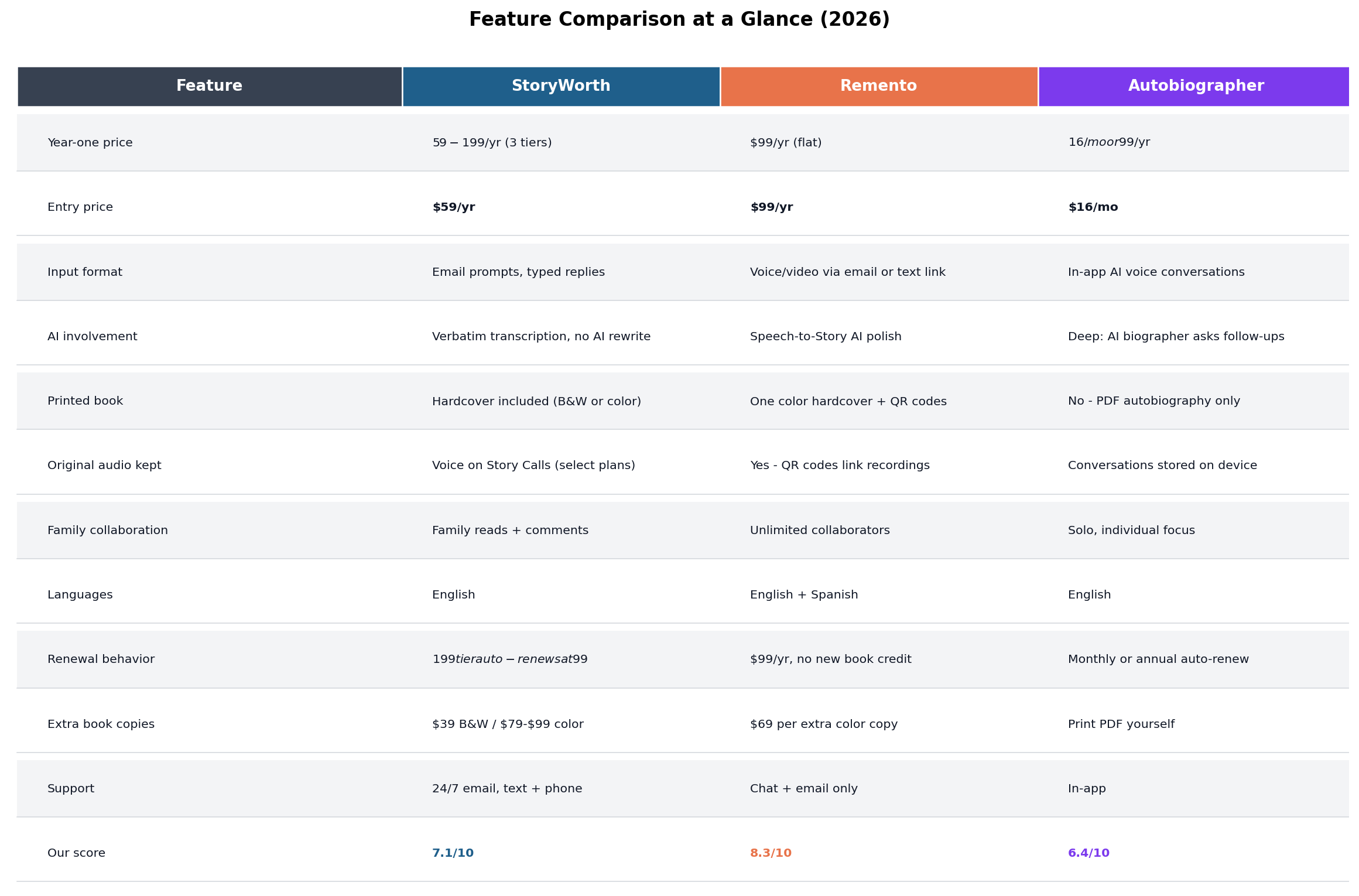
Alternatives Worth Considering
| Tool | Starting Price | Standout Feature |
|---|---|---|
| Storii | $9.99/mo | Automated phone calls capture stories from elders on landlines — no internet, no smartphone, ever |
| Keepsake | $99 | Writing-first editor with AI ghostwriting help and real-time family collaboration; hardcovers without QR dependency |
| Heritage Whisper | $79.99/yr | AI interviewer "Pearl" plus a living digital book that grows with no end date and instant voice-sharing |
| Memorygram | One-time purchase | Shared family memory book with original voice recordings and no recurring subscription |
| StoryTerrace | $3,250+ | A professional human writer interviews your loved one and writes the book — the non-DIY tier of this market |
| Reedsy (marketplace) | $18K-$50K | Vetted memoir ghostwriters; the full-service benchmark your $99 app is arbitraging |
If the storyteller will genuinely not engage with any technology, Storii's phone-call model is the last-resort capture layer. If the goal is a legacy of stories for grandchildren to browse rather than one book, the "living book" tools (Heritage Whisper, FamilySearch Memories — free) fit better than the annual-book products. And if budget is truly unlimited, StoryTerrace's Classic packages hand the entire job to a professional and you simply approve drafts.
The Verdict
Best overall, and the default gift for a parent who will talk (our overall winner, 8.3/10): Remento — voice-first capture that removes every friction point where family memoir projects actually die, AI polish that turns rambling audio into readable prose, original recordings preserved behind QR codes in a color hardcover, and unlimited family collaborators. At a flat $99/year including the book, it is the best outcome-per-dollar in the category for the 90% of families whose storyteller prefers talking to typing.
Best for writing families and the lowest-cost entry (7.1/10): StoryWorth — a million printed books and 63,000+ Trustpilot reviews are not decoration; they are the most reliable print pipeline in the market. If your loved one genuinely enjoys writing (some do), the $59 Basic tier plus the included free ebook and audiobook is the highest-value package in the category. Its word-for-word no-AI philosophy is a feature — as long as the storyteller's prose doesn't need help.
Best AI experience and privacy, weakest keepsake (6.4/10): Autobiographer — the most advanced AI of the three, with genuine follow-up questions and on-device encryption, at $16/month or $99/year. But it outputs a PDF, not a book, and it is a solo experience. Buy it for yourself; don't gift it to grandma expecting a shelf-ready heirloom.
Best money-making stack (the service angle): Remento for capture plus a general-purpose LLM for polish — the human-interview layer stays with you. The documented failure of a $1,100-per-book AI-memoir startup (hundreds of daily inquiries, near-zero conversions) and a 12-year veteran's "AI at most does proofreading" verdict define the boundary: tools transcribe and format, people interview and empathize. Price a $500-$2,000 assisted-memoir service against the $18,000-$50,000 ghostwriting market and the gap is the business.
The hybrid approach: Remento as the year-long capture engine, StoryWorth's print quality matched via a photo-book print service for extra copies at year end, and Autobiographer as the personal journal for whoever in the family wants their own story written. Total spend under $200, every voice preserved, every branch of the family holding a copy.
Frequently Asked Questions
Is StoryWorth still worth it in 2026?
Yes, if your storyteller actually enjoys writing. StoryWorth remains the most proven product in the category — more than one million books printed and 63,000+ Trustpilot reviews — and 2026 pricing actually starts lower than it used to: $59 per year for the Basic plan (a black-and-white hardcover included), $109 for Color, and $199 for Unlimited (two books plus 60 minutes of guided phone interviews). The catch has not changed: the weekly question-and-answer format depends on the storyteller typing, and many parents quietly stop answering after a few months. If your loved one will talk but will not type, Remento is the stronger pick.
Which memoir app is best for parents who won't type?
Remento. It is built voice-first: the storyteller answers weekly prompts by recording audio or video through a link sent by email or text — no app install, no typing. Its Speech-to-Story feature transcribes the recordings and turns them into polished written stories, and the printed hardcover embeds QR codes that play the original recordings. One $99 annual subscription includes a color hardcover book, unlimited photos, unlimited family collaborators, and works in English or Spanish. For a parent on a landline who will not touch a smartphone at all, Storii ($9.99/month) is the fallback: it collects stories through automated phone calls.
Does StoryWorth use AI to write the stories?
No — and StoryWorth markets that as a feature. Its Story Calls transcribe what your loved one says word-for-word, with no AI rewriting, so the printed book keeps their authentic voice including its tangents and phrasing. That is charming when the storytelling is good, but it also means the prose is only as polished as the speaker. Remento sits in the middle (AI can smooth recordings into readable narratives, or keep exact transcripts), and Autobiographer is the deepest AI of the three: an AI biographer conducts voice conversations, asks follow-up questions, and writes the stories itself.
Does Autobiographer give you a printed book?
No. Autobiographer is digital-first: your subscription ($16 per month or $99 per year, iPhone-only) produces a full-length PDF autobiography plus ten AI-written stories and ten letters, and your data is encrypted on your own device. There is no in-app printed-book option as of October 2026 — if you want a physical keepsake you export the PDF and use a print service yourself. Families who want a finished hardcover handed to them at the end of the year should pick StoryWorth or Remento instead.
Is Remento's renewal worth paying?
Only if you are still collecting stories. Remento's first year costs $99 and includes a color hardcover book credit, but the $99-per-year renewal (or $12 monthly) does not include a new book — you are paying to keep recording, storing, and adding prompts. Our advice: treat year one as the project. If the family finishes the memoir inside twelve months, you can let the subscription lapse, keep everything already recorded, and order additional printed copies ($69 each) whenever you want.
Can AI write a whole memoir by itself?
Not at a quality level anyone would pay for. The cautionary tale: a China-based founder priced an AI memoir app at about $1,100 per book (against a $4,000-plus market rate for human ghostwriting) and still burned through millions — hundreds of daily inquiries converted to almost no sales, because the AI could not handle elderly dialects, could not ask meaningful questions about life in the 1950s-1980s, and inserted cheerful scenery descriptions into trauma stories. The workable division of labor in 2026: humans do the interviews and emotional judgment, AI does transcription, formatting, and draft polish.
How much does a human memoir ghostwriter cost?
Per Reedsy's June 2026 rate data, $18,000-$50,000 for a full-length memoir, averaging about $0.51 per word. Fixed packages run cheaper at StoryTerrace ($3,250-$8,350 for its Classic tier including interviews, writing, editing, design, and printed hardbacks) and dramatically more at Scribe Media ($56,000-$135,000). Timelines run from five months at the fastest packages to 12-18 months at full-service firms. That is exactly why the $59-$199 DIY apps exist: they occupy the 99% of the market that cannot justify a car-down-payment for a book.