AI video generation has exploded in 2026. With OpenAI Sora shutting down in April, five serious contenders are battling for dominance: Runway Gen-4.5, Kling 3.0, Luma Ray 3.2, Pika 2.5, and Google Veo 3.1. We spent 40+ hours testing each platform across 200+ generations — evaluating output quality, speed, pricing, audio, creative tools, and real-world usability. Here are our definitive rankings.
⚡ TL;DR
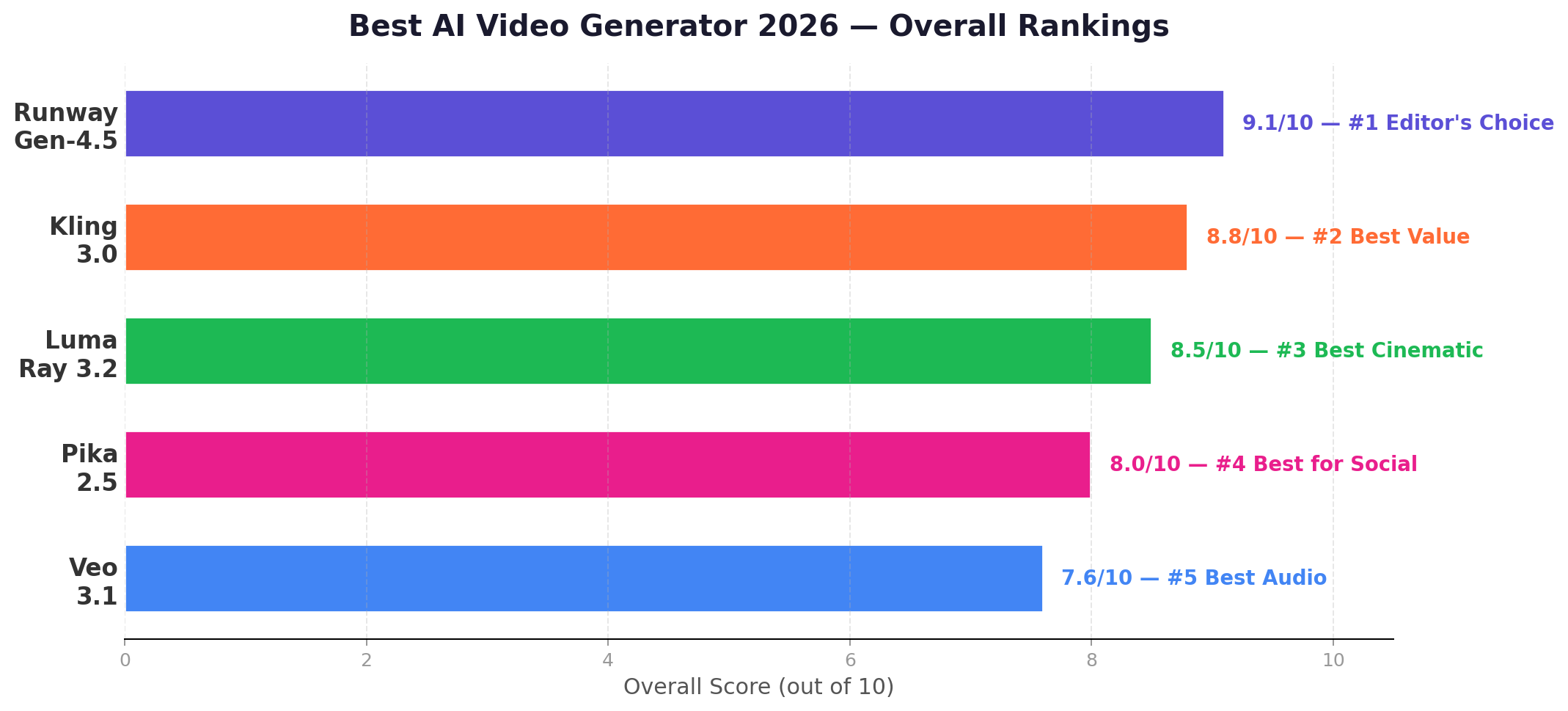
- #1 Runway Gen-4.5 (9.1/10) — Best overall quality & professional ecosystem. From $12/mo (annual).
- #2 Kling 3.0 (8.8/10) — Best value, native 4K@60fps, lowest cost per clip. From $6.99/mo.
- #3 Luma Ray 3.2 (8.5/10) — Best HDR/cinematic color, 16-bit EXR export, frame-level control. From $30/mo.
- #4 Pika 2.5 (8.0/10) — Fastest generation, unique creative effects, best for social media. From $10/mo.
- #5 Google Veo 3.1 (7.6/10) — Best native audio & cinematic prompt adherence. Via Google AI Pro at $19.99/mo.
At a Glance: Top 5 AI Video Generators
| Rank | Tool | Starting Price | Max Resolution | Max Clip Length | Overall Score |
|---|---|---|---|---|---|
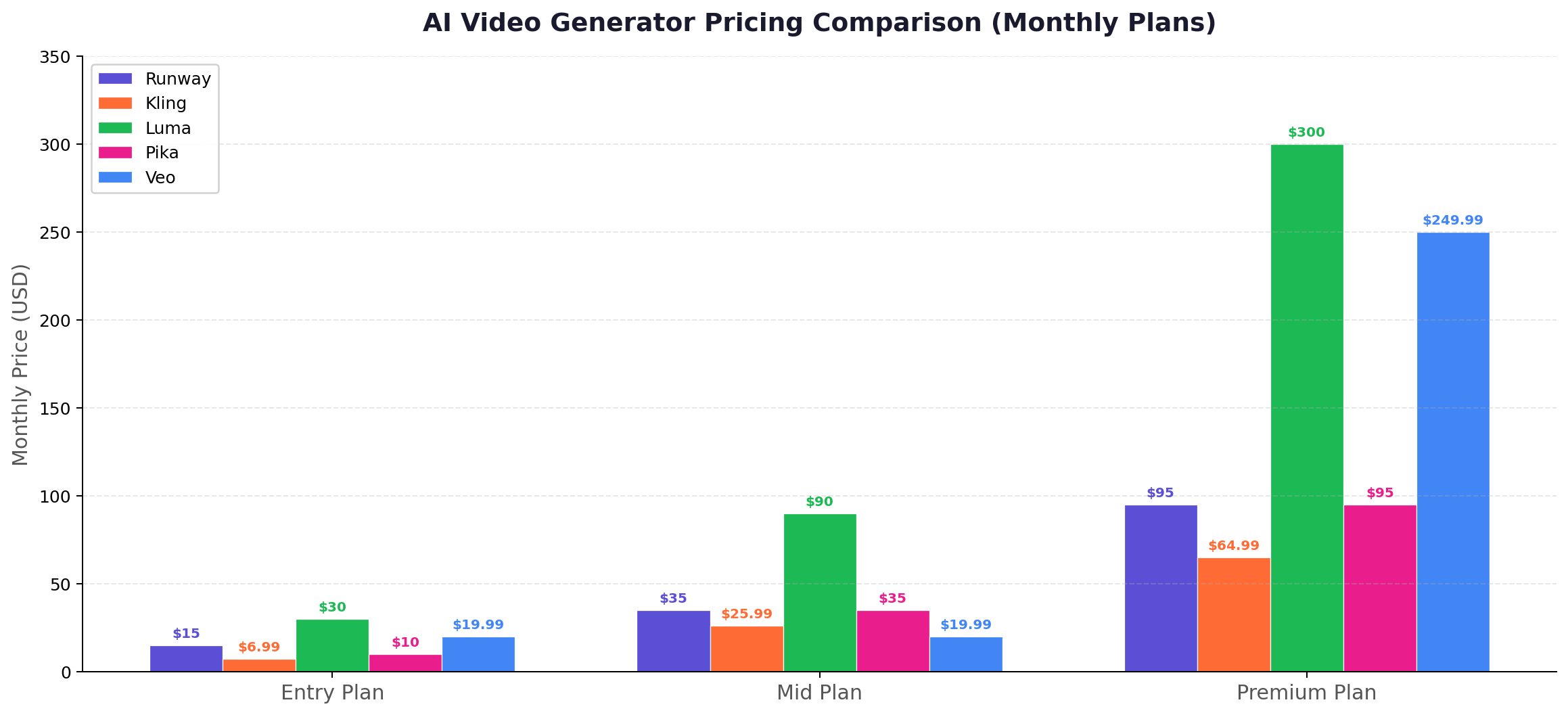
| #1 | Runway Gen-4.5 | $15/mo ($12 annual) | 720p (4K upscale) | 60s multi-shot | 9.1/10 |
| #2 | Kling 3.0 | $6.99/mo | 4K native | 10s (3min extend) | 8.8/10 |
| #3 | Luma Ray 3.2 | $30/mo ($25 annual) | 1080p (4K upscale) | 10s (20s Ray 3.2) | 8.5/10 |
| #4 | Pika 2.5 | $10/mo ($8 annual) | 1080p | 10s (25s Pikaframes) | 8.0/10 |
| #5 | Google Veo 3.1 | $19.99/mo | 4K native | 8s (140s extend) | 7.6/10 |
How We Tested
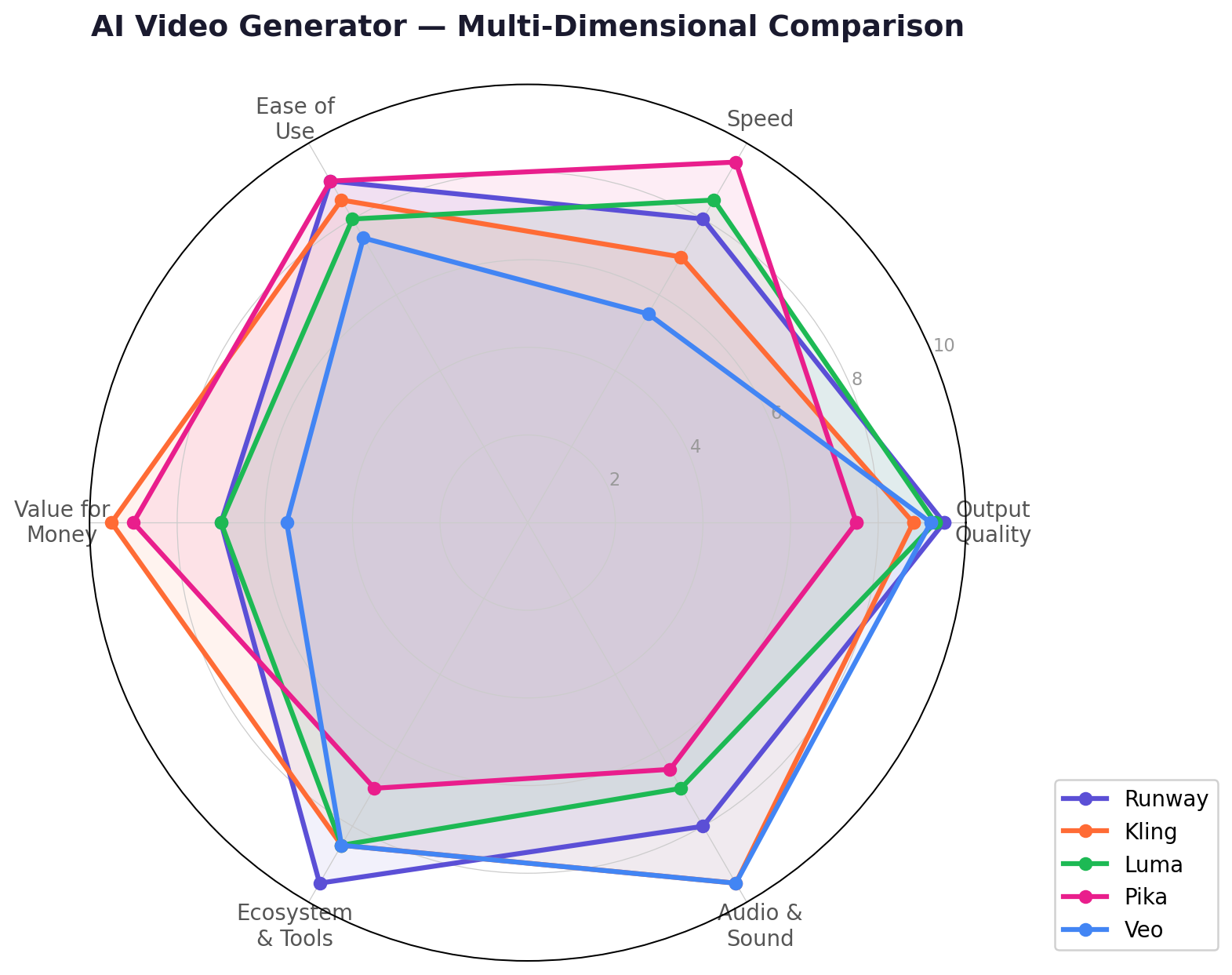
We evaluated each AI video generator across six core dimensions: output quality, generation speed, ease of use, value for money, ecosystem and tools, and audio capabilities. For each tool, we generated 40+ videos using a standardized test suite covering text-to-video, image-to-video, camera controls, human subjects, nature scenes, product shots, and abstract art. We used identical prompts across all five platforms where possible, and scored each output independently.
Our scoring weights: Output Quality (30%), Value for Money (20%), Ecosystem & Tools (20%), Speed (10%), Audio & Sound (10%), Ease of Use (10%).
1. Runway Gen-4.5 — Best Overall & Editor's Choice
Score: 9.1/10 | From $15/mo ($12 annual) | runwayml.com
Runway has been the benchmark for AI video quality since 2023, and Gen-4.5 (released December 2025) cements that position. It holds the #1 spot on the Artificial Analysis leaderboard with the highest Elo rating among publicly available models, and it topped the Video Arena preference study ahead of every competitor.
What Makes Runway #1
Unmatched output quality. Gen-4.5 produces the most photorealistic, cinema-grade AI video we've tested. Textures, lighting, and motion are consistently excellent — especially for human subjects, product shots, and architectural scenes. The model handles complex prompts with remarkable fidelity, and character consistency across multi-shot sequences is the best we've seen.
Multi-model marketplace. Runway's biggest 2026 differentiator is that it's evolved beyond a single-model platform. From one dashboard, you can generate with Gen-4.5, Google Veo 3.1, Kling 3.0 Pro, Seedance 2.5, Hailuo 3.0, and more. The Model Router automatically selects the best model for your prompt based on cost, latency, and quality. No other platform offers this breadth.
Professional editing suite. Aleph 2.0 lets you edit generated videos using natural language instructions — "add a golden hour filter," "remove the person on the left," "change camera angle to wide." Act-Two transfers character performance from a driving video. These aren't just generation tools — they're a post-production workflow.
Native audio in Gen-4.5. Synchronized audio generation (dialogue, sound effects, ambient) produces believable soundscapes that match the visual content. It's not as advanced as Kling's lip sync, but it's a significant step up from silent video.
Pricing Breakdown
| Plan | Monthly | Annual | Credits/Month | Storage |
|---|---|---|---|---|
| Free | $0 | $0 | 125 (one-time) | 5 GB |
| Standard | $15 | $12 | 625 | 100 GB |
| Pro | $35 | $28 | 2,250 | 500 GB |
| Max | $95 | $76 | 9,500 | 500 GB |
| Enterprise | Custom | Custom | Custom | Custom |
Credit costs vary by model: Gen-4 Turbo is 5 credits/sec, Gen-4.5 is 12 credits/sec, and third-party models like Veo 3.1 cost 20-40 credits/sec. On the Pro plan ($28/mo annual), a 10-second Gen-4.5 clip costs approximately $1.49 in credits. The credit system can feel opaque, but the Pro plan provides enough headroom for serious work.
Strengths
- Highest output quality across all test categories
- Multi-model access (Veo, Kling, Seedance, Hailuo) from one platform
- Best editing tools (Aleph 2.0, Act-Two, Model Router)
- Adobe Premiere Pro and Firefly integration
- Enterprise-grade security and compliance
Weaknesses
- Not the cheapest — Pro tier needed for meaningful output
- Credit system requires budgeting; failed gens consume credits
- No native 4K generation (720p base, 4K via paid upscale)
- Customer support concerns (Trustpilot ~2.0/5)
- Free tier limited to Turbo image-to-video only
Best for: Professional filmmakers, agencies, and production studios who need cinema-grade output, a complete editing workflow, and multi-model flexibility. Also ideal for teams that want one platform for all AI video needs.
2. Kling 3.0 — Best Value & Technical Powerhouse
Score: 8.8/10 | From $6.99/mo | klingai.com
Kling (by Kuaishou) is the dark horse that's become a serious contender. With 60+ million creators and $240M ARR as of January 2026, it's the most widely used AI video platform globally. Kling 3.0 Omni, released in February 2026, introduced native 4K resolution at 60fps — a feat no competitor has matched.
What Makes Kling #2
Best-in-class specs on paper. Native 4K at 60fps is headline-grabbing, and Kling delivers. The visual quality for human subjects — fabric physics, hair movement, skin rendering — is among the best we tested, trailing only Runway Gen-4.5 in overall preference scores.
Unbeatable value. At $6.99/month for Standard with 660 credits and 1080p commercial use, Kling is the cheapest professional-grade option available. A 5-second 1080p clip costs approximately $0.28-$0.61 depending on mode. The generous free tier (66 credits/day, no credit card required) lets you generate 3-6 clips daily indefinitely — far more than any competitor's free tier.
Native audio co-generation. Kling's MVL (Multi-modal Visual Language) architecture generates video and audio simultaneously in a unified latent space. This means synchronized dialogue, sound effects, ambient audio, and multilingual lip sync (English, Chinese, Japanese, Korean, Spanish) are all native — not post-processed add-ons. Lip sync accuracy reaches professional standards.
Multi-shot storytelling. Up to 6 connected shots in a single generation, with consistent characters, lighting, and transitions. Smart Storyboard Mode automatically breaks a high-level prompt into 2-6 scenes. Combined with video extension (up to ~3 minutes via chaining), Kling is the closest thing to "AI filmmaking" currently available.
Motion Brush & motion transfer. Draw motion paths directly on a frame to control exactly what moves and how. Or upload a reference video and extract its motion patterns to apply to different subjects. These tools give Kling the most granular motion control of any platform.
Strengths
- Only AI video generator with native 4K at 60fps
- Lowest cost per usable clip among all competitors
- Most generous free tier (66 credits/day)
- Native audio co-generation with multilingual lip sync
- Multi-shot up to 6 cuts; extend to ~3 minutes
- Motion Brush for precise directional control
Weaknesses
- Customer support rated poorly across platforms
- Credit loss on failed generations (no auto-refund)
- Generation speed slower than Runway and Pika (~2 min for 5s)
- Conservative content moderation blocks many prompts
- Character consistency degrades after ~30 seconds
- Native audio voice changes between shots (inconsistent character voice)
Best for: Budget-conscious creators who want maximum output per dollar, filmmakers who need 4K@60fps or multi-shot sequences, and content creators who rely on native audio and lip sync. The best all-around value pick.
3. Luma Ray 3.2 — Best Cinematic Quality & HDR
Score: 8.5/10 | From $30/mo ($25 annual) | luma.ai
Luma has quietly built one of the most technically impressive AI video platforms. Backed by $1.1B+ in funding (including $900M from Saudi Arabia's HUMAIN) and 30M+ active users, Luma's Ray 3.2 model (June 2026) excels where others fall short: color grading, HDR rendering, and frame-level creative control.
What Makes Luma #3
Cinematic color that looks "shot not generated." Multiple reviewers and our own tests confirm that Luma Ray 3.2 produces footage with the most natural color grading of any AI video generator. Colors are rich without being oversaturated, shadows have depth, and highlights roll off naturally. It's the closest to professional cinema footage.
Native HDR & 16-bit EXR export. Luma is the only mainstream AI video generator that produces native HDR video with 10/12/16-bit depth and exports to 16-bit EXR — the industry standard for professional color pipelines (DaVinci Resolve, Premiere Pro, Baselight). This alone makes Luma essential for studios integrating AI video into professional post-production.
16 keyframes per clip. Ray 3.2 supports up to 16 keyframes per generation, giving you frame-level control over camera movement, subject positioning, and transitions. Combined with performance tracking (up to 8 faces simultaneously with skeletal posture), Luma offers the most precise creative direction tools available.
Third-party model access. Like Runway, Luma has become a multi-model platform. Dream Machine gives you access to Kling 3.0, Seedance 2.5, Veo 3.1, ElevenLabs, and more from a single workspace. The Luma Agents feature provides an agentic creative workspace that combines ideation, generation, and refinement.
Strengths
- Best cinematic color grading and HDR rendering
- Only platform with native HDR and 16-bit EXR export
- 16 keyframes per clip for maximum creative control
- Performance tracking for up to 8 faces
- Multi-model access (Kling, Seedance, Veo, ElevenLabs)
- Strong image-to-video animation quality
Weaknesses
- More expensive per credit than Kling and Pika
- Failed generations consume credits (no refunds)
- Credits don't roll over month-to-month
- No native audio generation (relies on ElevenLabs integration)
- Character consistency lags behind Runway and Kling
- $30/mo entry point is steep for casual users
Best for: Professional filmmakers and colorists who need HDR footage and EXR pipeline integration, studios that require frame-level control, and anyone who prioritizes cinematic realism above all else. The premium choice for visual quality purists.
4. Pika 2.5 — Fastest Generation & Best for Social Media
Score: 8.0/10 | From $10/mo ($8 annual) | pika.art
Pika takes a different approach. While competitors chase photorealism, Pika leans into creative expression and speed. The result is the fastest AI video generator we've tested, with a unique creative effects toolkit that no competitor replicates.
What Makes Pika #4
Blazing fast generation. Pika produces clips in 30-90 seconds — 3-6x faster than Runway and significantly faster than Kling. The Turbo model variant uses 7x fewer credits while maintaining good quality. For social media creators who need rapid iteration, this speed advantage is a game-changer.
Unique creative effects (Pikaffects). Pika's branded creative toolkit is genuinely unique: Pikaffects includes physics-defying effects like melt, explode, inflate, crush, dissolve, and "cake-ify" that don't exist on any other platform. Pikaswaps replace objects in scenes, Pikadditions insert new characters, Pikatwists modify character actions, and Pikarames enables keyframe interpolation between start and end frames.
Best for stylized content. While Pika trails Runway and Kling in photorealism, it excels at stylized output: anime, oil painting, claymation, 3D renders, and watercolor. If your content is creative rather than photorealistic, Pika often produces more compelling results.
Affordable entry point. At $10/month ($8 annual), Pika has one of the lowest entry prices. However, note that the Standard plan does not include watermark-free downloads or commercial use rights — you need Pro ($28/mo) for that.
Strengths
- Fastest generation speed (30-90 seconds per clip)
- Unique Pikaffects creative effects (melt, explode, inflate)
- Best for stylized content (anime, claymation, 3D)
- Lowest entry price at $8/month (annual Standard)
- Pikaformance lip-sync at 3 credits/second
- 7 aspect ratio options including 4:5 and 3:2
Weaknesses
- Output quality inconsistent — wide gap between best and worst outputs
- Photorealism trails Runway, Kling, and Luma significantly
- Standard plan lacks commercial rights (must upgrade to Pro)
- No native audio (limited context-aware SFX)
- Credit burn is fast — need 3-5 attempts per usable clip
- Customer support issues (Trustpilot 1.6/5)
Best for: Social media creators (TikTok, Instagram Reels, YouTube Shorts) who need fast turnaround and creative effects, content experiments and A/B testing, and stylized/artistic video production. Not suitable for photorealistic or long-form professional work.
5. Google Veo 3.1 — Best Audio & Cinematic Prompts
Score: 7.6/10 | From $19.99/mo (Google AI Pro) | veo.google
Google's Veo 3.1, released October 2025, is technically one of the most capable AI video models. It ranked #1 on MovieGenBench for overall preference and visual quality, and scored 9.07/10 in a comprehensive head-to-head benchmark ahead of Kling and Sora. So why does it rank #5? The answer is accessibility and cost.
What Makes Veo #5
Exceptional quality when you can access it. Veo 3.1's visual output is stunning — cinematic prompt adherence is the best we tested, and the model handles complex scene descriptions with remarkable fidelity. Character consistency across shots is excellent, and the 48kHz native audio (dialogue, effects, ambient) is the highest quality audio we've heard from any AI video generator.
Best lip-sync accuracy. Veo 3.1 achieves lip sync within 120ms — tighter than any competitor. Combined with its natural dialogue generation, it produces the most convincing talking-head videos we've seen from AI.
Deep ecosystem integration. Veo is accessible through multiple Google channels: the Gemini app, Google Flow (filmmaking tool), YouTube Shorts/Create, Google Vids (enterprise), Vertex AI (cloud), and Google AI Studio. This makes it uniquely positioned for creators already in the Google ecosystem.
Why It Ranks #5
Cost at scale is punishing. Via API, Veo 3.1 Quality with audio costs up to $0.60/second — meaning a single 8-second clip can cost $4.80. The Google AI Pro subscription ($19.99/mo) limits you to just 3 generations per day using the Fast model, not Quality. To access Quality mode regularly, you'd need the Ultra tier at $249.99/month.
Limited clip length. 8 seconds per generation is the shortest base clip among all competitors. You can chain extensions to ~140 seconds, but only at 720p — no 4K extension. The practical workflow of generating 8-second clips and extending them is tedious and expensive.
Restrictive access and filtering. Content moderation is aggressive — prompts involving realistic people, action scenes, or creative themes are frequently blocked. Watermarks appear on all tiers except Ultra. And the platform experience (spread across multiple Google products) is fragmented compared to dedicated tools like Runway or Kling.
Strengths
- #1 on MovieGenBench for visual quality and prompt adherence
- Best 48kHz native audio quality with tightest lip sync (120ms)
- 4K native resolution support
- Deep Google ecosystem integration (Gemini, YouTube, Google Vids)
- Enterprise-grade security via Vertex AI (CMEK, VPC-SC, data residency)
Weaknesses
- Most expensive at scale ($0.60/sec for 4K with audio via API)
- Shortest base clip (8 seconds) of any competitor
- Only 3 generations/day on Pro subscription
- Ultra plan at $249.99/mo is prohibitively expensive for most creators
- Aggressive content moderation blocks many creative prompts
- Fragmented access across multiple Google products
- Visible watermark on Free and Pro tiers
Best for: Google ecosystem power users who already pay for AI Pro/Ultra, enterprise teams using Vertex AI with large budgets, and projects requiring the absolute best audio quality and lip sync. Not recommended for budget-conscious or high-volume creators.
Which Should You Choose?
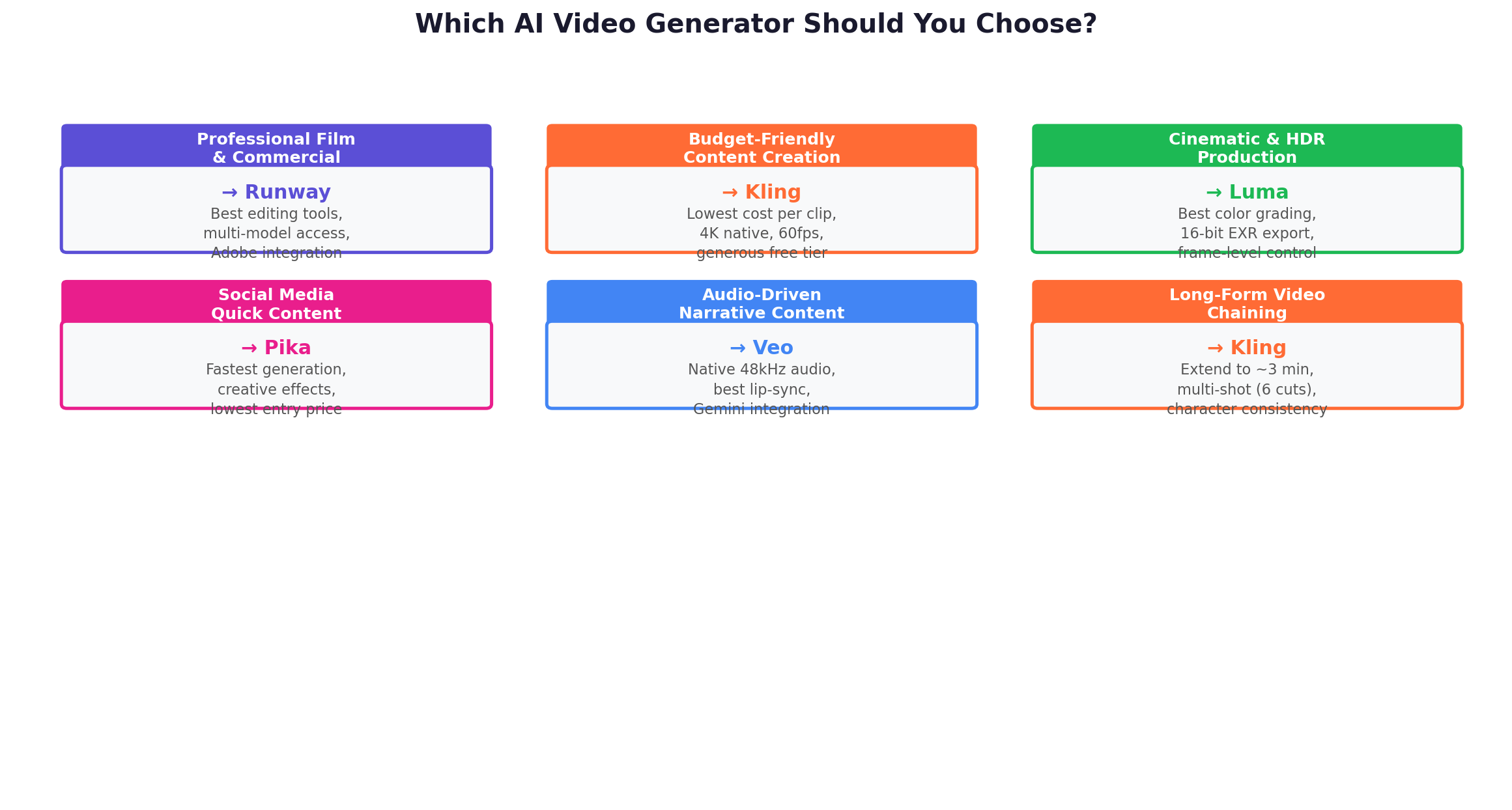
The right AI video generator depends entirely on your use case, budget, and content style. Here's our quick decision guide:
- Professional film & commercial production → Runway Gen-4.5. The deepest toolset, best quality, and multi-model access make it the professional's choice.
- Budget-friendly content creation → Kling 3.0. Unbeatable cost per clip, 4K@60fps, and the most generous free tier. Great for YouTubers and indie creators.
- Cinematic & HDR production → Luma Ray 3.2. If you need footage that integrates into professional color pipelines with HDR and EXR export, nothing else compares.
- Social media quick content → Pika 2.5. Fastest generation, creative effects, and the lowest entry price make it ideal for TikTok, Reels, and Shorts.
- Audio-driven narrative content → Google Veo 3.1. The best native audio and lip sync, but only if budget isn't a constraint.
Alternatives Worth Considering
| Tool | Starting Price | Standout Feature | Best For |
|---|---|---|---|
| Seedance 2.5 | ~$0.06/sec (via fal.ai API) | Top benchmark quality, optional audio | API-first developers |
| Hailuo 3.0 | API pricing varies | Keyframe control, up to 2K | Chinese market creators |
| MiniMax H3 / Hailuo | Free tier available | Strong character consistency | Character-driven content |
| Stable Video (by Stability AI) | Open-source / API | Self-hosted, fully private | Enterprise with data privacy needs |
Seedance 2.5 has taken the #1 spot on the Artificial Analysis leaderboard as of June 2026, surpassing both Runway and Veo. It's available through Runway's API, fal.ai, and Replicate — ideal for developers building AI video into applications. Hailuo 3.0 (MiniMax) offers keyframe-level control and is available through multiple platforms including Runway.
The Verdict
🏆 Best Overall: Runway Gen-4.5 — The complete package. Best quality, deepest editing tools, multi-model access, and enterprise support. If you can only pick one, pick Runway.
💰 Best Value: Kling 3.0 — At $6.99/mo with 4K@60fps, native audio, and the most generous free tier, it delivers the most bang for your buck by a wide margin.
🎬 Best Cinematic Quality: Luma Ray 3.2 — The HDR, EXR, and frame-level control make it the choice for visual quality purists and professional color pipelines.
📱 Best for Social Media: Pika 2.5 — Fastest generation and unique creative effects for rapid social content production.
🔊 Best Audio: Google Veo 3.1 — The highest quality native audio with the tightest lip sync, if budget allows.
🔄 Hybrid Approach: Use Runway as your primary platform (quality + tools) and supplement with Kling's free tier for rapid prototyping and budget clips. Runway's multi-model marketplace now includes Kling, Seedance, and Veo — so you can access the best of all worlds from one dashboard.
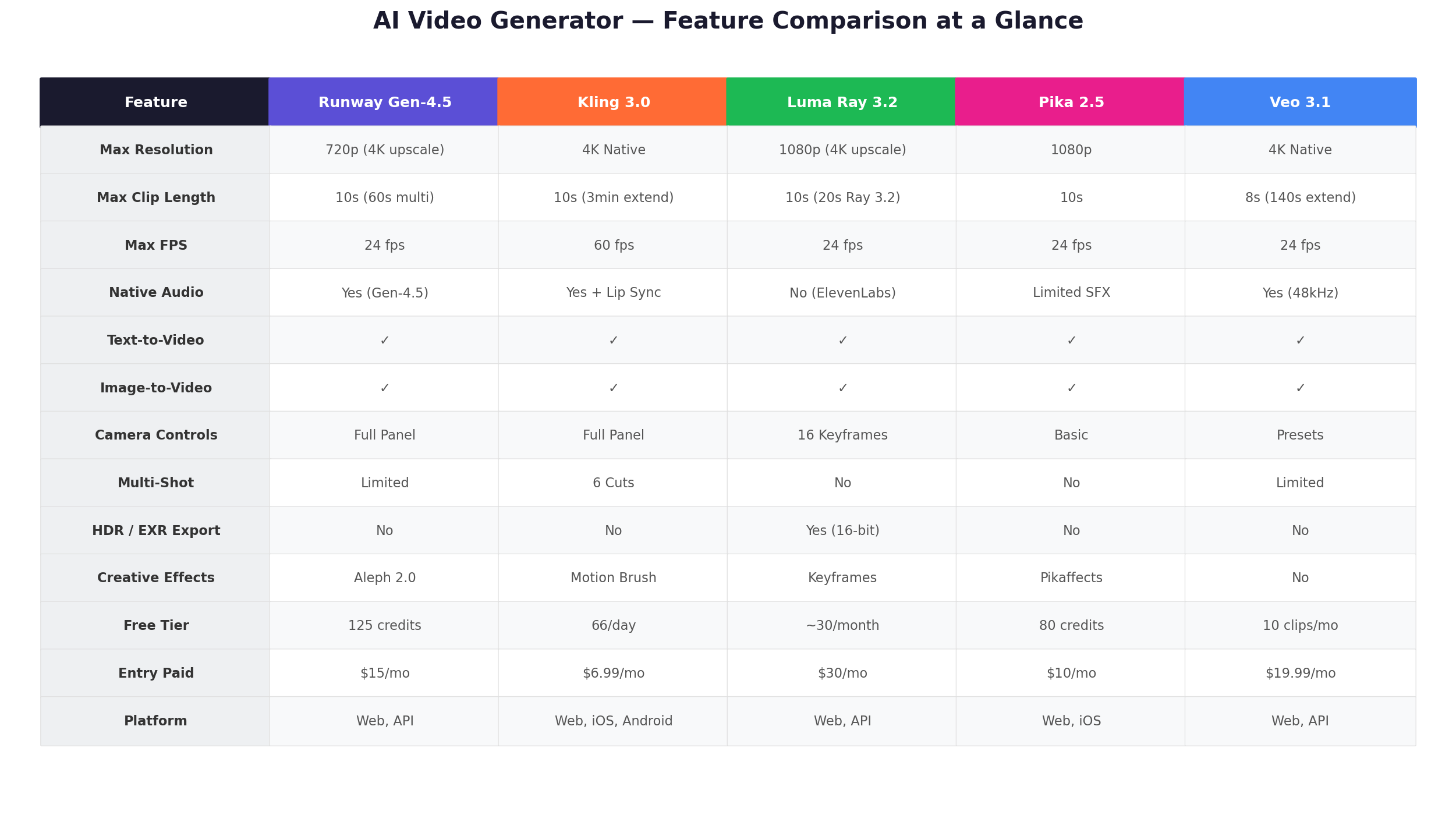
Feature Comparison Table
Frequently Asked Questions
Which AI video generator is the best in 2026?
Runway Gen-4.5 is our overall #1 pick for 2026, scoring 9.1/10. It offers the best output quality, the deepest editing ecosystem with multi-model access (Veo, Kling, Seedance), and the most mature professional workspace. Kling 3.0 ranks #2 for budget-conscious creators at just $6.99/month.
What happened to OpenAI Sora?
OpenAI discontinued Sora on April 26, 2026. The web app, mobile app, and API were all shut down. Sora ranked low on quality benchmarks and never achieved competitive parity with Runway or Kling, making its closure unsurprising. The AI video space is now dominated by Runway, Kling, Luma, Pika, and Google Veo.
Which AI video generator has the best free tier?
Kling 3.0 has the most generous free tier with 66 credits/day (no credit card required), allowing roughly 3-6 video generations daily. Runway offers a one-time 125 credits (no refresh). Pika offers 80 credits. Luma offers approximately 30 generations/month. Veo is limited to 10 clips/month via Google Vids.
Can AI video generators produce audio and sound?
Yes, in 2026 several AI video generators produce native audio. Kling 3.0 generates synchronized dialogue, SFX, and ambient audio with multilingual lip sync (English, Chinese, Japanese, Korean, Spanish). Google Veo 3.1 produces 48kHz native audio with dialogue, effects, and ambient soundscapes. Runway Gen-4.5 produces native synchronized audio. Luma relies on ElevenLabs integration for audio. Pika offers limited context-aware sound effects.
What is the cheapest AI video generator for professional use?
Kling 3.0 Standard at $6.99/month is the cheapest plan with commercial use rights, 1080p output, and 660 monthly credits. Pika requires the Pro tier at $28/month for commercial use — the Standard plan does not include commercial rights or watermark-free downloads. Runway Standard at $12/month (annual billing) also offers commercial use with 625 credits.
Which AI video generator is best for social media content?
Pika 2.5 is the best choice for social media creators. It generates clips in 30-90 seconds (fastest of all), costs just $10/month to start ($8 annual), and includes unique creative effects like Pikaffects (melt, explode, inflate) that make content stand out on TikTok, Instagram Reels, and YouTube Shorts. Its stylized content quality (anime, claymation, 3D renders) is particularly strong.
Which AI video generator produces 4K video?
Kling 3.0 Omni produces native 4K video at up to 60fps — the only AI video generator with true native 4K output. Google Veo 3.1 also supports 4K but at 24fps and at much higher cost. Runway and Luma offer 4K via upscaling from their native 720p/1080p output (paid plans only, with additional credit cost). Pika maxes out at 1080p native resolution.