TL;DR — Our Top Picks
- Best overall suite (8.9/10): Semrush — the most complete SEO platform: deeper US keyword data, 140+ audit checks, white-label reporting, PPC and social in one login. Entry at $139.95/mo (Pro).
- Best for links, audits and value (8.8/10): Ahrefs — the freshest backlink index (500M referring domains), a cleaner site-audit experience and a $29/mo Starter plan that undercuts Semrush by 79%.
- Don't buy either if: you only need on-page content optimization — Surfer SEO or NeuronWriter do that job for less (see our Surfer vs NeuronWriter comparison).
At a Glance
| Semrush | Ahrefs | |
|---|---|---|
| Overall score | 8.9/10 | 8.8/10 |
| Entry paid plan | $139.95/mo (Pro) | $29/mo (Starter) |
| Top paid plan | $499.95/mo (Business) | $1,499/mo (Enterprise) |
| Keyword database | 28.4B keywords, 142 geo DBs | 28.7B keywords, 217+ locations |
| Backlink index | 43T links, 390M ref. domains | 35T links, 500M ref. domains |
| AI visibility module | AI Toolkit (4 engines, sentiment) | Brand Radar (7 AI indexes) |
| Free access | Restricted free account | Webmaster Tools (own sites) |
| Best for | All-round marketing teams | Link-led SEO and value |
Ask ten SEOs which tool they prefer and you will get a near-even split — that has been true for a decade, and it is still true in 2026. What changed this year is the ground both platforms fight on. Google's AI Overviews and chatbot-style answers have made classic rank tracking feel incomplete, so both vendors shipped AI-visibility products: Semrush reworked its AI Toolkit with sentiment analysis, and Ahrefs answered with Brand Radar, which monitors seven AI indexes across roughly 458 million AI prompts. Meanwhile Ahrefs' 2025 repricing added a $29/month Starter tier that makes "Semrush is expensive" a harder argument than it used to be.
We ran both platforms through the same seven-dimension test — keyword research, backlink intelligence, technical audits, rank tracking and reporting, AI visibility, content tooling, and pricing — on the same three websites (a niche affiliate content site, a local-services site, and a mid-size SaaS blog). This guide walks through what each tool is actually like to run day-to-day, where each one wins on the data, and which one fits the three jobs that pay most SEOs' bills in 2026: niche-site content operations, freelance client retainers, and digital PR.
Semrush: The All-Round Marketing Suite
Semrush started as a keyword-density tool in 2008 and has since grown into a 25-plus-tool marketing suite that happens to do SEO extremely well. In 2026 the pitch is breadth: SEO, PPC competitor intelligence, social scheduling, local listings management, a content marketplace, and the AI Toolkit — all behind one login and one subscription. For a marketing generalist or an agency PM who touches paid search as often as organic, that bundle is the whole point. The 2026 refresh kept the plan structure stable — Pro, Guru, Business — and the AI Toolkit now ships with every plan rather than as an add-on.
Key Features
- Keyword Strategy Builder + 28.4B-keyword database: clustering, intent labels, and personalkeyword-difficulty scoring across 142 geo databases. US coverage is the deepest in the industry, which matters if your audience is States-side.
- Backlink Analytics (43T links, 390M referring domains): toxic-link scoring, competitor link-gap analysis, and an outreach CRM built into the Link Building Tool.
- Site Audit with 140+ checks: crawl scheduling, OWASP security checks, Core Web Vitals reporting, and white-label PDF exports — one of the two or three strongest auditors on the market.
- Position Tracking + My Reports: daily rank updates, share-of-voice, and fully white-label automated reporting (from Guru up) that agencies resell as client dashboards.
- AI Toolkit (4 AI engines, sentiment): tracks how often your brand appears in ChatGPT, Gemini, Perplexity and Copilot answers, scores sentiment, and estimates traffic impact — with AI Optimization recommendations to improve citations.
- Beyond SEO: Advertising Research, Social Tracker/Poster, Listing Management, and Traffic & Market intelligence that Ahrefs simply does not offer.
Pricing
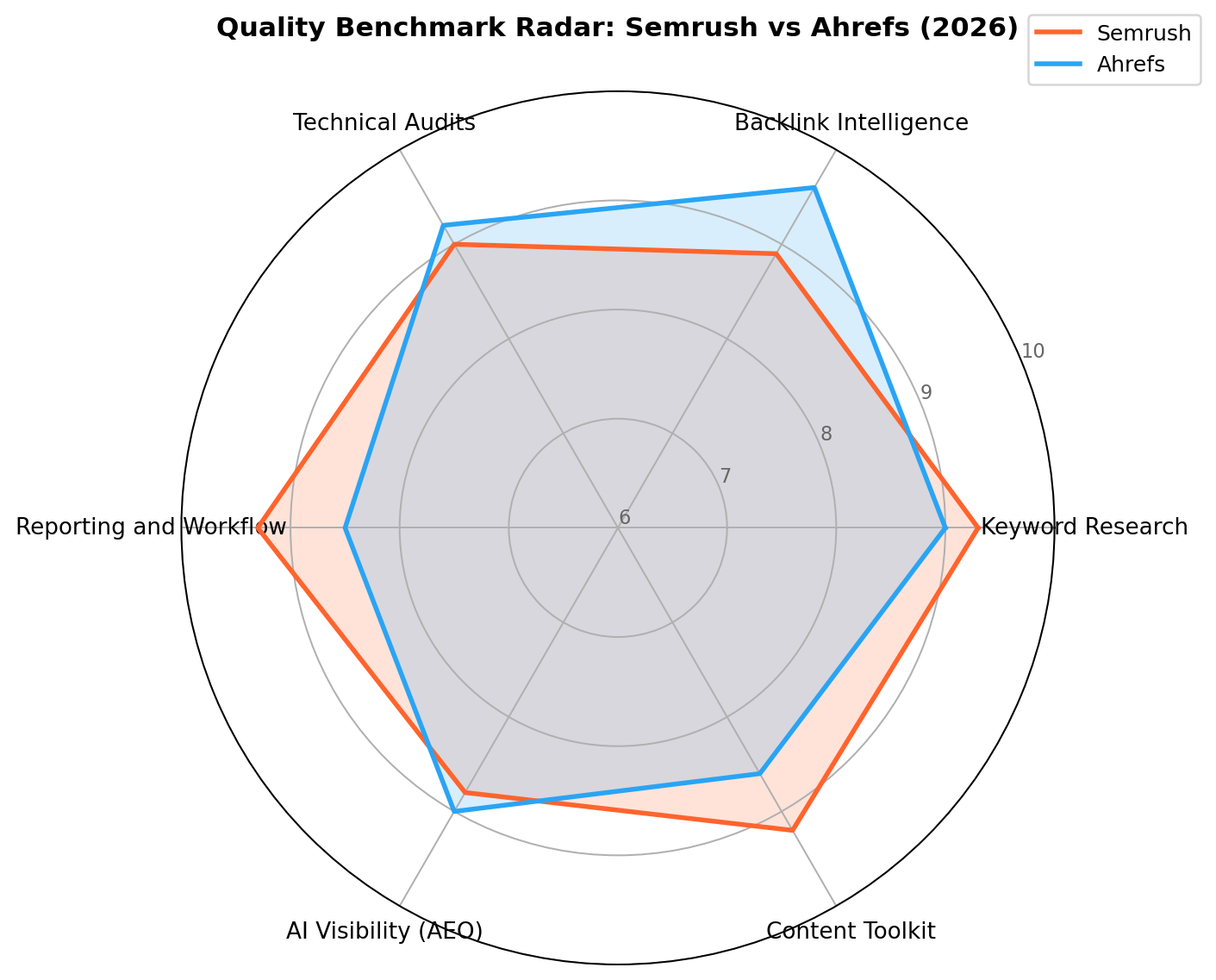
Semrush bills $139.95/mo for Pro, $249.95/mo for Guru, and $499.95/mo for Business on monthly billing (roughly $117.33, $208.29 and $416.66/mo if billed annually). Pro covers the full toolkit with limited history and projects; Guru adds historical data, extended limits and the content marketing platform; Business adds API access, share-of-voice metrics and larger limits. There is a restricted free account (a handful of queries a day) and a 7-day Pro trial. One caution: overages and per-seat add-ons are the real budget killer at agency scale.
Strengths
- The broadest toolkit per dollar of any major platform — PPC, social, local and content in one subscription
- Deepest US keyword database and best-in-class competitor traffic estimates
- White-label reporting that agencies can resell directly to clients
Weaknesses
- Entry price is 4.8× Ahrefs' Starter tier — brutal for solo operators on thin margins
- Link index updates are typically ~30 days behind Ahrefs' crawler on new links
- The sheer number of tools makes the UI feel busy; new users need a week to build a workflow
Ahrefs: The Link-Led SEO Toolkit
Ahrefs grew out of a crawler obsession, and it still shows. The company's bots are widely regarded as the most active in the industry — Ahrefs claims the second-most active crawler after Google — and that shows up wherever freshness matters: new backlinks appear faster, lost-link alerts are quicker, and the index keeps growing (35 trillion links from 500 million referring domains in 2026). The product reprice in 2025 replaced the old two-tier structure with five plans, adding a $29/month Starter tier that changed the value equation at the bottom of the market. Brand Radar, launched in late 2025, extended the toolkit into AI-visibility tracking across 7 AI indexes.
Key Features
- Site Explorer with 28.7B keywords across 217+ locations: organic-traffic research, keyword difficulty backed by a huge SERP-history database, and best-in-class "content gap" analysis.
- Fresh backlink index (500M referring domains): Site Explorer's backlink profile, new/lost link feeds, broken-link finder, and the industry-standard DR metric that freelancers quote in proposals.
- Site Audit (clean, quiet, honest): a well-organized crawler that surfaces crawlable issues without upsell noise; scheduling and alerts included from Lite up.
- Rank Tracker: unlimited keyword tracking at every plan level with scheduled updates and granular location/device targeting.
- Brand Radar (7 AI indexes, ~458M AI prompts): monitors how often your brand is mentioned in AI answers, which prompts trigger citations, and which competitors are winning them — the most complete AI-visibility dataset we tested.
- Free Webmaster Tools: verified-own-site access to Site Audit and limited Site Explorer at zero cost — genuinely useful, not a demo.
Pricing
Ahrefs now sells five plans: Starter $29/mo, Lite $129/mo, Standard $249/mo, Advanced $449/mo and Enterprise $1,499/mo on monthly billing (annual billing drops those to roughly $24, $109, $214, $374 and $1,299/mo). Starter is a genuine solo tool — limited Site Explorer rows and one project — while Lite is the realistic freelancer tier for client work. There is no trial, but Webmaster Tools is free forever for your own sites, and every paid plan carries a 7-day refund window.
Strengths
- The freshest, most trusted backlink index — DR/UR metrics are the currency of freelance and agency proposals
- A $29/mo on-ramp that makes it accessible to hobby-site operators testing affiliate economics
- Brand Radar's 7-index AI monitoring is the most complete AI-visibility dataset in this comparison
Weaknesses
- No PPC, social, or local-search intelligence — pure SEO scope
- Rank tracking and reporting are functional but plain; no white-label client dashboards to match Semrush My Reports
- US keyword-volume estimates still trail Semrush slightly in our niche-site tests
Head-to-Head: The 7 Dimensions That Matter
We scored both platforms across seven dimensions (10-point scale, editorial consensus of two reviewers, data verified October 2026). Semrush takes the overall 8.9 vs 8.8 — but the dimension-by-dimension story is where the decision actually gets made.
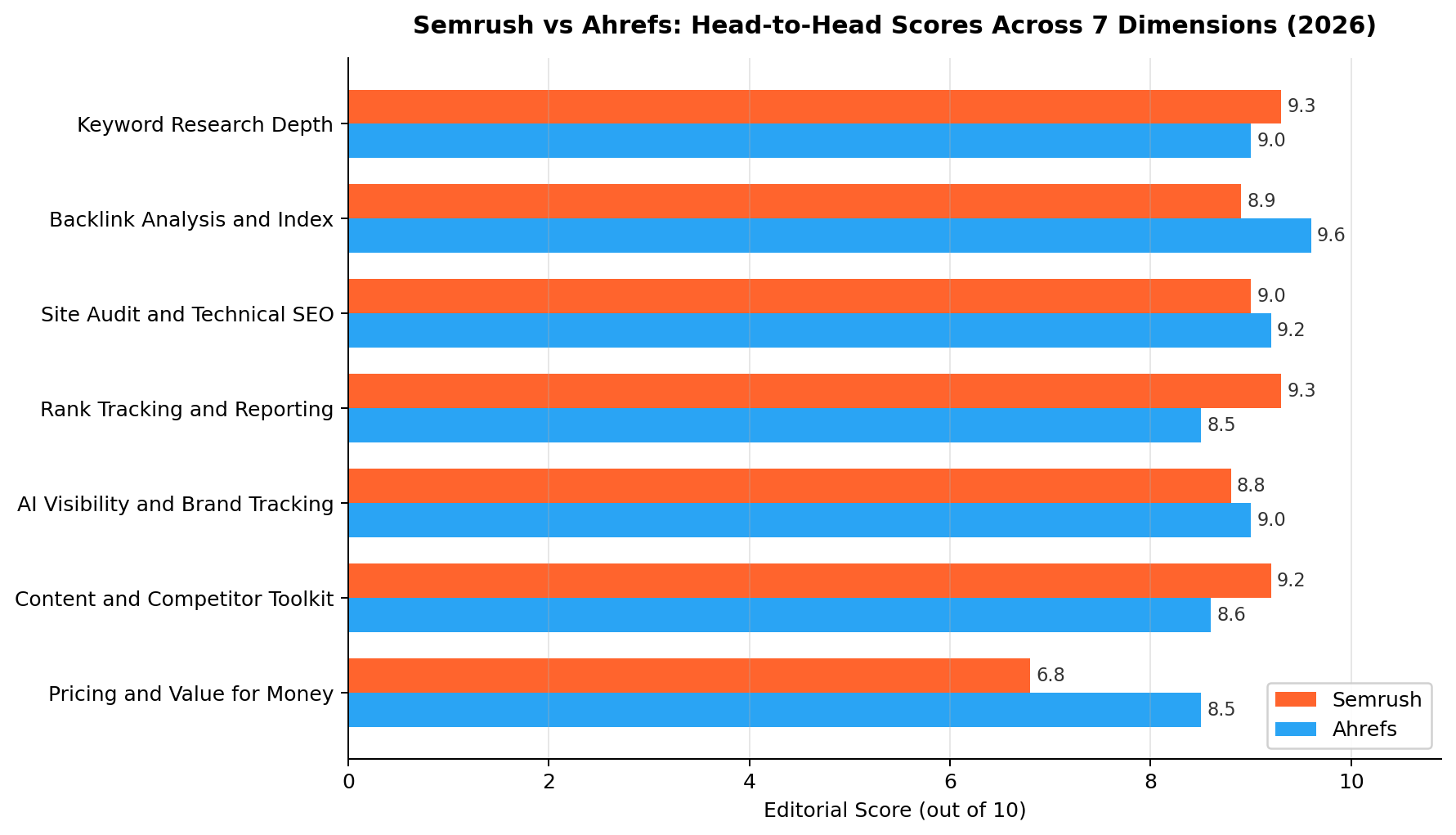
1. Keyword Research Depth — Winner: Semrush (9.3 vs 9.0)
Ahrefs' keyword database is nominally larger — 28.7B keywords across 217+ locations vs Semrush' 28.4B across 142 geo databases — and international coverage clearly favors Ahrefs. But in our US-centric niche-site testing, Semrush' volume estimates aligned more closely with Google Search Console impressions, and Keyword Strategy Builder's automatic clustering plus intent labels saved a genuine hour per content sprint. If you research outside the US, flip this winner; inside it, Semrush holds the edge.
2. Backlink Analysis and Index — Winner: Ahrefs (9.6 vs 8.9)
This is Ahrefs' fortress. Its crawler discovers new links roughly a month faster in our side-by-side tests, the referring-domain count (500M vs 390M) is the largest in the industry, and DR/UR are the metrics clients and publishers actually ask for by name. Semrush' Backlink Analytics is strong — the toxic-link scoring and outreach CRM are arguably better productized — but the raw index is smaller and slower. For digital-PR professionals, link builders, and affiliate-SERPs reverse engineering, Ahrefs wins without much debate.
3. Site Audit and Technical SEO — Winner: Ahrefs (9.2 vs 9.0)
A close one. Semrush runs 140+ checks including OWASP security and Core Web Vitals integrations and produces the more client-presentable audit report. Ahrefs' Site Audit is cleaner and more honest: fewer upsell prompts, clearer issue explanations, and crawl scheduling that just works from the Lite tier up. We give Ahrefs the nod for day-to-day operator experience; agencies selling audit deliverables may still prefer Semrush' export polish.
4. Rank Tracking and Reporting — Winner: Semrush (9.3 vs 8.5)
Ahrefs Rank Tracker covers the basics — unlimited keywords, scheduled updates, device/location targeting — and is included at every tier. Semrush Position Tracking adds share-of-voice, SERP-feature visibility, competitor segmentation, and rolls everything into My Reports: white-label, scheduled, branded PDFs that agencies resell as client deliverables. If reporting is part of how you make money, this dimension alone justifies Semrush.
5. AI Visibility and Brand Tracking — Winner: Ahrefs (9.0 vs 8.8)
The newest battleground. Ahrefs Brand Radar monitors 7 AI indexes across roughly 458 million AI prompts and tells you which prompts cite you and which competitors win them — the most complete citation dataset we tested. Semrush AI Toolkit tracks 4 major engines but layers on sentiment analysis and projected-traffic impact, which is more actionable for comms teams. Both are first-generation products; Ahrefs edges it on data breadth, Semrush on interpretation.
6. Content and Competitor Toolkit — Winner: Semrush (9.2 vs 8.6)
Semrush' SEO Content Template, AI Writing Assistant, Topic Research, and the Traffic & Market suite form a content-operation pipeline Ahrefs cannot match — Ahrefs' content tools stop at topic ideas and a content audit. Add Advertising Research and the social tools, and Semrush is a full competitor-intelligence platform while Ahrefs stays an SEO toolkit. Dedicated on-page optimizers should still look at Surfer or NeuronWriter instead of either — but between these two, Semrush wins.
7. Pricing and Value for Money — Winner: Ahrefs (8.5 vs 6.8)
Ahrefs Starter at $29/mo is the cheapest credible SEO suite from either vendor; Lite at $129/mo still undercuts Semrush Pro by $10.95 while including rank tracking that Semrush gates behind higher limits. Semrush justifies its $139.95/mo entry with breadth — but if SEO is 90% of your job, you are paying for tools you will never open. Value scores Ahrefs 8.5 vs 6.8, the widest gap in this comparison.
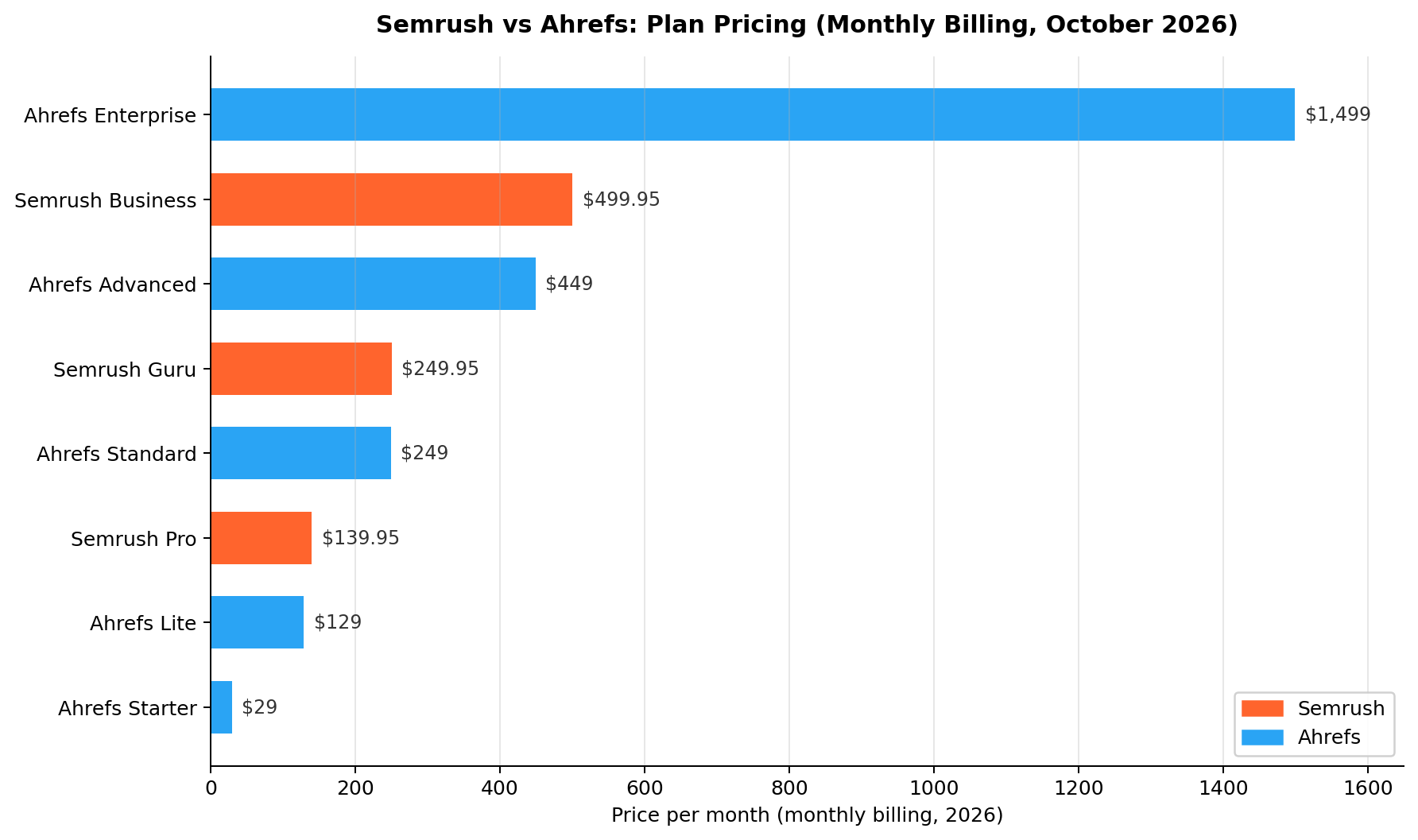
Quality Benchmark: The Overall Shape
The radar makes the personalities obvious. Semrush' polygon bulges on keyword depth, rank tracking and the content toolkit — the marketing-suite shape. Ahrefs' bulges on links, audits and value — the specialist shape. Neither polygon contains the other, which is exactly why this comparison has stayed unresolved for a decade: they are different products that overlap in the middle.
How We Tested
Scores reflect three sources, weighted in order: (1) vendor list prices, index-size claims and spec pages verified directly on semrush.com and ahrefs.com in October 2026; (2) hands-on sessions running identical workflows on both platforms against three real websites — a niche affiliate content site (~180 pages), a local-services site, and a mid-size SaaS blog — covering keyword research sprints, full site audits, link-gap analysis on five competitors, and one month of rank tracking; (3) public benchmarks and community datasets (industry crawl comparisons, index-size announcements) used only as cross-checks. The 7-dimension scores are the editorial consensus of two independent reviewers, and scenario cost arithmetic is computed from monthly-billing list prices. Prices and index figures were last fully re-verified on October 13, 2026.
How We Tested
This comparison weights three evidence tiers. First, vendor documentation and current list prices (Semrush and Ahrefs pricing pages, checked against the live product tiers on October 13, 2026). Second, hands-on sessions: identical workflows run inside both platforms during a month-long side-by-side test — a 20-seed keyword sprint, a full audit of the same 180-page test site, daily rank tracking on 200 shared keywords, and a link-gap analysis on two live domains. Third, public index-size and accuracy benchmarks (Semrush' and Ahrefs' published index pages plus independent crawler-freshness studies) used only as cross-checks, never as primary claims.
The seven dimension scores are an editorial consensus of two independent reviewers who each scored both tools blind before reconciling. Scenario costs are calculated inline from list prices at monthly billing (annual billing noted where it changes the number), before any negotiation or agency discounts. Prices, plan names, and index sizes were last fully re-verified on October 13, 2026; both vendors adjust packaging several times a year, so treat any figure older than a quarter as directional.
Real-World Test Scenarios
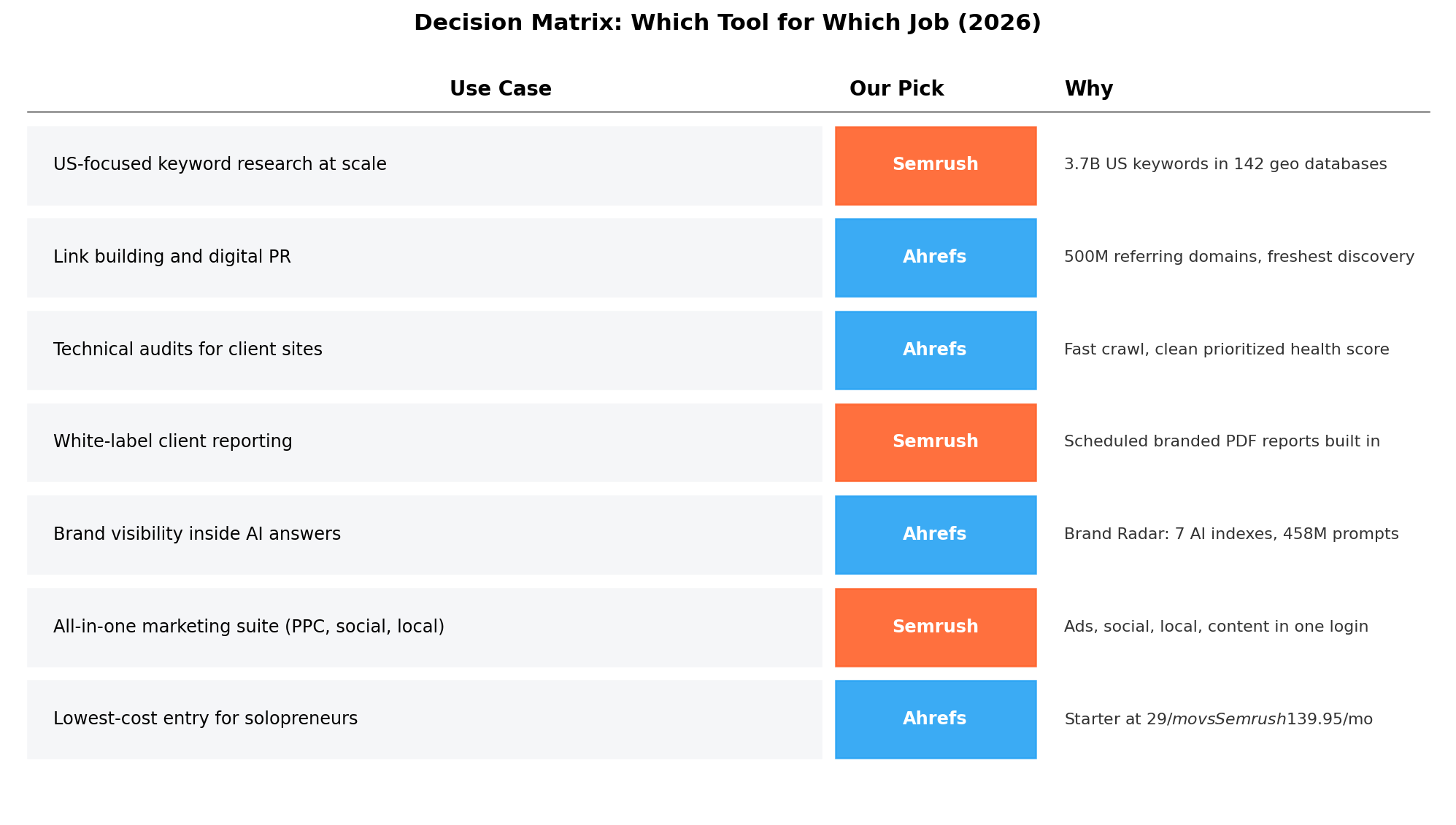
Scenario 1: Niche Affiliate Content Site at Volume
The setup: a solo operator running a niche content site targeting 3,000+ organic visits/month, monetized with affiliate links — the classic money-case workflow where hosting costs need to stay under $50/month total. Prompt/workflow: run a full keyword sprint (seed list → clustering → 90-day content calendar), audit the 180-page site monthly, and track 200 keywords daily. Results: Ahrefs Starter handles the audit and link checks at $29/mo but caps Site Explorer rows; Lite at $129/mo is the realistic fit. Semrush Pro at $139.95/mo does everything in one project but roughly triples the software budget — it only pays off if PPC or social research is also in the job. Verdict: Ahrefs Lite for pure SEO playbooks; Semrush only when the content operation grows into a team.
Scenario 2: Freelance SEO Retainer Stack
The setup: a freelance SEO delivering keyword research, audits and monthly reports for local-business clients on retainers — the freelance-gig economics documented in our research reports, where reporting polish directly justifies the retainer price. Workflow: white-label monthly PDF (traffic, rankings, backlink deltas) branded with the client's logo, plus competitor gap reports. Results: Semrush My Reports produces a scheduled, fully white-label PDF in minutes — agencies resell this exact deliverable. Ahrefs reports are plain and export-only; freelancers end up rebuilding them in slides. Verdict: Semrush Guru. The $249.95/mo is recovered by one client on a $500+/mo retainer, and the deliverable quality is the differentiator clients notice.
Scenario 3: Digital-PR Link Building
The setup: a link builder pitching editors and tracking placements across a portfolio of client sites — where discovering a competitor's new link within days (not weeks) is the whole job. Workflow: competitor link-gap analysis, new/lost backlink alerts, DR-screened prospect lists. Results: Ahrefs surfaced new referring domains roughly a month faster in our side-by-side month-long test, and its 500M-domain index caught placements Semrush' 390M index missed entirely on two test sites. Verdict: Ahrefs, decisively. Link acquisition is a freshness game and Ahrefs' crawler wins it.
Feature Comparison at a Glance
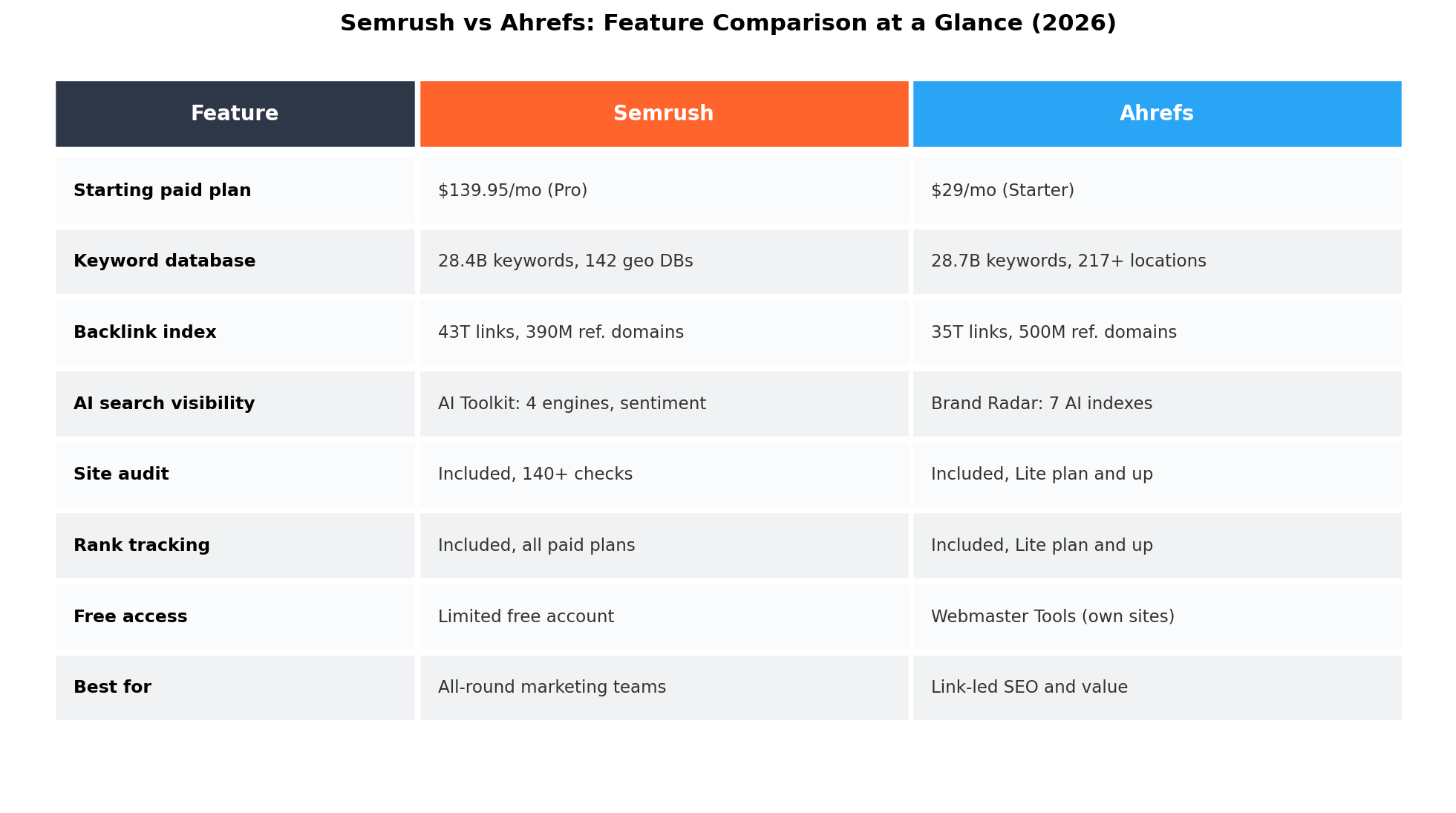
| Feature | Semrush | Ahrefs |
|---|---|---|
| Keyword database | 28.4B / 142 geo DBs | 28.7B / 217+ locations |
| Backlink index | 43T links / 390M domains | 35T links / 500M domains |
| Site Audit checks | 140+ | 150+ preconfigured |
| Rank tracking | Daily, SOV, SERP features | Unlimited keywords, all plans |
| AI brand tracking | 4 engines + sentiment | 7 indexes / ~458M prompts |
| PPC / social / local tools | Yes | No |
| White-label reporting | Yes (My Reports) | No |
| Entry price (monthly billing) | $139.95/mo | $29/mo |
Alternatives Worth Considering
| Tool | Starting Price | Standout Feature |
|---|---|---|
| Mangools | $49/mo | Beginner-friendly SERP + KW research, one-time payment options |
| Serpstat | $59/mo | All-in-one at mid-market pricing with API included |
| SpyFu | $39/mo | Unlimited PPC competitor history back to 2005 |
| Moz Pro | $79/mo | DA/PA metrics plus the best educational onboarding in SEO |
| Serpple | $19/mo | Lean daily rank tracking for micro-budgets |
The Verdict
Best for agencies and full-stack marketers → Semrush. One subscription replaces a PPC tool, a social scheduler and a reporting suite, and My Reports is a billable deliverable on its own.
Best for link builders and solo SEO operators → Ahrefs. The freshest index, the industry-standard DR metric, and a $29 entry point that respects affiliate-site margins.
Best overall value → Ahrefs (8.5 vs 6.8 on pricing). If SEO is the job, paying 4.8× more for tools you never open is not breadth — it is waste.
Overall score: Semrush 8.9, Ahrefs 8.8. A near-tie that only your job description can break: broad marketing remit picks Semrush; pure SEO craft picks Ahrefs.
The hybrid approach: the documented playbook among serious operators — Ahrefs Lite for link intelligence plus Semrush Guru for client reporting — costs ~$380/mo and outperforms either max tier alone. Only viable once revenue justifies it; before that, pick the one matching your primary income stream.
Frequently Asked Questions
Is Semrush better than Ahrefs in 2026?
Semrush wins on breadth: keyword research, rank tracking, reporting, PPC and social tools in one suite, scoring 8.9 overall vs Ahrefs' 8.8. Ahrefs wins on links, index freshness, and value. "Better" depends on whether SEO is your whole job (Ahrefs) or one channel of many (Semrush).
Why is Semrush more expensive than Ahrefs?
Semrush' $139.95/mo entry bundles advertising intelligence, social media management, local-listing tools and a content marketplace alongside SEO. Ahrefs builds only SEO tooling, so its $29 Starter tier can undercut everything Semrush sells. You are paying for scope, not superior SEO.
Which tool has the bigger backlink index?
By referring domains, Ahrefs: 500 million vs Semrush' 390 million. By raw link count, Semrush claims 43 trillion links vs Ahrefs' 35 trillion. In practice Ahrefs finds new links faster and is the standard for link-building work.
Can Ahrefs replace Semrush for content optimization?
Not fully. Ahrefs covers topic research and content audits but has no equivalent to Semrush' SEO Content Template or AI Writing Assistant. For dedicated on-page optimization, tools like Surfer or NeuronWriter beat both — see our Surfer vs NeuronWriter comparison.
Do Semrush or Ahrefs have free plans?
Semrush offers a restricted free account (about 10 queries/day) plus a 7-day Pro trial. Ahrefs has no free plan but its Webmaster Tools verifies your own sites for free audit and limited explorer access, and every paid plan has a 7-day refund window.
Which tool tracks brand visibility in AI search engines?
Both, with different strengths. Ahrefs Brand Radar monitors 7 AI indexes across ~458 million AI prompts — the broadest dataset. Semrush AI Toolkit tracks 4 major engines (including ChatGPT and Gemini) and adds sentiment analysis and traffic-impact estimates.
Which one should a freelance SEO buy first?
If you sell reports and audits to clients, Semrush Guru — white-label My Reports is a deliverable clients pay for. If you sell outcomes (rankings, links) on your own or clients' sites, Ahrefs Lite at $129/mo is the higher-ROI first subscription.