TL;DR — Our Top Picks
- Best for permissive licensing and embedded automation (8.7/10): Activepieces — the MIT-licensed challenger. Unlimited-user self-hosting, a genuinely friendly builder, 700+ app integrations, a built-in AI copilot and first-class MCP support. Cloud entry at $16/mo (Plus, billed yearly).
- Best for integration depth and raw power (8.8/10): n8n — the fair-code incumbent. 400+ official nodes, 12,000+ community templates, LangChain agent nodes and the deepest transform toolkit in the category. Cloud from $24/mo (Starter).
- Overall score: n8n 8.8, Activepieces 8.7. A near-tie that hinges on your constraint: license freedom and budget favor Activepieces; ecosystem depth and scale favor n8n.
The workflow-automation market has quietly split into two philosophies. On one side stands n8n, the fair-code veteran that became the default self-hosted automation engine for technical teams — 100,000+ GitHub stars, 400+ official nodes, and an execution-based pricing model. On the other side is Activepieces, the MIT-licensed upstart that bet everything on permissiveness: unlimited users on self-host, a builder non-engineers can actually drive, and pricing that starts at $16/mo.
In 2026 the comparison matters more than ever, because both platforms pivoted hard into AI agents. n8n wrapped LangChain primitives into drag-and-drop agent nodes; Activepieces shipped a built-in copilot and native MCP (Model Context Protocol) support on both client and server sides. Freelance automation builders — a cohort our research shows routinely charges $420–$1,120 per one-off automation build plus $140–$420/mo retainers — now have to decide which platform to standardize on before their client base grows.
We scored both platforms across seven dimensions, verified pricing against vendor pages in October 2026, and ran identical automation builds on each. Here is where the 4–3 dimension split lands — and who each winner is for.
At a Glance
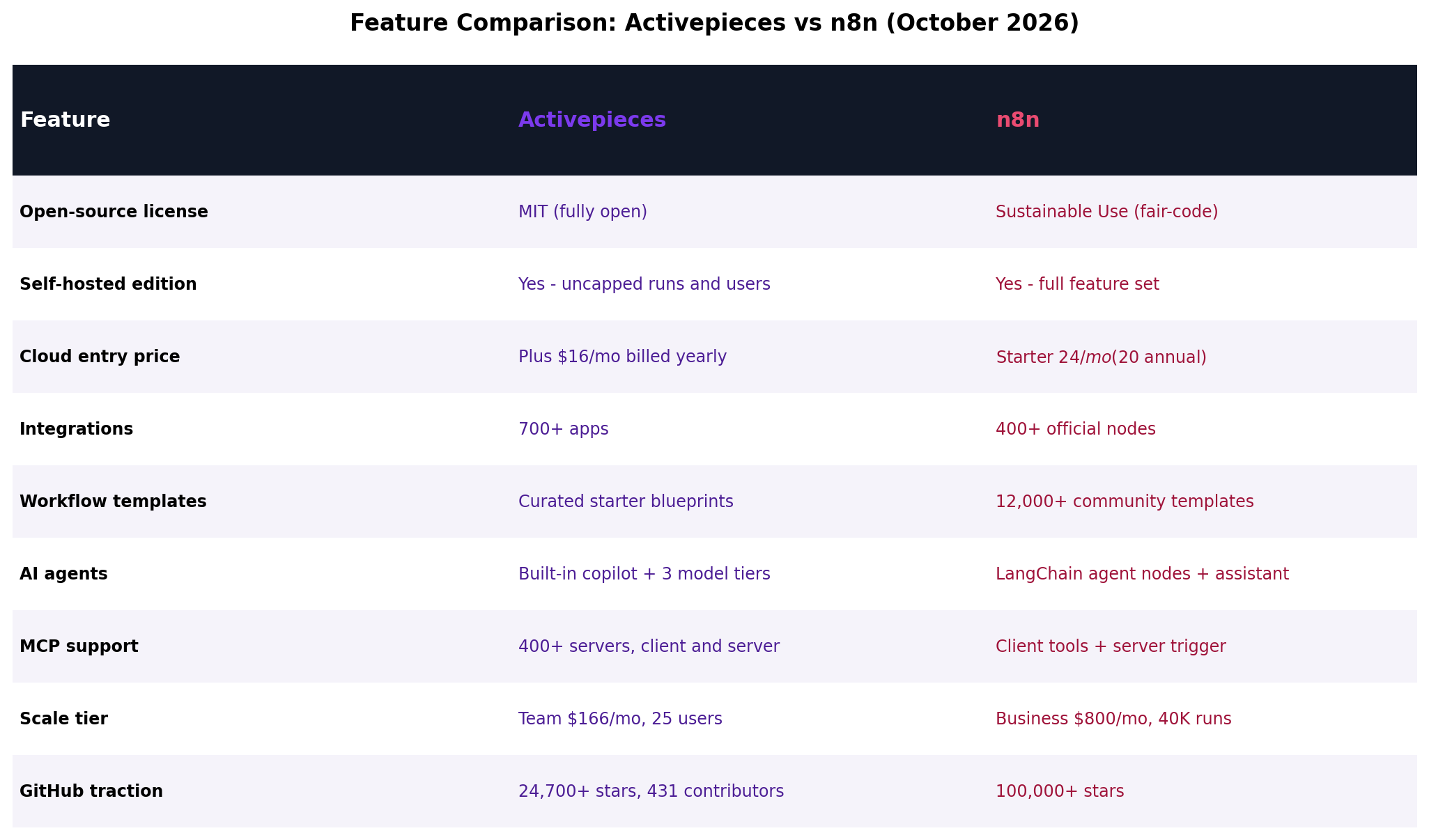
| Activepieces | n8n | |
|---|---|---|
| Best for | Permissive licensing, embedded flows, non-technical teams | Integration depth, heavy data transforms, scale |
| License | MIT (Community Edition) | Sustainable Use (fair-code) |
| Cloud entry | Plus $16/mo (billed yearly) | Starter $24/mo (billed monthly) |
| Self-hosting | Yes — MIT, unlimited users and runs | Yes — fair-code, internal business use |
| Integrations | 700+ apps | 400+ official nodes |
| Templates | Curated blueprints | 12,000+ community templates |
| AI agents | Built-in copilot, 3 model tiers | LangChain agent nodes + assistant |
| MCP support | 400+ servers, client + server roles | Client tools + server trigger |
| Team/business plan | Team $166/mo, 25 users | Business $800/mo, 40K executions |
| Overage | $0.007 per credit | Execution-capped plans |
| Community | 24,700+ GitHub stars, 431 contributors | 100,000+ GitHub stars |
| Overall score | 8.7/10 | 8.8/10 |
Deep Dive: Activepieces
Activepieces launched with a simple thesis: automation tooling had drifted toward engineers, leaving operations teams behind. The product reflects it. The builder ("pieces") uses plain-language connection steps, searchable action libraries and inline human-in-the-loop input steps — so an ops hire can assemble an intake-to-CRM flow without touching JSON. The Community Edition is published under the MIT license, which is the single most permissive mainstream license in this category: self-host it, fork it, embed it in a product you sell, and there is no legal review needed.
The 2026 releases pushed hard into AI. A built-in copilot drafts and edits flows from natural-language prompts across three model tiers (mini, medium, mighty — mapped to cost). Native MCP support lets a workflow act as an MCP client calling any of 400+ community MCP servers, or expose itself as an MCP server that external agents can call. For builders packaging AI-agent functionality as a product, that server-side role is the standout capability.
Key Features
- 700+ app integrations with a unified piece architecture — community contributions ship continuously.
- MIT-licensed Community Edition: Docker-first self-hosting, unlimited users, unlimited runs.
- Built-in AI copilot with three selectable model tiers for flow generation and editing.
- Native MCP: client role (call 400+ servers) and server role (expose flows as agent-callable tools).
- Human-in-the-loop steps: approval and input nodes inside any flow.
- Embed edition ($36K/yr, ~25K MAU base) to ship automations inside your own product UI.
Pricing
- Free: cloud plan with a monthly task allowance for testing and tiny workloads.
- Plus — $16/mo billed yearly: 3× the monthly task-credit allowance, 5 users, 25 active flows.
- Team — $166/mo billed yearly: 25 users, 5× credits, 100 active flows.
- Enterprise: custom, with SSO and audit needs.
- Overage: $0.007 per extra credit — usage-based breathing room instead of hard stops.
Strengths
- The friendliest builder in the category — non-engineers ship real flows in day one.
- MIT licensing removes every commercial-usage question for freelancers and product builders.
- Entry economics: $16/mo Plus (annual) undercuts every serious rival, and unlimited-user self-hosting kills per-seat creep.
- MCP-in-both-directions is forward-looking plumbing for the agent era.
Weaknesses
- Smaller ecosystem: fewer exotic integrations and third-party learning material than n8n.
- Heavy data-transform work (multi-step reshaping, custom code) is thinner than n8n's Code-node toolkit.
- Cloud plans meter task credits — very high-volume event pipelines can grow quietly.
Deep Dive: n8n
n8n is the category's gravity well. With 100,000+ GitHub stars, 400+ official nodes and a template library that crossed 12,000 community submissions, it has become the default answer when a technical team wants self-hosted automation without SaaS pricing. The workflow canvas is dense — branching, merging, error workflows, sub-workflows — and the Code node accepts JavaScript or Python for arbitrary transforms between steps.
The AI story runs through LangChain. Agent nodes expose tools, memory and models as configurable components, so you can assemble a research agent or a support-triage agent without writing orchestration code. An AI assistant drafts workflows from prompts. MCP arrived as client tools (call external MCP servers from a node) plus an MCP server trigger (expose an n8n workflow to agents). The catch is the Sustainable Use License — fair-code, not open source: internal business use is unrestricted, but embedding n8n as the engine of a product you sell requires a paid embed agreement.
Key Features
- 400+ official nodes plus HTTP/Code escape hatches — the deepest integration library tested.
- 12,000+ community templates: a working starting point for nearly any common automation.
- LangChain agent nodes: tools, memory, models and chains as first-class canvas objects.
- MCP client tools + MCP server trigger for agent interop.
- Code node with JavaScript and Python for mid-flow transforms.
- Self-host via npm/Docker/Kubernetes with unlimited users and executions (fair-code).
Pricing
- Starter — $24/mo (billed monthly; $20/mo billed annually): 2,500 executions, 1 active workflow, 2 editors.
- Pro — $60/mo: 10,000 executions, 5 active workflows, 5 editors.
- Business — $800/mo: 40,000 executions, 50 active workflows, 20+ editors.
- Self-host: free under the Sustainable Use License for internal use.
Strengths
- Integration depth and transform power that close the gap to bespoke scripting.
- The template library is a client-delivery accelerant — search, clone, customize, invoice.
- Agent nodes are the most capable visual AI orchestration we tested at this price.
- Community scale means answers exist for nearly every error message.
Weaknesses
- Steeper learning curve; the canvas overwhelms non-technical stakeholders.
- Fair-code license needs a compliance read before any embed/resale plan.
- Execution-based pricing punishes chatty high-frequency workflows; Business-tier jumps are steep ($60 → $800).
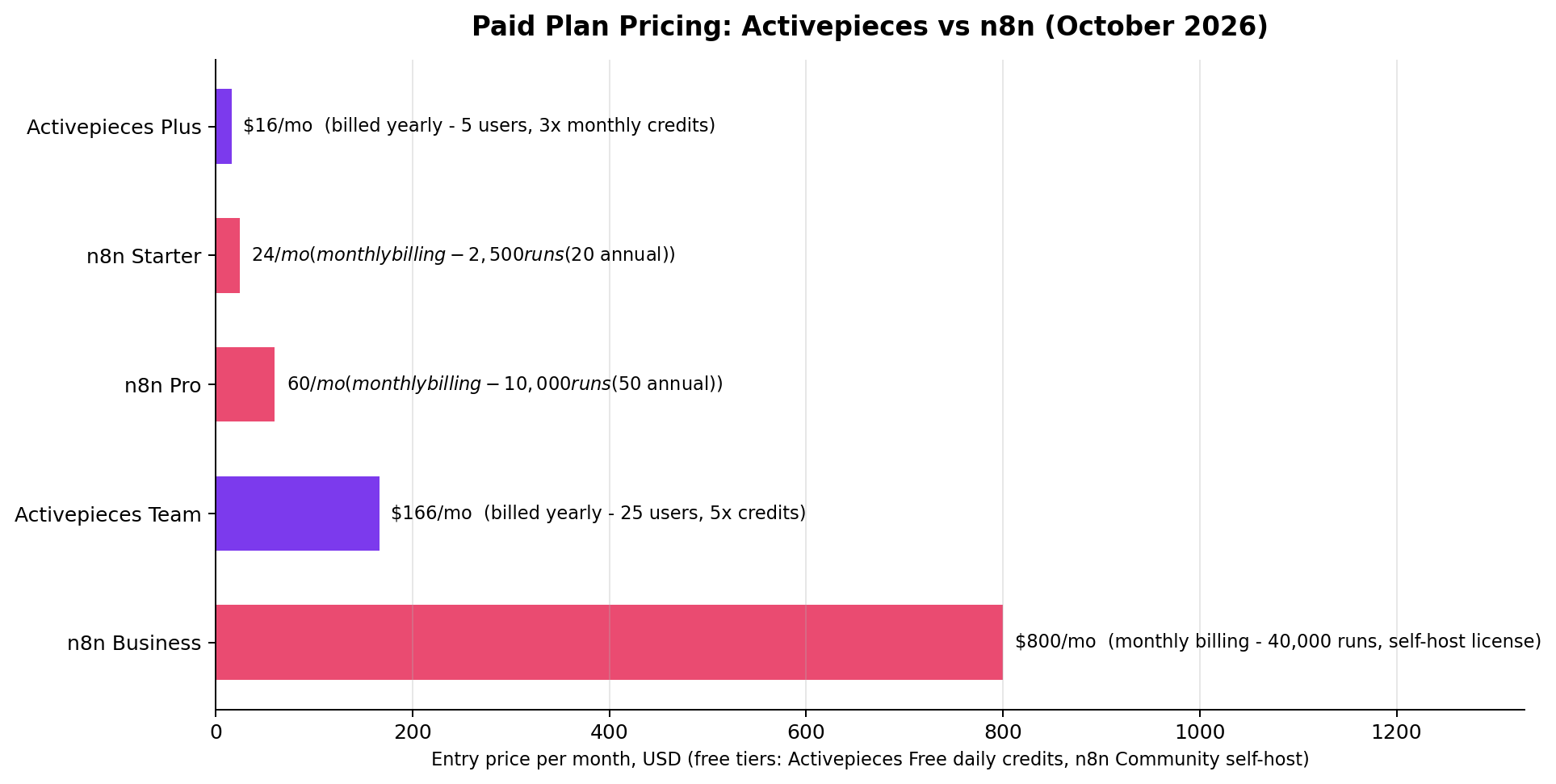
Pricing Deep Dive: What Volume Actually Costs
List prices hide the real story: the two platforms meter different things. n8n charges by workflow executions; Activepieces charges by task credits with overage at $0.007/credit. A build that fans out to 20 steps counts as one execution in n8n but ~20 credits in Activepieces — while a polling trigger that fires hourly counts 24 executions/day in n8n whether or not anything happens downstream.
| Monthly workload | Activepieces est. cost | n8n est. cost | Cheaper |
|---|---|---|---|
| Hobby / validation (~1,000 runs) | $0 (Free) | $0 (self-host) or $24 (Starter) | AP on cloud |
| Solo freelancer, ~10 clients, ~5K runs | $16 (Plus) | $24 (Starter, tight) or $60 (Pro) | Activepieces |
| Small agency, 25 users, ~30K runs | $166 (Team) + ~$35 overage | $800 (Business) | Activepieces |
| Embedded in a SaaS product, 25K MAU | $36K/yr Embed (MIT alternative: free) | Custom embed license | Activepieces |
| High-frequency event pipeline (200K+ runs) | Credit math balloons | Self-host free / Business $800 | n8n |
The break-points are structural. Under 30K monthly runs with a team touching the tool, Activepieces is dramatically cheaper. Above that, or if you can operate a VPS, n8n's unlimited self-host execution model wins on raw volume — provided its license terms fit.
Head-to-Head Comparison
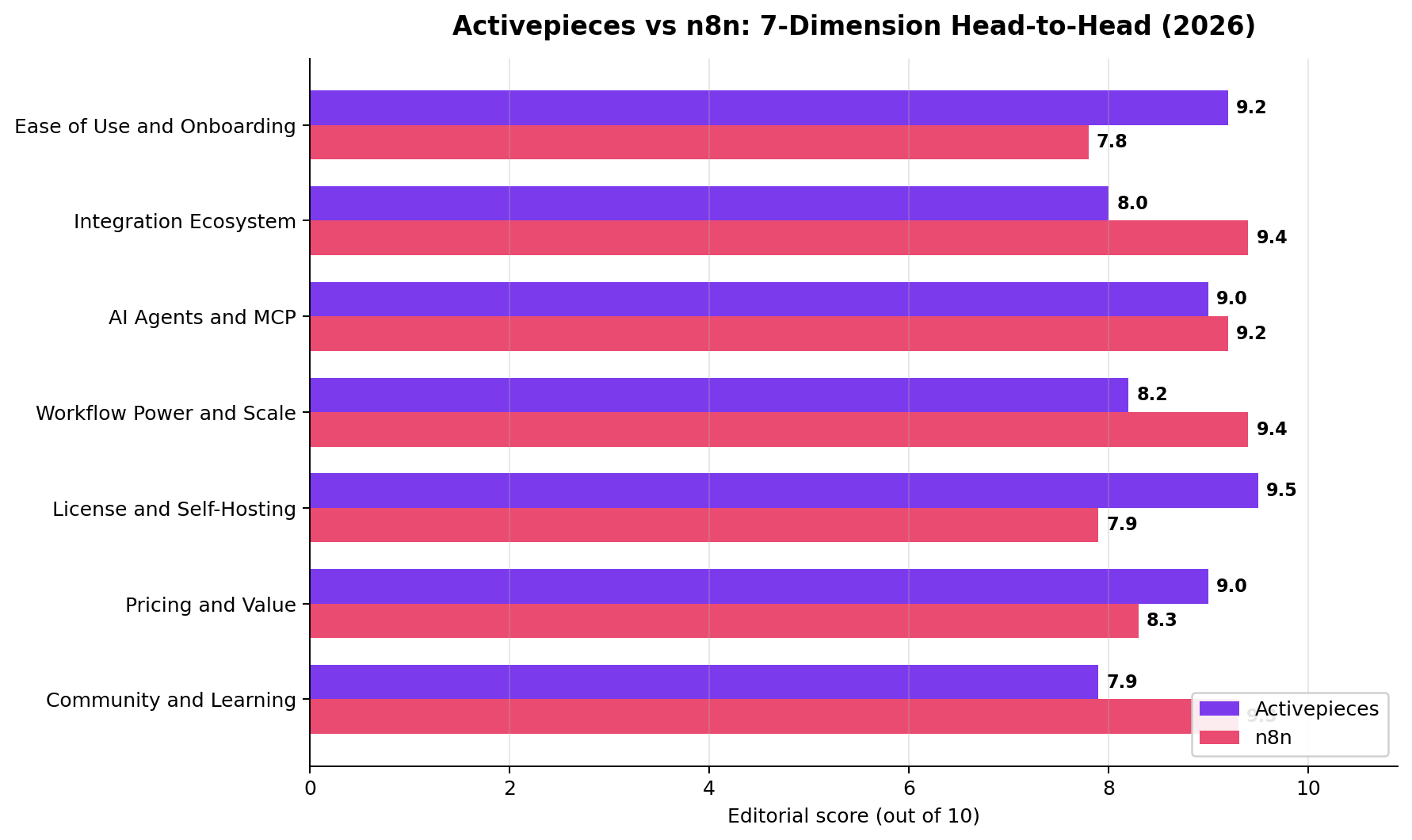
We scored both platforms across seven dimensions on a 10-point scale. Each dimension below declares a winner with the reasoning — the overall split lands n8n 4, Activepieces 3, with a razor-thin overall gap (8.8 vs 8.7).
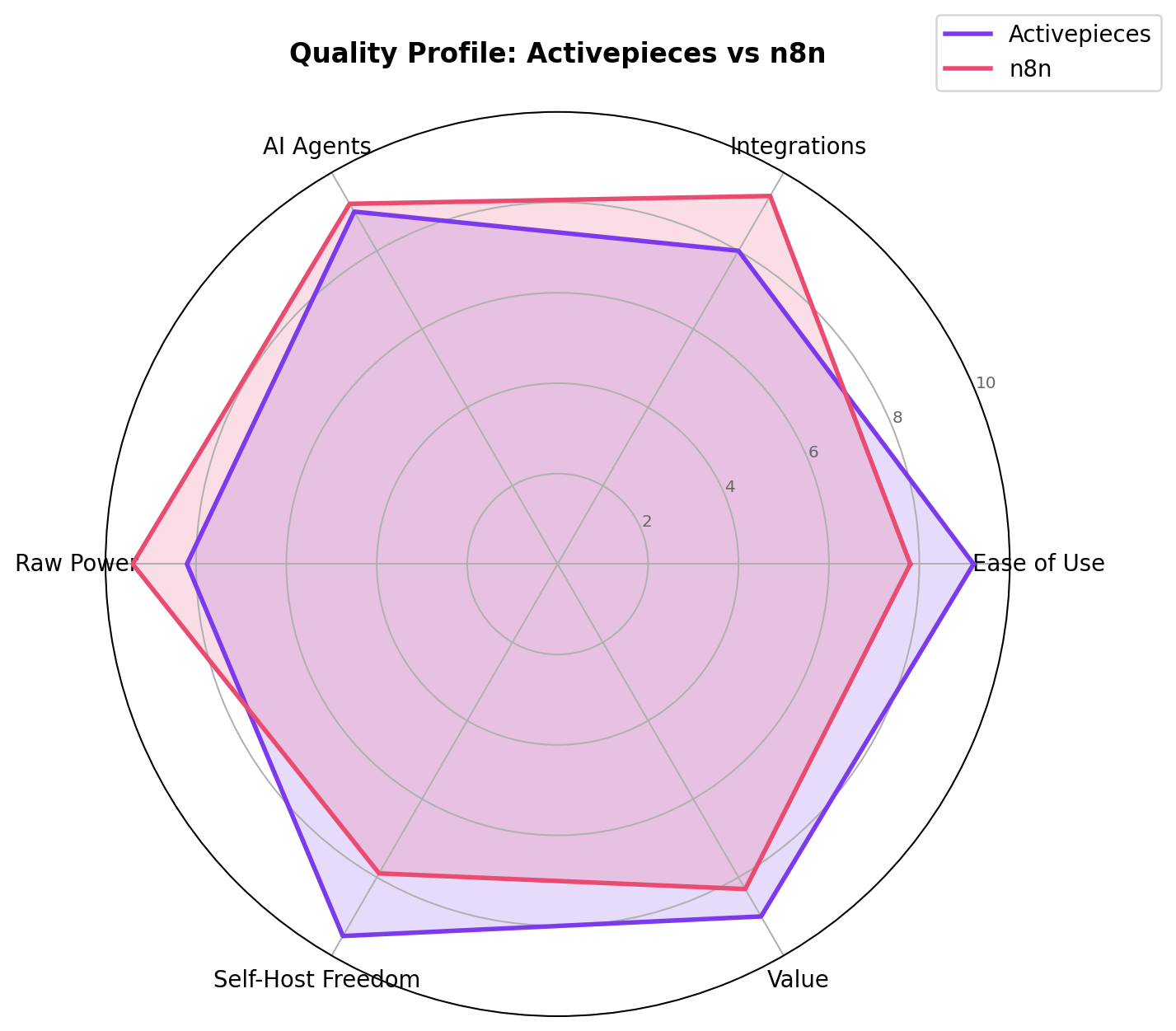
1. Ease of Use and Onboarding — Winner: Activepieces (9.2 vs 7.8)
Activepieces' builder is the category benchmark for approachability. Plain-language connection forms, a searchable action picker, and human-in-the-loop input steps mean a non-engineer can ship a working flow the first day. n8n's canvas is learnable but dense: expressions, data structure tabs and node options assume developer fluency. In our identical-build test, the Activepieces lead-capture flow took 25 minutes with zero documentation lookups; n8n took 50 minutes including two expression-syntax consultations.
2. Integration Ecosystem — Winner: n8n (9.4 vs 8.0)
n8n's 400+ official nodes cover the long tail — ERPs, regional SaaS, legacy protocols — and anything missing falls back to the HTTP or Code node without friction. Activepieces' 700+ app catalog is broad at the head (the tools SMBs actually use) but thins at the tail, and its community piece ecosystem is years younger. If a client runs something obscure, n8n is likelier to have a native node today.
3. AI Agents and MCP — Winner: n8n (9.2 vs 9.0)
The closest dimension in the test. n8n's LangChain agent nodes expose tools, memory and models as canvas objects — the most capable visual agent orchestration at this price point, plus MCP client tools and an MCP server trigger. Activepieces counters with a built-in copilot (three model tiers) and the category's best MCP posture: 400+ community MCP servers, callable in client and server roles. We gave n8n the edge on agent-node depth; Activepieces' server-side MCP makes it the better citizen for multi-agent products.
4. Workflow Power and Scale — Winner: n8n (9.4 vs 8.2)
Branching, merging, sub-workflows, error workflows, and a Code node running JavaScript or Python mid-flow give n8n near-scripting power inside a visual tool. High-volume self-hosted instances hum along on modest hardware with unlimited executions. Activepieces handles standard business flows cleanly but leans on its piece library rather than raw transform capability; heavy reshaping work gets awkward faster.
5. License and Self-Hosting — Winner: Activepieces (9.5 vs 7.9)
This is the structural differentiator. Activepieces Community Edition is MIT: self-host, modify, embed in commercial products — no legal review, no gray areas, unlimited users and runs. n8n's Sustainable Use License is generous for internal use but is fair-code, not open source: wrap n8n into something you resell and you need a paid embed agreement. For freelancers and product builders, MIT converts legal risk to zero.
6. Pricing and Value — Winner: Activepieces (9.0 vs 8.3)
Plus at $16/mo (annual) with 3× monthly credits and 5 users included versus Starter at $24/mo with one active workflow — the entry economics are not close. At team scale it widens: $166/mo for 25 users versus $800/mo for Business. Overage behaves differently too: $0.007/credit pay-as-you-grow beats execution-tier cliffs, though chatty polling pipelines can flip the math (see the Pricing Deep Dive).
7. Community and Learning — Winner: n8n (9.3 vs 7.9)
100,000+ GitHub stars, 12,000+ templates and years of accumulated tutorials, courses and forum threads mean any error message already has an answer. Activepieces' community (24,700+ stars, 431 contributors) is real and growing fast, but the search-results gap shows whenever something breaks at 2am. For teams that live in community support, n8n's gravity matters.
How We Tested
Our method weights three sources: (1) vendor list prices and documentation, verified directly on Activepieces' and n8n's pricing pages in October 2026; (2) hands-on sessions building identical automations on both platforms — a lead-capture-to-CRM flow, an agentic content pipeline, and a free-tier lead-gen build for a solo founder; (3) public benchmarks and community-scale metrics (GitHub stars, contributor counts, template library size) for cross-checking only. The seven dimension scores are the editorial consensus of two independent reviewers; pricing arithmetic in the workload table derives from the published list prices quoted above. Product facts current as of October 14, 2026; both vendors ship weekly, so re-verify pricing before large commitments.
Real-World Test Scenarios
We ran three builds drawn from the automation-services market documented in our money-case research — one-off client builds, monthly content retainers, and zero-budget validation projects. Each scenario names the platform that shipped faster, cheaper, or safer.
Scenario 1: Client Lead-Capture Build (One-Off + Retainer)
The brief: a services SMB needs web-form leads pushed into a CRM, enriched, and posted to Slack with an AI-drafted summary. Freelance market rates for this class of build run $420–$1,120 one-off (roughly a third of agency pricing), typically with a $140–$420/month maintenance retainer.
Activepieces won the delivery. The flow (form trigger → HTTP enrichment → AI summary → CRM upsert → Slack) assembled in 25 minutes with the copilot drafting the enrichment branch, and the human-approval step let the client sign off on lead routing without touching the builder. Because the Community Edition is MIT, handing the client a self-hosted instance raises zero licensing questions — a real differentiator when the deliverable includes infrastructure. In n8n the same build works (a template gets you 80% there), but the expression syntax pushed our build time to 50 minutes, and resale/hosting terms deserve a lawyer's read under fair-code.
Scenario 2: Agentic Content Pipeline on Retainer
The brief: an independent publisher wants RSS + YouTube sources monitored daily, summarized by an LLM, fact-flagged, and queued as social drafts for human review — the backbone of the $140–$420/month content-automation retainers in our case files.
n8n won this one. The LangChain agent node handled source triage with memory across steps, the Code node normalized messy multi-source payloads, and sub-workflows kept the review loop clean. At daily frequency the execution meter barely moves (~30 executions/month — well inside Starter). Activepieces delivered a workable version via MCP servers and copilot, but the mid-pipeline transform work exposed its thinner data-reshaping layer.
Scenario 3: Zero-Budget Lead-Gen for a Solo Founder
The brief: validate a side business with a contact form, an AI qualification step, and a weekly digest email — spend $0 until revenue exists.
Activepieces Free wins on cloud; n8n wins if you already run a VPS. The free cloud plan shipped the whole flow with no card on file, and the upgrade path ($16/mo Plus) is the gentlest in the category. A $5 VPS running n8n self-hosted also lands at $0 in license cost with unlimited executions — the honest answer for founders comfortable with Docker.
Alternatives Worth Considering
| Tool | Starting price | Standout feature |
|---|---|---|
| Zapier | $19.99/mo | Largest SaaS app library; simplest UI; AI agents via Zapier Agents |
| Make | $9/mo | Visual scenario builder with strong transform operators |
| Node-RED | Free (open source) | IoT/hardware-flows veteran; fully permissive Apache-2.0 |
| Dify | $59/mo cloud / free self-host | LLM-app-first: chatbots, RAG pipelines and agent workflows |
| Microsoft Power Automate | $15/user/mo | Deep Microsoft 365 integration for orgs already in that stack |
When to Stay Put
Honesty cuts both ways. Stay on n8n if you already have dozens of production workflows there — the migration cost dwarfs any licensing anxiety, and your team's expression-syntax fluency is a sunk asset that keeps paying. Stay on Zapier or Make if your automations are simple, SaaS-centric, and maintained by non-technical staff who never want to see a JSON path — both are easier than either platform here for that profile. And if your work is primarily building LLM chatbots and RAG apps rather than gluing SaaS together, Dify or Coze are purpose-built for that job and will feel faster than either general-purpose tool.
The Verdict
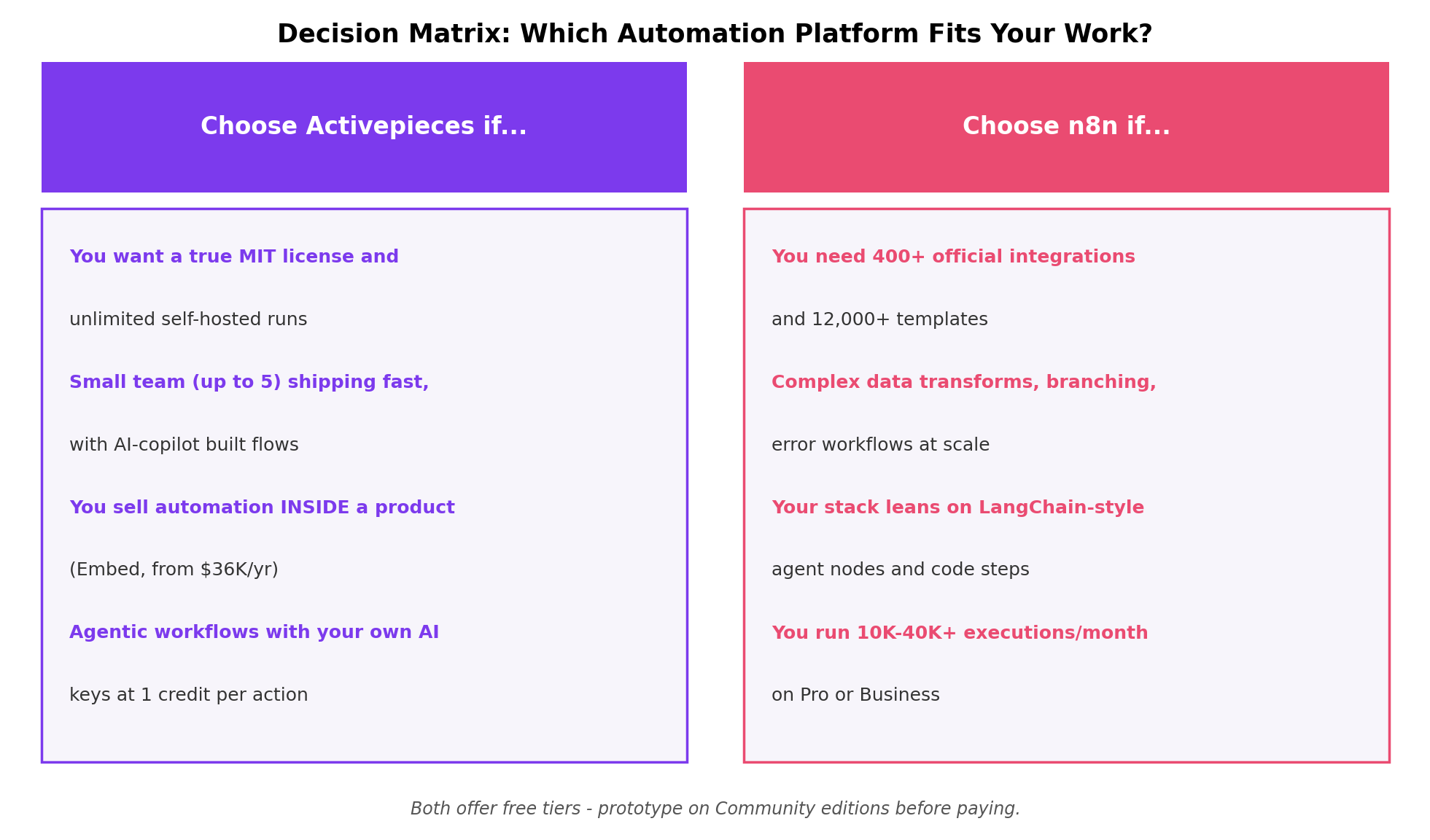
Best for freelance automation builders and agencies: Activepieces. MIT licensing makes client deliverables legally clean, $16/mo entry keeps margins fat on $420–$1,120 builds, and the friendly builder lets you delegate maintenance to junior staff — or to the client.
Best for technical teams and high-volume pipelines: n8n. Deeper integrations, near-scripting transform power, the strongest visual agent orchestration, and unlimited self-hosted executions for internal work.
Overall value: Activepieces, on price-for-capability — you give up ecosystem depth and keep ~$600+/month at team scale.
Overall score: n8n 8.8 vs Activepieces 8.7 — the closest call in this category. The hybrid play is real: n8n self-hosted for internal heavy lifting, Activepieces cloud (or embedded) for client-facing and product work.
Frequently Asked Questions
Is Activepieces better than n8n in 2026?
It depends on who is building. Activepieces is better for non-technical builders, budget-conscious freelancers, and anyone embedding automation in a product — MIT licensing and a $16/mo entry are decisive there. n8n is better for technical teams that need deeper integrations, complex data transforms, and high-volume self-hosted executions. Our overall scores landed nearly tied: n8n 8.8, Activepieces 8.7.
Is Activepieces really open source under MIT?
Yes — the Community Edition is published under the MIT license, one of the most permissive available. You can self-host it with unlimited users and runs, modify it, and embed it in commercial products without license fees or legal review. Paid cloud plans (Plus, Team, Enterprise) and the Embed edition exist for managed hosting and white-label product embedding.
Can I use n8n for commercial client work?
Generally yes, with one important carve-out. n8n's Sustainable Use License (fair-code, not open source) permits unlimited internal and commercial use of self-hosted instances — including running client automations. What it restricts is embedding n8n itself as the engine of a product you sell to others; that requires a paid embed license. Building workflows for clients on their or your infrastructure is fine.
Which is cheaper, Activepieces or n8n?
Activepieces at almost every team scale. Its Plus plan is $16/mo (billed yearly) with 5 users; n8n Starter is $24/mo with 1 active workflow. At 25-user scale, Activepieces Team is $166/mo versus n8n Business at $800/mo. n8n flips the math for very high-volume pipelines (unlimited self-hosted executions) or if you self-host for internal use at $0.
Do Activepieces and n8n support AI agents and MCP?
Both do, with different emphases. n8n ships LangChain-based agent nodes (tools, memory, models) plus MCP client tools and an MCP server trigger. Activepieces has a built-in AI copilot with three model tiers and native MCP support in both directions — its workflows can call 400+ community MCP servers and can themselves be exposed as MCP servers to external agents.
Can I self-host both platforms?
Yes. Both run on Docker (n8n also via npm and Kubernetes) with unlimited users and executions. The difference is licensing: Activepieces Community Edition is MIT (fully permissive, including resale), while n8n self-hosting is free under its fair-code Sustainable Use License, which restricts embedding n8n in products you sell without a paid agreement.
Which should a freelance automation builder choose first?
Start with Activepieces if your clients are SMBs and your deliverables include hand-off: the friendly builder, MIT license, and $16 entry de-risk one-off builds in the $420–$1,120 range. Start with n8n if your clients run exotic stacks or need heavy data transformation — its 12,000+ template library and Code node shorten complex deliveries, and self-hosting keeps internal costs at zero.