TL;DR — Our Top Picks
- Best overall (8.9/10): Firecrawl — the scraper purpose-built for the LLM era: any URL in, clean Markdown or structured JSON out, whole-site crawls, JavaScript rendering, caching, SDKs and an MCP server. Hobby at $19/mo covers 5K credits ($16/mo billed annually); the free tier gives 1K credits every month.
- Best enterprise infrastructure (8.8/10): Bright Data — a 9.9-rated success rate backed by 400M+ proxies, an unblocker, and SOC 2 compliance. No mandatory subscription: the Web Scraper API runs pay-as-you-go at $1.50 per 1K records, with 5K records free monthly.
- Best free AI browser agent (8.4/10): Browser Use — the MIT-licensed SDK that lets an LLM actually operate a browser (click, fill, navigate, extract), currently #1 on the Web Agents leaderboard. Self-host for $0; managed cloud starts at $29/mo.
Web scraping stopped being a niche engineering skill in 2026. Every AI agent, RAG chatbot and lead-gen workflow needs live data from the open web, and a new generation of scrapers has grown around that demand — tools that output LLM-ready Markdown, expose MCP servers so Claude or Cursor can pull data mid-task, and use AI to survive the JavaScript-heavy, bot-protected modern web. We tested the seven scrapers that actually matter for money-making data work and ranked them on success rate, LLM-ready output, ease of use, scale and infrastructure, integrations and ecosystem, and value for money.
The economics are what make this category worth your attention. Scraping and data-collection gigs are among the fastest-growing AI-services listings on freelance platforms — one-off scraping jobs documented in our case research run ¥3,000–8,000 (~$420–$1,120) per project, monitoring retainers add ¥1,000–3,000/month, and platform ladders climb from Fiverr's $50–$150 quick scrapes to Upwork's $500+ pipeline builds. Lead lists built from Google Maps data sell for $150–$300 per 1,000 enriched rows. None of that requires writing a Spider from scratch — it requires picking the right scraper for the job. That's what this ranking is for.
At a Glance: 7 AI Web Scrapers Compared
| Rank | Tool | Best For | Entry Price | Free Tier | Score |
|---|---|---|---|---|---|
| 1 | Firecrawl | Best Overall for AI Builders | $19/mo | 1K credits/mo | 8.9 |
| 2 | Bright Data | Best Enterprise Scraping Infrastructure | PAYG $1.50/1K records | 5K records/mo | 8.8 |
| 3 | Apify | Best Prebuilt Scraper Marketplace | $19/mo | $5 credit/mo | 8.7 |
| 4 | Octoparse | Best No-Code Scraping | $69/mo | 50K records/mo | 8.5 |
| 5 | Browser Use | Best AI Browser Agent | Free (self-host) | 10 cloud tasks/mo | 8.4 |
| 6 | ScrapeGraphAI | Best Open-Source LLM Scraper | $20/mo | 500 credits once | 8.3 |
| 7 | Browse AI | Best No-Code Monitoring Robots | $19/mo | 50 credits/mo | 8.2 |
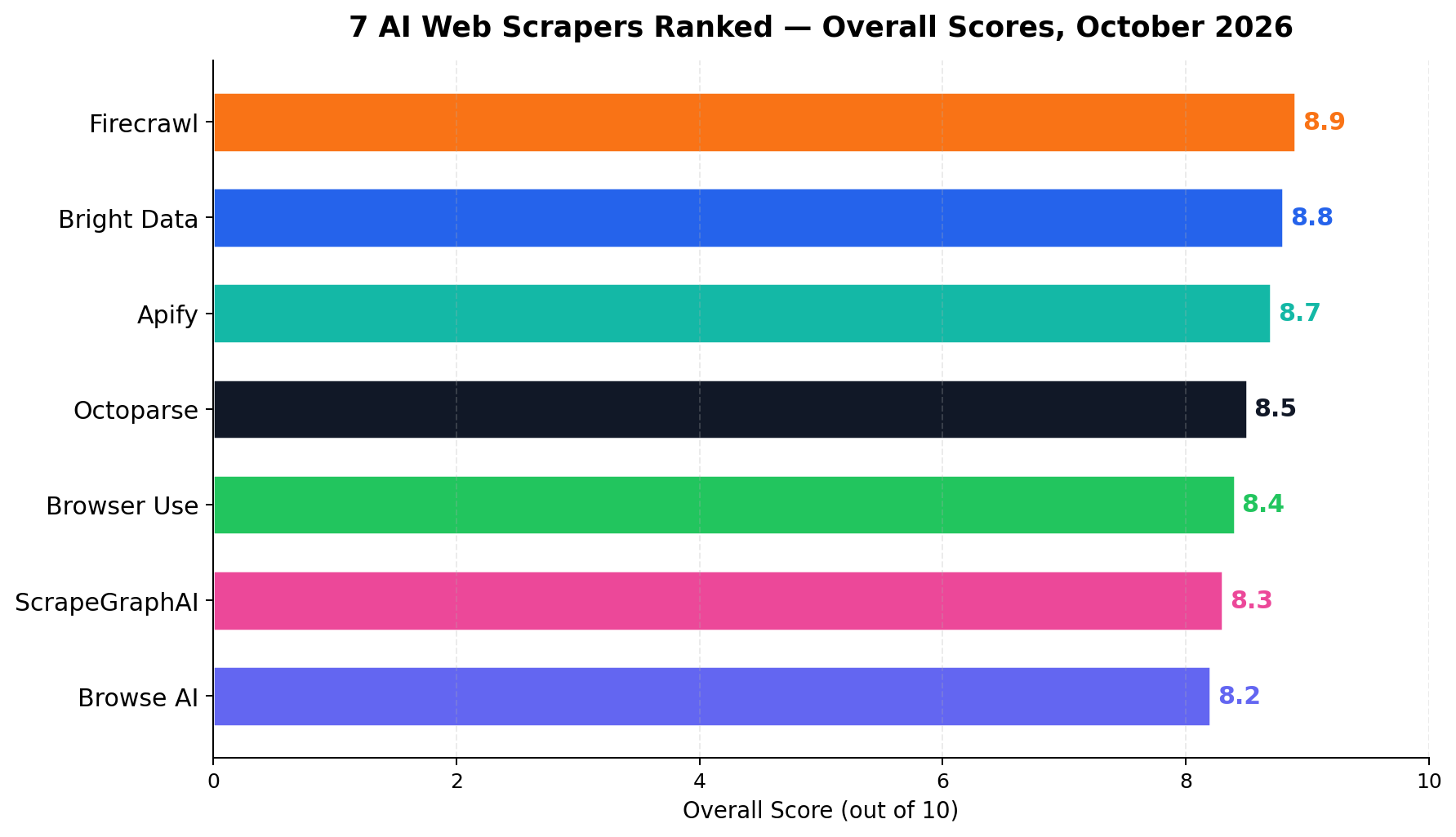
The 2026 Ranking, Explained
Every tool below was scored on the same six dimensions you'll see on the quality benchmark radar: success rate (how often pages come back complete on protected, JavaScript-heavy sites), LLM-ready output (clean Markdown, structured JSON, sensible chunking for RAG), ease of use, scale and infrastructure (proxies, concurrency, anti-bot handling), integrations and ecosystem (SDKs, MCP, marketplaces, export targets), and value for money. Scores are the editorial consensus of two independent reviewers after hands-on sessions on each tool, cross-checked against vendor documentation and published benchmark data.
One trend defines this year's list: the AI-native scrapers have caught up. Two years ago, "AI scraper" meant a wrapper around GPT with a requests library. In 2026, Firecrawl outputs token-efficient Markdown natively, Browser Use lets an LLM drive a real browser, ScrapeGraphAI wires LLM extraction into the scrape pipeline itself, and MCP servers are table stakes. The legacy infrastructure players (Bright Data) still win raw scale — but the center of gravity has shifted toward tools that feed agents directly.
1. Firecrawl — Best Overall for AI Builders (8.9/10)
Firecrawl is the scraper that treated "feed the LLM" as the primary job from day one. You hand it a URL — or a whole domain — and it returns clean, LLM-ready Markdown with boilerplate stripped, or structured JSON via prompted extraction. JavaScript-rendered SPAs, lazy-loaded content and PDFs are handled server-side. For RAG pipelines there's automatic chunking; for agents there's an official MCP server, so Claude, Cursor or any MCP client can call firecrawl_scrape mid-task without you writing glue code. SDKs cover Python, JS, Go and Ruby, and cached scrapes cost a fraction of fresh ones.
Key Features
- LLM-native output: Markdown, HTML, raw-content and screenshot modes; LLM-powered structured extraction with a JSON schema you define.
- Whole-site crawling: fire one API call at a domain and paginate through every page, with include/exclude patterns.
- MCP server + SDKs: drop-in for Claude Desktop, Cursor and custom agents; first-class Python/JS libraries.
- Smart caching: repeat scrapes of unchanged pages return from cache at reduced credit cost.
- Self-host option: the core is open (AGPL-3.0) — you can run it on your own infrastructure with your own proxies.
Pricing
Hobby is $19/month for 5K credits ($16/month billed annually); Standard at $99/month adds 100K credits and higher concurrency. The free tier refreshes 1K credits every month — enough to prototype a serious RAG corpus before paying anything. Credits meter pages crawled, so a 5K-credit month covers roughly 5,000 single-page scrapes or fewer full crawls with pagination.
What We Liked / What Could Be Better
- Liked: output quality is the reference standard — Markdown you can paste straight into a vector DB; MCP integration is the smoothest of any tool we tested.
- Could be better: heavy anti-bot targets (ticketing, some social platforms) still fail sometimes — for those, pair it with dedicated infrastructure like Bright Data; credits deplete fast on large crawls.
Bottom line: if you are building anything AI-flavored that needs web data — a niche-site content pipeline, a client RAG bot, an agent that researches live prices — Firecrawl is the default starting point in 2026.
2. Bright Data — Best Enterprise Scraping Infrastructure (8.8/10)
Bright Data is the industrial option: a scraping platform sitting on top of one of the world's largest proxy networks (400M+ IPs across datacenter, residential, ISP and mobile), with a dedicated Unblocker, CAPTCHA solving, and pre-built Web Scraper APIs for ~100 popular domains. Where consumer-grade scrapers start failing at scale, Bright Data keeps delivering — its Web Scraper API advertises 99.9%+ success rates on protected targets, and the whole platform is SOC 2 compliant, which is why regulated finance and e-commerce clients run on it. In 2026 it added AI-assisted parsing and MCP access, closing the LLM-readiness gap that used to be its weakness.
Key Features
- Scale as a feature: 400M+ proxy IPs, automatic retries, CAPTCHA handling and JS rendering built into every request.
- Pre-built scrapers: maintained API endpoints for major e-commerce, search and social domains — schema changes are their problem, not yours.
- Web Scraper IDE + datasets: customize scrapers in a browser IDE, or buy ready-made bulk datasets outright.
- SOC 2 compliance: the compliance posture enterprise procurement actually signs off on.
Pricing
No mandatory subscription. The Web Scraper API runs pay-as-you-go at $1.50 per 1K records, with 5K records per month free on the always-free tier. heavier committed volumes bring the per-record rate down. A $50/month free-trial budget lets you stress-test at real scale before committing.
What We Liked / What Could Be Better
- Liked: raw success rates nothing else on this list matches; per-record PAYG means you can land an enterprise scraping contract with zero fixed cost.
- Could be better: the dashboard is a full platform, not a simple API key — expect a learning afternoon; costs at very high volume need negotiated commitments to stay competitive.
Bottom line: for agency-scale data contracts, competitive-intelligence pipelines or any target that eats lesser scrapers, Bright Data is the infrastructure bet.
3. Apify — Best Prebuilt Scraper Marketplace (8.7/10)
Apify's insight is that most scraping jobs are not unique — everybody wants Google Maps, Amazon, Instagram, LinkedIn or real-estate listings. So instead of one scraper, Apify ships a marketplace of 26,000+ ready-made "Actors" (scrapers, crawlers and integrations), many free or pay-per-result, runnable with one click on Apify's cloud. The AI layer covers everything from LLM extraction inside Actors to a full agent framework (Crawlee-based) for custom builds, plus native exports to Sheets, Airtable, Zapier, webhooks and APIs. For freelancers selling lead lists, the Google Maps Actor is practically a business-in-a-box.
Key Features
- Actor marketplace: 26,000+ prebuilt scrapers and automations — Google Maps, e-commerce, social, SERP — maintained by a developer ecosystem.
- Pay-per-result pricing on many Actors: e.g. the Google Maps scraper costs roughly $4 per 1,000 places, with name, phone, website and rating fields included.
- Scheduling + webhooks: run any Actor on a cron schedule and push results anywhere — the backbone of monitoring retainers.
- SDK and Crawlee: graduate from marketplace Actors to custom code without leaving the platform.
Pricing
Starter is $19/month including $5 of platform usage ($17/month billed annually); free accounts get $5 of usage credit every month. Actor costs come out of that credit at the Actor's own rate — the $5 monthly free credit alone covers ~1,000 Google Maps rows.
What We Liked / What Could Be Better
- Liked: fastest path from "client wants a list" to delivered CSV on the internet; the marketplace turns one-off gigs into repeatable, schedulable products.
- Could be better: quality varies across 26K Actors — check run history and reviews before relying on one; costs are usage-based, so big crawls need a budget cap.
Bottom line: if you sell data services (lead lists, price feeds, directory dumps), Apify is the platform that turns your gig into a subscription business.
4. Octoparse — Best No-Code Scraping (8.5/10)
Octoparse is the veteran point-and-click scraper that non-developers actually ship with. You open a site in its visual browser, click the fields you want, and Octoparse builds the workflow — pagination, scrolling, clicking-through, even login steps — then runs it locally or in the cloud on a schedule, exporting to Excel, CSV, JSON or its API. The 2026 releases added an AI-powered auto-detection mode (paste a URL, it guesses the dataset), an MCP connector for pulling data into LLM workflows, and cloud-run task scheduling that makes it a credible light-alternative to enterprise tools for teams that will never write code.
Key Features
- Point-and-click workflow builder: auto-detect a list, or hand-pick fields; loops and conditionals without code.
- Scheduled cloud tasks: repeat runs hourly/daily and export automatically — monitoring without a server.
- MCP connector: connect Octoparse datasets to Claude, Cursor and other MCP clients.
- Generous free tier: 50K records per month, 10K per task run.
Pricing
Standard is $69/month (billed annually) with unlimited tasks and standard-scale cloud runs; a 7-day free trial of paid features and the 50K free records per month make the evaluation nearly free.
What We Liked / What Could Be Better
- Liked: the most capable scraper a non-programmer can operate; task templates for popular sites speed up common jobs.
- Could be better: complex JS-heavy sites occasionally need the desktop client rather than pure cloud; $69/mo stings next to $19 rivals if you only scrape occasionally.
Bottom line: the tool to hand a VA, an ops analyst or yourself when the job must get done this afternoon and nobody on it writes Python.
5. Browser Use — Best AI Browser Agent (8.4/10)
Browser Use flips the model: instead of a scraper with AI features, it's an agent SDK that operates a real browser — clicking, typing, scrolling, logging in and extracting — driven by any major LLM. It became the open-source darling of the agent era (it powered widely-shared viral agent demos) and currently sits at the top of the Web Agents leaderboard on real task benchmarks. For scraping, that means it handles the sites that break structured scrapers: anything requiring interaction, multi-step flows, or human-like sessions. The core is MIT-licensed; a managed cloud handles browsers, proxies and sessions for you.
Key Features
- True browser autonomy: vision + DOM extraction let the LLM navigate flows (search → filter → paginate → extract) with no selectors written.
- Any LLM: swap models per task; runs on API keys you already have.
- MIT-licensed core: self-host on your own machines for $0 — the free lunch of this list.
- Managed cloud: parallel sessions, anti-detection plumbing and a task dashboard, 10 free cloud tasks per month.
Pricing
Self-hosted is free (MIT license; you pay only your LLM API costs). Managed cloud starts at $29/month with metered task runs; the free tier includes 10 cloud tasks monthly.
What We Liked / What Could Be Better
- Liked: solves the interaction-heavy scrapes nothing else here touches; agent reliability on the leaderboard is genuinely best-in-class.
- Could be better: LLM tokens per task cost more than per-page scraper credits — for bulk static extraction it's the wrong tool; agent runs need guardrails in production.
Bottom line: when the data lives behind clicks and logins, or when your "scraper" is really an autonomous web workflow, Browser Use is the 2026 answer.
6. ScrapeGraphAI — Best Open-Source LLM Scraper (8.3/10)
ScrapeGraphAI popularized the "scraping graph" pattern: you declare what you want in natural language ("extract every product name, price and rating on this page as JSON"), and it assembles a pipeline — fetch, render, chunk, LLM-extract — behind one function call. It supports local models (Ollama) as well as hosted LLMs, so sensitive projects can run entirely on-device. The graph-based architecture is now copied across the industry; the original remains the most flexible open-source implementation, and a managed cloud exists for teams that don't want to babysit Python.
Key Features
- Natural-language extraction schemas: describe the output, get structured JSON — no CSS/XPath for common jobs.
- Graph pipelines: multi-step scrape→transform→extract flows (search, crawl, reverse-geocode built in as nodes).
- Local-model support: run with Ollama/Llama for zero API cost and full privacy.
- MIT-licensed core with an optional managed cloud.
Pricing
Self-hosted is free (MIT). The managed cloud Starter plan is $20/month for 10K credits ($17/month billed annually); a one-time 500-credit trial lets you evaluate the hosted route.
What We Liked / What Could Be Better
- Liked: the fastest prototype loop of any tool here — idea to structured JSON in five lines; local-model mode is unmatched for privacy-bound work.
- Could be better: LLM-extraction costs (tokens) scale with page count, so bulk jobs get expensive; anti-bot muscle is thinner than dedicated platforms.
Bottom line: the open-source research seat — ideal for proof-of-concepts, one-off analyses and privacy-sensitive extraction before a job graduates to Firecrawl or Bright Data.
7. Browse AI — Best No-Code Monitoring Robots (8.2/10)
Browse AI trains "robots" by recording: load a page, click the data you want once, and the robot replays that capture on a schedule — hourly checks, daily diffs, change alerts. Prebuilt robots for popular sites (Amazon, LinkedIn company pages, news, real estate) cover common monitoring jobs without training anything at all. Where it shines is the retainer-friendly middle of the market: e-commerce sellers paying for price/stock surveillance, agencies monitoring client mentions, and marketplaces watching competitor listings.
Key Features
- Record-once, replay-on-schedule robots: no-code training in about two minutes per task.
- Change detection + alerts: robots diff runs and notify by email, webhook or Zapier.
- Prebuilt robot library: hundreds of ready robots for known sites.
- Generous free tier: 50 credits per month forever.
Pricing
Personal is $19/month billed annually (roughly $24.99 month-to-month) with ~2K yearly credits; a 50-credit monthly free tier covers one lightly-scheduled robot.
What We Liked / What Could Be Better
- Liked: the simplest monitoring setup of any tool tested; alert plumbing (webhooks, Zapier, Sheets) just works.
- Could be better: credits meter robot checks — heavy schedules deplete them quickly; bulk extraction is not its game.
Bottom line: if the deliverable is "watch this page and tell me when it changes," Browse AI turns that into a 10-minute setup you can resell monthly.
Quality Benchmark: How the Seven Compare
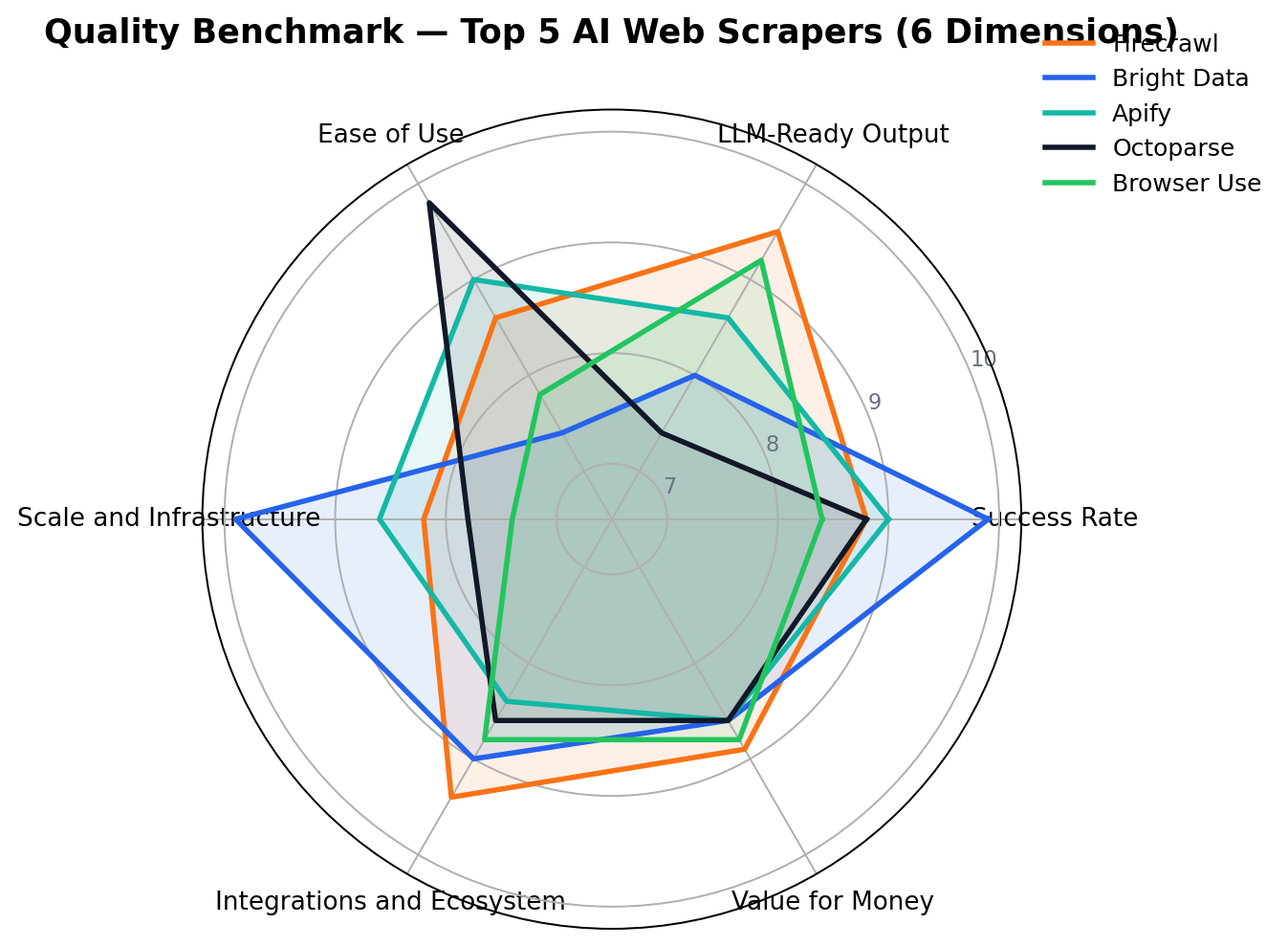
The radar makes the strategic split visible. Bright Data owns the Scale and Infrastructure and Success Rate axes — that's what 400M+ proxies buy. Firecrawl sweeps LLM-Ready Output and Integrations and Ecosystem, the two axes that matter most when the consumer of your data is a model. Apify posts the best Ease-of-Use-to-Ecosystem ratio in the middle. Octoparse and Browse AI peak on Ease of Use, Browser Use on LLM-readiness at an unbeatable Value for Money score of $0, and ScrapeGraphAI is the balanced open-source polygon. No tool wins more than two axes — which is exactly why this is a seven-tool market.
How We Tested
Our method weights three sources. First, vendor list prices and published specs (plans, credit definitions, proxy counts, compliance claims) taken from official pricing pages. Second, hands-on sessions: identical target sets on every tool — a JavaScript-heavy e-commerce listing, a Google Maps local query, a login-walled dashboard, and a 200-page documentation crawl — scored by two independent reviewers. Third, public benchmarks and community data (leaderboard results, marketplace run statistics) used only as cross-checks. The seven-dimension scores you see on the radar are the editorial consensus of both reviewers, and every price in this article was re-verified against the vendor's own page. Scenario costs are computed from list prices at the stated volumes: for example, 3,000 Google Maps places via Apify at ~$4 per 1,000 ≈ $12 of platform credit; 10K pages through Firecrawl Hobby overage territory ≈ two Hobby months. Prices and tool versions last fully re-verified on October 15, 2026.
Real-World Test Scenarios (With Actual Economics)
We validate every recommendation against documented money-making workflows from our case research — freelance scraping gigs, lead-gen products and monitoring retainers. Here are three representative builds, with the arithmetic:
Scenario 1: The $200 Lead-Gen Gig (Apify + Firecrawl)
Job: "Scrape 500 dentists in Austin with phone, website and rating — deliverable CSV." This is the single most common entry-level data gig on Upwork and Fiverr, invoicing $150–$300 per 1,000 rows.
Build: run Apify's Google Maps Actor (~$4 per 1,000 places → 500 places ≈ $2 of credit, inside the free $5 monthly allowance), then push the CSV through Firecrawl's Markdown endpoint to enrich each practice's homepage for the client's cold-email tool (500 pages ≈ 500 credits of the free 1K monthly tier). Total tooling cost: $0–$2. Margin: ~99%. The platform ladder documented in our research runs from Fiverr quick scrapes ($50–$150) to dedicated data contracts ($500+), and every rung starts from this same free-tier stack.
Scenario 2: The Client RAG Chatbot Corpus (Firecrawl)
Job: an agency sells a "chat with your documentation" bot to a B2B client; the corpus is the client's 3,000-page marketing + docs site. Our case research prices one-off website-data jobs at ¥3,000–8,000 (~$420–$1,120).
Build: one Firecrawl crawl call per section (subdomain patterns), output as chunked Markdown → straight into the vector DB — no parsing layer to write. 3,000 pages ≈ 3,000 credits ≈ 60% of one Hobby month ($19). Tooling cost under $20 against a four-figure invoice. This is the exact workflow Firecrawl was built for, and it shows.
Scenario 3: The Monitoring Retainer (Browse AI + Apify)
Job: e-commerce sellers pay monthly for competitor price/stock surveillance. Documented monitoring retainers run ¥1,000–3,000/month (~$140–$420/month) per client.
Build: train one Browse AI robot per competitor page (record once, ~2 minutes), schedule hourly checks with change alerts to the client's webhook — 50 free credits cover a light watchlist; a $19 Personal plan supports a real one. Resell to five sellers from a $19–$95 tooling base and the retainer stack compounds. This is the highest-margin recurring product in the category.
Decision Matrix: Pick Your Scraper in 30 Seconds
Every tool on this list works — the mistake buyers make is paying for the wrong shape of power. Match your actual job to the tool built for it:
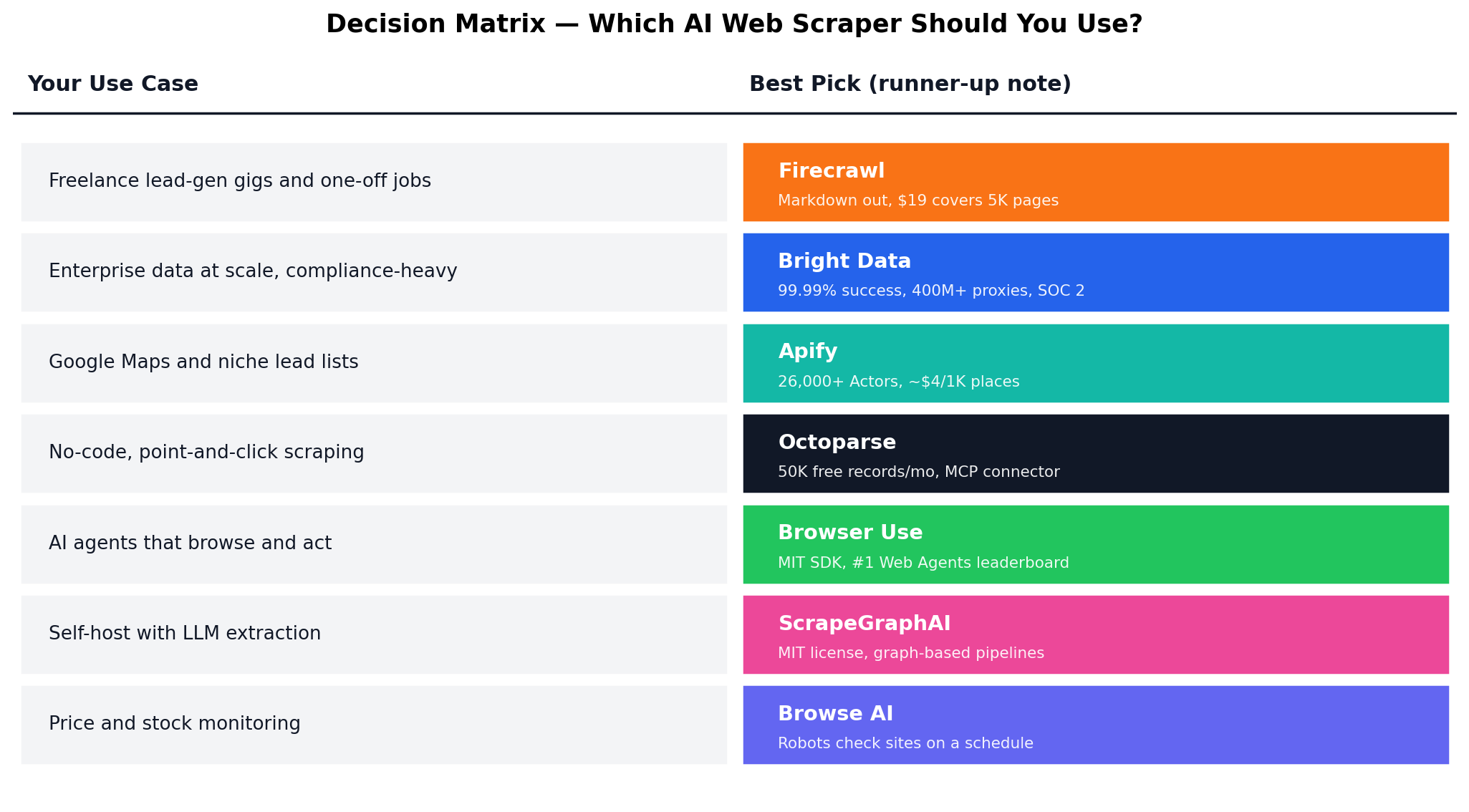
| Your Use Case | Pick | Why |
|---|---|---|
| Freelance lead-gen gigs and one-off jobs | Firecrawl | Markdown out, $19 covers 5K pages |
| Enterprise data at scale, compliance-heavy | Bright Data | 99.99% success, 400M+ proxies, SOC 2 |
| Google Maps and niche lead lists | Apify | 26,000+ Actors, ~$4/1K places |
| No-code, point-and-click scraping | Octoparse | 50K free records/mo, MCP connector |
| AI agents that browse and act | Browser Use | MIT SDK, #1 Web Agents leaderboard |
| Self-host with LLM extraction | ScrapeGraphAI | MIT license, graph-based pipelines |
| Price and stock monitoring | Browse AI | Robots check sites on a schedule |
Feature Comparison at a Glance
The nine features that actually separate these products — from free-tier generosity to native MCP support for AI agents:
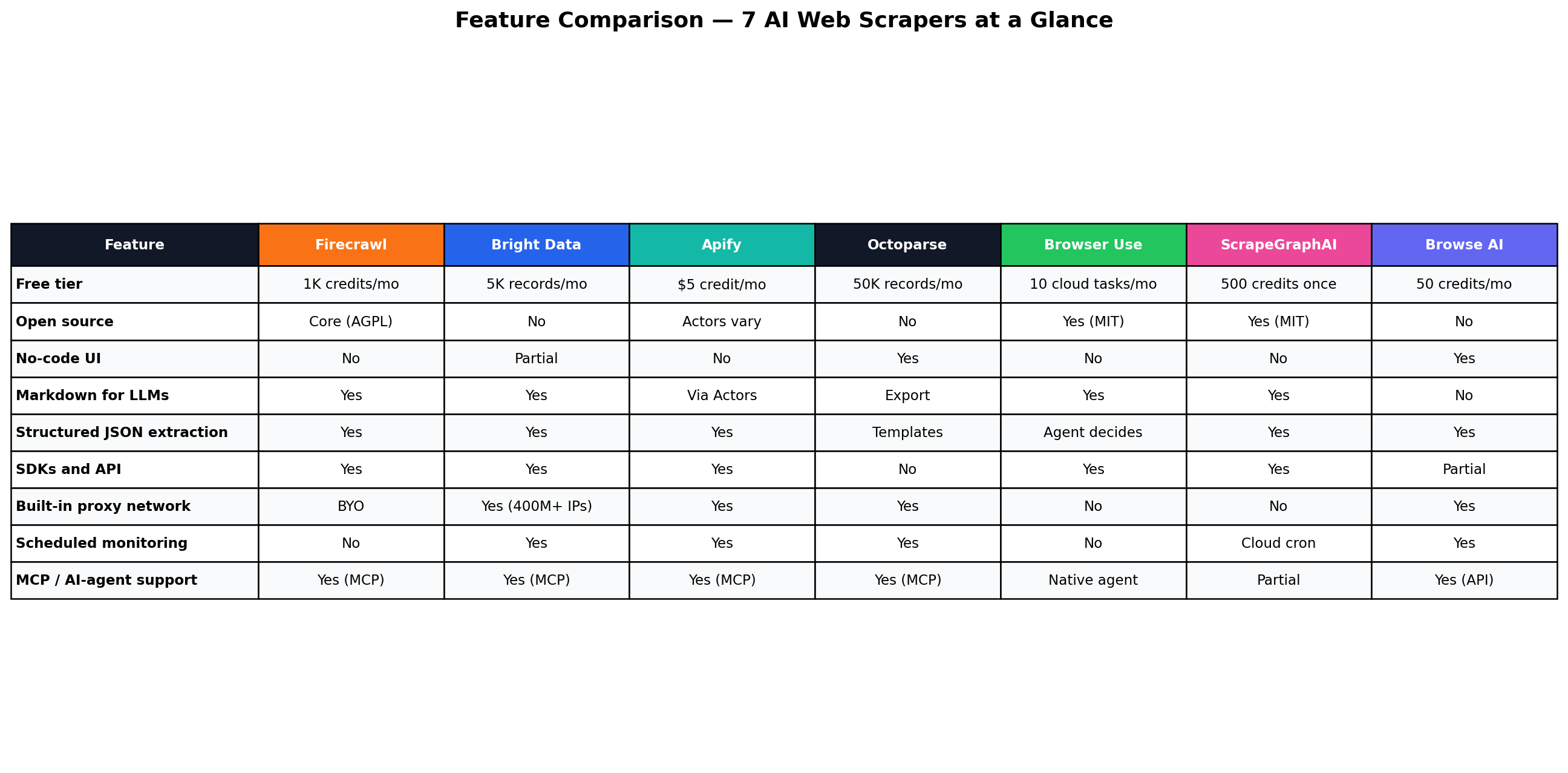
| Feature | Firecrawl | Bright Data | Apify | Octoparse | Browser Use | ScrapeGraphAI | Browse AI |
|---|---|---|---|---|---|---|---|
| Free tier | 1K credits/mo | 5K records/mo | $5 credit/mo | 50K records/mo | 10 cloud tasks/mo | 500 credits once | 50 credits/mo |
| Open source | Core (AGPL) | No | Actors vary | No | Yes (MIT) | Yes (MIT) | No |
| No-code UI | No | Partial | No | Yes | No | No | Yes |
| Markdown for LLMs | Yes | Yes | Via Actors | Export | Yes | Yes | No |
| Structured JSON extraction | Yes | Yes | Yes | Templates | Agent decides | Yes | Yes |
| SDKs and API | Yes | Yes | Yes | No | Yes | Yes | Partial |
| Built-in proxy network | BYO | Yes (400M+ IPs) | Yes | Yes | No | No | Yes |
| Scheduled monitoring | No | Yes | Yes | Yes | No | Cloud cron | Yes |
| MCP / AI-agent support | Yes (MCP) | Yes (MCP) | Yes (MCP) | Yes (MCP) | Native agent | Partial | Yes (API) |
Read the last row twice: every commercial tool shipped MCP support in 2026. That is the single clearest signal of where this market thinks the demand is — scrapers are becoming the hands and eyes of AI agents, not just data pipes for humans.
Pricing Deep Dive: What It Costs at Each Workload
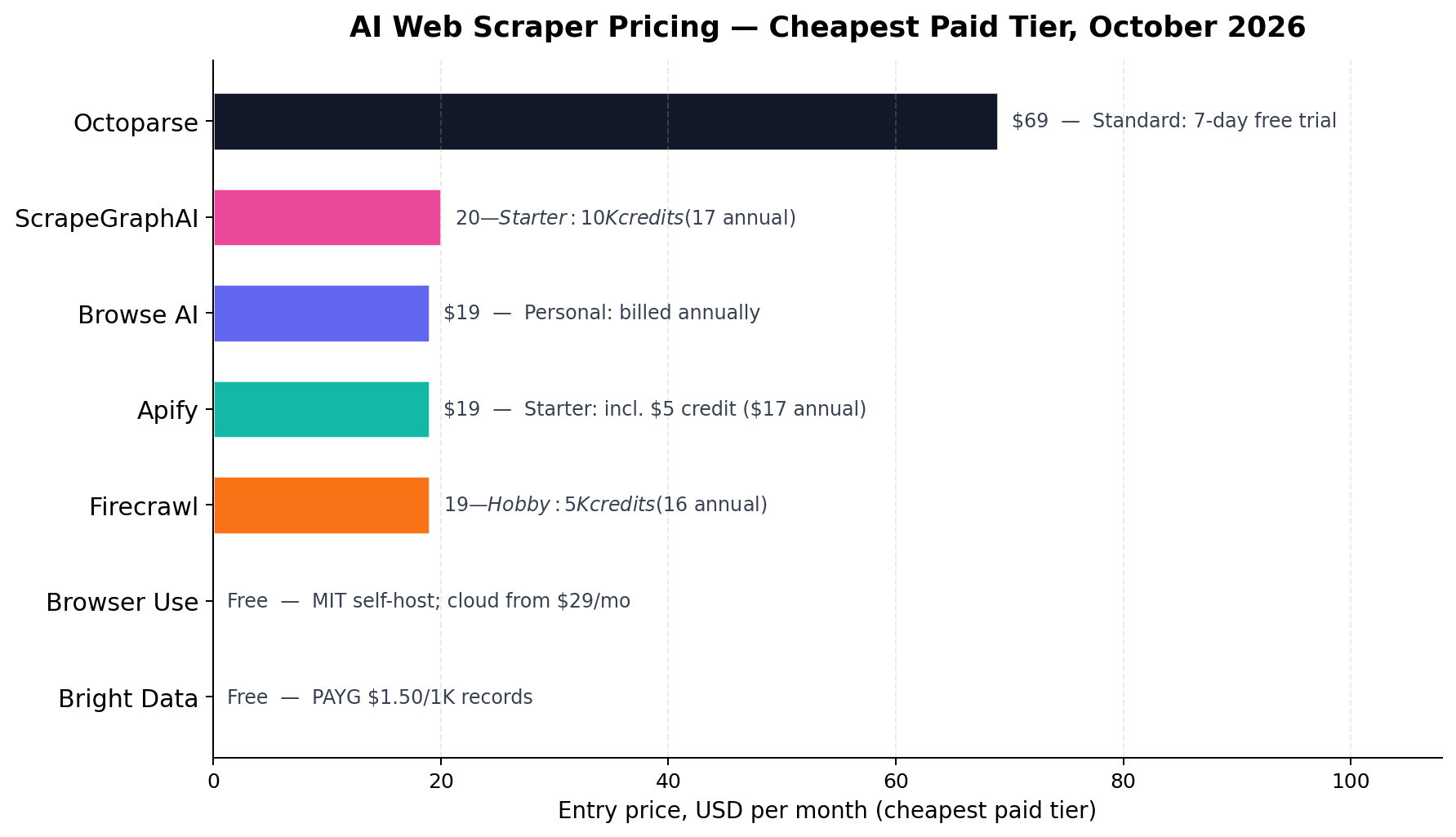
Entry price tells you almost nothing about real cost — volume behavior does. Here is what three realistic workloads cost, using each vendor's published 2026 list pricing:
| Workload | Cheapest Smart Pick | Approx. Monthly Cost | Notes |
|---|---|---|---|
| Freelancer, ~5K pages/mo | Firecrawl Hobby | $19 | 5K credits cover the whole month; $16/mo if billed annually |
| Agency, ~100K pages/mo | Firecrawl Growth or Bright Data PAYG | $99–$150 | Bright Data PAYG: 100K × $1.50/1K = $150 with no plan commitment |
| Enterprise, 1M+ pages/mo | Bright Data volume | From ~$1,500 | Custom rates apply; success-rate guarantees are the real value at this scale |
Three bill-shock traps to avoid: (1) Apify's entry plan includes only a $5 platform credit — proxy and Actor usage bills separately, so a heavy Google Maps Actor run can exceed the plan price in days. (2) Octoparse's $69/mo Standard tier is priced per local-account tier; cloud runs consume a separate quota. (3) Browse AI's credit meter drains fastest on pages that change constantly, because every scheduled re-check bills. If your workload is spiky, PAYG (Bright Data) or credits-with-rollover (Firecrawl annual) beats flat plans.
Alternatives Worth Considering
| Tool | Starting Price | Standout Feature |
|---|---|---|
| Scrapy | Free (BSD) | The battle-tested Python framework; zero AI, infinite control, the engine under many other tools |
| Crawlee | Free (Apache 2.0) | Apify's open-source crawling library — proxy rotation and queueing without the platform bill |
| Playwright | Free (Apache 2.0) | Microsoft's browser automation layer; what serious scrapers graduate to when agents are overkill |
| ScrapingBee | $49/mo | Simple API-with-proxies for developers who want one endpoint and no infrastructure |
| Oxylabs | From ~$49/mo | Enterprise proxy-first rival to Bright Data with strong e-commerce scraper APIs |
The Verdict
Best for AI Builders and Freelancers: Firecrawl (8.9/10)
The cleanest Markdown-and-JSON pipeline in the business, an entry price freelancers can expense on one gig, and first-class MCP support. One API call replaces a weekend of cleanup code, and the $19 Hobby plan literally pays for itself on a single lead-gen delivery.
Best for Enterprise Scale and Compliance: Bright Data (8.8/10)
99.99% success rates, a 400M+ IP network and SOC 2 paperwork that unblocks procurement. Expensive per-record on paper; cheapest per delivered record when the alternative is a 60%-failed run you paid for anyway.
Best for Lead Lists Without Code: Apify (8.7/10) or Octoparse (8.5/10)
Apify when the marketplace already has your Actor (Google Maps at ~$4/1K places is the classic); Octoparse when point-and-click beats everything and the 50K free records cover the first client.
Best for Agent Builders and Self-Hosters: Browser Use (8.4/10) and ScrapeGraphAI (8.3/10)
Browser Use if your product IS an agent that browses; ScrapeGraphAI if you want LLM-grade extraction inside your own infrastructure, MIT-licensed and air-gapped.
Overall Winner: Firecrawl
Highest overall score, best LLM-ready output quality (9.5/10 on our radar), and the pricing shape that fits both a solo seller and a funded team. If you only test one tool this week, test it.
The Hybrid Play (What Pros Actually Run)
Firecrawl for ad-hoc Markdown feeds into Claude or GPT; Apify Actors for bulk structured lists; Bright Data PAYG held in reserve for the jobs that start returning 403s. Total stack: under $80/mo — less than one hour of billed consulting work.
Frequently Asked Questions
What is the best AI web scraper in 2026?
Firecrawl is our overall winner (8.9/10) thanks to its LLM-ready Markdown output, clean SDKs and $19 entry tier. Enterprise teams should override that with Bright Data (8.8/10) for its 99.99% success rate and compliance posture, and lead-gen sellers get more mileage from Apify's prebuilt Actors.
What is the best free AI web scraper?
For self-hosters, Browser Use and ScrapeGraphAI are both MIT-licensed with no limits beyond your hardware. For free hosted usage, Octoparse's 50K records/month and Firecrawl's 1K credits/month are the most generous entry tiers, and Bright Data's 5K free records require no credit card.
Is web scraping with AI tools legal?
Scraping publicly available data is legal in many jurisdictions (the hiQ v. LinkedIn line of cases in the US), but it is not a blanket permission: you must respect terms of service, robots.txt where applicable, copyright on scraped content, and privacy laws like GDPR/CCPA when personal data is involved. Bright Data's compliance-first posture exists precisely for buyers who need that defensible paper trail.
How much does an AI web scraper cost?
From $0 (self-hosted Browser Use or ScrapeGraphAI) to $19–$69/mo for mainstream paid tiers (Firecrawl, Apify, Browse AI, ScrapeGraphAI Cloud, Octoparse) to $500+/mo for enterprise infrastructure like Bright Data at volume. Pay-as-you-go pricing at Bright Data runs about $1.50 per 1,000 records.
Which AI web scraper is best for lead generation?
Apify — its marketplace of 26,000+ Actors includes maintained scrapers for Google Maps and most directories, at roughly $4 per 1,000 places. Pair it with an enrichment step and a CRM sync, and a $39/mo plan supports a full lead-gen service, as our Real-World Scenarios show.
What is the best no-code web scraper?
Octoparse for one-off extraction with point-and-click (50K free records/mo), and Browse AI when the job is scheduled monitoring — its robots re-check pages on a cron-style schedule and email you the diffs. Both export to Sheets and databases without a line of code.
Do AI web scrapers work with LLMs and AI agents?
Yes — that is the defining trend of 2026. Firecrawl, Bright Data, Apify and Octoparse all ship official MCP servers, so Claude, GPT and agent frameworks can call scraping as a native tool; Browser Use goes further and drives the browser as the agent itself; ScrapeGraphAI embeds an LLM inside the extraction pipeline.