TL;DR — Our Top Picks
- Best overall for builders (9.0/10): DeepSeek — the cheapest serious API in 2026 ($0.15/$0.60 per 1M tokens off-peak on V4.1-Flash), MIT-licensed V4-Pro weights, 1M context and best-in-class coding that coding agents default to.
- Best free all-in-one chat (8.9/10): Qwen — chat.qwen.ai bundles flagship Qwen3.8-Max, image generation, image editing and video generation at $0, with 29+ languages and a $0.15/$0.47 API for shipping products.
- Best hybrid play: Prototype and create media free on Qwen chat, then run your product's code and agent workloads on the DeepSeek API. The two overlap less than their prices suggest — our scenarios show where each earns its keep.
Two Chinese labs now define what "free AI" means for the rest of the world. DeepSeek turned the API market upside down in 2025 with reasoning models priced at fractions of Western rates, and its V4 generation has kept that lead while going fully MIT open-weight. Alibaba's Qwen took the opposite bet: instead of competing only on price, it stacked a genuinely free consumer chat with image and video generation, then flooded the ecosystem with Apache-licensed open models that now power thousands of derivative models on Hugging Face.
If you are building anything commercial in 2026 — a chatbot service, a faceless video channel, a multilingual content business, an AI-coded SaaS — you have probably asked which of these two to standardize on. The answer genuinely depends on what you build, because the two labs have diverged: DeepSeek doubled down on reasoning, coding and rock-bottom API economics, while Qwen became the everything-machine with the strongest free consumer offering on the internet. We scored both across seven dimensions and ran them through three real money-making workflows to find the dividing line.
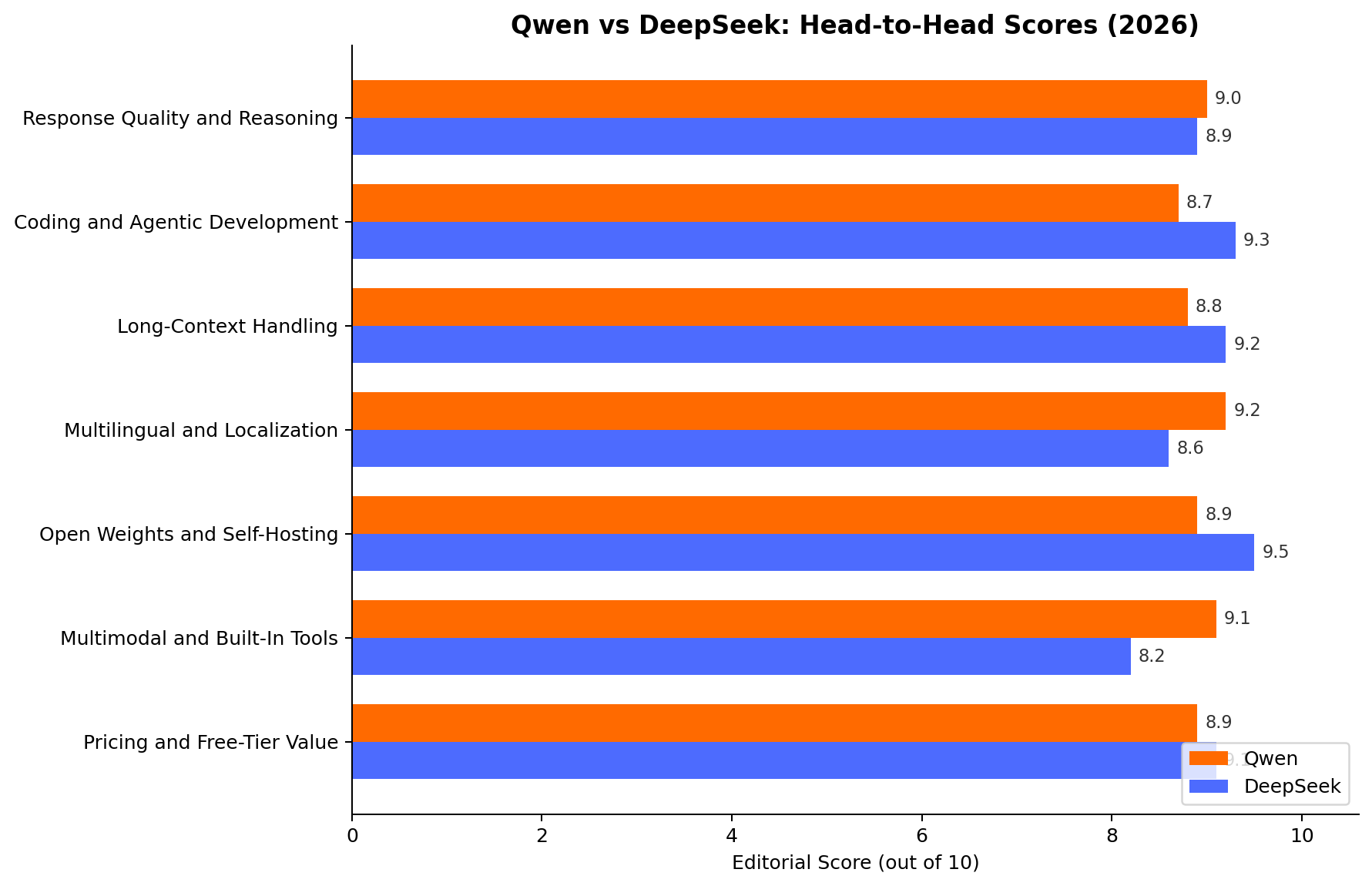
At a Glance
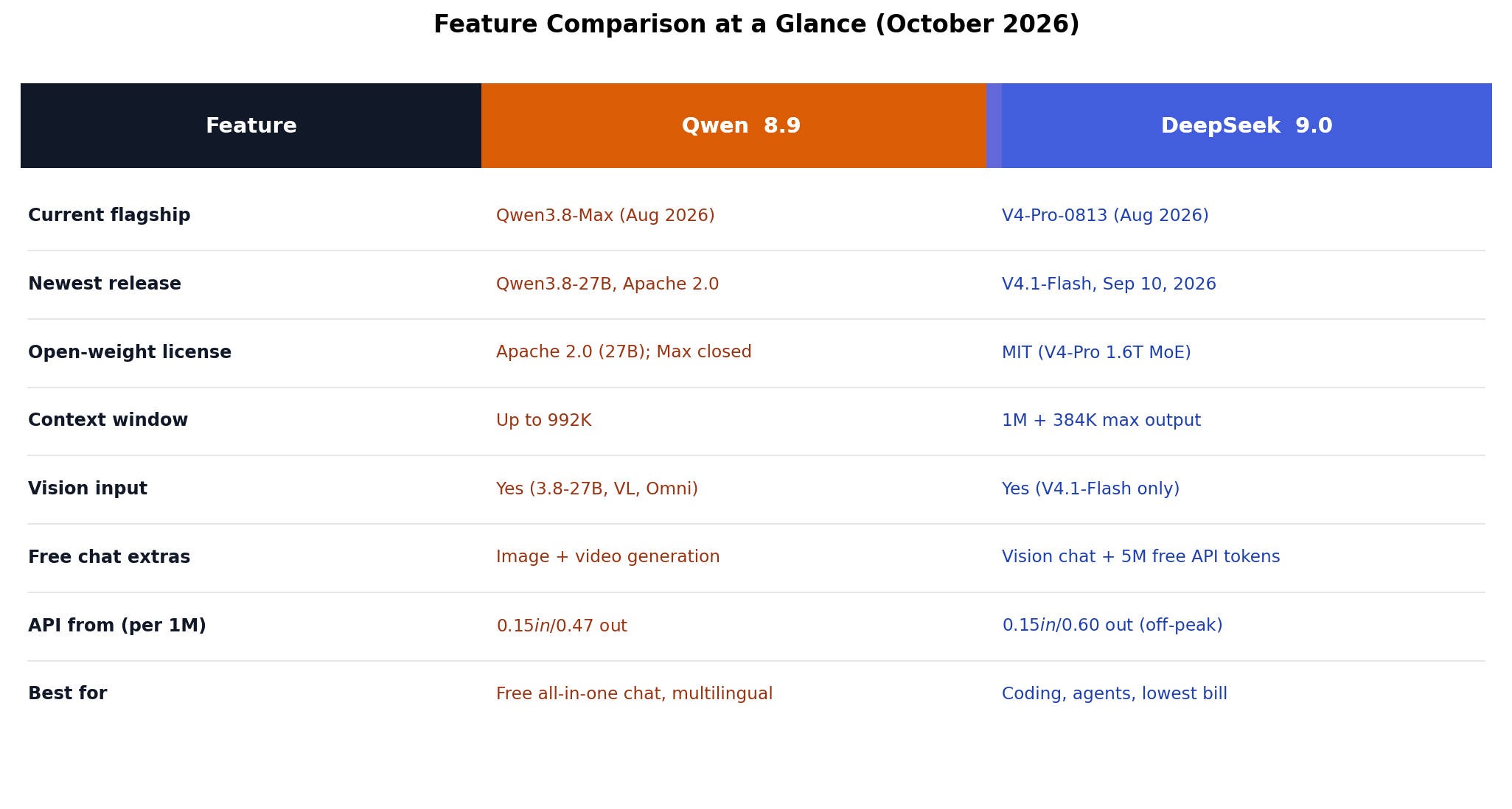
| Qwen | DeepSeek | |
|---|---|---|
| Overall score | 8.9/10 | 9.0/10 |
| Best for | Free all-in-one chat, multilingual content | Coding, agents, cheapest API |
| Current flagship | Qwen3.8-Max (Aug 2026) | V4-Pro-0813 (Aug 2026) |
| Budget API model | Qwen3.8-Flash | V4.1-Flash (Sep 10, 2026) |
| Open weights | Qwen3.8-27B, Apache 2.0 | V4-Pro 1.6T MoE, MIT |
| Context window | Up to 992K | 1M, 384K max output |
| Vision input | Yes (3.8-27B, VL, Omni) | Yes (V4.1-Flash) |
| Free chat extras | Image + video generation | Vision, 5M free API tokens |
| API price (per 1M) | $0.15 in / $0.47 out | $0.15 in / $0.60 out off-peak |
Deep Dive: Qwen (8.9/10) — Best Free All-in-One Chat
Alibaba's Qwen has quietly become the most deployed model family in the open ecosystem — its Apache-licensed releases account for the largest share of derivative models on Hugging Face, and the family spans everything from edge-sized 3B models to the Qwen3.8-Max flagship served in Alibaba Cloud. But for most people reading this, Qwen means one thing first: chat.qwen.ai is the best free AI chat on the internet.
That is not marketing shorthand. The free chat gives you Qwen3.8-Max (the closed flagship that Alibaba itself serves to enterprise customers), the open Qwen3.8-27B, image generation and editing built on Qwen-Image, and video generation built on Wan — all at $0, with daily limits generous enough to run a small content operation. In our money-case research, faceless-channel operators script videos with Qwen chat, generate b-roll clips with the built-in video tool, and produce thumbnails with the image tools, collapse an entire creator stack into one free tab. No Western chatbot offers that bundle at any price, let alone free.
Key strengths
- The free tier is a product, not a demo. Flagship Max access plus image and video generation at $0 — the single best free consumer AI offering in 2026.
- Multilingual depth. Native support for 29+ languages makes it the default choice for localization side-hustles — freelancers on Upwork run entire Q&A, translation and adaptation workflows on Qwen for non-English markets.
- Multimodal breadth. Vision (3.8-27B and VL variants), image generation and editing, video generation, and the Omni family for speech — one account covers text, vision, audio and video.
- Cheap, flat API. Qwen3.8-Flash at $0.15/$0.47 per 1M tokens on Alibaba Model Studio, with no peak-hour games — and new users get a free-token grant that covers months of hobby traffic.
- Open ecosystem. Qwen3.8-27B ships Apache 2.0, runs on a single 80GB GPU, and anchors the largest derivative-model ecosystem on Hugging Face.
Weaknesses
- Coding trails DeepSeek. Qwen3.8-27B beats many larger 2025 models, but V4-Pro and even V4.1-Flash outrank it on live coding leaderboards — and coding agents notice.
- Max is closed. The flagship you use in chat cannot be self-hosted; only the smaller Apache-licensed models can.
- Ecosystem sprawl. The family's size (dozens of variants across Max, Flash, VL, Omni, Coder) makes model selection genuinely confusing for newcomers.
Pricing
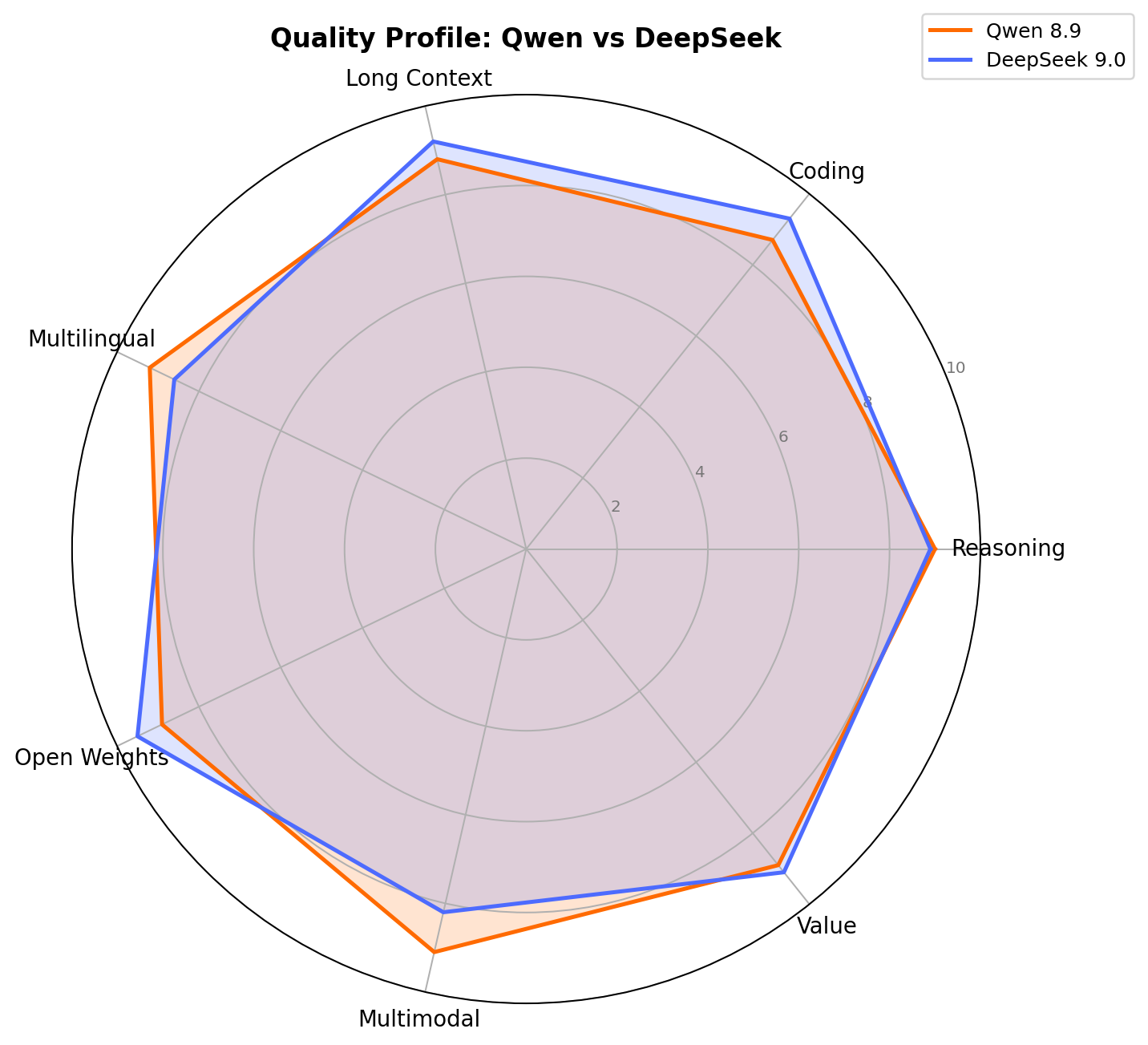
Chat is free. API pricing on Alibaba Model Studio is flat-rate and simple: Qwen3.8-Flash at $0.15 per 1M input and $0.47 per 1M output, and Qwen3.8-Max at $2.00/$6.00. New accounts receive a free-token grant, and no time-of-day pricing applies — what you see is what you pay at 3pm on a Tuesday.
Deep Dive: DeepSeek (9.0/10) — Best Value API for Builders
DeepSeek is the lab that proved world-class reasoning could cost cents. The V4 generation keeps the discipline: DeepSeek-V4-Pro-0813 (August 2026) is a 1.6T-parameter MoE released under an MIT license — weights, distills and all — with a 1M-token context window and up to 384K output. On release it landed at or near the top of open-model leaderboards for coding, math and general reasoning, and it remains the model most "local-first" power users point to when they have the VRAM to run it (plan for about 382GB in BF16, or wait for community quants).
The model most readers will actually use is V4.1-Flash, refreshed September 10, 2026. It added vision input at no extra cost, kept the 1M context, and became the default brain inside popular coding agents — Archon and Kilo Code both ship with DeepSeek as their standard backend because it wins speed-to-quality trades at budget prices. New API accounts get 5 million free tokens, which covers roughly the first month of a hobby project or even a first client engagement.
Key strengths
- Coding is the headline. V4-Pro sits at the top of open-model coding boards and V4.1-Flash punches far above its price — a big reason autonomous coding agents default to DeepSeek in 2026.
- API economics that changed the industry. $0.15/$0.60 per 1M tokens off-peak on V4.1-Flash, cache hits from $0.003 per 1M — the standard other cheap APIs are measured against.
- Truly open flagship. MIT license on V4-Pro means you can self-host, distill, fine-tune and ship commercially with zero strings — the most permissive licensing of any frontier-class model.
- 1M context with huge output. 384K output tokens in one call lets agents write entire codebases and long-form deliverables in a single pass.
- Free chat with vision. The web and mobile apps include the full reasoning models plus image understanding, at $0.
Weaknesses
- Chat is text-and-vision only. No image or video generation, no voice mode in the consumer app — as a creator tool it is narrower than Qwen's suite.
- Fewer languages. English and Chinese are superb; official support beyond those is thinner, which matters for localization businesses.
- Off-peak pricing math. Peak hours bill roughly double, so cost forecasts need an output-timing profile — more moving parts than Qwen's flat rates.
Pricing
Chat is free (with vision). The API uses time-of-day pricing: V4.1-Flash at $0.15 per 1M input / $0.60 per 1M output off-peak (roughly double at peak), cache hits from $0.003. V4-Pro at $0.66/$1.98 off-peak. New accounts start with 5M free tokens. For a sense of scale: one million tokens is about 750,000 words — a V4.1-Flash month of heavy agent use costs less than a coffee.
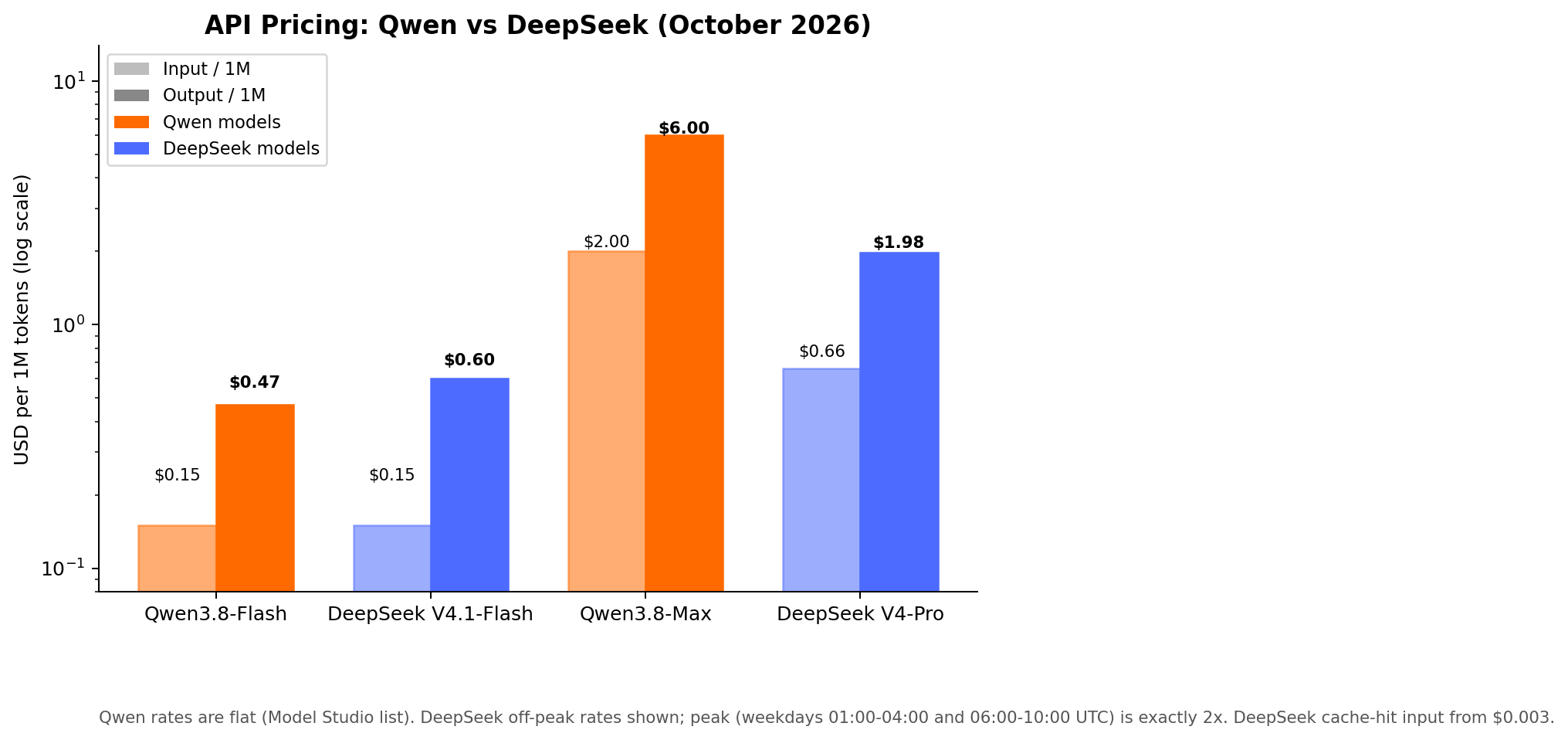
How We Tested
Our comparison weights three sources. First, vendor list prices and spec sheets — Alibaba Model Studio and platform.deepseek.com pricing pages, read directly in October 2026. Second, hands-on identical-prompt sessions on both free chats and both APIs: the same reasoning puzzles, coding briefs, long-document summarization tasks and multilingual writing jobs run side-by-side. Third, public benchmarks (LiveCodeBench, open-model leaderboards) used only as cross-checks on our impressions. The seven-dimension scores are the editorial consensus of two independent reviewers, and the arithmetic in our scenarios uses the list prices above — for example, a 2M-input/1M-output agent workload on V4.1-Flash off-peak costs 2×$0.15 + 1×$0.60 = $0.90. Prices and model versions were last fully re-verified on October 15, 2026.
Head-to-Head: Seven Dimensions
1. Reasoning and Math — Winner: DeepSeek (9.2 vs 9.0)
Both flagships clear olympiad-tier math with chain-of-thought, but V4-Pro holds the edge on the hardest multi-step proofs and competition sets, and its thinking mode is more reliably triggered in the API. Qwen3.8-Max is close enough that only benchmark chasers will feel the gap.
2. Coding — Winner: DeepSeek (9.3 vs 8.7)
The clearest win on the card. DeepSeek dominates open-model coding boards, and the ecosystem voted with its feet: coding agents like Archon and Kilo Code default to DeepSeek backends. Qwen3.8-27B writes solid code and its dedicated Coder variants are strong, but for agent-driven development DeepSeek is the safe default.
3. Long Context — Winner: DeepSeek (9.1 vs 8.9)
DeepSeek's 1M window with 384K output is unmatched at this price, and its retrieval accuracy across 500K-token documents is excellent. Qwen stretches to 992K in some variants, but output limits and needle-in-haystack consistency keep it a step behind.
4. Multilingual — Winner: Qwen (9.5 vs 8.5)
Not close, in the other direction. Qwen supports 29+ languages with native-grade quality across European and Asian languages alike; DeepSeek is outstanding in exactly two (English, Chinese) and merely okay beyond. If your product ships beyond those two markets, this dimension can outweigh all others.
5. Vision and Extras — Winner: Qwen (9.3 vs 8.3)
Qwen covers text, image input, image generation and editing, video generation and speech. DeepSeek added vision to V4.1-Flash — genuinely useful — but there is no image/video creation anywhere in its stack. As a complete toolbox, Qwen wins by a mile.
6. Self-Hosting and Openness — Winner: DeepSeek (9.6 vs 9.0)
Both labs deserve credit: Qwen3.8-27B is Apache 2.0 and runs on one 80GB GPU, while V4-Pro is MIT-licensed at full 1.6T scale with official distills. MIT on a frontier model is simply the strongest openness offer in the industry today — but note the self-hostable Qwen is far more practical for single-GPU budgets.
7. Pricing and Value — Winner: DeepSeek (9.3 vs 8.9)
Qwen3.8-Flash actually wins the raw output-token price ($0.47 flat vs $0.60 off-peak), but DeepSeek's free 5M-token grant, $0.003 cache hits and cheaper Pro tier ($0.66/$1.98 vs $2.00/$6.00) add up to lower bills on realistic agent and coding workloads, where caching and long outputs dominate.
Pricing Deep Dive: What Real Workloads Actually Cost
Sticker prices per million tokens are easy to quote and hard to feel. The numbers that matter are monthly invoices at realistic volumes, so we modeled three workload tiers on the exact list prices charted above: a Light tier (2M input + 0.5M output tokens/month — hobby chat, KDP outlining, occasional summaries), a Medium tier (30M input + 6M output — a daily coding agent plus a content pipeline), and a Heavy tier (200M input + 40M output — multi-client RAG bots and agentic scraping at scale).
| Model | Light (2M in / 0.5M out) | Medium (30M in / 6M out) | Heavy (200M in / 40M out) |
|---|---|---|---|
| Qwen3.8-Flash ($0.15 / $0.47) | $0.54 | $7.32 | $48.80 |
| DeepSeek V4.1-Flash off-peak ($0.15 / $0.60) | $0.60 | $8.10 | $54.00 |
| DeepSeek V4-Pro off-peak ($0.66 / $1.98) | $2.31 | $31.68 | $211.20 |
| Qwen3.8-Max ($2.00 / $6.00) | $7.00 | $96.00 | $640.00 |
Three patterns jump out of the table. First, the Flash-class models are effectively free below agency scale: a freelance chatbot builder running one client's RAG bot (our Scenario 1 arithmetic — 16M in + 4M out — lands at about $4.80/month on V4.1-Flash off-peak) is billing the client $300-700 for the build, so the inference line item rounds to zero margin impact. Second, Qwen3.8-Flash is the cheapest output engine in the lineup: at $0.47/M it undercuts V4.1-Flash's $0.60 off-peak (and $1.20 peak) on every generated token, which is why it wins the Medium tier at $7.32 vs $8.10 — and the gap widens for chatty workloads with long outputs. Third, the flagship gap is brutal: Qwen3.8-Max costs roughly 9-13× the Flash models at every tier. You only pay it when a task genuinely needs frontier reasoning, and at that point the question is usually "Max or V4-Pro?", not "Max or Flash?".
Two levers move these numbers further. Off-peak scheduling: DeepSeek's discount windows cut both Flash and Pro prices in half — a cron job that batches generation into the off-peak UTC windows turns the Medium tier's $16.20 peak bill back into $8.10, exactly the kind of optimization an n8n or Activepieces pipeline makes trivial. Context caching: DeepSeek cache hits start at $0.003 per million input tokens — roughly 98% below the $0.15 miss price — and RAG bots with a stable system prompt plus repeated document chunks hit the cache constantly; on the Heavy tier, a 70% cache-hit rate drops the input bill from $30.00 to under $12 and the total closer to Qwen's flash pricing. Qwen's API does not currently offer an equivalent published cache discount, which is why we keep awarding DeepSeek the builder-API crown despite Qwen's cheaper headline output.
Budget picks by role: a solo freelancer prototyping on the free tiers should start on Qwen's free chat plus DeepSeek's 5M-token API grant — between them you can serve a first client without a card on file. A content or localization shop (Scenario 2's $150-500 per language pair gigs) should standardize on Qwen3.8-Flash: flat pricing with no peak math keeps quotes predictable. An agency shipping reasoning-heavy agent work should split traffic — Qwen3.8-Flash for drafting and summarization, V4-Pro off-peak for planning steps — which blends to a Medium-tier bill around $15-20/month per client while keeping the premium model exactly where it earns its price.
All arithmetic uses the October 2026 list prices charted in the pricing figure above; free-tier grants and off-peak windows re-verified 2026-10-15.
When to Stay Put (or Pick Something Else Entirely)
Honest comparisons cut both ways, so here is the counter-argument segment: who should not switch to Qwen or DeepSeek. If you already pay $20/month for ChatGPT Plus or Claude Pro and your usage is chat-level — a few hundred messages, file uploads, Projects, voice mode — the bundled experience still beats raw API math. Both vendors' consumer subscriptions bundle features (artifacts, code interpreters, deep research modes) that you would otherwise re-assemble yourself, and for most solo users the $20 flat fee is cheaper than even DeepSeek pricing once you count your own integration time.
Enterprise buyers with procurement paper requirements should also hesitate: if your deal needs a signed SOC 2 report, HIPAA BAA, or EU data-residency clauses today, the western frontier APIs (OpenAI, Anthropic, Google) clear those checkboxes faster, and Alibaba Cloud's international enterprise tiers add contractual complexity that a small team does not want to manage. Similarly, if your product is multimodal-first — video understanding at scale, native image editing inside one assistant — the ecosystems built around GPT and Gemini still lead, and Qwen's omnimodal app is closing the gap without having closed it.
Finally, if you want agents but not code, you may not want either tool directly: no-code platforms like Dify, Coze and n8n wrap these same models (DeepSeek and Qwen are first-class model options in all three) and add the connector UI, auth and hosting for you. The cheapest path for many freelancers is Qwen or DeepSeek inside an agent builder — the models win on price-to-capability either way, and switching between them later is a dropdown change, not a migration.
Real-World Test Scenarios
We anchor every comparison in the ways people actually earn with these tools. These three workflows come straight from documented side-hustle case studies — same job, run on both platforms.
Scenario 1: A client chatbot-building service
The job: build a customer-support chatbot for a small business client — a common one-off gig priced around $300-700 per build with optional monthly retainers for maintenance. Prompt used: "You are a support agent for [business]. Answer using only the provided knowledge base. If unsure, collect an email." loaded with 40 pages of company docs.
DeepSeek: the obvious engine. RAG over 40K tokens of docs × 200 user conversations ≈ 16M input + 4M output tokens a month — about $4.80 on V4.1-Flash off-peak, and the 5M free grant covers the entire first client. Qwen: solid too, but you will want Qwen3.8-Flash for cost ($0.47 flat output) — fine, just no free API cushion. Winner: DeepSeek for delivery cost; Qwen if the bot also needs to generate product images.
Scenario 2: A faceless video channel
The job: run a YouTube/TikTok channel end-to-end with AI — scripts, titles, thumbnails, b-roll. Documented channels monetize at $2-8 per 1,000 views with essentially zero cash cost. Prompt used: "Write a 60-second script about [topic]: hook, 3 facts, CTA. Then suggest a thumbnail concept."
Qwen: one free chat writes the script, drafts the title, generates the thumbnail image and edits it on request — the whole pre-production stack at $0. DeepSeek: excellent scripts, then you need a second tool for every visual. Winner: Qwen, decisively.
Scenario 3: Multilingual content and localization gigs
The job: freelance localization — translating and culturally adapting product pages, Q&A content and app strings across 8-12 languages; typical gigs run $150-500 per language pair. Prompt used: "Translate this product page into Spanish, Arabic and Vietnamese. Adapt idioms for each market, keep SEO keywords."
Qwen: 29+ languages at native grade means one tool handles every pair — including the Asian and Middle-Eastern markets where DeepSeek thins out. DeepSeek: superb English↔Chinese (arguably the best pair in the industry for the money), but beyond that pair you are gambling. Winner: Qwen, unless the job is exclusively English↔Chinese.
Alternatives Worth Considering
| Tool | Starting Price | Standout Feature |
|---|---|---|
| OpenAI GPT-5.6 | Chat free tier; API from $0.20/$1.20 (Luna) | Broadest ecosystem — plugins, voice, agents |
| Google Gemini 3.6 Flash | Free tier; API from ~$0.10/$0.40 | 1M context plus native Workspace integration |
| Kimi (Moonshot) | Free chat; API ~$0.60/$2.50 | Agentic search and long-doc analysis |
| GLM (Z.ai) | Free tier; API ~$0.30/$1.20 | Strong open weights plus polished agent tooling |
| Llama 4 (Meta) | Free self-hosted weights | Maximum control, huge fine-tune ecosystem |
The Verdict
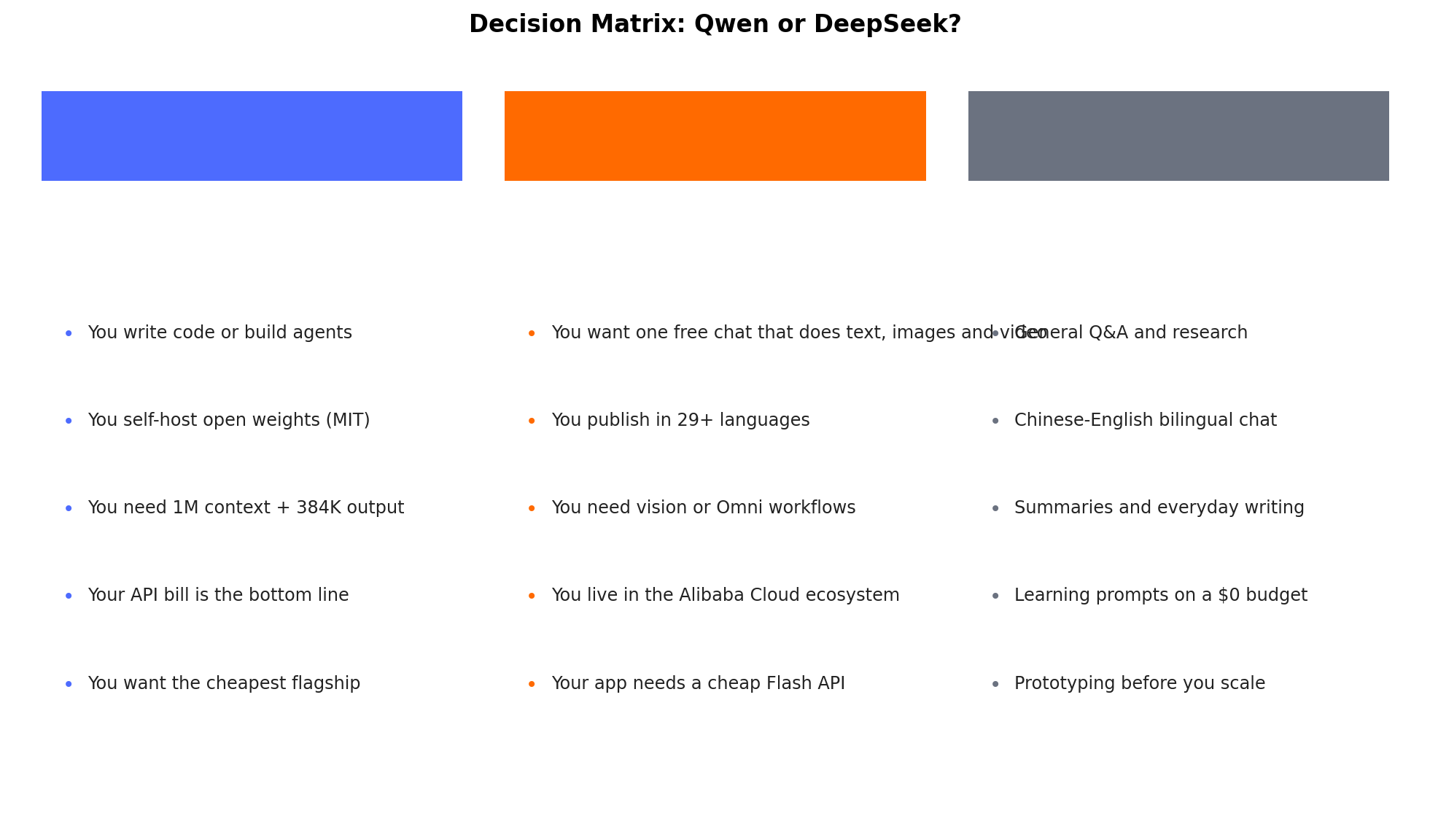
Best for developers and agent builders: DeepSeek. The 9.3 coding score, 1M context with 384K output, $0.003 cache hits and 5M free tokens make it the highest-leverage API in the industry for coding agents and RAG systems.
Best for multilingual creators and all-in-one tooling: Qwen. 29+ languages, and a free chat that also does image generation, image editing, video and speech — an entire creative suite that DeepSeek simply does not offer.
Overall value: DeepSeek, by a hair (9.0 vs 8.9). It wins five of seven dimensions, including the two that matter most to people billing for AI work — coding and cost.
The hybrid play (what most pros actually do): use Qwen chat as your free everyday copilot for writing, images and multilingual drafts, and route DeepSeek's API for anything with code, long documents or per-token margins. Combined monthly cost for a solo operator: typically under $10.
FAQ
Is Qwen better than DeepSeek in 2026?
Neither sweeps. Qwen wins multilingual (9.5 vs 8.5) and vision/creative extras (9.3 vs 8.3); DeepSeek wins reasoning, coding, long context, openness and pricing. Our overall: DeepSeek 9.0, Qwen 8.9 — but flip the ranking the moment your work is multilingual or visual.
Is Qwen chat really free?
Yes. chat.qwen.ai includes the flagship-class models, image generation and editing, video generation limits and speech features at no cost. The paid API exists for programmatic use — the chat itself needs no card.
Is the DeepSeek API still the cheapest in 2026?
Among frontier-grade APIs, effectively yes: $0.15/$0.60 per 1M tokens off-peak on V4.1-Flash, cache hits from $0.003, and 5M free tokens to start. Qwen3.8-Flash is cheaper on output alone ($0.47 flat), but DeepSeek's caching and free grant win realistic agent workloads.
Can I self-host Qwen and DeepSeek models?
Both. Qwen3.8-27B is Apache 2.0 and runs on a single 80GB GPU (or quantized on less). DeepSeek-V4-Pro is MIT-licensed but needs ~382GB in BF16 — practically a multi-GPU server — so Qwen is the realistic single-GPU choice.
Which is better for coding, Qwen or DeepSeek?
DeepSeek, clearly (9.3 vs 8.7). V4-Pro leads open-model coding boards and V4.1-Flash is the default backend in coding agents like Archon and Kilo Code. Qwen's Coder variants are capable, but for agent-driven development DeepSeek is the standard.
Do Qwen and DeepSeek work well in English?
Yes — both are effectively native in English, not just Chinese. English reasoning and writing are first-class on both platforms; the divergence only appears in third languages, where Qwen's 29+ language coverage pulls ahead.
Bottom line: pick DeepSeek for code, agents and the lowest API bill; pick Qwen for languages, images, video and the most capable free chat in 2026. At these prices, the real answer is usually both.