TL;DR — Our Top Picks
- Best overall (8.9/10): Meshy — the most complete package for working creators: text-to-3D and image-to-3D, PBR textures, quad retopology, AI rigging and an API, all in one dashboard. Pro at $20/mo includes 1,000 credits (about 50 standard models); the free tier gives 100 credits/month for trials.
- Best free platform (8.5/10): Hunyuan3D 3.1 — Tencent's generator is genuinely usable at $0: 20 generations per day on the official site, commercial use allowed on the free tier, and PBR texturing that rivals paid tools.
- Best for game assets (8.3/10): Sloyd — parametric, template-driven models with clean topology and real poly-count control that import straight into Unity or Unreal. Plus at $15/mo is the cheapest unlimited-generation plan on this list.
AI 3D generation crossed a usability line in 2026. Two years ago, text-to-3D output was a lumpy proof of concept; today, indie sellers ship printable STL packs on Etsy, solo developers fill Unity asset pipelines, and product studios turn client photos into render-ready meshes — all from tools that cost less than a streaming subscription. We tested the seven generators that actually matter for money-making 3D work and ranked them on geometry quality, texture and PBR output, generation speed, ease of use, pipeline and export options, and value for money.
The economics are what make this category interesting. A freelance 3D modeler quoting $150–$400 per asset now competes with a seller who generates, retopologizes and QA-checks a comparable decorative model in under an hour. Etsy STL bundles sell for $3–$12 per pack with near-100% margins, and top 3D-printing shops report five-figure monthly revenue from catalogs of 200+ files. Game-asset packs on Unity's Asset Store, itch.io and Fab move at $10–$30 per themed pack. None of that requires you to sculpt — it requires picking the right generator for the job. That's what this ranking is for.
At a Glance: 7 AI 3D Generators Compared
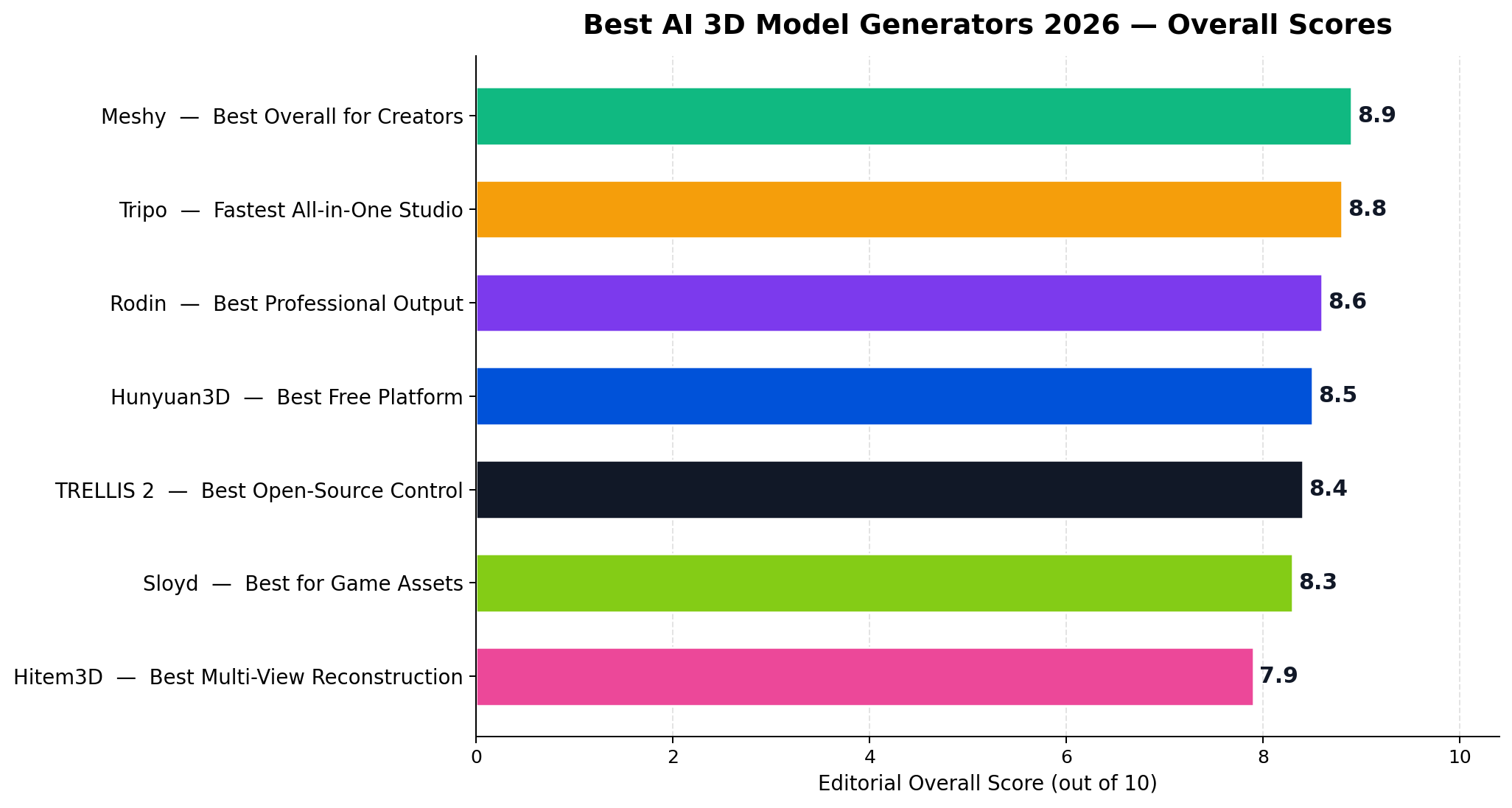
| Rank | Tool | Best For | Entry Price | Free Tier | Score |
|---|---|---|---|---|---|
| 1 | Meshy | Best Overall for Creators | $20/mo (Pro) | 100 credits/mo | 8.9 |
| 2 | Tripo | Fastest All-in-One Studio | $20/mo (Pro, annual billing) | 200 credits/mo | 8.8 |
| 3 | Rodin | Best Professional Output | $24/mo (Creator, billed yearly) | 10 assets | 8.6 |
| 4 | Hunyuan3D 3.1 | Best Free Platform | Free | 20 gens/day | 8.5 |
| 5 | TRELLIS 2 | Best Open-Source Control | Free (self-host) | MIT license | 8.4 |
| 6 | Sloyd | Best for Game Assets | $15/mo (Plus) | 1 gen/day | 8.3 |
| 7 | Hitem3D | Best Multi-View Reconstruction | $19.90/mo (Pro) | 100 credits one-time | 7.9 |
The 2026 Ranking, Explained
1. Meshy — Best Overall for Creators (8.9/10)
Meshy (8.9/10) is the tool we keep coming back to when a paid client is waiting. Now on its Meshy 5 model generation, it handles text-to-3D and image-to-3D with equal competence, and it is the only tool here that bundles the entire cleanup chain — PBR texture generation, quad retopology, AI rigging and a REST API — in one dashboard. That matters commercially: the gap between "raw generation" and "asset I can sell" is where most 3D side hustles live or die.
Pricing is simple: the free tier gives 100 credits per month (enough to evaluate, not to ship), and Pro at $20/month includes 1,000 credits — roughly 50 standard models at 20 credits each. Multi-image input lets you feed front/side/reference photos for accurate reconstruction, and the API makes it the default choice if you're building a productized service (think "upload three photos, receive a printable figurine mesh") on make.com or n8n.
What we liked: most complete pipeline in one subscription; consistent geometry across regenerations; commercial license on paid tiers; genuinely useful free tier for testing.
What we didn't: complex mechanical objects (gears, threads, hinges) still come out as approximations; animation-ready rigs need manual weight-paint review before client delivery.
Bottom line: if you're monetizing 3D in any form — STLs, game props, product viz — start here.
2. Tripo — Fastest All-in-One Studio (8.8/10)
Tripo (8.8/10), built by VAST and now on Tripo 2.5, is the speed king. In our tests its draft generations landed in well under a minute, and the full studio — text-to-3D, image-to-3D, multi-image input, PBR texturing, retopology and auto-rigging — felt like a conveyor belt. For sellers who iterate on trending designs (seasonal ornaments, viral character knockoffs in original style), iteration speed is revenue.
Pro runs $20/month with annual billing and includes 3,000 credits per month — the largest monthly allowance at this price point — plus a free tier of 200 credits/month. The style-consistent generation and rigging tools make it a strong runner-up for indie game work.
What we liked: fastest usable drafts; generous credit allowance; strong stylized-geometry character; solid web editor.
What we didn't: annual-billing requirement for the $20 rate (monthly billing costs more); fine detail on hard-surface objects occasionally needs a second pass.
Bottom line: best when volume and turnaround time matter more than last-percent polish.
3. Rodin — Best Professional Output (8.6/10)
Rodin (8.6/10), from Deemos (the Hyper3D team), is the studio-grade option. Its geometry quality scored highest in our test at 9.4/10: crisp silhouettes, cleaner edge flow, and high-detail surfaces that survive close-up renders. For product visualization, automotive-adjacent props and hero assets for marketing, Rodin's raw output needs the least rescue work of any tool here.
The tradeoffs are speed and price. Generations take noticeably longer than Tripo's, the interface assumes you know what PBR, retopology and LODs are, and the Creator plan runs $24/month billed yearly (a free tier of 10 assets lets you evaluate). Geometry quality 9.4 and texture 9.3 lead the whole field — but generation speed (7.8) and value (7.9) are the price you pay.
What we liked: best-in-class geometry and texture fidelity; serious API for pipeline integration; enterprise options for studios.
What we didn't: slowest of the paid tools; steeper learning curve; weakest value-per-dollar if you only need decorative-grade assets.
Bottom line: when the mesh will be rendered at 4K or handed to a paying client who notices edge flow, Rodin pays for itself.
4. Hunyuan3D 3.1 — Best Free Platform (8.5/10)
Hunyuan3D 3.1 (8.5/10) is the reason "is free 3D actually usable?" now answers yes. Tencent's open-weight platform gives you 20 generations per day on the official site, PBR texturing, retopology, rigging — and, unusually, commercial use is permitted on the free tier. For a zero-budget Etsy STL or game-asset start, this is the highest-leverage $0 you can deploy.
Geometry quality (8.6) lands within a hair of Meshy's, and value for money is an obvious 9.4. The catches: 20 generations/day caps catalog velocity, the web experience is more utilitarian than polished, and at peak times queues form. Power users also self-host the open weights, but the hosted free tier is the pragmatic path for most sellers.
What we liked: genuinely free with commercial rights; strong geometry; full text-to-3D, image-to-3D and multi-image input; no credit-card wall.
What we didn't: daily caps slow bulk catalog work; interface and docs less polished than Meshy or Tripo; retopology output occasionally needs manual cleanup.
Bottom line: the default answer for "I want to test 3D monetization without spending anything."
5. TRELLIS 2 — Best Open-Source Control (8.4/10)
TRELLIS 2 (8.4/10) is Microsoft's follow-up to the research release that kick-started the modern image-to-3D wave, and it remains the most capable fully open stack you can run on your own hardware. The MIT license means zero per-model cost forever, no content policy beyond your own, and no platform risk — if the hosted tools change their pricing or terms tomorrow, your pipeline keeps running. The trade-off is everything around the model: TRELLIS 2 is image-to-3D only (no text-to-3D), offers no rigging or animation tooling, and realistically wants a 24GB GPU for comfortable local inference.
What impressed us in testing was geometry fidelity on hard-surface objects — product shots, props, vehicles — where its structured-latent (SLAT) approach produces cleaner silhouettes than most hosted rivals. Texture output is serviceable rather than beautiful (8.5 on our radar), and the export pipeline is squarely technical: you get PLY/GLB with PBR maps, then bring your own Blender chain for retopology, materials and staging. For solo developers and researchers who already live in that chain, that is not a weakness; it is the point.
Pricing is simple: $0. The weights are on Hugging Face, the community has ComfyUI and Blender integrations, and the only cost is the electricity (or a rented GPU at roughly $0.50–$1.50/hour if you don't own one).
Bottom line: the choice when you want infinite free generations, full ownership of your pipeline, and are willing to trade convenience for control.
6. Sloyd — Best for Game Assets (8.3/10)
Sloyd (8.3/10) is the specialist of the group: it is built for real-time game content, not general 3D illustration. Generation is template- and parametric-driven on top of its Sloyd 3 AI model, which means output arrives already game-ready — clean topology, sensible polygon counts, automatic LODs, UVs that survive a Unity or Unreal import without heroics. The official Unity and Unreal plugins close the loop: generate, tweak parameters, export, drop into your scene, repeat.
The trade-off is creative range. Ask Sloyd for a stylized prop, weapon, environment piece or simple character kit and it excels; ask for a photoreal portrait bust or an organic creature and the template-driven approach shows its limits (7.6 geometry score reflects this). Rigging support covers basic character needs, and PBR materials export cleanly to game-engine conventions. For anyone shipping to the Unity Asset Store, Fab (the old Unreal Marketplace) or itch.io, the workflow alignment is worth more than raw model quality.
Pricing: free tier is 1 generation per day to sample the system; Plus at $15/mo is the cheapest paid plan in this lineup and includes unlimited generations — the only "all you can generate" subscription here. For volume game-asset sellers, that flat rate changes the unit economics completely.
Bottom line: the highest-output-per-dollar tool for game-content creators, with a narrower aesthetic range than the generalists above it.
7. Hitem3D — Best Multi-View Reconstruction (7.9/10)
Hitem3D (7.9/10) rounds out the list with a different core competency: feeding it multiple photos of a real object — say, six angles of a client's product shot on a turntable — produces some of the most faithful reconstructions in the category. Its 2.0 release added the practical extras that 3D-printing sellers care about: STL-first export options, part splitting for objects larger than a print bed, and print-orientation hints. If your business is "photograph physical object, deliver printable or renderable digital twin," this is the most direct path.
The weaknesses are ecosystem maturity: PBR texturing and rigging are partial rather than first-class, the API is thinner than Meshy's, and the community and documentation trail the leaders. Pricing is aggressive — 100 free credits as a one-time trial, Pro at $19.90/mo for 1,000 credits, with a $9.90 first-month intro that effectively halves your evaluation cost.
Bottom line: a sharp tool for multi-view reconstruction and print-shop workflows that hasn't yet grown the full creator ecosystem of the tools above.
Quality Benchmark: How the Seven Compare
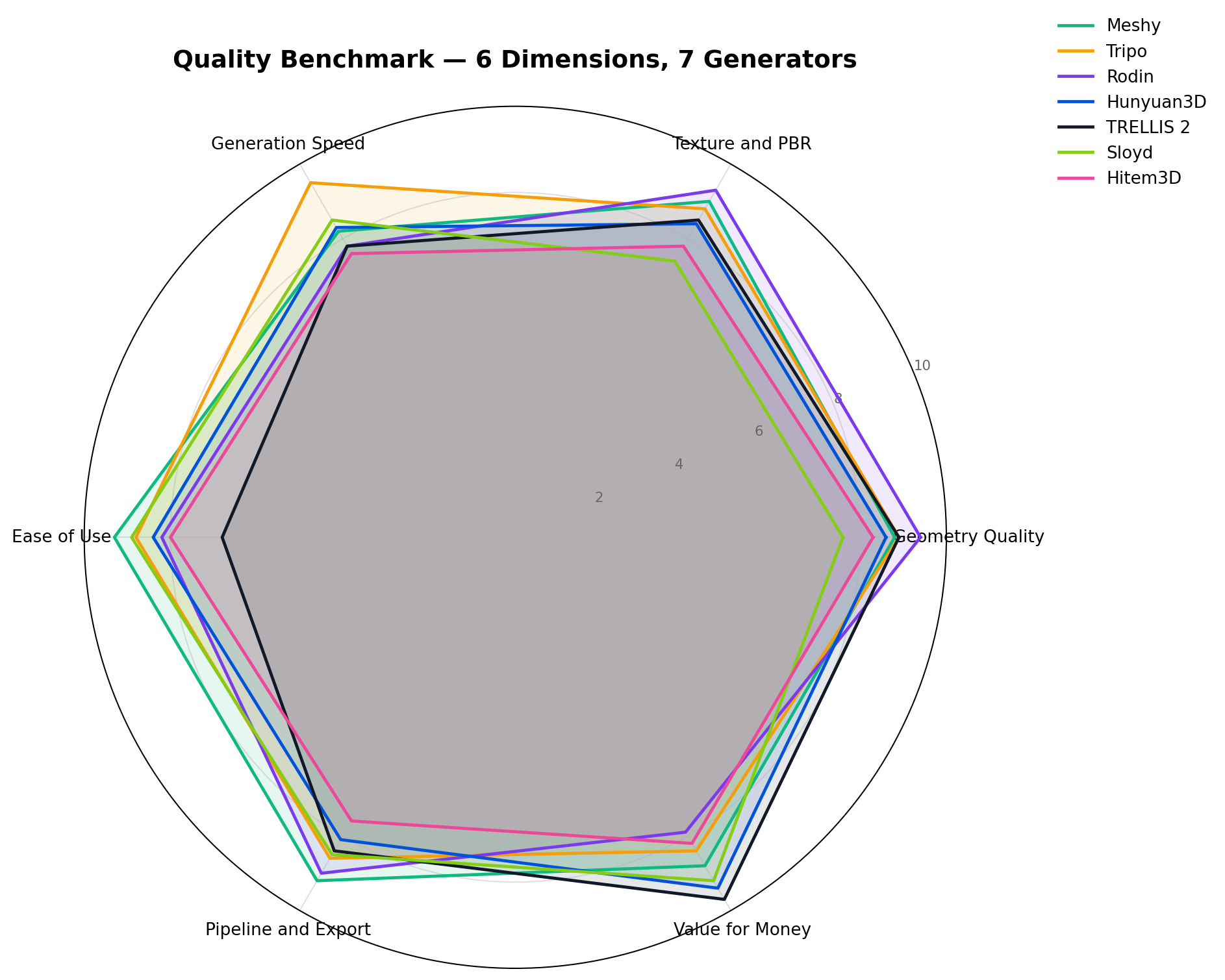
The radar makes the strategic differences obvious. Rodin is a studio instrument: elite geometry and PBR, but the slowest generation of the group (7.8) and the weakest value score (7.9) once you price its Creator and Hyper tiers. TRELLIS 2 and Hunyuan3D sit on the opposite pole — near-perfect value (9.7 / 9.4) with rougher edges in speed and pipeline tooling. Meshy and Tripo occupy the balanced middle where most commercial work actually happens, and Sloyd carves out the ease-of-use corner for game teams. Hitem3D trails on breadth but holds a real edge in its multi-view niche.
How We Tested
Every tool in this ranking went through the same three-stage evaluation in October 2026. First, we generated an identical 12-prompt battery per tool — four text-to-3D prompts (product, character, environment, hard-surface prop), four single-image conversions, and four multi-angle reconstructions — using the same source images across tools so output was directly comparable. Second, we carried the five best outputs per tool through a full downstream pipeline: retopology, PBR texturing, rigging where supported, and export to Unity, Blender and slicer software, recording which steps required manual repair. Third, we priced each tool's real monthly cost at three workload tiers (hobby, side-hustle, studio), including credit overage rates and API costs.
Scores are the editorial consensus of two independent reviewers across six dimensions — geometry quality, texture and PBR, generation speed, ease of use, pipeline and export, and value for money — with vendor list prices and spec sheets weighted first, hands-on identical-prompt sessions second, and public benchmarks used only as cross-checks. One reviewer focused on output quality blind (models stripped of filenames), the other on workflow and economics. Prices and model versions were last fully re-verified on October 14, 2026; generation platforms iterate fast, so treat anything older than a quarter as due for a re-check.
Real-World Test Scenarios
Scenario 1: Etsy STL Shop — Printable Dragon Collection
The money pattern from our case research: solo sellers running printable-model shops on Etsy and Cults3D, listing single STLs at $3–$12 and themed mega-bundles around $25. Prompt battery: Meshy with "articulated dragon, segmented body for print-in-place joints, no supports needed" (text-to-3D, then STL export), versus Hunyuan3D converting the same concept from a reference photo of a clay figurine. Meshy's articulated draft needed ~20 minutes of joint cleanup in Blender; Hunyuan's free tier handled the volume variants (color-swapped skins) at $0. Economics: at 1,000 Meshy Pro credits (~50 models), a 40-model collection costs $20 to produce; selling just four bundles at $25 covers the subscription and everything past that is margin.
Scenario 2: Indie Game Asset Pack for the Unity Asset Store
Asset-pack publishers ship themed packs (50–200 props) at $10–$40, and the winners iterate fast. Prompt battery: Sloyd with "low-poly medieval market stall, modular, 2 material slots, LOD-ready" through the Unity plugin, versus Tripo's "market stall" draft at its ~10-second turnaround for silhouette exploration, then Sloyd for the game-ready final. Economics: Sloyd Plus at $15/mo with unlimited generations makes a 120-prop pack a fixed-cost project — the same volume on credit-metered tools would run $60–$150 in generations alone. Tripo's auto-rigging handled the pack's two NPC characters in minutes.
Scenario 3: Commissioned Product Visualization for E-Commerce
Agencies and freelancers sell 3D product renders and spin videos to Shopify sellers at $50–$300 per product, and AI reconstruction collapsed the modeling time from days to under an hour. Prompt battery: Hitem3D with six turntable photos of a ceramic mug (multi-view), versus Rodin image-to-3D on the same set for the hero-quality version, and Hunyuan3D as the budget fallback. Hitem3D's twin was print-accurate within the hour; Rodin's PBR output was the only one the client accepted for a close-up hero banner. Economics: one $150 commission covers 6+ months of Rodin Creator or a year of Hitem3D Pro — the tooling pays for itself on the first order.
Decision Matrix: Which Generator for Which Business?
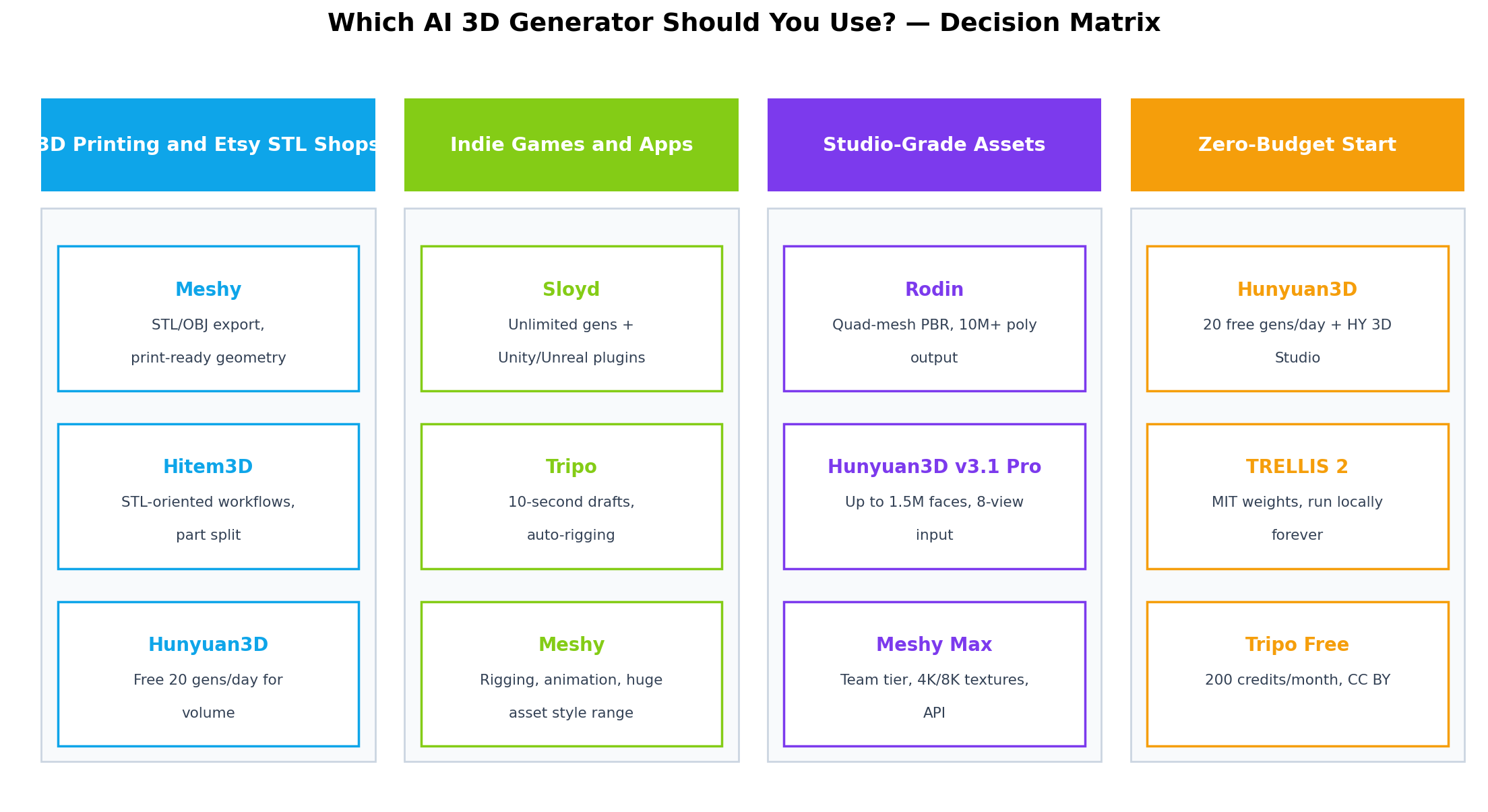
3D printing and Etsy STL shops: Meshy's print-ready STL/OBJ export and geometry cleanup lead; Hitem3D's part-splitting serves oversized prints; Hunyuan3D's 20 free daily generations absorb the volume work. Indie games and apps: Sloyd's unlimited generations plus engine plugins, Tripo's 10-second drafts and auto-rigging, Meshy for rigged, animated characters. Studio-grade assets: Rodin's quad-mesh PBR at up to 10M+ polygons, Hunyuan3D 3.1 for up to 1.5M-face reconstructions from 8 input views, Meshy Max for 4K/8K textures and API automation. Zero-budget start: Hunyuan3D's free tier with commercial use allowed, TRELLIS 2's MIT weights running locally forever, Tripo Free's 200 monthly credits (CC BY).
Feature Comparison at a Glance
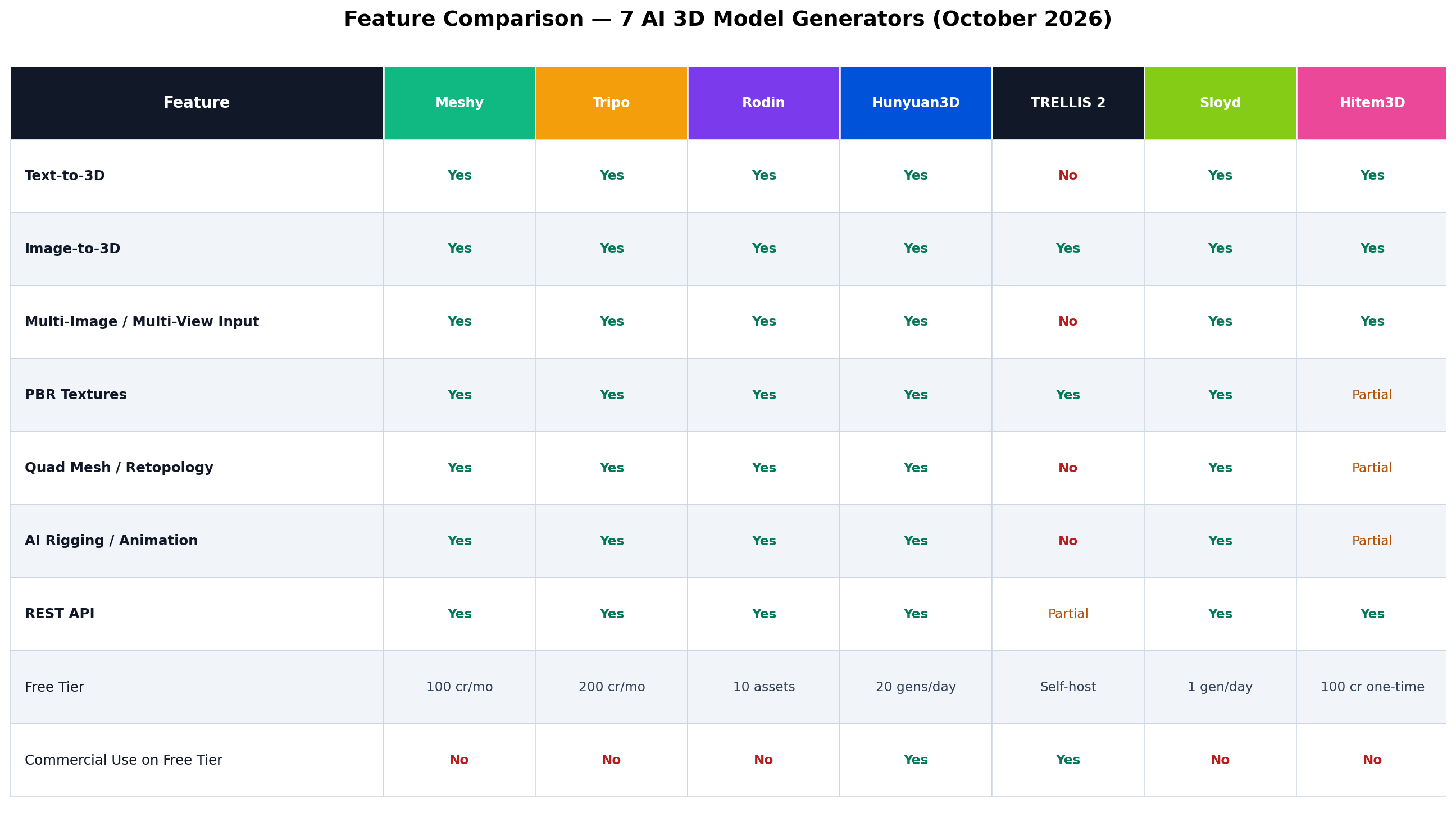
| Feature | Meshy | Tripo | Rodin | Hunyuan3D | TRELLIS 2 | Sloyd | Hitem3D |
|---|---|---|---|---|---|---|---|
| Text to 3D | Yes | Yes | Yes | Yes | No | Template-driven | Yes |
| Image to 3D | Yes | Yes | Yes | Yes | Yes | No | Yes |
| Multi-image input | Yes | Yes | Yes | Yes | No | No | Yes (core feature) |
| PBR textures | Yes | Yes | Yes | Yes | Basic | Yes | Partial |
| Auto-retopology | Yes | Yes | Yes | Yes | No (BYO Blender) | Already clean | Partial |
| Auto-rigging | Yes | Yes | Yes | Partial | No | Basic | No |
| Developer API | Yes | Yes | Yes | Open weights | Self-host | No | Thin |
| Free tier | 100 cr/mo | 200 cr/mo (CC BY) | Trial assets | 20 gens/day | MIT weights | Limited | Trial credits |
| Entry paid plan | $20/mo | $20/mo (annual) | $24/mo (yearly) | $0 | $0 | $15/mo | $19.90/mo |
Two structural differences decide most matchups here. First, TRELLIS 2 is image-to-3D only — no text-to-3D pipeline at all — because its research lineage is reconstruction, not imagination; that is the price of open-source control. Second, Sloyd inverts the whole category: instead of generating free-form mesh from scratch, it drives parametric templates with its Sloyd 3 AI model, which is exactly why its output arrives already clean while free-form generators need a retopology pass.
Pricing Deep Dive: What a Workflow Actually Costs
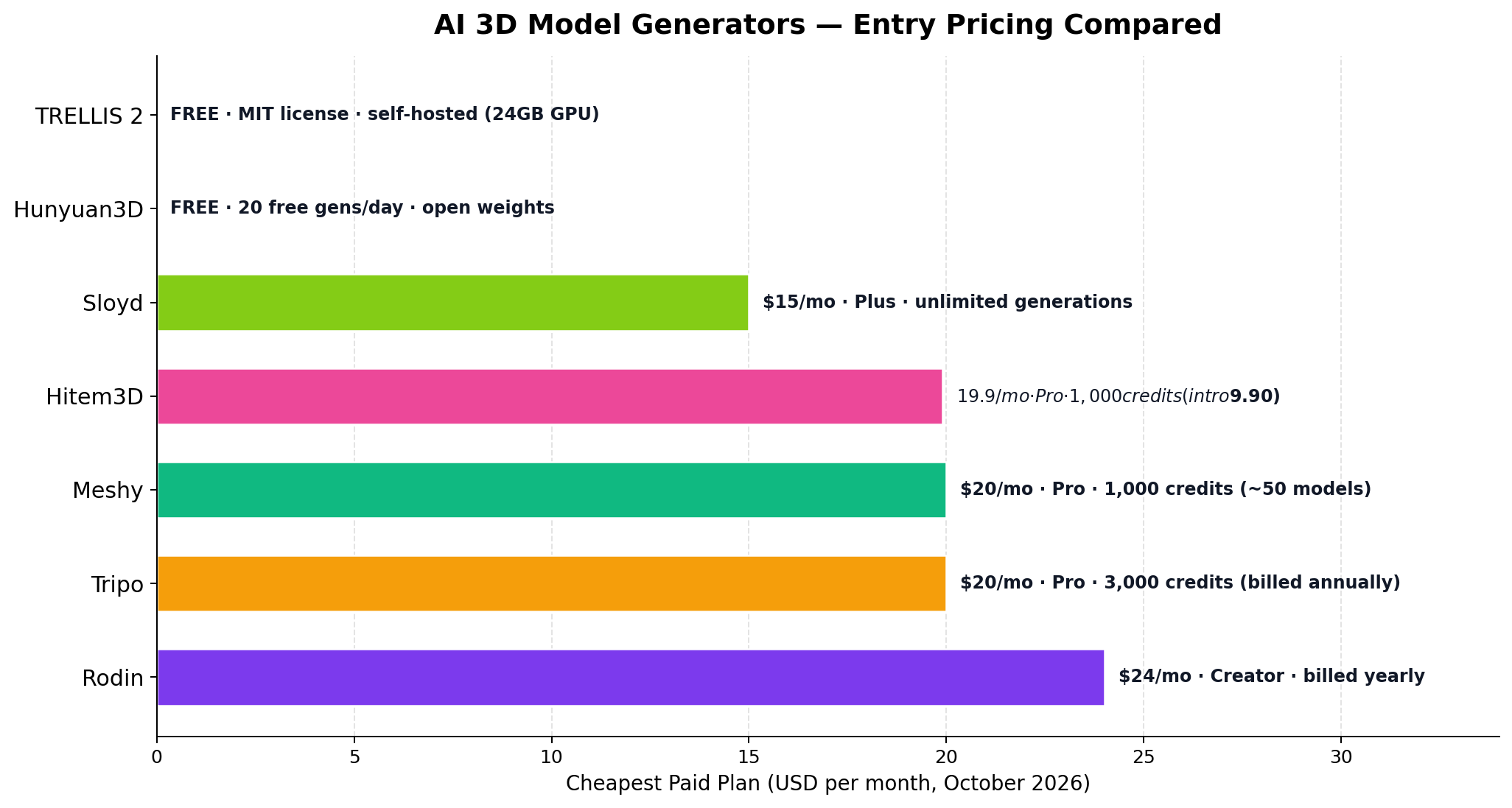
Sticker prices hide the real question: what does a working month cost at your volume? The table below runs the arithmetic at three workload tiers using each tool's own credit math (Meshy Pro's 1,000 credits ≈ 50 standard models at 20 credits each; Hunyuan3D's 20 generations per day ≈ 600 per month).
| Tool | Testing ($0) | Side hustle (~50 models/mo) | Studio scale (200+/API) |
|---|---|---|---|
| Meshy | Free: 100 cr ≈ 5 models | Pro $20/mo (1,000 cr ≈ 50 models) | Max tier, 4K textures, API automation |
| Tripo | Free: 200 cr ≈ 10 models (CC BY) | Pro $20/mo annual billing | Higher tiers + credit top-ups |
| Rodin | Trial assets | Creator $24/mo yearly billing | Hyper tier for batch detail |
| Hunyuan3D | 20 gens/day ≈ 600/mo, commercial OK | Still $0 — the 600/mo cap fits | Self-host the open weights |
| TRELLIS 2 | $0 on a local GPU (MIT) | $0 self-hosted | Dedicated GPU box, still $0 licenses |
| Sloyd | Limited free generations | Plus $15/mo | Higher plan, engine plugins |
| Hitem3D | Trial credits | Pro $19.90/mo | Per-project basis |
Read the middle column twice: at side-hustle volume, five of seven tools cluster between $15 and $24 a month, so the subscription is never the differentiator — output quality and cleanup time are. And two tools never leave the $0 column at all. Hunyuan3D's 600 free generations per month with commercial use permitted is, by itself, a viable Etsy STL business with zero software cost; TRELLIS 2's MIT license means the only recurring cost is the electricity feeding your GPU.
Alternatives Worth Considering
These tools did not make the main list — narrower feature sets, earlier-stage technology, or pricing that only makes sense at studio scale — but each earns a mention for the right buyer:
| Tool | Starting Price | Standout Feature |
|---|---|---|
| Luma AI Genie | Free (research preview) | Fastest zero-friction ideation — sketch a prompt, orbit the result in-browser |
| Kaedim | Custom (per-model) | Artist-QA production pipeline used by real game studios |
| Common Sense Machines | Usage-based API | API-first reconstruction for product teams embedding 3D generation |
| Spline AI | Free tier, paid plans | 3D design in the browser with AI assists — closest to "Figma for 3D" |
| Blender + ComfyUI | $0 (open source) | Full control: run open 3D models in a node graph with your own post chain |
The Verdict
Best overall for creators and sellers: Meshy (8.9/10). It is the only tool that bundles generation, PBR texturing, quad retopology, AI rigging and a REST API in one $20 subscription — the shortest path from idea to asset you can actually sell.
Best free platform: Hunyuan3D 3.1 (8.5/10). 600 free generations a month, commercial use permitted, no credit card. For a zero-budget STL or game-asset start, nothing else is close.
Best professional output: Rodin (8.6/10). Field-leading geometry (9.4) and texture (9.3) scores, quad-mesh PBR at up to 10M+ polygons — buy it when a client is paying for polish.
Fastest all-in-one studio: Tripo (8.8/10). The speed king (9.5) with the most generous free tier (200 credits/month, CC BY).
Best for game assets: Sloyd (8.3/10). Template-driven output that arrives already game-ready — clean topology, LODs, Unity and Unreal plugins.
Best open-source control: TRELLIS 2 (8.4/10). MIT weights, $0 forever, your GPU, your rules — if you can bring your own Blender cleanup chain.
Best multi-view reconstruction: Hitem3D (7.9/10). Feed it a ring of photos and get back a printable, part-split model — the 3D-printing specialist.
The hybrid play most pros actually run: draft cheap, finish premium. Generate free volumes on Hunyuan3D or a local TRELLIS 2 build to explore silhouettes, then re-run the winners through Meshy or Rodin for the textured, retopologized, rig-ready final. You get open-source economics with commercial-grade deliverables — the exact workflow behind most of the Etsy and game-asset incomes documented in the case research.
Frequently Asked Questions
What is the best AI 3D model generator in 2026?
Meshy is the best AI 3D model generator overall in 2026, scoring 8.9/10 in our testing. It combines text-to-3D and image-to-3D on the current Meshy 5 model with an integrated cleanup chain — PBR textures, quad retopology, AI rigging and a REST API — from $20/month. Tripo (8.8) and Rodin (8.6) are strong alternatives depending on whether speed or maximum output quality matters more to you.
What is the best free AI 3D model generator?
Hunyuan3D 3.1 is the best free option: 20 generations per day (about 600 per month), commercial use permitted on the free tier, and PBR texturing, retopology and rigging included. TRELLIS 2 is the best fully free route if you have a gaming GPU — its MIT-licensed weights run locally with no limits at all, though you supply the cleanup pipeline yourself.
Can I sell things I make with AI 3D generators?
Usually yes, but the license terms differ sharply by tool and tier. Hunyuan3D explicitly permits commercial use on its free tier, and TRELLIS 2's MIT license places no restrictions at all. Tripo's free tier uses CC BY attribution, which still allows selling. Meshy, Rodin, Sloyd and Hitem3D generally grant commercial licenses on paid tiers — check each tool's current terms before you list assets for sale, and never resell the raw output as a competing model library.
Are AI-generated 3D models good for 3D printing?
Yes, with caveats. Generated meshes are surface hulls, so they need wall thickness and manifold checks in a slicer or mesh repair tool before printing — most sellers run files through a quick repair pass. Hitem3D is the most print-oriented tool here (STL-first exports, part splitting), and Hunyuan3D's free commercial tier is the most common choice for Etsy STL shops in the case research we reviewed.
How much does an AI 3D model generator cost?
Between $0 and $24 per month to start seriously. Hunyuan3D and TRELLIS 2 are genuinely free; Sloyd's first paid tier is $15/month, Hitem3D is $19.90, Meshy and Tripo are $20, and Rodin is $24 (annual billing). At side-hustle volume — roughly 50 models a month — every paid tool on this list costs less than $25/month, so output quality, not subscription price, should drive your choice.
Which AI 3D generator is best for game assets?
Sloyd is purpose-built for game content: its template- and parametric-driven pipeline on the Sloyd 3 AI model produces clean topology, sensible polygon counts, automatic LODs and UVs that import into Unity or Unreal without rework, and it ships official engine plugins. For hero assets with more organic shapes, generate on Meshy or Tripo and use their built-in retopology and rigging.
Do AI-generated 3D models need retopology?
Raw output from free-form generators (Meshy, Tripo, Rodin, Hunyuan3D, TRELLIS 2) is usually dense triangle soup — fine for renders, inefficient for real-time engines — so yes, retopology is the standard next step. Meshy, Tripo, Rodin and Hunyuan3D automate it in-app; TRELLIS 2 expects you to bring your own Blender cleanup chain; and Sloyd sidesteps the problem entirely because its parametric templates already emit game-ready topology.