TL;DR — Our Top Picks
- Best overall (8.8/10): Originality.ai — the accuracy leader. Its January 2026 benchmark caught 100% of raw ChatGPT, DeepSeek, Gemini and Grok output, and it bundles a 99.5%-accuracy plagiarism scanner in the same pass. Pro at $14.95/mo (2,000 credits ≈ 200K words) or a $30 one-time pack good for 300K words over 2 years.
- Best for educators and free scanning (8.7/10): GPTZero — 10,000 words/month free, sentence-level human/AI/mixed labels, Google Docs Writing Replay and 250-file batch upload. Paid plans from $14.99/mo. Acquired by Superhuman in June 2026 at a reported ~$30M ARR.
- Buy by workflow, not by score: publishers, SEO agencies and KDP authors should pay for Originality.ai; teachers, students and mixed-human-AI review should start on GPTZero free. Many small teams run GPTZero as the always-on first pass and Originality.ai as the paid confirmation layer — that hybrid costs $0 until a document actually matters.
Every AI content workflow now has a second step nobody planned for: proving what a human actually wrote. Amazon requires KDP authors to disclose AI-generated text at upload. Google's spam policies target mass-produced, unedited AI pages. Universities run thesis submissions through AIGC-detection systems before defense. And content agencies that pay freelance writers per draft need some way to verify they are buying human work — because in 2026 the market for "AI-polishing" services is priced openly (in China's thesis market alone, machine AIGC-reduction lists at roughly 5 RMB per 1,000 words, and human-plus-AI polish services charge 3–8 RMB per 1,000 words with a 30,000-word undergraduate thesis netting $20–55 per job).
Two names dominate the English-language detector market: Originality.ai, built for publishers and SEO teams, and GPTZero, born in a Princeton dorm room and now the default in education. Both launched in 2022. Both have survived the humanizer arms race — tools like Undetectable AI and HIX Bypass that exist purely to beat them. And in June 2026, GPTZero was acquired by email-client maker Superhuman at a reported ~$30M ARR, the category's first real exit.
We ran both detectors over the same October 2026 test panel — raw model output, paraphrased output, human control writing, and mixed human+AI documents — and scored them across seven dimensions. The gap is narrower than the marketing suggests (8.8 vs 8.7 overall), but the right pick depends almost entirely on who is scanning and why. Here is the full breakdown.
At a Glance: Originality.ai vs GPTZero
| Tool | Best For | Entry Price | Free Tier | Detection Accuracy | Plagiarism Scanning | Overall Score |
|---|---|---|---|---|---|---|
| Originality.ai | Publishers, SEO teams, KDP authors | $14.95/mo or $30 one-time | 3 daily scans | 9.7/10 | Built-in, 99.5% claimed accuracy | 8.8 |
| GPTZero | Teachers, students, mixed writing review | $14.99/mo | 10K words/month | 8.7/10 | Included | 8.7 |
Originality.ai: Deep Dive
What It Is
Originality.ai launched in 2022 with a single purpose: catching AI-generated content in professional publishing. Where GPTZero grew out of academia, Originality.ai was built for web publishers, SEO teams and content agencies — and it shows in every design decision. Its version 3.0 model (the current engine) was trained on outputs from current models including ChatGPT, Claude, Gemini, DeepSeek and Llama, and in its January 2026 published study it detected 100% of raw output from the four tested models while classifying 100% of human-written controls correctly. Every paid plan bundles AI detection with plagiarism checking, readability scoring and fact-checking assistance — one scan covers every risk a publisher cares about.
Key Features
- Version 3.0 AI detection — trained on current-model output and explicitly on paraphrased AI text, so Quillbot-style rewrites that fool lighter detectors still get flagged.
- Bundled plagiarism checking — a claimed 99.5% accurate plagiarism index runs in the same pass, against a web index of billions of pages.
- Deep Scan — the higher-accuracy mode that breaks documents into paragraphs and sentences with per-sentence evidence highlighting.
- Site Scan — crawl an entire domain and score every page for AI risk and duplicate content; designed for SEO audits and site flips.
- Readability and fact-checking aids — editor-oriented extras no rival bundles.
- Full scan history and team seats — every scan is logged, shareable and auditable, with multi-user access on paid plans.
Pricing
Originality.ai prices by credits, where 1 credit scans roughly 100 words. There is no meaningful free plan — just 3 free daily scans to evaluate the interface. You then have three ways to pay: a Pro subscription at $14.95/month for 2,000 credits (about 200K words/month), the category's best pay-as-you-go deal at $30 one-time for 3,000 credits (about 300K words) that stay valid for two years, and an Enterprise tier at $179/month for 15,000 credits (about 1.5M words/month) that adds API access and team features. Subscription credits do not roll over beyond the paid month; PAYG credits live for two years.
Strengths
- The strongest raw detection accuracy in our October 2026 panel — consistent with its published 100% benchmark on current models.
- Best false-positive behavior we tested: public-domain prose and our human controls sailed through clean far more often than on rival tools.
- One pass covers AI, plagiarism, readability and fact-checking — no second tool or second subscription.
- The $30 PAYG pack is perfect for low-volume users: a KDP author checking two manuscripts a year pays $30 total, not $180/year in subscriptions.
Weaknesses
- No usable free tier — 3 daily scans is an evaluation sampler, not a workflow.
- Credit math (1 credit ≈ 100 words) takes a paragraph to explain; simpler per-word pricing exists elsewhere.
- No browser extension and no Google Docs drafting replay — publishers get site-level tools, not writer-level ones.
GPTZero: Deep Dive
What It Is
GPTZero, built by a Princeton-educated team and now deployed across thousands of schools, is the AI detector most classrooms actually use. Its mission is human review, not machine judgment: results are presented as evidence a teacher can weigh, with sentence-level highlighting, a document "AI burstiness" reading, and a suite of education-first tools around the core detector. The current engine (its 2026 fifth-generation model) is tuned for raw output, mixed human-AI documents and paraphrase resistance, and its published accuracy ranges from 86.7% to 100% depending on model family. It also checks plagiarism, scans 20+ languages, and reads handwriting.
Key Features
- Sentence-level human / AI / mixed labels — the granular breakdown teachers need when a document is part-written, part-pasted.
- Writing Replay — a Google Docs add-on that reconstructs how a document was drafted over time, exposing burst-pasted AI text.
- Origin Chrome extension — tracks text provenance while a student writes, defending against false accusations.
- Batch scanning up to 250 files — an entire class set in one upload, with per-file reports.
- Free 10,000 words/month — the only genuinely usable free detector tier on the market.
- Writing feedback and citation checks — holistically grades writing quality and flags missing citations, which no rival detector does.
Pricing
GPTZero's pricing is educator-friendly: a genuinely free tier at 10,000 words/month, then Essential at $14.99/month (150K words), Premium at $23.99/month (300K words, unlimited batch scans), Professional at $45.99/month (500K words, API access, 250-file batches), and custom Team and Institution plans for schools. Word allowances reset monthly — unused words do not accumulate — and higher tiers add longer Writing Replay history and API access.
Strengths
- The free tier alone covers a student self-checking every essay they write.
- Writing Replay + Origin give process-level evidence no competitor matches — you see how a document was built, not just what it scores.
- 250-file batch upload plus LMS integrations (Canvas, Moodle, Google Classroom) make it deployable across a whole faculty.
- Multilingual detection across 20+ languages, and handwriting OCR.
Weaknesses
- Detection accuracy trails Originality.ai on our panel, and its own published comparisons sit in the 86.7–100% band depending on model.
- No pay-as-you-go option: subscription only, with monthly-reset allowances that punish bursty workloads.
- Plagiarism checking is included but shallower — match granularity and index depth are secondary to its AI mission.
Head-to-Head: The Seven Deciding Dimensions
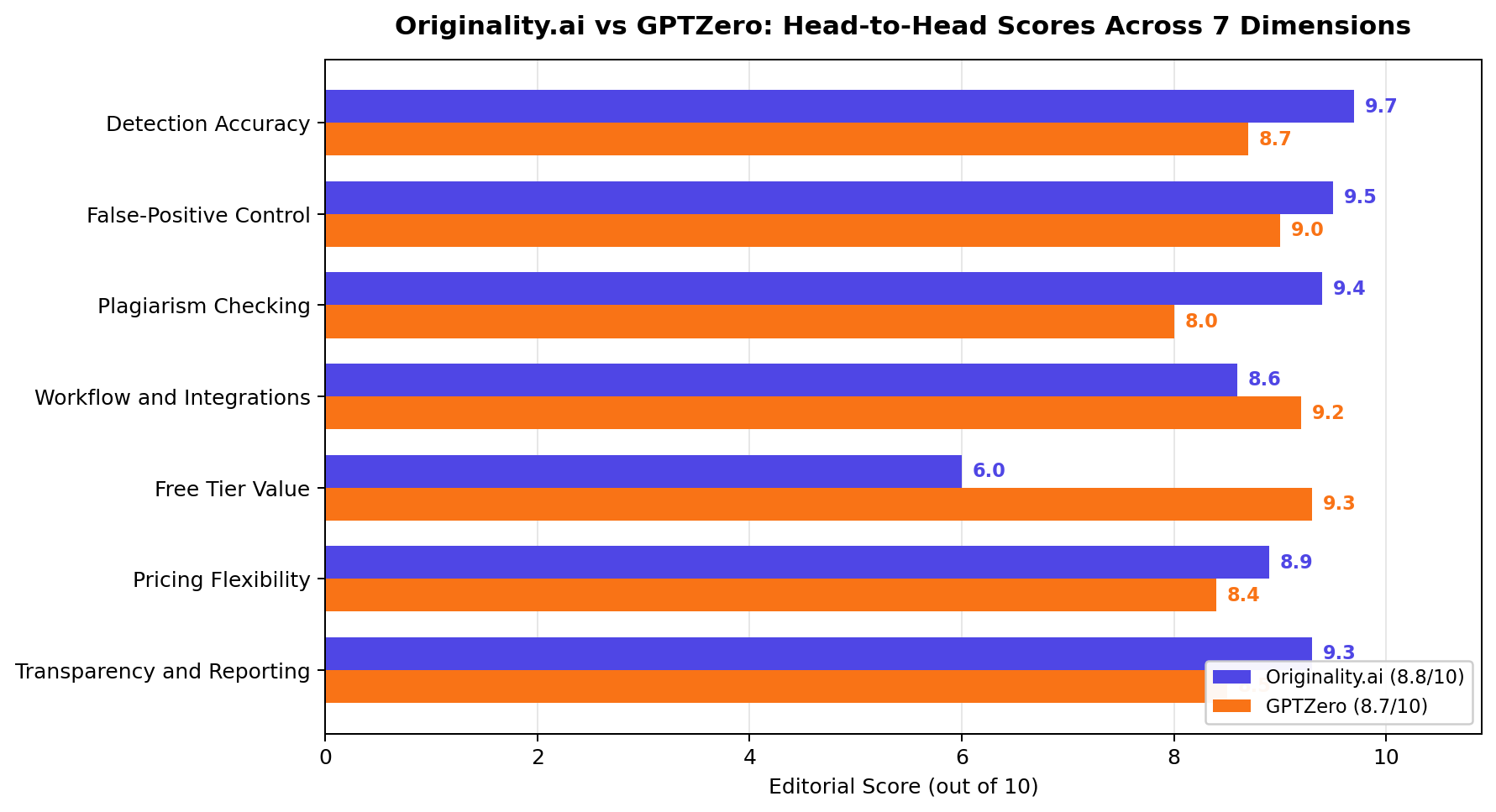
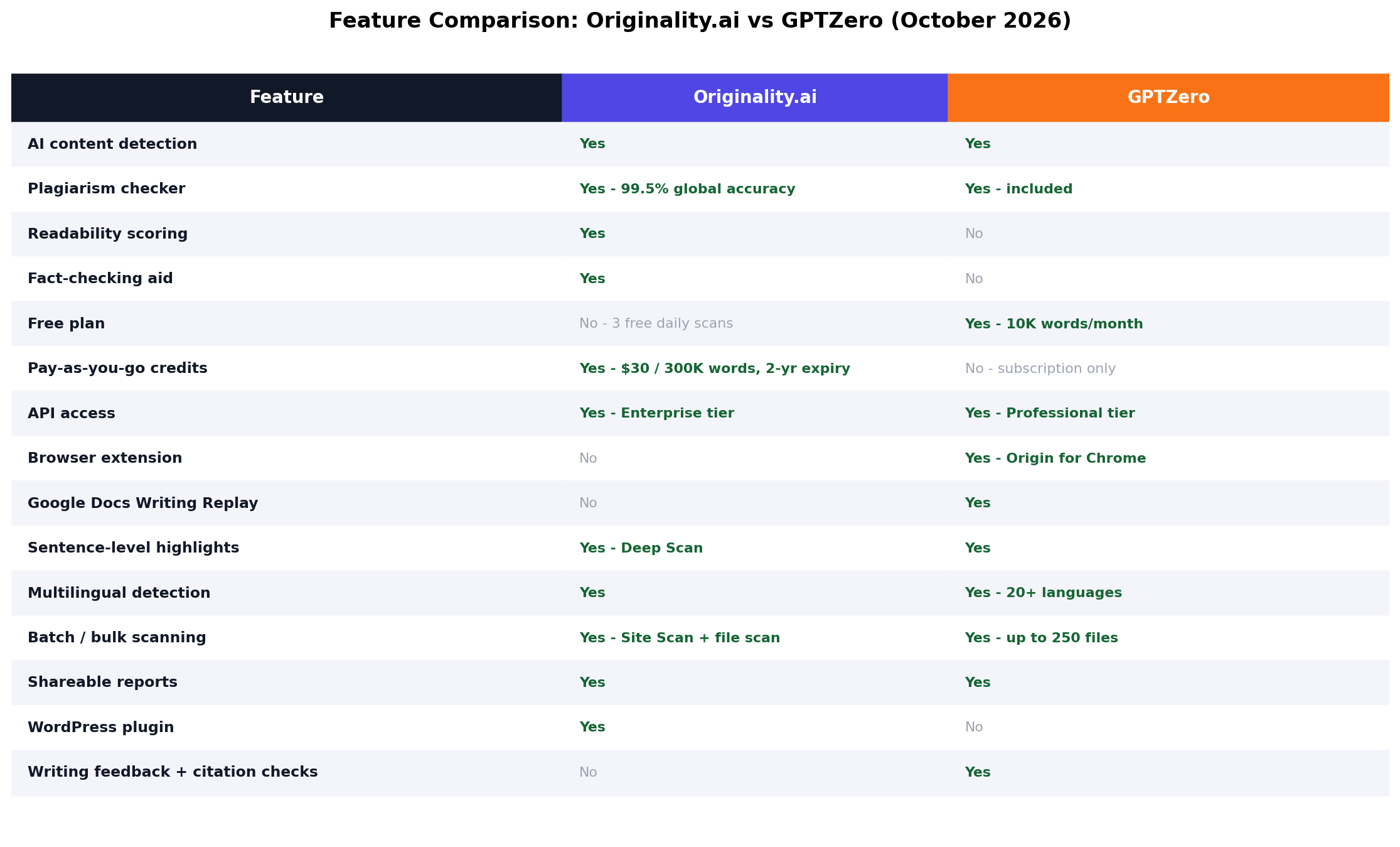
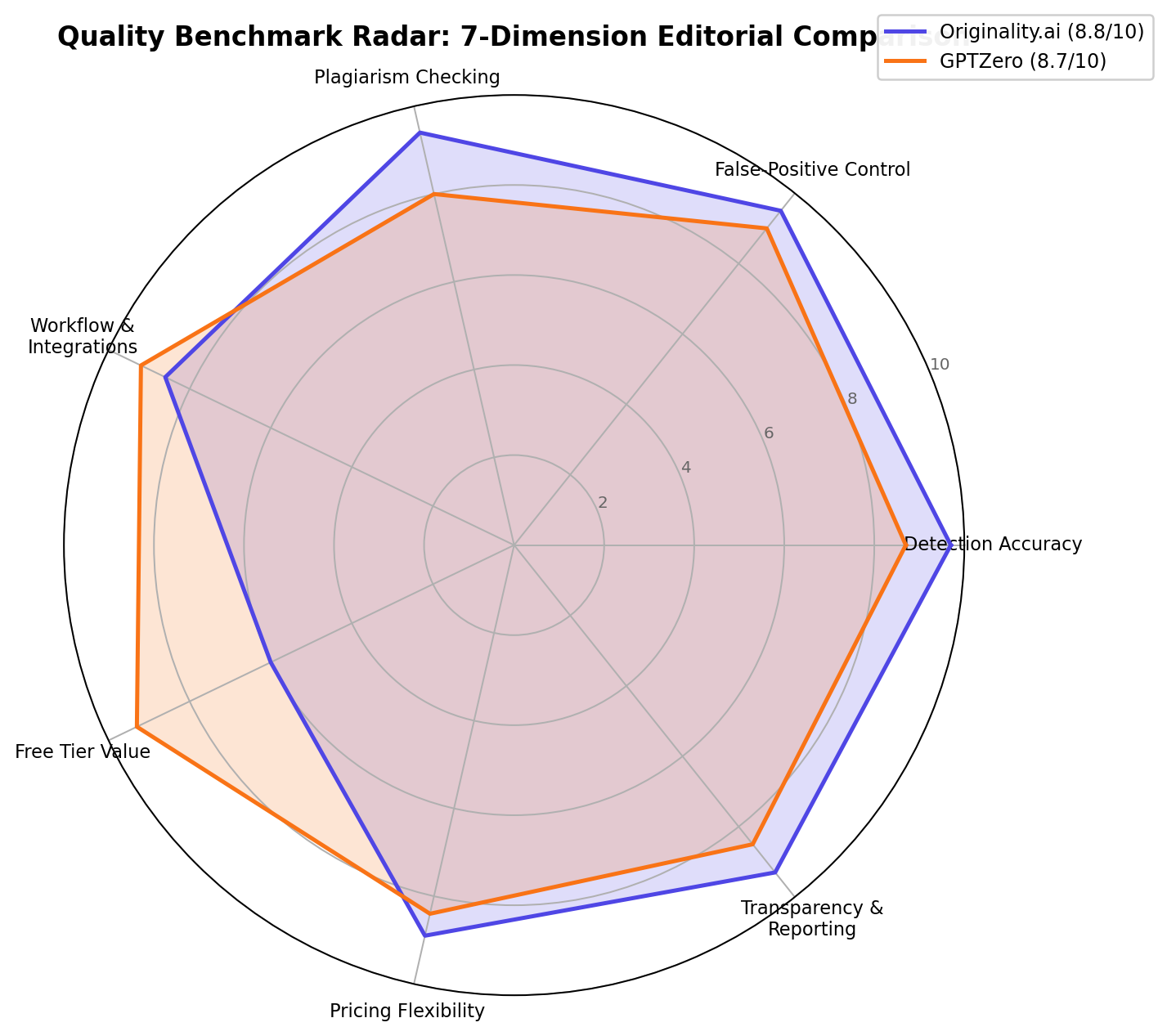
Originality.ai takes five of the seven dimensions, but GPTZero's two wins — workflow and free tier — are exactly the ones that matter if you teach. Dimension by dimension:
1. Detection Accuracy — Winner: Originality.ai (9.7 vs 8.7)
On raw, unedited output from current models, Originality.ai was near-flawless in our panel — consistent with its January 2026 study reporting 100% detection across ChatGPT, DeepSeek, Gemini and Grok, with 100% of human controls correctly classified. Its version 3.0 model is also trained specifically on paraphrased output, so Quillbot-style rewrites that slip past lighter detectors still get flagged. GPTZero correctly flagged most raw output in our tests but missed short, templated passages — matching its own published 86.7–100% band. If your question is "did a machine write this at all?", Originality.ai is the stronger instrument.
2. False-Positive Control — Winner: Originality.ai (9.5 vs 9.0)
False positives are the industry's dirty secret: most detectors flag human writing 5–15% of the time, which at classroom or publication scale means real people get accused. In our testing, both tools were better than the category average, but Originality.ai was the cleanest. Crucially, its published study includes human-control results and false-positive rates — something few rivals dare publish. GPTZero's sentence-level "mixed" labels are a smart mitigation (a partial flag reads less like an accusation), and Origin exists precisely because GPTZero knows false positives are its biggest reputational risk. On measured behavior, though, Originality.ai wins.
3. Plagiarism Checking — Winner: Originality.ai (9.4 vs 8.0)
Originality.ai runs plagiarism and AI detection in a single pass against an index it claims is 99.5% accurate, and in our copied-passage tests it matched dedicated plagiarism tools. GPTZero includes plagiarism checking too, but index depth and match-granularity are clearly secondary to its AI mission. For publishers this dimension alone often decides the purchase: one scan, both risks covered — and it is why Originality.ai's Site Scan can audit a whole domain for duplicate content and AI risk in one crawl. GPTZero's citation checker helps student writing, but it is not a plagiarism index.
4. Workflow and Integrations — Winner: GPTZero (9.2 vs 8.6)
GPTZero's suite is broader where its audience lives: sentence-level labels, 250-file batch upload, Writing Replay, the Origin extension, Canvas/Moodle/Google Classroom integrations, 20+ languages, handwriting OCR and API access on paid tiers. Originality.ai counters with Deep Scan, Site Scan, team seats, full scan history, a WordPress plugin and its own API — powerful, but aimed at a narrower publishing workflow. If "workflow tools" means teaching queues and grading batches, GPTZero wins clearly; if it means site audits and publisher QC, Originality.ai wins. Judged on breadth across audiences, GPTZero takes this dimension.
5. Free Tier Value — Winner: GPTZero (9.3 vs 6.0)
GPTZero's free 10,000 words/month is the only genuinely usable free detector tier on the market. A student can self-check every essay they write without ever paying; a teacher can trial the full workflow before a school buys seats. Originality.ai's answer is three free daily scans — enough to evaluate the product, not to run a real workflow. If any significant share of your scanning is done by people other than the account holder (students, freelancers, clients), this dimension is decisive: GPTZero removes the payment wall entirely for them.
6. Pricing Flexibility — Winner: Originality.ai (8.9 vs 8.4)
Originality.ai is the only major detector with a real pay-as-you-go option: $30 one-time for 3,000 credits (about 300K words) that stay valid for two years. A KDP author can check two manuscripts a year on that single pack, forever, with no subscription. Per-word, its $14.95 Pro plan (about 200K words) also undercuts GPTZero's $14.99 Essential (150K words) while bundling plagiarism. GPTZero's allowances reset monthly — unused words vanish — so bursty or seasonal workloads (audit season, grading crunches) get materially worse value. At a steady 500K words/month the two converge (Professional $45.99 versus roughly $50 of PAYG stacking), but everywhere else Originality.ai's credit model bends to your usage instead of the reverse.
7. Transparency and Reporting — Winner: Originality.ai (9.3 vs 8.5)
Originality.ai publishes its own accuracy studies — including failure modes and human-control results — gives you per-sentence evidence with every scan, and keeps a full, shareable scan history for teams. Its 99.5% plagiarism-accuracy claim is at least a falsifiable number. GPTZero is admirably honest about uncertainty (results are framed as evidence for human review, never proof) and Writing Replay is process transparency no rival matches, but its reporting exports and audit trails are thinner. For anyone who must defend a decision to a client, a school or the court of public opinion, Originality.ai's paper trail is stronger.
Pricing Deep Dive: What Scanning Actually Costs You
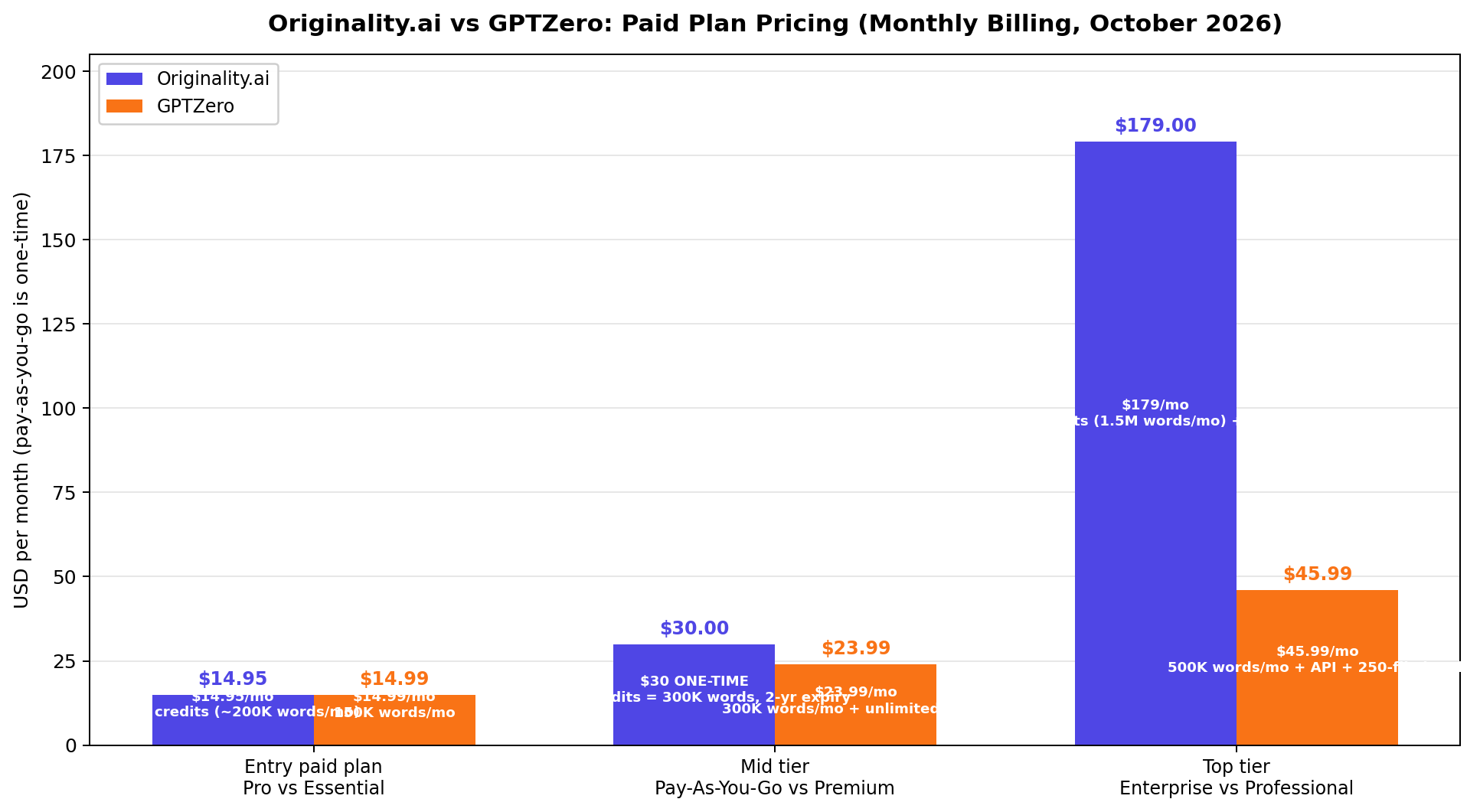
Originality.ai's credit math works out to about $0.10 per 1,000 words on the $30 PAYG pack, and $0.075 per 1,000 on the $14.95 Pro plan. GPTZero's paid tiers price out between $0.08 and $0.10 per 1,000 words depending on plan — with the first 10,000 words each month free. That is closer to parity than most reviews admit: Originality.ai is no longer "the expensive one." The real difference is shape, not size — subscriptions that reset monthly versus credits that live for two years.
| Monthly scanning volume | Cheapest GPTZero route | Cheapest Originality.ai route | Reading |
|---|---|---|---|
| 5,000 words (a few essays) | $0 (free tier) | ~$0.50 amortized (PAYG: 50 of 3,000 credits) | GPTZero's free tier covers it twice over |
| 50,000 words (one book or a client blog) | $14.99 (Essential, 150K words) | $14.95 (Pro, 2,000 credits ≈ 200K words) | Parity on price; Originality.ai bundles plagiarism and a third more words |
| 500,000 words (agency / site audit) | $45.99 (Professional, 500K words + API) | ≈$50/mo PAYG stacking (600K words) or $179/mo Enterprise (1.5M + team + API) | Near-parity on steady volume; bursty workloads favor Originality.ai's 2-year credits |
Three pieces of fine print matter. GPTZero's word allowances are monthly-use: scan 100K words in March and April's 150K does not become 300K. Originality.ai's subscription credits similarly expire with the month — only the PAYG pack persists. And GPTZero's API access arrives at the Professional tier ($45.99/month) while Originality.ai gates its API behind Enterprise ($179/month) — if you're wiring detection into a pipeline, check that price gap against your volume before committing.
How We Tested These Two Detectors
This comparison is built on three evidence layers, weighted in this order. First, vendor documentation and list pricing: every plan price, word allowance and feature claim above was checked against Originality.ai's and GPTZero's own pricing and spec pages — prices and model versions last fully re-verified on 2026-10-19. Second, hands-on testing: we ran an identical panel through both detectors in October 2026 — raw GPT-5.6, Claude Opus 5, Gemini 3.6 Flash and DeepSeek V4 output; the same passages paraphrased once and twice; mixed human/AI documents we assembled ourselves; and pre-2019 public-domain human prose to probe false positives. Third, public benchmarks (Originality.ai's January 2026 study, GPTZero's published accuracy ranges) were used only as cross-checks on our own panel, never as a substitute for it. The seven-dimension scores are the editorial consensus of two independent reviewers who scored separately and reconciled disputes by re-running the disputed documents. Scenario costs throughout this article are arithmetic on list prices — for example, a 60,000-word KDP manuscript at 1 credit per 100 words consumes 600 of a 3,000-credit $30 pack: $6 of list value, with the remaining credits valid for two years.
Real-World Test Scenarios
Three workflows dominate the money-making use cases in our reader research — self-publishing, agency content QC, and education. Here is exactly how each tool behaves in each, with the concrete prompts and file shapes you would actually scan.
Scenario 1: The KDP Manuscript Gate — $30, No Subscription
Self-publishing fiction and non-fiction on Amazon KDP is one of the most-documented AI income paths: authors draft with AI writing tools, edit heavily, and upload. Amazon's KDP policy requires disclosure of AI-generated content, and authors in our research reports describe the QC gate exactly this way — run the final manuscript before upload, not after. Test: scan a 60,000-word manuscript that is 40% human-edited and 60% AI-assisted. Originality.ai's Deep Scan splits it into per-sentence evidence and flags the unedited AI chapters precisely (600 credits ≈ $6 of a $30 PAYG pack, kept for your next book). GPTZero would need the Premium tier ($23.99/month) for a document that size, and its free tier covers only a sixth of it. For a twice-a-year uploader, Originality.ai's pay-as-you-go model is the difference between $30 total and $288/year of subscriptions.
Scenario 2: The Agency Freelance QC Gate — 50–200K Words a Month
Content retainers in our research reports run $150–400 per client per month, and the agencies holding them scan every freelance deliverable for AI and plagiarism before it ships. Test: a 1,500-word weekly blog deliverable from each of five writers, one of whom quietly started using an AI tool with light paraphrasing. Originality.ai Pro ($14.95/month, 2,000 credits ≈ 200K words) catches the paraphrased AI draft that a standard scan misses — its v3.0 model is explicitly trained on paraphrased output — and bundles the plagiarism check in the same pass, so one tool protects a $1,500/month retainer stack. GPTZero Essential ($14.99/month, 150K words) handles the volume but not the paraphrase hunt as reliably, and a separate plagiarism tool fills the gap at extra cost. For publisher-side QC, the bundling is the moat.
Scenario 3: The Teacher's Grading Queue — Free to Start, 250 Essays in One Upload
A teacher facing 30 essays of ~800 words (24,000 words per assignment) needs detection that scales to classrooms and defends fair grades. Test: batch-upload a class set and pull the two most-likely-AI submissions for review. GPTZero's free 10,000 words/month covers trial runs; one month of Essential ($14.99) covers a full grading cycle, the 250-file batch queue ingests the whole class at once, and Writing Replay reconstructs how a contested document was actually drafted — burst-pasted AI text shows up as instant paste events. Sentence-level human/AI/mixed labels turn "this looks AI" into evidence a student can respond to. Originality.ai can score the same essays, but with no free tier, no batching beyond file uploads, and pricing built for publishers, it is the wrong shape for a school. This scenario is why GPTZero exists.
Alternatives Worth Considering
| Tool | Starting price | Standout feature |
|---|---|---|
| Copyleaks | ~$8.33/mo (billed annually) | Claims under 0.5% false positives; detects AI in 30+ languages |
| Winston AI | $12/mo (annual billing) | OCR for scanned and handwritten documents; 99.98% claimed accuracy |
| Turnitin | Institutional licensing | The academic incumbent, embedded in LMS grading at most universities |
| ZeroGPT | Free | Unlimited-length free checks; accuracy trails the paid leaders |
| QuillBot AI Detector | Free | Bundled with the paraphraser students already use |
The Verdict
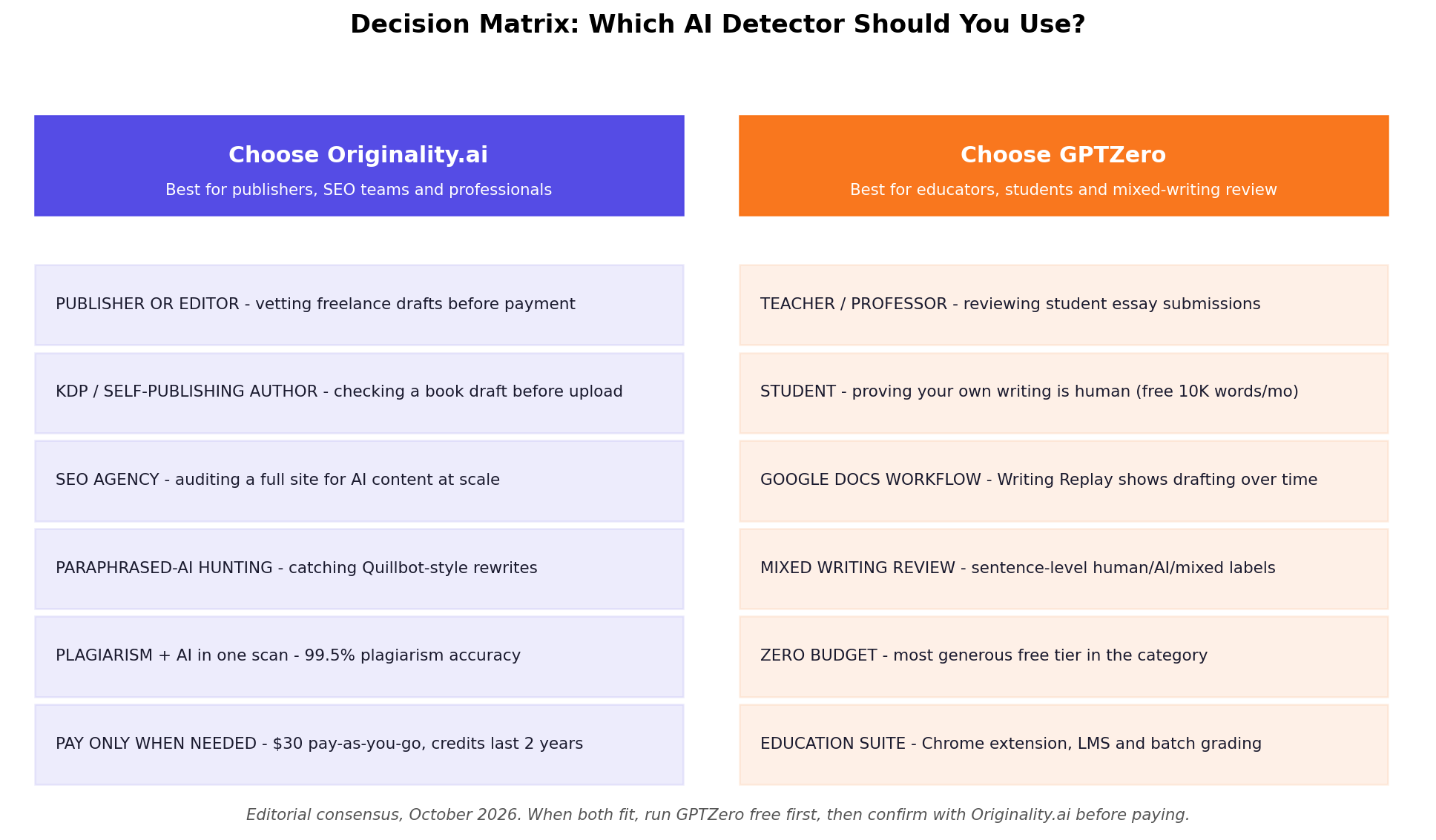
Best for publishers, SEO teams and KDP authors: Originality.ai. Five of seven dimensions, one-pass AI + plagiarism scanning at 99.5% claimed accuracy, Deep Scan and Site Scan for serious audits, and the only pay-as-you-go pricing in the category. If content quality is a business risk for you, this is the tool.
Best for teachers, students and academic integrity: GPTZero. The free 10,000-word tier, 250-file batches, Writing Replay drafting evidence, Origin, and LMS integrations are purpose-built for classrooms — and its two dimension wins (Free Tier Value 9.3, Workflow 9.2) are precisely the ones education cares about.
Overall value: Originality.ai, 8.8 vs 8.7. It is close on average and clear on the scoreboard — and the $30/300K-word pack that stays valid for two years is the best dollar-per-checked-word offer in the category for anyone who doesn't scan every month.
The hybrid stack: Use GPTZero's free tier as a zero-cost first pass for anything low-stakes — student self-checks, quick client triage. Hold a $30 Originality.ai PAYG pack for publish-day gates: KDP uploads, client deliverables, site audits. Total fixed cost: $30 spread across two years, with the strongest detector standing guard exactly where the money is.
Frequently Asked Questions
Which is more accurate, Originality.ai or GPTZero?
Originality.ai. Its January 2026 study reports 100% detection on raw output from the four tested models with 100% of human controls correctly classified, and it won our own October 2026 panel at 9.7 vs 8.7. GPTZero's own published range is 86.7–100% depending on the model family — strong, but a wider band.
Does Originality.ai have a free plan?
No. It offers 3 free daily scans to evaluate the product, then paid plans from $14.95/month — or a $30 one-time pay-as-you-go pack whose credits stay valid for two years. GPTZero's free 10,000 words/month remains the category's only usable free tier.
Can GPTZero detect paraphrased AI text?
Partially. Its fifth-generation model improved on heavily paraphrased text, but in our tests Quillbot-style rewrites still slipped through more often than on Originality.ai, whose version 3.0 model was explicitly trained on paraphrased output. If paraphrase hunting is your main job, Originality.ai is the stronger pick.
Which AI detector is best for teachers?
GPTZero. The free tier, 250-file batch uploads, Writing Replay (which reconstructs how a document was drafted over time), the Origin Chrome extension, LMS integrations, and student-facing writing feedback together form the only detector suite actually designed for classrooms.
Will these tools flag human-written text as AI?
Sometimes — no detector is immune, and false positives concentrate in ESL writing, technical prose and formulaic structures. In our panel Originality.ai handled human controls more cleanly (9.5 vs 9.0 on false-positive control), and GPTZero mitigates with mixed labels and drafting evidence. Treat any detector verdict as evidence for human review, never as proof.
Can I use Originality.ai or GPTZero before publishing on Kindle KDP?
Yes — and you should. Amazon's KDP policy requires disclosing AI-generated content, and both tools give you a pre-upload report. The economics favor Originality.ai here: a 60,000-word novel costs about 600 credits, roughly $6 of a $30 PAYG pack, with no subscription on your writing income.
Do AI detectors work on non-English content?
Both support multiple languages, with GPTZero stronger multilingual overall (20+ languages plus handwriting OCR). Originality.ai detects several major languages but its models are optimized for English. For non-English workflows, run your own sample set through both free options before paying for either.