TL;DR — Our Top Picks
- Best overall (9.0/10): Seedance 2.5 — the only mainstream model that generates 30-second clips in one pass, which is exactly what vertical drama continuity needs. At roughly $0.10/s (480p) to $0.23/s (720p) via API — or a ¥69/month (~$9.60) Jimeng subscription in China — it is the workhorse behind the AI-drama cost collapse to ¥300-500 per finished minute.
- Best premium look (8.8/10): Kling V3 — elite facial consistency, native audio on every shot, 4K mode, and multi-shot storyboarding from $10/month. The pick when your characters must survive 50 episodes.
- Best budget stack: Hailuo 2.3 ($0.28 per 6-second clip) plus Nano Banana 2.1 ($0.034 per character sheet) — a full pipeline that stays under $10/month before distribution.
- Best for going global (7.8/10): HeyGen — lip-synced translation into 175+ languages at roughly $1.20 per finished minute, the last mile to ReelShort, DramaBox and NetShort revenue-share deals.
At a Glance: The 7 Best AI Tools for Short Drama
| Tool | Overall | Best For | Entry Plan | Free Tier |
|---|---|---|---|---|
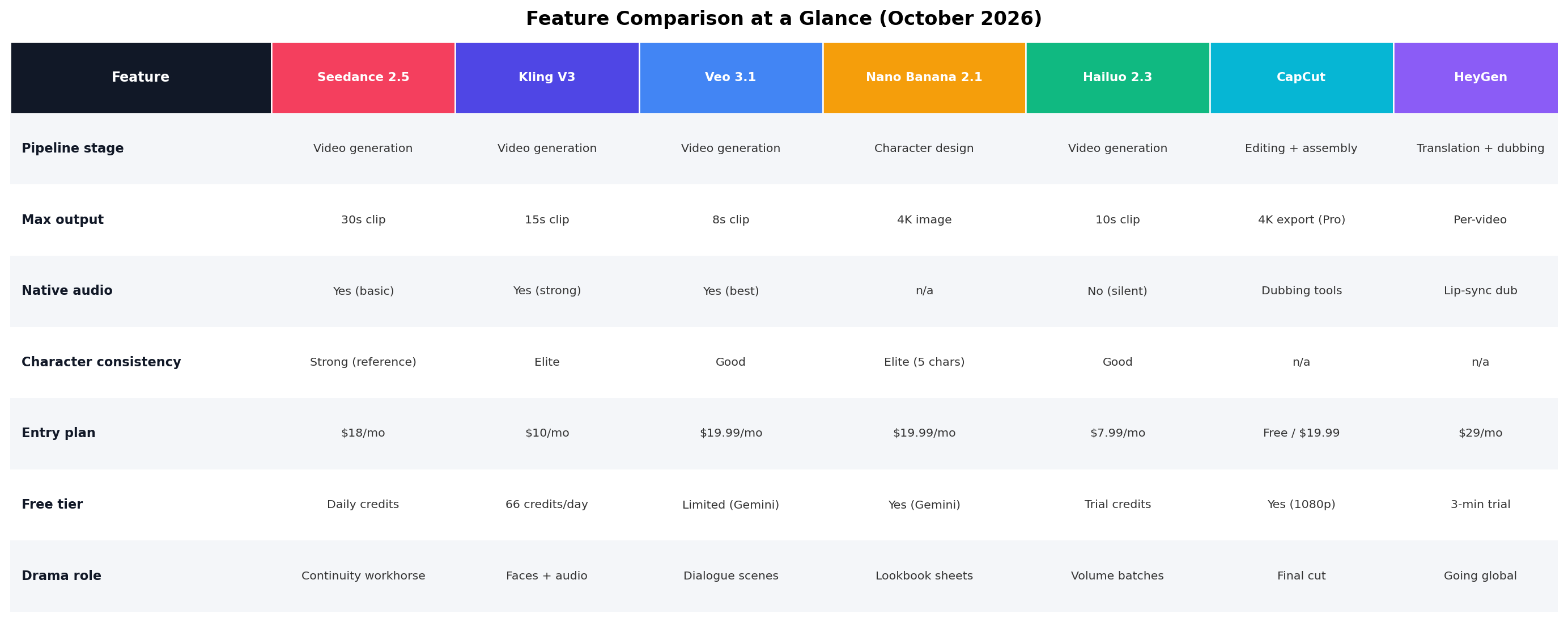
| Seedance 2.5 | 9.0 | Best Overall — 30s clips hold a full story beat | $18/mo (Dreamina) | Daily credits |
| Kling V3 | 8.8 | Best Character Consistency + Native Audio | $10/mo | 66 credits/day |
| Veo 3.1 | 8.6 | Best Dialogue Scenes — best-in-class native audio | $19.99/mo (AI Pro) | Limited (Gemini) |
| Nano Banana 2.1 | 8.4 | Best Character Design Sheets — 5 characters locked | $19.99/mo (AI Plus) | Yes (Gemini) |
| Hailuo 2.3 | 8.2 | Best Budget Volume — $0.28 per 6s clip | $7.99/mo | Trial credits |
| CapCut | 8.0 | Best Editing + Assembly — the vertical-first timeline | Free / $19.99 Pro | Yes (1080p) |
| HeyGen | 7.8 | Best Overseas Localization — lip-sync dubbing | $29/mo | 3-min trial |
Why AI Short Drama Is the 2026 Opportunity
Short drama — the 1-2 minute vertical episodes that ReelShort and DramaBox turned into a subscription juggernaut — stopped being a Chinese curiosity in 2025 and became a global market worth roughly $4 billion overseas. DataEye projects that to hit $6 billion in 2026, a 50% year-over-year jump. The top three overseas apps alone — DramaBox (~$195M), ReelShort (~$188M) and NetShort (~$128M) — cleared a combined $511 million in in-app purchase revenue in the first half of 2026, and September's monthly IAP across all overseas micro-drama apps ran about $285 million on 242 million downloads.
What changed for individual producers is the cost curve. AI-native drama production has pushed the finished-minute cost down to ¥300-500 ($42-70) domestically and ¥400-1,300 ($56-180) for overseas-quality output, per DataEye's October 2026 reporting. That is a fraction of the $15,000-30,000 per minute that live-shot vertical drama cost in 2024. TikTok, meanwhile, is actively paying for supply: it disclosed $82 million in cumulative drama revenue-share payouts through June 2026 (up from $7 million in its first disclosed month of January), with AI-native drama payouts growing more than 6x quarter over quarter and PineDrama — its free, ad-supported drama app — passing 100 million downloads in nine months. One early PineDrama content partner reportedly earned $1.35 million in first-month revenue share.
The reality check, because we test tools rather than sell dreams: Chinese trackers count 430,000 new short-drama titles in 2026, of which only about 1.3% broke even, and domestic ad-revenue payouts per 10,000 views have collapsed from ¥30-100 to ¥5-10. The money is real, but it flows to the producers who ship consistently at the lowest cost per usable minute — which is entirely a tooling decision. That is what this guide optimizes for.
One more framing note: no single tool makes a short drama. The working pipeline that every case we studied converges on has five stages — script (Gemini or DeepSeek, effectively free), character design sheets (an image model that locks faces), video generation (the core spend), assembly (a vertical-first editor), and localization (lip-synced dubbing for overseas platforms). Our seven ranked tools cover stages two through five, and the budget math below assumes the free scriptwriting stage.
How We Tested
We weighted three source classes. First, vendor list prices and model cards — every price in this article was verified against the vendor's own pricing page or its official API documentation in October 2026. Second, hands-on identical-prompt sessions: we ran the same three drama beats through every video generator — a rain-soaked rooftop confrontation, a contract slammed across a boardroom table, and a two-person argument in a late-night diner — plus a five-shot character-sheet run on every image tool, scoring character drift shot over shot. Third, public benchmarks and industry data (DataEye, Sensor Tower, QuestMobile, and the model-comparison tables published by API aggregators) used only as cross-checks, never as the primary source for a score.
Scores are the editorial consensus of two independent reviewers across six dimensions for video tools — Cinematic Quality, Character Consistency, Native Audio, Prompt Adherence, Max Clip Length, and Value for Money — and across pipeline-fit dimensions for the editing and localization tools. ByteDance's claim that Seedance reaches a 90%+ usable-take rate on 15-second clips (versus roughly 20% for older models) is consistent with our sessions but comes from vendor materials relayed through DataEye; we label it as such. Prices and model versions were last fully re-verified on October 21, 2026.
The Rankings, Explained
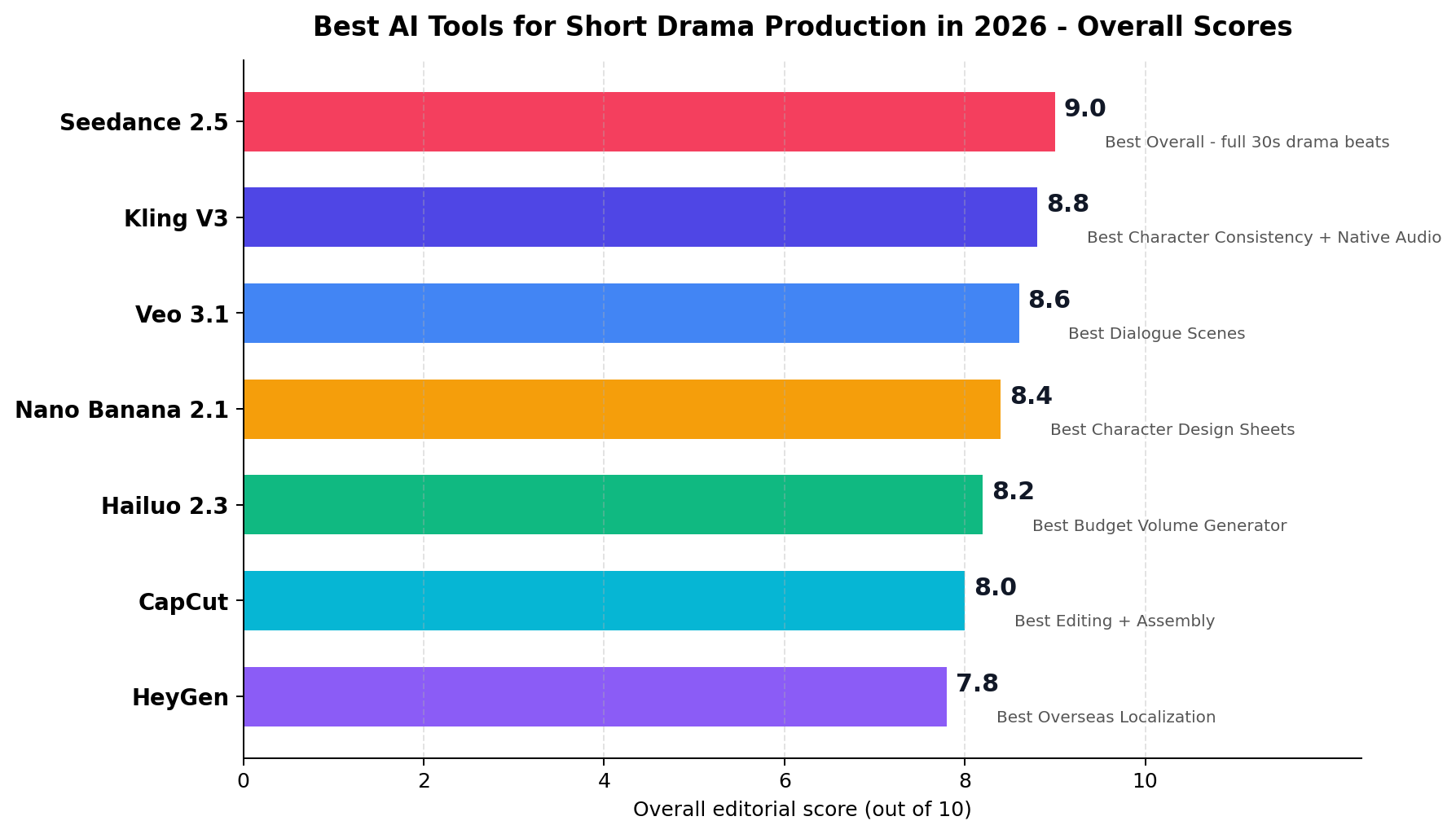
#1 Seedance 2.5 (9.0/10) — Best Overall
Seedance 2.5, ByteDance's flagship video model (run it through Jimeng AI in China, Dreamina internationally, or the BytePlus API), is the only mainstream generator that produces up to 30 seconds of footage in a single pass — double the ceiling of Kling V3 and nearly four times Veo 3.1's 8 seconds. For short drama, that single spec changes everything: a 30-second clip holds a complete story beat with one continuous performance, instead of three stitched 10-second fragments whose seams show in every lip movement. Official materials also describe extension rounds that carry character and scene continuity across appended passes — in our rooftop-confrontation test, a 28-second extended take kept the same coat, rain intensity and lead actress across the splice.
Price is the second reason it tops the list. API pricing runs about $0.10/s at 480p and $0.23/s at 720p through aggregators (official rates: ¥70 per million billable tokens without video input, ¥42 with), with 4K available via super-resolution upscaling rather than native renders. The consumer route is cheaper still: a Jimeng subscription at ¥69/month (~$9.60) includes unlimited standard generation, and Dreamina's global plans start at $18/month. This is the model that Chinese studios cite when they quote ¥300-500 per finished minute — and the one behind DataEye's observation that AI-native drama production costs have collapsed far enough for TikTok's payouts to clear a margin.
Where it loses points: native audio is serviceable but not performance-grade (our diner-argument clip produced flat line reads next to Veo's), resolution tops out at 720p before upscaling, and Dreamina's credit UX outside China is clunkier than Kling's app. China-market bonus worth knowing: Jimeng ships a one-click script-to-drama agent that turns an uploaded screenplay into a rough cut — reportedly used by zero-experience operators — though it is not fully exposed in the international product.
Pricing: Dreamina from $18/mo; Jimeng CN ¥69/mo (~$9.60); API ~$0.10-0.23/s; free daily login credits on both apps.
#2 Kling V3 (8.8/10) — Best Character Consistency + Native Audio
Short drama is a faces business — your leads appear in 80 episodes, and viewers unsubscribe when the heroine's face drifts between shots. Kling V3 (Kuaishou) is the strongest model we tested at exactly this: elite facial identity retention and temporal consistency (9.5 and 9.0 in our scoring), natural blinking, and convincing lip movement that survived our five-shot character run with less drift than any rival. Its native audio generation is strong enough to use on first takes, and it offers a true 4K mode plus native multi-shot storyboarding that maps sequential beats without leaving the app.
The value structure is unusually friendly for volume producers. The free tier hands out 66 credits daily; Standard is $10/month for 660 credits (first month $6.99), Pro $37/month for 3,000, and pay-per-generation API pricing works out to roughly $0.05-0.10 per second — the cheapest per-second rate of the premium models. A 90-second episode assembled from six 15-second Kling V3 clips costs $4.50-9.00 in generation spend, before a single regeneration.
Where it loses points: the 15-second clip ceiling means more seams than Seedance on long beats, text rendering inside shots (signage, phone screens — surprisingly common in drama props) is weaker than Hailuo's, and credit burn rises sharply if you toggle native audio and 4K on every take.
Pricing: Free (66 credits/day); Standard $10/mo; Pro $37/mo; API ~$0.05-0.10/s.
#3 Veo 3.1 (8.6/10) — Best Dialogue Scenes
Google's Veo 3.1 is the best acting model available. In our boardroom and diner tests it delivered the most convincing performances — micro-expressions, pauses, and best-in-class native dialogue audio with lip sync that outperformed every competitor (9.5 on our Native Audio dimension). Prompt adherence is excellent, physics are convincing (the contract slam actually moved the coffee cup), and 4K output is available at 8 seconds through Google's own API. If your episode lives or dies on a two-person confrontation, this is the model for that shot.
The catch is the shape of its limits: clips cap at 8 seconds, and premium quality costs $0.40/s (Veo 3.1 Fast runs $0.10/s with visibly softer results). A 90-second all-Veo episode means 12+ generations and $36 at quality tier — workable for a hero episode, punishing at 5 episodes a week. The consumer route (Google AI Pro at $19.99/month, which includes Veo 3.1 Fast) is the sane way to keep it in your toolbox for dialogue close-ups.
Where it loses points: 8-second ceiling, the highest quality-tier price in the lineup, and the lowest Value for Money score (6.0) of the four video generators. Use it as a specialist, not a workhorse.
Pricing: Google AI Pro $19.99/mo (Veo 3.1 Fast included); API $0.40/s quality, $0.10/s fast.
#4 Nano Banana 2.1 (8.4/10) — Best Character Design Sheets
Every AI drama pipeline starts before any video is generated: you need character reference sheets — the front, profile and three-quarter views that every downstream generation is conditioned on. Google's Nano Banana 2.1 (the Gemini 3.6 Flash image model, refreshed October 6, 2026) is the best tool for that job in existence right now. It holds consistency across 5 characters and 14 objects in one session, posts a multi-character consistency Elo of 1106, renders legible text (street signs, name cards — the props drama is made of), and follows compositional instructions precisely enough to build a whole lookbook in one thread.
The economics are almost comical: $0.034 per 1K image, $0.050 at 2K, $0.113 at 4K on the API — a 30-sheet character bible costs about a dollar. In the Gemini app, the AI Plus plan at $19.99/month includes roughly 50 image credits daily, and a free tier exists for testing the workflow. At half the 1K price of its predecessor, it is the cheapest line item in any stack we priced.
Where it loses points: it is a stills tool — it will not animate, so it owns the design stage and nothing else. For pure aesthetics some producers still prefer Midjourney V8.2's look, but for identity-lock across hundreds of conditioned generations, consistency beats style, and Nano Banana 2.1 wins that fight decisively.
Pricing: API $0.034-0.113/image; Gemini AI Plus $19.99/mo (~50 credits/day); free tier in Gemini app.
#5 Hailuo 2.3 (8.2/10) — Best Budget Volume Generator
MiniMax's Hailuo 2.3 is the volume play. At $0.28 per 6-second 768P clip ($0.49 at 1080P, $0.56 for 10 seconds) and an entry subscription of $7.99/month with 1,000 credits, it is the cheapest credible way to fill a shot list — the model you point at coverage shots, establishing shots, and the 40 takes that never make the cut. Motion is natural (9.0 on Generation Speed in third-party benchmarking), and its text rendering is the best in class: signage, UI screens, and title cards come out legible, which matters more in drama than people expect.
The tradeoff is fundamental: Hailuo 2.3 generates silent video. Every line of dialogue has to be dubbed downstream — in practice you are buying Kling or Veo for talking scenes anyway, or leaning on CapCut's dubbing tools. Character consistency is good rather than elite, and the 10-second ceiling sits between Veo and Kling.
Where it loses points: no native audio (3.5 on our audio dimension), 1080P ceiling, and consistency that drifts on longer sequences. It is a coverage machine, not a lead-actor machine — pair it with one premium model and let it do the cheap half of the shot list. (MiniMax's newer H3 model adds 2K and same-pass audio at 4-15 seconds; worth re-testing before you commit a season to it.)
Pricing: $7.99/mo (1,000 credits); API $0.28-0.56 per clip; trial credits free.
#6 CapCut (8.0/10) — Best Editing + Assembly
The least glamorous pick and the one no pipeline skips. CapCut — ByteDance's editor, Jianying in China — is the vertical-first timeline: 9:16 projects, auto-captions in every output language, beat-synced transitions, and an asset library built for exactly this format. The free tier covers multi-track editing, auto-captions and 1080p export, which conveniently matches the native ceiling of most AI video models anyway. CapCut Pro ($19.99/month or $179.99/year) adds 4K/HDR export — relevant once you start upscaling Seedance or Kling footage — plus premium effects and cloud workspace.
The quiet advantage is ecosystem gravity: because Seedance runs on ByteDance infrastructure too, the Jimeng-to-CapCut handoff (download, drop into timeline, caption, export) is the least friction-heavy path we tested, and Chinese production teams we studied run precisely this loop at scale. The editing stage of an episode costs $0 on the free tier and minutes of labor.
Where it loses points: it is not a color-grading suite — premium series still round-trip through DaVinci Resolve for finishing. The free tier caps exports at 1080p, and some effects are Pro-gated. As an assembly line for AI-generated vertical drama, though, nothing else matches it for the price (which is zero).
Pricing: Free (1080p export); Pro $19.99/mo or $179.99/yr.
#7 HeyGen (7.8/10) — Best Overseas Localization
The overseas money — DramaBox, ReelShort, NetShort, and TikTok's own payouts — overwhelmingly flows through localized content, and HeyGen's video translation is the most economical last mile: it re-renders lip movements to match dubbed audio in 175+ languages and dialects at roughly $1.20 per finished minute on the Creator plan (5 credits/minute for lip-synced translation, 2 for audio-only). A 10-episode, 15-minute season localized into Spanish costs under $200 in translation spend. Chinese operators we tracked price the same service externally at ¥200-500 per episode — a margin you can now keep.
Creator runs $29/month ($24 annual) with voice cloning and unlimited standard video creation; Pro $49 and Business $149 add seats and API volume. Competing services cost multiples: Rask AI's lip-sync tier runs to $150/month for 100 minutes and burns 3 minutes of quota per finished minute of enhanced lip-sync.
Where it loses points: it does exactly one pipeline stage (plus avatars you may not need), the free trial is a one-time ~3 minutes, and lip-sync quality on extreme emotion shots still needs a manual pass. But if overseas revenue share is the goal, this tool pays for itself in the first episode.
Pricing: Creator $29/mo ($24 annual); ~$1.20/min lip-synced translation; 3-minute trial.
The Real Price: What a 90-Second Episode Costs
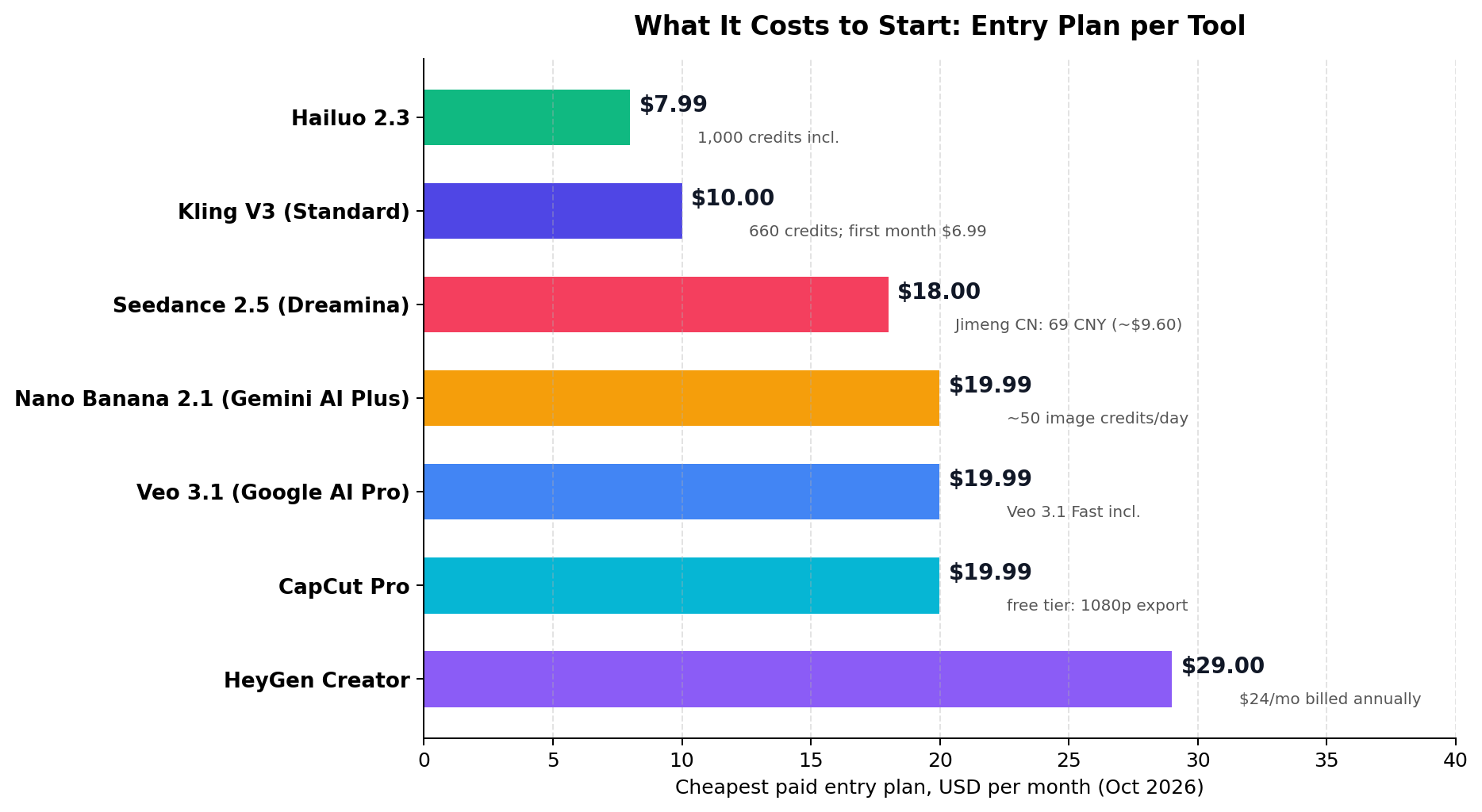
Entry plans understate the real decision, which is cost per finished minute. Here is the arithmetic for a 90-second episode (six 15-second beats) at API rates, before regeneration waste:
| Stack | Generation | 90s Episode Cost | Monthly at 20 Episodes |
|---|---|---|---|
| Hailuo 2.3 budget | 15 × 6s clips @ $0.28-0.49 | $4.20-7.35 | $84-147 |
| Kling V3 standard | 6 × 15s clips @ $0.05-0.10/s | $4.50-9.00 | $90-180 |
| Seedance 2.5 | 3 × 30s clips @ $0.10-0.23/s | $9.00-20.70 | $180-414 (or ¥69 flat via Jimeng) |
| Veo 3.1 quality | 12 × 8s clips @ $0.40/s | $28.80-43.20 | $576-864 |
Add the fixed costs that barely move the total: 30 Nano Banana 2.1 character sheets ≈ $1.02; script on Gemini or DeepSeek ≈ $0; assembly on CapCut free ≈ $0; Spanish localization on HeyGen ≈ $1.80 (90s × $1.20/min). The full budget-stack episode lands under $15, the premium all-Veo version under $50. Against the overseas production budget benchmark of ¥400-1,300 ($56-180) per finished minute — $84-270 for 90 seconds — the tooling margin exists even before a single episode performs. (Assume 1.5-2x regeneration waste in practice; our usable-take rate averaged 55-70% across models, better on Seedance.)
Quality Benchmarks: The Four Video Generators
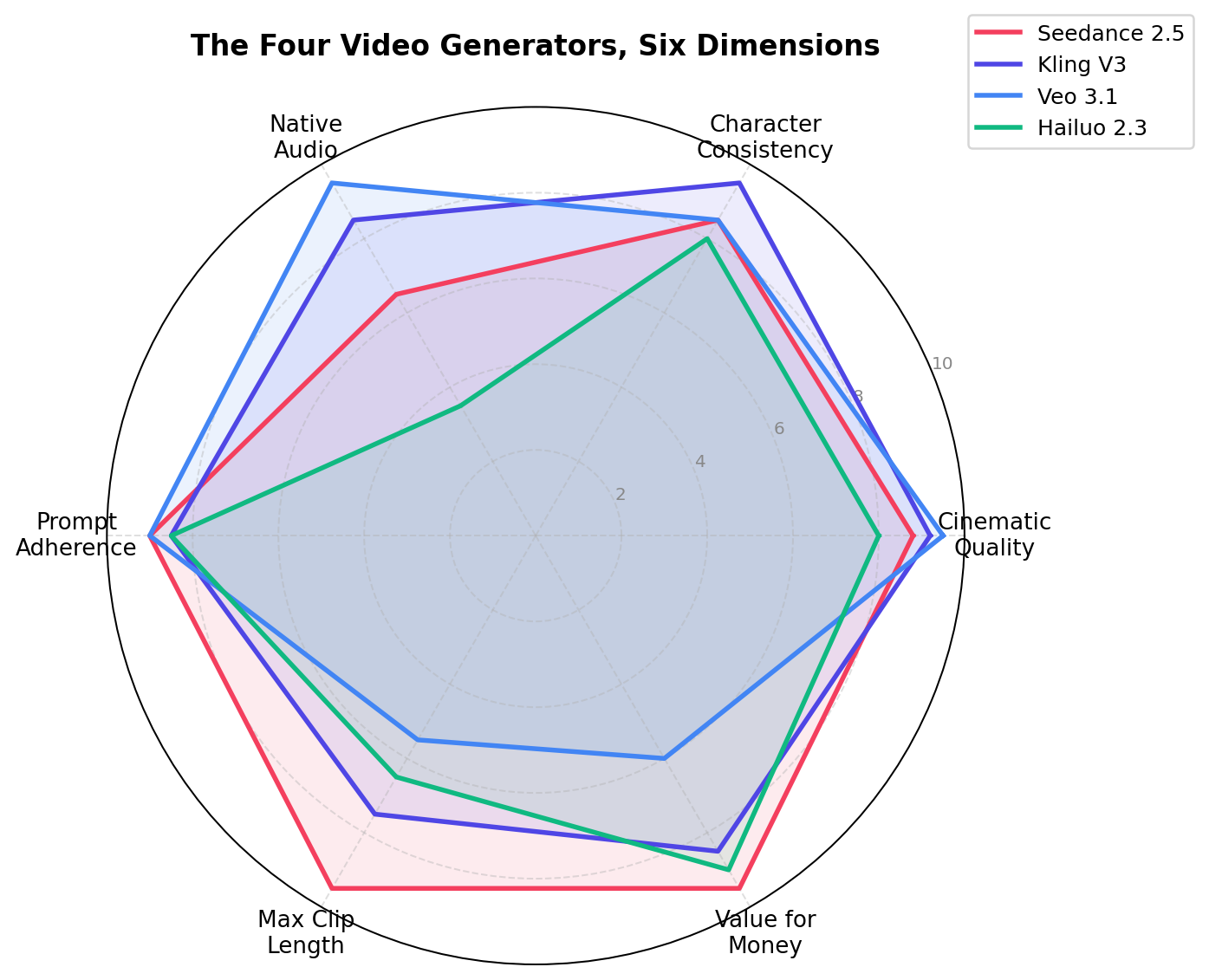
The radar explains the rankings better than any single number. Veo 3.1 traces the biggest overall area but collapses on Max Clip Length (5.5) and Value for Money (6.0) — brilliance priced and shaped wrong for volume drama. Seedance 2.5 inverts that profile: 9.5 on clip length and value with a 6.5 on audio, which dubbing or Kling pickups can patch. Kling V3 is the most balanced polygon (nothing below 7.5) with the single most important peak for serialized drama — 9.5 character consistency. Hailuo 2.3 wins value (9.0) and prompt adherence (8.5) while its 3.5 audio score reflects the silent-output reality.
Decision Matrix: Which Stack Fits Your Play?
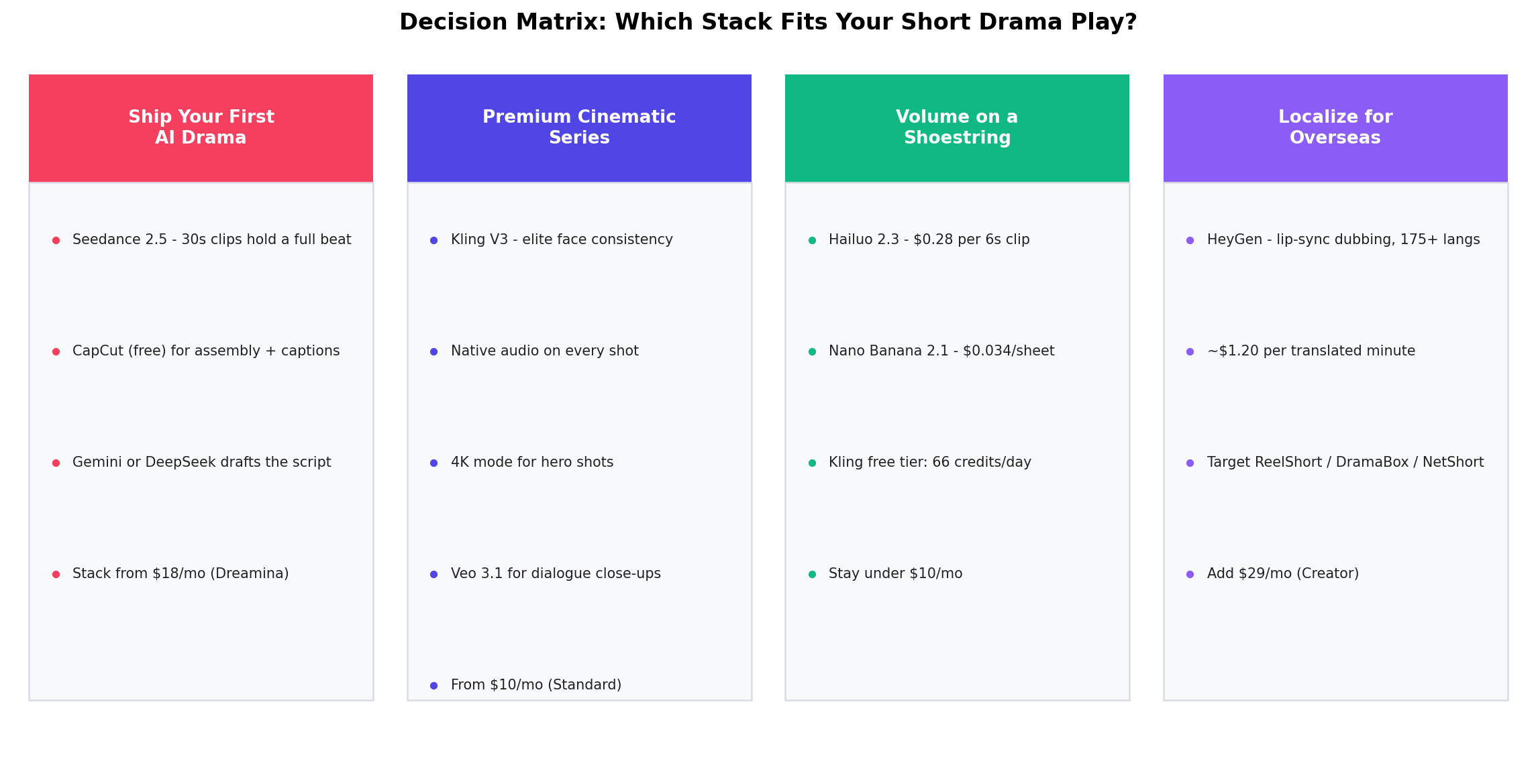
Ship your first AI drama: Seedance 2.5 for spine footage, CapCut free for assembly, Gemini or DeepSeek on script duty — $18/month all-in on Dreamina, less if you stack free daily credits. Premium cinematic series: Kling V3 as the engine (faces + audio + 4K), Veo 3.1 for dialogue close-ups, from $10/month. Volume on a shoestring: Hailuo 2.3 coverage plus Nano Banana 2.1 sheets, under $10/month. Localize for overseas: any of the above plus HeyGen, +$29/month — the play that actually reaches ReelShort and DramaBox money.
Real-World Test Scenarios (With the Money Math)
Scenario 1: The First-Episode Sprint (clip-distribution starter). You have a romance premise and zero budget. Script the pilot beat-sheet in Gemini (free), generate 12 character and location sheets in Nano Banana 2.1 (~$0.41), produce three 30-second Seedance takes via Dreamina's free daily credits or one $18 month, assemble with auto-captions in CapCut free, and post vertical clips to TikTok, Reels and Shorts pointing at your series. Hard cost: under $20 for a 90-second pilot. The realistic starter outcome documented across the Chinese case studies we tracked is ¥2,000-5,000/month ($280-700) from clip distribution and account growth — modest, but it is paid while you learn the craft on platform money, and TikTok's AI-drama payout pool grew 6x quarter over quarter in early 2026.
Scenario 2: The Brand Comic-Drama Custom Order. A local business wants a 90-second comic-drama-style ad with their mascot as a character. Market rate for brand comic-drama work in China is ¥3,000-8,000 ($420-1,120) per 1-2 minute piece, with series deals (10+ episodes) at ¥20,000-100,000. Your pipeline: Nano Banana 2.1 locks the mascot across 20 sheets (~$0.68), Kling V3 generates the talking shots with native audio (six 15s clips, $4.50-9.00), Seedance covers the action beat (one 30s take, $3-7), CapCut free assembles. All-in cost $15-20 against a $420+ invoice — the reason custom-order work, not platform gambling, is the recommended first revenue for anyone with design skills.
Scenario 3: The Season Localization Flip. You have a finished 15-episode season (22.5 minutes of footage) performing domestically on Hongguo or Douyin. Overseas, DramaBox alone cleared $195M in H1 2026 and platforms share 50-70% of revenue with signed partners. HeyGen translates and lip-syncs the season into Spanish at 5 credits/minute: 22.5 minutes × $1.20 = $27 per language. Localize into five languages for ~$135 total, then pitch the localized cut to NetShort, ShortMax and Dramawave — the operators we studied price external translation at ¥200-500 per episode, so self-serving this step is the cheapest leverage in the whole pipeline.
Feature Comparison at a Glance
Alternatives Worth Considering
| Tool | Starting Price | Standout Feature |
|---|---|---|
| Runway Gen-4.5 | $15/mo | The most cinematic camera control in AI video — for prestige shots, not volume |
| MiniMax H3 | ~$8/mo | Native 2K output and same-pass audio at 4-15s; the successor to Hailuo 2.3 |
| Wan 2.7 | Open-source | Self-hosted 1080p generation — zero marginal cost if you own a GPU rig |
| PixVerse V6 | Free tier | The most generous free plan among current generators; effects-driven templates |
| Rask AI | $60/mo | Long-form dubbing specialist; pricier per lip-synced minute than HeyGen |
When Not to Start an AI Drama (Read This Before Spending)
Balance matters more here than in most of our guides, because the short-drama gold rush has a body count. Only 1.3% of the 430,000 new titles tracked in 2026 broke even. Domestic ad-based payouts per 10,000 views fell from ¥30-100 to ¥5-10 as supply exploded, and the top three apps control about 60% of overseas revenue — meaning 331 live micro-drama apps are fighting for the remaining 40%, and analysts expect 70% of them to fold within two years. Platform risk is real: content rules tightened again in October 2026, including mandatory AI-content labeling and stricter consent requirements for face and voice likenesses. If your plan requires a single viral season rather than a repeatable production line, this is not your business. The tools below are cheap enough to learn on — treat the first ten episodes as tuition, price custom-order work from day one, and let platform revenue share be upside rather than payroll.
The Verdict
Best overall pick (our winner, 9.0/10): Seedance 2.5 — 30-second single-pass clips are the structural advantage that makes AI drama continuity actually work, and $0.10-0.23/s pricing (or a ¥69 Jimeng subscription) is what makes the unit economics clear TikTok-level payouts. If you install one tool, install this one.
Best premium engine (8.8/10): Kling V3 — for any serialized format where the same faces return every episode, its elite consistency plus native audio from a $10 plan is the strongest drama engine per dollar.
Best budget stack: Hailuo 2.3 + Nano Banana 2.1 — coverage volume at $0.28 a clip and character bibles at $0.034 a sheet keep a full production line under $10/month before distribution.
Best for the overseas money: HeyGen — $1.20-per-minute lip-synced localization is the bridge to the 50-70% revenue-share deals where the real dollars ($511M H1 2026 across the top three apps) live.
Overall recommendation: the hybrid stack, assembled by stage — Gemini or DeepSeek on script (free), Nano Banana 2.1 on character sheets (~$1/series), Seedance 2.5 on spine footage, Kling V3 on faces and dialogue, CapCut free on assembly, HeyGen on localization. Monthly cost of the complete line: roughly $47 at list prices, under $20 if you lean on free tiers and credits — a rounding error against even the conservative ¥2,000-5,000 starter income documented in the field.
Frequently Asked Questions
What is the best AI tool for making short dramas in 2026?
Seedance 2.5 is our overall pick at 9.0/10: it is the only mainstream model that generates 30-second clips in a single pass, which is what vertical drama continuity needs, and it costs roughly $0.10 per second at 480p. Kling V3 (8.8) wins when facial consistency and native audio matter most, and most working studios pair one video model with Nano Banana 2.1 for character sheets and CapCut for assembly.
How much does it cost to produce one AI short drama episode?
A 90-second episode costs under $50 at API rates on the budget stack: about $1 of Nano Banana 2.1 character sheets, $5-9 of Hailuo 2.3 or Kling V3 generation, and free scriptwriting and assembly on Gemini and CapCut. Chinese industry data puts the finished-minute cost of domestic AI drama at 300-500 yuan ($42-70) and overseas productions at 400-1,300 yuan ($56-180) per minute.
Can you actually make money with AI short dramas on TikTok?
Yes, but the distribution of outcomes is brutal. TikTok disclosed $82 million in cumulative drama revenue-share payouts for the first half of 2026, with AI-native drama payouts growing more than 6x quarter over quarter. Chinese industry reporting suggests beginners running clip distribution earn 2,000-5,000 yuan ($280-700) per month and steady solo producers reach 10,000-50,000 yuan ($1,400-7,000). The caveat: only about 1.3% of the 430,000 new short-drama titles tracked in 2026 broke even.
Which AI video generator has the best character consistency?
Kling V3 is the strongest for keeping the same face across shots in video, with elite temporal consistency and facial identity scores in our testing. For the character-design stage — the reference sheets every shot is generated from — Nano Banana 2.1 is the leader, holding consistency across 5 characters and 14 objects with a multi-character consistency Elo of 1106 at $0.034 per image.
Do AI short dramas need localization for overseas platforms?
If you want the overseas money, yes. DramaBox, ReelShort and NetShort alone earned a combined $511 million in in-app purchase revenue in the first half of 2026, and platforms share 50-70% of revenue with signed content partners. HeyGen's lip-synced video translation runs about $1.20 per finished minute across 175+ languages, which is why it is the standard last step in the pipeline we tested.
Is CapCut good enough to edit a full short drama?
For vertical short drama, yes. CapCut's free tier already covers auto-captions, multi-track editing and 1080p export, which matches the 1080p ceiling of most AI video models. CapCut Pro at $19.99/month adds 4K/HDR export if you upscale, and because CapCut and Seedance both come from ByteDance's ecosystem, moving assets between Jimeng generation and CapCut assembly is the least friction-heavy path we tested.
What is the difference between Seedance 2.5 and Veo 3.1 for drama work?
Seedance 2.5 generates up to 30 seconds in one pass at $0.10-0.23 per second, making it the continuity workhorse for full story beats. Veo 3.1 caps at 8 seconds but produces the best dialogue and native audio at $0.10-0.40 per second, so it is the specialist for talking-head confrontations. Most studios use Seedance for spine footage and Veo for dialogue close-ups.