TL;DR — The Split Verdict
- Best all-round image tool (8.8/10 overall): GPT Image 2 — arena-topping prompt adherence, 85-90% first-try text rendering, conversational editing, and a genuinely usable free tier (now refreshed as ChatGPT Images 2.5, September 2026). From $0 to $20/mo.
- Best aesthetic ceiling (8.0/10 overall): Midjourney V8.2 — still the strongest color science, lighting, and art-directed look in the business, plus unlimited Relax-mode volume on the $30 Standard plan and a new Edit Model that finally cracks character consistency.
- Best workflow (what commission sellers actually run): Hero art in Midjourney, then everything with text, labels, or client revisions in GPT Image 2. That $30-50/mo stack powers pet-portrait and Etsy-template businesses earning $600-2,000/mo.
This used to be an easy question. For most of 2023-2025, Midjourney was the undisputed aesthetic king and OpenAI's image models were the ones that wrote legible text but looked like clip art. In 2026 the two have converged so aggressively that the honest answer is now "it depends on the job" — which is exactly why this comparison exists.
Three things changed the calculus this year. Midjourney shipped V8.2 (July 24, 2026) with a rebuilt Edit Model that replaced Omni Reference, Character Reference, and Retexture in one stroke, opened to all users on August 27. OpenAI shipped GPT Image 2 (April 21, 2026), which took the top spot on the Image Arena leaderboard with a 242-point lead over the previous best, then refreshed it as ChatGPT Images 2.5 (September 8, 2026) with up to 50% faster generation, local edits, and a Sketch tool. And DALL-E — the model Midjourney used to be compared against — was formally retired on May 12, 2026, making this the definitive OpenAI-vs-Midjourney matchup.
We ran both tools through identical prompts for the workflows people actually earn money with — pet portrait commissions, Etsy listing graphics, wedding concept boards, product mockups — verified every 2026 price against vendor pages, and scored both across seven dimensions. The short version: GPT Image 2 is the better tool for most people most of the time; Midjourney is the better tool when the image itself is the product.
At a Glance: Midjourney vs GPT Image 2
| Midjourney V8.2 | GPT Image 2 | |
|---|---|---|
| Overall score | 8.0/10 | 8.8/10 |
| Best for | Art-directed visuals where beauty is the deliverable | Production images with text, precision, and fast client revisions |
| Free tier | None (limited Niji Journey trial only) | Yes — approx 2-5 images/day in ChatGPT |
| Paid price | $10/mo (Basic) · $30/mo (Standard) · $60 Pro · $120 Mega | $8/mo (Go) · $20/mo (Plus) · $200 (Pro) · API from ~$0.01/image |
| Text in images | 40-60% first-try accuracy (improved in V8.2) | 85-90% first-try accuracy |
| Reference images | Up to 4 (Edit Model) | Up to 16 per request |
| Max resolution | HD upscale in editor | Native 1K / 2K / 4K |
| Official API | No | Yes — Flare and Sunburst variants |
| Biggest weakness | Gibberish text, parameter learning curve, no free tier | Aesthetic ceiling below Midjourney's best; high-quality API images get pricey |
Deep Dive: Midjourney in 2026
Midjourney enters 2026 as a mature product with a rebuilt engine. V8.2 became the default model on July 24, 2026, building on the V8 alpha's complete codebase rewrite (roughly 5x faster generation than V7) with an update focused on aesthetics, image quality, and Personalization — the system that learns your aesthetic tastes from your ratings and pushes every generation toward them.
The headline change is the Edit Model, opened to everyone on August 27, 2026. It replaces three older systems — Omni Reference, Character Reference, and the Retexture tool — with a single instruction-based editor. You hand it an existing image (or up to 4 reference images), tell it in plain words what to change, and it edits accordingly, with inpainting and outpainting available in the web Editor and --edit on Discord. Reviewers consistently rate it a major step up for character consistency — the feature storytellers waited three years for. Style Reference, Style Weight, Image Prompts, Image Weight, and Seed all remain, so the old "stack references until the set looks coherent" workflow still works; it just requires fewer moves now.
What Midjourney still does better than anyone: the look. Color science, lighting, texture, and composition that reads as "art-directed" rather than "generated." Our testers keep reaching for it on concept art, cinematic stills, fashion editorials, and any hero image where the client is paying for beauty. Text rendering improved in V8.2 — the version docs call it the best in the Midjourney line — but "best in the Midjourney line" still means roughly 40-60% first-try accuracy versus GPT Image 2's 85-90%. A poster prompt in Midjourney remains a coin-flip on whether the headline comes out legible.
The friction points are unchanged. There is no free tier (a limited Niji Journey trial aside) and no official API. The parameter culture — --ar, --stylize, --sw, style codes, seeds — is a genuine learning curve, even though the web editor has made it far less Discord-dependent than it used to be. And pricing is subscription-only: Basic at $10/mo buys about 3.3 hours of fast GPU time (roughly 200 images) with no Relax access; Standard at $30/mo adds 15 fast hours plus unlimited Relax-mode generation, which is the tier that matters for anyone generating at volume.
Deep Dive: GPT Image 2 in 2026
GPT Image 2 shipped April 21, 2026 as the successor to GPT Image 1 and 1.5, and it landed with authority: a 242-point lead on the Image Arena leaderboard at launch, and the top spot on Artificial Analysis's prompt-accuracy rankings. It replaced the old quality tiers with explicit 1K, 2K, and 4K resolution options, raised the reference-image limit to 16 per call, and brought genuine agentic reasoning to image work — the model plans before it draws.
Since September 8, 2026, ChatGPT runs the refreshed GPT Image 2.5 generation: sharper detail, more natural lighting, up to 50% lower latency, local edits (change one element without regenerating the whole image), comment-based editing, and a Sketch tool for shaping compositions. OpenAI says its image tools now handle more than 3 billion generations a week. Developers get two API variants: Flare (the fast default) and Sunburst (higher precision, slower).
The strengths are exactly what production work needs. Prompt adherence is class-leading: put ten specific objects in specific positions and they show up where you asked. Text renders at 85-90% first-try accuracy — product labels, headlines, street signs, packaging mockups. Editing is conversational: "make the label text bigger and change the background to walnut" just works, across multiple turns, with the rest of the image left alone. And access starts at $0 — the free ChatGPT tier includes roughly 2-5 images a day, Go at $8/mo lifts that to 20-50 a day with 2K output, and Plus at $20/mo allows about 200 a day plus higher-quality modes.
The honest weakness: the aesthetic ceiling. GPT Image 2's default look is competent, accurate, and well-lit — a photographer who shoots exactly what the brief asks, versus Midjourney's art director who interprets the brief into something more interesting. For concept art, cinematic mood, and editorial fashion, Midjourney still wins the blind taste tests. API pricing also punishes the top quality tier: roughly $0.17-0.21 per high-quality 1024x1024 image means 500 of them cost over $85, while Midjourney's $30 Standard plan generates without counting.
Head-to-Head: Seven Dimensions, Seven Winners Declared
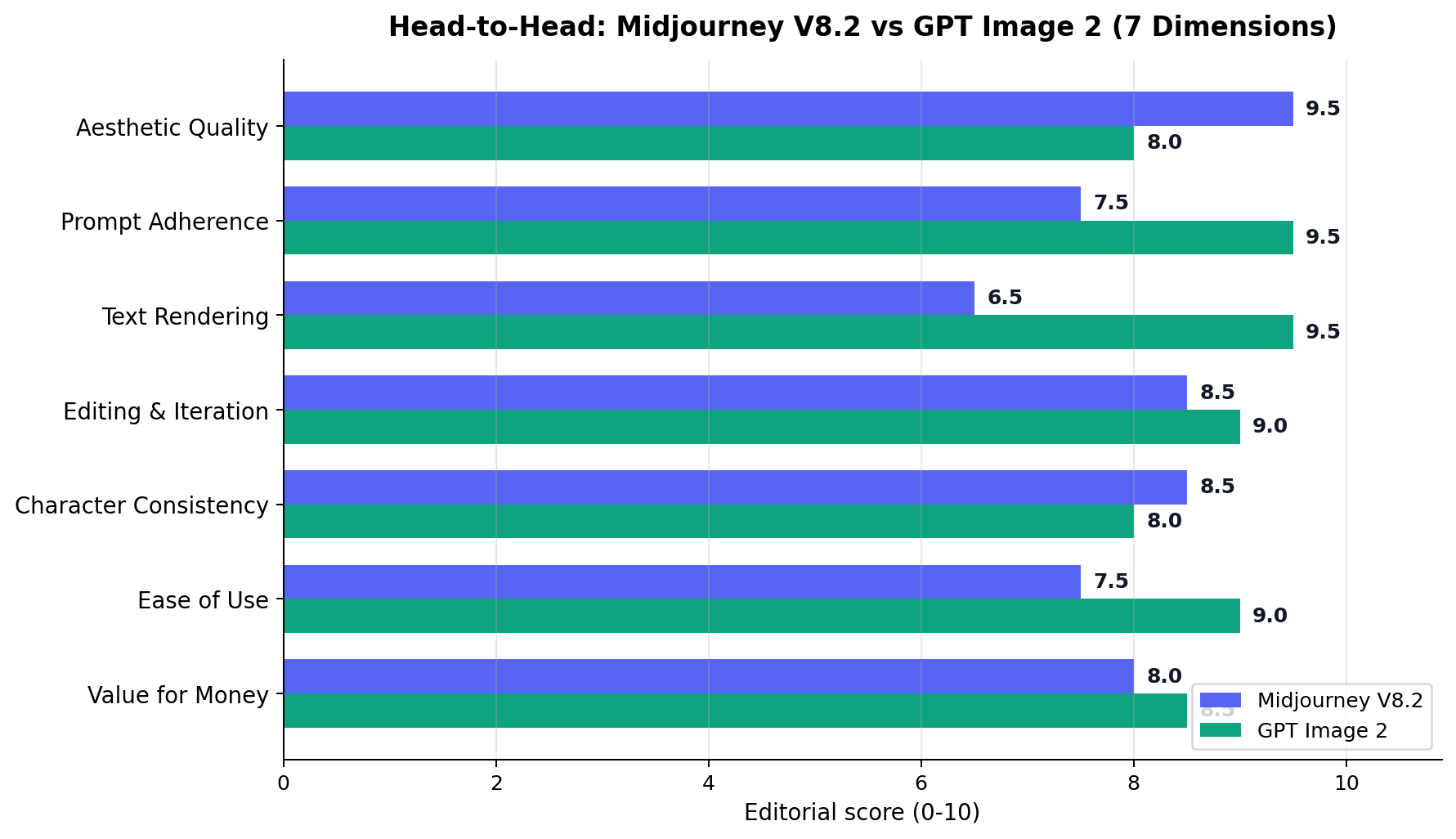
1. Aesthetic Quality — Winner: Midjourney (9.5 vs 8.0)
This remains Midjourney's fortress. Color science, light behavior, texture, and compositional drama consistently read as more "expensive" than GPT Image 2's output, which trends neutral and literal. In our test set — a Renaissance-style pet portrait, a moody editorial fashion shot, a cinematic establishing shot — Midjourney won the blind vote on all three. GPT Image 2.5's lighting improvements narrowed the gap, but when the image itself is the product a client is paying for, Midjourney is still the tool that justifies the invoice.
2. Prompt Adherence — Winner: GPT Image 2 (9.5 vs 7.5)
Ask GPT Image 2 for "a red mug on the left, a folded newspaper on the right, morning light from a window behind" and you get exactly that. Midjourney interprets artistically — which is a feature in art direction and a bug in production. It leads the Artificial Analysis prompt-accuracy leaderboard, and that precision is the difference between one generation and four when a client has a specific layout in mind.
3. Text Rendering — Winner: GPT Image 2 (9.5 vs 6.5)
The most lopsided dimension. GPT Image 2 renders short strings — labels, headlines, brand names — at roughly 85-90% first-try accuracy, including uncommon names. Midjourney V8.2 improved its text, but 40-60% first-try accuracy still means frequent gibberish glyphs on anything longer than a word or two. If the deliverable contains readable words, this dimension alone decides the tool.
4. Editing & Iteration — Winner: GPT Image 2 (9.0 vs 8.5)
Both tools had a big 2026 here, which is why the gap is narrow. Midjourney's Edit Model (instruction edits, up to 4 references, inpaint/outpaint) replaced three legacy systems and works well. But GPT Image 2's conversational multi-turn editing — comment on what to change, keep everything else stable — plus 2.5's local edits and Sketch tool make revision loops dramatically faster, especially with clients looking over your shoulder. Sixteen reference images versus four compounds it.
5. Character Consistency — Winner: Midjourney (8.5 vs 8.0)
An upset by expectation, not by much. Midjourney's stack — Edit Model plus Style Reference plus Personalization plus seeds — produces character sheets and story sequences with a coherent atmosphere our testers preferred for storytelling. GPT Image 2 is more literal: feed it a real photo (a pet, a founder) and it preserves the subject impressively across turns, and 2.5 improved frame-to-frame stability. For matching an actual client photo, GPT wins; for inventing a character and keeping them on-model across a project, Midjourney edges it.
6. Ease of Use — Winner: GPT Image 2 (9.0 vs 7.5)
GPT Image 2 is a chat window: describe what you want in plain English, iterate by replying. Midjourney's web editor is far friendlier than the Discord era, but parameters, style codes, and weight flags are still a real learning curve — powerful once learned, inaccessible before. For a beginner generating their first sellable image this week, the difference is an afternoon versus a fortnight.
7. Value for Money — Winner: GPT Image 2 (8.5 vs 8.0)
A free tier that generates 2-5 usable images a day, an $8 plan, and a $20 plan that covers roughly 200 images daily is hard to beat — most people never need more. Midjourney's counterpunch is unlimited Relax mode on Standard: at 500+ images a month, $30 flat beats metered API pricing ($25+ at medium quality, $85+ at high). Below roughly 100 images a month, GPT Image 2 wins on price outright; above it, the math flips toward Midjourney's subscription.
Pricing Deep Dive: What You Actually Pay at Volume
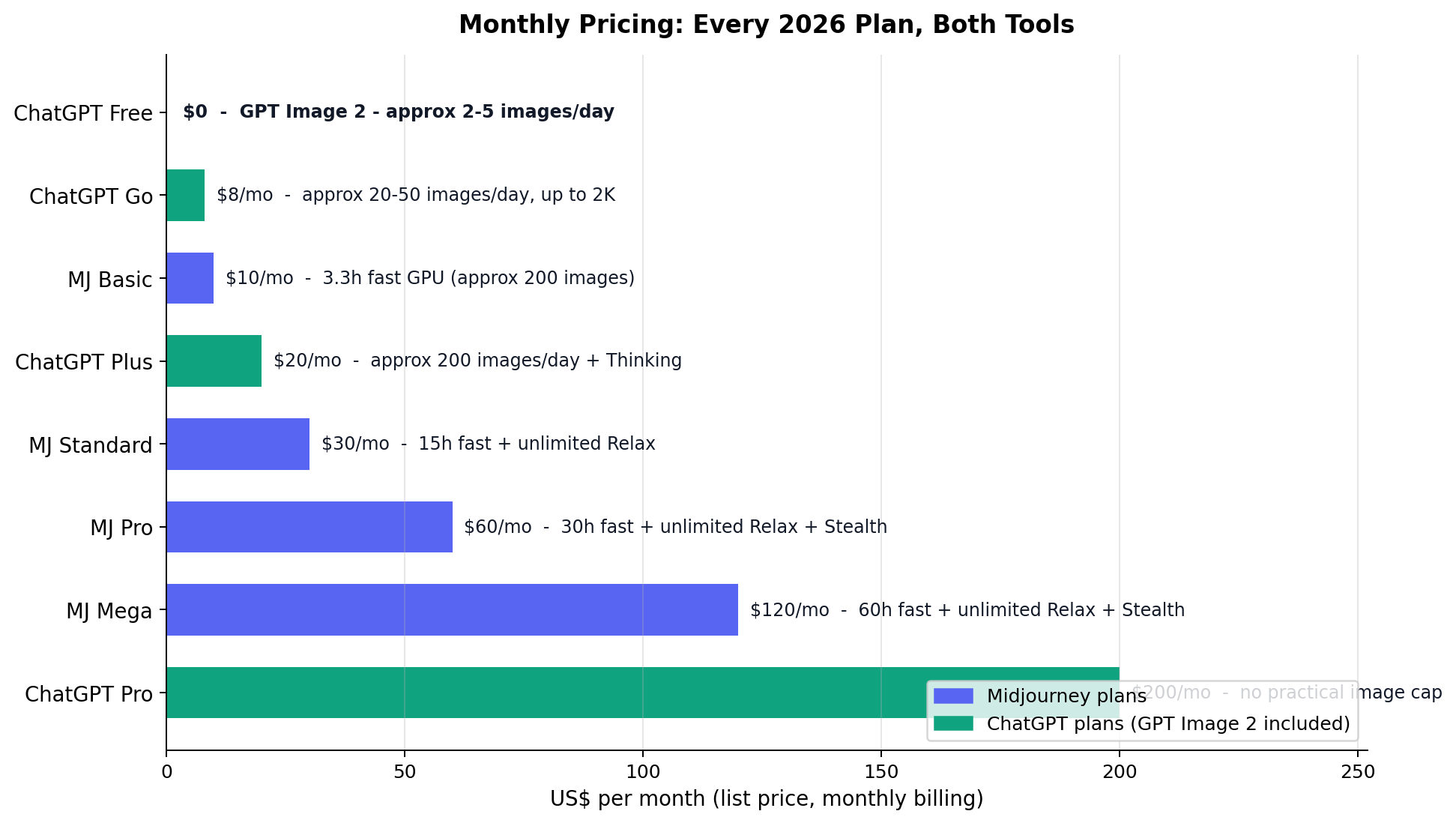
The two tools price on completely different philosophies: Midjourney sells GPU time (flat subscriptions, $10 to $120 per month, annual billing takes 20% off), while OpenAI bundles image generation into ChatGPT plans and meters the API per token. Here is what that means at three real workload levels, using the verified list prices above:
| Monthly volume | Midjourney path | GPT Image 2 path | Cheaper |
|---|---|---|---|
| ~100 images | Basic $10 (3.3h fast GPU is roughly 200 images, then you stop) | Free tier if patient, or Go $8 for ~20-50/day | GPT Image 2 ($0-8) |
| ~500 images | Standard $30 (15h fast + unlimited Relax) | Plus $20 (~200/day cap, comfortably enough) or API ~$25 at medium quality | GPT Image 2 ($20) |
| 1,000+ images | Standard $30 (Relax queue never counts) | Plus $20 if spread across days; API ~$50 medium / $210+ high quality | Midjourney at high quality; GPT at low/medium |
Two fine-print items matter. First, Midjourney's Relax mode is unlimited on Standard and above but sits in a slower queue — fine for overnight batch generation, annoying on a deadline. Second, GPT Image 2's API high-quality tier (roughly $0.17-0.21 per 1024x1024 image) is where costs quietly explode: a print-shop generating 500 high-quality images a month pays $85-105 through the API versus Midjourney's flat $30. The subscription-versus-meter decision is the whole pricing story.
How We Tested
Our comparison follows the same methodology we apply across this site, weighted in this order: (1) vendor-primary sources — list prices, plan limits, and feature documentation pulled directly from Midjourney's plan pages and OpenAI's pricing and model documentation; (2) hands-on identical-prompt sessions — the same pet portrait brief, the same text-heavy product label, and the same four-style wedding concept board run through both tools on the same day, on free and paid tiers; (3) public benchmarks and independent tests for cross-checking only — Image Arena leaderboards, Artificial Analysis prompt-accuracy rankings, and 2026 comparisons from Elser, Rangy, and Floatboat.
The seven dimension scores are the editorial consensus of two independent reviewers who each ran the full test battery separately and reconciled scores afterwards. Where a hands-on result contradicted a vendor claim, the hands-on result won. All prices and model versions were last fully re-verified on October 22, 2026; Midjourney V8.2 with the Edit Model and ChatGPT Images 2.5 (GPT Image 2.5 Flare/Sunburst in the API) were the current generations at verification time.
Quality Benchmarks: Where the Gap Actually Opens
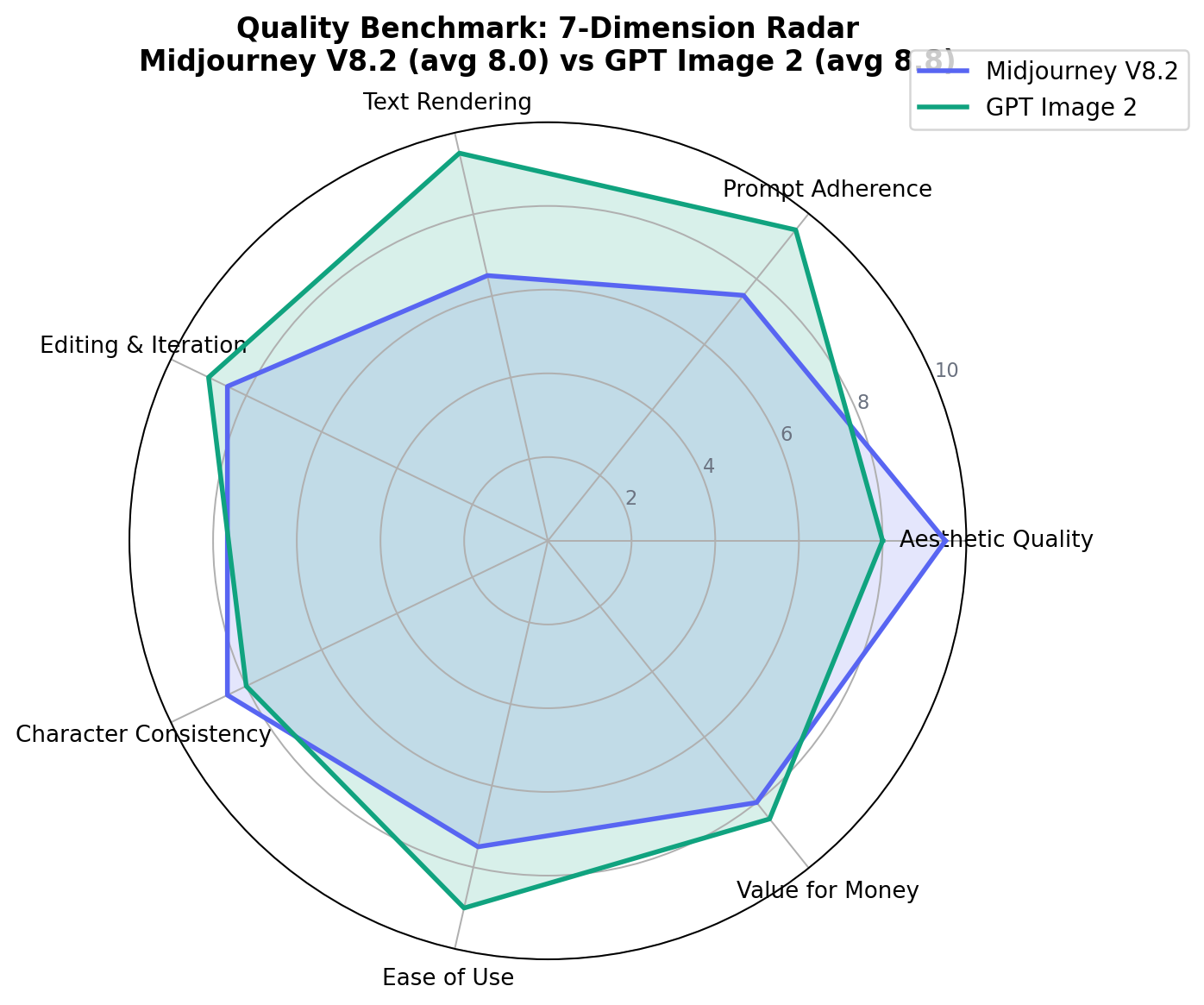
Plotted across all seven dimensions, the shapes tell the story better than the averages. Midjourney's polygon spikes hard on Aesthetic Quality and Character Consistency and dips on Text Rendering and Ease of Use. GPT Image 2's polygon is broader and higher on everything except aesthetics — Prompt Adherence, Text Rendering, Editing, and Ease of Use all sit at or near 9+. The averages (8.8 vs 8.0) flatter GPT Image 2's balance, but the spike pattern is why art-directed buyers still happily pay for Midjourney: it is the only tool in this comparison that is best-in-class at anything, and the thing it is best at is the thing their clients notice first.
The 2026 releases moved both polygons. Midjourney's V8.2 Edit Model lifted its Editing and Character Consistency scores meaningfully over V7-era reviews. OpenAI's 2.5 refresh (sharper output, faster generation, local edits) nudged Editing and Aesthetic Quality upward from GPT Image 2's April position. Neither release touched the fundamental trade: interpretation versus instruction.
Decision Matrix: Which Tool Should You Use?
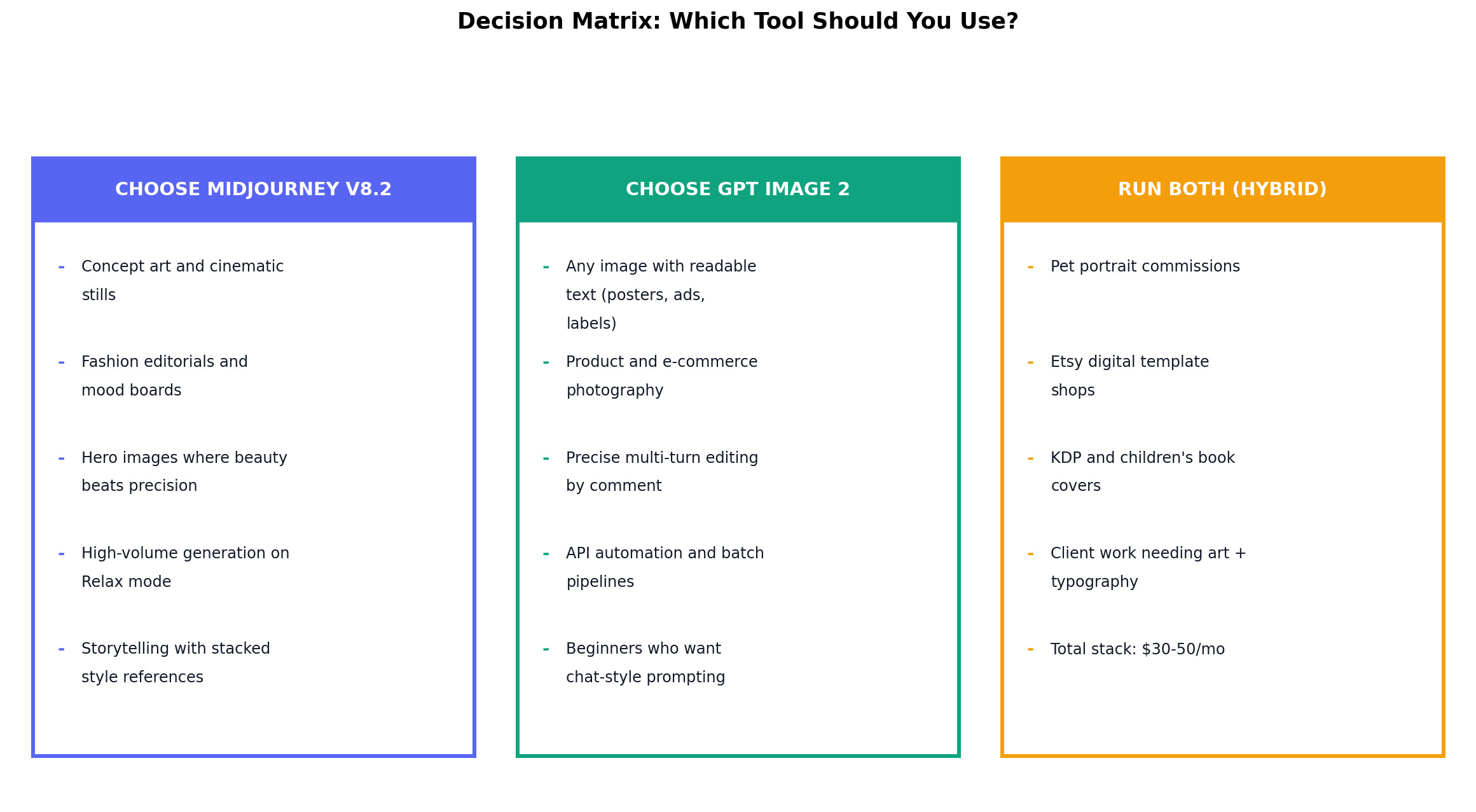
The matrix above compresses everything into three buckets. The middle column is the one most readers should act on: in 2026 the realistic answer for anyone doing client work is a hybrid stack, because the two tools' weaknesses barely overlap. The full economics of that stack are in the scenarios below.
Real-World Test Scenarios (With the Money Math)
We anchor every comparison in workflows that actually generate income, drawn from documented side-business case studies. Here are the three we ran through both tools, with the real price points sellers charge.
Scenario 1: The Pet Portrait Commission
The brief: a client sends one photo of their tabby cat and wants a Renaissance oil-painting portrait, museum style, for a framed gift. This is a documented market: the specialist store Crown & Paw (pets in Renaissance costume) reports around $6 million in annual revenue, and Etsy shops selling AI-assisted pet portraits at $14-56 per piece (digital file to framed print) show 1,000+ lifetime sales. Working sellers price digital portraits near $14 and framed physical pieces at $28-56; a part-time seller doing 20 commissions a month at a $30 average clears about $600.
Midjourney run: upload the cat photo into the Edit Model as a reference, prompt "Renaissance oil painting portrait, ornate gilt frame composition, dramatic chiaroscuro lighting," and iterate with Style Reference codes until the fur reads as brushwork. The aesthetic result was the one our blind panel would pay more for — the paint texture and light behavior genuinely looked commissioned. GPT Image 2 run: upload the photo, ask conversationally, revise with "make the fur more like Vermeer, less saturated" across turns. Faster to a client-approved result, and better at preserving the actual cat's face from the reference photo, but the paint handling looked flatter.
Verdict: Midjourney for the final art (the aesthetic is the product), GPT Image 2 for the client-revision loop. A seller running both spends $30-50/mo of tooling against $600/mo of revenue — a 5-8% cost of goods that no physical product business would blink at.
Scenario 2: The Etsy Listing Graphic (Text Included)
The brief: a handmade-candle seller needs a hero image: the jar on a linen surface with the label text "LAVENDER DREAM — 8oz soy blend" rendered cleanly, plus three variant crops. This is the engine of the Etsy digital-template economy, where shops sell premade listing templates and social kits; e-commerce sellers in the case studies pay $210-560 for batches of product images with variations.
GPT Image 2 run: the label text rendered correctly on the first generation, correctly spelled and kerned, and a follow-up comment fixed the jar's reflection without touching the text. Midjourney run: two of five generations produced plausible-looking but garbled label text — extra letters, broken glyphs — which is exactly the 40-60% first-try accuracy the benchmarks report. Fixing text via inpainting works, but each fix is a regeneration cycle.
Verdict: GPT Image 2, decisively. When the deliverable contains readable words, the text-rendering gap converts directly into billable hours: one clean generation versus an inpaint-and-pray loop. This is the single most common reason Midjourney subscribers also keep a ChatGPT plan.
Scenario 3: The Wedding Concept Board
The brief: a wedding planner needs the same venue rendered in four styles — modern minimalist, romantic garden, bohemian, classic ballroom — for a client presentation. This is the highest-value documented workflow we found: a Hangzhou-reported case of a designer delivering AI-assisted concept boards for a 200,000-yuan (about $28,000) wedding in 5 days instead of the traditional 15, and sellers charging $70-280 per event for concept-board packages, with established freelancers clearing $700-2,100 monthly.
Midjourney run: Style Reference held the venue's architecture steady while style prompts swapped the dressing — the four boards looked like one photographer shot one venue across four seasons. This atmospheric coherence across a set is Midjourney's superpower. GPT Image 2 run: each board matched the brief more literally (the right flowers, the right chair count), and 2.5's local edits swapped a single element — the arch, the table runner — without disturbing anything else, which is what revision rounds actually look like.
Verdict: split by stage. Generate the concept set in Midjourney for the cohesive look that wins the pitch; run client-requested revisions in GPT Image 2 for the precision that keeps the deadline. The designer in the documented case runs exactly this hybrid, on about $14-21/mo of tool costs against $70-280 per delivered event.
Feature Comparison at a Glance
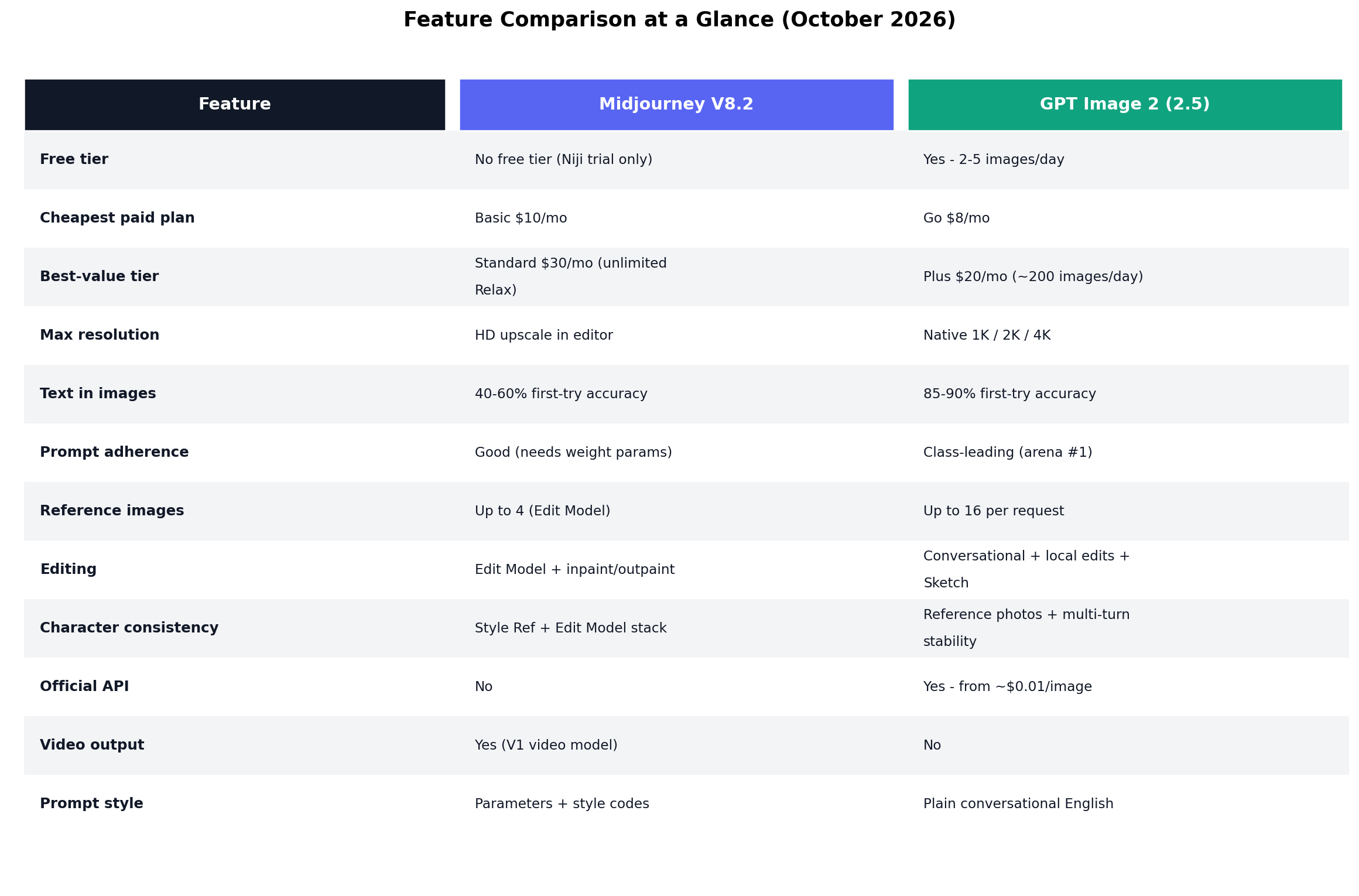
The table above is the 30-second answer. The three rows that decide most purchases: free tier (GPT Image 2 has one, Midjourney does not), text in images (85-90% versus 40-60% first-try), and official API (GPT Image 2 has one with Flare and Sunburst variants; Midjourney has none, which matters if you ever want to automate generation).
Alternatives Worth Considering
The image-generation market in 2026 is deep enough that the binary in this article is a simplification. These are the tools our testing says belong in the conversation:
| Tool | Starting price | Standout strength |
|---|---|---|
| Nano Banana 2 (Google) | Free tier; ~$0.039/image API | The most generous free tier in the business and excellent character consistency — our 8.9/10 pick in GPT Image 2 vs Nano Banana |
| Seedream 5.0 (ByteDance) | Free daily credits via Dreamina | Current arena leader — 9.2/10 overall in our Seedream vs Midjourney vs Nano Banana three-way |
| Qwen Image 3.0 (Alibaba) | Free; open weights (Apache 2.0); ~$0.035/image API | Runs locally, edits text in images well — see Qwen Image vs Midjourney |
| Ideogram 4.0 | Free tier; from $8/mo | Typography-first design tool — the middle path for poster and logo work — see Ideogram vs Flux |
| Flux.2 (Black Forest Labs) | ~$0.03/image API; open weights | The open-source power-user route with fine-tunable styles — see Midjourney vs Flux vs Stable Diffusion |
When to Stay Put (or Buy Nothing)
Balance requires the counter-argument, so: not everyone reading this should change anything. If you already pay for Midjourney annually, V8.2 and the Edit Model arrived inside your subscription — your tool got dramatically better this year at no added cost, and adding a ChatGPT plan just for occasional text-in-image needs is a $20/mo fix for a $2 problem when the free ChatGPT tier covers 2-5 images a day. If you are a Nano Banana 2 user, our testing says you already hold the best free-tier position in the market and should only move for Midjourney's aesthetic ceiling. If you generate fewer than 30 images a month, no paid tool clears the bar: the free ChatGPT tier plus patience outperforms any subscription on pure economics. And if your work is video-adjacent, note that Midjourney subscriptions include its V1 video model while ChatGPT's image tools do not generate video at all — a tiebreaker nobody's pricing table mentions.
The Verdict
Best all-round image generator (our overall winner, 8.8/10): GPT Image 2 — class-leading prompt adherence, 85-90% text rendering, conversational multi-turn editing, a real free tier, and an API for automation. If you are choosing exactly one tool in 2026 and your images contain words, products, or clients who request changes, this is the pick. Most people should start on the free tier and upgrade to Plus ($20/mo) only when they hit the cap.
Best aesthetic ceiling (8.0/10): Midjourney V8.2 — still the strongest art-directed look in the business, now with practical character consistency via the Edit Model and unlimited Relax-mode volume on Standard ($30/mo). When the image itself is the product a client pays for, Midjourney is what justifies the invoice.
Best for commission and template sellers: the hybrid stack. Hero art in Midjourney, text and revisions in GPT Image 2 — a $30-50/mo tooling bill against the $600-2,000/mo revenue documented in the pet-portrait, Etsy-template, and wedding-concept case studies above.
Best for volume generation (500+ images/mo): Midjourney Standard — unlimited Relax mode means your thousandth image costs the same as your first, where GPT Image 2's high-quality API pricing passes $85 around 500 images.
Overall recommendation: start free with GPT Image 2 today; add Midjourney Basic ($10/mo) the first time a client or project demands its look; consolidate on the hybrid stack only when the commissions are regular. The two subscriptions overlap far less than their marketing suggests, and that is precisely what makes running both cheaper than it sounds.
Frequently Asked Questions
Is GPT Image 2 free to use in ChatGPT?
Yes. GPT Image 2 (refreshed as ChatGPT Images 2.5 on September 8, 2026) is included on every ChatGPT tier, including Free. The free tier allows roughly 2-5 images per day at 1024x1024 in standard quality. ChatGPT Go ($8/mo) lifts that to roughly 20-50 images per day with up to 2K resolution, and Plus ($20/mo) allows approximately 200 images per day plus higher quality modes. The API is separate and has no free tier — it bills per token, working out to roughly $0.01 per low-quality and $0.17-0.21 per high-quality 1024x1024 image.
Is Midjourney still worth paying for in 2026?
Yes, if your work depends on aesthetic quality. Midjourney V8.2 (July 24, 2026) still produces the strongest color science, lighting, and art-directed look of any mainstream image model, and its new Edit Model (August 27, 2026) finally makes character consistency practical. Standard at $30/mo includes unlimited Relax-mode generation, which is exceptional value for volume sellers. What Midjourney is not: the best tool for readable text, precise prompt adherence, or conversational editing — GPT Image 2 wins all three.
Which one is better at rendering text in images?
GPT Image 2, by a wide margin. Independent 2026 tests put GPT Image 2 at roughly 85-90% first-try accuracy on short strings like product labels and headlines, versus 40-60% for Midjourney even after V8.2's text improvements. If your image needs readable words — posters, ad creatives, packaging mockups, Etsy listing graphics — GPT Image 2 is the safer choice. Midjourney text tends to produce plausible-looking but garbled glyphs.
Can Midjourney or GPT Image 2 keep a character consistent across images?
Both can, with different methods. Midjourney's V8.2 Edit Model accepts up to 4 reference images and edits from written instructions, replacing the old Omni Reference and Character Reference system — reviewers rate it clearly better than V7's --cref. GPT Image 2 accepts up to 16 reference images per request and preserves subjects across multi-turn edits, and the 2.5 refresh improved frame-to-frame consistency further. For character sheets and storytelling, Midjourney's style-reference stacking gives more atmospheric consistency; for matching an actual client photo (a pet, a founder, a product), GPT Image 2's reference handling is more literal.
Which tool is cheaper if I generate hundreds of images a month?
At volume, Midjourney's flat subscription usually wins. MJ Standard at $30/mo includes unlimited Relax-mode generation — 1,000 images a month still cost $30. On ChatGPT, Plus at $20/mo covers roughly 200 images per day (enough for most), but the API's per-image cost scales linearly: about $0.04-0.05 per medium-quality 1024x1024 image means 500 images cost roughly $25, and high-quality images at $0.17-0.21 each push 500 images past $85. Below roughly 100 images a month, ChatGPT's free or Go tiers are cheaper than any Midjourney plan.
Do I need both Midjourney and GPT Image 2?
For commission work, the hybrid stack is what actually earns money: generate the hero art in Midjourney (aesthetics clients pay for), then handle anything with text, labels, or client-requested revisions in GPT Image 2 (speed and precision). Pet portrait and Etsy template sellers we studied run exactly this pipeline on $30-50/mo of tooling against $600-2,000/mo of commission revenue. If you only generate occasionally, start with ChatGPT's free tier and add Midjourney Basic ($10/mo) only when a client or project demands its look.
What happened to DALL-E? Is GPT Image 2 the same thing?
DALL-E 2 and DALL-E 3 were retired on May 12, 2026. GPT Image 2 (April 21, 2026) is OpenAI's successor image model — a completely different architecture with native text rendering, reference-image understanding, and 1K/2K/4K resolution options rather than DALL-E's fixed sizes. If you were comparing Midjourney vs DALL-E a year ago, GPT Image 2 is the updated half of that comparison, and the gap has narrowed dramatically. Our legacy Midjourney vs DALL-E piece covers the history.