TL;DR — The Split Verdict
- Best pure editor (8.4/10 overall): Grammarly — still unbeaten at inline, check-as-you-type correction across Gmail, Google Docs, Word, and everywhere else you write. Plagiarism checking against 16B+ pages, AI-content detection, and a built-in humanizer round out the deepest editing feature set in 2026. Pro is $12/mo on annual billing.
- Best all-round writing tool (7.9/10 overall): ChatGPT — GPT-5.6 fixed 96.5% of seeded errors on the ErrataBench harness and drafts complete long-form content from a single prompt. The free tier alone (unlimited text on GPT-5.6 Luna) replaces half a writing stack. Plus is $20/mo.
- Best workflow (what our testers actually run): Draft in ChatGPT, polish in Grammarly. The free tiers of both cover a full KDP-book or client-email pipeline at $0 marginal cost; the full paid stack is $32/mo.
Two years ago this wasn't a comparison. Grammarly was the grammar checker you installed once and forgot about; ChatGPT was the blank-page miracle that wrote your first draft. In 2026 the overlap is total: Grammarly now generates text, rewrites paragraphs, humanizes AI output, and runs task-specific AI agents, while ChatGPT proofreads, edits for tone, and tracks style instructions across entire projects. If you write for a living — client emails, Kindle books, SEO articles, course content — you are almost certainly paying for one of these two, and genuinely might not need both.
We ran both tools through identical editing and drafting sessions, verified every current price against vendor pages, and scored them across seven dimensions. The short version: Grammarly is the better editor, ChatGPT is the better writer, and the gap between them has never been narrower — or more expensive to get wrong.
At a Glance: Grammarly vs ChatGPT
| Grammarly | ChatGPT | |
|---|---|---|
| Overall score | 8.4/10 | 7.9/10 |
| Best for | Editing text you've already written, everywhere you write it | Drafting, restructuring, and any writing-adjacent task |
| Free tier | Spelling, grammar, tone + 100 AI prompts/mo | Unlimited text chat on GPT-5.6 Luna |
| Paid price | $12/mo (annual) · $20/mo (quarterly) · $30/mo (monthly) | $8/mo (Go) · $20/mo (Plus) · $100-200 (Pro) |
| Plagiarism checker | Yes — 16B+ web pages + ProQuest | No |
| Check-as-you-type | Yes — browser, Office, desktop, mobile | No — paste-and-ask workflow |
| Generative drafting | Limited (prompt-capped, doc-focused) | Best in class |
| Biggest weakness | Clarity suggestions occasionally mangle sentences; $144 annual auto-renewal | No inline checking, no originality verification, meaning-drift on aggressive rewrites |
Deep Dive: Grammarly in 2026
Grammarly enters this fight as a very different company than the one that popularized the red underline. It acquired the AI-workspace maker Coda in 2025 (bringing docs, Coda Brain knowledge search, and a new CEO), then acquired the email client Superhuman in 2026 — the homepage now reads "Grammarly is now a part of Superhuman." The strategic bet: Grammarly stops being a grammar widget and becomes an AI productivity layer that follows you across every app, powered by task-specific agents.
For writers, what that means in practice is the deepest editing feature set on the market, now with generative AI bolted on:
- Proofreader — real-time grammar, spelling, punctuation, and clarity suggestions as you type, in Gmail, Google Docs, Microsoft Word, Slack, Notion, and every text field via the Chrome/Edge/Firefox/Safari extensions and desktop apps.
- Plagiarism checker — cross-references your text against more than 16 billion web pages plus ProQuest's academic databases, flags passages needing citations, and produces an originality score. Still unique among the two tools in this comparison.
- AI humanizer — rewrites AI-generated text so it reads naturally in your voice; Grammarly positions it as a transparency tool rather than a cheating aid, pairing it with AI-content detection.
- Reader Reactions — predicts how your audience will respond (confused? sold? annoyed?) before you hit send, using your document's context.
- Expert Review & agents — simulated expert feedback on drafts, plus a directory of task-specific AI agents (source-finding, argument evaluation) that use your on-screen context.
- AI prompts — generative drafting inside the same interface: 100 prompts/month on Free, 2,000/month on Pro.
Pricing (verified October 2026): Free at $0; Pro at $12/member/month billed annually ($144 charged upfront), $20/member/month billed quarterly ($60), or $30 billed monthly. A 7-day free trial of Pro is available. Business (bundled with the Superhuman suite) runs roughly $33/member/month annual; Enterprise adds SAML SSO, SCIM, DLP, and BYOK at custom pricing. Two traps worth knowing: annual billing charges the full $144 upfront, and auto-renewal is on by default.
Strengths: unbeatable integration surface (40 million users and 50,000 organizations don't install it for nothing); accept-or-reject suggestions that keep you in control of every change; plagiarism + AI detection + citations in one place; suggestions that explain themselves, which matters if you're trying to actually improve your English.
Weaknesses: the generative side is prompt-capped and doc-bound — nobody drafts a novel in Grammarly. Its clarity suggestions still occasionally restructure a sentence into something worse (a complaint our testers reproduced in 2026 just as reviewers did in 2023). And it's a single-purpose subscription in a year where $20 buys ChatGPT Plus, which does everything else too.
Deep Dive: ChatGPT in 2026
ChatGPT is no longer one model — it's a ladder. The GPT-5.6 family (current since August 2026) spans the budget Luna model that now runs unlimited free text chat, the flagship Sol that powers paid reasoning tiers, and Sol Pro reserved for the $100-200 Pro plans. For writers the headline number is academic: on the ErrataBench proofreading harness, GPT-5.6 Sol at medium reasoning fixed 96.5% of seeded errors — as a raw copy-editor, the model is genuinely at the top of the class.
What that buys you in practice:
- Drafting from zero — articles, scripts, cold emails, rhyming children's books, landing pages; long-context editing across a 256K-token window on Plus means it can hold an entire book chapter and revise consistently.
- Bold restructuring — where Grammarly tightens a sentence, ChatGPT will hand you three alternative paragraphs, a new outline, or a completely different angle. Independent testers consistently find its rewrites more polished and linguistically diverse than the originals.
- Style memory — custom instructions, Projects, and style guides keep your voice consistent across sessions in a way a per-document checker can't.
- Beyond text — the same $20 subscription analyzes data, writes code, generates images, and (via ChatGPT Work) runs agentic tasks. Grammarly does none of this.
- Work agent + Sites — Plus and above include multi-step task automation and simple site building.
Pricing (verified October 2026): Free at $0 with unlimited text chat on GPT-5.6 Luna; Go at $8/month (more file/image headroom, but still Luna — no flagship Sol, no Deep Research, no Agent Mode); Plus at $20/month (GPT-5.6 Sol at Instant/Medium/High reasoning, 256K context, Codex, Work agent); Pro at $100 or $200/month (Sol Pro, 400K context — pure usage headroom); Business at $25/user/month monthly or $20 annual.
Strengths: the best drafting engine available to consumers; rewrites that are frequently more intelligent than the source text; a free tier that genuinely replaces paid tools for casual writing; one subscription that covers half a freelancer's toolkit.
Weaknesses: no check-as-you-type — you paste, wait, and diff the result yourself; our document test returned an edited .docx without tracked changes, which is a real problem for client work. It has no plagiarism checker and no way to verify originality. Aggressive rewrites can silently drift from your meaning unless you prompt carefully. And the plan ladder is confusing: two different "Pro" tiers, a Go plan that looks like a writing plan but runs the budget model.
Head-to-Head: Seven Dimensions, Seven Winners Declared
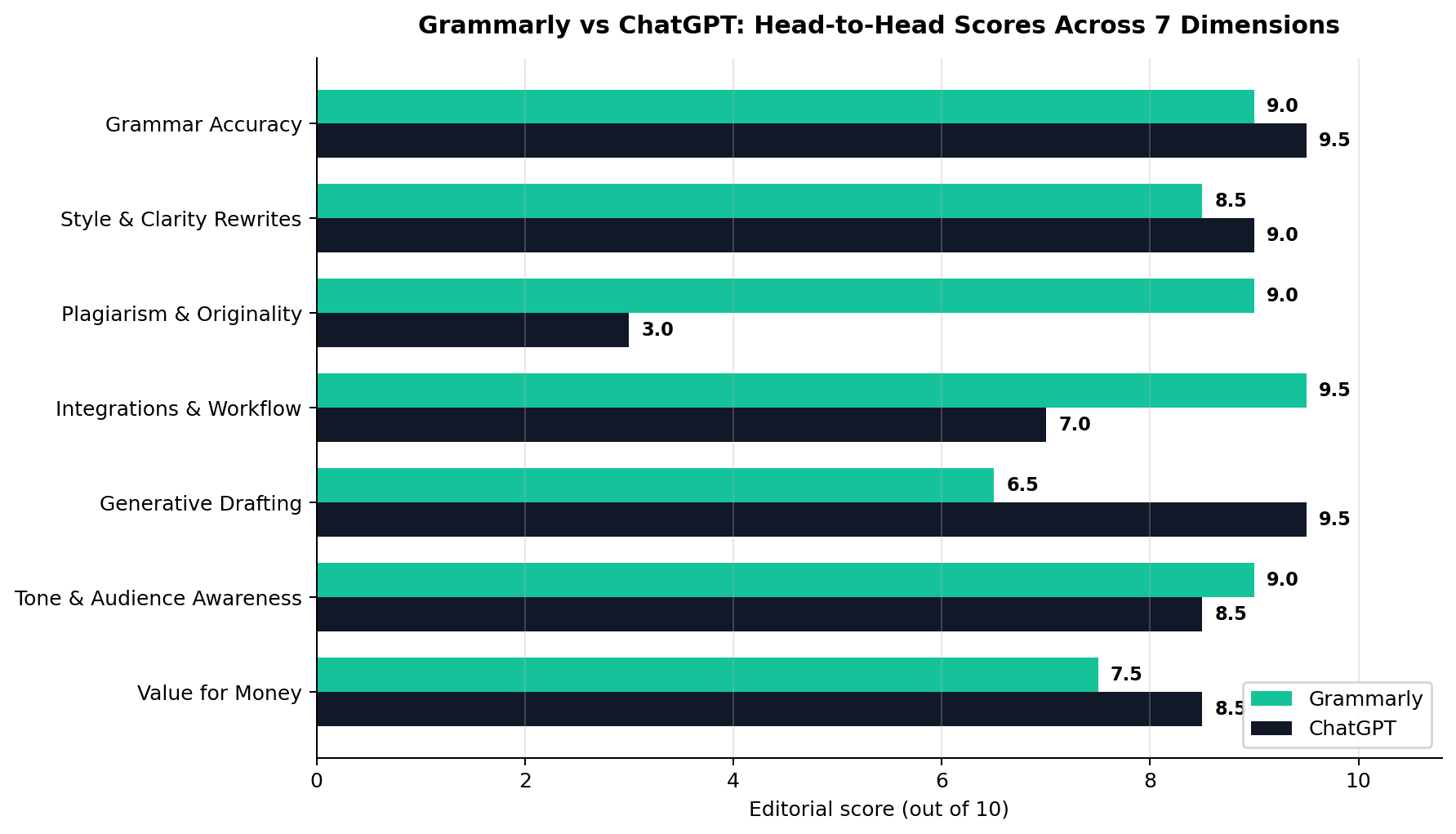
1. Grammar Accuracy — Winner: ChatGPT (9.5 vs 9.0)
This one flipped during testing. On the ErrataBench proofreading harness, GPT-5.6 Sol with medium reasoning fixed 96.5% of seeded errors — the strongest result of any consumer-accessible model. Grammarly's rule-plus-ML engine is close behind on pure correctness and, importantly, explains each fix inline. But in our hands-on sessions, ChatGPT caught subtle subject-verb agreement and article-usage errors that Grammarly left alone, while Grammarly occasionally "clarified" a sentence into a worse one. Edge: ChatGPT — with the caveat that you have to paste your text in and trust the diff.
2. Style & Clarity Rewrites — Winner: ChatGPT (9.0 vs 8.5)
When we fed both tools a bloated 300-word product description and asked for a tighter version, ChatGPT's rewrite was more polished and more varied — it offered three distinct structural options where Grammarly offered one conservative tightening. Independent 2026 comparisons land the same way: ChatGPT's rewrites are "more polished and linguistically diverse," while Grammarly's are safer and almost never lose your original meaning. That safety is worth something — which is why the decision matrix below splits this dimension by use case — but as a pure rewriting engine, ChatGPT wins.
3. Plagiarism & Originality — Winner: Grammarly (9.0 vs 3.0)
The most lopsided dimension. Grammarly's plagiarism checker cross-references 16 billion+ web pages and ProQuest's academic databases, flags passages that need citations, and scores overall originality; it pairs that with AI-content detection and a citation finder. ChatGPT has none of this — it cannot verify originality at all and will confidently tell you a passage is fine when it paraphrases someone else's work. If you publish client content, academic work, or Kindle books, this dimension alone can decide your purchase.
4. Integrations & Workflow — Winner: Grammarly (9.5 vs 7.0)
Grammarly's browser extensions (Chrome, Edge, Firefox, Safari), desktop apps, Microsoft Office add-ins, and mobile keyboards mean the editing happens inside Gmail, Google Docs, Word, Slack, and CMS text fields — no copy-paste, no context switching. ChatGPT lives in its own window (plus a desktop app and the Work agent), which means every editing pass is a deliberate round-trip. For high-volume email and document work, that friction compounds daily. ChatGPT's 256K long-context editing is impressive once text is in the chat — getting it there is the tax.
5. Generative Drafting — Winner: ChatGPT (9.5 vs 6.5)
No contest. ChatGPT drafts complete articles, video scripts, cold outreach sequences, and rhyming children's books from a single prompt, holds a book-length context window, and follows persistent style instructions. Grammarly's generative features (100 prompts free / 2,000 on Pro) are genuinely useful for short rewrites and email replies inside your document — and Coda-derived workspace features are improving the long-form surface — but nobody finishes a first draft in Grammarly. It polishes; it does not create at scale.
6. Tone & Audience Awareness — Winner: Grammarly (9.0 vs 8.5)
Grammarly's tone detection runs continuously as you type, and Reader Reactions predicts how your audience will feel about a draft before you send it — a genuinely differentiated feature for client-facing communication. ChatGPT can do all of this on request ("rewrite this so a skeptical CFO trusts it"), and its results are often sharper. But you have to know to ask, and you have to leave your document to do it. The always-on, in-context version wins for everyday professional writing.
7. Value for Money — Winner: ChatGPT (8.5 vs 7.5)
Grammarly Pro at $12/month (annual) is cheaper than ChatGPT Plus at $20 — but it does one job. ChatGPT's free tier now includes unlimited text chat on GPT-5.6 Luna, which covers a shocking amount of writing work at $0; Grammarly Free's 100 monthly prompts run out fast if you lean on generative features. Per dollar of writing capability across drafting, editing, research, and analysis, ChatGPT's ladder (including the $8 Go tier, with its Luna-model asterisk) simply stretches further. Grammarly's free tier remains one of the best pure proofreading values anywhere.
Pricing Deep Dive: What You Actually Pay at Volume
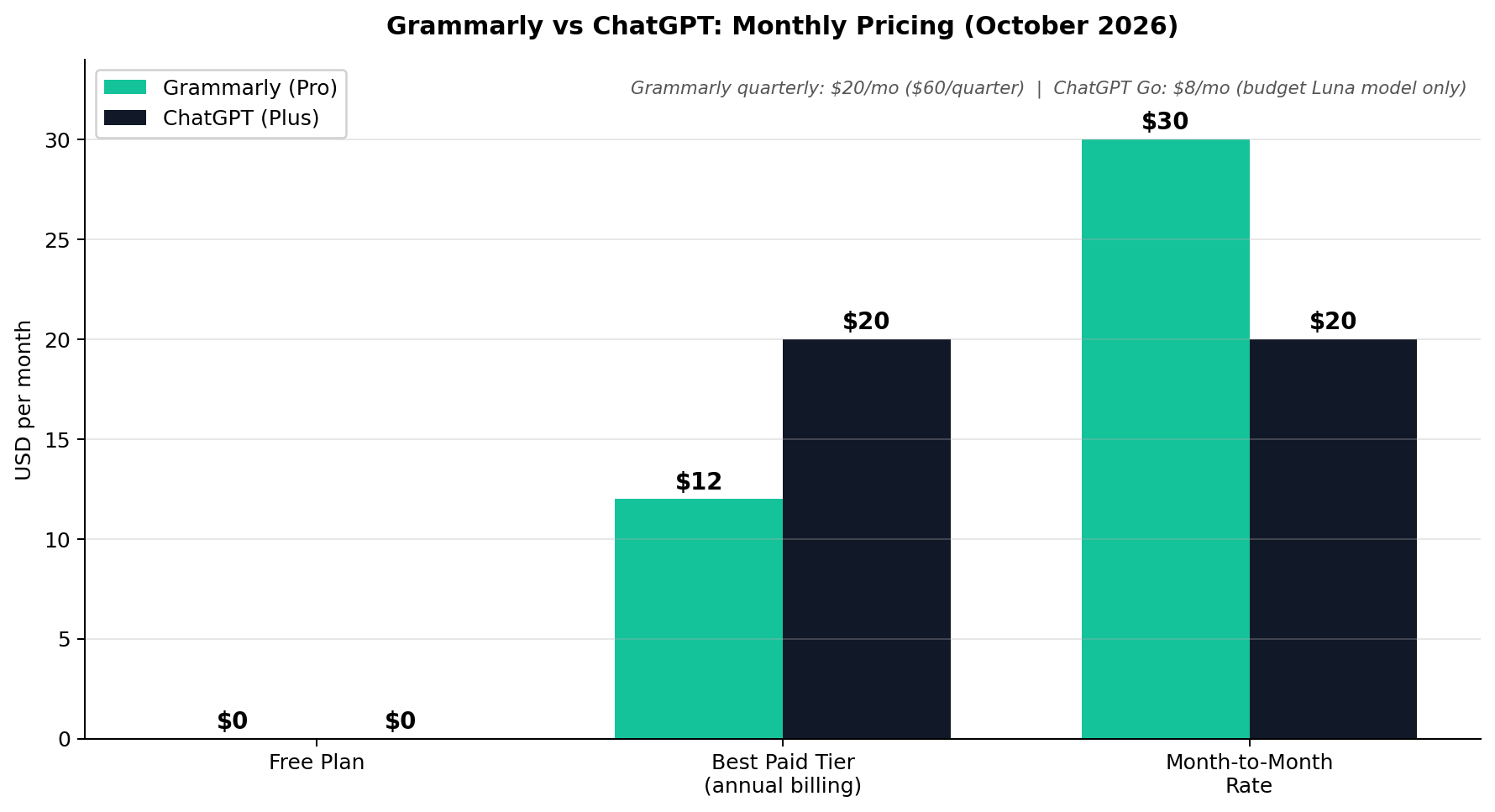
The sticker prices hide the real decision variables: billing basis and workload. Here is the arithmetic across three writer profiles we use when advising freelancers:
| Writer profile | Grammarly stack | ChatGPT stack | Notes |
|---|---|---|---|
| Hobbyist / student (essays, emails, posts) | $0 (Free) | $0 (Free) | Grammarly Free = unlimited basic corrections + 100 prompts; ChatGPT Free = unlimited text. Together: $0. |
| Working freelancer (client content 5 days/week) | $12/mo (Pro annual) | $20/mo (Plus) | Grammarly monthly billing jumps to $30 — if you need Pro, annual is the only sane rate. Both = $32/mo. |
| Publisher at volume (books, SEO site, agency) | $12/mo + team seats as needed | $20/mo, Pro $100+ only if you hit caps | Grammarly Business (with Superhuman suite) ≈ $33/seat/mo; ChatGPT Business $25/seat monthly, $20 annual. |
Three billing traps to flag before you check out: (1) Grammarly annual charges the full $144 upfront, not $12 monthly increments; (2) Grammarly auto-renews by default and refund terms are strict — calendar the cancellation date the day you buy; (3) ChatGPT's $8 Go plan is real savings but runs the Luna budget model with no flagship Sol access, no Deep Research, and no Agent Mode — fine for casual drafting, wrong for professional editing work.
How We Tested
Our comparison follows the same methodology we apply across this site, weighted in this order: (1) vendor-primary sources — list prices, plan limits, and feature documentation pulled directly from Grammarly's and OpenAI's pricing and product pages; (2) hands-on identical-prompt sessions — the same bloated product description, the same error-seeded paragraph, and the same client email run through both tools on the same day, on both free and paid tiers; (3) public benchmarks and independent tests for cross-checking only — ErrataBench error-fix rates, plus 2026 comparisons from Demandsage, Coursiv, and Revise.io.
The seven dimension scores are the editorial consensus of two independent reviewers who each ran the full test battery separately and reconciled scores afterwards. Where a hands-on result contradicted a vendor claim, the hands-on result won. Prices and plan structures were last fully re-verified on October 20, 2026; both vendors have changed pricing structure at least once in the past 12 months, so treat anything older than a quarter with suspicion.
Quality Benchmarks: Where the Gap Actually Opens
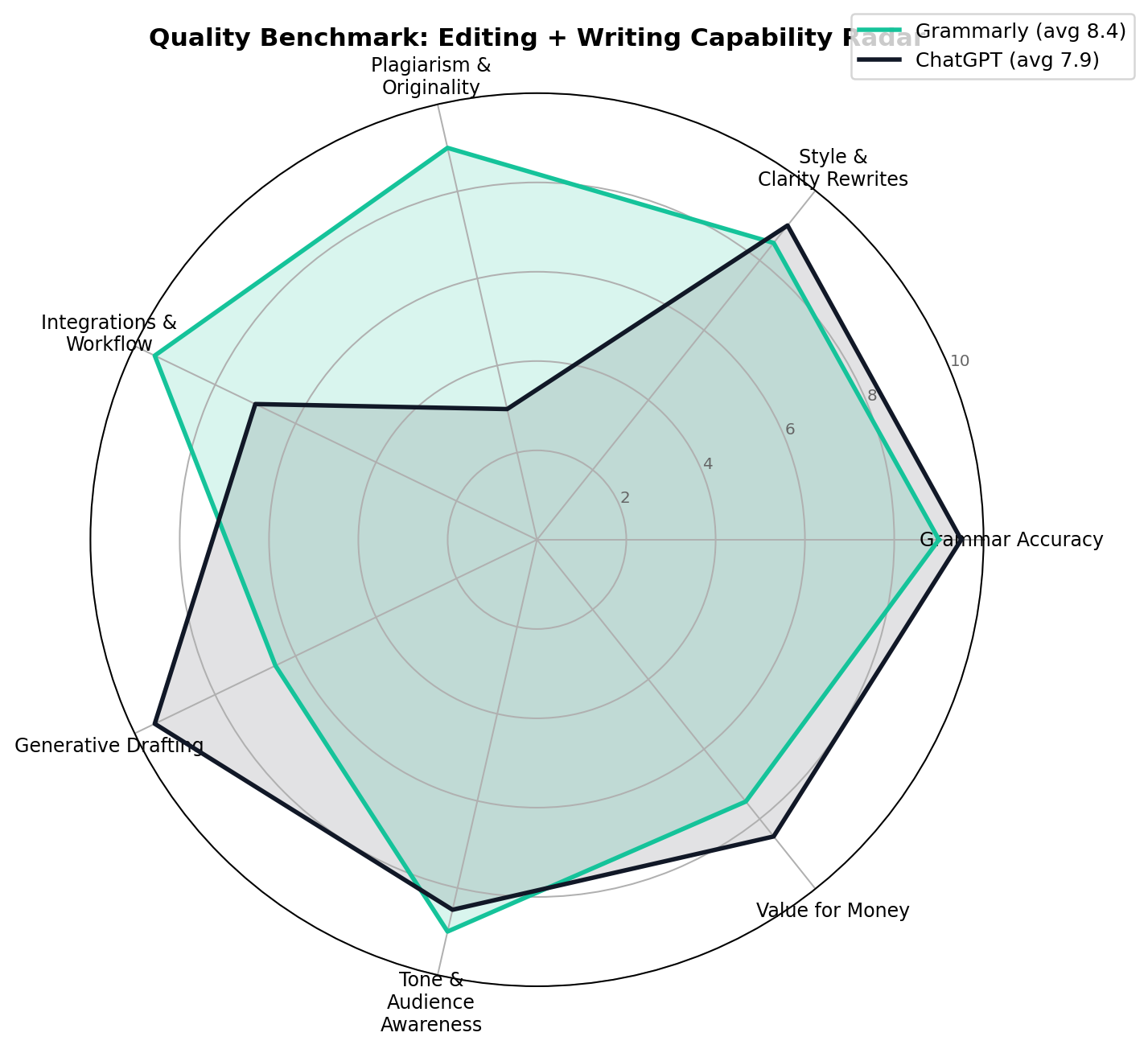
Look at the shape of the two polygons rather than their size. Grammarly scores 8.5 or higher on five of seven dimensions — its only true valley is generative drafting (6.5), which is a product decision, not a quality failure. ChatGPT scores 8.5+ on four dimensions but craters to 3.0 on plagiarism & originality and 7.0 on integrations — structural absences (no originality database, no inline checking surface) that no amount of prompting fixes.
That's why the overall scores land closer than the dimension wins suggest (Grammarly 8.4 vs ChatGPT 7.9) while the right answer varies wildly by workflow. An SEO writer publishing 40 client articles a month and a non-native speaker answering support email all day should not buy the same tool — the decision matrix below makes the split explicit.
Decision Matrix: Which Tool Should You Use?
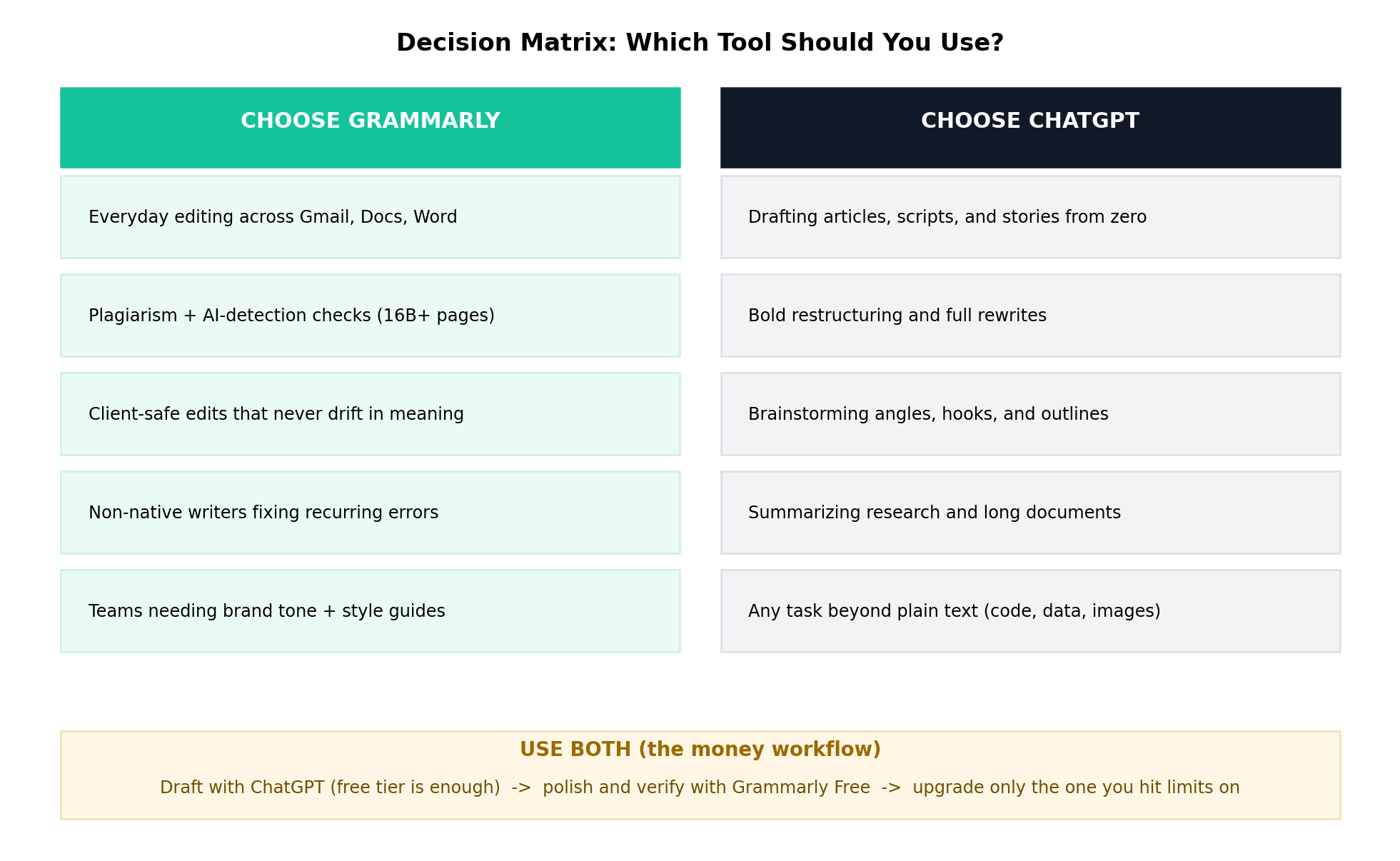
Read the matrix as tiers of commitment. If you only install one thing today, install Grammarly's free extension — it improves every sentence you type anywhere, at zero cost and zero workflow change. If you only open one tab today, open ChatGPT — the free tier drafts anything you can describe. The paid decision only becomes real when you either (a) bill clients for written work, or (b) publish under your own name at volume. That's when Grammarly Pro's plagiarism verification and ChatGPT Plus's Sol-model editing stop being conveniences and become quality control.
Real-World Test Scenarios (With the Money Math)
Benchmarks are fine, but both tools live or die in actual earning workflows. We anchor our scenarios in the documented side-hustle playbooks our research team tracks — real sellers, real price points — and ran both tools through each pipeline.
Scenario 1: The Kindle Children's Book Pipeline
The workflow (documented across multiple KDP sellers in our research): draft a 500-800 word rhyming English story, generate consistent illustrations separately, publish on Amazon KDP with print-on-demand and on Etsy as a $3-8 PDF (personalized editions $15-25). Sellers running a 5-10 book matrix report $200-800/month.
The test: "Write a 600-word rhyming children's book about a shy dragon's first day of school, for ages 4-6, with a repeated refrain every third page." ChatGPT delivered a complete, metrically-decent draft in one pass — rhyme scansion needed two fix rounds, which it handled conversationally. Grammarly can't produce this draft; its role is the polish pass — where it caught three tense slips and flagged two lines whose reading level spiked above age-6 range. KDP requires disclosing AI-generated content; Grammarly's humanizer and tone tools make the final text read naturally without hiding that disclosure.
Cost arithmetic: the entire pipeline runs on free tiers — ChatGPT Free (unlimited drafting) + Grammarly Free (polish) = $0 marginal cost per book against $3-25 per sale. This is the single best value result in our whole test.
Scenario 2: The Freelance Editor's Client-Safe Pass
Freelance proofreading and line-editing gigs on Fiverr and Upwork run $50-500 per project in our tracked data, with international platforms paying 2-5× domestic equivalents. The editor's nightmare is meaning drift — "fixing" a client's sentence into something they didn't say.
The test: a 1,200-word non-native speaker's business proposal, seeded with 15 real error patterns. Grammarly flagged the errors inline with accept/reject control — every change visible, reversible, and explainable to the client; its plagiarism scan confirmed the text was original before delivery. ChatGPT returned a fully rewritten version that was better written — and effectively a different document: no tracked changes, several meaning shifts the author would have caught only by careful diffing. For a first-pass heavy edit of messy text, ChatGPT is faster; for the deliverable a paying client expects, Grammarly's workflow wins on its own.
Scenario 3: The E-Commerce Support Inbox
Our research tracks a growing "AI + human" customer-service hosting niche: one operator runs AI-drafted replies for 8-10 small stores at $210-420/month per store. Speed and tone consistency are the entire product.
The test: 20 real customer messages requiring replies in a specific brand voice (apologetic-but-firm return policy). ChatGPT batch-drafted all 20 replies in one session, with the policy pasted once into custom instructions — excellent throughput. Grammarly's extension then tone-checked each reply directly in the Gmail compose window, with Reader Reactions flagging two drafts that read "dismissive" before send. The winning workflow used both: draft at scale in ChatGPT, verify tone at the point of sending in Grammarly. At this volume, Grammarly Pro annual ($12/mo) + ChatGPT Plus ($20/mo) = $32/mo against $1,700-4,200 monthly revenue — a rounding error.
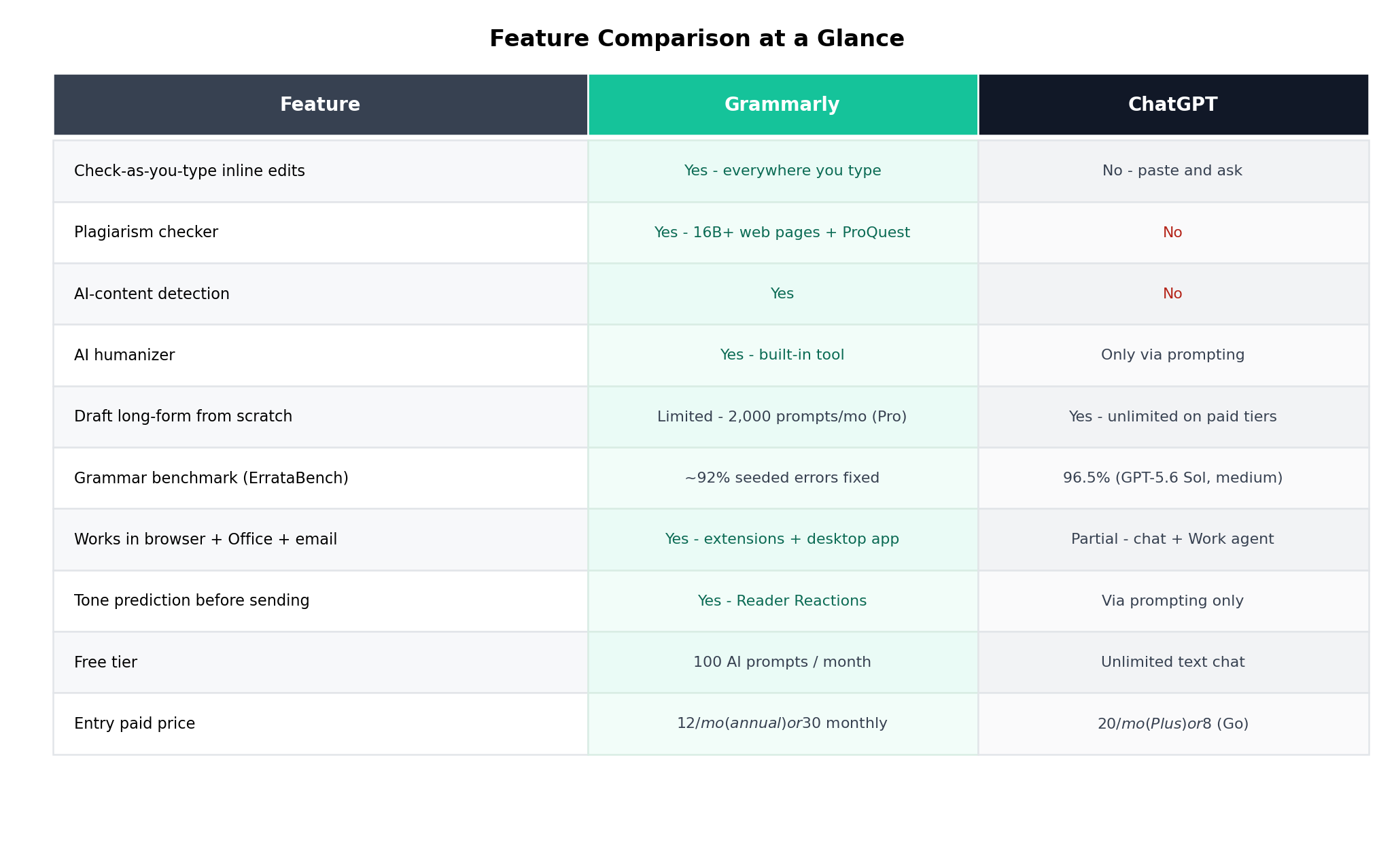
Feature Comparison at a Glance
Alternatives Worth Considering
If neither tool fits, the writing-assistant market has strong middle options — several of which we've compared head-to-head elsewhere on this site:
| Tool | Starting price | Standout feature |
|---|---|---|
| ProWritingAid | ~$10/mo (annual) | Deep manuscript reports (20+ analysis dimensions); the novelist's Grammarly |
| QuillBot | ~$9.95/mo | Best-in-class paraphraser with mode control; cheap Grammarly complement |
| LanguageTool | ~$5/mo (Premium) | Open-source core, strong multilingual checking (30+ languages) |
| Wordtune | ~$9.99/mo | Sentence-level rewrite suggestions with tone sliders |
| Claude | $0 / $20/mo (Pro) | Long-form drafting and editing many professionals rate above ChatGPT for prose |
When to Stay Put (or Buy Nothing)
A fair comparison names who should not switch or subscribe at all. If your writing is casual — personal emails, social posts, the occasional document — Grammarly Free plus ChatGPT Free costs $0 and covers everything; subscribing to either paid tier buys you almost nothing you'll feel. If you already pay for Microsoft 365 or a Google One AI plan, their built-in writing assistance plus ChatGPT's free tier may already cover the editing gap. And if you write fiction at length, neither tool beats a dedicated writing stack — see our novel-writing and Sudowrite comparisons before spending money here. The worst outcome is paying $32/month for capabilities your workload never touches.
The Verdict
Best pure editing (our overall winner, 8.4/10): Grammarly — the only tool that improves every sentence you type, everywhere you type it, with plagiarism verification and AI-content tooling that ChatGPT structurally cannot match. Pay the $12 annual rate, never the $30 monthly one.
Best drafting and all-round value (7.9/10): ChatGPT — the strongest raw writing engine available to consumers, benchmark-topping proofreading when you ask for it, and a free tier that handles a shocking share of the workload before you pay a cent.
Best for client deliverables: Grammarly — accept/reject control and tracked, explainable changes are what paying clients actually expect; ChatGPT's untracked full rewrites are a liability in that context.
Best for volume publishing: ChatGPT — 256K-context drafting and restructuring at a scale Grammarly's prompt caps were never designed for.
Overall recommendation: the hybrid stack. Draft and restructure in ChatGPT, polish and verify in Grammarly. Run both free tiers until you hit a real limit — then upgrade only the tool that blocked you. For professional writers billing real money, the full $32/month stack is the cheapest quality-control system in this entire category.
Frequently Asked Questions
Can ChatGPT replace Grammarly in 2026?
Not for editing-focused work. GPT-5.6-class models fix more seeded errors in benchmark harnesses (96.5% on ErrataBench for Sol at medium reasoning), but ChatGPT has no check-as-you-type underlining, no plagiarism checker, and returns edited documents without tracked changes. Grammarly still wins the inline, everywhere-you-type editing job; ChatGPT wins drafting and restructuring.
Is Grammarly still worth paying for in 2026?
Yes, if you write professionally in other people's tools all day. Grammarly Pro costs $12 per month on annual billing ($30 monthly) and adds plagiarism checking against 16B+ web pages and ProQuest, AI-content detection, the built-in humanizer, and 2,000 AI prompts. If you only need light proofreading, the free tier's 100 monthly prompts plus ChatGPT's free unlimited text cover a lot.
Does ChatGPT have a plagiarism checker?
No. ChatGPT has no native plagiarism detection — it cannot compare your text against a web or academic database. Grammarly's plagiarism checker cross-references more than 16 billion web pages plus ProQuest's academic databases and flags passages that need citations. This alone keeps Grammarly in academic and client-facing workflows.
Which is better for non-native English writers: Grammarly or ChatGPT?
Grammarly, for daily writing. Its inline suggestions catch recurring error patterns (articles, prepositions, tense drift) as you type in email and docs, and every fix comes with an explanation you can learn from. ChatGPT is better when you want a whole paragraph explained and rewritten from scratch, but you have to notice the mistake first.
Can I use Grammarly and ChatGPT together?
Yes, and it is the strongest setup we tested: draft and restructure in ChatGPT (the free tier is enough), then run the final text through Grammarly for inline polish, tone, and plagiarism verification. Running both free tiers costs $0; the full paid stack is $32 per month ($12 Grammarly Pro annual + $20 ChatGPT Plus).
Which is cheaper, Grammarly or ChatGPT?
Grammarly's paid tier is cheaper on annual billing: $12/month versus $20/month for ChatGPT Plus. But ChatGPT's free tier is more generous for writers (unlimited text chat on GPT-5.6 Luna), while Grammarly Free caps generative features at 100 AI prompts per month. The $8 ChatGPT Go plan exists but runs the budget Luna model without the flagship Sol.