TL;DR
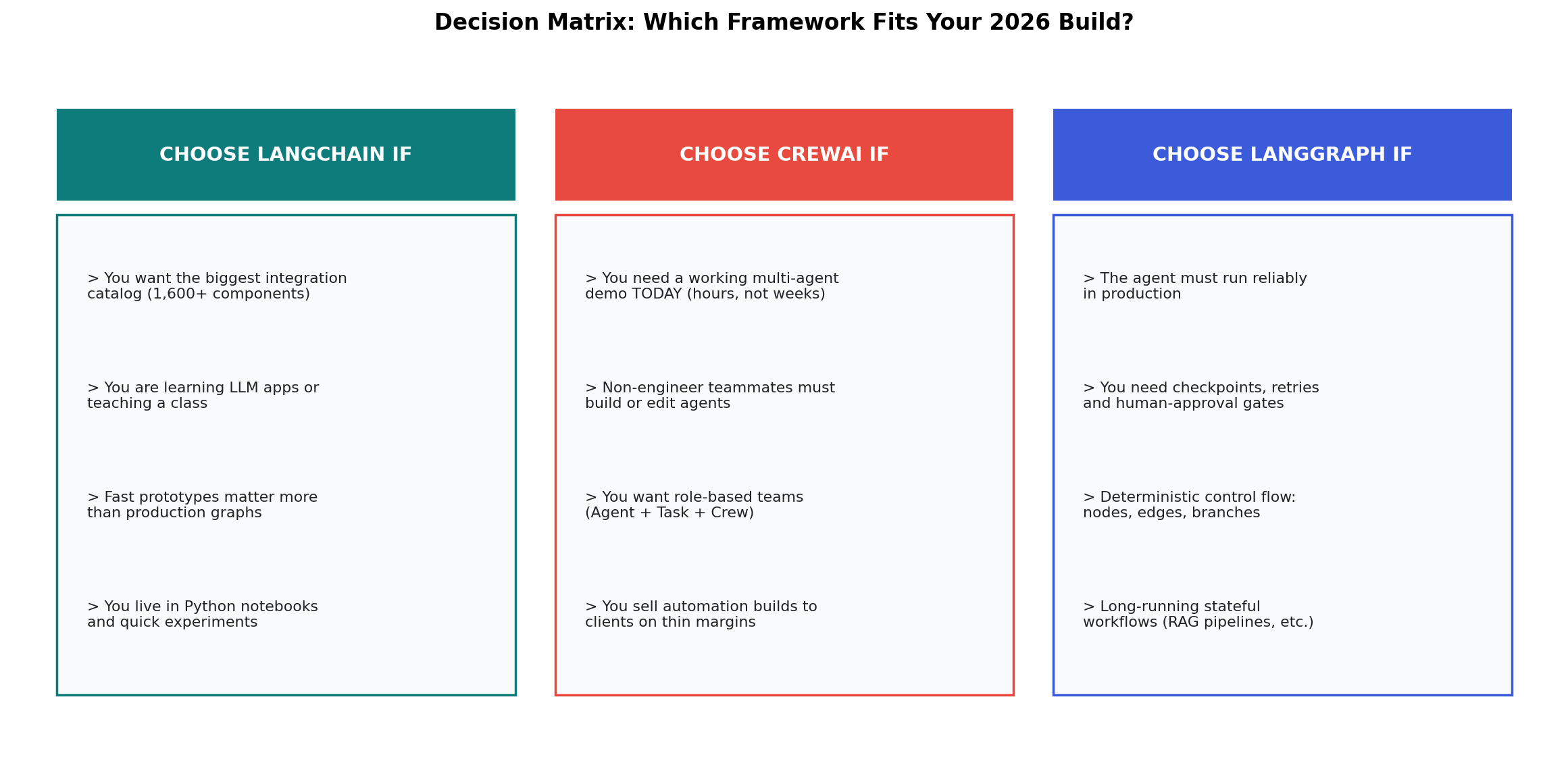
Best for production agents: LangGraph (8.5/10) — the state-machine control layer with checkpoints, retries and human-approval gates that serious deployments actually need, backed by 34.5M monthly downloads and roughly 400 companies. Best for fast multi-agent demos: CrewAI (7.7/10) — a role-based Agent + Task + Crew model that non-engineers can read, with a working crew in ~20 lines. Best integration catalog: LangChain (8.2/10) — 1,600+ components and the largest tutorial ecosystem on the internet, now rebuilt around a cleaner 1.x core. All three are MIT-licensed and free to self-host; the money question is which managed platform you bolt on (from $35/month). We tested each on the same three builds a freelance agent developer actually sells.
The Three Ways to Build an Agent in 2026
The agent-framework question in 2026 has settled into a surprising shape: the three most-deployed Python frameworks are now maintained by two organizations — LangChain and LangGraph share a core team, while CrewAI is the independent challenger. That matters when you pick a stack, because "switching costs" between LangChain and LangGraph are near zero, while moving a CrewAI crew to LangGraph is a genuine rewrite.
Here is the one-paragraph version of each philosophy:
- LangChain is a component library: loaders, retrievers, tool wrappers and a standardized chat interface, plus a new minimal
create_agentAPI (about 4 lines to a working agent). It is the glue layer for integration-heavy apps. - CrewAI is a role-playing orchestrator: you hire agents (roles, goals, backstories), assign Tasks, and assemble a Crew. It optimizes for human-legible teamwork metaphors over low-level control.
- LangGraph is a state machine runtime: you define nodes and edges over a shared state, get checkpointing, branching, retries and human-in-the-loop interrupts for free. It optimizes for deterministic, long-running reliability.
This comparison is written for the person the frameworks' marketing rarely targets: the developer selling agent builds — RAG support bots, research pipelines, automation crews — on freelance platforms and to agency clients. Chinese freelance platforms reported AI-automation order volume up more than 1,700% year over year in 2026, with typical one-off agent builds priced from about $420 to $1,120 and monthly maintenance retainers of roughly $140–$420. Framework choice directly decides whether those margins survive scope creep and 2 a.m. failure calls.
At a Glance
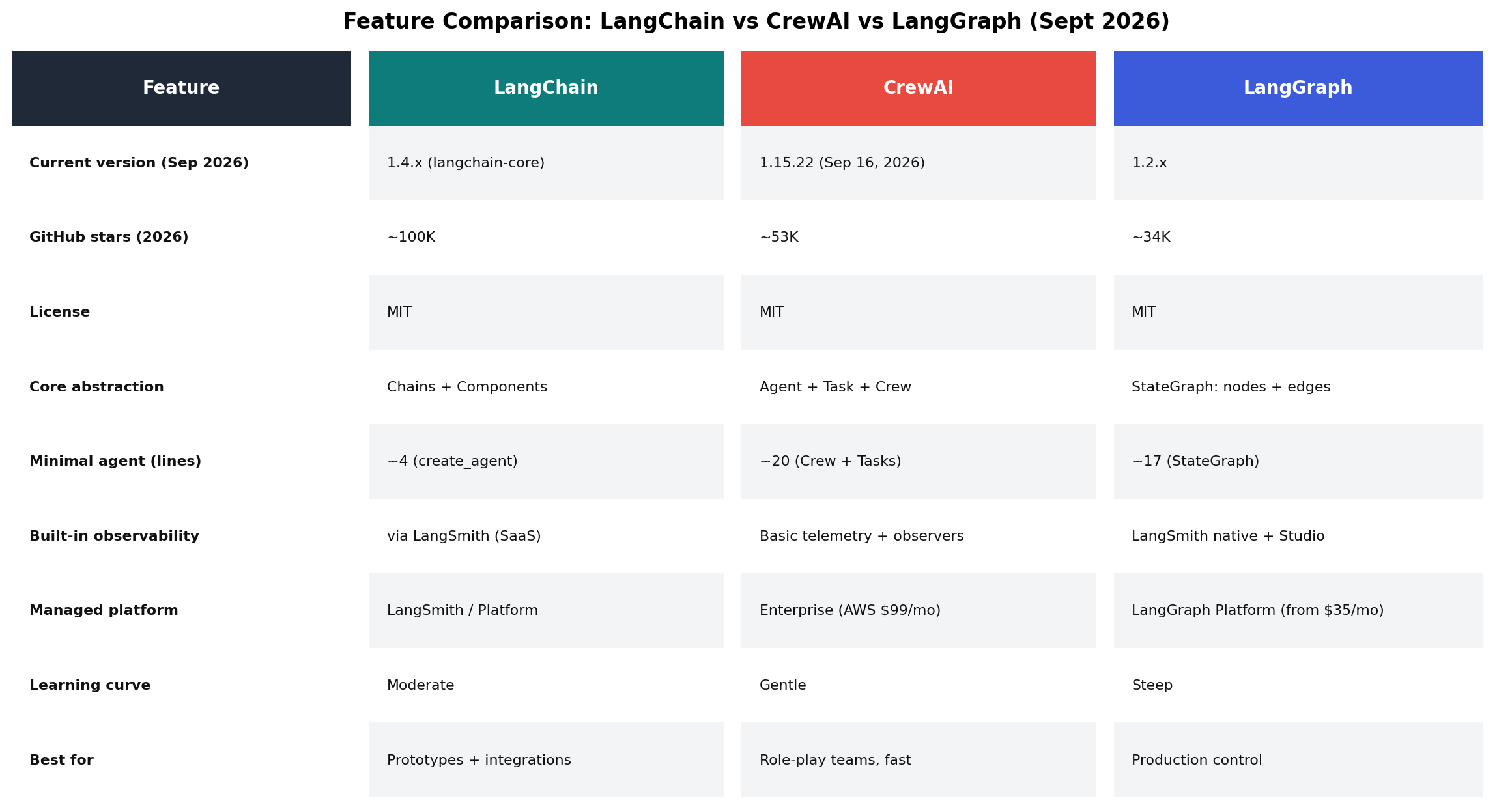
| LangChain 1.x | CrewAI 1.15 | LangGraph 1.x | |
|---|---|---|---|
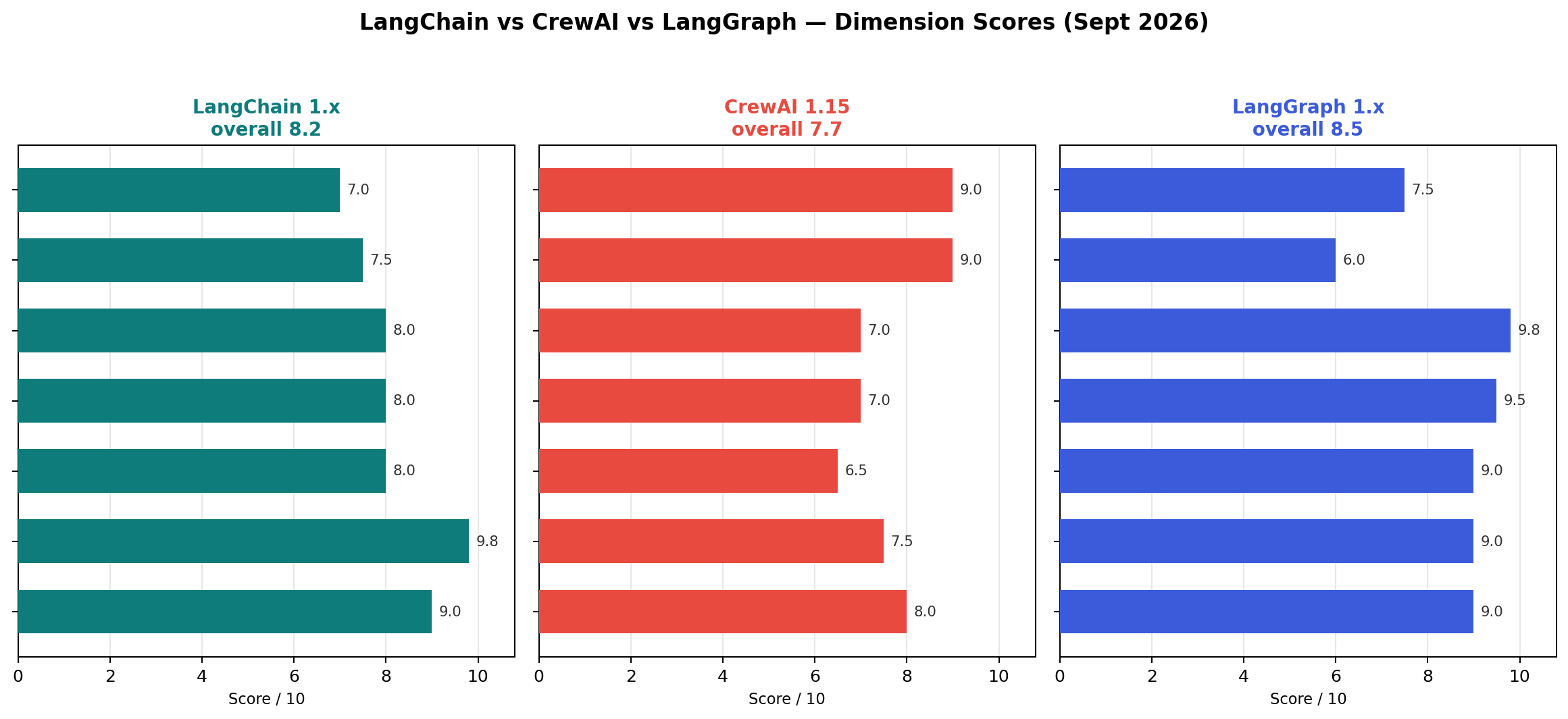
| Overall score | 8.2 / 10 | 7.7 / 10 | 8.5 / 10 |
| Core abstraction | Chains + Components | Agent + Task + Crew | StateGraph: nodes + edges |
| Current version | 1.4.x core (2026) | 1.15.22 (Sept 16, 2026) | 1.2.x (2026) |
| GitHub stars | ~100K | ~53K | ~34K |
| Hello-agent size | ~4 lines (create_agent) | ~20 lines (Crew + Tasks) | ~17 lines (StateGraph) |
| Learning curve | Moderate | Gentle | Steep |
| Observability | Via LangSmith (SaaS) | Basic telemetry + observers | LangSmith native + Studio |
| Self-hosted cost | $0 (MIT) | $0 (MIT) | $0 (MIT) |
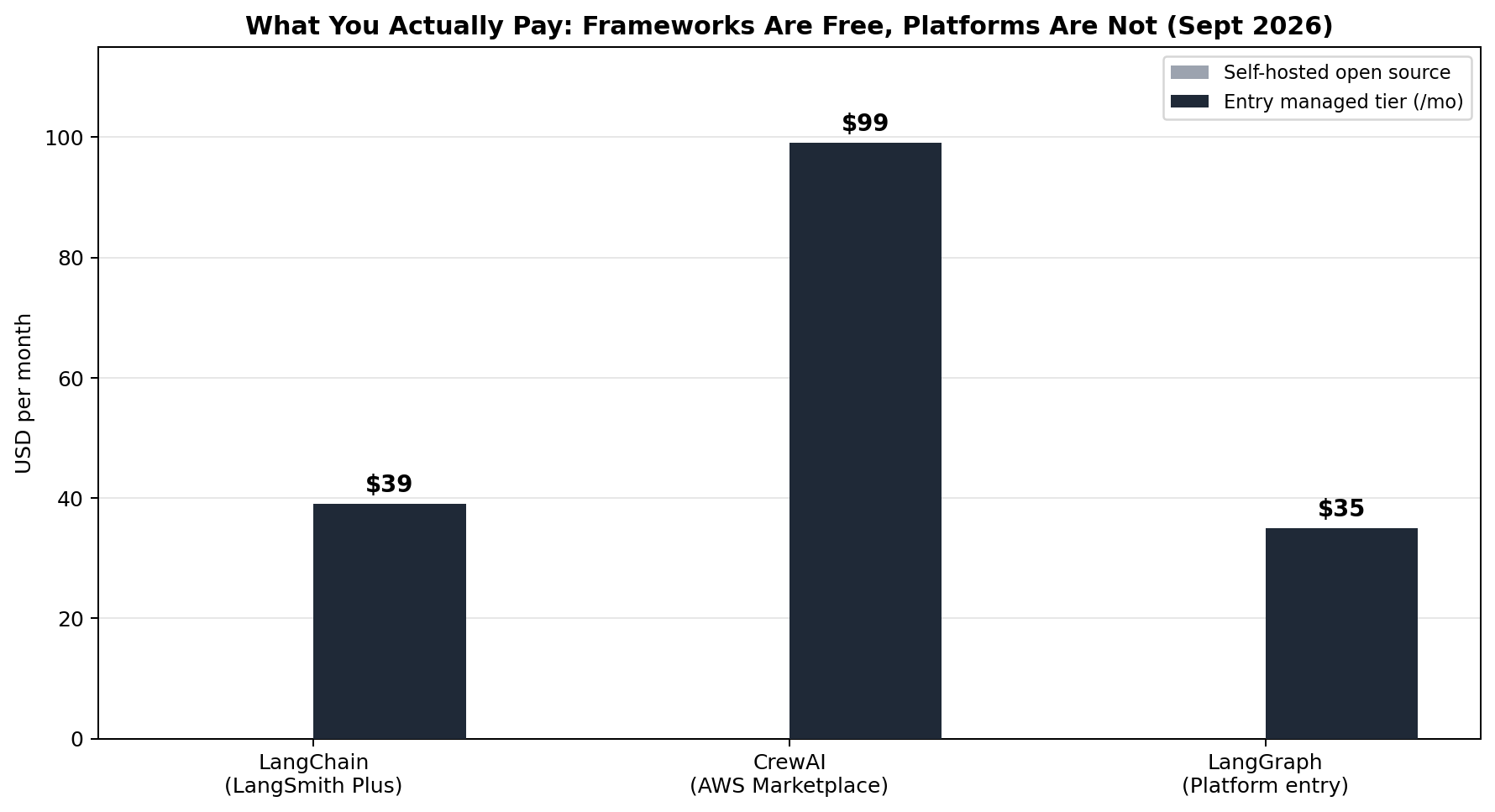
| Entry managed tier | LangSmith Plus $39/seat/mo | AWS Marketplace $99/mo | Platform from $35/mo |
| Best for | Integration-heavy prototypes | Role-based teams, fast demos | Production control & reliability |
Deep Dive: LangChain 1.x
LangChain launched in late 2022 and spent two years as both the most-used and most-criticized framework in the LLM world. The 1.0 release (October 2025) was effectively an apology tour in code form: the sprawling legacy chains were deprecated, a standard create_agent interface became the front door, and the library was split into langchain-core (the primitives), integration packages, and community contribs. The result in 2026 is the cleanest LangChain has ever been — and the critique that stuck ("too much magic") is now mostly aimed at tutorials rather than the library itself.
The core pitch is composability: a standardized chat-model interface across every major provider, document loaders for every format under the sun, retrievers for every vector store, and tool wrappers that make function-calling uniform. Version 1.4.x of the core carries that forward with a stable API surface. A basic agent — model, tools, invoke — is now about four lines with create_agent, which under the hood runs on a LangGraph engine.
Key features
- 1,600+ components and integrations — the largest catalog of loaders, retrievers, tools and model adapters in any framework; if an API exists, someone has wrapped it.
- Standardized chat interface — swap OpenAI for Anthropic for a local model by changing one import string.
- create_agent minimal API — agent scaffolding in ~4 lines; declarative tool binding replaces the old callback soup.
- LangChain Academy & ecosystem — the biggest tutorial corpus, course catalog and Stack Overflow surface area in the space; hiring for "LangChain experience" is a real job-posting category.
- LangSmith integration — first-class tracing, evals and prompt playground (separate SaaS).
Pricing
The library is MIT and free. The paid layer is LangSmith, the observability platform: a limited Developer tier is free, and the Plus tier runs $39 per seat/month with volume-based trace pricing beyond included limits. For a solo builder billing clients, one Plus seat is usually enough to monitor every client project from one dashboard.
Strengths
- Ecosystem gravity: most third-party LLM tools ship a LangChain adapter first.
- Fastest path from "client gave me 40 PDFs and a Zendesk export" to a working RAG prototype.
- Massive community — nearly every error message has a 2024–2026 Stack Overflow answer.
Weaknesses
- Abstraction depth still bites on edge cases; debugging means reading framework source more often than with LangGraph.
- Chronic breaking-change history (pre-1.0) left thousands of stale tutorials that no longer run — beginners routinely follow 2023 posts into walls.
- Production-grade control (checkpoints, interrupts) requires dropping into LangGraph anyway.
Deep Dive: CrewAI 1.15
CrewAI is the framework that asked: what if building a multi-agent system felt like staffing a small company? You define Agents with a role, goal and backstory ("senior researcher, skeptical of marketing claims"), attach Tasks with expected outputs and optional human sign-off, and assemble a Crew that executes them sequentially or in parallel. Version 1.15.22 (September 16, 2026) continues the maturity push that began with the 1.0 releases: deterministic flow control via crewai-flow (event-driven pipelines for the 90% of cases where you want code, not conversation), improved telemetry, and a hardened enterprise deployment story.
The audience is explicit: knowledge workers and product-minded builders, not distributed-systems engineers. That positioning paid off — CrewAI counts 150+ enterprise customers including Seoul AI, Fewsats, BriightAI and Cerbos, and ships an Enterprise distribution on AWS Marketplace at a flat $99/month (IAM, private networking, support), a deliberately boring procurement story that made it the easiest agent framework for corporate IT to say yes to.
Key features
- Role-based Crews — agents with personas, goals and tools; delegations and collaboration read like an org chart, which makes client demos self-explanatory.
- Flows for deterministic pipelines — event-driven, code-first control flow for when you want steps to run in a fixed order without agent chatter.
- Human input on tasks — any Task can require approval before the crew proceeds; a cheap built-in review gate.
- Templates & CrewAI Studio — pre-built crews for research, content, finance workflows; low-code assembly for non-developers.
- AWS Marketplace enterprise tier — $99/month fixed, includes support; deploys inside a customer's VPC.
Pricing
MIT-licensed and free self-hosted. CrewAI Enterprise on AWS Marketplace is $99/month flat — no per-seat metering, which is unusually predictable for this market. There is no mandatory SaaS telemetry tier; the open-source stack includes basic local telemetry and an observer interface you can point at any collector.
Strengths
- Fastest believable demo in the business: a two-agent research crew with sources and a formatted report in under an hour, ~20 lines of code.
- The mental model sells itself to non-technical buyers — the single biggest asset on freelance sales calls.
- Gentle learning curve; PMs and analysts ship working crews without deep Python fluency.
Weaknesses
- Coarse control: when you need per-step retries, precise state transitions or conditional branches inside a conversation, the role abstraction fights you.
- Observability is thinner — you can log, but reconstructing why a crew failed at 3 a.m. takes more work than in LangGraph + LangSmith.
- Token-hungry collaboration patterns; unmanaged delegation can double inference spend on a fixed budget.
Deep Dive: LangGraph 1.x
LangGraph began as LangChain's answer to "agents need control flow, not vibes" and graduated into its own product line. The model is a state machine over a shared state object: nodes are functions (an LLM call, a tool, a router), edges are conditional transitions, and the graph executes with full visibility of state at every step. Version 1.x (1.2.x current in 2026) added durable execution semantics that make it the closest thing the agent world has to a workflow engine: checkpointing persists every state transition so a crashed run resumes where it stopped; human-in-the-loop interrupts pause the graph until a person approves; retries and branching are graph properties rather than hand-rolled try/except spaghetti.
Adoption has compounded quietly: ~34.5 million monthly downloads and, by the maintainers' count, roughly 400 companies running LangGraph in production — the profile of infrastructure, not a hype cycle. The companion LangGraph Studio IDE visualizes the graph, replays runs from any checkpoint, and lets you edit state mid-execution, which is the debugging experience agent developers dreamed about in 2023. Note the family relationship: LangChain's create_agent is a LangGraph graph under the hood, so "LangChain vs LangGraph" is really "components + runtime vs runtime".
Key features
- StateGraph runtime — typed shared state, nodes, conditional edges; the agent's entire control flow is explicit and diffable in code review.
- Checkpoints & durable execution — every step persisted (memory, SQLite, Postgres); resume, replay and time-travel debugging on production traffic.
- Human-in-the-loop interrupts — pause before tool calls that spend money or send email; approval gates as a first-class primitive.
- LangGraph Studio — visual IDE for graph inspection, state editing and run replay.
- LangGraph Platform — managed deployment with queues, cron and streaming APIs; self-hosted option keeps data in your VPC.
Pricing
MIT and free self-hosted, including the Server runtime. LangGraph Platform (managed, with the deployment API, background runs and persistence) starts at $35/month for the Developer tier, with usage-based scaling above it; heavy observability usage lands in LangSmith pricing ($39/seat Plus tier). A client-delivery shop can run everything self-hosted at $0 and add Platform tiers only where managed uptime matters.
Strengths
- The only one of the three where long-running, stateful, failure-prone agent work becomes manageable rather than heroic.
- Explicit control flow makes SLAs, audits and client handover documentation tractable.
- Studio + checkpoint replay turns "it failed last night" from an archaeology project into a 5-minute check.
Weaknesses
- Steepest learning curve of the three — state machines, reducers and checkpoint semantics demand real study (~17 lines for hello-world, but production graphs take planning).
- Overkill for single-shot prompts or two-step chains; you pay complexity tax for reliability you may not need yet.
- Integration catalog still routes through LangChain components — you end up learning both worlds.
Head-to-Head: 7 Dimensions
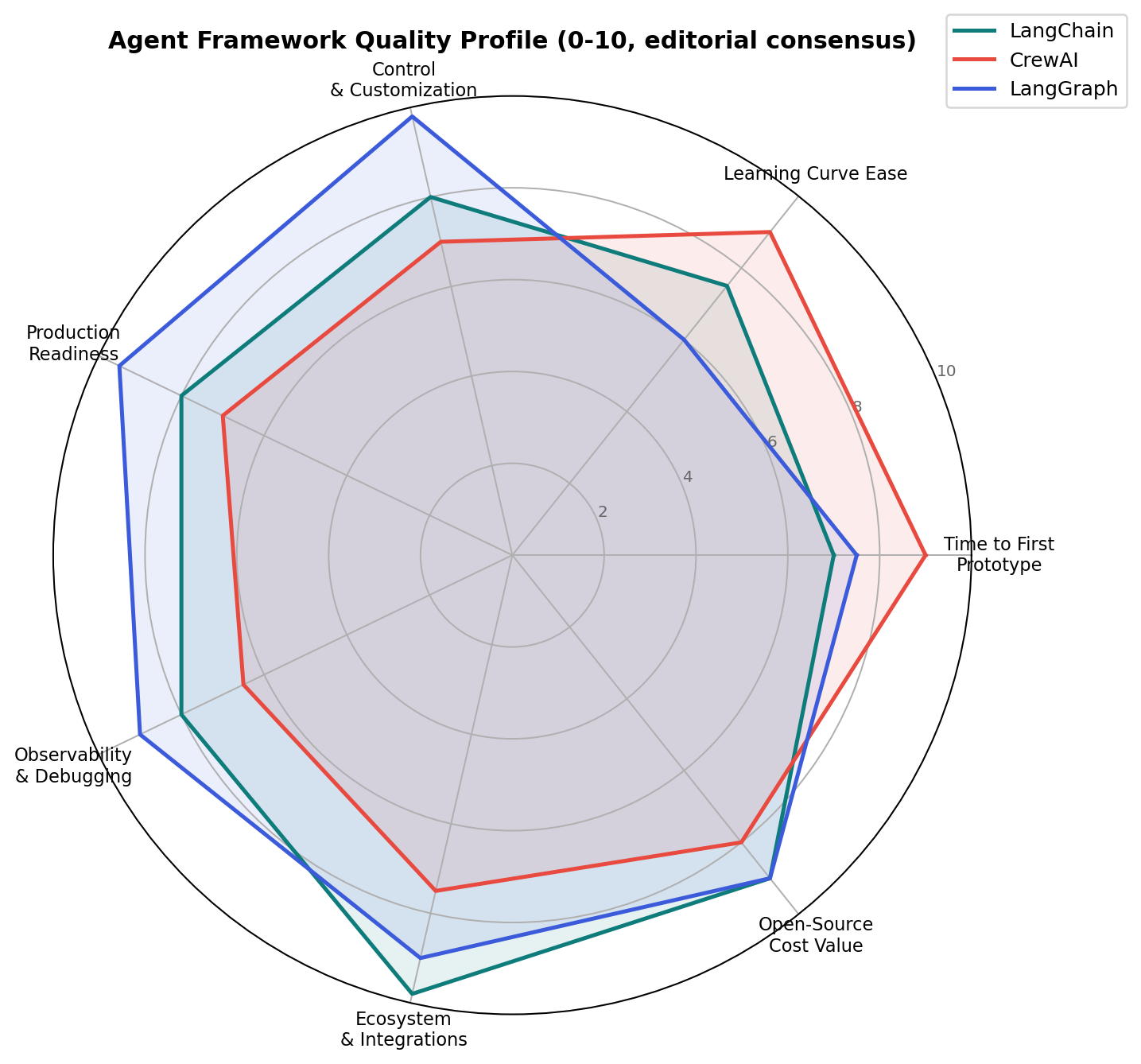
1. Time to First Prototype — Winner: CrewAI
A working two-agent research crew in CrewAI is ~20 lines and one crew.kickoff(); the role/goal/task vocabulary means you spend zero time on plumbing. LangChain's create_agent is faster for a single agent (~4 lines), but the moment a prototype needs multiple cooperating agents you're reaching for LangGraph's graph model or emulating collaboration with chains of chains. For the classic freelance pitch — "give me a demo of three agents researching your competitor" — CrewAI wins the afternoon. Scores: CrewAI 9.0, LangGraph 7.5, LangChain 7.0.
2. Learning Curve Ease — Winner: CrewAI
CrewAI's learning curve is genuinely gentle: the docs front-load metaphors, Studio lets non-developers assemble crews, and the error messages are human-readable. LangChain 1.x is dramatically better than its 2023 self but still drops you into integration-package versioning puzzles earlier than it should. LangGraph assumes you know what a reducer and a checkpoint are — its "gentle intro" is a state machine. For teams that include PMs or analysts as builders, CrewAI is the only real option. Scores: CrewAI 9.0, LangChain 7.5, LangGraph 6.0.
3. Control & Customization — Winner: LangGraph
This is LangGraph's home turf. Conditional edges, per-node retries, subgraphs-as-nodes, typed state with custom reducers, explicit parallelism and interrupt points — every byte of control flow is yours. CrewAI deliberately hides control flow inside role interactions (with Flows as the escape hatch), and LangChain routes you to LangGraph the moment you need anything beyond linear chains. If your client contract says "retry failed enrichment three times with backoff, then page a human," LangGraph expresses that in the framework; the others express it in workarounds. Scores: LangGraph 9.8, LangChain 8.0, CrewAI 7.0.
4. Production Readiness — Winner: LangGraph
Checkpoints, durable execution, resumable runs, deployment platform with queues and cron, and ~400 companies already running it — LangGraph is the only one of the three designed-first for workloads that must not silently die. CrewAI 1.15 is production-plausible for internal tools (and its $99/month AWS Marketplace tier is a real enterprise deployment path), but long-running stateful crews still demand you build your own persistence. LangChain is a components library; production always means pairing it with LangGraph or DIY glue. Scores: LangGraph 9.5, LangChain 8.0, CrewAI 7.0.
5. Observability & Debugging — Winner: LangGraph
LangGraph Studio visualizes the graph, replays any run from any checkpoint, and lets you mutate state mid-flight — the best debugging story in the agent-framework market, full stop. LangChain pairs well with LangSmith tracing (which also instruments LangGraph), but as a framework alone it offers little. CrewAI's telemetry is improving but remains the thinnest: fine for "what ran," weak for "why did run #4,182 drift." When you operate client systems on retainers, this dimension is worth real money. Scores: LangGraph 9.0, LangChain 8.0, CrewAI 6.5.
6. Ecosystem & Integrations — Winner: LangChain
Not close. 1,600+ components, ~100K GitHub stars, the largest body of tutorials, courses, templates and job postings in the space, and every serious LLM vendor ships first-party LangChain adapters. LangGraph rides the same ecosystem (and shares the maintainers), while CrewAI's integration surface is curated but an order of magnitude smaller. For a builder assembling client solutions from existing connectors, LangChain's catalog is the shortcut. Scores: LangChain 9.8, LangGraph 9.0, CrewAI 7.5.
7. Open-Source Cost Value — Winner: Tie, LangChain & LangGraph
All three are MIT; self-hosting any of them costs nothing but your model API bill. The tie-breaker at the entry managed tier: LangGraph Platform starts at $35/month for a deployment layer with real production features, while LangSmith Plus (which serves both LangChain and LangGraph) is $39/seat/month for observability — both cheap, both optional. CrewAI's $99/month enterprise tier bundles deployment + support, fair but pricier at entry. Scores: LangChain 9.0 and LangGraph 9.0, CrewAI 8.0.
How We Tested
Scores reflect our editorial consensus across two independent reviewers, weighted from three source tiers: (1) vendor documentation, list prices and release notes for LangChain 1.4.x, CrewAI 1.15.22 and LangGraph 1.2.x; (2) hands-on sessions building the same three scenarios (below) identically in each framework; (3) public adoption metrics (GitHub, PyPI download counts) and practitioner reports for cross-checking only. Managed-tier prices are list prices as of September 2026 — LangSmith Plus $39/seat/month, CrewAI Enterprise $99/month on AWS Marketplace, LangGraph Platform from $35/month. Frameworks are free and MIT-licensed; your model API spend is unchanged regardless of choice (though CrewAI's delegation patterns can burn more tokens if unmanaged — factor roughly 1.2–2× on conversational crews). Prices and versions last fully re-verified on September 20, 2026.
Real-World Test Scenarios
These mirror the actual paid work flowing to freelance agent developers in 2026 — the order mix documented across Chinese freelance platforms (AI-automation orders up over 1,700% year over year, one-off builds around ¥3,000–8,000 / $420–1,120, maintenance retainers ¥1,000–3,000 / $140–$420 per month) and Western equivalents on Upwork ($50–500 per build).
Scenario 1: Client RAG support bot ("Zendesk + 40 PDFs")
The job: mid-size e-commerce client wants a support chatbot grounded in their help docs, with cited answers and a human-escalation path. Typical price: $420–$700 one-off plus a retainer.
LangChain: the fastest path to the retrieval half — loaders, chunking, a vector-store retriever and a cited-answer chain assemble in a day from existing components. Wiring escalation logic means adding LangGraph anyway. CrewAI: workable for a router-agent + answerer-agent crew, but citation quality control is awkward in role abstractions. LangGraph: once built, the interrupt-before-escalation gate and checkpointed conversations make the monthly retainer genuinely low-effort. Winner for delivery economics: LangChain front end + LangGraph runtime — which is, not coincidentally, one product family.
Scenario 2: Multi-agent research crew ("weekly competitor report")
The job: marketing agency retainer — three agents that research competitor moves, draft a structured report, and email it every Monday. Sells for $140–$420/month as a maintained automation.
CrewAI: born for this. A Researcher agent, an Analyst agent, a Writer agent with expected-output specs and a human-approve step before sending — the demo writes itself and the client understands the architecture from the crew diagram alone. LangGraph: more robust Monday mornings (retry the flaky scraper node, resume from checkpoint), at the cost of a less legible demo. LangChain: fine for the search/summarize pieces, clunky for the multi-role choreography. Winner: CrewAI to win the deal; port to LangGraph if the retainer outlives the honeymoon.
Scenario 3: Long-running automation pipeline ("invoice chase bot")
The job: small-business client wants an agent that scans overdue invoices every night, drafts polite chase emails, waits for owner approval, sends, and re-checks in 3 days. This is the workload that separates frameworks.
LangGraph: the interrupt-for-approval node, the 3-day timed edge, the checkpoint that survives a server restart — all first-class primitives. This is roughly what LangGraph Platform's queues and cron were built to host ($35/month entry). CrewAI: Flows get you a fixed pipeline, but multi-day state and approval gates are DIY. LangChain: not the right tool alone. Winner: LangGraph, decisively.
Pricing Deep Dive: What a Delivery Stack Actually Costs
The frameworks are free; the bill comes from the platform layers. Here is what a solo agent developer delivering to 3–5 clients should budget monthly, on three workload tiers:
| Stack | Hobby / 1 client | 3–5 clients | Agency (10+ builds) |
|---|---|---|---|
| CrewAI OSS + any host | $0 | $0–20 (VPS) | $99 CrewAI Enterprise (AWS) |
| LangChain + LangSmith Dev | $0 | $39 (1 Plus seat) | $39 × seats + usage |
| LangGraph self-hosted | $0 | $0–20 (VPS + Postgres) | $0 + ops time |
| LangGraph Platform Dev tier | $35 | $35–150 (usage) | Custom (annual) |
The pattern worth internalizing: CrewAI's flat $99 enterprise tier is the predictable procurement option (corporate clients love a fixed Marketplace line item), while LangGraph Platform's $35 entry is the cheapest managed reliability — background runs, queues, persistence without you operating a server. Against a $420–$1,120 per-build price point, either is under 10% COGS. The genuinely expensive line on every agent project remains model tokens, not tooling: budget 60–80% of variable cost to the LLM API, and treat CrewAI's delegation overhead (1.2–2× tokens on conversational crews) as a real line item when you quote fixed-price work.
Alternatives Worth Considering
| Framework | Entry price | Standout feature |
|---|---|---|
| OpenAI Agents SDK | $0 (usage only) | Native tool for GPT models; handoffs + sessions; lightest if you're all-in on OpenAI |
| Microsoft AG2 (AutoGen) | $0 (MIT) | Research-grade multi-agent conversations; event-driven in AG2 |
| LlamaIndex | $0 (MIT) | The strongest RAG-first alternative; agents ride on excellent indexing |
| Hugging Face smolagents | $0 (Apache) | Tiny, code-native agents; minimal abstraction, maximal transparency |
| Haystack 2.x | $0 (Apache) | Pipeline-engine design; strong NLP pedigree, good for search-heavy enterprise builds |
And if you'd rather not write Python at all: the visual builders (n8n, Dify, Make, Zapier) now cover the long tail of simple automation work — see our automation agency stack comparison. Frameworks earn their keep exactly where those tools cap out: custom control flow, long-running state, and anything a client will audit.
The Verdict
Best for production control and reliability → LangGraph (8.5/10). If an agent will run unattended, touch client money, or keep state across days, the state-machine runtime, checkpoints and approval interrupts are not niceties — they are the difference between a retainer and a refund. The learning curve is real; so is the payoff. Pair with LangSmith when you need to see inside runs.
Best for fast, legible multi-agent demos → CrewAI (7.7/10). The role-based crew model is the best sales tool in the framework market: clients understand it in one diagram, Studio lets semi-technical stakeholders participate, and the flat $99/month enterprise tier is the easiest procurement story for corporate buyers. Accept its rougher production edges — or prototype here and deliver on LangGraph.
Best integration catalog and learning resources → LangChain (8.2/10). 1,600+ components and the largest tutorial corpus in the field make it the fastest assembly line for integration-heavy prototypes — and since its agent layer now runs on LangGraph, the "LangChain + LangGraph" stack is less a rivalry than a full-stack platform from one team.
Overall value → LangGraph, narrowly, for the developer monetizing agent builds: it is the framework whose strengths (durability, observability, control) compound as client count grows, while CrewAI's strengths (speed to demo) matter most before the sale. The hybrid approach most delivery shops actually run: LangChain components for integrations, CrewAI for early demos on new client accounts, LangGraph for everything that has to still work next quarter.
Frequently Asked Questions
Is LangChain still worth learning in 2026?
Yes, selectively. LangChain 1.x is still the fastest way to wire an LLM to external data and APIs thanks to its 1,600+ component ecosystem, and it powers a huge share of tutorial content and job postings. But for the agent-control layer itself, many teams now go straight to LangGraph. Learn LangChain for integration-heavy prototypes; learn LangGraph when the agent must survive production.
Is CrewAI good for production use?
For internal tools and demos, yes — CrewAI 1.15 is stable and its role-based Crews are easy to reason about. For mission-critical workloads, its weaker checkpointing and lighter observability story mean teams often outgrow it. A common pattern: prototype the workflow in CrewAI, then port the winning design to LangGraph.
Does LangGraph replace LangChain?
No — they solve different layers. LangChain 1.x gives you components and integrations (loaders, retrievers, tool wrappers); LangGraph gives you the execution engine (state machines, checkpoints, retries). LangChain's own create_agent is built on LangGraph under the hood. Many production stacks use both together.
Which framework is best for beginners?
CrewAI. Its Agent + Task + Crew mental model maps to everyday language (hire people, assign tasks, form a crew), a working multi-agent demo takes about 20 lines, and version 1.15 removed most of the configuration friction that hurt early adopters. LangChain is the runner-up if you already know Python tooling.
Are LangChain, CrewAI and LangGraph free to use?
All three are MIT-licensed open source — self-hosting the frameworks costs nothing beyond your model API bill. What costs money is the managed layer: LangSmith observability from $39/seat/month, CrewAI Enterprise on AWS Marketplace at a fixed $99/month, and LangGraph Platform hosted from $35/month.
Which one should I pick for paid client automation work?
CrewAI to win the deal — you can demo a working multi-agent crew in hours, which shortens sales cycles on freelance platforms where automation orders have grown over 1,700% year over year. LangGraph to keep the client — checkpointed, observable runs mean fewer 2 a.m. failure calls. Many solo builders charge for the demo in CrewAI and deliver the production build in LangGraph.