TL;DR
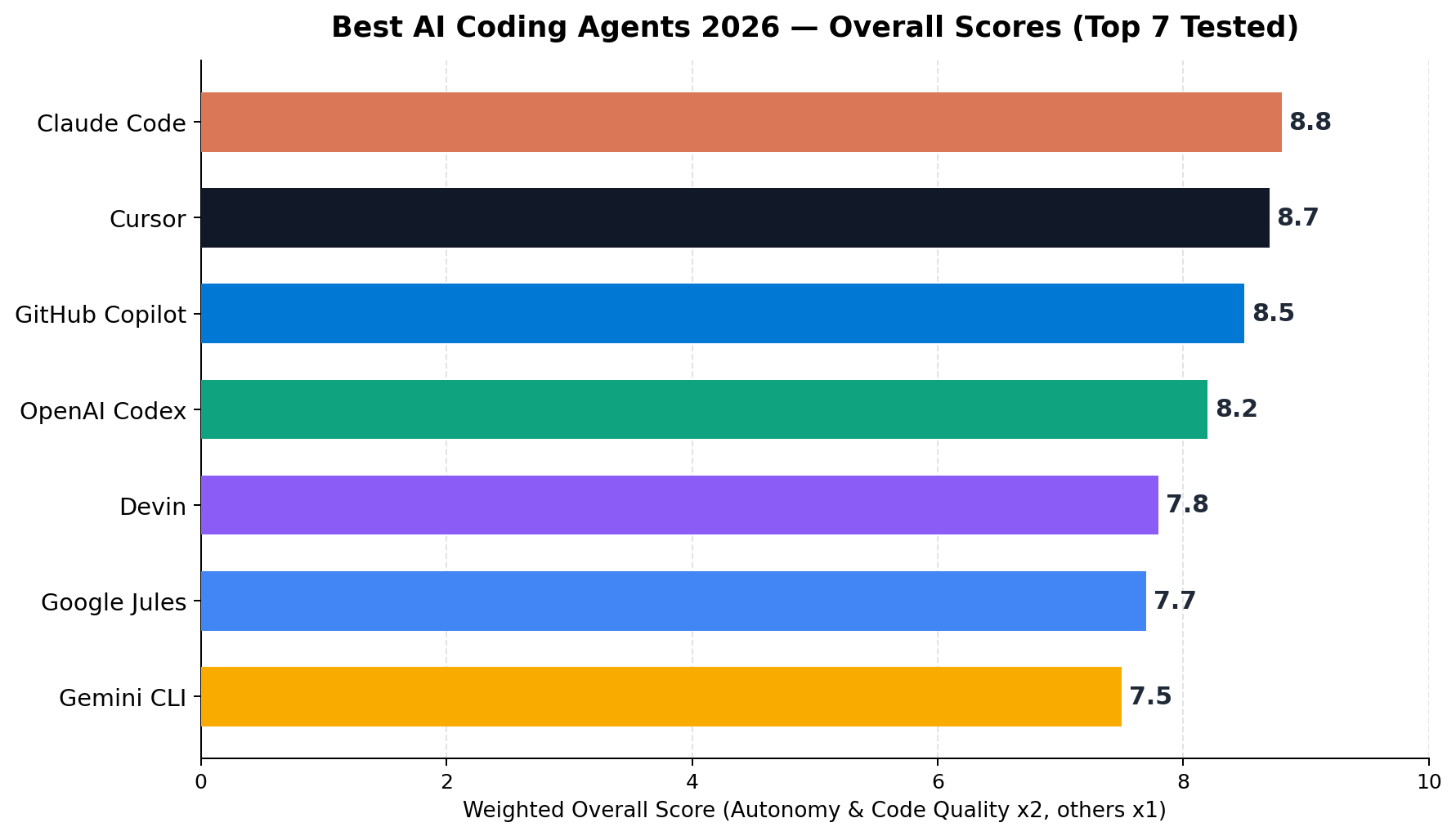
Claude Code (8.8/10) is the best AI coding agent of 2026. It scored highest on autonomy (9.7) and code quality & reasoning (9.6), runs agents in the background while you keep typing in the terminal, and turns multi-hour refactors into review sessions. No free tier — it ships with a Claude subscription ($20 Pro) or your own API key.
Cursor (8.7) is the best agent that lives inside your IDE: Composer 2.5, Tab autocomplete and whole-repo context earned it 9.7 on workflow integration and 9.0 on ease of learning. GitHub Copilot (8.5) is the best-value serious agent at $10/month with the easiest onboarding (9.4).
Free picks: Google Jules (7.7) runs 15 async tasks a day on cloud VMs and returns pull requests; Gemini CLI (7.5) gives you 1,000 requests/day and a 1M-token context window — the two best $0 stacks for marketplace gigs. Quick verdict: default to Claude Code for hard problems, Cursor for daily driving, Copilot for teams on a budget.
The 7 Best AI Coding Agents at a Glance
| # | Agent | Score | Best For | Entry Price |
|---|---|---|---|---|
| 1 | Claude Code | 8.8 | Hardest refactors, deepest reasoning | $20/mo Pro |
| 2 | Cursor | 8.7 | Daily driver inside the IDE | $20/mo Pro |
| 3 | GitHub Copilot | 8.5 | Best value for teams | $10/mo Pro |
| 4 | OpenAI Codex | 8.2 | ChatGPT-centric local + cloud work | $20/mo Plus |
| 5 | Devin | 7.8 | Overnight parallel backlogs | $20/mo Core + ACU |
| 6 | Google Jules | 7.7 | Free async fixes on GitHub | Free (15 tasks/day) |
| 7 | Gemini CLI | 7.5 | Free terminal agent, huge context | Free (1,000 req/day) |
What Changed for AI Coding Agents in 2026
The category didn't just improve in 2026 — it forked. Two years ago "AI coding assistant" meant autocomplete in your editor. Today the tools that matter are agents: you describe a task, they read the repo, edit files, run commands, and hand you a diff. Three shifts define the field this year:
- Everyone shipped a terminal agent. OpenAI turned Codex into a CLI plus cloud task runner, Anthropic's Claude Code became the default power-user tool, and Google entered from both sides — Gemini CLI in your terminal, Jules in the browser. The IDE-only era is over.
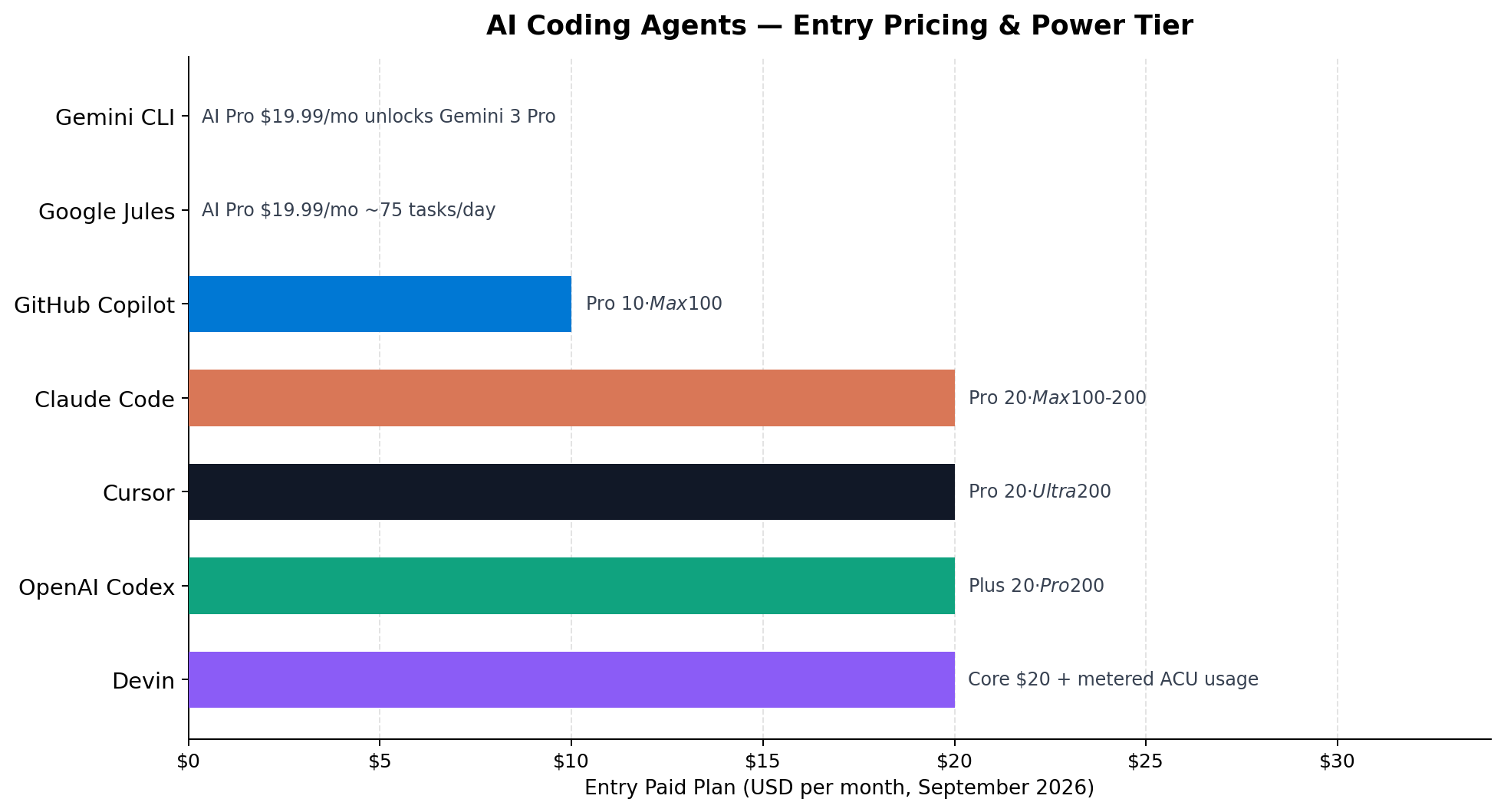
- Power tiers hit $200. Cursor Ultra and ChatGPT Pro both list at $200/month, Claude Max runs $100–200 depending on usage, and Copilot Max caps at $100. Entry plans stayed at $10–20 — the gap between "serious" and "maximum" has never been wider.
- Free tiers got genuinely usable. Gemini CLI's 1,000 requests/day with a 1M-token context window and Jules' 15 async tasks/day are not demos — they're enough to run small client gigs at zero tooling cost, which is exactly what freelance markets are doing. AI-assisted coding orders on Chinese marketplace Xianyu reportedly grew 1,732% year over year.
How We Tested
Our sources, in order of weight: (1) vendor list prices and product documentation for every plan tier and rate limit quoted below; (2) hands-on sessions with identical prompts on each agent — the same three builds described in the Real-World Test Scenarios section, run on the same repos; (3) public benchmarks and community reports, used only as cross-checks, never as the primary source.
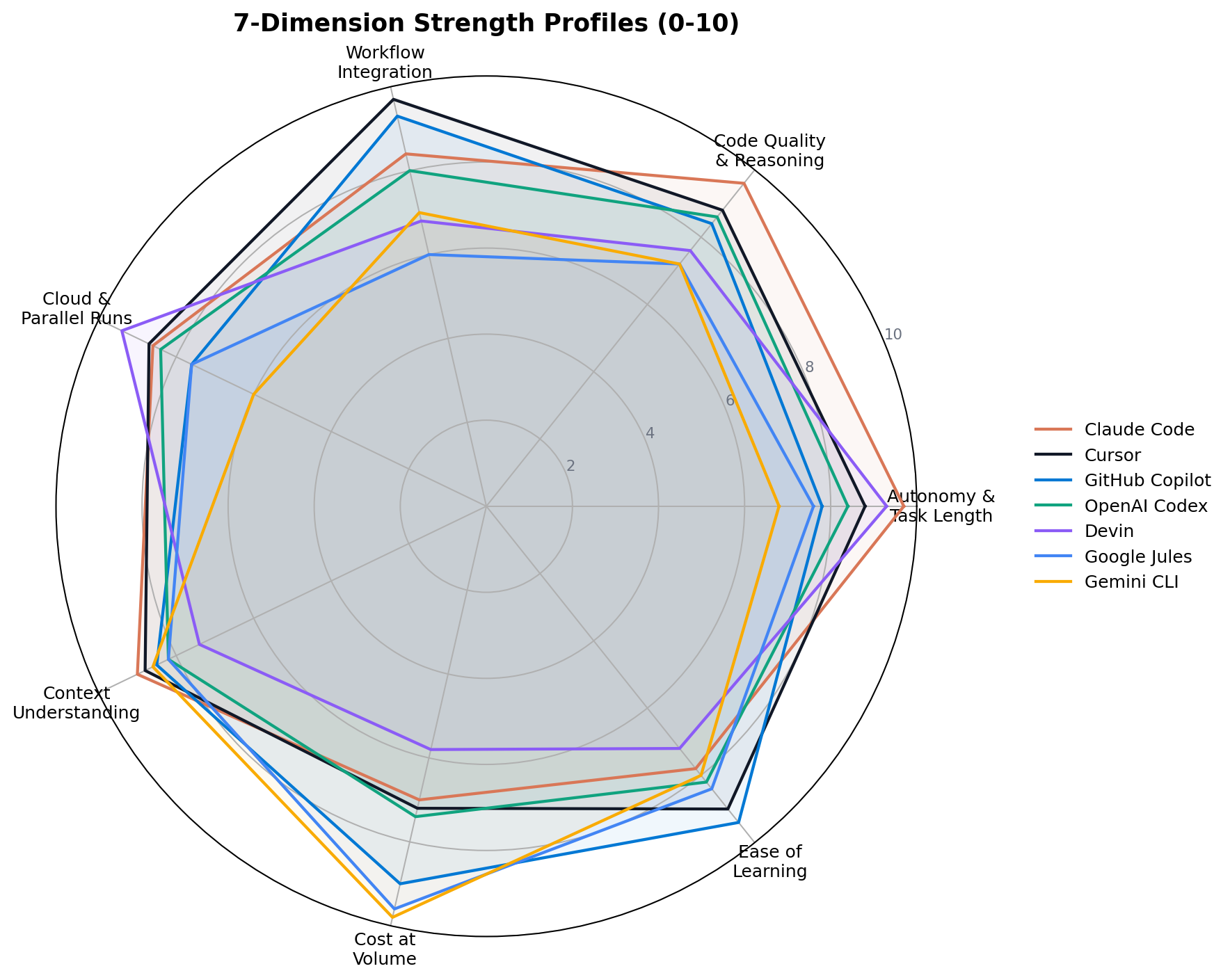
Each agent received a 0–10 score on seven dimensions: Autonomy & Task Length, Code Quality & Reasoning, Workflow Integration, Cloud & Parallel Runs, Context Understanding, Cost at Volume, and Ease of Learning. The headline number weights autonomy and code quality ×2 because those two traits define what an agent is for; the other five count once. Scores are the editorial consensus of two independent reviewers after the hands-on rounds. Prices and model versions were last fully re-verified on September 23, 2026.
The Scoreboard: 7 Agents, 7 Dimensions
| Agent | Autonomy | Code Quality | Workflow | Cloud/Parallel | Context | Cost | Ease |
|---|---|---|---|---|---|---|---|
| Claude Code | 9.7 | 9.6 | 8.4 | 8.6 | 9.0 | 7.0 | 7.8 |
| Cursor | 8.8 | 8.8 | 9.7 | 8.7 | 8.8 | 7.2 | 9.0 |
| GitHub Copilot | 7.8 | 8.4 | 9.3 | 7.6 | 8.5 | 9.0 | 9.4 |
| OpenAI Codex | 8.4 | 8.6 | 8.0 | 8.4 | 8.2 | 7.4 | 8.2 |
| Devin | 9.3 | 7.6 | 6.8 | 9.4 | 7.4 | 5.8 | 7.2 |
| Google Jules | 7.6 | 7.2 | 6.0 | 7.6 | 8.2 | 9.6 | 8.4 |
| Gemini CLI | 6.8 | 7.2 | 7.0 | 6.0 | 8.6 | 9.8 | 8.0 |
Bold marks the dimension leader. Two dimensions split the field sharply: on autonomy, the gap between Claude Code (9.7) and Gemini CLI (6.8) is the whole story of what you're paying for; on cost at volume, the free Google stack (9.6–9.8) sits three full points above Devin (5.8), whose metered ACU billing adds up fast on heavy weeks.
Strength Profiles
#1 Claude Code — Best Overall (8.8/10)
What it is: Anthropic's terminal-first coding agent. It installs in one command, indexes your repo, and then does something deceptively simple: it works like a colleague who never gets tired of reading your codebase. Plan Mode lets it propose a multi-step approach before touching files; background agents keep working while you stay in the flow; checkpointing lets you rewind a bad direction.
Why it wins: the two dimensions that define an agent are the two it dominates — Autonomy & Task Length 9.7 and Code Quality & Reasoning 9.6. In our hands-on builds it was the only agent that reliably took a vague brief ("this checkout flow drops items when the session expires — find out why and fix it properly") and returned a correct, tested diff without hand-holding. Context understanding (9.0) is equally real: it holds the shape of a large repo in its head across a long session.
Pricing: no free tier. Claude Pro at $20/month includes Claude Code usage; Max tiers at $100–200/month add Opus-class models and far higher limits. You can alternatively run it on your own API key and pay per token.
Weaknesses: it lives in the terminal (IDE plugins exist but are secondary), so the learning curve (7.8) is steeper than any IDE-native rival, and cost at volume (7.0) is mid-pack — heavy weeks on Max plans add up.
Bottom line: if you make a living shipping code — especially freelance or solo — this is the agent that changes what you can quote.
#2 Cursor — Best In-IDE Daily Driver (8.7/10)
What it is: a VS Code fork rebuilt around AI. Composer 2.5 orchestrates multi-file agent edits inside the editor, Tab is the best autocomplete in the business, and whole-repo context means the agent knows your conventions, not just the open file. Cloud Agents extend sessions to Cursor's infrastructure when you want async runs.
Why it ranks here: Workflow Integration 9.7 — the highest single score any tool posted on any dimension. Nothing else blends agent, editor, diff view and terminal that smoothly. Add 9.0 on ease of learning and 8.8s across autonomy, code quality and context, and you get the roundest polygon in the radar chart: no weak dimension below 7.2.
Pricing: a limited free tier exists; Pro at $20/month is the daily-driver plan; Ultra at $200/month targets heavy agent usage.
Weaknesses: it's an IDE commitment — if your team lives in another editor, Cursor's advantage evaporates. Deep multi-hour autonomy still trails Claude Code (8.8 vs 9.7).
Bottom line: the tool you'll actually spend your day in. For speed of iteration on client work, nothing beats it.
#3 GitHub Copilot — Best Value for Teams (8.5/10)
What it is: the agent that's already inside your stack: IDE extensions, a CLI, and a GitHub coding agent that can be assigned issues and opens pull requests on its own. Onboarding is nearly zero-effort — sign in with GitHub and it works.
Why it ranks here: Cost at Volume 9.0 at a headline price nobody else matches — Pro at $10/month, Max at $100. Ease of Learning 9.4 is the best in class, and workflow integration (9.3) is second only to Cursor, with native issue-to-PR automation GitHub users get for free.
Pricing: limited free tier; Pro $10/month; Max $100/month.
Weaknesses: autonomy (7.8) and cloud/parallel runs (7.6) trail the leaders — its agent mode is best on scoped, well-described tasks rather than open-ended investigations.
Bottom line: for a team of five on GitHub, $50/month total for a serious agent stack is the best deal in this entire list.
#4 OpenAI Codex — Best for the ChatGPT-Centric Workflow (8.2/10)
What it is: OpenAI's agent in three shapes — a terminal CLI, an IDE extension, and cloud tasks — all unlocked by one ChatGPT subscription. If your whole stack is already OpenAI, Codex is the agent that meets you where you are.
Strengths: balanced scores everywhere (8.4–8.6 on autonomy, code quality, cloud/parallel, context). The local CLI + cloud-task combo scored well on cloud & parallel runs (8.4): kick off a task from the terminal, let it run on OpenAI's infrastructure, review the PR later. Code quality & reasoning (8.6) benefits from the GPT-5.6 family behind it.
Pricing: limited free tier; Plus $20/month; Pro $200/month for heavy usage.
Weaknesses: workflow integration (8.0) — the three surfaces exist but feel like three products; ease of learning (8.2) is fine but not exceptional. Nothing here leads the category; nothing is bad.
Bottom line: the rational pick if you already pay for ChatGPT — otherwise the leaders offer sharper edges.
#5 Devin — Best for Overnight Parallel Backlogs (7.8/10)
What it is: Cognition's autonomous software engineer — a web app (plus Slack integration) where you hand tasks to ACU workers that run on Devin's own cloud, in parallel, for hours. You assign a backlog of GitHub issues before you sleep; you review pull requests in the morning.
Strengths: Cloud & Parallel Runs 9.4 — only matched by the async-first design of Jules — and Autonomy 9.3, second overall. This is the tool for volume: ten small tickets, ten parallel workers, one review session.
Pricing: trial credits to start; Core $20/month plus metered ACU usage — compute units are billed as consumed beyond the included amount.
Weaknesses: Cost at Volume 5.8 is the worst score on the board — metered ACUs on a busy week cost real money. Workflow integration (6.8): it's a separate destination, not embedded in your editor. Code quality (7.6) needs more review passes than Claude Code's output.
Bottom line: hire it for the backlog you never get to; don't make it your daily driver.
#6 Google Jules — Best Free Async Agent (7.7/10)
What it is: Google's browser-based async coding agent. Log in with GitHub, pick a repo and task, and Jules spins up a cloud VM, clones your repo, builds a plan, edits code, runs commands, and opens a pull request for review.
Strengths: Cost at Volume 9.6 — the free tier alone allows 15 tasks/day, and a Google AI Pro subscription ($19.99/month) raises it to roughly 75. For a freelancer taking ¥100–800 ($15–110) marketplace gigs, a $0 tooling bill on async PRs is a genuine moat.
Weaknesses: Workflow Integration 6.0, the lowest in the lineup — it lives in a browser tab, far from your editor. Autonomy (7.6) handles scoped fixes well but struggles on open-ended briefs.
Bottom line: the best $0/agent deal on the internet if your tasks arrive as tidy GitHub issues.
#7 Gemini CLI — Best Free Terminal Agent (7.5/10)
What it is: Google's open-source terminal agent: install, sign in with a Google account, and you get 1,000 requests/day free with a 1M-token context window — the largest context in this comparison.
Strengths: Cost at Volume 9.8, the single best score on any dimension. Context understanding (8.6) leverages that million-token window — it ingests entire small repos in one pass. A Google AI Pro subscription ($19.99/month) upgrades the model to Gemini 3 Pro.
Weaknesses: autonomy (6.8) — it needs tighter prompts and more supervision than any paid rival. No cloud runs (6.0): everything executes locally, so long tasks occupy your machine.
Bottom line: the gateway drug to coding agents, and permanently good enough for small gigs.
Pricing Deep Dive: What a Month Actually Costs
Three cost patterns matter more than the sticker prices:
- The $10–20 entry band is where value lives. Copilot Pro at $10, then Claude Pro / Cursor Pro / ChatGPT Plus / Devin Core at $20 — every one of them is a serious daily agent. The jump to $100–200 tiers buys volume (higher limits, bigger models), not fundamentally different capability.
- Metering is the hidden multiplier. Devin's ACU billing is the extreme case (5.8 on cost at volume), but per-token API billing for Claude Code behaves the same way: heavy weeks cost disproportionately more than the plan price suggests. Budget agents by workload, not by headline.
- The free Google stack covers a real workload. 1,000 Gemini CLI requests/day plus 15 Jules tasks/day is enough for a solo freelancer shipping small gigs — documented marketplace workflows (scrapers, landing pages, mini-programs) run comfortably inside those limits.
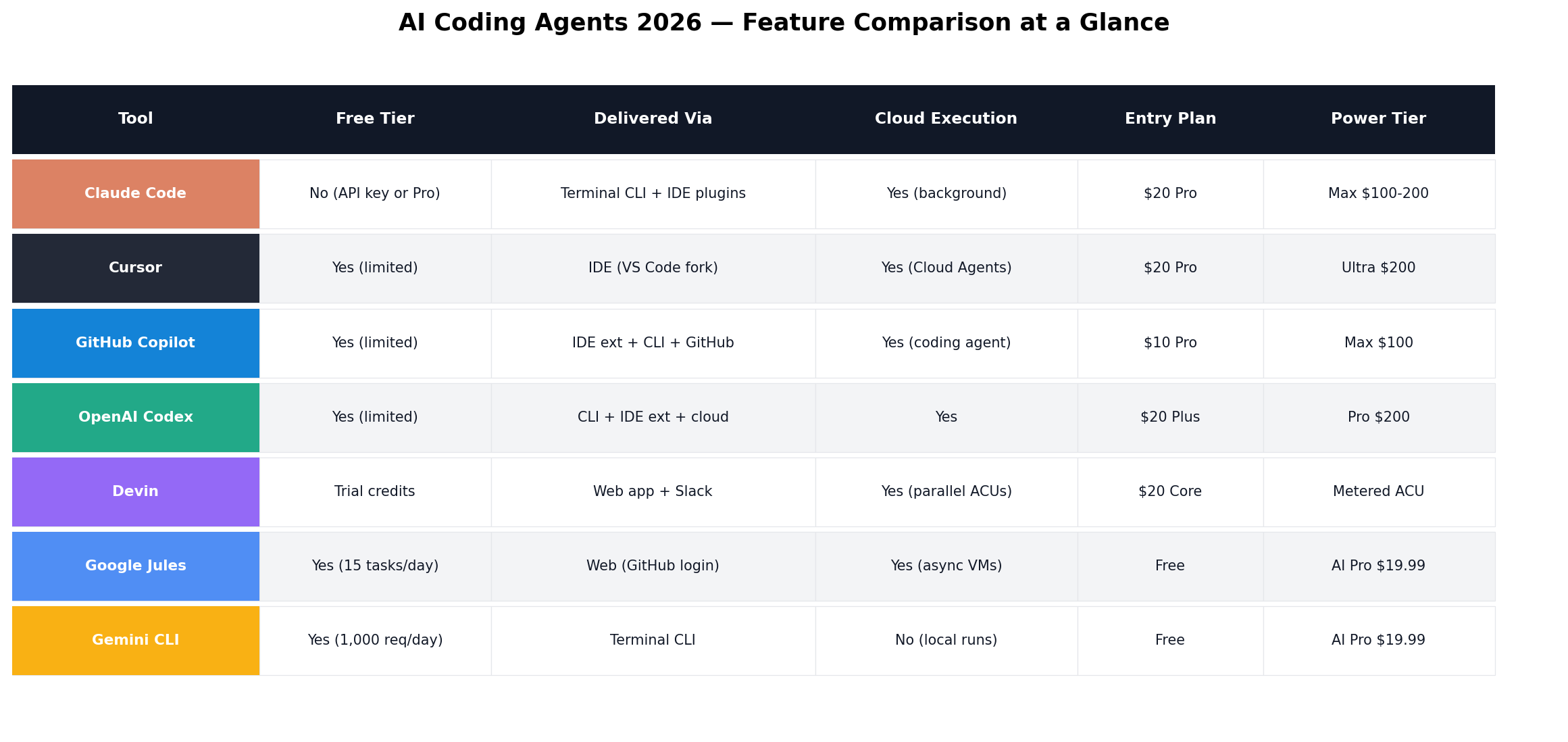
| Agent | Entry Plan | Premium Tier | Free Tier |
|---|---|---|---|
| Claude Code | $20/mo (Claude Pro) | $100–200 (Max) | None (or BYO API key) |
| Cursor | $20/mo (Pro) | $200 (Ultra) | Limited |
| GitHub Copilot | $10/mo (Pro) | $100 (Max) | Limited |
| OpenAI Codex | $20/mo (ChatGPT Plus) | $200 (ChatGPT Pro) | Limited |
| Devin | $20/mo (Core) + ACU | Metered | Trial credits only |
| Google Jules | Free; AI Pro $19.99/mo | ~75 tasks/day on Pro | 15 tasks/day |
| Gemini CLI | Free; AI Pro $19.99/mo | Gemini 3 Pro on Pro | 1,000 req/day |
Real-World Test Scenarios (With Real Money Attached)
We scored every agent on the same three builds — each one modeled on a documented freelance workflow from our 2026 money-case research files, so the tests reflect what people actually get paid for, not toy examples.
Scenario 1: The One-Off Client Website (≈ $420–1,100 per gig)
The brief: "This repo is a small business marketing site. Replace the placeholder copy with the supplied content, wire up a contact form with validation, add a Stripe payment link, and make it pass Lighthouse ≥ 90. Open a PR when done."
Prompt we used: "Read the whole repo first. List every file you plan to change and why before you edit anything. Then implement: contact form with client+server validation, Stripe payment link button, copy swap per CONTENT.md, and performance pass (image compression, lazy loading). Run the build and fix errors until green."
How the field did: Claude Code and Cursor nailed it in one pass — Claude Code's plan-then-execute approach caught a broken build step Cursor's faster loop missed on the first try. Codex and Copilot needed two rounds. Jules opened a clean PR unattended but picked the wrong lazy-loading library. Freelancers documented on marketplace ladders (Xianyu → Zhubajie → Upwork) quote ¥3,000–8,000 for exactly this shape of work; at 3–5 hours with an agent instead of 40–60 manual, the effective hourly rate goes from ¥37 to ¥500+ (~$70).
Scenario 2: The Overnight Bug-Hunt Backlog (retainer clients, $280–420/month each)
The brief: a repo with 12 real-world bugs of varying difficulty (race conditions, off-by-one pagination, a flaky test suite, one gnarly memory leak). Assign all 12 in the evening; review in the morning.
How the field did: this is Devin's home turf — parallel ACU workers chewed through 9/12 with correct fixes, the best overnight batch. Claude Code (background agents, sequentially kicked off) got 10/12 but needed a second evening. Jules finished 6 within its free 15-task daily budget at $0 tooling cost — for a solo operator, that ratio (six real bug fixes, zero dollars) is the sleeper result of this whole test. Copilot's issue-assignable agent went 7/12. Content-retainer workflows (¥1,000–3,000/month per client for maintenance) map directly onto this scenario.
Scenario 3: The Greenfield Micro-SaaS MVP (build-to-sell or early-signal launch)
The brief: "Build a URL-shortener SaaS: Next.js front end, Supabase auth + DB, usage dashboard, Stripe billing, and a clean README. Ship a working deployment."
How the field did: Cursor Composer 2.5 produced the most coherent multi-file architecture in a single session — its in-IDE diff review makes greenfield builds feel like pair programming. Claude Code matched the architecture quality but split into more checkpoints. Gemini CLI got a working v1 free (1,000 requests/day held up) though styling needed a second pass. Documented solo-operator results in this category: a marketable MVP in one focused week, versus 4–6 weeks unassisted — enough to run the "launch one micro-SaaS per month" portfolio strategy on free-tier tooling.
Which Agent Should You Pick?
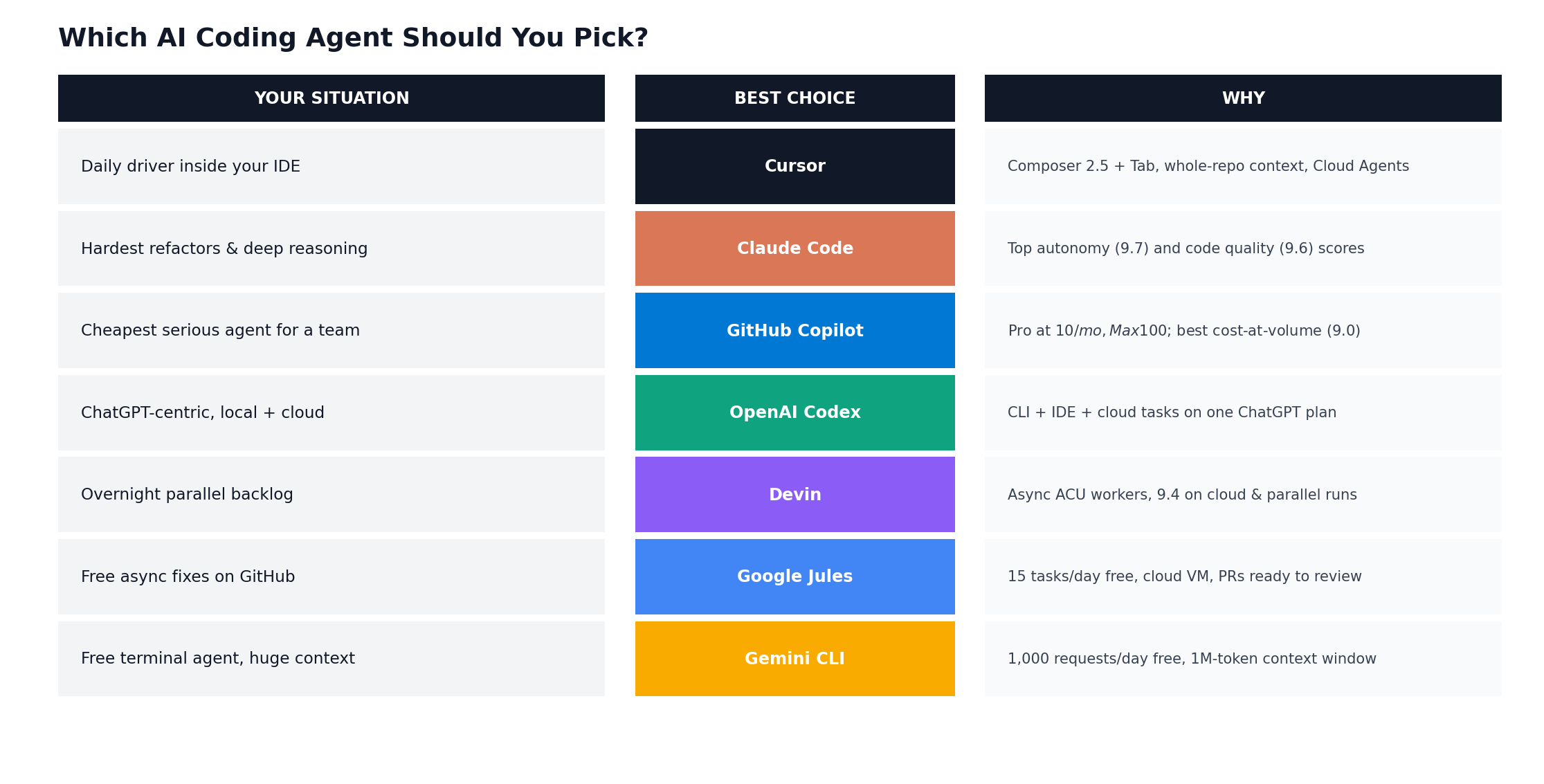
- Solo freelancer / contractor → Claude Code on Pro ($20). Highest autonomy means you quote fixed-price work with confidence.
- Established team on GitHub → Copilot Pro ($10/seat). Issue-to-PR automation with zero onboarding cost.
- Daily-driver IDE lover → Cursor Pro ($20). Best in-editor experience, period.
- Backlog owner (10+ small tickets) → Devin. Parallel overnight workers, budgeted carefully.
- $0 budget / student / testing the waters → Gemini CLI + Jules. 1,000 requests/day + 15 async tasks/day covers real gigs.
Feature Comparison at a Glance
Alternatives Worth Considering
| Tool | Starting Price | Standout Feature |
|---|---|---|
| Windsurf | $15/mo | Agentic IDE with a generous free tier — closest Cursor rival |
| Aider | Free (BYO API key) | Open-source terminal agent, git-native workflow |
| Cline | Free (BYO API key) | Open-source VS Code agent extension |
| Replit Agent 4 | $25/mo Core | Agent + hosting + database in one product |
| Trae | Free | ByteDance's free agentic IDE |
The Verdict
Best for Solo Freelancers & Contractors
Claude Code ($20/mo Pro, $100–200 Max). The autonomy and code-quality scores (9.7 / 9.6) translate directly into quoting fixed-price work profitably. If your income depends on one agent, this is the one.
Best for Established Teams
GitHub Copilot ($10/seat Pro). Issue-to-PR automation, zero onboarding friction, and the lowest per-seat cost. Five developers for $50/month.
Best Overall Value
Gemini CLI (free, 1,000 req/day) + Jules (free, 15 tasks/day). The Google free stack covers a real freelancer workload at $0/month — no other vendor offers anything close.
Best for Parallel Backlogs
Devin ($20/mo + ACUs). Ten parallel overnight workers; watch the meter.
The Hybrid Play (What We'd Actually Do)
Run Gemini CLI for daily in-terminal grunt work, Jules for async fix batches, and Claude Code Pro for the gnarly, high-stakes tasks that justify $20/month. Total: $20/month for near-maximum capability coverage.
Frequently Asked Questions
What is the best AI coding agent in 2026?
For most professional developers, Claude Code (8.8/10) — it leads our scoring on autonomy (9.7) and code quality (9.6), the two capabilities that define what a coding agent is for. Cursor (8.7) is the better pick if you want the agent fused into your IDE, and the free Gemini CLI + Jules combo is the best $0 option.
Is Claude Code better than Cursor?
They win different dimensions. Claude Code is better at long autonomous tasks and produces the highest-quality diffs with the least supervision; Cursor is better as the editor you live in — its workflow integration (9.7) is the best score any tool posted, and its learning curve is gentler. Many developers run both: Cursor for the daily loop, Claude Code for the hard problems.
What is the best free AI coding agent?
Gemini CLI — 1,000 requests/day with a 1M-token context window, open source. Pair it with Google Jules (15 async cloud tasks/day, each ending in a reviewable PR) and you have a complete free agent stack that covers real freelance workloads.
How much do AI coding agents cost per month?
Entry plans run $10–20/month: GitHub Copilot Pro $10, Claude Pro / Cursor Pro / ChatGPT Plus / Devin Core $20. Premium tiers run $100–200/month (Copilot Max $100, Claude Max $100–200, Cursor Ultra and ChatGPT Pro $200). Devin additionally bills metered ACU compute beyond its Core plan. Gemini CLI and Jules are free with generous daily limits.
Can AI coding agents finish tasks on their own?
For scoped, well-described tasks — yes, routinely: bug fixes, small features, refactors, test writing. In our 12-bug overnight test, the best agents correctly fixed 9–10 of 12 unattended. For open-ended architecture work or vague briefs, every agent still needs a human reviewing direction. Treat them as junior engineers who write fast and never get tired: supervise the plan, review the diff.
Which AI coding agent is best for freelance gigs?
Claude Code — its autonomy score means you can quote fixed-price work (client sites at $420–1,100, maintenance retainers at $280–420/month) with predictable hours. On a $0 budget, Gemini CLI + Jules covers small marketplace gigs inside their free limits; documented workflows show scrapers and landing pages shipped entirely on free-tier tooling.
Will AI coding agents replace developers?
Not in 2026 — they change what developers do. The documented freelance pattern this year is agents compressing delivery times 8–12× (40–60 hours to 3–5 for a client site), which raises effective hourly rates rather than eliminating the operator. The scarce skills are now task specification, review judgment, and integration — exactly the things agents can't do for you.