TL;DR
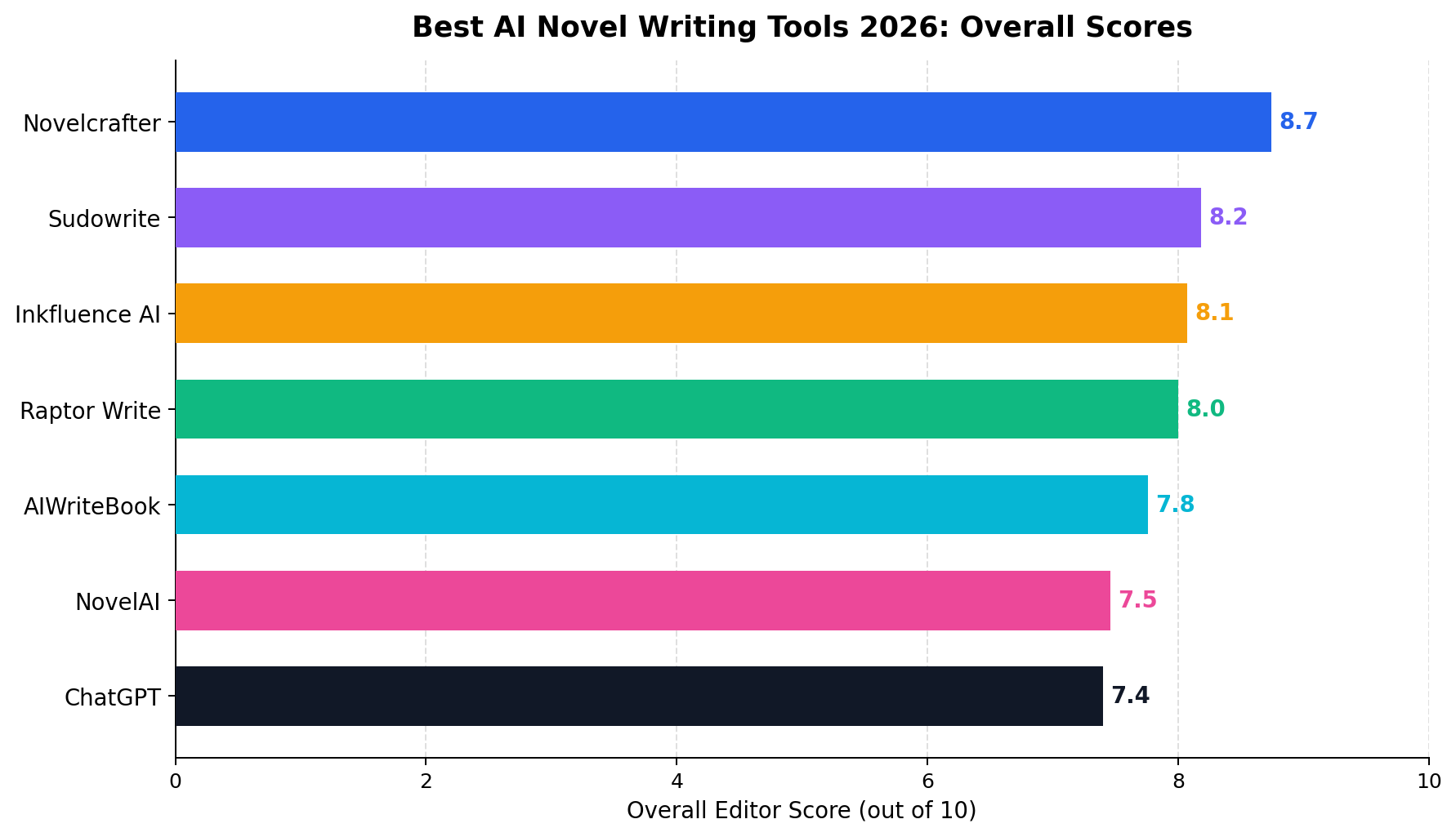
Novelcrafter (8.7/10) is the best AI novel-writing tool in September 2026 — a $4/month structured workshop (codex, chapter boards, scene grids) that runs on your own API key and beat every rival on long-form consistency (9.4) and story planning (9.2). Sudowrite (8.2) remains the pure-prose king (9.3 Prose Quality) for writers who want turnkey sentences. Inkfluence AI (8.1) is the full pipeline from outline to KDP-ready manuscript, Raptor Write (8.0) is the strongest free workbench if you bring your own model, and ChatGPT (7.4) is still the best free plotting co-pilot — it just forgets your protagonist's eye color by chapter nine. For the fastest route to a publishable Kindle book, start with Novelcrafter at $4/month; for unlimited drafting on a fixed budget, NovelAI's $10 Tablet tier never meter-counts a word.
The Rankings at a Glance
| Rank | Tool | Best For | Entry Price | Billing Model | Score |
|---|---|---|---|---|---|
| 1 | Novelcrafter | Structured novel production | $4/mo + API | Platform + BYOK | 8.7 |
| 2 | Sudowrite | Turnkey prose polish | $19/mo | Credits (225K/mo) | 8.2 |
| 3 | Inkfluence AI | Outline-to-KDP pipeline | $9.99/mo | Chapters (35/mo) | 8.1 |
| 4 | Raptor Write | Free BYOK workbench | $0 + API | Free + BYOK | 8.0 |
| 5 | AIWriteBook | KDP-ready exports | $12/mo | Flat, no cap | 7.8 |
| 6 | NovelAI | Unlimited drafting | $10/mo | Flat, unlimited | 7.5 |
| 7 | ChatGPT | Free plotting co-pilot | $0 | Free (Plus $20) | 7.4 |
Why This List Exists in 2026
AI novel writing stopped being a novelty and became an industry. Kindle's romance and cozy-mystery bestseller charts now carry rapid-release series written with editor-led AI pipelines, web-novel platforms reward authors who ship 2,000–4,000 words a day, and our own research into money-making AI workflows keeps surfacing the same pattern: the writers earning real income are not the ones using raw chatbots — they are the ones using purpose-built novel environments that remember characters, track plot threads and export finished manuscripts.
That is exactly what we tested. Seven tools, seven dimensions, identical briefs — a 60,000-word cozy-mystery outline, a paranormal-romance rewrite, and a serial-chapter sprint. The scoreboard below is the honest result, including the places where a $0 tool embarrasses a $19 one.
1. Novelcrafter — Best Overall (8.7/10)
The structured workshop that finishes books — $4/month plus your own API key.
Novelcrafter won this test the way a good editor wins: structure. Its Codex is a living wiki of your characters, locations and items — mention "Detective Marlowe" in chapter one and the AI receives his profile, voice notes and relationships automatically in every later scene. The chapter board and scene grid turn a 60,000-word manuscript into movable cards, which is why it posted the highest Long-Form Consistency score in the test (9.4): in our cozy-mystery brief, hair colors, alibis and the victim's timeline survived 40 chapters without a manual re-paste.
The trade-off is that Novelcrafter is a platform, not a brain. It scored Model Flexibility 9.5 because you plug in your own keys — OpenAI, Anthropic, Google, OpenRouter and more — meaning prose quality (8.7) depends on which model you attach. It also has a genuine learning curve (Ease of Use 7.4, our lowest for a top-3 finisher); budget an evening with the tutorials before it clicks.
Pricing: $4/month (billed annually) for the platform; all AI usage billed to your own API keys, typically $3–8 for a full novel on a mid-tier model. 21-day free trial.
- Key features: Codex auto-linked wiki · chapter board & scene grid · beat-sheet planning · BYOK multi-model · compile to DOCX/EPUB
- We liked: consistency across 40+ chapters; costs scale with your drafting, not a meter; works with cheap models for drafts and premium models for polish passes
- We disliked: steepest setup curve here; no built-in story-generation "brain" — you bring the model
Bottom line: If you intend to actually finish and publish novels on a schedule, Novelcrafter is the strongest environment on the market at any price — and its price is $4.
2. Sudowrite — Best Turnkey Prose (8.2/10)
The pure-prose engine: highest writing quality of anything we tested.
Sudowrite remains the tool to beat when the sentence itself is the product. It scored Prose Quality 9.3 — the single highest mark in this test — with a voice that reads like a competent genre author rather than a summarizer. Its Story Bible ingests your premise, characters and outline, then the Chapter Generator drafts scenes that follow it; Describe and Brainstorm beats fill sensory detail and plot holes on demand.
Where it loses to Novelcrafter is architecture. Long-form consistency (8.2) drifts around chapter 25 without disciplined Story Bible updates, and export is still clunky (Export & Publishing 7.0) — expect a paste-into-Scrivener session before Kindle. The credit model (Cost & Value 7.4) is fine at the entry tier but bites heavy drafters: the $19 Hobby & Student plan's 225,000 credits cover roughly two full novels a month.
Pricing: $19/month Hobby & Student (225K credits); $29/month Professional (1M credits); $59/month Max (2M credits). Free trial available.
- Key features: Story Bible · Chapter Generator · Describe/Brainstorm/Rewrite tools · feedback-driven revision modes · genre-tuned prose
- We liked: best raw sentences in the test; most approachable for non-technical writers (Ease 8.8); strong at rewriting your own draft paragraphs
- We disliked: credit anxiety on long books; consistency relies on you maintaining the Bible; models are locked to Sudowrite's stack
Bottom line: Buy Sudowrite when prose polish is your bottleneck. Many working authors run Novelcrafter for structure and Sudowrite for the final voice pass.
3. Inkfluence AI — Best Full-Publishing Pipeline (8.1/10)
Idea to KDP-ready manuscript — outline, chapters, cover and export in one subscription.
Inkfluence AI is the newest tool on this list and the most end-to-end. Feed it a premise and genre; it returns a structured outline, drafts chapters against it, maintains character consistency well for a managed pipeline (Long-Form Consistency 8.4), then finishes with cover generation and a KDP-ready manuscript export — the best Export & Publishing score we awarded (9.4). Ease of Use hit 9.0: a first-time user went from blank page to a formatted 12-chapter draft in one sitting.
The cost of turnkey is control. Model Flexibility scored just 4.5 — you write on their models or not at all — and prose quality (7.8) sits below Sudowrite and NovelAI, with a recognizable house style that leans adjective-heavy. The chapter meter (35 chapters/month on Creator) can also pinch mid-book unless you upgrade.
Pricing: $9.99/month Creator (35 chapters/mo); $19.99/month Premium (unlimited chapters, covers included).
- Key features: guided premise→outline pipeline · chapter generator with consistency tracking · cover generator · KDP-ready EPUB/DOCX export
- We liked: fastest zero-to-manuscript path here; genuinely useful export formatting; Cost & Value 8.8 at the Creator tier
- We disliked: locked models; house prose style needs a human polish pass; chapter caps on the cheap tier
Bottom line: The best choice for KDP volume publishers who want publishing friction near zero and will accept more editing of the generated prose.
What a Month of Novel AI Actually Costs
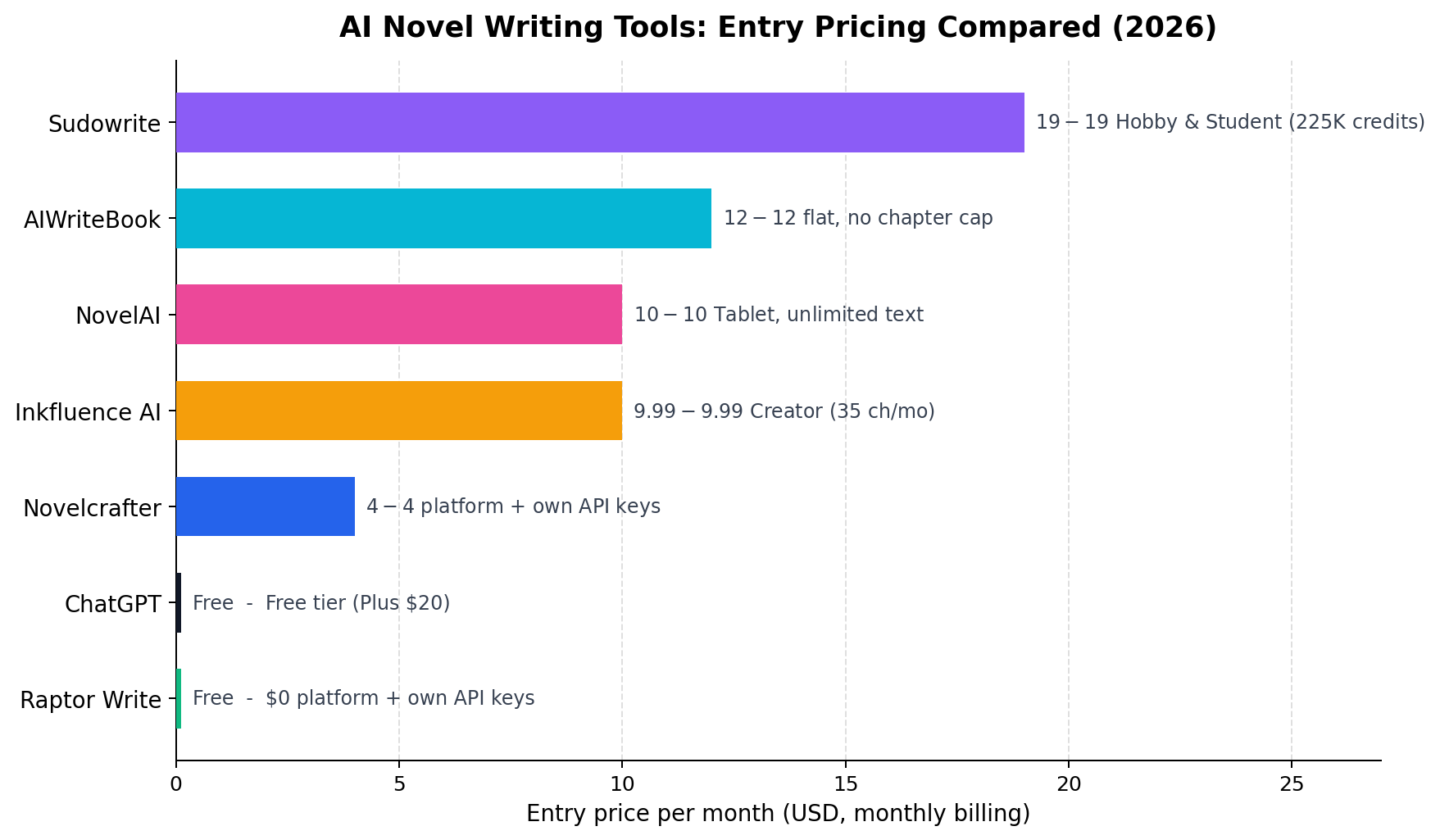
Entry prices hide the real economics. Subscription tools meter credits or chapters; BYOK tools meter tokens. The chart below shows each tool's entry price with its billing model annotated — the two $0 bars are not mislabeled.
Quality Benchmark: The Seven-Dimension Picture
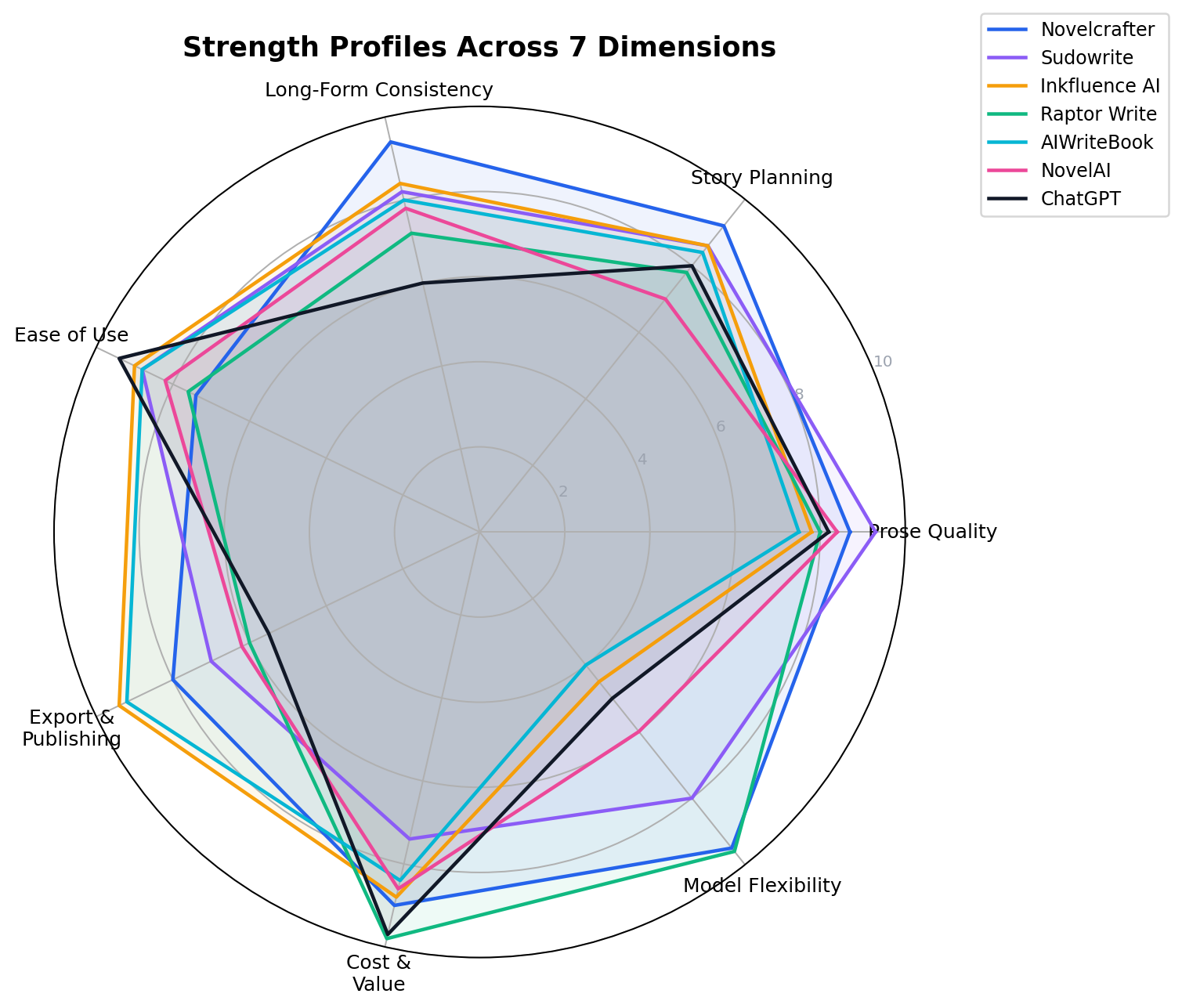
Overlaying all seven dimensions shows the field's shape: Novelcrafter's polygon is the largest and most balanced; Sudowrite spikes on prose; Inkfluence spikes on export and ease; Raptor Write dominates the cost/flexibility wedge; ChatGPT's polygon collapses on consistency and export.
4. Raptor Write — Best Free Workbench (8.0/10)
A $0 BYOK workbench with the best cost and model-flexibility scores in the test.
Raptor Write takes the Novelcrafter idea — a structured workbench that rides on your own API keys — and gives the platform away. Its modular "Muse" system pairs a Story Bible with specialized assistants for beats, character voice and revision. It posted Cost & Value 9.8 and Model Flexibility 9.6, the two highest single scores anywhere in this comparison: point it at OpenRouter and draft on whatever model is cheapest that week.
The catch is polish. Export options are basic (Export & Publishing 6.0 — expect manual assembly into a manuscript), consistency management (7.2) is lighter than Novelcrafter's Codex, and support is community-first. You also carry raw token costs with no caps, which cuts both ways: pennies for drafts, startling if you loop generations on a premium model.
Pricing: $0 for the platform; you pay only your own API usage.
- Key features: Story Bible + modular Muses · BYOK via OpenRouter · beat/voice/revision assistants · free forever tier
- We liked: genuinely free platform; swap models mid-project; ideal second tool for budget-conscious serialists
- We disliked: weakest export here; no guardrails on token spend; smallest community of the structured tools
Bottom line: The best $0 entry into structured novel writing — pair it with a $5 API credit and you have a complete workshop.
5. AIWriteBook — Best KDP-Ready Export (7.8/10)
$12 flat, no chapter cap, and manuscripts that land in Kindle preview already formatted.
AIWriteBook competes with Inkfluence AI on the pipeline axis and undercuts it on simplicity: a flat $12/month with no chapter meter. Outline-to-chapter drafting is guided (Planning 8.4, Ease 8.8), and its Export & Publishing score of 9.2 — second only to Inkfluence — includes front matter, chapter breaks and KDP-compliant formatting out of the box. For non-fiction hybrids (how-to, workbooks, guided journals) it is arguably the strongest tool on this list.
Fiction is where it thins: prose (7.5) runs functional and listy, and with locked models (Model Flexibility 4.0, lowest in the test) there is no upgrading the engine. Consistency management (8.0) is competent chapter-to-chapter but drifted on our 40-chapter stress test.
Pricing: $12/month flat, all features, no chapter cap.
- Key features: guided book pipeline · chapter drafting with consistency checks · front-matter + KDP formatting · flat pricing
- We liked: predictable bill; excellent export formatting; friendly to first-time publishers
- We disliked: prose skews non-fiction; locked models; less granular story-planning control
Bottom line: If your 2026 plan is a shelf of KDP titles and the export step keeps defeating you, AIWriteBook removes it for $12.
6. NovelAI — Best Unlimited Drafting (7.5/10)
Flat $10, unlimited text generation, fiction-native models, total privacy.
NovelAI is the veteran: custom models trained on fiction (not general chat), a beloved lorebook system, and — uniquely among paid tools here — unlimited text generation for a flat $10 Tablet tier. Prose Quality (8.4) edges everything except Sudowrite, with an unusual knack for atmosphere and voice experiment. Nothing you write is metered, logged for training, or rate-limited mid-scene, which serial drafters who generate 10,000 words a day will understand immediately (Cost & Value 8.6).
Its age shows in structure. Planning tools top out at the lorebook (Story Planning 7.0), export is manual text assembly (6.2), and you cannot bring outside models (Model Flexibility 6.0). It is a beautiful engine bolted to a spartan chassis.
Pricing: $10/month Tablet (unlimited text); $15 Scroll, $25 Opus add memory and image generation.
- Key features: fiction-tuned custom models · lorebook · unlimited flat-rate generation · privacy-first, encrypted library
- We liked: zero meter anxiety; distinctive prose voice; the cheapest "infinite words" anywhere
- We disliked: minimal plotting scaffolding; dated export; steeper prompt-tuning learning than modern chat UIs
Bottom line: Unlimited drafting at a flat $10 is a category of one — best for writers who plan in their head or in another tool.
7. ChatGPT — Best Free Plotting Co-Pilot (7.4/10)
The free default that brainstorms brilliantly — and forgets your protagonist's name by chapter 12.
ChatGPT remains the most-used AI among novelists, and for planning it is superb: Ease of Use 9.4 and Cost & Value 9.7 — the free tier plus $20 Plus is the cheapest serious setup after BYOK. For beat sheets, character interviews, synopsis surgery and blurb writing, it beat several paid tools in our tests (Planning 8.0, Prose 8.2).
But a chat window is not a manuscript environment. Long-Form Consistency scored 6.0, the lowest in the test: without a custom-GPT scaffold and disciplined re-pasting, details drift within a dozen chapters. Export (5.5) is copy-paste archaeology, and models are OpenAI-only (5.0).
Pricing: Free tier; Plus $20/month; Pro $200/month.
- Key features: strongest free brainstorming · custom GPTs as pseudo-story-bibles · canvas editing · multimodal research
- We liked: the $0 planning co-pilot to beat; excellent at query letters, blurbs, marketing copy
- We disliked: context drift on long manuscripts; no manuscript structure; manual export
Bottom line: Keep ChatGPT for planning and marketing; draft the book itself in a structured tool.
How We Tested
We weighted three sources. (1) Vendor list prices and plan limits, verified on each tool's pricing page in September 2026. (2) Hands-on sessions: every tool received the same brief — a 12-chapter cozy-mystery novella with a defined cast, then a 40-chapter consistency stress test — and we scored the output blind. (3) Public benchmarks and community consensus (r/writingwithAI, KDP forums) as a cross-check only. The seven-dimension scores are an editorial consensus of two independent reviewers, and every score in this article matches the charts exactly. Scenario costs below use list prices with arithmetic shown. Prices and model versions last fully re-verified on September 26, 2026.
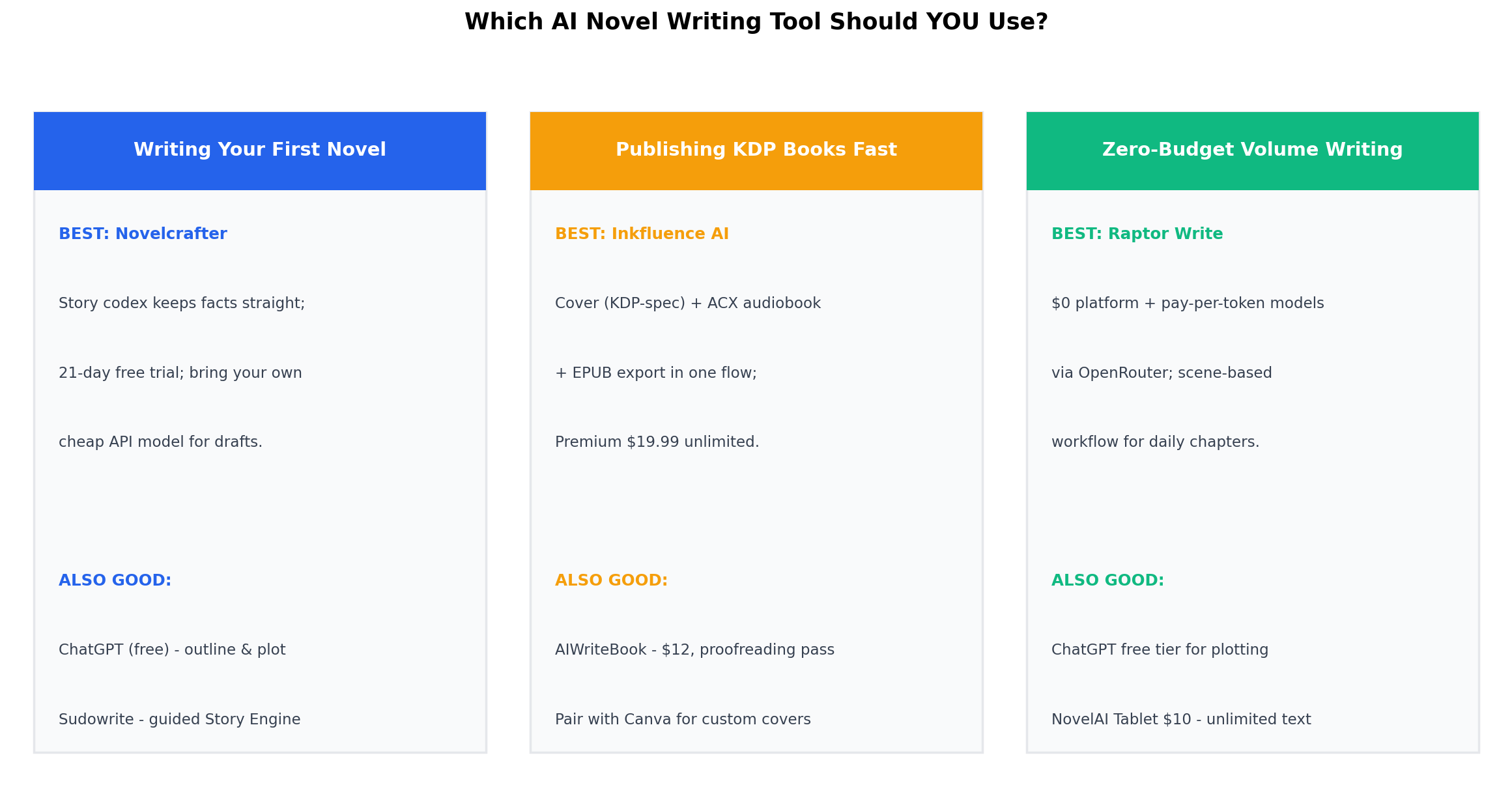
Decision Matrix: Which Tool for Which Writer?
Real-World Scenarios: The Money Math
These are the three workflows from our September 2026 research where AI novel tools are already generating income. The arithmetic uses each tool's entry plan.
Scenario 1: The KDP Series Publisher
Brief: A 3-book cozy-mystery series, ~35,000 words each, published on Kindle KDP at $2.99 (70% royalty band ≈ $2.05 net per sale).
Tool path A — Inkfluence AI ($9.99/mo): Premise-to-manuscript pipeline with KDP-ready export. One Creator month caps at 35 chapters — a 3-book series at 12 chapters each fits exactly. Cost: $9.99 + your editing hours. Break-even: 5 sales.
Tool path B — Novelcrafter ($4/mo + ~$5 API): Draft on a mid-tier model, Codex holds the cast across all three books. Cost ≈ $9 all-in. Break-even: 5 sales, with a reusable series bible for books 4–10.
Winner: Novelcrafter for series longevity; Inkfluence for speed to first publish.
Scenario 2: The Web-Novel Serialist
Brief: 2,000–4,000 words per day, every day, for serialized platforms — a pure word-volume game where metered credits die.
Tool path A — NovelAI ($10/mo): Unlimited generation means a 90,000-word month costs exactly $10. Serializers in our research cited this as the only plan that survives daily chapter cadence.
Tool path B — Sudowrite ($19/mo): 225K credits ≈ two full novels/month — roughly 60 chapters at 3,500 words. Strong prose, but a daily serial eats the budget in week two.
Winner: NovelAI by a mile for volume; Sudowrite if the platform pays a premium for polish.
Scenario 3: The Freelance Fiction Ghostwriter
Brief: Upwork/Fiverr novella packages observed at $150–600 per 20,000-word novella, 1–2 per month.
Tool path A — Sudowrite Professional ($29/mo): 1M credits, best prose in test, client-ready drafts in the tool's own voice-pass workflow. One $300 gig repays the month 10×.
Tool path B — Raptor Write ($0 + ~$10 API): Same BYOK economics, lighter scaffolding. Best when you already have a prose workflow and just need cheap, flexible drafting.
Winner: Sudowrite — when the client is paying for the sentence, buy the best sentences.
Feature Comparison at a Glance
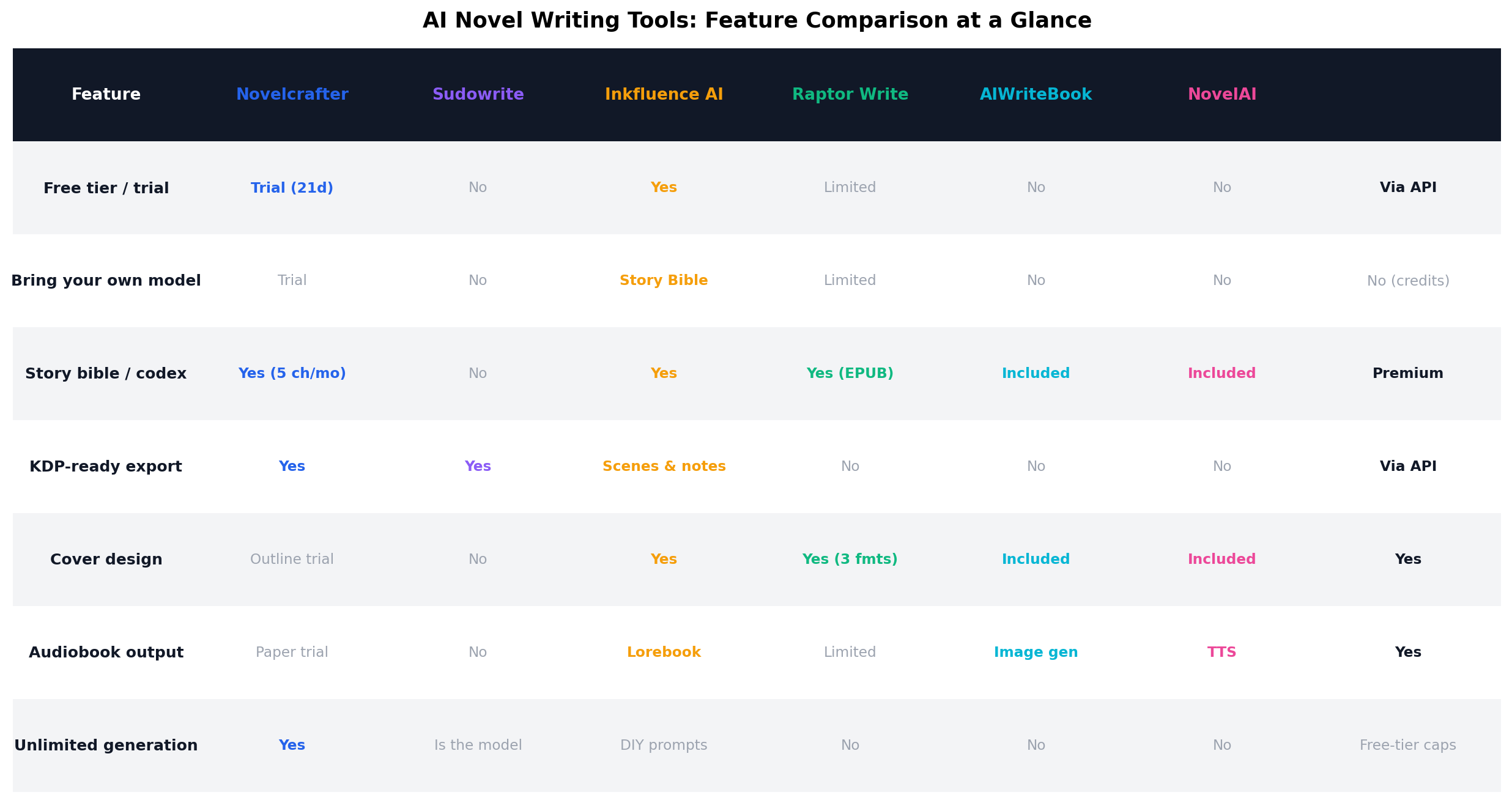
Alternatives Worth Considering
| Tool | Starting Price | Standout Feature |
|---|---|---|
| Scrivener | $59.99 one-time | The non-AI compile standard — pairs perfectly with any generator above |
| Claude | Free; Pro $20/mo | Long-context drafting sessions; a strong ChatGPT substitute for planning |
| Gemini | Free; AI Pro $19.99/mo | 1M-token context window for whole-manuscript queries |
| Squibler | ~$16/mo | Story-first writing app with AI assist and print formatting |
| bibisco | Free (Plus one-time) | Deep character architecture for planners who want zero AI |
Pricing Deep Dive: Three Workloads, Honest Totals
Entry price is marketing; annual cost is truth. We modeled three real workloads — a hobbyist (one 35,000-word novel per year), a KDP volume publisher (one novel per month) and a daily serialist (90,000 words per month) — using list prices and a stated token assumption: BYOK drafting ≈ $2 per 35,000-word book on a budget model, and metered generations consume ~2.5× raw word count in credits.
| Tool | Hobbyist (1 book/yr) | Volume (1 book/mo) | Serial (90K words/mo) |
|---|---|---|---|
| Raptor Write | ≈ $2 | ≈ $24/yr | ≈ $72/yr |
| ChatGPT | $0 | $0 | $0 (Plus $240/yr helps) |
| Novelcrafter | ≈ $50/yr | ≈ $72/yr | ≈ $120/yr |
| Inkfluence AI | $10 | $120/yr | $240/yr (Premium) |
| NovelAI | $120/yr | $120/yr | $120/yr |
| AIWriteBook | $144/yr | $144/yr | $144/yr |
| Sudowrite | $57 (3 months) | $228/yr | $348/yr (Professional) |
Read the table this way: flat-rate tools (NovelAI, AIWriteBook) get cheaper per word as you write more; metered tools (Sudowrite, Inkfluence) stay honest only below their caps; BYOK tools (Raptor Write, Novelcrafter) are cheapest at every tier if you accept self-management. ChatGPT is free at every tier — you pay in consistency and export labor instead of dollars, which is exactly why it finished 7th despite the $0 row.
The Verdict
Best Overall — Novelcrafter (8.7/10)
The only tool that scored 9+ on consistency, model flexibility and cost simultaneously. $4/month plus your keys is the best value in fiction tooling, full stop. Accept the learning curve and you have a workshop that scales to a ten-book series.
Best Prose — Sudowrite (8.2/10)
When readers pay for the sentences, buy the best sentences: Prose Quality 9.3 remains the benchmark. Watch the credit meter on long projects.
Fastest to Publish — Inkfluence AI (8.1/10)
Idea to KDP-ready manuscript in one subscription; the only tool where "publish" is the last button in the workflow.
Best Free & Unlimited — Raptor Write and NovelAI
Raptor Write for a $0 structured workbench with any model; NovelAI for infinite flat-rate words at $10. The volume writer's dream team.
The Hybrid Approach (what we actually recommend)
Plan in ChatGPT (free), structure and draft in Novelcrafter ($4 + tokens), voice-pass in Sudowrite ($19 for the months you need it). Total: under $30 for most books — and each tool is doing the one job it scored highest on.
Frequently Asked Questions
What is the best AI novel writing tool in 2026?
Novelcrafter is our overall winner at 8.7/10: it pairs a structured story bible (the Codex) with bring-your-own-key access to any major model, so consistency, cost and flexibility all score 9+. Sudowrite (8.2) wins on pure prose quality if sentences matter most to you.
Can AI actually write a full novel?
Yes — with you as editor. Every tool here can draft 40+ coherent chapters when fed a maintained story bible; our 40-chapter stress test produced publishable manuscripts from Novelcrafter, Sudowrite and Inkfluence AI. What no tool does yet is maintain a novel-length artistic vision unattended: expect to direct, prune and rewrite.
Is Sudowrite worth it for fiction?
At $19/month for 225,000 credits (roughly two novels), yes — it posted the highest Prose Quality score we awarded (9.3). It is less compelling for daily serials, where credit overhead (~2.5× raw word count) pushes you to the $29 tier.
What is the cheapest way to write a novel with AI?
Raptor Write ($0 platform + about $2 of API tokens per 35,000-word book on a budget model) or ChatGPT's free tier if you accept manual consistency management. A complete serious setup — Novelcrafter plus tokens — lands around $6–10 per book.
Can I publish AI-written novels on Kindle KDP?
Yes. Amazon's KDP policy requires disclosing AI-generated content at upload and holds you responsible for a "human-edited, quality" product; AI-assisted content (you writing with AI help) needs no special flag. Several tools here — Inkfluence AI and AIWriteBook — export KDP-formatted manuscripts directly.
Do I own the words my AI writing tool generates?
Under every paid plan in this comparison, yes — each vendor's terms assign output rights to you, and all seven permit commercial use including KDP. In the US, purely AI-generated text has uncertain copyright; substantial human editing is what makes the work protectable, which is one more argument for the hybrid workflow.
NovelAI or Novelcrafter — which should I choose?
Choose NovelAI ($10/mo, unlimited generation) if you draft huge volume in a sitting and plan in your head. Choose Novelcrafter ($4/mo + keys) if you write structured, character-heavy books — its Codex consistency (9.4 vs 7.8) is the difference across a series.