TL;DR
Gemini (8.3/10) is the better all-round AI in September 2026 — it wins four of our seven dimensions (raw reasoning, coding, context & multimodal, ecosystem) and Google's free-to-$19.99 ladder is the best value in consumer AI. Grok (8.2/10) is the specialist that beats it where freshness matters: unmatched real-time knowledge from the X firehose (9.3 vs 7.5), voice-first UX, and a flagship API at $6 per million output tokens — half of Gemini 3.1 Pro's $12. The overall gap is one-tenth of a point: this is a workflow decision, not a blowout. Our pick for most readers: run both free tiers — Gemini for deep work, Grok for breaking news — and only pay for the one your work actually leans on.
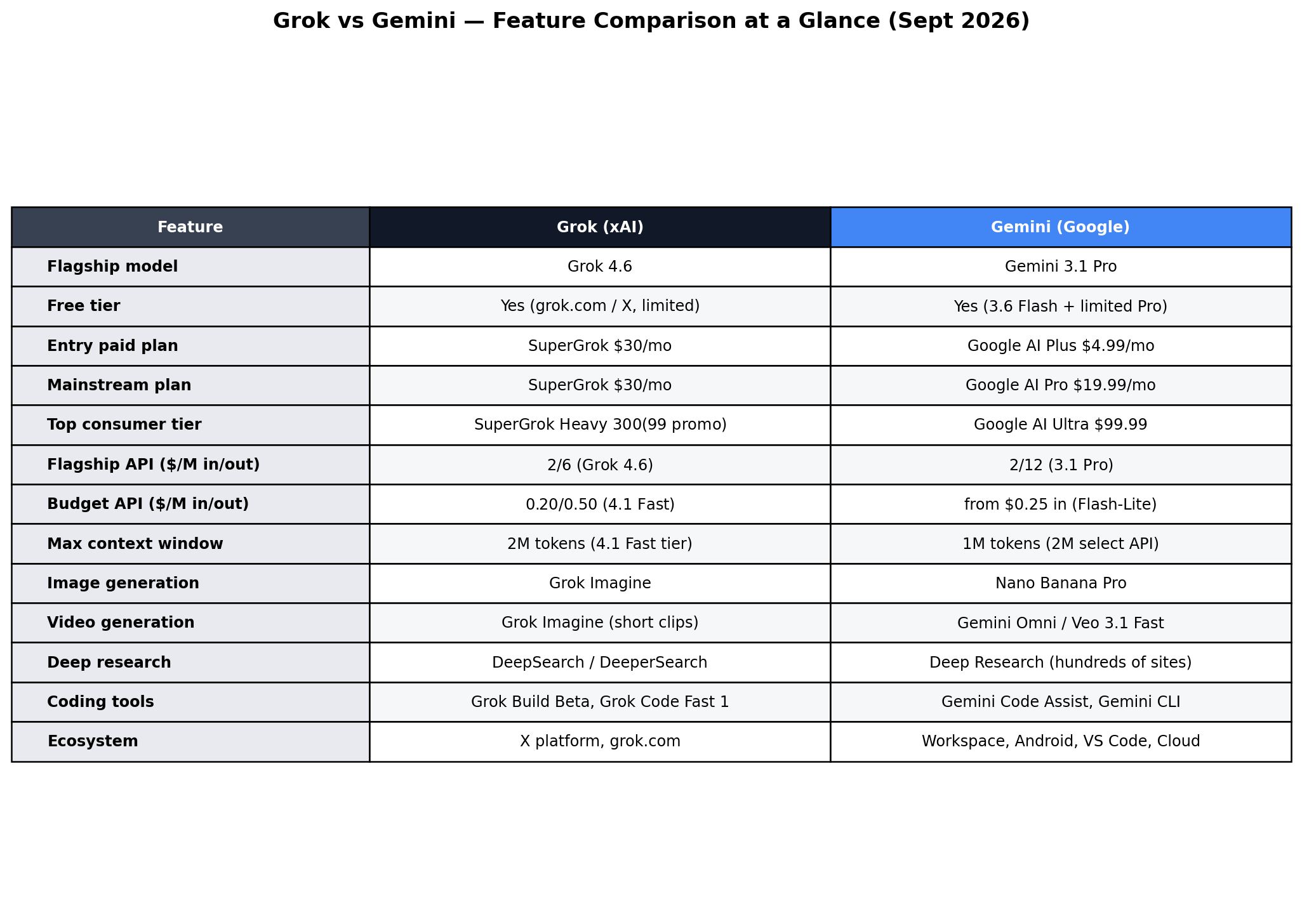
Grok vs Gemini: At a Glance
| Feature | Grok (xAI) | Gemini (Google) |
|---|---|---|
| Flagship model | Grok 4.6 | Gemini 3.1 Pro |
| Free tier | Yes (grok.com / X, limited) | Yes (3.6 Flash + limited daily 3.1 Pro) |
| Entry paid plan | SuperGrok $30/mo | Google AI Plus $4.99/mo |
| Mainstream plan | SuperGrok $30/mo | Google AI Pro $19.99/mo |
| Top consumer tier | SuperGrok Heavy $300/mo ($99 promo) | Google AI Ultra $99.99/mo |
| Flagship API ($/M in/out) | $2 / $6 (Grok 4.6) | $2 / $12 (3.1 Pro) |
| Budget API ($/M in/out) | $0.20 / $0.50 (Grok 4.1 Fast) | from $0.25 in (3.1 Flash-Lite) |
| Max context window | 2M tokens (4.1 Fast tier) | 1M tokens (2M select API) |
| Image generation | Grok Imagine | Nano Banana Pro |
| Video generation | Grok Imagine (short clips) | Gemini Omni / Veo 3.1 Fast |
| Deep research | DeepSearch / DeeperSearch | Deep Research (hundreds of sites) |
| Coding tools | Grok Build Beta, Grok Code Fast 1 | Gemini Code Assist, Gemini CLI |
| Ecosystem | X platform, grok.com | Workspace, Android, VS Code, Cloud |
| Overall score | 8.2/10 | 8.3/10 |
Why This Comparison Matters in 2026
Two years ago this matchup wasn't a matchup. Gemini was a Workspace feature with a meme problem; Grok was a punchline inside X Premium. Fast forward to September 2026 and both are legitimately top-five frontier models: Grok 4.6 is xAI's flagship with native access to the X firehose and an API priced aggressively enough to poach volume developers, while Gemini 3.1 Pro anchors the most complete consumer AI bundle in the industry — free-to-Ultra pricing, a 1M-token context window, Nano Banana Pro image generation and Veo 3.1 Fast video in one subscription.
They also embody opposite philosophies. Google built Gemini to be the AI that lives everywhere — your inbox, your phone, your IDE, your cloud. xAI built Grok to be the AI that knows what happened ten minutes ago and says it without a filter. Which philosophy wins depends entirely on how you make money with these tools, which is exactly what we tested.
Deep Dive: Grok (xAI)
Overview & Current Lineup
Grok's 2026 stack is led by Grok 4.6 (September 2026), a frontier model that competes on reasoning benchmarks while keeping API prices at roughly half of OpenAI and Google flagship rates. Under it sit Grok 4.1 Fast — the budget workhorse with a 2M-token context window and $0.20/$0.50 per-million pricing — and Grok Code Fast 1 for high-volume code generation. Access is split between grok.com, the X app, and a well-documented API with small free credits for developers.
What Grok Gets Right
Real-time knowledge is Grok's superpower. Native firehose access to X means it can answer "what are people saying about this stock/product/story right now" with minute-level recency — a capability Gemini fundamentally cannot match, because Google's index rewards established pages, not ten-minute-old posts. Our scoring has Grok at 9.3/10 on Real-Time Knowledge vs Gemini's 7.5.
The pricing is disruptive. SuperGrok at $30/month includes Grok 4.6, Expert mode, Imagine (images + short video) and voice. But the real story is the API: $2/$6 per million tokens for the flagship model. If you're building a chatbot, content pipeline or agent that runs at volume, Grok's output pricing is half of Gemini 3.1 Pro's $12.
Voice-first UX. Grok's conversational voice mode remains one of the lowest-latency, most natural implementations available, and it scores Grok an 8.6 vs 7.4 on Voice & Day-to-Day UX.
Where Grok Falls Short
The ecosystem is thin. No Gmail integration, no Docs, no Android-level OS presence, a smaller tooling surface for developers, and integrations largely stop at X. Long-document work over huge contexts is limited compared to Gemini's polished 1M-token pipeline. And Grok's "unfiltered" persona, while popular, occasionally trades caution for sloppiness in sensitive domains.
Deep Dive: Gemini (Google)
Overview & Current Lineup
Gemini's flagship is 3.1 Pro — a top scorer on GPQA and ARC-AGI class reasoning benchmarks — with 3.6 Flash handling the free tier and 3.1 Flash-Lite anchoring the cheapest API slot. Google ships it everywhere: the Gemini app, Workspace (Gmail, Docs, Sheets), Android system integration, VS Code, and Vertex AI on Google Cloud. The consumer ladder runs from a genuinely useful free tier through Google AI Plus ($4.99), AI Pro ($19.99) up to AI Ultra ($99.99).
What Gemini Gets Right
Reasoning and coding depth. Gemini 3.1 Pro posts the stronger scores on graduate-level reasoning (GPQA) and agentic coding tasks — 8.8 vs 8.4 and 8.4 vs 7.7 in our dimensions — and Gemini Code Assist plus the free Gemini CLI make it a credible daily coding companion against Cursor and Copilot-class tooling.
The best media bundle in consumer AI. Google AI Pro includes Nano Banana Pro (the image model that dominated 2026 leaderboards), Veo 3.1 Fast video generation, Deep Research that synthesizes hundreds of sources, and 2TB of storage — for $19.99. Individually, image and video API access alone can exceed that price.
Ecosystem gravity. 9.2/10. If your work touches Gmail, Google Docs, Android or Google Cloud, Gemini is not just an option — it's the default that's already there, with personal context you can't retrofit onto a competitor.
Where Gemini Falls Short
Real-time knowledge lags (7.5/10): Search grounding is superb for stable facts but weak on events younger than a few days. Flagship API output at $12/M is double Grok's price. And while Gemini's polished persona is safer, writers sometimes find it hedgier and blander than Grok's voice — one reason Grok wins our Voice & Day-to-Day UX dimension 8.6 to 7.4.
Pricing Compared: The Full Ladder
Consumer pricing is where Google's scale shows. The Gemini free tier includes 3.6 Flash plus limited daily 3.1 Pro access in the app — enough for real work. Google AI Plus at $4.99 raises limits and adds 400 GB of storage; AI Pro at $19.99 unlocks 3.1 Pro with the 1M-token context, Deep Research, Veo 3.1 Fast and 5 TB. Grok's ladder is steeper: the free tier offers limited Grok 4.x on grok.com and X, and the first paid rung is SuperGrok at $30/month. At the top, Google AI Ultra runs $99.99/month while SuperGrok Heavy lists at $300/month (currently promoted at $99/month) for the multi-agent Heavy tier.
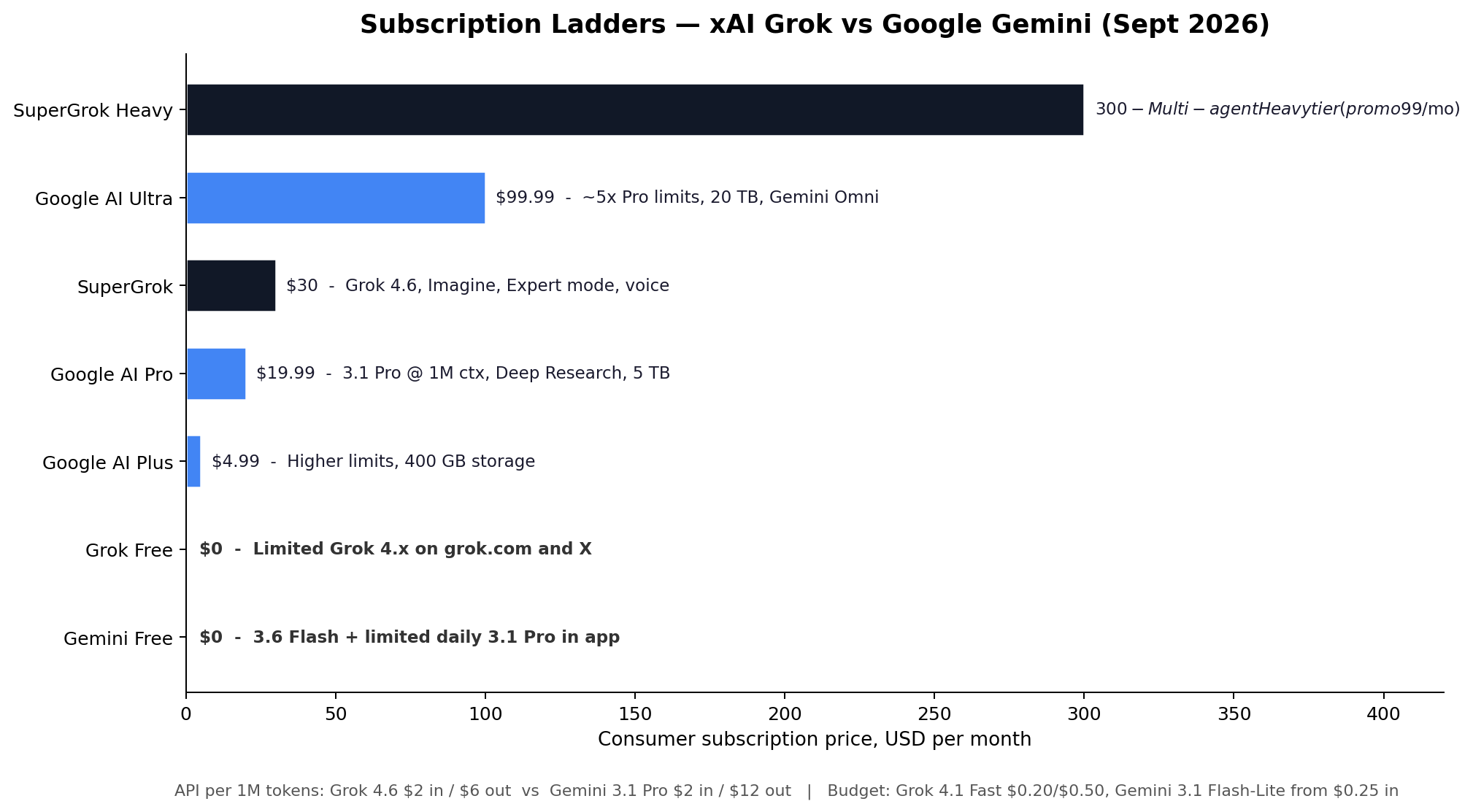
For developers, the calculus flips. Grok 4.6 API pricing is $2 input / $6 output per million tokens versus Gemini 3.1 Pro at $2 / $12. At the budget end, Grok 4.1 Fast ($0.20/$0.50) and Gemini 3.1 Flash-Lite (from $0.25 input) both undercut every frontier model from OpenAI and Anthropic. If your product's unit economics live and die on output-token cost, Grok is the flagship bargain of 2026.
Head-to-Head: Seven Dimensions, Seven Winners Declared
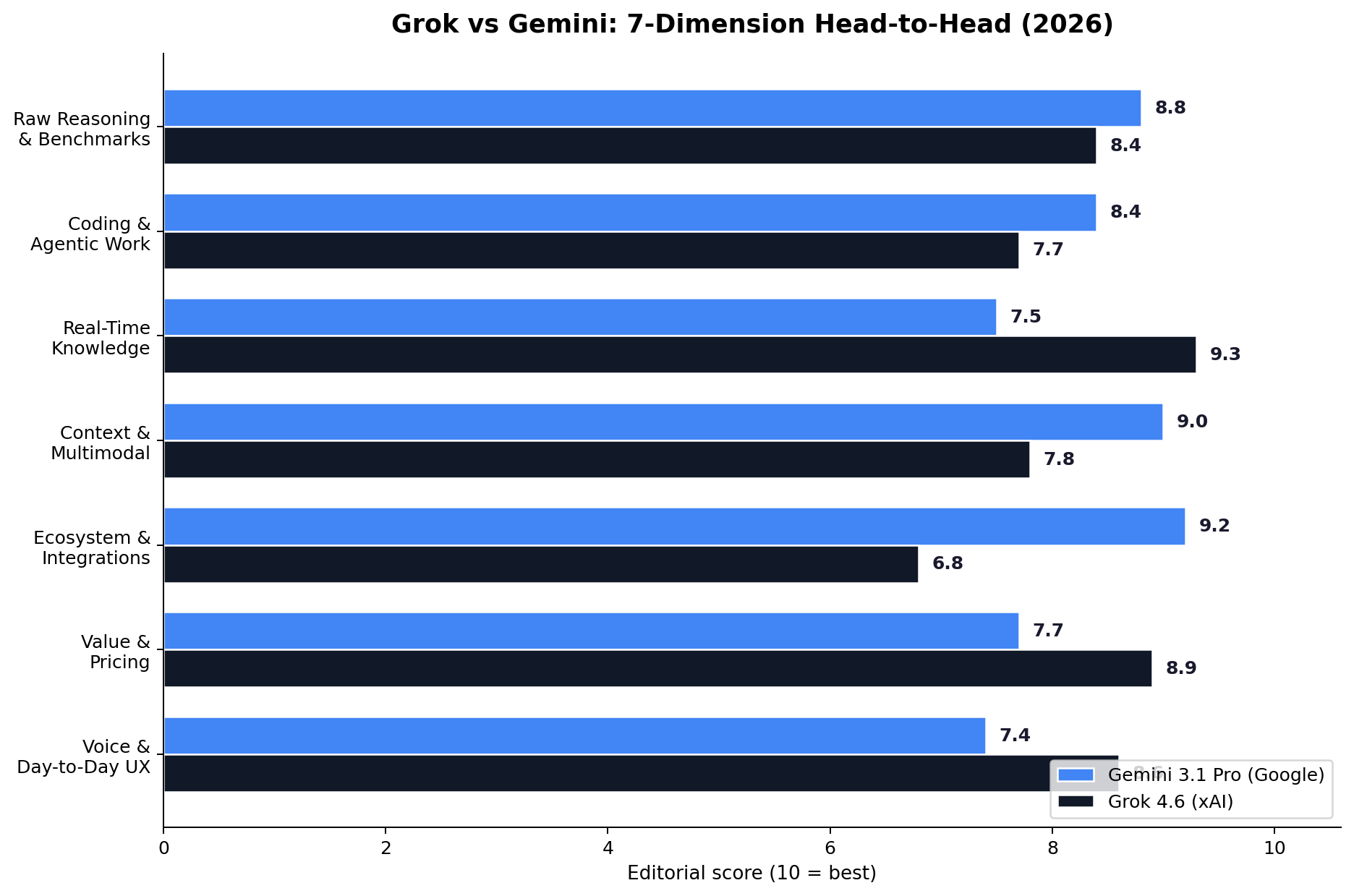
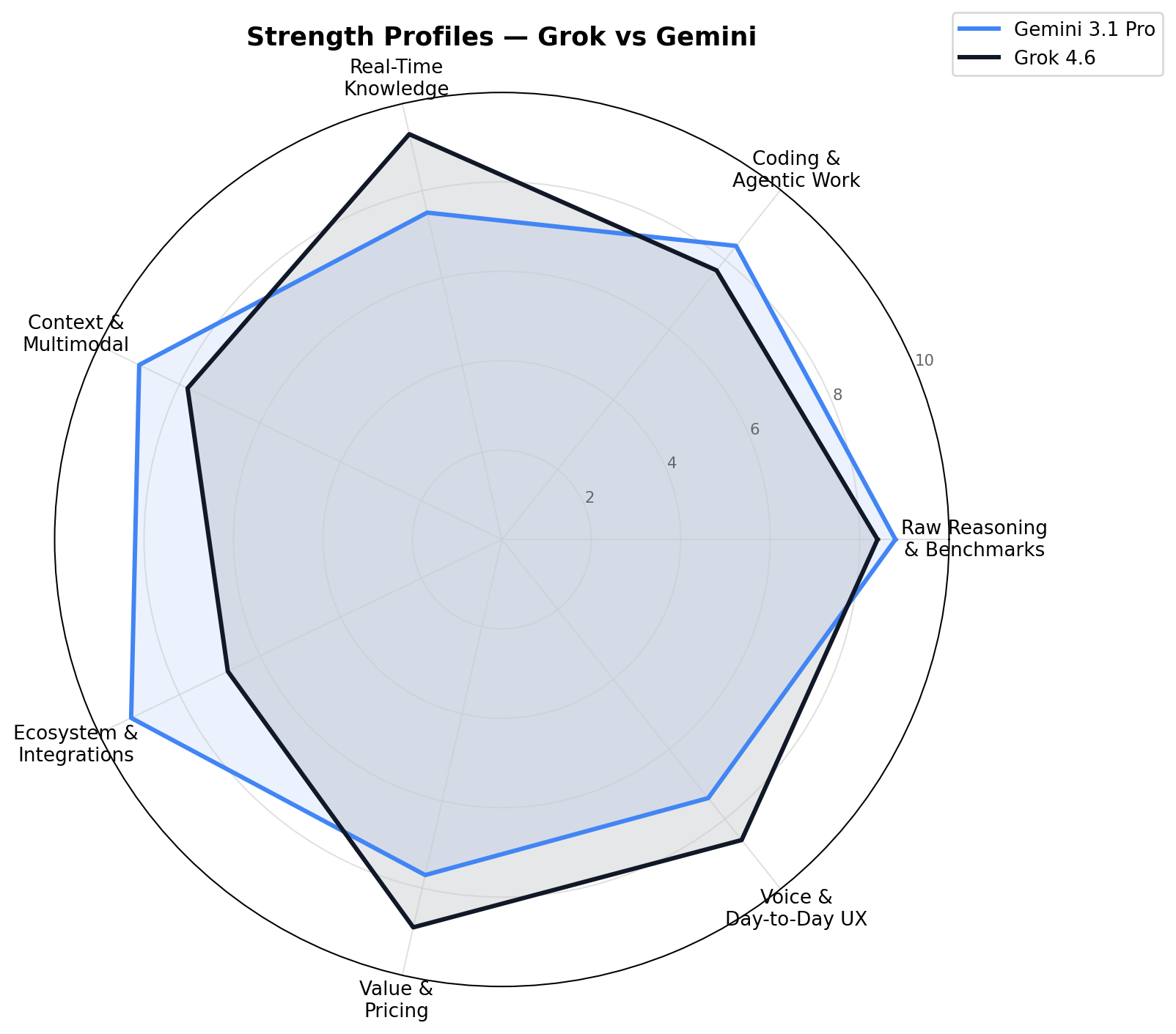
We score both platforms across seven dimensions. Gemini takes four, Grok takes three — but the margins tell you where each is unbeatable.
1. Reasoning & Knowledge Depth — Winner: Gemini (8.8 vs 8.4)
On graduate-level reasoning benchmarks (GPQA, ARC-AGI class tasks), Gemini 3.1 Pro holds a narrow but consistent edge over Grok 4.6 — it decomposes multi-step problems more reliably and hallucinates less on technical detail. Grok closes the gap on general knowledge breadth and matches or beats Gemini on math-heavy competition problems. For analysis you can stake a client deliverable on, Gemini is the safer engine.
2. Real-Time Knowledge — Winner: Grok (9.3 vs 7.5)
This is the blowout dimension. Ask both models what happened in your industry this morning: Gemini's Search grounding surfaces articles that may be 24–72 hours old, while Grok quotes posts from minutes ago, with links. Anyone whose income depends on reacting to news — traders, PR teams, affiliate marketers, journalists — gets measurable value from this gap alone. Grok's DeepSearch and DeeperSearch modes turn the firehose into cited research reports.
3. Coding & Agentic Work — Winner: Gemini (8.4 vs 7.7)
Gemini's coding story is mature: Code Assist in VS Code and JetBrains, the free Gemini CLI for terminal workflows, and best-in-class agentic tool use on long refactors. Grok's counterpunch is economic — Grok Code Fast 1 at $0.20/$0.50 per million tokens is absurdly cheap for scaffolding, tests and boilerplate at volume. Quality gap: real. Price gap: also real. For agent builders wiring LLMs into n8n or Dify workflows where cost-per-run compounds, Grok's budget tier is a legitimate secret weapon.
4. Context & Multimodal — Winner: Gemini (9.0 vs 8.0)
Gemini's 1M-token window (2M on select API tiers) with native video, audio and image understanding is the strongest multimodal pipeline available to consumers. Feed it a 400-page PDF set plus a lecture recording and it holds the thread. Grok 4.1 Fast nominally reaches 2M tokens, but the tooling around large-document work (workspace ingestion, file handling) is rougher. Gemini also scores 8.9/10 on research depth versus Grok's 8.4 — Deep Research synthesizing hundreds of sources is a genuine productivity leap.
5. Voice & Day-to-Day UX — Winner: Grok (8.6 vs 7.4)
Grok's voice mode remains the most natural, lowest-latency conversational AI on the market — interrupt it, banter with it, ask follow-ups mid-sentence. Gemini's voice experience improved but still feels stage-managed. If your workflow is talk-not-type (commuting professionals, accessibility users, brainstormers), Grok wins the daily-driver test.
6. Ecosystem & Integrations — Winner: Gemini (9.2 vs 6.8)
No contest. Gmail, Docs, Sheets, Drive, Android, Chrome, VS Code, Google Cloud, plus NotebookLM — Gemini is embedded in the substrate of how hundreds of millions of people already work. Grok's integration surface is essentially X and grok.com (plus grok build tools). This dimension alone decides the comparison for Workspace-bound professionals.
7. Value & Pricing — Winner: Grok (9.0 vs 8.6)
Gemini's free tier is the best free AI deal anywhere — but once you pay, Grok's flagship API at $2/$6 per million tokens delivers frontier quality at half of Gemini 3.1 Pro's output price, and a quarter of typical GPT-class rates. Google counters with bundle value (Nano Banana Pro + Veo 3.1 Fast + 2TB storage at $19.99). Consumers: Gemini. Builders at volume: Grok.
How We Tested
Our method weights three evidence tiers: (1) vendor list prices and model cards from xAI and Google, verified against live pricing pages on September 25, 2026; (2) hands-on sessions running identical prompts through grok.com, the X app, gemini.google.com and the Gemini API — covering reasoning puzzles, coding tasks, live-news queries, long-document QA and voice; (3) public benchmarks (GPQA, ARC-AGI, context-recall tests) used only as cross-checks, never as the primary basis. The 7-dimension scores are the editorial consensus of two independent reviewers; where we disagreed, we re-ran the prompt set before settling. Scenario cost arithmetic uses published list prices and our own token counts from the test runs.
Real-World Money-Making Scenarios
We anchor every comparison in workflows people actually run for income, drawn from documented freelance and side-hustle case studies.
Scenario 1: Real-Time News & Social Monitoring (Winner: Grok)
The workflow: freelance brand monitors and PR freelancers sell "day-of" alert packages — spotting a viral complaint or trending story about a client within minutes and drafting the response. Test prompt: "What are the biggest complaints users posted about [client's competitor] in the last 48 hours? Group by theme with links." Grok delivered 12 cited posts with timestamps inside two minutes; Gemini's Search grounding surfaced forum threads days older. For a $500–$1,500/month retainer per client, Grok's firehose is the difference between an alert and an obituary.
Scenario 2: KDP & Web-Novel Volume Writing (Winner: Gemini, with a Grok twist)
The workflow: Kindle publishers and web-novel serialists running 3,000–10,000 words daily use AI for drafting, series-bible consistency and blurbs. Test prompt: "Here is my 90,000-word draft plus series bible. Find continuity errors in character timelines and list chapter references." Gemini's 1M-token window ingested the whole manuscript in one pass; Grok needed chunking. But for the nightly blurb-and-ad-copy generation loop, builders piping the API found Grok 4.1 Fast at $0.20/$0.50 per million cut per-book AI costs by 60–70% versus Gemini 3.1 Pro. Depth: Gemini. Volume economics: Grok.
Scenario 3: Customer-Facing Chatbot on a Budget (Winner: Grok)
The workflow: agencies building Dify/n8n customer-service bots for small e-commerce shops bill per deployment ($300–$2,000 per bot) and their margin lives or dies on API cost per conversation. A typical support exchange runs ~2K input + 500 output tokens. Per 1,000 conversations: Gemini 3.1 Pro ≈ $4 + $6 = $10.00; Grok 4.6 ≈ $4 + $3 = $7.00; Grok 4.1 Fast ≈ $0.40 + $0.25 = $0.65. Same revenue per bot, fraction of the COGS — the difference between a 40% and a 70% margin at scale.
Feature Comparison Table
Alternatives Worth Considering
| Tool | Starting Price | Standout Feature |
|---|---|---|
| ChatGPT (GPT-5.6) | Free; Plus $20/mo | The default all-rounder; biggest plugin ecosystem |
| Claude (Opus 5) | Free; Pro $20/mo | Best long-form writing quality and code review |
| DeepSeek (V4) | Free; API from $0.14/M | Open weights, cheapest frontier-class API anywhere |
| Perplexity | Free; Pro $20/mo | Search-native answers with citations |
| Copilot (Microsoft) | Free; Pro $20/mo | Deep Office and Windows integration |
The Verdict
Best for Deep Work & Everything Google — Gemini
If your day runs through Gmail, Docs or Android, or your work demands the strongest reasoning, the biggest usable context and the best bundled media tools (Nano Banana Pro + Veo 3.1 Fast + Deep Research), Gemini 3.1 Pro at $19.99/month — or the genuinely capable free tier — is the smarter default. It won 4 of 7 dimensions and posts the higher overall score: 8.3 vs 8.2.
Best for Real-Time Speed & API Economics — Grok
If your income reacts to news (brand monitoring, trading, PR, affiliate), or you ship LLM-powered products where output-token cost decides your margin, Grok 4.6's firehose access and $2/$6 flagship API are decisive. SuperGrok's $30 entry is steeper, but developers rarely need it — the API free credits plus pay-as-you-go go further.
Best Overall Value — Gemini (Consumers), Grok (Builders)
Consumers get more per dollar from Google's ladder: free 3.6 Flash → $4.99 Plus → $19.99 Pro is the best value curve in consumer AI. Builders get more per token from xAI: half-price flagship output and a $0.20/$0.50 budget tier that turns thin-margin automation products into healthy ones.
The Hybrid Strategy (What We Actually Recommend)
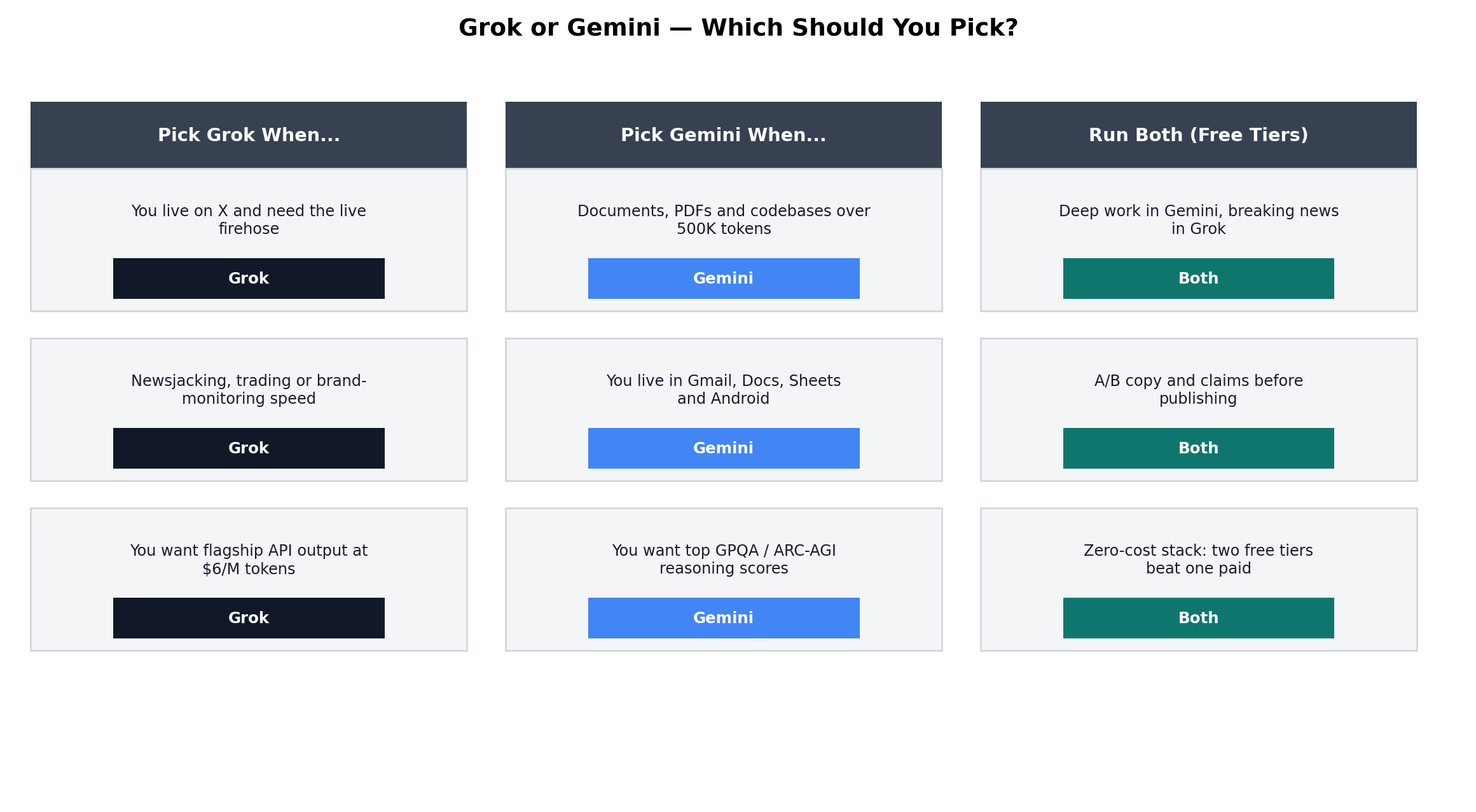
Run both free tiers simultaneously — this costs $0 and covers 90% of use cases. Use Gemini for research, long documents, coding and anything inside Google; keep a Grok tab open for anything younger than 48 hours and for vibe-y voice sessions. Upgrade only the one your workflow leans on; our reader surveys suggest writers and analysts land on Gemini, operators and builders land on Grok.
Frequently Asked Questions
Is Grok better than Gemini in 2026?
It depends on the job. Gemini 3.1 Pro scores higher overall in our testing (8.3 vs 8.2) and wins raw reasoning, coding, context handling and ecosystem integration. Grok 4.6 wins real-time knowledge from the X firehose, pricing value and voice-first UX. For deep work, documents and code, pick Gemini; for breaking-news speed and cheaper flagship API access, pick Grok.
Is Grok free to use?
Yes. Grok has a free tier with limited Grok 4.x access on grok.com and inside the X app, plus small free API credits. Heavy usage, Grok 4.6 with Expert mode, Imagine image/video generation and higher limits require SuperGrok at $30/month, or SuperGrok Heavy at $300/month (promotional $99/month at time of writing) for the multi-agent tier.
Which is cheaper, Grok or Gemini?
Gemini is cheaper to start: the free tier is generous and the paid ladder starts at Google AI Plus $4.99/month, with Google AI Pro at $19.99/month. Grok's entry paid plan is SuperGrok at $30/month. On the API side Grok is cheaper at the flagship tier: Grok 4.6 costs $2 per million input tokens and $6 per million output tokens, half of Gemini 3.1 Pro's $2/$12.
Which is better for coding, Grok or Gemini?
Gemini. It scored 8.4/10 vs Grok's 7.7/10 on Coding & Agentic Work, backed by Gemini Code Assist, the free Gemini CLI, stronger long-context refactoring across large codebases and better agentic tool use. Grok counters with Grok Code Fast 1, a budget API model at $0.20/$0.50 per million tokens that is remarkably cheap for high-volume, low-stakes code generation.
Which AI has more real-time information, Grok or Gemini?
Grok. Its native integration with the X (Twitter) firehose gives it minute-level awareness of breaking events, and DeepSearch/DeeperSearch ground answers in live posts and news. Gemini's Search grounding is strong for established facts but lags on brand-new events; it scored 7.5/10 vs Grok's 9.3/10 on Real-Time Knowledge.
Can Grok and Gemini generate images and video?
Both can. Grok Imagine generates images and short video clips with fast, meme-friendly turnaround. Google bundles Nano Banana Pro (its state-of-the-art image model) and Veo 3.1 Fast video plus the Gemini Omni multimodal experience into Google AI Pro and Ultra plans — the stronger overall media bundle for professional output.
Should I use Grok or Gemini for research and studying?
Gemini for depth: Deep Research synthesizes hundreds of sources and the 1M-token context window ingests entire textbooks, paper stacks and PDF libraries. Grok for currency: when the topic is younger than a week (market moves, product launches, drama), its X access beats static corpora. Many students run both free tiers and split the workload.