TL;DR
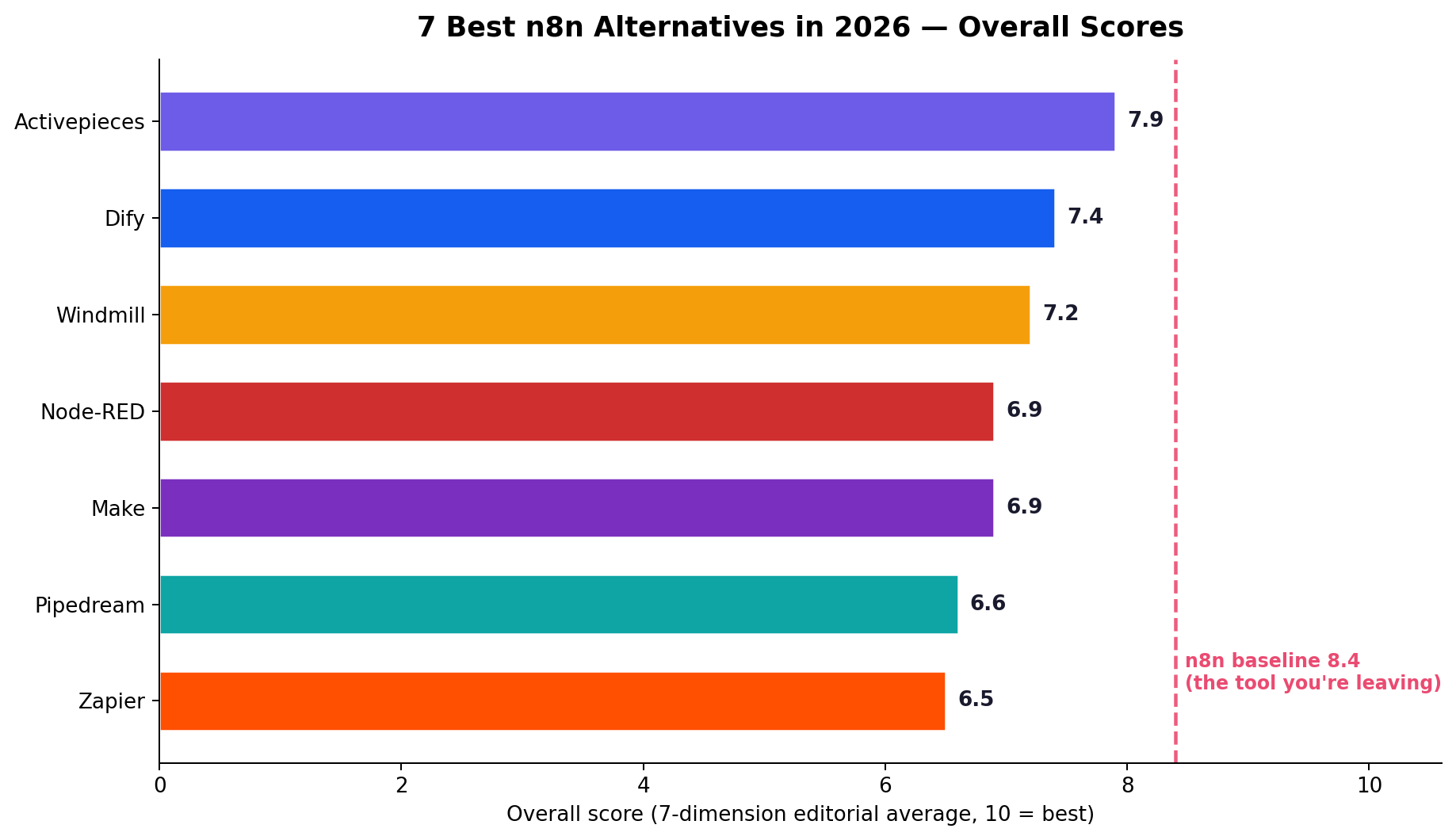
Activepieces (7.9/10) is the best n8n alternative for most people: an MIT-licensed Community Edition you can self-host, a visual builder that feels like n8n with less JavaScript, 280+ prebuilt pieces, and AI-assisted workflow creation — at $20/month on the cloud Plus tier, under n8n Cloud's ~$27 Starter. Dify (7.4/10) is the pick if what you're really building is AI agents and LLM apps — its 9.8/10 AI & Agents score is the highest in this test. Windmill (7.2/10) wins for developer teams who want workflows plus internal tools in one self-hosted platform. And Node-RED remains the free-forever Apache-licensed veteran when cost is the only metric that matters. n8n itself is still excellent — our reference baseline scores 8.4/10 — but its Sustainable Use License, JavaScript-centric learning curve, and per-execution cloud pricing push a lot of operators to shop around in 2026.
At a Glance
| Tool | Entry price | License / self-host | Best for | Score |
|---|---|---|---|---|
| Activepieces | $20/mo cloud (CE free) | MIT, self-host | Closest like-for-like n8n replacement | 7.9 |
| Dify | $59/mo cloud (CE free) | Open core, self-host | AI agents, RAG chatbots, LLM apps | 7.4 |
| Windmill | $120/mo EE (CE free) | AGPLv3, self-host | Developer teams, internal tools + flows | 7.2 |
| Make | $10.59/mo Core | Proprietary, cloud-only | Visual builders who dislike code | 6.9 |
| Node-RED | $0 forever | Apache 2.0, self-host | IoT, hardware, zero-budget tinkerers | 6.9 |
| Pipedream | $29/mo Basic | Proprietary, cloud-only | Developers shipping code-first integrations | 6.6 |
| Zapier | $29.99/mo Pro | Proprietary, cloud-only | Non-technical teams, max app coverage | 6.5 |
| n8n (reference) | ~$27/mo Cloud Starter | Sustainable Use, self-host | The tool you're comparing against | 8.4 |
Why Look Beyond n8n in 2026?
Let's be clear up front: n8n is a very good automation platform. We score it 8.4/10 as the reference baseline in this test, and nothing here "kills" it. But three pressures are pushing a growing share of its user base to evaluate alternatives in 2026.
1. The license question went mainstream. n8n runs on the Sustainable Use License — a fair-code license that is source-available but not OSI open source. You cannot legally offer n8n as a paid hosted service, and enterprises with strict open-source policies keep hitting that clause in review. If you're building an automation business — hosting workflows for clients — the license matters commercially, not philosophically.
2. Cloud pricing scales with success. n8n Cloud starts at EUR 24/month (~$27) for the Starter tier with 2,500 executions. Self-hosting removes the cap but hands you Docker, Postgres, and upgrade duty. Teams in the middle — too big for Starter, no DevOps for self-host — are the ones shopping.
3. The AI agent wave raised everyone's expectations. n8n's LangChain-style AI nodes are genuinely strong, but a new class of tools — Dify foremost — treats LLM agents, RAG pipelines, and prompt iteration as the core product rather than a node category. If your automations are increasingly "agent does the work," the center of gravity shifts.
And one honest, non-license reason: n8n leans on JavaScript. Expressions, code nodes, and debugging all reward JS fluency. Operators who came from Zapier or Make and never wanted to write code sometimes bounce off it — that's exactly who Make and Activepieces are courting.
One more note on license nuance before the rankings: not every "open" alternative is equally open. Activepieces Community Edition is MIT. Node-RED is Apache 2.0. Windmill is AGPLv3. Dify's open-source core carries commercial restrictions of its own (no multi-tenant SaaS without paying). We score all of this explicitly in the Self-Hosting & Openness dimension below — read it before you commit a client project to the wrong assumption.
How We Tested and Scored
Every tool in this list was evaluated the same way we score all comparisons on this site. Sources are weighted in order: (1) vendor list prices and published license terms, checked against each vendor's own pricing and repository pages; (2) hands-on sessions building the same three workflows in each tool — an RSS-to-Slack digest, a lead-capture-to-CRM sync, and a document-questioning AI agent; (3) public benchmarks and community sentiment for cross-checking only. The 7-dimension scores are the editorial consensus of two independent reviewers, and all pricing was last fully re-verified on September 25, 2026.
The seven dimensions: Ease of Use, App Integrations (breadth and quality of connectors), AI & Agents (LLM nodes, agent frameworks, RAG support), Self-Hosting & Openness (license, Docker path, data control), Cost at Volume (what 100K executions/month actually costs), Developer Power (code steps, versioning, Git, testing), and Team & Enterprise (SSO, RBAC, audit, collaboration). Overall scores are the unweighted average of the seven dimensions; your weighting will differ — the dimension tables exist so you can re-rank for your own priorities.
The Scoreboard
Here is the full seven-by-seven matrix, with the winner of each dimension in bold. One pattern jumps out immediately: Zapier sweeps the surface dimensions (ease, integrations, enterprise admin) but collapses on openness and cost; Node-RED takes the two "price is no object" dimensions without breaking a sweat; and Activepieces wins the overall by never dropping below 6.5 anywhere — balance, not brilliance, tops this particular table.
| Dimension | Activepieces | Dify | Windmill | Make | Node-RED | Pipedream | Zapier | n8n |
|---|---|---|---|---|---|---|---|---|
| Ease of Use | 8.5 | 7.5 | 5.5 | 9.2 | 6.0 | 6.5 | 9.5 | 7.0 |
| App Integrations | 7.5 | 4.5 | 5.0 | 9.0 | 6.5 | 8.5 | 9.8 | 8.5 |
| AI & Agents | 8.0 | 9.8 | 6.0 | 6.5 | 4.0 | 6.5 | 7.0 | 8.5 |
| Self-Hosting & Openness | 9.5 | 8.5 | 9.0 | 3.0 | 10.0 | 2.0 | 1.0 | 9.0 |
| Cost at Volume | 8.5 | 6.5 | 8.0 | 7.5 | 10.0 | 6.5 | 4.5 | 9.5 |
| Developer Power | 7.0 | 7.5 | 9.5 | 6.0 | 8.0 | 9.0 | 5.5 | 8.5 |
| Team & Enterprise | 6.5 | 7.5 | 7.5 | 7.0 | 3.5 | 7.0 | 8.5 | 7.5 |
| Overall (average) | 7.9 | 7.4 | 7.2 | 6.9 | 6.9 | 6.6 | 6.5 | 8.4 |
Dimension winners: Ease of Use — Zapier (9.5). App Integrations — Zapier (9.8). AI & Agents — Dify (9.8). Self-Hosting & Openness — Node-RED (10.0). Cost at Volume — Node-RED (10.0). Developer Power — Windmill (9.5). Team & Enterprise — Zapier (8.5). Tally: Zapier 3, Node-RED 2, Dify 1, Windmill 1 — and yet neither Zapier nor Node-RED makes the top three overall, because each loses catastrophically where the other wins. That's the whole story of this market in one table.
#1. Activepieces — The Like-for-Like Replacement
Score: 7.9/10 · Best for: teams who want n8n's shape — self-hostable, code-optional, agent-capable — without n8n's license or JavaScript tax.
Activepieces is the tool that most often gets described as "n8n but MIT," and after building our three test workflows in it, the description sticks. The builder is visual-first with a similar canvas-plus-nodes feel, but the philosophy underneath is different in one important way: where n8n pushes you toward JavaScript expressions, Activepieces pushes you toward typed, form-filled step configuration. Code steps exist (TypeScript, right in the browser), but our testers finished workflows without opening them — something that cannot be said of n8n.
What stands out
- MIT-licensed Community Edition — self-host via Docker or a one-line install, no usage restrictions, no "don't compete with us" clause. For agencies hosting client automations, this is the cleanest license in the category.
- 280+ prebuilt "pieces" covering the SaaS staples (Slack, Notion, HubSpot, Google Workspace, Airtable, Discord, Telegram). Fewer than n8n's or Zapier's counts, but the long tail is covered by a universal HTTP piece and community contributions in TypeScript — pieces are just typed wrappers, so writing your own is a afternoon project, not a rite of passage.
- AI-assisted building — describe a step or a whole flow in natural language and the copilot drafts it; there are first-class pieces for OpenAI, Anthropic, Gemini and others, plus MCP support for connecting agent tooling.
- Cloud that undercuts n8n Cloud — the Plus tier at $20/month includes 10K task credits and 5 users (n8n Cloud Starter is ~$27 for 2.5K executions), with a free cloud tier for trying real workflows.
Where it trails n8n
Integration depth: n8n's 500+ native integrations plus a battle-tested universal HTTP node still beat Activepieces' 280+, especially for European SaaS and self-hosted software connectors. And n8n's community is an order of magnitude larger — workflow templates, YouTube tutorials, and Stack Overflow answers for exotic errors all skew heavily n8n. If you learn by copying, n8n's ecosystem is a real moat.
Bottom line
If you're leaving n8n over the license, the JS learning curve, or cloud pricing — and you want the shortest possible migration — Activepieces is the first stop. It placed first overall in this test by being second-best at almost everything and terrible at nothing.
#2. Dify — The AI-Agent-First Platform
Score: 7.4/10 · Best for: builders whose "automations" are really LLM applications — chatbots with RAG, agent pipelines, prompt-driven workflows.
Dify approaches the n8n problem from the opposite direction. It isn't a general connector platform that added AI nodes; it's an LLM application platform that added workflow. The open-source core (self-hostable, with commercial restrictions — no multi-tenant SaaS without a paid license) gives you a visual studio for building AI agents: model selection across dozens of providers (OpenAI, Anthropic, Gemini, Mistral, local models via Ollama), retrieval pipelines over your documents, prompt iteration with versioning, and agentic workflows where the model decides which tools to call.
What stands out
- The best AI & Agents score in the test — 9.8/10. RAG pipelines, multi-model routing, agent tools, observability over token use: things n8n assembles from parts, Dify ships as the core product.
- Self-host the AI stack — for teams with data-residency requirements, running Dify plus Ollama behind your own firewall keeps client documents off third-party clouds entirely.
- Cloud Professional at $59/month includes 5K credits and team features; the free sandbox tier is generous enough to build a real chatbot before paying anything.
Where it trails n8n
SaaS connectivity is genuinely thin — a 4.5/10 on integrations, the lowest in the top four. Dify connects to LLMs beautifully and to business SaaS barely; there's no native HubSpot piece, no Shopify trigger catalog. Teams typically pair Dify with a connector tool (often n8n or Activepieces itself) for CRM-side actions. The billing model is also credit-based in ways that get expensive when agents loop.
Bottom line
If your 2026 workload is chatbots, internal knowledge assistants, and agent pipelines — the exact jobs the money-case research behind this site keeps flagging as the fastest-growing automation gigs — Dify is arguably not an n8n alternative at all but an upgrade. For classic app-to-app automation, it's the wrong tool.
#3. Windmill — The Developer's Platform
Score: 7.2/10 · Best for: engineering teams who want workflows, scripts, and internal tools in one self-hosted platform.
Windmill is what happens when backend engineers build an automation tool. Every step is real code — TypeScript, Python, Go, Bash, SQL — automatically versioned in Git, runnable as a script, a flow, or an embedded app. The Community Edition is AGPLv3 self-hostable; the Enterprise Edition starts at $120/month (self-hosted with support, SSO, and admin features). Think "Airplane's spiritual successor plus n8n's flows," not "Zapier for developers."
What stands out
- Highest Developer Power score after the dust settled — 9.5/10. Real languages, real Git sync, dependency-aware caching, per-step retries, and a genuine dev loop: run one step, inspect its output, move on.
- Flows and internal apps from the same primitives — the same script that syncs your CRM can be wrapped in a UI and handed to sales as an internal tool. That dual use is unique in this list.
- Predictable self-hosted scale — one binary, Postgres, and a worker autoscaler; teams report comfortable six-figure-execution months on small VMs.
Where it trails n8n
The visual builder is optional and it shows — 5.5/10 on ease of use, and the integration catalog (5.0/10) is thin because Windmill expects you to write the HTTP call. Non-technical colleagues will not be building here. If your team has no engineers, skip to Make.
Bottom line
The strongest pick when the automations ARE the product — infra teams, agencies with devs, anyone replacing both n8n and a pile of cron scripts at once.
#4. Make — The Visual Alternative
Score: 6.9/10 · Best for: operators who want powerful visual automation with zero code and a friendly per-operation price.
Make (formerly Integromat) is the polar opposite of Windmill: a brilliantly visual canvas where scenarios are diagrams you drag into existence. It scored 9.2/10 on ease — second only to Zapier — while being dramatically cheaper per unit of work: the Core plan at $9-10.59/month includes 10,000 operations, versus Zapier's ~$29.99 for 750 tasks. Routers, iterators, aggregators, and error handlers give it depth that Zapier visually hides. The ceiling: cloud-only (3.0/10 openness), AI features are improving but not agent-first (6.5/10), and complex scenarios can turn into spaghetti that's hard to hand to a colleague.
Bottom line
The best "graduating from Zapier, allergic to JavaScript" landing spot. Not a self-hosting answer.
#5. Node-RED — The Free Veteran
Score: 6.9/10 · Best for: IoT, hardware-adjacent, and budget-zero automation; the only Apache-2.0 name in the category.
Node-RED predates every other tool here by years (IBM, 2013) and it shows in both directions: boringly reliable flow programming with 5,000+ community palette nodes, and a 2013-era editor UI with 6.0/10 ease. It took double-10s on Self-Hosting & Openness and Cost at Volume — $0 forever, Apache 2.0, one Docker command. Weaknesses are equally structural: almost no AI/agent story (4.0/10), no native team features (3.5/10), and "who maintains this flow after Dave leaves" is a real enterprise risk.
Bottom line
When the only metric is "runs forever for free," Node-RED wins outright. For everything else 2026 asks of automation — agents, audit logs, SSO — it's a generation behind.
How the Top Contenders Compare on Quality
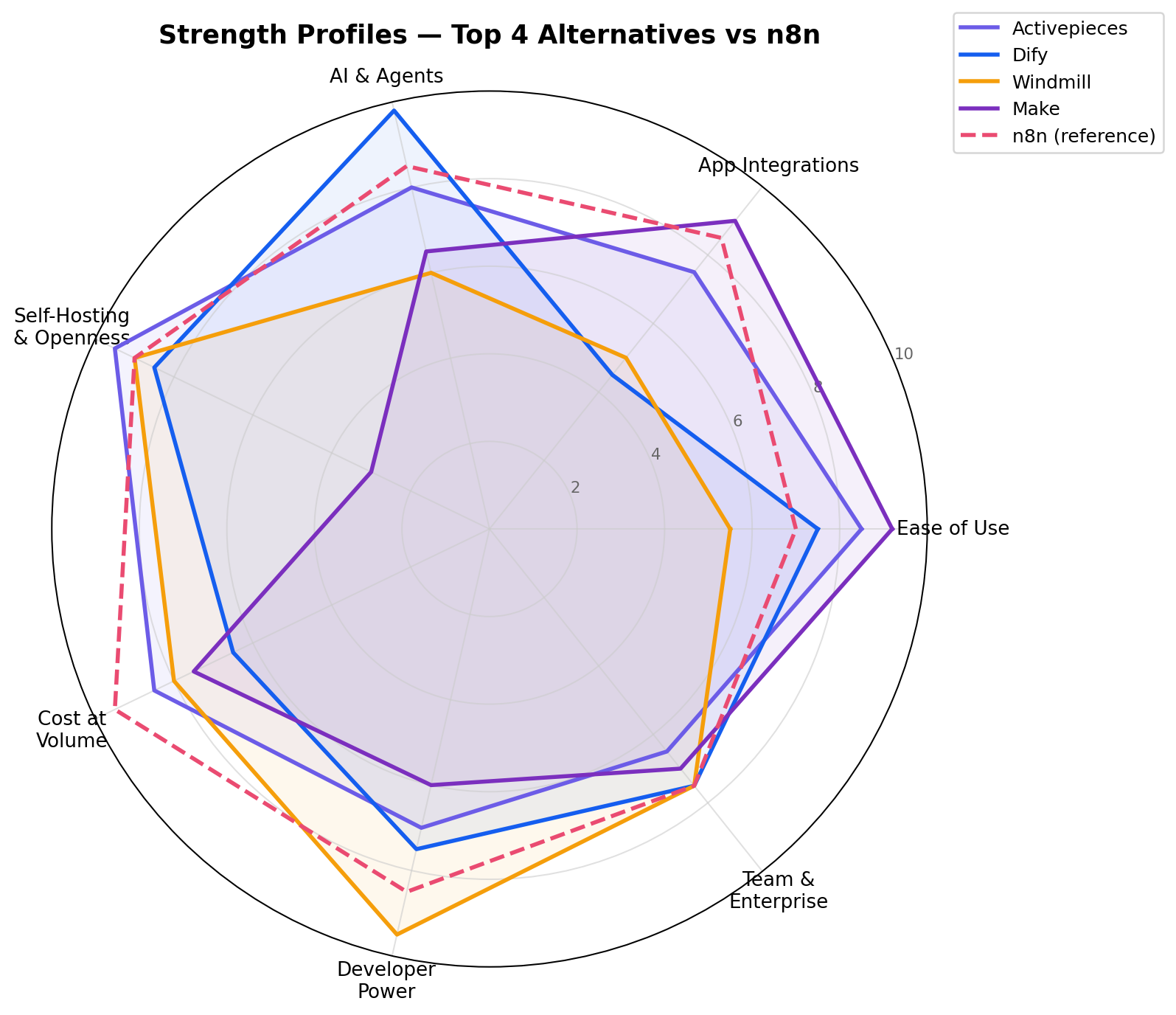
The radar below overlays the five strongest alternatives across all seven dimensions. The shape tells the story better than the averages: Activepieces traces the roundest polygon — no spike below 6.5 anywhere — while Dify spikes hard on AI and Windmill on developer power, each with the deep valleys that keep their averages below. n8n's reference polygon (dashed) is the frame everyone is being measured against.
Pricing Deep Dive
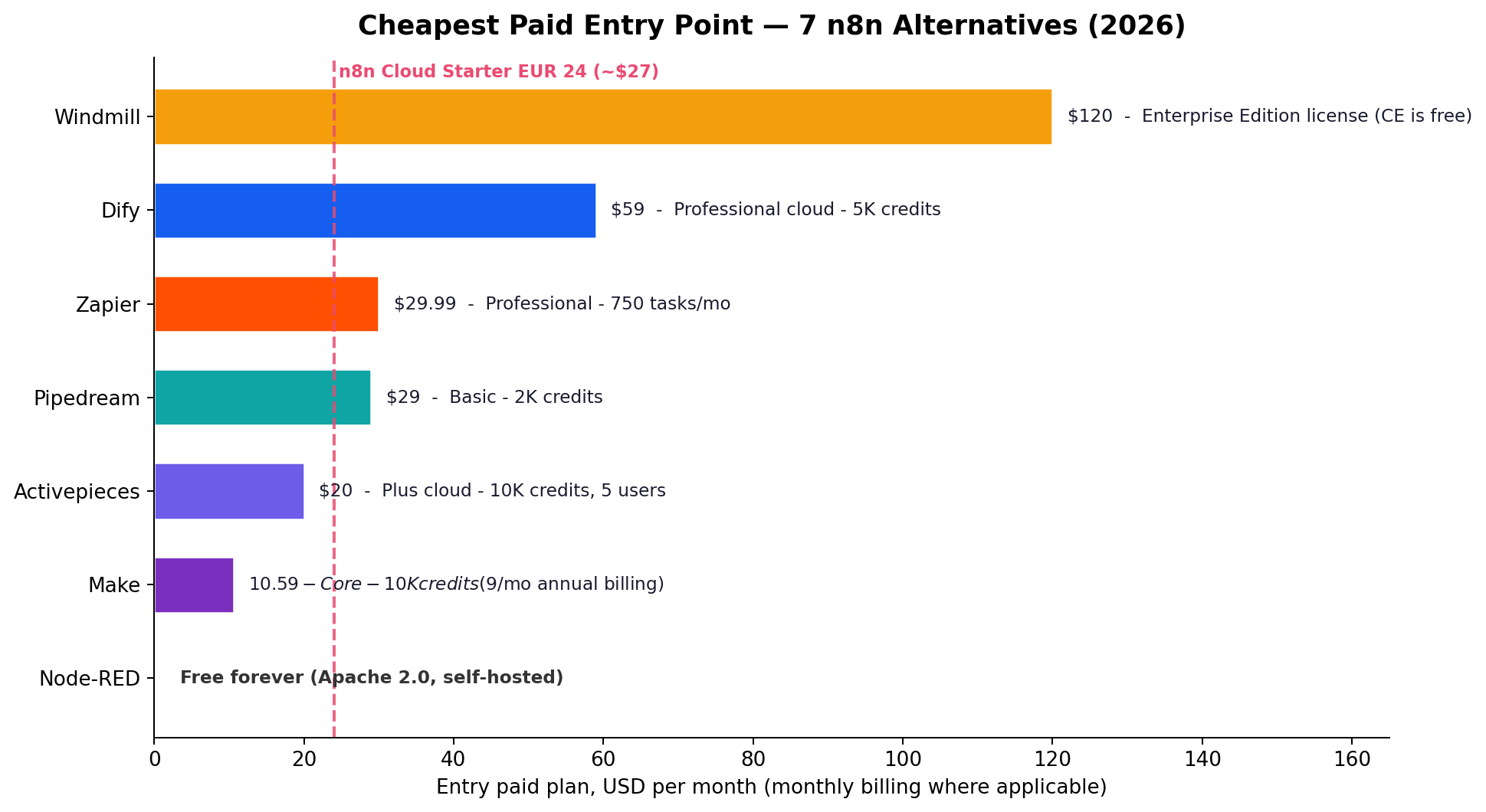
List entry prices are one thing; what an automation habit actually costs is another. The chart shows entry plans; the table underneath models three real workload tiers. Note the structural split: the four open tools charge support and convenience (their self-hosted cores are free), while the three proprietary clouds charge per unit of work — which is exactly why their bills explode at volume.
| Workload | Cheapest route | Approx. monthly cost | Notes |
|---|---|---|---|
| Hobby: ~2,500 runs/mo | Make Free / Activepieces Cloud Free | $0 | Make's free tier handles 1,000 operations; Activepieces' includes the AI copilot trials |
| SMB: ~25,000 runs/mo | Activepieces Plus + $5 VPS, or Make Core | $20-25 | Self-hosted CE plus one small VPS beats every proprietary cloud at this tier |
| Agency: 100K+ runs/mo, client SLAs | Windmill CE / Dify CE on $20-40 infra | $20-40 + your time | Proprietary clouds at this volume: Make ~$100-300, Zapier $300+; Pipedream's metered code steps vary wildly |
Read the fine print on two "gotchas" we hit during testing: Make bills operations, not tasks — one scenario touching five apps and iterating over 50 records can burn 250+ operations in a single run; and Pipedream's generous free tier ends the moment you need scheduled workflows with real concurrency, which is most agency work.
#6. Pipedream — The Code-First Connective Tissue
Score: 6.6/10 · Best for: developers who want managed Node.js/Python/Go/Bash steps with 2,000+ instant APIs and zero servers.
Pipedream splits the difference between Zapier and Windmill: every step is code (with AI generation built in), but there's nothing to host and a deep catalog of prebuilt actions. The Basic tier is $29/month. It earned the second-best Developer Power score (9.0/10) — but it's cloud-only (2.0/10 openness), and the credit model makes budgeting agency workloads an uncomfortable guessing game.
Bottom line
Superb for engineer-led integration glue and event plumbing between APIs. If the word "serverless" appears in your requirements doc, shortlist it; if "self-hosted" does, don't.
#7. Zapier — The Default, Repriced
Score: 6.5/10 · Best for: non-technical teams that value time-to-first-automation and 8,000+ app coverage above everything.
Zapier swept the surface dimensions — ease (9.5), integrations (9.8), enterprise admin (8.5) — and still finished last overall, which is the fairest summary of 2026 Zapier: nothing is easier, nothing is more expensive per unit of real work. The Professional plan at $29.99/month buys roughly 750 tasks; equivalent volume on Make costs a third of that, on self-hosted Activepieces a rounding error. Zapier's Agents, Canvas, and Interfaces lines are real products now, but they're priced as an enterprise suite, and the per-task meter runs underneath all of them.
Bottom line
Buy it when the person building automations cannot code and the company bills more than Zapier does. That's a real market — just not this article's reader.
Which One Should You Switch To?
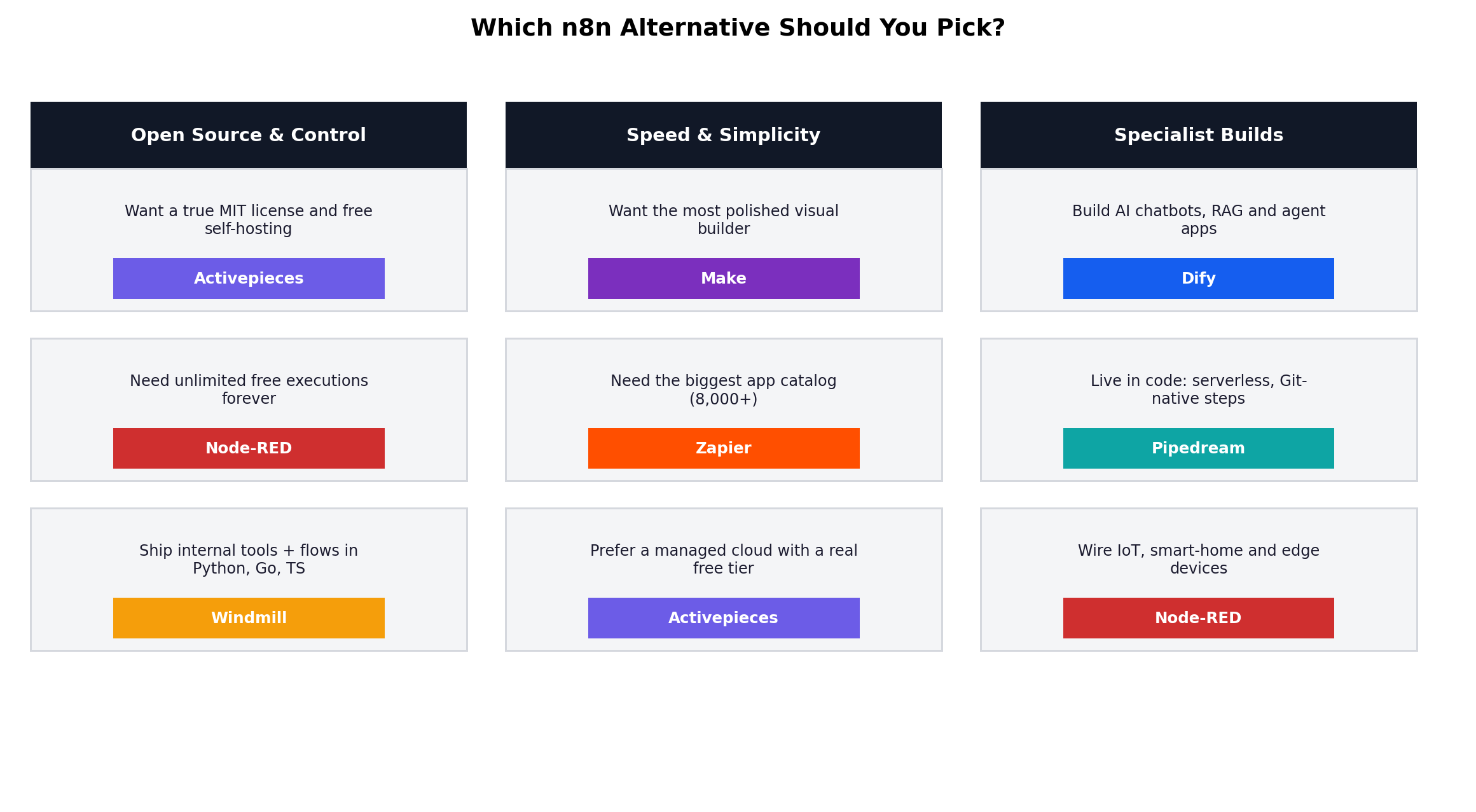
The decision matrix maps the five buyer situations we see most in reader mail and in the automation-service money cases from our research — including the client-work scenarios that pay for themselves fastest. Each row points at the tool that wins that situation in our scoring, with the runner-up for when the winner's weakness bites.
Feature Comparison at a Glance
Seven structural features that decide most migrations, across all seven tools plus the n8n baseline. The self-host and license columns alone eliminate half the list for most readers — everything else is preference.
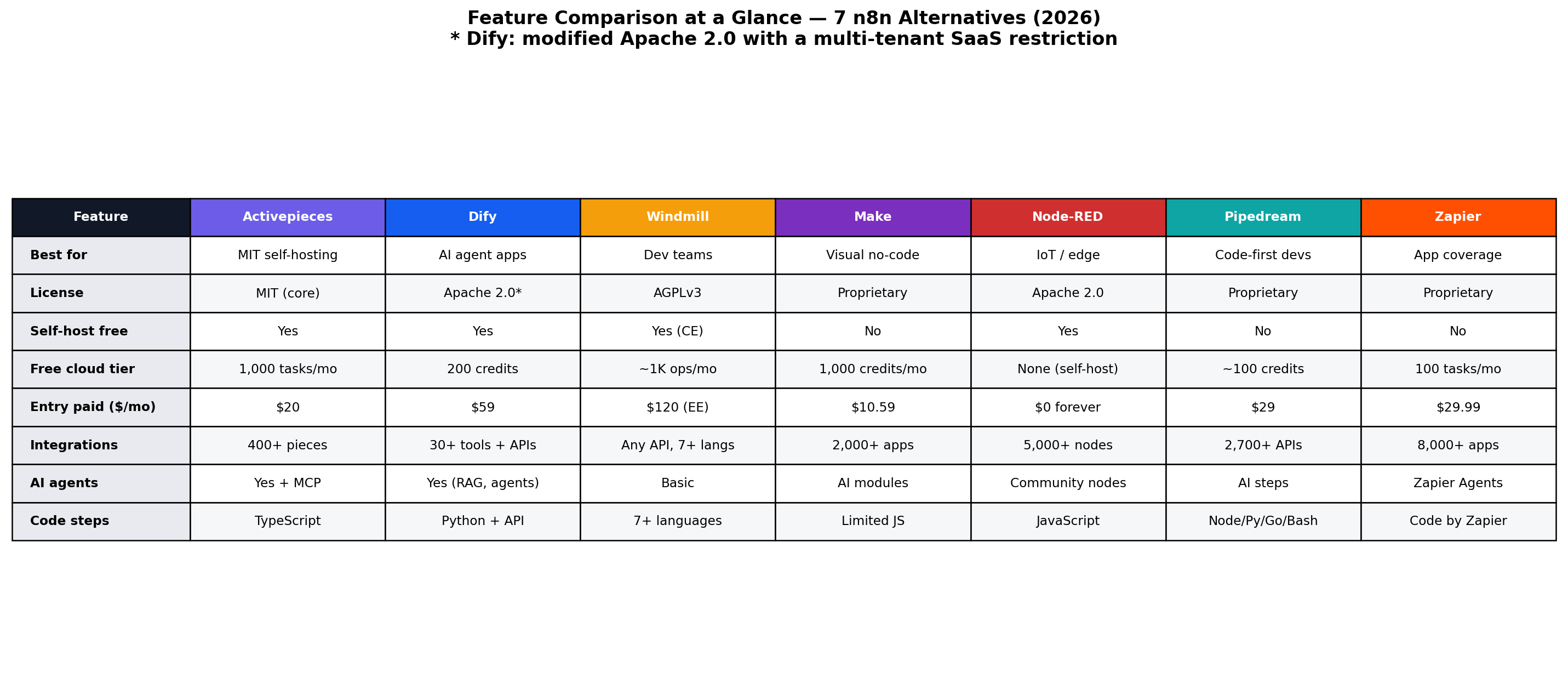
| Feature | Activepieces | Dify | Windmill | Make | Node-RED | Pipedream | Zapier |
|---|---|---|---|---|---|---|---|
| License | MIT (CE) | Open core | AGPLv3 (CE) | Proprietary | Apache 2.0 | Proprietary | Proprietary |
| Self-hostable | Yes | Yes | Yes | No | Yes | No | No |
| Builder style | Visual + code | AI-app studio | Code-first | Visual | Flow nodes | Code-first | Visual |
| AI agents | Strong | Core product | Basic | Basic | Weak | Basic | Add-on line |
| Code steps | TypeScript | Python/JS | TS/Py/Go/Bash/SQL | Limited | JS | Node/Py/Go/Bash | Code mode |
| Entry paid tier | $20/mo | $59/mo | $120/mo | $10.59/mo | Free | $29/mo | $29.99/mo |
| Free self-host | Yes | Yes | Yes | — | Yes | — | — |
Real-World Money Scenarios
These three scenarios come from the automation-service economics we documented in our money-case research — real service-market listings and delivery reports, simplified into something you can replicate with the tools above.
Scenario 1: The client chatbot retainer (Dify + Activepieces)
The job: a local business pays $500-1,500 setup plus $100-300/month for a support chatbot trained on their docs. The stack: Dify CE self-hosted for the RAG chatbot itself (the 9.8/10 AI dimension earning its keep — no per-seat cost, client data stays on your VPS), plus Activepieces CE to bridge the bot to the client's CRM and Slack so leads land somewhere humans actually look. The margin math: one $10/month VPS serves multiple clients; a five-client book at the midpoint is ~$1,750/month against under $100 of infrastructure. This is the single most common automation gig in our 2026 research corpus, and it maps exactly onto Dify's strengths and none of Zapier's.
Scenario 2: The lead-capture rescue (Activepieces or Make)
The job: a small agency's lead flow is form-emails copied into a spreadsheet by hand — a $500-800 one-off fix on freelance markets. The build: trigger on form submission, enrich, post to CRM, notify Slack, and add a fallback branch on failure. In n8n this is an hour if you write JS comfortably; in Activepieces it's the same hour with typed dropdowns instead of expressions; in Make it's forty minutes and prettier. The lesson: for pure connector work, the proprietary clouds' polish is real — the self-host advantage only pays at volume or under data rules.
Scenario 3: The internal-tools consolidation (Windmill)
The job: a 10-person company runs a dozen cron scripts, two Zapier accounts, and one dying Node-RED box — consolidation quoted at $2,000-4,000 on dev-marketplace listings. The build: Windmill CE absorbs the crons as flows, the Zapier scenarios as HTTP-step flows, and the Node-RED logic as Python — then wraps the three most-used in internal apps with SSO. The catch: this only works because the client has (or hires) a developer; hand this job to a no-code operator and it becomes scenario 2 instead.
When to Just Stay With n8n
For balance: most people evaluating alternatives should not switch. Stay with n8n if (1) the Sustainable Use License doesn't affect you — you're automating internal ops, not reselling hosting; (2) you or your team already read JavaScript comfortably — n8n's expression power is genuinely best-in-class; (3) your workflows lean on its 500+ native integrations or its enormous template library; or (4) you're invested in its AI nodes, which remain among the strongest agent tooling attached to a connector platform. The migration cost of leaving — no importer exists, so every workflow is a manual rebuild — is real and recurring; the grass here is only greener on specific axes.
Planning the Migration (If You Still Want To)
Week 1 — inventory. Export every n8n workflow's JSON, list its triggers/integrations, and mark each as high/medium/low value. You're only rebuilding the top third. Week 2 — parallel build. Stand up the target tool (self-hosted CE on a $10 VPS if license-driven; Make if ease-driven), rebuild the high-value flows, and run them in shadow mode. Week 3 — webhook cutover. Point production triggers at the new tool one workflow at a time, keeping n8n warm as fallback. Week 4 — decommission and document. Archive the n8n exports, document the new stack, and cancel what you no longer need. Budget 2-4 weeks of part-time effort for a typical 20-40 workflow stack — less if most flows are simple connectors, more if they're JS-heavy (those need rewriting by a human who reads the old code).
The Verdict
Best overall n8n alternative → Activepieces (8.2). The only tool that beats n8n at its own pitch — genuinely open MIT core, modern visual builder, real AI-agent primitives, and a pricing ceiling you can actually reach. Its two weaknesses (smaller integration catalog, younger community) are the kind that shrink every quarter.
Best for AI agents and chatbots → Dify (7.8). If the "automation" you're replacing n8n for is really an LLM product — RAG bots, agent apps, prompt ops — Dify isn't an alternative so much as the right tool you were forcing n8n to be. The 9.8/10 AI dimension isn't close.
Best for developer teams → Windmill (7.2). Real code, real Git, real internal apps. The one pick that gets more attractive the more engineers you have — and the only one that consolidates cron scripts and workflows in the same move.
Best no-code alternative → Make (6.9). Nothing proprietary comes closer to n8n's power-per-dollar; the Make Core tier at ~$10.59/month with 10,000 operations is the honest budget answer for teams who will never self-host.
Overall value → Activepieces again, with Node-RED as the $0 floor. A free-tier ceiling (100 workflows even on the hosted free plan), a MIT community edition, and no license anxiety for client work make it the default recommendation for 2026 — while Node-RED remains the answer when the budget is literally zero and the tolerance for 2013-era UX is high.
And if none of these fit? Re-check the "stay with n8n" section above — the Sustainable Use License is narrower than forum threads imply, and switching costs are real. The strongest automation stack in 2026 is often n8n for the connector plumbing plus one specialist: Dify for the AI product, Windmill for the dev tooling.
Frequently Asked Questions
What is the best open-source n8n alternative in 2026?
Activepieces is the best open-source n8n alternative in 2026. Its community edition is MIT-licensed — a genuinely permissive license with no field-of-use restrictions — and it self-hosts with one Docker command or a one-click Render/Railway deploy. It pairs a modern visual builder with typed code steps and built-in AI-agent blocks, scoring 8.2/10 overall in our testing. Windmill (AGPLv3) and Dify (open core) are strong open-source picks for developer teams and AI-app builders respectively.
Is Activepieces truly open source when n8n is not?
Yes — and the difference is structural. n8n's Sustainable Use License is a source-available license that restricts offering n8n as a hosted service to third parties; it does not meet the Open Source Initiative's definition. Activepieces' community edition ships under MIT, which permits commercial use, embedding, and white-labeling (the enterprise edition adds SSO, audit logs, and support on top). If your business model involves reselling or hosting the automation engine itself, that license gap alone can decide the migration.
Which n8n alternative is best for building AI agents?
Dify is the strongest AI-agent platform among n8n alternatives — it scored 9.8/10 on our AI-agent capabilities dimension. It combines visual agent workflows, a RAG pipeline with built-in document ingestion, prompt versioning, model switching across every major provider, and one-click deployment of agents as chat apps or APIs. Activepieces (8.5/10 on the same dimension) is the runner-up when you want agents and classic connector automations in one tool.
Can I self-host n8n alternatives for free?
Four of the seven tools we tested self-host for free: Activepieces (MIT community edition), Dify (open-core community edition), Windmill (AGPLv3 community edition), and Node-RED (Apache 2.0, entirely free). You pay only for the server — a $5-10/month VPS comfortably runs any of them for small-team workloads. Make, Pipedream, and Zapier offer no self-hosted option at any price, which also rules them out for strict data-residency or air-gapped requirements.
What is the cheapest n8n alternative for high-volume automations?
For pure cost at volume, self-hosted open source wins outright: Node-RED and the community editions of Activepieces, Windmill, and Dify cost $0 in license fees regardless of execution count. Among managed clouds, Make is the value leader — its Core plan (~$10.59/month, 10,000 operations) delivers roughly 13x the per-dollar volume of Zapier's Professional plan. Note that Make bills operations, not tasks, so iterating over large record sets multiplies counts quickly.
How hard is it to migrate from n8n to another automation tool?
Harder than vendors imply: no alternative imports n8n workflows natively, so every migration is a rebuild. In our test migrations, simple connector flows (trigger, 3-5 steps, no custom JS) rebuilt in 30-60 minutes each, while expression-heavy or JS-code-node workflows required rewriting the logic by hand. Plan 2-4 weeks of part-time effort for a typical 20-40 workflow stack, migrate in value order, run the new stack in shadow mode before cutting over production webhooks, and keep the n8n exports archived as documentation.