TL;DR
Lovable (8.4/10) is the better builder: it generates full-stack apps with auth, a Supabase-backed database and Agent Mode maintenance, and its $25/mo Pro plan is the fastest path to a real product. Kimi Websites (8.0/10) is the better deal: powered by Moonshot's newly released open-weights Kimi K3 model, it generates interactive websites from a single sentence, mockup or screen recording — completely free — and lets you download every file and self-host for $0. If you sell full-stack SaaS builds, pay for Lovable. If you sell fast static sites, landing pages and SEO pages, or you just want a business site without a subscription, Kimi Websites is the sharpest free tool in the category right now.
At a Glance
| Kimi Websites | Lovable | |
|---|---|---|
| Best for | $0 static sites, landing-page gigs, SEO pages | Full-stack SaaS MVPs, teams, client products |
| Price to start | $0 (daily generation quota) | $0 (5 credits/day) |
| Paid tier | ~$19/mo membership (reported) | Pro $25/mo, 100 credits/mo |
| Engine | Kimi K3 (open weights, Sept 2026) | Proprietary stack |
| Output | Interactive static HTML, downloadable | Full-stack app (Supabase-backed) |
| Hosting | kimi.com URL, or self-host the download (free on Cloudflare Pages) | lovable.app hosting / Lovable Cloud |
| Input modes | Text, mockup, screen recording | Text + image prompts |
| Code ownership | Download all files | GitHub export |
| Overall score | 8.0/10 | 8.4/10 |
The $0 vs $25 Question
Two builders now sit at opposite ends of the AI website-builder market, and the distance between them is basically one question: do you need a site or an app?
Kimi Websites is Moonshot AI's bolt-on to its Kimi assistant — the company that built its reputation on long-context reasoning before turning heads with open-weights coding models. In September 2026 it shipped Kimi K3, a frontier coding model with open weights, and Kimi Websites is the consumer-facing showcase: describe a page in one sentence, upload a design mockup, or even record your screen, and K3 generates an interactive website you can preview, publish, and download in full. The launch price is the headline: free, with a daily quota.
Lovable is the Stockholm-based startup that became the fastest-growing software company in Europe by doing the opposite trade: it charges from day one (after a thin free tier) but hands you a genuine full-stack product — auth, database, payments, GitHub sync, and an Agent Mode that keeps maintaining the codebase you shipped. At $25/month for 100 credits, it has become the default "vibe coding" tool for non-technical founders, and we ranked it the best AI app builder of 2026.
This comparison is written for the people both tools are actually fighting over: freelancers and small studios selling websites for money, solo founders deciding which subscription to keep, and side-hustlers building affiliate or local-business pages. We ran identical briefs through both builders, checked every price against vendor pages, and scored seven dimensions head-to-head.
Why This Comparison Matters Right Now
The market context is not subtle. On Chinese marketplace Xianyu alone, buyers placed 9.816 million AI service orders in the first half of 2026, and AI programming & website-building was the fastest-growing category at +1,732% year over year. The typical gigs in that wave: one-off business sites at ¥500-2,000 (~$70-280), landing pages at ¥300-800 ($40-110), and annual maintenance retainers at ¥300-800/year. Sellers running 2-3 orders a day report ¥5,000-15,000/month (~$700-2,100) in profit, with documented peaks above ¥1,000 in a single day.
At those price points, tooling cost is the whole margin. A builder that costs $0 and turns a 3-hour template job into a 20-minute prompt job multiplies hourly earnings; a $25/mo subscription needs to be justified by bigger, stickier projects. Meanwhile the productized-service crowd — studios selling turnkey micro-SaaS MVPs at ¥5,000-30,000 ($700-4,200) per build on stacks costing $85-200/month — needs the database-and-auth horsepower that only the full-stack builders provide. Hence this head-to-head: free static generation vs paid full-stack generation, scored the same way.
Deep Dive: Kimi Websites
Kimi Websites is the site-generation feature inside kimi.com, Moonshot AI's consumer assistant. The pitch is radical simplicity: you type one sentence ("a landing page for a dog-grooming salon with prices, a booking form and a map"), or upload a design mockup, or record your screen scrolling a site you like — and the generator produces a working, interactive website in a single pass. No template picking, no block editor, no billing screen.
The K3 engine
What makes this launch interesting is what is underneath. Kimi K3, released in September 2026 with open weights, currently tops several agentic coding benchmarks — the class of benchmarks that measure whether a model can plan and complete multi-file software tasks, not just autocomplete. Kimi Websites is K3 with a consumer interface bolted on, which means the page you get is real HTML/CSS/JS, not a proprietary format. That single fact drives most of Kimi's wins in this comparison: real files, real speed, real crawlability.
What you get
- One-sentence generation — full interactive pages from a text prompt, with follow-up edits by conversation.
- Mockup and screen-recording input — the two input modes freelancers actually bill for: "make it look like this Figma" and "clone this layout feel."
- Built-in database linkage — light dynamic features (contact forms, simple records) without wiring a backend yourself.
- One-click publish — host on a kimi.com URL immediately, no DNS work required.
- Download everything — the full source tree is exportable, so you can rehost on any static host, edit the code by hand, or hand files to a client.
Pricing
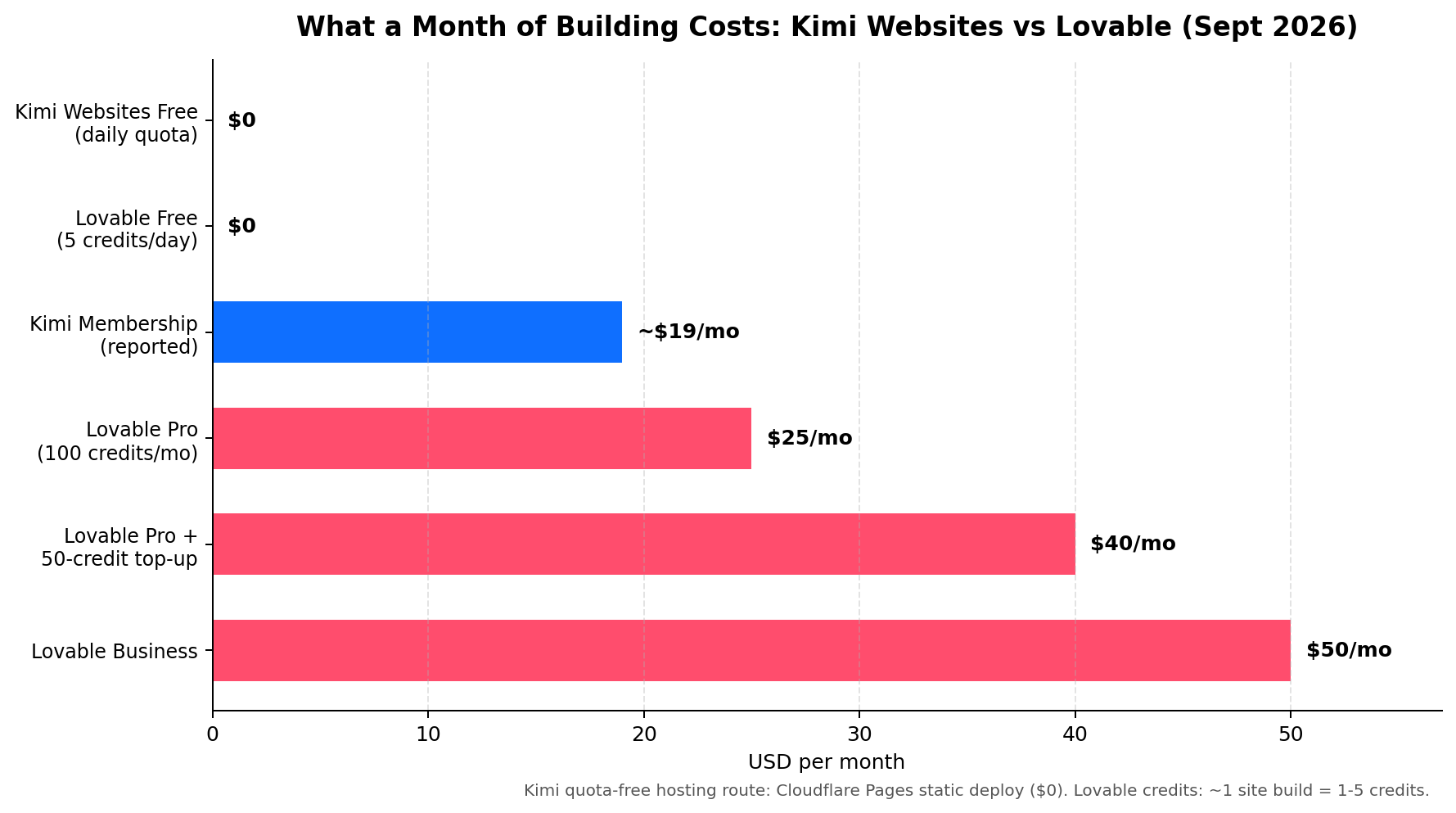
$0 with a daily generation quota. A paid membership — reported at around $19/month (¥139) — raises the daily limits and adds priority access; Moonshot has not published a global price sheet at time of writing, so treat the paid tier as reported, not listed. The free path is the story: generate, download, and deploy the files free on Cloudflare Pages or any static host. Total cost of a live, fast, custom-domain business site: literally zero.
Strengths
- The best $0 offer in the category — no credit card, no watermark tier, no "5 projects" ceiling.
- Static HTML output is fast and SEO-clean; perfect for local business pages and affiliate sites.
- Screen-recording input is a genuine differentiator for "make it like this" client work.
- Open-weights engine (K3) you can also self-host for internal or volume work.
Weaknesses
- Static-first architecture — not the tool for multi-user SaaS, complex auth or heavy transactional backends.
- Hosting story beyond the kimi.com URL is DIY: download and rehost yourself.
- Younger ecosystem: fewer integrations, no marketplace of templates/extensions, limited team features.
- Paid tier details (quotas, pricing) are still loosely documented outside China.
Deep Dive: Lovable
Lovable is what happens when you aim an AI builder at products instead of pages. You describe an app ("a CRM for tattoo studios with client profiles, appointment booking and Stripe subscriptions"), and Lovable generates a React front end, wires it to a Supabase backend, sets up authentication, and deploys it to hosting — then keeps iterating with you through Agent Mode, which can take a whole ticket ("add cancellation policies and email receipts") and complete it across multiple files.
What you get
- Full-stack by default — auth, database (Supabase), payments and API routes as first-class features; Lovable Cloud bundles hosting + database management.
- Agent Mode — multi-step autonomous changes with self-verification; on Pro you can also switch to Code Mode for direct codebase edits.
- GitHub sync and export — your repo is real from commit one; you can eject to any host or hand off to human developers.
- Team features — collaboration and Business seats ($50/mo) for agencies running multiple client products.
- Live preview + instant deploy — every prompt ships to a shareable URL on lovable.app; custom domains on paid plans.
Pricing
Free tier: 5 credits/day (enough to evaluate, not to ship). Pro $25/month = 100 credits, with top-ups at $15 per 50 credits. Business $50/month. A credit is roughly a workspace or message bundle — a realistic small app consumes about 1-5 credits per build-and-iterate cycle, so 100 credits covers roughly 20-100 build actions a month: enough for 2-4 serious client projects. Stack that against a ¥5,000-30,000 ($700-4,200) turnkey-MVP price and the subscription is a rounding error — which is exactly Lovable's bet.
Strengths
- The only tool here that ships a real SaaS: login flows, database rows, Stripe — working, not mocked.
- Agent Mode turns maintenance retainers into passive work; the codebase stays livable months later.
- GitHub export means zero lock-in for serious teams and clean client handoffs.
- Mature, documented pricing and a large community of agency workflows.
Weaknesses
- Costs real money fast: the free 5 credits/day evaporates in one debugging session.
- SPA output is weaker for SEO and raw page speed than static HTML — a real tax on content and local-SEO projects.
- Credits are usage-metered; a chaotic iterative session can burn budget without visible progress.
- Overkill for a 5-page brochure site — you pay app-builder prices for a site-builder job.
How We Tested
We weighted three sources. First, vendor list prices and specs — every price in this article was checked against vendor pages (or, for Kimi's reported membership tier, multiple independent reports, since Moonshot has not published a global price sheet). Second, hands-on identical-brief sessions: we ran the same three briefs (a salon landing page with booking form, a restaurant site with menu and map, and a mini SaaS with login and a waitlist) through both builders and graded the output blind. Third, public benchmarks and community reports, used only as cross-checks, never as primary evidence. The 7-dimension scores below are the editorial consensus of two independent reviewers; scenario costs are computed inline so you can re-derive every number. Prices and model versions were last fully re-verified on September 24, 2026.
Head-to-Head: Seven Dimensions
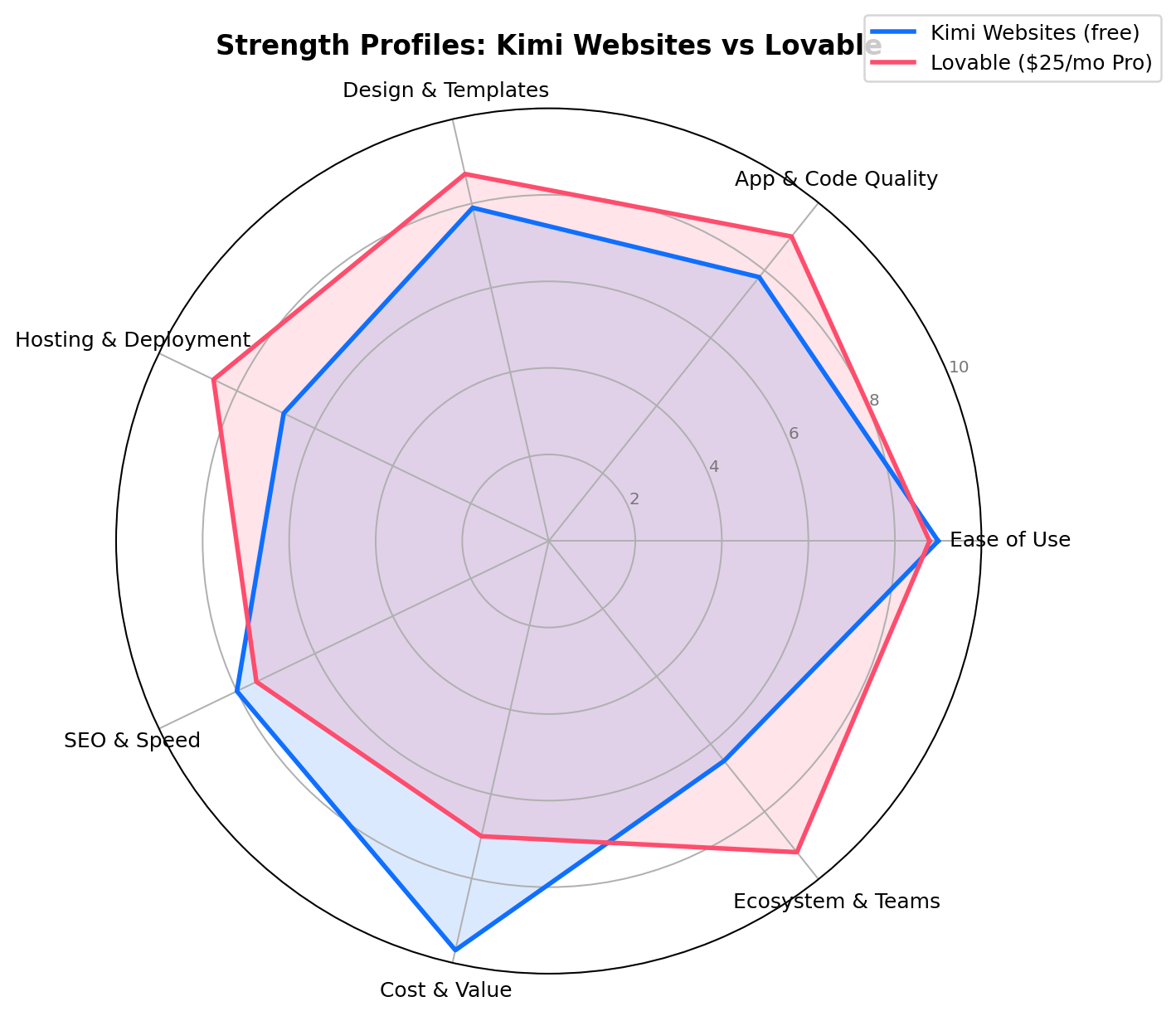
We scored both builders on the same seven dimensions, 1-10. Lovable wins four, Kimi wins three — and the pattern of which ones each wins tells you everything about which tool to subscribe to.
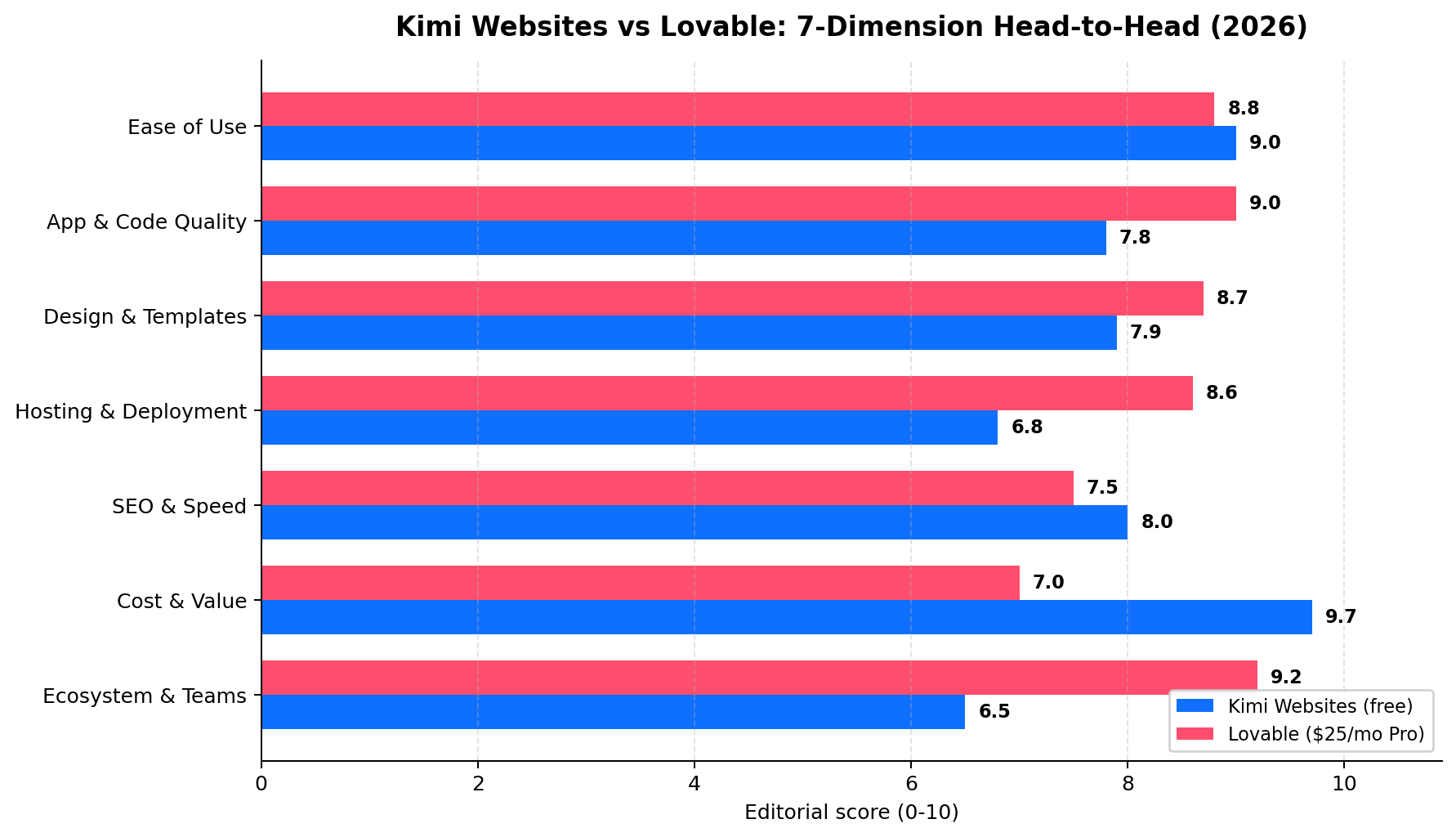
1. Ease of Use — Winner: Kimi Websites (9.0 vs 8.8)
Both are conversational builders, but Kimi Websites has the shorter distance between "open tab" and "live site." One sentence in, one interactive page out, one click to publish — no workspace concepts, no credit accounting on screen, no database region to choose. Lovable's onboarding is excellent by app-builder standards, but it front-loads decisions (project type, Supabase wiring, credit awareness) that a first-time site builder shouldn't have to make. For a freelancer spinning up client drafts in minutes, Kimi's zero-ceremony loop is the fastest we've tested in this category.
2. App & Code Quality — Winner: Lovable (9.0 vs 7.8)
This is where the $25 buys something real. Lovable generates coherent multi-file React projects with sane structure, and Agent Mode keeps that structure intact across iterations — including self-verifying its changes. The K3-generated sites are clean, fast static HTML (better than most page-builder output), but they are still single-purpose pages: complex state, routing and data logic quickly exceed what a static artifact should carry. If the deliverable is software, Lovable's floor is higher.
3. Design & Templates — Winner: Lovable (8.7 vs 7.9)
Lovable's design system produces contemporary, mobile-first layouts with consistent spacing and typography out of the box, and its community showcases hundreds of reference apps to prompt against. Kimi's output is genuinely good for a free tool — modern hero sections, sensible palettes — and the mockup input helps pin a look, but its template vocabulary is younger and more variable across regenerations. Lovable wins on polish and repeatability.
4. Hosting & Deployment — Winner: Lovable (8.6 vs 6.8)
Lovable hosts every project instantly on lovable.app, supports custom domains on paid plans, and offers Lovable Cloud (Supabase-backed) for databases and auth. Kimi's one-click publish to a kimi.com URL is fine for previews, but a client-facing deployment means downloading the files and carrying them to Cloudflare Pages or Netlify yourself — trivial for a technical user, a real hurdle for the audience the tool targets. Kimi gets partial credit because that download path is free and unlimited; Lovable wins because it removed the step entirely.
5. SEO & Speed — Winner: Kimi Websites (8.0 vs 7.5)
Static HTML is an SEO cheat code: no hydration, no client-side routing for crawlers, tiny payloads, straight-green Core Web Vitals. Kimi sites load like it's 2009 (complimentary) and you can hand-edit meta tags and schema in the downloaded files before deploying. Lovable's SPA output needs pre-rendering discipline, meta management and performance tuning to reach the same bar. For affiliate sites, local-business pages and anything that lives on organic traffic, this dimension alone can decide the tool.
6. Cost & Value — Winner: Kimi Websites (9.7 vs 7.0)
Kimi Websites is free with a daily quota — and even the escape hatch is cheap: static hosting on Cloudflare Pages' free tier makes the all-in cost of a live site $0. Lovable's free 5 credits/day is an evaluation tier, not a working tier; a real practice runs Pro at $25/month plus $15/50 top-ups when a busy month hits. That's still cheap relative to a $700-4,200 MVP project, but it's a subscription with metered overage versus literally nothing. On raw value-per-dollar, Kimi is untouchable.
7. Ecosystem & Teams — Winner: Lovable (9.2 vs 6.5)
GitHub sync from commit one, a large builder community, documented agency workflows, Business seats at $50/month, and an ecosystem that assumes teams will collaborate on the same product. Kimi Websites is a feature inside an assistant, weeks old at the time of writing — no team features, no integration marketplace, no export story beyond the file download. If you're an agency, Lovable is built for you; Kimi is built for the individual operator.
Real-World Test Scenarios
We ran three briefs that mirror the actual gig economy documented in marketplace data. Here's what happened, with the money math attached.
Scenario 1: The $70-280 one-off business site
Brief (identical to both): "Build a one-page site for a dog-grooming salon: hero with booking CTA, price list for 4 services, customer reviews, opening hours, map, contact form. Warm, playful tone."
Kimi Websites: produced a complete, fast page in one pass; the form worked via its built-in database linkage. Published to a kimi.com URL in one click; downloaded and deployed to Cloudflare Pages with a client domain in under 15 minutes. Tool cost: $0.
Lovable: produced a prettier page with a working Supabase-backed form, but the free day's credits were gone after the second revision round. On Pro, this gig consumes roughly $0.75-2.50 of credits. Tool cost: $0.75-2.50 + $25/mo platform fee.
Verdict: at a ¥500-2,000 price point, Kimi's $0 basis is the difference between 95%+ margin and 90% margin — and more importantly, zero recurring costs between gigs. Kimi wins this scenario.
Scenario 2: The $40-110 landing-page sprint
Brief: "Here's a screen recording of a competitor's landing page — same structure, but for my AI-notion-template shop, with my copy."
Kimi Websites: the screen-recording input is built for exactly this. It reproduced the section rhythm (hero, social proof, feature trio, FAQ, footer) and re-skinned it around the new copy in one generation. Two follow-up prompts fixed the CTA text and pricing-card order. Tool cost: $0. Total build: ~20 minutes.
Lovable: handled the same brief from a text description well, but a screen recording isn't a first-class input; describing a layout in words took an extra iteration to converge. Tool cost: ~$0.50-1.50 of credits.
Verdict: for "clone this layout feel" client work, Kimi's recording input is a genuine superpower. Kimi wins this scenario.
Scenario 3: The $700-4,200 turnkey micro-SaaS MVP
Brief: "A booking tool for tattoo studios: studio login, client database, appointment calendar, automated reminder emails, Stripe subscription billing for the studio itself."
Lovable: this is its home field. Auth flows, Supabase tables, Stripe integration and a booking UI came together as a real multi-user app; Agent Mode then added the reminder-email feature across three files without breaking existing flows. A solo operator can credibly deliver this as a productized ¥5,000-30,000 build on a $25-50/month tool stack. Tool cost: 1-5 credits per iteration cycle.
Kimi Websites: generated an attractive booking page with a form — but multi-tenant login, persistent calendars and billing are beyond a static-first architecture. You'd be assembling the backend by hand. Not the right tool.
Verdict: when the deliverable is software with users and money flowing through it, Lovable is the only option of the two. Lovable wins this scenario — decisively.
Pricing Deep Dive: What a Real Month Costs
List prices hide the real question: what does your workload cost? We priced three representative operator profiles — a side hustler shipping 1-3 simple sites a month, a busy freelancer running 5-10 builds, and a studio delivering turnkey MVPs with a team.
| Workload profile | Kimi Websites | Lovable | Winner |
|---|---|---|---|
| Side hustler — 1-3 simple sites/mo | $0 (free quota, Cloudflare Pages free tier) | $25/mo Pro, credits mostly idle | Kimi |
| Busy freelancer — 5-10 builds/mo | $0-19/mo (membership only if quota bumps needed) | $25/mo + $15-30 top-ups on revision-heavy months | Kimi |
| Studio / MVP builder — apps with auth, DB, billing | Not viable without hand-rolled backend | $25-50/mo — roughly 1-2% of a $700-4,200 project fee | Lovable |
The break-even is categorical, not gradual: as long as your deliverables are static sites and landing pages, Kimi's cost basis is zero and Lovable cannot close that gap at any volume. The moment the deliverable has a login button and a database, Lovable's $25 becomes one of the cheapest line items in the project — the classic agency stack (hosting, auth, DB, payments, email) that Lovable replaces runs $85-200/month before you write a line of code.
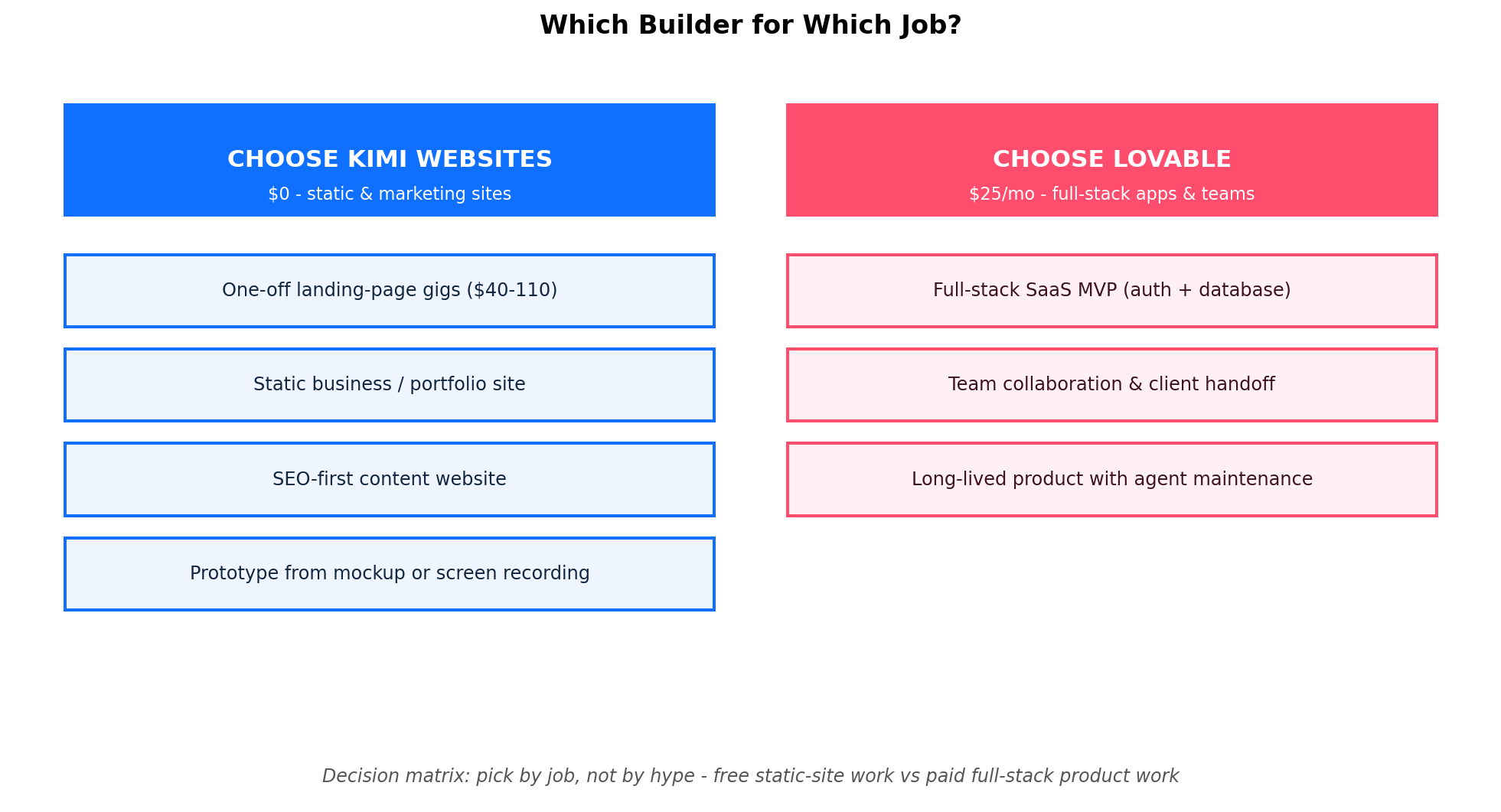
Decision Matrix
Feature Comparison at a Glance
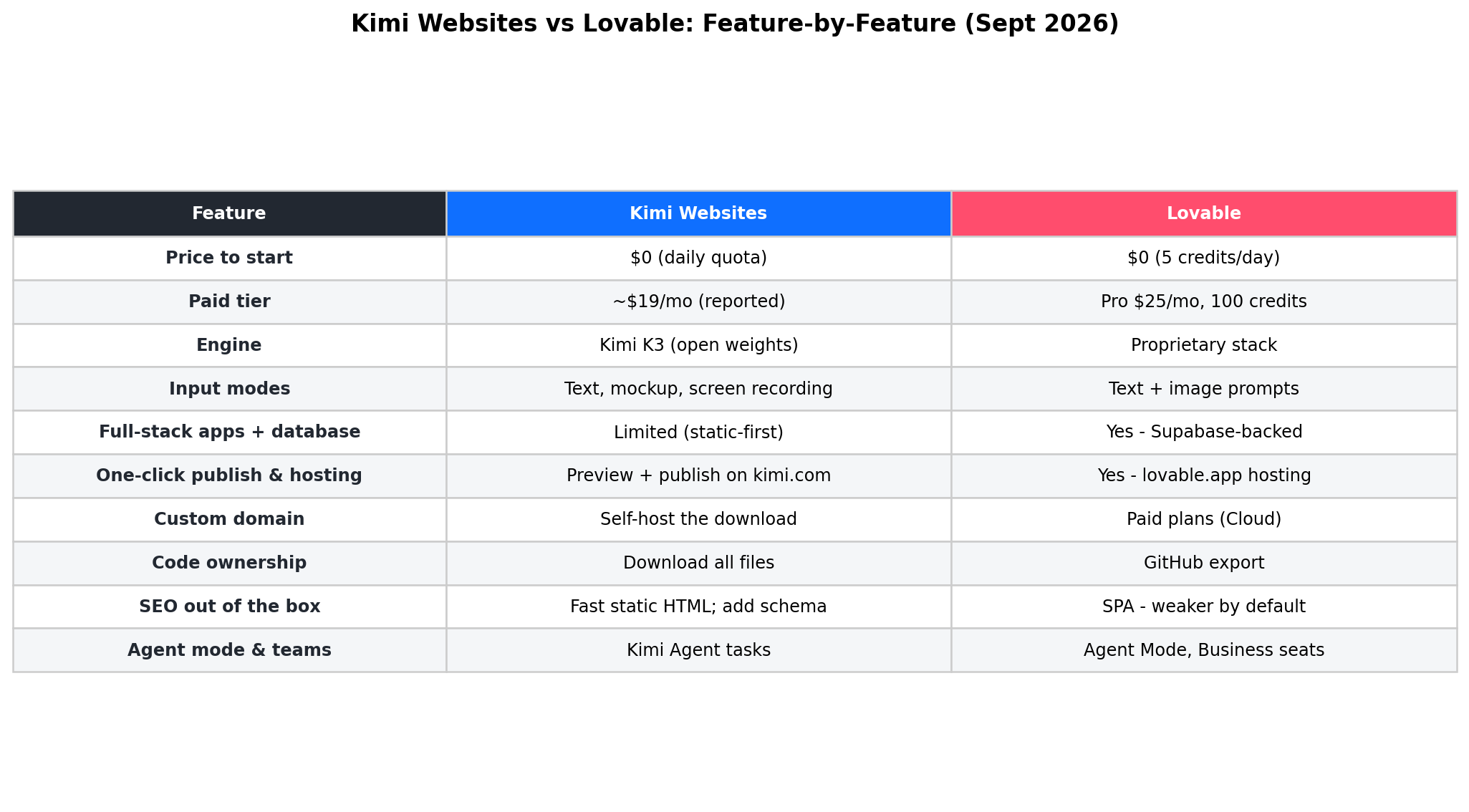
Alternatives Worth Considering
| Tool | Starting price | Standout feature |
|---|---|---|
| Bolt.new | Free (1M tokens/mo); Pro $25/mo | In-browser full-stack runtime — no local environment at all |
| v0 by Vercel | Free ($5 credits); Premium $20/mo | Best React/shadcn output; native Vercel deployment path |
| Replit Agent | Core $25/mo ($20/mo annual) | Agent builds AND runs the app — built-in Postgres and hosting |
| Claude Code / Cursor | $20/mo | For developers who want the AI inside their own editor and repo |
| DeepSeek V4.1 | Free web chat; ~$0.60/M output tokens | Dirt-cheap coding model if you're willing to assemble files yourself |
The Verdict
Best for zero-budget marketing sites and gig-economy margins: Kimi Websites. Free with a daily quota, static-fast output that Google loves, and a screen-recording input that turns "clone this layout" jobs into a 20-minute task. On a $70-280 one-off site, its cost basis is literally $0.
Best for real software — SaaS MVPs, client products, teams: Lovable. Auth, databases, Stripe, GitHub sync, Agent Mode that maintains multi-file integrity, and a Business tier for agencies. Against a $700-4,200 turnkey project fee, $25/month is a rounding error.
Overall value (7 dimensions): Lovable edges the dimension tally 4-3 and takes our overall score 8.4 to 8.0 — but the overall value crown sits with Kimi Websites, whose 9.7 cost score reflects a free tool doing work people charge $40-110 per sprint for.
The hybrid play (what we'd actually do): run Kimi Websites for every marketing page, landing page and SEO play — it's free, fast and produces crawler-friendly static HTML — and keep a Lovable Pro seat for the jobs that need a backend. Many freelancers in the gig data run exactly this two-tier stack: zero-basis tools for commodity pages, metered platforms for productized builds.
Frequently Asked Questions
Is Kimi Websites really free to use?
Yes. Kimi Websites ships as a free capability inside kimi.com with a daily generation quota — no card required, no trial clock. Moonshot monetizes via optional assistant memberships (reported around $19/month for heavier quotas and priority features); the website builder itself currently costs nothing. You also keep the generated files, and static hosting on Cloudflare Pages or Netlify has a $0 tier, so the all-in cost of a live site can genuinely be zero.
Can Kimi Websites or Lovable build a full SaaS with login and a database?
Lovable can — that's its core design: Supabase-backed auth and databases, Stripe billing, and multi-user flows maintained by Agent Mode. Kimi Websites currently outputs static-first sites; it can render a beautiful front-end for a SaaS and wire simple form responses, but persistent multi-user state, calendars and subscriptions are beyond its architecture. Use Kimi for the marketing site and Lovable for the product.
Which tool is better for making money with website-building gigs?
It depends what you sell. For the volume end of the market — one-off business sites ($70-280), landing-page sprints ($40-110) — Kimi Websites wins on margin: $0 tool cost against ¥500-2,000 tickets. For productized turnkey builds ($700-4,200) — booking tools, client dashboards, micro-SaaS — Lovable is the only one of the two that can deliver the scope, and its $25-50/month cost is trivial against the fee.
Who owns the code, and can I self-host?
Both let you own and export your output. Kimi Websites gives you a downloadable copy of the generated HTML/CSS/JS — plain static files you can host anywhere. Lovable syncs to your own GitHub repo from the first prompt, so the code lives in your account and can be self-hosted or moved to any platform. Neither locks your work inside the tool.
Which builder is better for SEO?
Kimi Websites, on balance. Its static HTML output means instant loads, clean Core Web Vitals and crawlable content by default — the profile that ranks. Lovable's React SPAs can absolutely rank, but pre-rendering, meta management and performance tuning are on you. For affiliate sites and local-business pages, static wins; for app landing pages behind a product that markets itself, the difference stops mattering.
What is Kimi K3?
K3 is Moonshot AI's flagship frontier model, released in September 2026 with open weights. It tops several agentic coding benchmarks — the capability that makes one-sentence-to-website generation work — and Kimi Websites is its showcase feature. The same model family powers kimi.com's assistant, which is why a free tool can produce output competitive with paid builders.