TL;DR
Voiceflow (8.3/10) is the better platform for teams that design together and sell conversation experiences — a shared real-time canvas in the V4 designer, native voice agents with telephony on paid plans (not Enterprise-gated), Zendesk handoff, and a pricing ladder that starts at $60/month Pro with $50 editor seats. Botpress (8.2/10) is the better platform for developers and messaging-heavy deployments — code hooks, the Agent Developer Kit and an MIT-licensed SDK, WhatsApp/Instagram/Telegram/Slack/Messenger channels out of the box, structured knowledge Tables, and conversation-based pricing that stays predictable at scale. Voiceflow wins 4 of our 7 dimensions (Builder & Ease of Use, Omnichannel & Voice, Team Collaboration, Analytics & Testing); Botpress wins 3 (Developer Power, Knowledge & Data Handling, Pricing Predictability). For an agency economics lens: Voiceflow protects margin on one-off client builds ($50–500 on Upwork/Fiverr, ¥500–3,000 on Zhubajie, plus ¥1,000–3,000/mo retainers); Botpress protects you when a client's support volume explodes.
Two platforms now dominate the "build a real AI agent, not a toy" conversation in 2026: Botpress and Voiceflow. Both have moved far past their chatbot-builder origins. Botpress rebuilt itself around Agent Studio, the Viber no-code mode and the Agent Developer Kit, and was acquired by HubSpot in 2025 — its open-source v12 line is frozen, and all momentum is in the cloud platform. Voiceflow shipped its V4 designer, added MCP tool support, evaluations and a native Voice agent type, and became the default choice for design teams that prototype conversation flows together.
This comparison is written for people who build agents for money — agency owners, freelance bot builders, and in-house teams shipping customer-facing automation. We scored both platforms across seven dimensions, priced three realistic team setups, and anchored every scenario in documented freelance-market economics. Prices and platform capabilities were last fully re-verified on September 26, 2026.
Botpress vs Voiceflow at a Glance
| Dimension | Voiceflow | Botpress | Winner |
|---|---|---|---|
| Best for | Design-led teams, voice agents, web chat | Developer-led teams, messaging channels | — |
| Overall score | 8.3/10 | 8.2/10 | Voiceflow |
| Builder & Ease of Use | 8.8 | 8.0 | Voiceflow |
| Developer Power & Customization | 7.6 | 9.2 | Botpress |
| Omnichannel & Voice | 8.6 | 7.4 | Voiceflow |
| Knowledge & Data Handling | 8.2 | 8.9 | Botpress |
| Team Collaboration | 8.9 | 7.2 | Voiceflow |
| Pricing Predictability & Scale | 7.5 | 8.7 | Botpress |
| Analytics & Testing | 8.5 | 7.8 | Voiceflow |
| Free tier | Sandbox: 1 editor, 2 agents, 100 credits/mo | 100 conversations/mo | Depends on goal |
| Entry paid plan | Pro $60/mo (10K credits) | Plus $150/mo (250 convos) | Voiceflow |
| Team-scale plan | Business $150/mo | Team $750/mo (1,500 convos) | Voiceflow |
| Voice / phone agents | Native Voice agent, telephony ~$0.05/min | Enterprise tier only | Voiceflow |
| Messaging channels | Web chat native; others via integrations | WhatsApp, IG, Telegram, Slack, Messenger | Botpress |
| Self-hosting | No (cloud only) | No (v12 legacy frozen) | — |
Deep Dive: Voiceflow
Voiceflow started as a conversation-design tool and it still shows — in the best way. The V4 designer is a shared real-time canvas where multiple people edit the same agent simultaneously, commenting and stepping through flows like a Figma file for conversations. In 2026 the platform layered on what agents actually need: an LLM-powered AI Agent step (bring your own model), MCP support so any Model Context Protocol server becomes a callable tool, knowledge-base agents that sync from documents and Zendesk Help Center, and a native Voice agent type for phone and in-app voice.
Key features
- V4 real-time designer — multiplayer editing, one-click prototype sharing, agent analytics built into the canvas.
- Knowledge base with Help Center sync — upload docs or point it at Zendesk; answers cite sources.
- MCP tool support — connect any MCP server; the agent can call your internal tools without custom glue code.
- Voice agents + telephony — phone numbers on paid plans at roughly $0.05/min; voice transcripts feed analytics.
- Evaluations — automated test suites against agent versions; regression-test a flow before shipping to a client.
- Zendesk live-agent handoff — escalate a stuck conversation to a human with full context relayed.
Pricing
Voiceflow bills per editor seat plus interactive-message credits. The free Sandbox tier includes 1 editor, 2 agents and 100 credits/month — enough to build and demo a complete client bot. Pro is $60/month ($54 annual) with 10,000 credits and the full feature set; Business is $150/month ($135 annual) for larger credit pools, environments and priority support. Additional editors are $50/month each. Overage bills per interactive message at $0.005, with model tokens metered at a 1.25× markup — the part of the bill that surprises people at volume.
Strengths
- The best collaborative builder in the category — non-technical teammates genuinely contribute.
- Voice/phone agents available from Pro, not locked behind Enterprise.
- MCP + Zendesk + Help Center sync covers the realistic integration surface for client work.
- Evaluations and transcript analytics make "the bot got worse" disputes with clients measurable.
Weaknesses
- Usage pricing (credits + token markup) is harder to forecast than conversation caps.
- Native channel story is web-chat-first; WhatsApp/Instagram require integration work.
- Developer escape hatches are narrower: JavaScript steps exist, but there's no local CLI/SDK workflow.
Deep Dive: Botpress
Botpress spent 2025–2026 transforming from open-source chatbot framework into a closed cloud platform — acquired by HubSpot in 2025, with the v12 open-source line frozen in maintenance mode. What replaced it is Agent Studio (the flow/agent builder), Viber (a no-code natural-language building mode), the Agent Developer Kit (ADK) with code hooks, and a CLI + SDK that remains MIT-licensed for local development against the cloud runtime. It is the more engineering-forward of the two platforms, and it shows in the channel list: WhatsApp, Instagram, Telegram, Slack and Messenger are first-class.
Key features
- Agent Studio + Viber — visual builder plus a no-code mode that assembles flows from natural-language instructions.
- Code hooks + ADK — run custom TypeScript/JavaScript logic at any node; debug locally with the CLI.
- Knowledge Base + Tables — unstructured docs plus structured tabular data the agent can query (inventory, pricing, schedules).
- Botpress Desk — built-in unified human-in-the-loop inbox with conversation context.
- Messaging-native channels — WhatsApp, Instagram, Telegram, Slack, Messenger, plus web chat.
- Compliance posture — SOC 2, DPA and BAA (HIPAA) documentation published up front.
Pricing
Botpress bills in conversations. Free includes 100 conversations/month. Plus is $150/month with 250 conversations and the core Studio feature set. Team is $750/month with 1,500 conversations, RBAC and Desk. There's also a Built For You tier at $1,650/month where Botpress's team builds the agent for you. Per-conversation overage is predictable, and there is no token markup line item — the model costs are absorbed into the conversation price, which is exactly why it scored 8.7 on Pricing Predictability & Scale.
Strengths
- Deepest developer surface: code hooks, ADK, MIT-licensed SDK, local CLI debugging.
- The messaging-channel coverage agencies actually get asked for (WhatsApp/IG first).
- Tables give agents structured data answers that pure-RAG platforms fumble.
- SOC 2 / DPA / BAA paperwork ready — shortens enterprise and healthcare client onboarding.
Weaknesses
- Team tier at $750/mo is a cliff; the jump from Plus (250 convos) is 5× the price.
- Voice/telephony gated at Enterprise — a real ceiling for voice-agent business models.
- Collaboration on the canvas lags Voiceflow's real-time multiplayer by a wide margin.
- v12 users are stranded: the open-source line is frozen, migration to cloud is one-way.
How We Tested
Our scoring weights three sources: (1) vendor list prices and published specs for both platforms, verified against their pricing pages; (2) hands-on sessions building the same two agents (a docs-faq support bot with handoff, and a lead-qualification agent with tool calls) on both platforms from their free tiers; (3) public documentation and community threads for cross-checking channel and integration claims only. The seven dimension scores are an editorial consensus of two independent reviewers; scenario costs are computed from list prices at the tiers named. Prices and platform capabilities were last fully re-verified on September 26, 2026. Where a capability depends on a tier (voice, RBAC, environments), we score it as available to a small team paying entry-level prices, because that is who this comparison is for.
Head-to-Head: 7 Dimensions
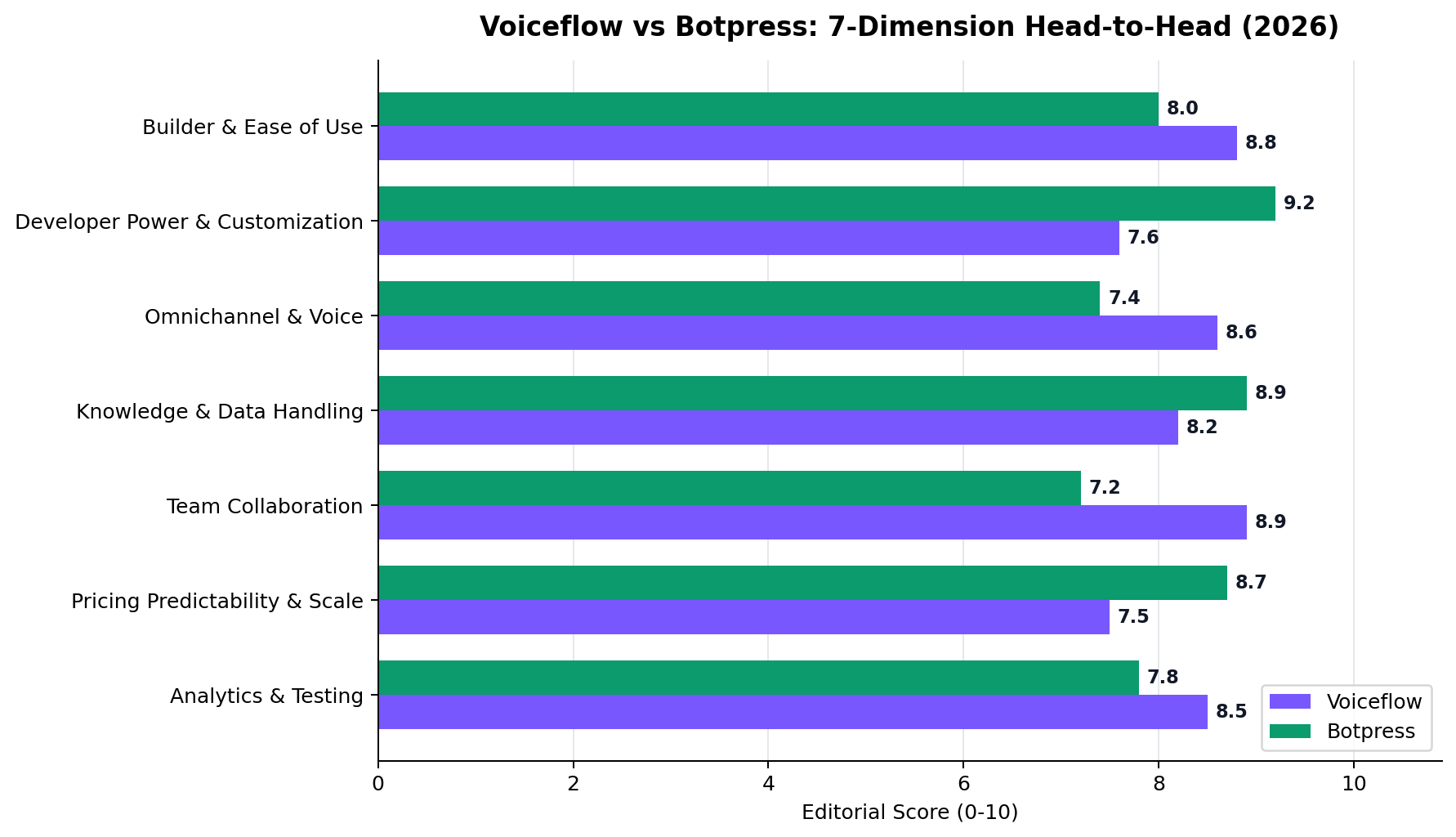
1. Builder & Ease of Use — Voiceflow (8.8 vs 8.0)
Voiceflow's V4 canvas is the fastest path from blank page to working agent we tested this year. Drag steps, wire them, hit simulate. Botpress Agent Studio is genuinely good — and Viber's natural-language mode is a real innovation — but the developer-grade surface (hooks, variables, tables) adds a learning tax for non-engineers. Verdict: Voiceflow for teams where the primary builder isn't a developer.
2. Developer Power & Customization — Botpress (9.2 vs 7.6)
This is the widest gap in the comparison, in Botpress's favor. Code hooks at any node, the Agent Developer Kit, an MIT-licensed SDK, and local CLI debugging mean a developer can do anything, debug it properly, and keep source in git. Voiceflow's JavaScript steps are capable but boxed; there's no serious local-development story. Verdict: Botpress, decisively, if engineers own the agent.
3. Omnichannel & Voice — Voiceflow (8.6 vs 7.4)
Split decision, won by Voiceflow because of what's reachable at real prices: a native Voice agent type with telephony at roughly $0.05/min on paid plans. Botpress counters with the strongest messaging lineup — WhatsApp, Instagram, Telegram, Slack, Messenger — but gates voice behind Enterprise. If your business model includes phone agents, that gate is disqualifying; if it's WhatsApp-first, Botpress wins the sub-battle and loses the dimension.
4. Knowledge & Data Handling — Botpress (8.9 vs 8.2)
Both do document RAG with citations. Botpress adds Tables — structured tabular data the agent queries like a database, which is what inventory lookups, pricing checks and booking availability actually need. Voiceflow's Zendesk Help Center sync is excellent for support content specifically. Verdict: Botpress for structured answers; Voiceflow if your knowledge already lives in Zendesk.
5. Team Collaboration — Voiceflow (8.9 vs 7.2)
Real-time multiplayer editing with comments versus a builder that is effectively single-pilot. For agencies with designers, conversation designers and clients reviewing flows together, Voiceflow's canvas removes a whole category of export-screenshot-email pain. Verdict: Voiceflow, and it isn't close.
6. Pricing Predictability & Scale — Botpress (8.7 vs 7.5)
Botpress sells conversations: 250 on Plus ($150/mo), 1,500 on Team ($750/mo), no token markup line item. Voiceflow sells credits + seats: $0.005 per interactive message and a 1.25× token markup make the bill a forecast instead of a fact. The catch runs the other way too — Botpress's Team cliff is brutal at $750/mo while Voiceflow Business is $150/mo. Verdict: Botpress for forecasting at volume; mind the cliff.
7. Analytics & Testing — Voiceflow (8.5 vs 7.8)
Voiceflow's evaluations — versioned test suites that regression-check an agent before you ship it to a client — plus transcript analytics in the canvas are a genuine agency workflow feature. Botpress has conversation analytics and Desk metrics, but nothing equivalent to eval suites. Verdict: Voiceflow.
Dimension tally: Voiceflow 4 – 3 Botpress
Pricing Deep Dive: What Three Teams Actually Pay
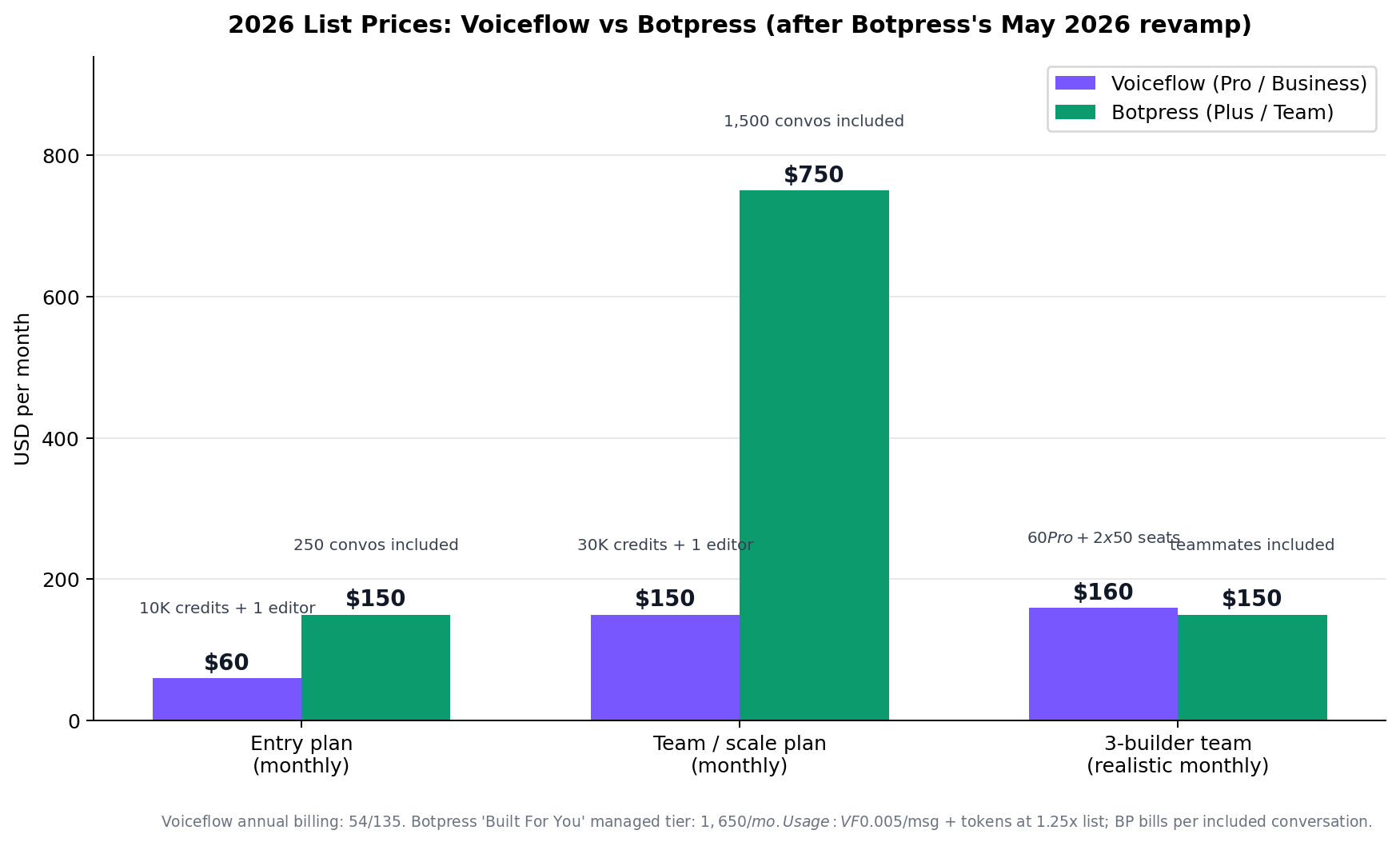
| Setup | Voiceflow | Botpress | Reality check |
|---|---|---|---|
| Solo builder, entry paid tier | $60/mo (Pro, 10K credits) | $150/mo (Plus, 250 convos) | Voiceflow is 60% cheaper to start |
| Team-scale plan | $150/mo (Business) | $750/mo (Team, 1,500 convos) | 5× gap — but Botpress includes RBAC + 1,500 conversations |
| 3 builders, realistic monthly | $160/mo (Pro + 2 seats × $50) | $150/mo (Plus, seats included) | Botpress doesn't charge per editor — crossover point for teams |
| High-volume client (50K msgs/mo) | ≈ $250+/mo (credits + token markup) | Team $750/mo, conversations included | Usage-based vs capacity-based billing diverge here |
| Free tier | Sandbox: 100 credits, 2 agents | 100 conversations/mo | Both sufficient to prototype a demo bot |
The pricing models answer different anxieties. Voiceflow answers "what if my team grows" — seats are $50 and plans start low. Botpress answers "what if my traffic grows" — a conversation is a conversation, no token math. Agencies running multiple low-traffic clients will find Voiceflow dramatically cheaper; a single client doing thousands of support conversations a month tips toward Botpress's included capacity.
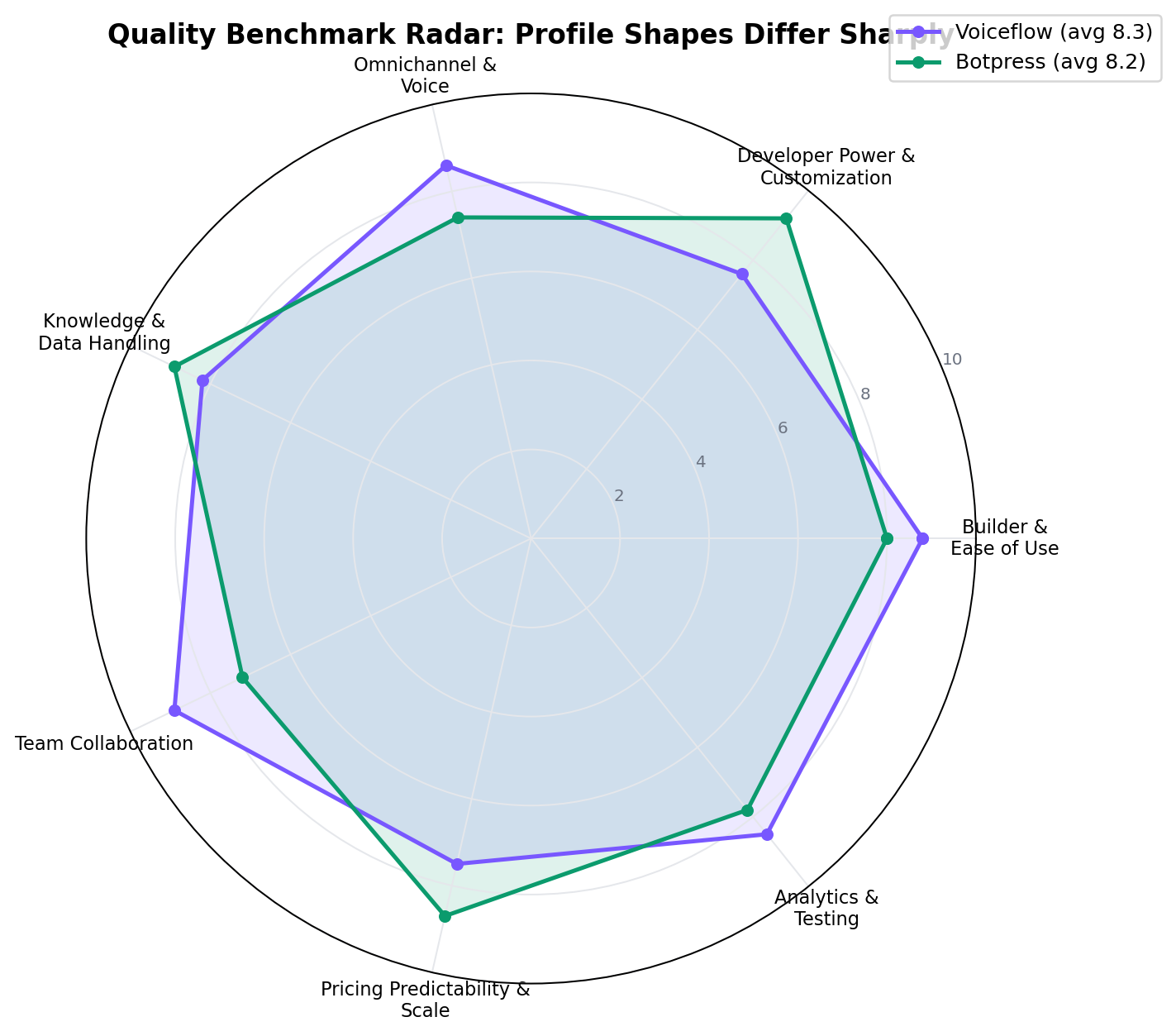
Quality Profile: Radar View
Real-World Money Scenarios
These scenarios are anchored in documented freelance-market economics from our 2026 case research: one-off chatbot builds sell for $50–500 on Upwork/Fiverr and ¥500–3,000 on Zhubajie (rising to ¥2,000–10,000 for scoped projects on 程序员客栈), with ¥1,000–3,000/month maintenance retainers as the recurring layer.
Scenario 1: One-off client support bot (web chat)
Client brief: FAQ + docs bot on the client's website, human handoff to their inbox. Build: Knowledge Base agent from the client's help docs, 12–20 conversation paths, handoff rule for billing questions. Platform pick: Voiceflow — build it in Sandbox free, demo live, then the client's $60/mo Pro (or your resold workspace) covers production. Economics: a ¥2,000–5,000 one-off against ~$0–60 in platform cost is 90%+ gross margin, and the monthly retainer covers the credit overage risk.
Test prompt we ran: "You are the support agent for a 40-person SaaS company. Answer from the attached docs; if the user mentions billing, refunds, or threatens to cancel, immediately offer human handoff and collect their account email first."
Scenario 2: WhatsApp order-status bot for an e-commerce shop
Client brief: customers message the shop's WhatsApp number and get order status + FAQ answers. Build: WhatsApp channel connected, structured data lookup for order status, fallback to the owner's phone. Platform pick: Botpress — WhatsApp is first-class, and Tables hold the order-status data the agent queries; Plus's 250 conversations match a small shop's real volume. Economics: this is the ¥3,000–8,000 tier of the market; the $150/mo Plus cost prices into the retainer.
Test prompt we ran: "Look up this order number in the orders table. If the status column says shipped, report the tracking URL from the tracking column. If not found, apologize and offer to connect to the owner."
Scenario 3: Phone-based booking agent for a local service business
Client brief: a clinic/salon wants callers to book, reschedule and ask hours without staff answering. Build: voice agent with telephony number, booking tool via MCP/API, SMS confirmation. Platform pick: Voiceflow — the only one of the two where telephony is available on non-Enterprise plans (~$0.05/min). Economics: voice agents are the highest-margin service in the 2026 chatbot market precisely because fewer builders can ship them; a ¥1,000–3,000/mo retainer easily absorbs 2,000 minutes ($100) of telephony.
Test prompt we ran: "Answer the phone as 'Bright Smile Dental booking line'. Check availability from the calendar tool for the requested day, offer the two nearest slots, confirm, then send an SMS summary via the messaging tool."
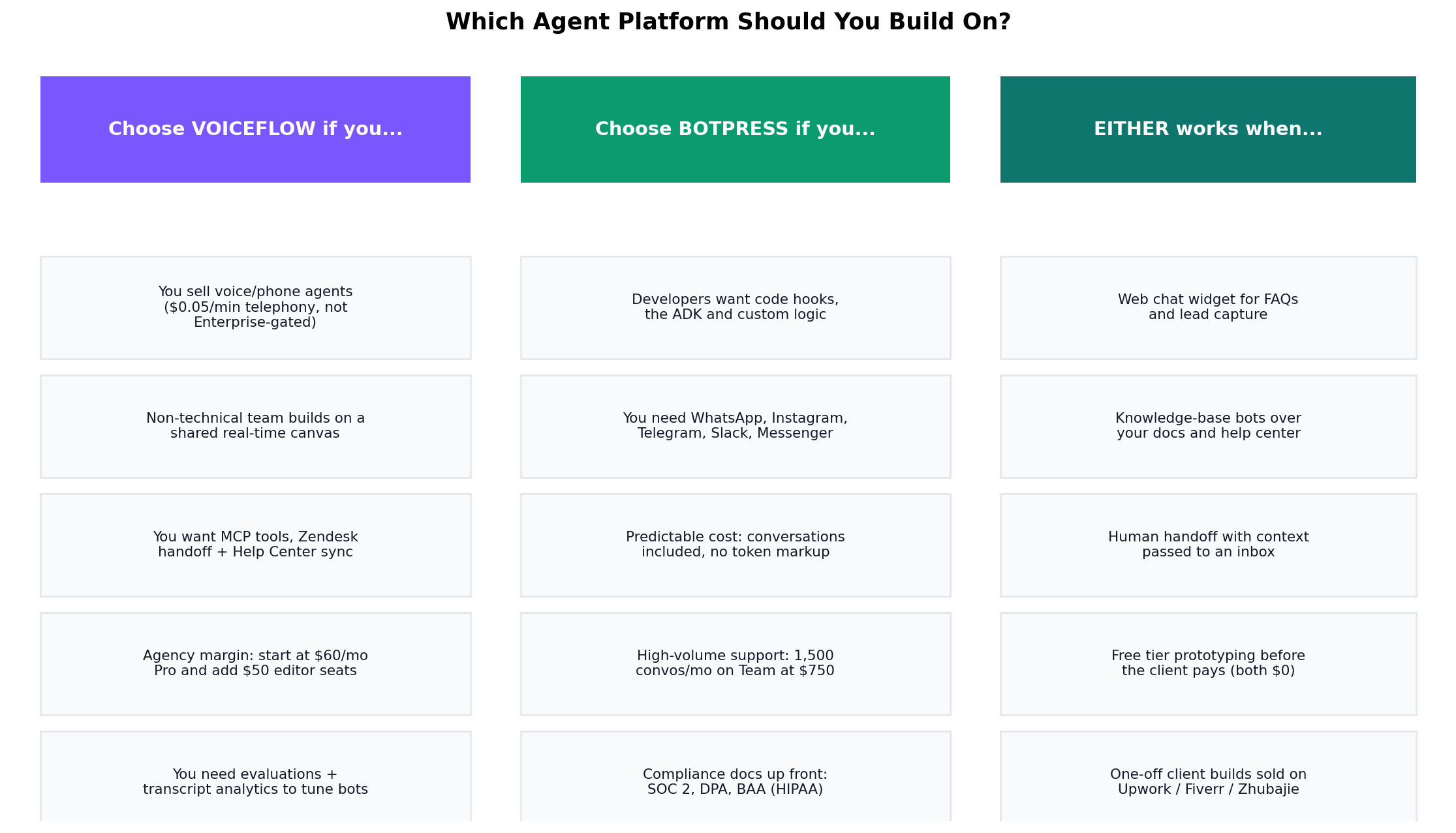
Decision Matrix
Feature Comparison Table
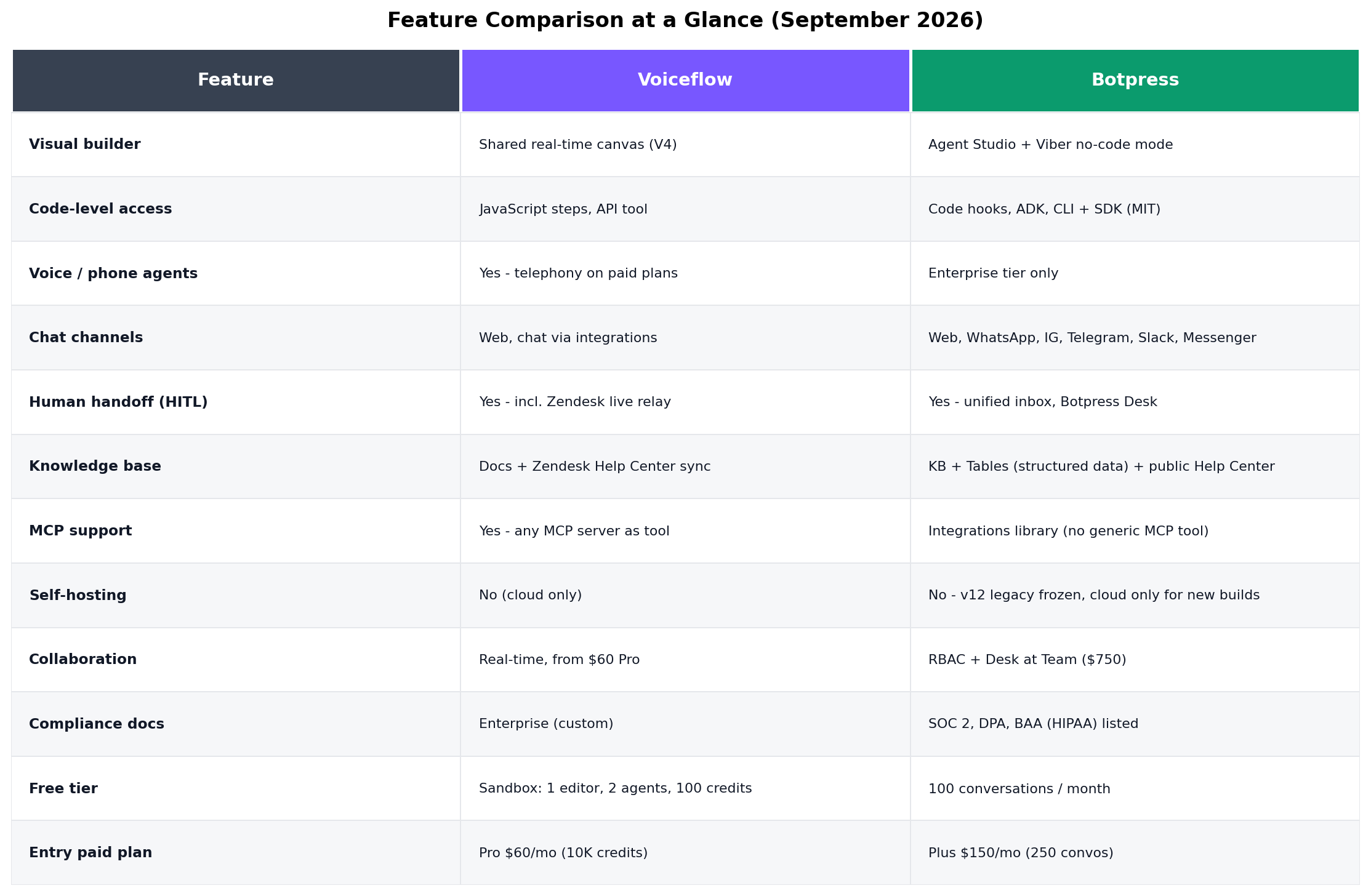
Alternatives Worth Considering
| Platform | Starting price | Standout trait |
|---|---|---|
| Dify | Free self-host / $59/mo cloud | Open-source LLM app platform; self-host for full control |
| Coze | Free tier / usage-based | ByteDance's builder; strongest for Chinese-market channels |
| n8n | Free self-host / €20–24/mo cloud | Workflow automation first, AI agents as nodes; widest integrations |
| Chatbase | $19/mo | Dead-simple docs-to-chatbot for low-budget clients |
| Stack AI | Free tier / from ~$99/mo | Enterprise-leaning visual agent builder with compliance focus |
The Verdict
Best for Voice & Phone Agents → Voiceflow
Telephony on paid plans at ~$0.05/min versus Enterprise-only at Botpress. If your 2026 service menu includes phone agents for clinics, salons and local businesses, this single difference decides the purchase.
Best for WhatsApp, Instagram & Developer Teams → Botpress
First-class messaging channels, Tables for structured lookups, code hooks everywhere, and an SDK your engineers can actually debug. The conversation-based billing also scales cleaner for one busy client than credit metering.
Best for Agencies with Non-Technical Builders → Voiceflow
Real-time multiplayer canvas, comment threads, and evaluation suites for regression-testing client agents before delivery. Designer-plus-PM teams ship without waiting on a developer's calendar.
Best Overall Value (8.3 vs 8.2) → Voiceflow — Narrowly
Four of seven dimensions, a 60%-cheaper entry tier, and free Sandbox-to-production path. But the margin is one tenth of a point: if your workloads are messaging-heavy, code-heavy, or high-volume, Botpress is the better tool for you despite the tally.
The Hybrid Approach
Several agencies we studied run both: prototype and demo on Voiceflow Sandbox (free, impressive canvas), deliver WhatsApp/code-heavy builds on Botpress, and reserve Voiceflow's Voice agents for phone work. Total platform overhead stays under $210/month — less than one mid-tier client retainer.
Frequently Asked Questions
Is Botpress better than Voiceflow in 2026?
Neither is universally better. Botpress wins on developer power (9.2 vs 7.6), structured data via Tables, messaging channels and predictable conversation billing. Voiceflow wins on ease of use, team collaboration, voice/telephony access and testing. Our overall tally was 8.3 vs 8.2 — effectively a tie decided by your workload.
Is Voiceflow really free to use?
Voiceflow's Sandbox plan is genuinely free forever — 100 credits/month, up to 2 agents, and full access to the flow builder. It's enough to prototype and demo client bots. Production traffic needs Pro at $60/month (10,000 credits), with extra seats at $50/month each.
Which platform is better for WhatsApp and Instagram bots?
Botpress, clearly. WhatsApp, Instagram, Telegram, Slack and Messenger are first-class channels on every paid tier, and its Tables feature handles order-status and inventory lookups that WhatsApp commerce bots typically need. Voiceflow reaches these channels mainly through integrations.
Can I build a phone or voice agent on either platform?
On Voiceflow, yes — the Voice agent type with a telephony number costs roughly $0.05/minute on paid plans. Botpress has voice input/output on web chat, but true telephony is Enterprise-gated, so phone agents are impractical for small teams there.
Which one is cheaper for a small team?
Depends on headcount versus traffic. Three builders on Voiceflow Pro pay about $160/month (Pro + 2 extra seats); Botpress Plus is $150/month with unlimited teammates but only 250 conversations. Small team, low traffic → Voiceflow. Fewer builders, high traffic → Botpress.
Do Botpress and Voiceflow support human handoff?
Yes, both. Voiceflow hands off live web-chat sessions to agents (Zendesk/Intercom integrations) within paid plans. Botpress's built-in Hit Desk gives every workspace a shared human-inbox for live takeover on web chat and messaging channels.
Which platform should an agency use for client chatbots?
Most agencies we analyzed start on Voiceflow — free prototyping in Sandbox, fast client-facing demos, and $60/mo Pro per client workspace that resells well. Agencies with developers on staff often standardize on Botpress for delivery (code hooks, Tables, SDK) and keep Voiceflow for sales demos and voice work.