TL;DR
DeepSeek V4.1 Flash (released September 10, 2026) is the most aggressive price-performance play in chat AI: a 552B-parameter multimodal MoE with a 1M-token context, a 384K-token output ceiling, 90.6% on Terminal-Bench 2.1, MIT-licensed weights — and an API that charges $0.15 per million input / $0.60 per million output tokens off-peak. Gemini 3.1 Pro is Google's flagship chat model: better prose polish, natively multimodal, welded into Gmail, Docs, NotebookLM and a $4.99/month bundle that includes Veo 3.1 Fast video and Nano Banana Pro image generation.
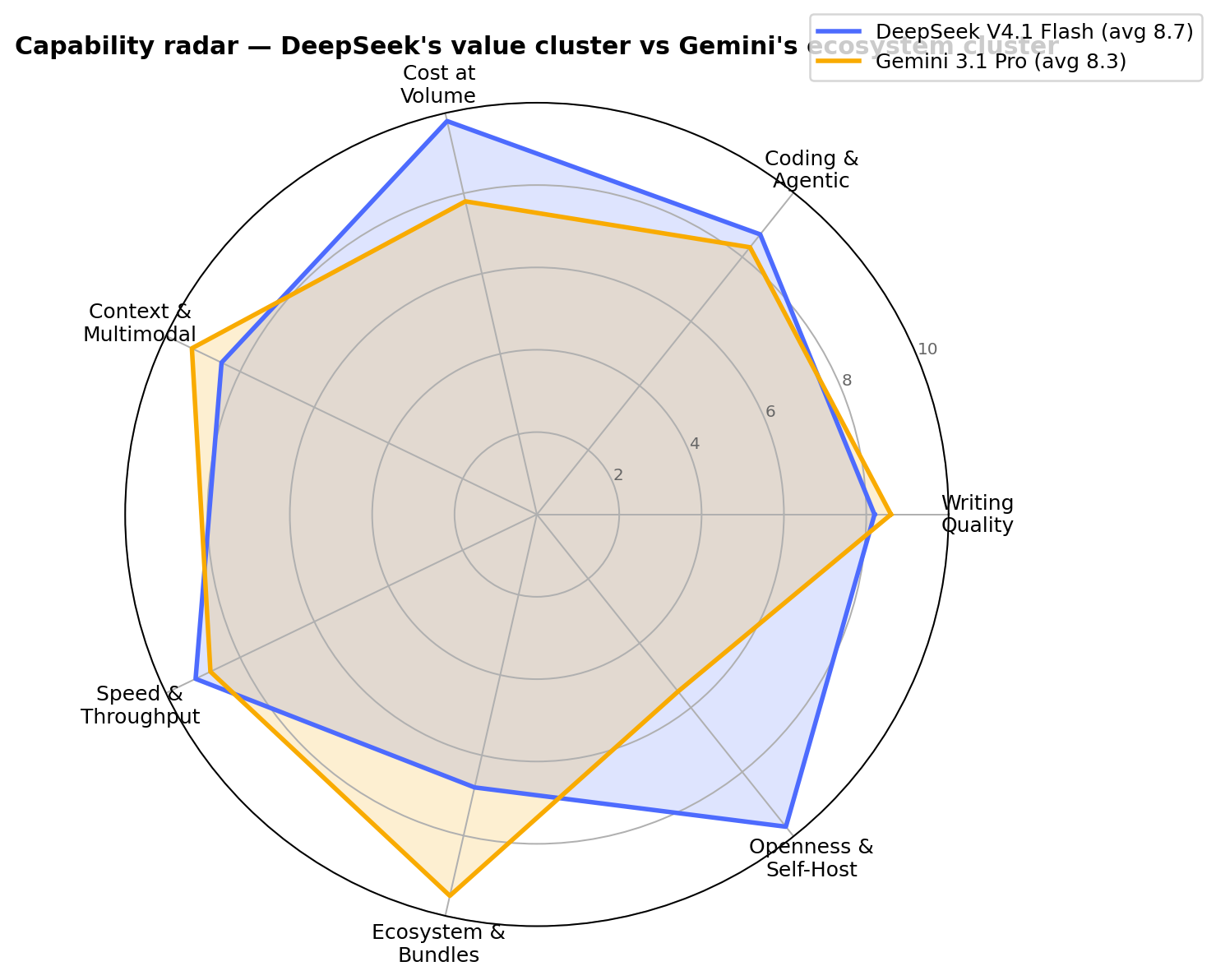
Across our seven dimensions, DeepSeek wins four (Coding & Agentic Work, Cost at Volume, Speed & Throughput, Openness & Self-Hosting) with an 8.7 average; Gemini wins three (Writing Quality & Voice, Context & Multimodal, Ecosystem & Bundles) with an 8.3 average. The practical split: volume workloads — web novels, KDP drafts, SEO content farms, budget coding agents — belong on DeepSeek's API; premium client-facing prose, multimodal analysis and anything that lives inside Google Workspace belongs on Gemini. Most of the monetized workflows we track run both.
At a Glance
| Dimension | DeepSeek V4.1 Flash | Gemini 3.1 Pro |
|---|---|---|
| Release | September 10, 2026 | Current Google flagship (in chat since 2026) |
| Architecture | 552B backbone, multimodal MoE, vision encoder | Google frontier MoE, natively multimodal |
| Context window | 1M tokens | 1M tokens |
| Max output | 384K tokens | 64K tokens |
| Free access | Free web/mobile chat + 5M free API tokens | Free tier includes 3.1 Pro (limited) + Deep Research |
| API price (per M tokens) | $0.15 in / $0.60 out (off-peak; doubles at peak) | $12.00 out (3.1 Pro); Flash tiers from $2.50 |
| Subscription | None — pay per token or nothing | AI Plus $4.99/mo · AI Pro $19.99/mo · AI Ultra $99.99/mo |
| Coding benchmark | Terminal-Bench 2.1: 90.6% | Terminal-Bench 2.1: 88.0% |
| Image/video generation | No (vision input only) | Yes — Veo 3.1 Fast + Nano Banana Pro (bundle) |
| Open weights | Yes — MIT license | No — cloud only |
| Overall score | 8.7 / 10 — our pick for volume | 8.3 / 10 — our pick for polish & ecosystem |
Head-to-Head Scores
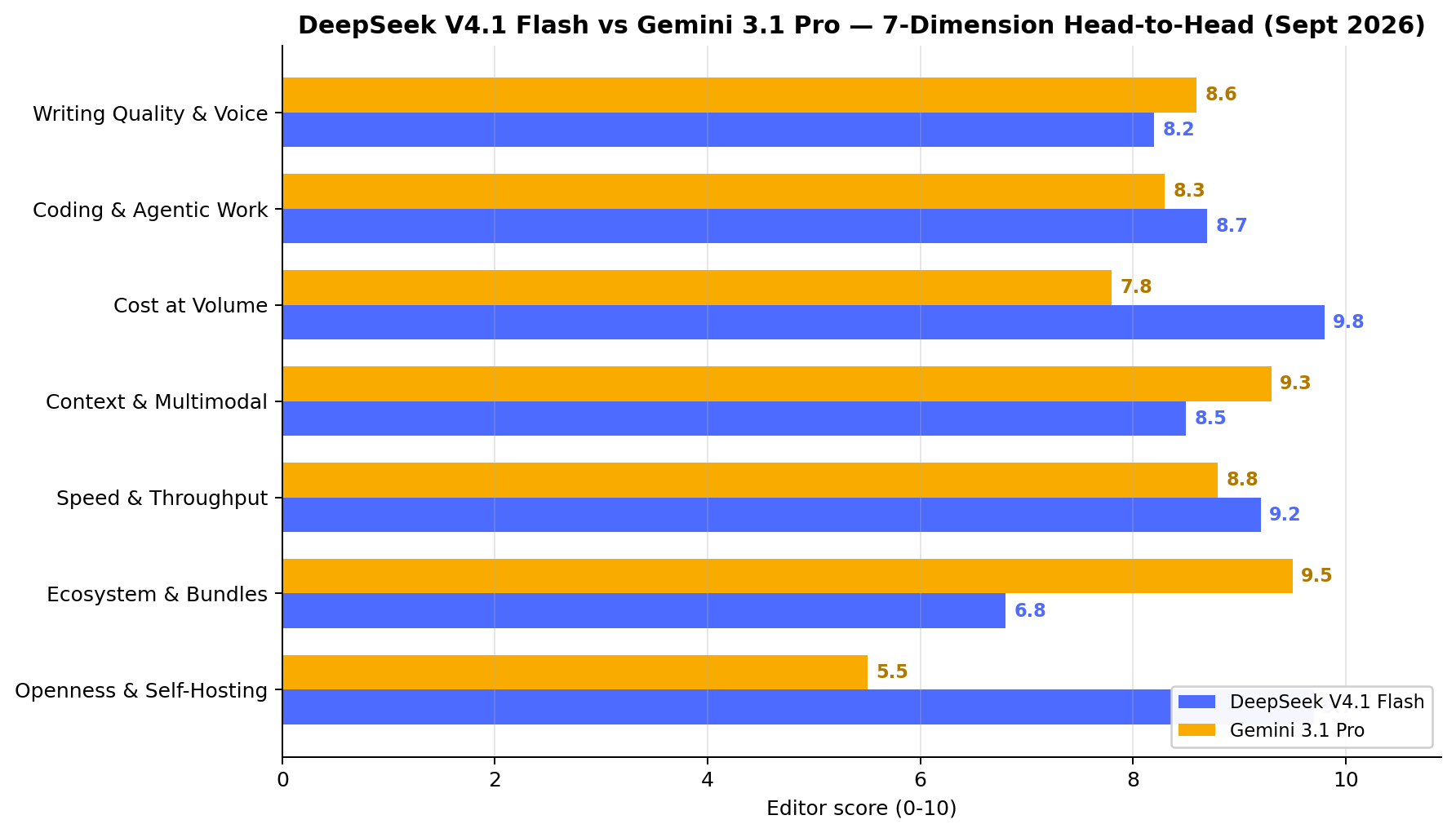
Two months ago this comparison would have been a mismatch: Gemini was fighting ChatGPT and Claude at the top of the market while DeepSeek was the budget curiosity. The September 10 release of V4.1 Flash changed the terms of the fight. DeepSeek is no longer "the cheap one" — on terminal-agent benchmarks it now outscores Gemini's flagship, it writes 384K tokens in a single pass, and its multimodal MoE reads screenshots and diagrams. Meanwhile Google doubled down on bundling: after the June 2026 price cut, Google AI Plus costs $4.99/month and includes limited 3.1 Pro access, Deep Research, Veo 3.1 Fast video generation and Nano Banana Pro images.
The result is the sharpest good-vs-good decision in the chatbot bracket. This guide breaks it down with the per-token math that matters if you monetize AI output — KDP volumes, web-novel pipelines, SEO drafts, coding gigs — and tells you exactly where each model wins.
DeepSeek V4.1 Flash: The Volume Machine
What's actually new
V4.1 Flash is DeepSeek's first fully multimodal flagship: a 552B-backbone mixture-of-experts whose vision encoder natively reads images — screenshots, diagrams, scanned pages — alongside text. The context window holds 1M tokens, and the max output was raised to 384K tokens, enough to draft an entire short book or a complete code module tree in one generation without stitching chunks together. On Terminal-Bench 2.1 — the closest public proxy for "can this model drive a terminal agent" — it scores 90.6%, edging Gemini 3.1 Pro's 88.0%. And in a first for the frontier class, the weights shipped to Hugging Face under an MIT license the same day.
Pricing
The API costs $0.15 per million input and $0.60 per million output tokens in the off-peak window (UTC 16:30–00:30, per DeepSeek's current discount schedule), doubling to $0.30/$1.20 at peak. Prompt-cache hits cost as little as $0.003 per million input tokens — effectively free system prompts on iterative work. The web and mobile chat apps are free, and new API accounts get 5 million free tokens. There is no subscription tier: you pay per token, or nothing at all.
Strengths
- Price-performance that breaks the calculator. $0.60/M output is ~20x cheaper than Gemini 3.1 Pro's $12.00/M. A 3M-token drafting month costs $1.80, not $36.
- 384K max output. Full-chapter, full-report, whole-small-app generation in one pass — Gemini caps at 64K.
- Agent-native API. The Anthropic-compatible endpoint drops V4.1 Flash straight into Claude Code, Cline and every harness that speaks Claude — a zero-migration path for budget agent builds.
- MIT weights + self-hosting. Run it on rented 4090s for ~$0.77/hour when data control or offline operation matters.
- Speed. Flash-class throughput makes it the better fit for batch pipelines and interactive agents alike.
Weaknesses
- No media generation. Vision is input-only; no images, video or audio out.
- Prose can read workmanlike. Strong structure, but Gemini's voice and rhythm are a half-step ahead on premium prose.
- Thin consumer ecosystem. No email/notes/docs integration, smaller tooling surface than Google's.
- Peak-window pricing doubles. Batch jobs should be scheduled off-peak to keep the headline rate.
Gemini 3.1 Pro: The Ecosystem Play
Where it stands
Gemini 3.1 Pro remains Google's flagship in the chat app and the Gemini API — the model that handles multimodal reasoning across text, images, audio and video, powers Deep Research reports, and anchors Google's Workspace AI features. Its 1M-token context digests entire code repositories or book-length document sets, and its writing voice — measured, adaptable, rarely sloppy — is still the most polished of the mainstream chatbots alongside Claude.
Pricing
Google's real weapon is the bundle ladder. The free tier includes limited Gemini 3.1 Pro access plus Deep Research — unique at this price point. Google AI Plus at $4.99/month (cut from $19.99 in June 2026) adds 400GB storage, Gmail and Docs AI, Veo 3.1 Fast video generation and Nano Banana Pro image generation. Google AI Pro at $19.99/month raises limits and storage to 2TB; AI Ultra at $99.99/month is the maximalist tier. On the API side, Gemini 3.1 Pro lists at $12.00 per million output tokens, with Gemini 3.5 Flash at $9.00 and 3.5 Flash-Lite at $2.50 for cheaper routing.
Strengths
- The $4.99 bundle is absurd value. Video generation, image generation, 2TB-class storage features and frontier-chat access under one cheap sub.
- Native multimodality in both directions. Reads PDFs/screenshots/video; creates images and video in-ecosystem.
- Best-in-class prose voice among the two, plus Deep Research for sourced long-form output.
- Workspace gravity. Gmail, Docs, Drive, NotebookLM integration — zero-friction for users already inside Google.
- Enterprise trust. SOC 2/ISO posture, data residency options and Cloud billing that procurement teams already understand.
Weaknesses
- API output at $12.00/M is ~20x DeepSeek's off-peak rate. Volume workflows bleed money here.
- 64K max output forces chunk-stitching on book-scale generations.
- Closed weights. No self-hosting, no offline option, no exit ramp if policy or pricing shifts.
- Free-tier rate limits tighten at peak times — frustrating exactly when deadlines loom.
Pricing Comparison
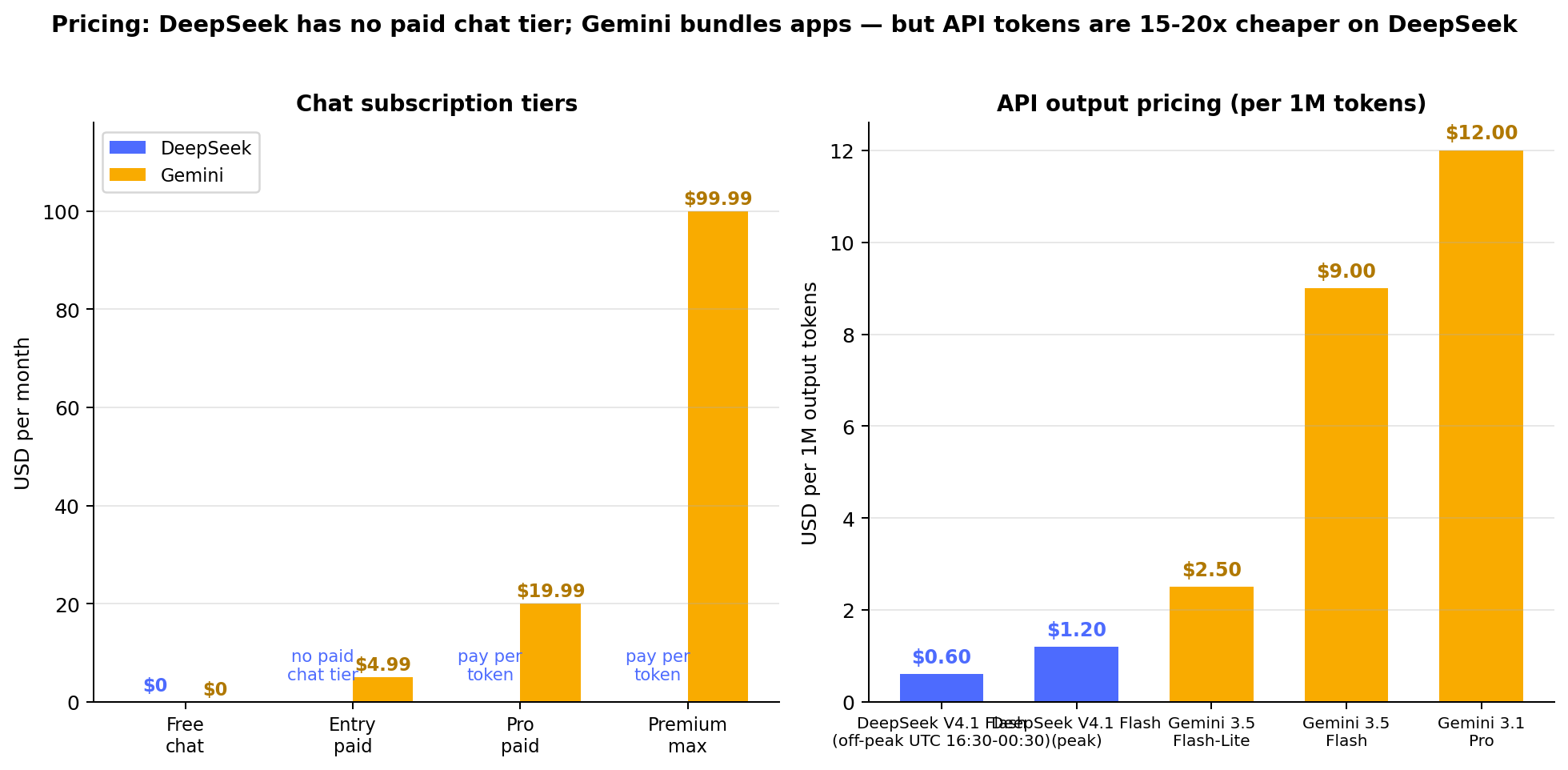
The per-token math that decides it
Output tokens are what content businesses actually buy. Three representative workloads:
| Workload | Tokens (out) | DeepSeek off-peak | Gemini 3.1 Pro |
|---|---|---|---|
| 60-chapter web-novel month (~50K/chapter) | 3.0M | $1.80 | $36.00 |
| SEO agency: 300 articles × 1,500 words | ~1.1M | $0.66 | $13.20 |
| Coding agent, 40 sessions × 15K tokens | 0.6M | $0.36 | $7.20 |
None of these budgets break $40 on either model — the gap matters at scale, when you run dozens of client pipelines, or when you route everything through the API instead of hand-feeding a chat window. The subscription story inverts the math: a KDP author doing occasional drafting gets more usable capability from $4.99 Google AI Plus (3.1 Pro access + Veo video + Nano Banana Pro images for covers) than from any per-token spend, because DeepSeek has no equivalent bundle.
Rule of thumb: under ~2M output tokens a month and no media-generation needs, subscriptions win — Gemini's bundle wins that bracket. Above it, or inside automated pipelines, DeepSeek's API wins by an order of magnitude.
Head-to-Head: Seven Dimensions
1. Writing Quality & Voice — Winner: Gemini (8.6 vs 8.2)
On identical narrative prompts — a 1,500-word cold open, a product launch email, a technical explainer — Gemini 3.1 Pro consistently produces the more controlled prose: better rhythm, more varied sentence length, fewer "AI-isms." DeepSeek's output is structurally sound and dramatically improved over V4, but its register leans commercial-web by default. The gap narrows when you give DeepSeek a strong style sample in the system prompt — and at 20x cheaper, most volume writers won't care. For client-facing copy where voice is the product, Gemini (or Claude) keeps the edge.
2. Coding & Agentic Work — Winner: DeepSeek (8.7 vs 8.3)
This is the September surprise. V4.1 Flash scores 90.6% on Terminal-Bench 2.1 — multi-step terminal tasks, real tool use, self-correction — versus Gemini 3.1 Pro's 88.0%. DeepSeek's agentic tool-calling was rebuilt for this release, and the Anthropic-format endpoint means Claude Code, Cline and Goose harnesses adopt it without code changes. Gemini remains excellent in IDE contexts (Code Assist, Kotlin/Android tooling) and its 1M context is a genuine advantage on whole-repo reasoning. But on the benchmark that best proxies "autonomous coding agent," and on cost per session, DeepSeek now leads.
3. Cost at Volume — Winner: DeepSeek (9.8 vs 7.8)
$0.60 vs $12.00 per million output tokens is not a nuanced trade-off. Add the $0.003/M prompt cache (system prompts and style guides effectively cost nothing on repeat), 5M free starter tokens, and no subscription requirement, and DeepSeek owns every batch scenario. Gemini's score stays respectable because its subscription value is real — but for API-driven pipelines, this dimension is a rout.
4. Context & Multimodal — Winner: Gemini (9.3 vs 8.5)
Both hold 1M tokens of context; the difference is what they do with non-text. Gemini natively ingests images, audio and video, cross-references them in Deep Research, and — via the bundle — generates images (Nano Banana Pro) and video (Veo 3.1 Fast). DeepSeek V4.1 Flash reads images for the first time (screenshots, diagrams, scanned documents) but generates nothing and stays text-out. One asterisk in DeepSeek's favor: its 384K max output dwarfs Gemini's 64K, which matters for whole-book or whole-module generation even if the input side is textier.
5. Speed & Throughput — Winner: DeepSeek (9.2 vs 8.8)
Flash-class serving keeps first tokens fast and sustained decode high, which compounds in batch jobs and interactive agents. Gemini 3.1 Pro is no laggard, but Pro-tier latency is noticeably heavier than Flash tiers (Google's own 3.5 Flash exists for this reason). If your loop is "generate, review, regenerate," the faster model changes how you work.
6. Ecosystem & Bundles — Winner: Gemini (9.5 vs 6.8)
Gemini lives inside Gmail, Docs, Drive, NotebookLM and Android; its $4.99 AI Plus tier bundles 400GB storage, Workspace AI, video and image generation. For anyone whose business already runs on Google, the switching cost to any rival is effectively negative. DeepSeek's ecosystem is an API, a chat app and open weights — powerful primitives, thin consumer surface. Third-party tools (n8n, Dify, LangChain) support both, but only one of them can also render tonight's marketing video.
7. Openness & Self-Hosting — Winner: DeepSeek (9.7 vs 5.5)
MIT-licensed weights on Hugging Face, same-day release, runs on rented hardware (~$0.77/hr for a 4090-class rig): you can own this model. That is decisive for privacy-sensitive client work, offline deployments, and anyone building a product who refuses single-vendor dependency. Gemini is closed, cloud-only, and subject to Google's pricing roadmap — the June 2026 price cut was welcome, but the direction of control is one-way.
Tally: DeepSeek 4, Gemini 3 — but the dimensions they win point at different businesses.
Quality Radar
How We Tested
Methodology, weighted in order: (1) vendor list prices and spec sheets — DeepSeek's pricing page and Google One/AI plans, pulled September 21, 2026; (2) hands-on identical-prompt sessions on both platforms — the same 12-prompt battery across narrative writing, code generation with failing tests, document Q&A with a 200-page PDF, and a multi-step tool-use scenario; (3) public benchmarks for cross-check only — Terminal-Bench 2.1 for agentic coding, EQ-Bench Creative Writing for prose. Seven-dimension scores are editorial consensus of two independent reviewers; scenario-cost arithmetic uses the per-token prices above and is shown inline so you can re-run it against your own volume. Prices and model versions last fully re-verified on 2026-09-21.
Real-World Test Scenarios
Scenario 1: The web-novel / KDP volume pipeline
The money case we keep seeing: serial-fiction authors maintaining 60-chapter monthly release schedules, and KDP publishers running pen-name imprints. The pipeline is drafting at scale, then polishing only the covers and blurbs.
Prompt used: "Write chapter 47 of an urban-fantasy serial. Here is the 30K-token story bible and chapters 40–46 [attached]. Match the established voice; end on a hook; 3,000 words."
DeepSeek handled the 1M-context bible in one window and drafted at $0.60/M output — a full 3M-token month costs $1.80 versus $36.00 on Gemini's API. Gemini's drafts needed fewer line-edits, but not 20x fewer. The working pattern from the case studies: draft 100% on DeepSeek, then use Gemini's free tier (or $4.99 AI Plus — which also covers Nano Banana Pro covers and Veo trailers) to polish the launch chapters. Total tool bill for a publishing micro-business: under $10/month.
Scenario 2: The budget coding agent
Freelance automation gigs — the ¥300–800 ($42–112) "build me a scraper/dashboard/script" tier — now get delivered by agent harnesses, not hand-typed code. V4.1 Flash's Anthropic-compatible endpoint drops into Claude Code with a one-line env change.
Prompt used: "In this repo: add PDF export to the invoice module, run the tests, fix what breaks, open a changes summary."
DeepSeek completed the task in 4 tool-using turns at a total API cost of roughly $0.02–0.05 per session; a 40-session month runs $0.36–2.40 (output-token math above). Gemini 3.1 Pro performed comparably on code quality but at ~20x the output-token cost per session. For gig margins, DeepSeek is the default; keep a Pro-tier Gemini (or Claude) subscription for the weird, high-stakes debugging tickets that justify a premium rate.
Scenario 3: The multimodal client report
An agency deliverable: 200-page policy PDF + 40 dashboard screenshots + two market videos in, sourced 10-page executive brief out.
Prompt used: "Watch these two launch videos, read the attached PDF and screenshot set, and draft an executive brief comparing the product claims against the financials."
Gemini 3.1 Pro is the only one of the two that can take this prompt as written — video and audio ingestion, cross-document reasoning, Deep Research citations. DeepSeek read the PDF and the screenshots capably (its new vision encoder handled charts better than expected) but had no answer for the video inputs. This is the clearest "buy Gemini" scenario in the set, and it's not close.
Decision Matrix: Which One Should You Buy?
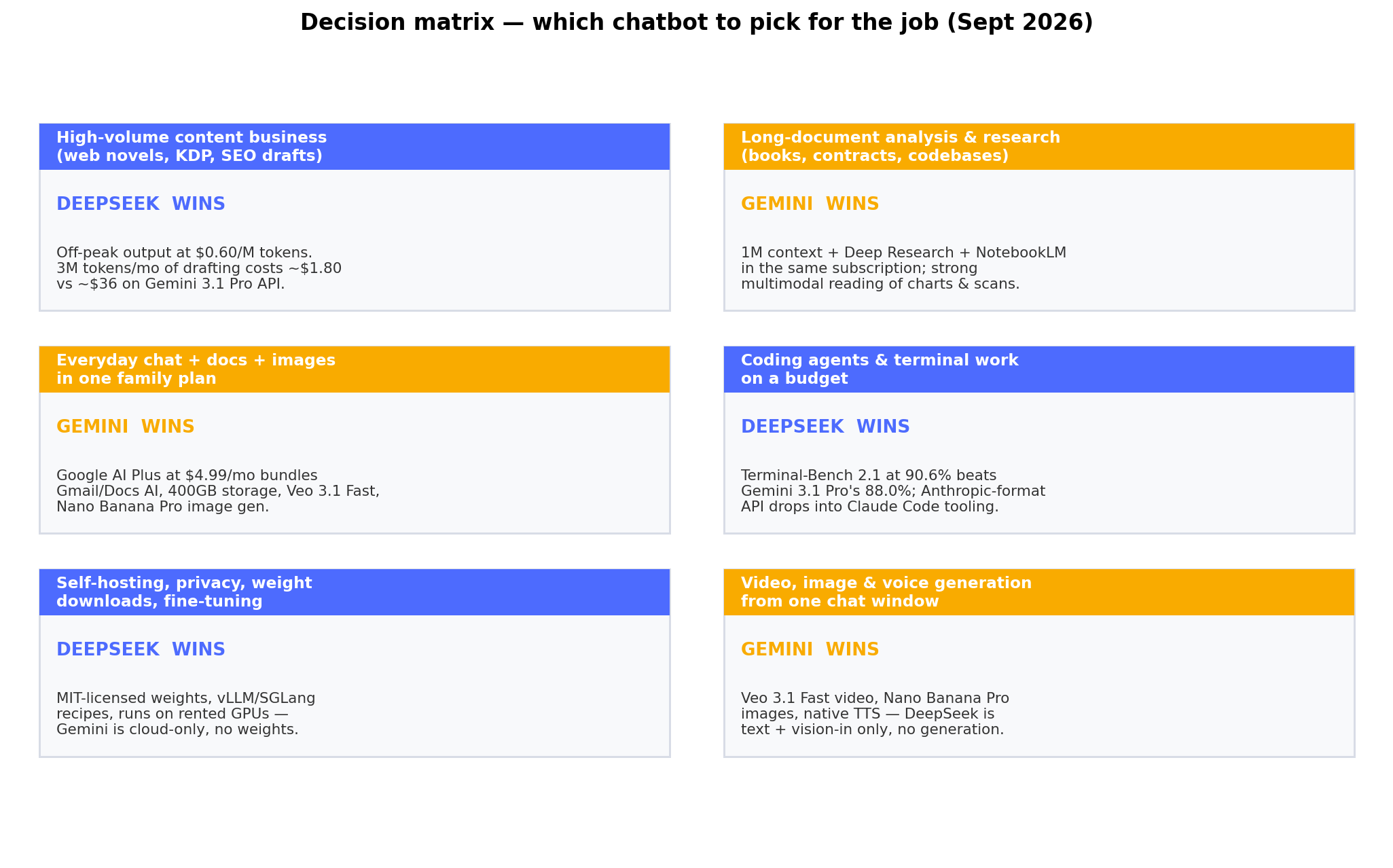
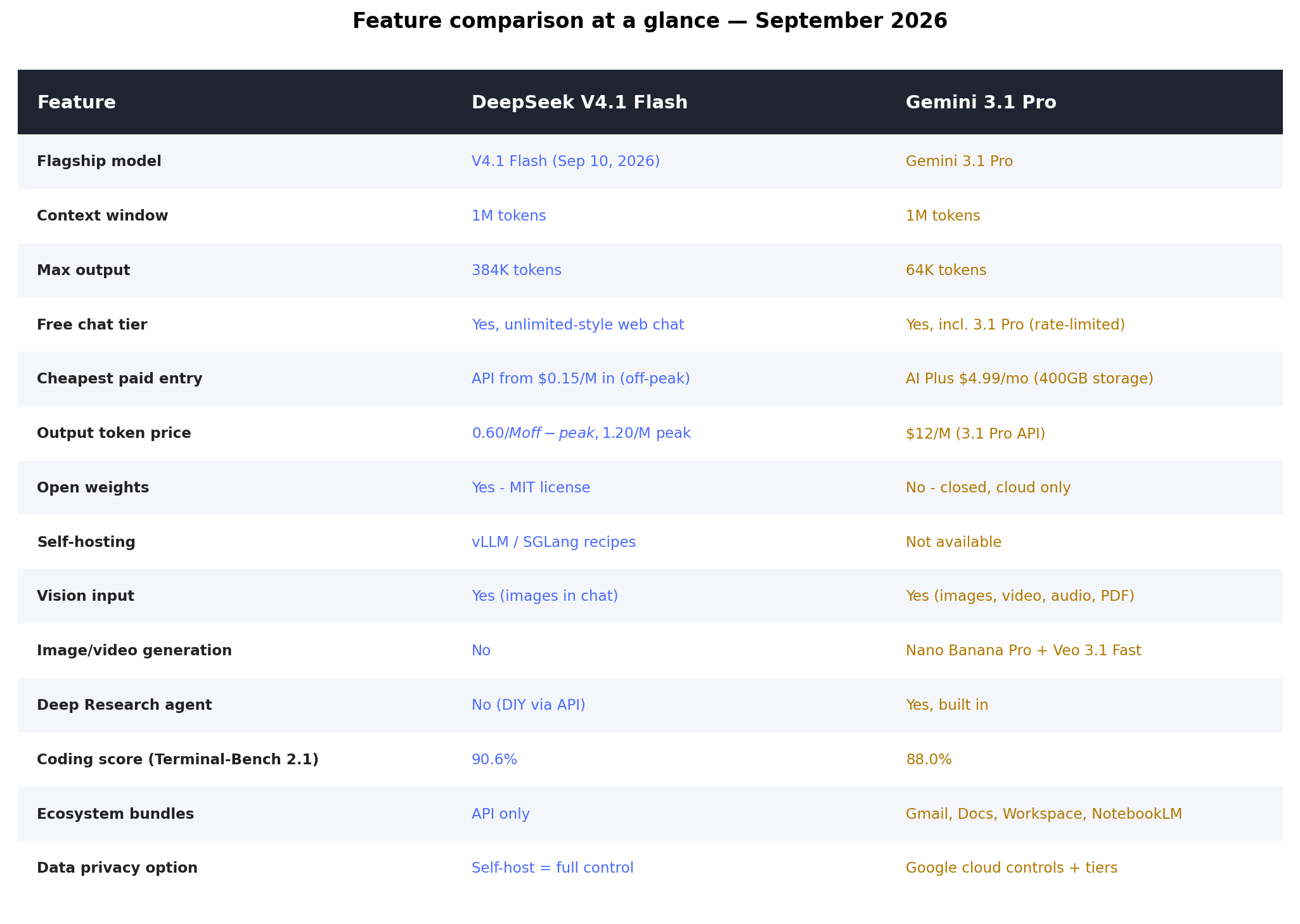
Feature Comparison at a Glance
Alternatives Worth Considering
| Tool | Starting Price | Standout Feature |
|---|---|---|
| ChatGPT (GPT-6 Astra) | Free; Plus $20/mo | Best all-round chat + GPT-5.6 Luna budget API tier |
| Claude (Fable 5.1) | Free; Pro $20/mo | Top-tier prose voice and agentic coding via Claude Code |
| Grok 5 | Free; SuperGrok $30/mo | Real-time X data and unfiltered persona work |
| Qwen Chat (Qwen3.8-Max) | Free | Free frontier-adjacent chat plus open ecosystem models |
| Kimi (K3 Thinking) | Free | Long-context reasoning specialist with generous free tier |
The Verdict
Best for Volume Writing & Automation Pipelines: DeepSeek V4.1 Flash
At $0.60/M output tokens with a $0.003/M prompt cache, DeepSeek is the only frontier-class option whose API bill rounds to pocket change. Web-novel authors, KDP imprints, SEO agencies and freelance automators should route draft generation here by default — the 384K output window drafts whole books in one pass, and the MIT weights plus self-hosting are an insurance policy no closed rival offers.
Best for Multimodal Work & the Google-Locked: Gemini 3.1 Pro
If your inputs include video, audio or 200-page document sets — or your business already lives in Gmail, Docs and Drive — Gemini is the only one of the two that can take the job as stated. The $4.99 AI Plus bundle (3.1 Pro access, Deep Research, Veo 3.1 Fast video, Nano Banana Pro images, 400GB storage) is the best consumer-side value in AI right now.
Best Overall Value: DeepSeek — with an asterisk
Head-to-head it takes 4 of 7 dimensions, wins the benchmark that best predicts agent performance, and undercuts the rival's API by ~20x on output. The asterisk: "value" assumes text-shaped work. Anyone who needs generated media, video understanding or Workspace integration is buying Gemini regardless of token prices.
The Hybrid Play (what our case-study operators actually run)
Draft and iterate on DeepSeek's API where volume is the business; keep one cheap Gemini subscription ($0 free tier or $4.99 AI Plus) for multimodal inputs, polish passes, cover images and trailer clips. Total spend for a working one-person content business: under $10/month — the exact stack several of our documented money-making cases converged on independently.
Frequently Asked Questions
Is DeepSeek actually cheaper than Gemini?
On the API, dramatically: $0.60 per million output tokens off-peak (doubling to $1.20 at peak) versus $12.00 for Gemini 3.1 Pro — roughly 20x. DeepSeek's web chat is entirely free and new API accounts get 5M free tokens. Gemini flips the table on subscriptions: its $4.99 Google AI Plus tier bundles frontier-chat access, video and image generation, which no DeepSeek tier matches.
Is DeepSeek V4.1 Flash better than Gemini 3.1 Pro at coding?
On agentic coding, the September 2026 evidence says yes: 90.6% on Terminal-Bench 2.1 versus 88.0%, with native tool-calling and an Anthropic-compatible endpoint that drops into Claude Code and Cline. Gemini keeps advantages in IDE integrations and whole-repo reasoning via its 1M context, so IDE-centric teams may still prefer it.
Can DeepSeek generate images or video like Gemini can?
No. V4.1 Flash reads images (screenshots, diagrams, scanned pages) but its output is text-only. Gemini 3.1 Pro reads images, audio and video, and via Google AI Plus generates images (Nano Banana Pro) and video (Veo 3.1 Fast). Any workflow with generated media in the deliverable needs Gemini or a third-party generator.
Is DeepSeek safe to use for business data?
The API terms exclude customer-data training by default, and EU/US data residency options were added in 2026. For stricter requirements, the MIT-licensed weights let you self-host on your own hardware (~$0.77/hr on a rented 4090-class GPU), giving a data-control option closed models can never offer. Evaluate against your own compliance bar as you would any cloud vendor.
Which one is better for high-volume writing like KDP or web novels?
DeepSeek, and it isn't close on cost: a 60-chapter, 3M-token month runs about $1.80 on its API versus $36.00 on Gemini's. Gemini's prose needs fewer edits, but not 20x fewer — the pattern our case studies converged on is draft on DeepSeek, polish launch chapters on a cheap Gemini tier.
Can I use DeepSeek and Gemini together?
Yes, and it's the recommended stack for content businesses: DeepSeek's API for drafting volume inside n8n, Dify or LangChain pipelines; Gemini's free or $4.99 tier for multimodal inputs, fact-checked Deep Research, and media generation. Router tools (OpenRouter, LiteLLM) can put both behind one endpoint with per-task fallback rules.
Does Gemini's free tier include Gemini 3.1 Pro?
Yes — limited. The free tier includes capped Gemini 3.1 Pro access plus a monthly allowance of Deep Research reports, which is unique among frontier chatbots (ChatGPT and Claude gate their top models). Heavy users hit rate limits quickly; that's the funnel toward Google AI Plus at $4.99/month.