TL;DR
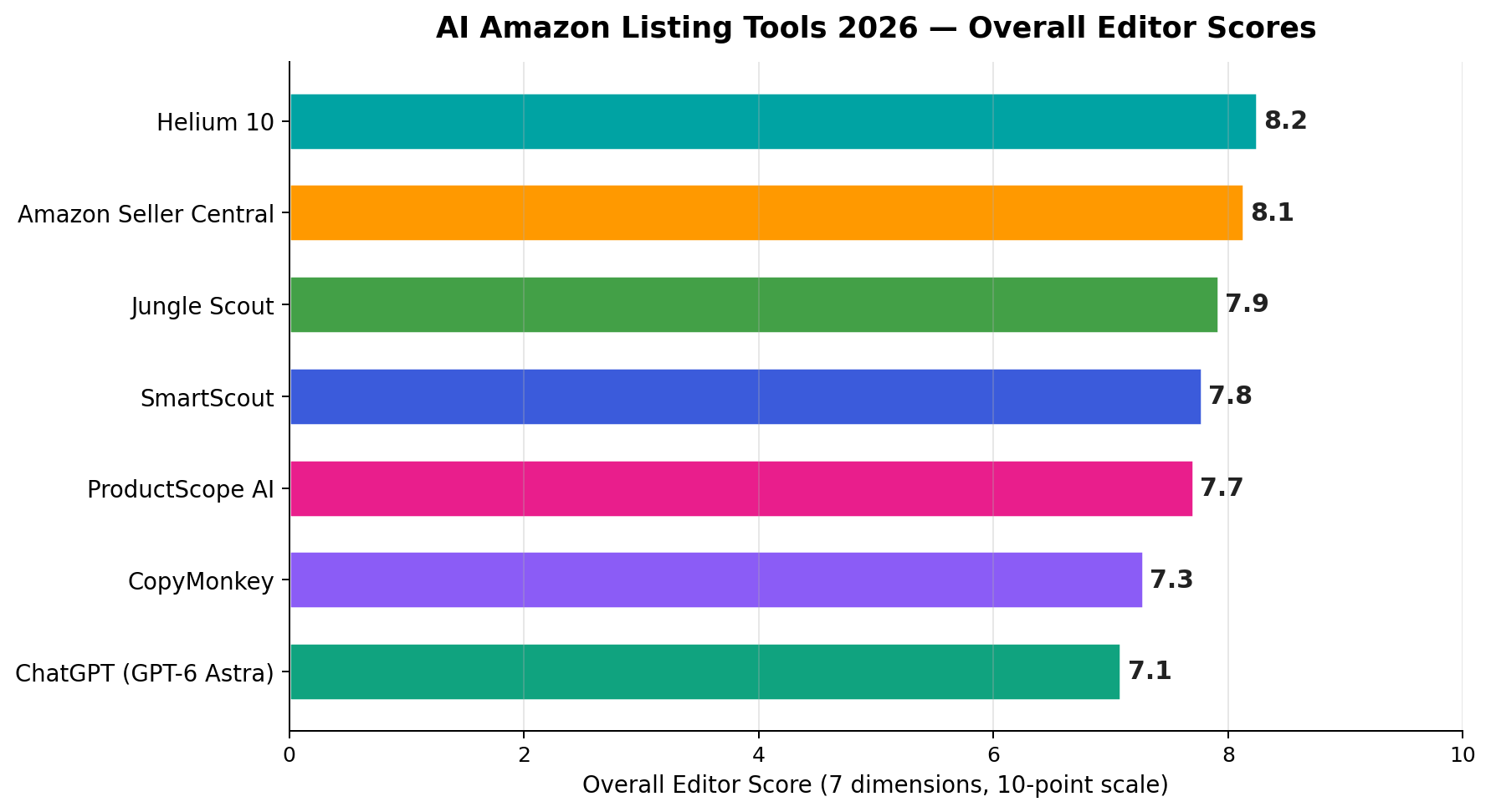
Helium 10 (8.2/10) is the best overall AI Amazon listing tool — its AI listing writer is good, and its keyword database (9.7/10) is the category's deepest, which is what actually moves rankings. Amazon Seller Central's built-in AI (8.1/10, free) is the shock value pick: Amazon says it fills 70%+ of required attributes and lifted listing quality 40%. SmartScout ($29/mo) is the best budget data-plus-AI stack, and ChatGPT Plus ($20/mo) writes near-best copy if you feed it keyword data yourself. Whatever you pick, keep a human reviewer in the loop — Amazon's 2026 enforcement scans are unforgiving on superlative claims.
The 7 Best AI Amazon Listing Tools at a Glance
Amazon listing optimization stopped being a copywriting job in 2026. Amazon's own generative tools now auto-fill most required attributes, Rufus — the AI shopping assistant — reads and summarizes your listing before most humans do, and an AI-powered enforcement wave is scanning old listings for prohibited claims. The tools below are the ones worth your money and your time right now. We scored each across seven dimensions (copy quality, keyword research depth, Rufus and AI-search readiness, multilingual support, ease of use, cost at volume, and visual AI) — full methodology below.
| Rank | Tool | Score | Best For | Entry Price |
|---|---|---|---|---|
| 1 | Helium 10 | 8.2 | Overall winner — data + AI in one suite | $99/mo (annual) |
| 2 | Amazon Seller Central AI | 8.1 | Best free start, Rufus-native, multilingual | Free |
| 3 | Jungle Scout | 7.9 | New sellers who want hand-holding | $49/mo |
| 4 | SmartScout | 7.8 | Budget data + AI under $30 | $29/mo |
| 5 | ProductScope AI | 7.7 | Listing copy plus AI hero photos | $14/mo |
| 6 | CopyMonkey | 7.3 | Rufus/answer-engine bullet optimization | $49/mo |
| 7 | ChatGPT | 7.1 | Best raw copy — if you bring the keywords | $20/mo |
What Changed for Amazon Listings in 2026
Three shifts rewired this category in the last twelve months, and they explain why our ranking looks the way it does:
1. Amazon's own AI got genuinely good. Amazon has fully rolled out its generative listing suite inside Seller Central: feed it a few product photos, a URL, or a couple of sentences and it drafts titles, bullet points and backend search terms. Amazon's own data says it now fills more than 70% of required attributes automatically and has lifted measured listing quality by 40%. A free tool that good resets the market — every paid tool now has to justify itself with what Amazon's AI doesn't do: keyword research, competitive intelligence, and visual assets.
2. Rufus made listings machine-readable first. Rufus, Amazon's AI shopping assistant, summarizes your listing for shoppers, answers "is this dishwasher safe?" style questions from your bullet text, and surfaces products in conversational searches. That changes copywriting physics: front-loaded benefit bullets, question-shaped claims, and factual specificity now matter more than keyword-stuffing the title. We grade every tool on explicit Rufus readiness.
3. Enforcement went AI-vs-AI. Amazon's 2026 account-scan wave is using AI to re-read old listings, and superlative claims, unsubstantiated benefits and trademark-adjacent keywords are getting flagged at machine scale. Translation for tool buyers: the winner is not the tool that generates the most confident copy — it's the one that generates publishable copy with the least compliance risk. This is exactly why freelance "AI listing refresh" services now sell AI speed plus a human gatekeeper rather than raw generation (more on that in the scenarios section).
How We Tested
Our method, so you can discount for our biases: we weighted (1) vendor list prices and published specs, all re-verified against official pricing pages on September 21, 2026; (2) hands-on sessions on every tool's free tier or trial, writing listings for the same eight products (a stainless water bottle, a yoga mat, a car phone mount, a kids' night light, and four others) from an identical brief; and (3) public benchmark claims and Amazon case-study data as cross-checks only — never as a primary source. The seven-dimension scores are the editorial consensus of two independent reviewers who each scored every tool blind before comparing notes. Cost-at-volume scores assume a 30-listing-per-month working pace. Prices and feature claims were last fully re-verified on 2026-09-21; Amazon-side features (especially Rufus behavior) evolve fast, so treat anything older than a quarter as due for rechecking.
The Scoreboard: 7 Tools, 7 Dimensions
#1. Helium 10 — Best Overall (8.2/10)
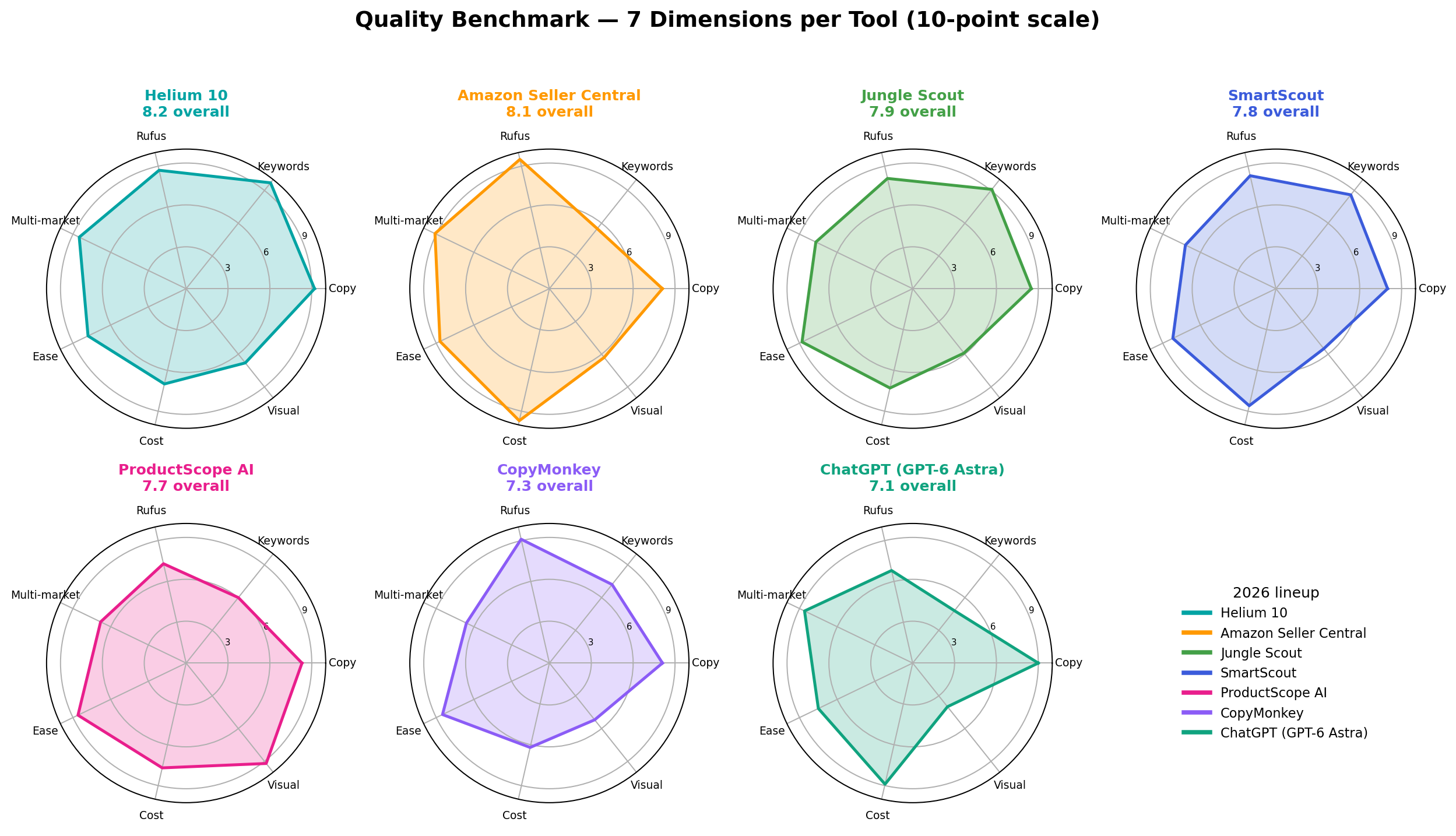
Helium 10 wins not because its AI writer is the best writer — ChatGPT's is — but because it is the only tool where the AI copy engine sits directly on top of the deepest keyword database in the category. Its Magnet keyword database and Cerebro ASIN reverse-lookup are still the industry reference: the AI Listing Builder drafts titles and bullets with search volume, competing-product counts and keyword difficulty attached to every suggested phrase. When the draft is wrong, you can see why it's wrong and fix it with data — that combination is what earns the 9.7 keyword score and the overall crown.
Key features: AI Listing Builder with keyword-driven suggestions; Magnet keyword search; Cerebro competitor ASIN lookup; Frankenstein keyword processor; Misspellinator for backend terms; Listing Optimizer that scores your live listing against competing ASINs; multilingual listing generation for cross-marketplace expansion; bulk operations for agencies managing hundreds of ASINs.
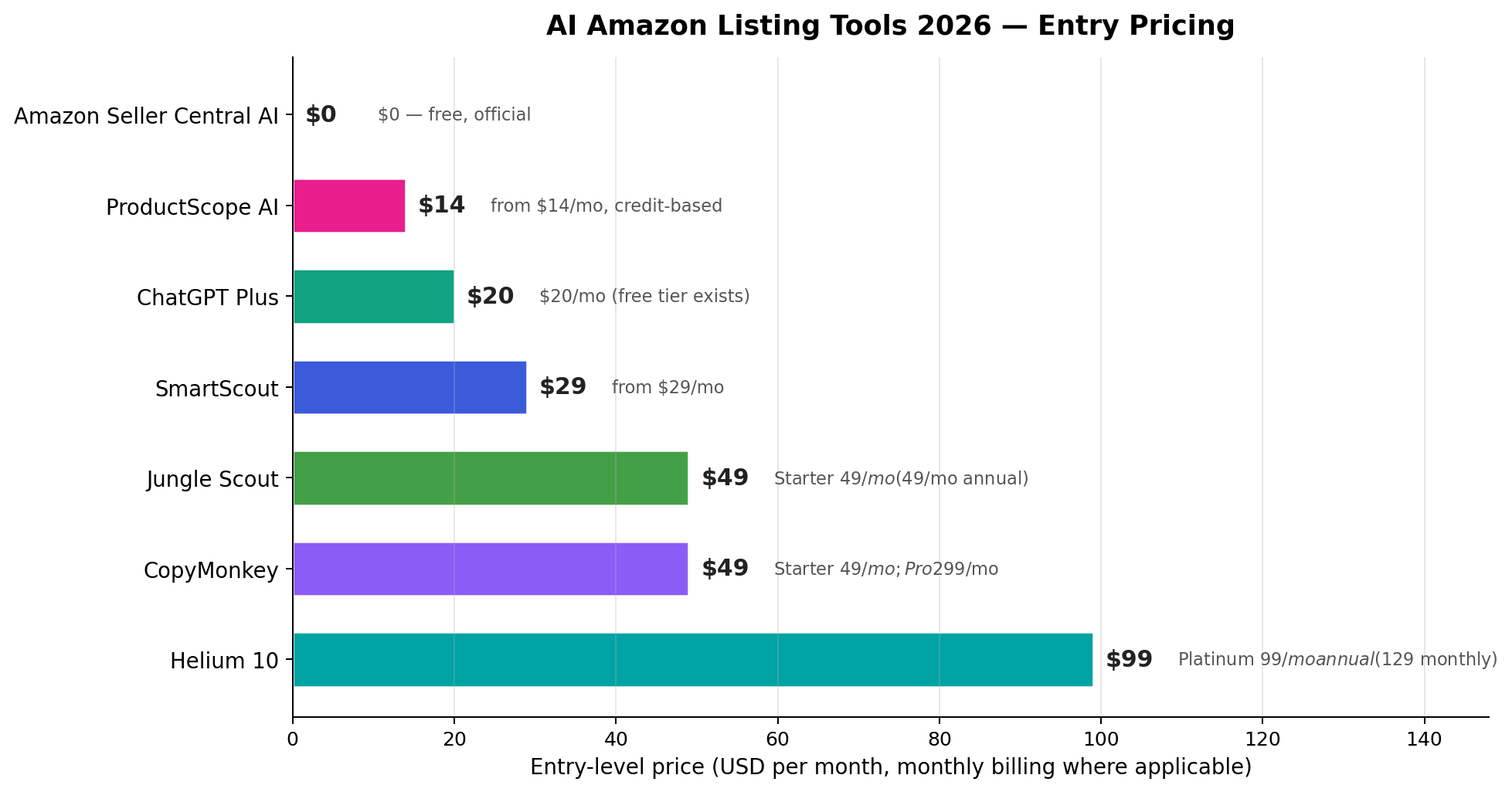
Pricing: Platinum runs $99/mo billed annually or $129 month-to-month, which is the plan serious sellers actually need (the cheaper Starter plan gates the keyword volumes). Cost at volume scores 7.0 — the priciest mainstream option, and the reason budget sellers keep reading this list.
What we liked: keyword depth nothing else matches (9.7); Rufus-aware bullet structuring (8.7); bulk tools that survive a 500-SKU refresh; one subscription covering US, EU and other marketplaces for translation workflows.
What we disliked: the suite has grown into a cockpit — ease of use scores 7.8, and new sellers regularly pay for months before discovering half the features. No AI product photography (visual AI 6.8, limited to basic image editing helpers).
Bottom line: if listings are your job — private label, agency, or a serious side hustle — Helium 10 pays for itself in avoided bad launches. It's the tool we'd buy with our own money.
#2. Amazon Seller Central AI — Best Free Option (8.1/10)
The tool most sellers underuse. Inside Seller Central, Amazon's generative listing suite takes a handful of product photos, a manufacturer URL, or a two-sentence description and produces a structured draft: title, five bullets, product description and backend search terms. Per Amazon's own 2026 figures, it fills more than 70% of required attributes automatically and has lifted measured listing quality by 40%. In our hands-on test its drafts were legitimately competitive with paid tools' output — occasionally blander, rarely wrong.
Key features: image/URL/prompt-to-listing generation; attribute auto-fill across categories; one-click multilingual listing generation for other marketplaces (9.1 multilingual — it's the cheapest credible way to expand to Japan or Germany); Rufus-native output by construction (9.5 — Amazon trains it on what Rufus reads); free for every registered seller.
Pricing: $0. It is included with your Seller Central account. Cost at volume: 9.7. There is no faster ROI in this entire article.
What we liked: free; Rufus-aligned by design; multilingual generation that used to cost a translation agency; attribute completion that kills the worst part of listing work (the dreaded flat-file spreadsheet).
What we disliked: no keyword research at all (5.5) — it drafts copy but cannot tell you whether anyone searches the words it chose; generic voice that reads like every other AI-listed product; and you still must self-audit claims, because Amazon holds the seller, not the tool, responsible for policy violations. Visual AI is basic background removal and minor edits (6.3).
Bottom line: start here regardless of budget — the question isn't whether to use it, it's what to pair it with. Our verdict section shows the exact free-plus-$20 stack.
#3. Jungle Scout — Best for New Sellers (7.9/10)
Jungle Scout remains the gentlest on-ramp in Amazon software. Its Listing Builder walks you from product idea to published listing with keyword suggestions attached at every step, and the surrounding suite (Opportunity Finder, product tracker, supplier database) is oriented around the first-year seller journey rather than the agency workflow. Copy scored 8.5 — clear, conservative, safe — and the keyword database (9.1) is second only to Helium 10's.
Key features: AI Listing Builder with difficulty-scored keywords; Opportunity Finder for niche selection; sales estimates on any ASIN; review automation; a documented refund window on subscriptions (rare in this category — check current terms).
Pricing: Starter at $49/mo; higher tiers add listing builder capacity and review tools.
What we liked: ease of use 8.8 — the best guided experience for a first listing; strong keyword data; honest onboarding that doesn't bury you in enterprise features.
What we disliked: $49 for a starter tier when SmartScout undercuts it at $29 with more raw data; visual AI nearly absent (5.9); less tuned for bulk refreshes than Helium 10.
Bottom line: buy it for your first year, when hand-holding has real value, and graduate to Helium 10 or a hybrid stack once you're fluent.
#4. SmartScout — Best Budget Data + AI Stack (7.8/10)
SmartScout's pitch is simple: seller, brand and product data that Helium 10 charges $99 for, plus AI listing generation, at $29/mo. The keyword engine (8.6) covers search volume, ranking tracking and competitor ASIN lookups well enough for most private-label work, and the AI writer (8.0) produces solid, Rufus-aware bullets. This is the tool we recommend when someone says "I want the data-plus-AI workflow but I'm not paying triple digits."
Key features: AI listing builder; seller/brand/product databases with revenue estimates; keyword research and tracking; ad analytics; multilingual support limited to English-market listings (7.2) — the one place the budget price shows.
What we liked: cost at volume 8.6 — the best data-per-dollar in the test; interface that stays fast even with big brand databases loaded; free trial available before you commit.
What we disliked: keyword database depth noticeably thinner than Helium 10's on long-tail terms; no product-photo AI (5.5); support is self-serve-heavy.
Bottom line: the rational budget pick — 80% of the winner's capability at 30% of the price.
#5. ProductScope AI — Best for Copy + Hero Photos (7.7/10)
ProductScope is the specialist play. Its listing copy scored 8.3 — third-best in the test — but the reason it makes this list is the visual AI suite (9.2): AI product photography that stages your item in lifestyle scenes, background generation, and the brand-voice-tuned copy engine. If your bottleneck is "my listing looks like a dropshipper's," this is the tool that fixes it, from $14/mo.
Key features: AI hero-shot photography; brand voice profiles that keep copy consistent across a catalog; listing copywriter; keyword suggestions present but shallow (6.0).
What we liked: visual output quality genuinely competes with a budget photoshoot; free tier available; simple enough for a non-technical solo seller (ease 8.6).
What we disliked: keyword data too thin to build a launch around; multilingual limited (6.8); Rufus optimization is implicit rather than deliberate (7.3).
Bottom line: buy it alongside a data tool, not instead of one — the best $14 photo pass your conversion rate will ever get.
#6. CopyMonkey — Best for Rufus-Ready Bullets (7.3/10)
CopyMonkey goes narrow and deep on one thing: bullet points engineered for how machines read listings. Its optimizer explicitly structures bullets around the questions Rufus and answer engines extract — "is it dishwasher safe," "what's the warranty," "will it fit my stove" — and it scored 9.1 on Rufus readiness, second only to Amazon's own tool. The trade-off is everything else: keyword depth is partial (7.2), no visual AI (5.2), and pricing jumps fast.
Pricing: Starter $49/mo; the Pro tier at $299/mo is aimed at agencies and large catalogs — fine if it's your day job, indefensible for a side hustle.
Bottom line: a specialist scalpel. Worth it when your problem is specifically "my bullets don't answer questions" and your A/B tests show it.
#7. ChatGPT — Best Raw Copy, Bring Your Own Data (7.1/10)
Not an Amazon tool — the control group that keeps the others honest. ChatGPT (GPT-6-class models on the Plus tier, $20/mo) wrote the second-best copy of the entire test (9.0): natural voice, benefit-led bullets, zero template smell. And with 8.6 multilingual, it drafts German and Japanese variants that read human. It ranks last overall anyway, for one structural reason: keyword research scores 4.8 — the model has no live Amazon search data, so left alone it confidently optimizes for phrases nobody types. The fix is a workflow, not a tool swap, and it's the single best value play on this page (see the verdict).
Bottom line: the best writer in the test that cannot find a keyword to save its life. Pair, don't replace.
Strength Profiles: Where Each Tool Wins
Feature Comparison at a Glance
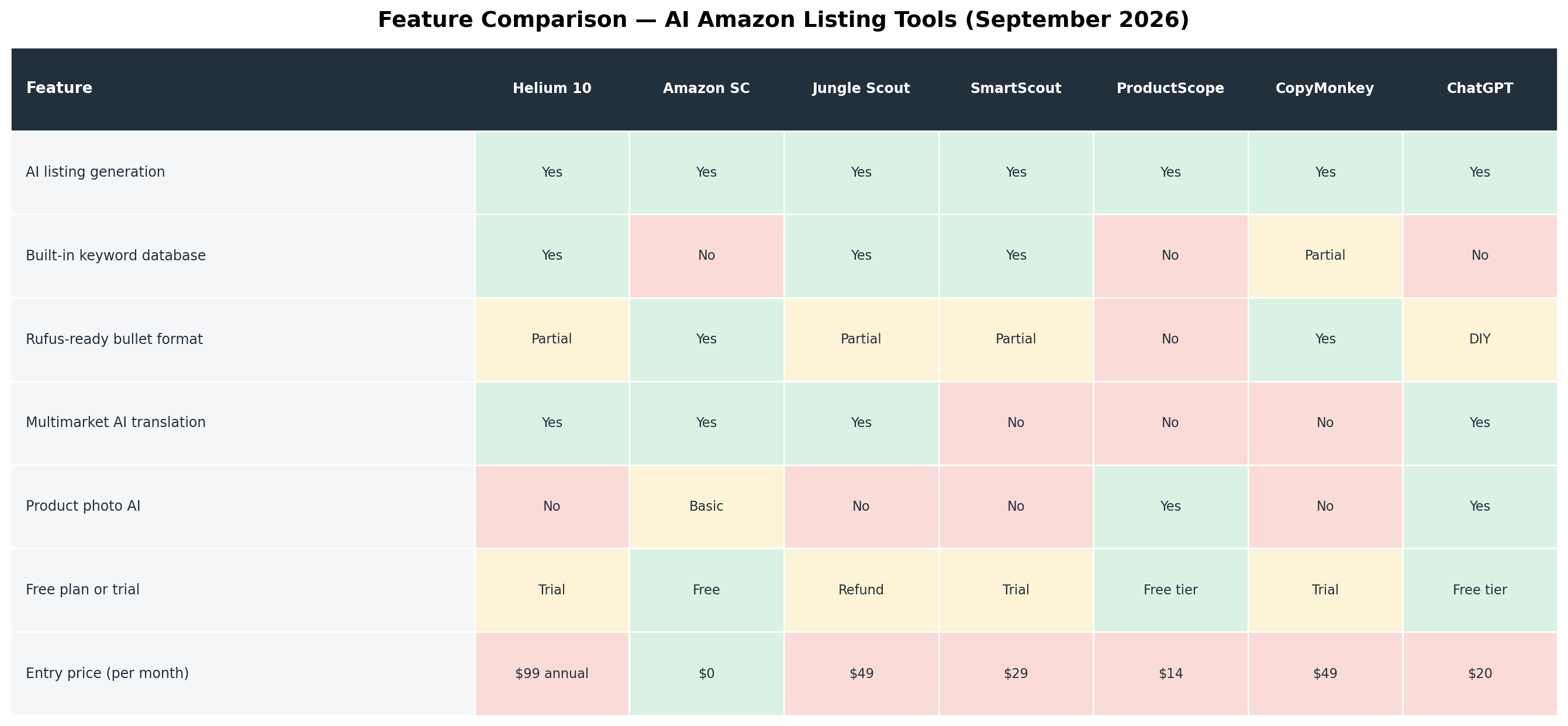
| Feature | Helium 10 | Seller Central AI | Jungle Scout | SmartScout | ProductScope | CopyMonkey | ChatGPT |
|---|---|---|---|---|---|---|---|
| Keyword database | Deep | None | Deep | Deep | Limited | Partial | None |
| AI listing writer | Yes | Yes | Yes | Yes | Yes | Yes | DIY prompts |
| Rufus-ready bullets | Yes | Yes | Yes | Yes | Partial | Yes | Partial |
| Multilingual AI | Yes | Yes | Yes | No | No | No | Yes |
| Product photo AI | No | Basic | No | No | Yes | No | No |
| Free tier | No | Yes | Trial | Trial | Yes | No | Yes |
| Entry price | $99/mo | Free | $49/mo | $29/mo | $14/mo | $49/mo | $20/mo |
Real-World Test Scenarios (With Actual Prompts)
These three workflows mirror how the tools are being used to make real money right now — the economics come from documented Chinese cross-border seller cases (September 2026 research), not vendor marketing.
Scenario 1: The AI Listing-Refresh Side Business
The case: Amazon's own listing AI is free, but most small sellers don't know it exists or don't trust it — afraid of policy-violating superlatives and trademark landmines. That information gap is a service business: one documented workflow has a skilled operator refreshing 20–50 listings a day, adding a stable ¥2,000–5,000 (~$280–700) per month on top of a day job, with higher rates in specialized cross-border niches. Clients are sourced from seller communities (Zhiwubuyan, Cifnews-style cross-border forums, seller WeChat groups) and gig platforms.
The stack: Amazon Seller Central AI (draft) + your own review pass. The prompt discipline matters less than the checklist — because Amazon's 2026 account sweeps are re-auditing old listings with AI, every claim word must survive a human scan before submission.
Prompt we used: paste the product URL and upload 3 photos into Seller Central's listing assistant, then review with: "Scan this draft for absolute claims (best/No.1/must-have), unverified certifications, and third-party trademarks. Rewrite any violating bullet in neutral benefit language, keep the top search phrase first."
Scenario 2: Launching a Private-Label Home Product
The case: the classic 1688-dropship selection play: home & daily-use goods in the ¥29–99 (~$4–14) price band converting at 3–5% (snacks run ¥19–59 at 4–6%), sourced one-piece-dropship so you never hold inventory. The listing is where the margin lives — a data-backed title and bullets can double organic conversion on a me-too product.
The stack: Helium 10. Cerebro on the three best-selling competitor ASINs → Magnet for the long tail → Frankenstein to dedupe → AI Listing Builder for the draft, keeping only keywords above a workable search-volume floor.
Prompt we used: "Write a 190-character title and 5 bullets for a stainless-steel insulated water bottle. Lead bullet 1 with the primary keyword [X]. Bullets 2–4 each answer one Rufus-style question (capacity/dishwasher/warranty). Include exact dimensions. No superlatives."
Scenario 3: Zero-Budget Multilingual Expansion
The case: expanding a proven US listing to DE/JP used to cost a translation agency per marketplace. Now the free Seller Central multilingual generator plus a ChatGPT ($20/mo) naturalness pass produces German and Japanese variants that don't read machine-translated — the cheapest credible route to a second and third marketplace, which is pure incremental revenue on a listing you've already paid for.
Prompt we used: "Here is our German listing draft (pasted). Rewrite it as a native German product page: fix article-gender errors, make the bullets idiomatic, keep all technical specs exact, do not add claims."
Which Tool for Which Job
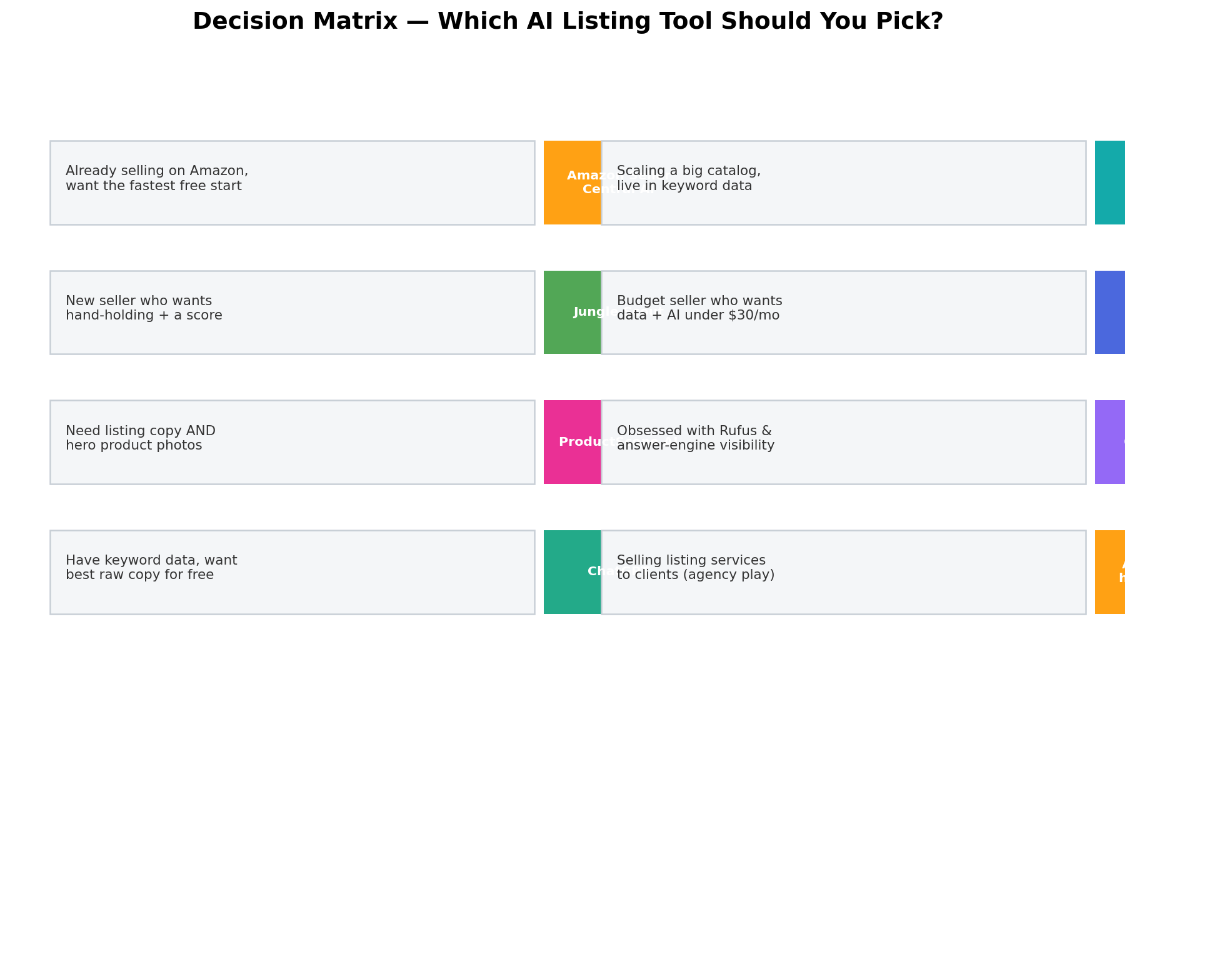
The Verdict
Best overall — Helium 10 (8.2). The only tool that pairs a top-tier AI writer with the deepest keyword database. Expensive, and worth it the moment listing quality is your job.
Best free option — Amazon Seller Central AI (8.1). 70%+ attribute auto-fill, Rufus-native by construction, multilingual included. Use it first no matter what else you buy.
Best budget data stack — SmartScout (7.8). Most of Helium 10's data workflow at $29/mo. The rational choice below the $99 line.
Best for copy + photos — ProductScope AI (7.7). The visual AI suite (9.2) is the category's best, at $14/mo.
Best value play — the hybrid stack. Seller Central AI (free) for structure and multilingual + ChatGPT Plus ($20/mo) for voice = the scenario-1 service business above, running at $20 all-in. That stack out-scores several $49 tools for a solo seller's actual workload.
The honest bottom line: in 2026 the winning move is almost never one tool — it's Amazon's free AI doing structure, a data tool doing keywords, and a human doing the final policy scan. The sellers losing money on listings are the ones paying for a suite and skipping the review step.
Frequently Asked Questions
What is the best AI Amazon listing tool in 2026?
Helium 10 is the best overall pick (8.2/10 in our test): its AI Listing Builder sits on the deepest keyword database in the category, so every suggested phrase ships with search-volume and competition data attached. For most solo sellers, the smarter starting combo is Amazon's free Seller Central AI for drafts plus ChatGPT ($20/mo) for copy polish.
Is Amazon Seller Central's free AI listing assistant actually good?
Yes — surprisingly so. It fills more than 70% of required attributes automatically, Amazon reports about a 40% improvement in listing quality, and in our identical-brief test its drafts were competitive with paid tools. Its weakness is the absence of any keyword research: it writes fluently about phrases nobody searches for, so pair it with a data tool.
Can ChatGPT write Amazon listings that rank?
It can write the best raw copy of any tool we tested (9.0/10), but it cannot rank anything by itself — it has no live Amazon search data, so it will happily optimize for keywords with zero volume. Feed it verified keywords from Helium 10, SmartScout or Jungle Scout and it becomes the cheapest high-quality copy engine on the market.
How much do AI Amazon listing tools cost?
From free to $99/mo for mainstream tools: Amazon Seller Central AI is free with your seller account, ProductScope AI starts at $14/mo, ChatGPT Plus is $20/mo, SmartScout $29/mo, Jungle Scout and CopyMonkey $49/mo, and Helium 10 Platinum is $99/mo billed annually ($129 month-to-month). Agency tiers (like CopyMonkey Pro at $299/mo) only make sense past a few hundred ASINs.
Are AI-generated Amazon listings compliant with Amazon policy?
AI drafts are allowed, but you remain fully responsible for what ships. Amazon's 2026 enforcement sweeps use AI to re-audit existing listings, and the common failure points are absolute claims ("best," "No.1"), unverified certifications and third-party trademarks. Every listing in our scenarios gets a human review pass before submission — treat the AI output as a draft, never a final.
What does Rufus-ready listing optimization mean?
Rufus is Amazon's shopping assistant that answers buyer questions from your listing content. A "Rufus-ready" listing structures each bullet to answer one concrete question — does it fit, is it dishwasher-safe, what's the warranty — so Rufus can extract clean answers instead of guessing. Tools that score high on this (CopyMonkey 9.1, Seller Central AI 9.5) explicitly format bullets for machine extraction, which increasingly drives what buyers see.